A Progressive Constitution?

EJ Dionne’s latest column outlines how liberals might embrace constitutionalism:

For too long, progressives have allowed conservatives to monopolize claims of fealty to our unifying national document. In fact, those who would battle rising economic inequalities to create a robust middle class should insist that it’s they who are most loyal to the Constitution’s core purpose. Broadly shared well-being is essential to the framers’ promise that “We the people” will be the stewards of our government.

Kilgore comments:

[W]hile I offer best wishes to those who wish to argue for “constitutional progressivism,” I do think it’s important for progressives to raise an occasional objection to the general idolatry of the Founders and their work before competing for the allegiance of their acolytes. Yes, the basic constitutional framework has held up relatively well, and probably better than the Founders themselves had any reason to anticipate. But it still required a bloody civil war and significant amendment (not to mention judicial interpretation) to function effectively at all.

Jonathan Bernstein agrees:

The Constitution is no more a formula for social democracy (or whatever liberals want) than it is for a libertarian paradise. To the extent that it works (and it works extraordinarily well), then it’s appropriate to praise those who wrote it. But that’s all. We should use the Constitution with eyes wide open, aware of its problems and limitations.

Jack Balkin wants liberals to stop framing “the debate on terms set by movement conservatives in the 1980s”:

It was conservatives, and not liberals, who insisted on drawing a clear distinction between originalism and the work of the Warren and early Burger courts. Liberals had been quite happy to draw on adoption history to explain how and why enduring constitutional commitments should be applied to present-day circumstances. As Frank Cross has pointed out in his article Originalism: The Forgotten Years, the trend of increasing citations to the founders in Supreme Court opinions begins with the Warren Court. And the great avatar of the living Constitution, Franklin Roosevelt, explained and defended his constitutional commitments in terms of fidelity to the constitutional text and to the founders’  vision.

If you start by accepting that the difference between conservative and liberal visions of the Constitution is that one attempts to be faithful to the text and to the founders’ vision and the other does not, well, that’s just not a very helpful way for liberals to talk, either to themselves, or to the general public.  And of course, that’s precisely why modern movement conservatives sought to frame the choice in that way.

Ramesh chimes in:

The Constitution is in many ways a conservative document, and originalism a conservative methodology. Those aren’t points that can be proven in a blogpost, of course; suffice it to say that if that’s right, then conservatives should not be embarrassed that insisting on the original understanding of the document will tend to serve conservative ends and subvert progressive ones.

Dionne wants of course to press a progressive reading of the document—and because it deliberately leaves so many matters unsettled, some of the space the Constitution creates can be filled by progressive initiatives. But progressivism does not seem to me as good a fit with the constitutional structure, which is why so many progressives over the years have expressed impatience with that structure.

Meme Of The Day

Zack Danger Brown wins the Internet today with this Kickstarter:

Potato Salad

John Herrman lets us in on the joke:

As of writing, a Kickstarter campaign for “just making potato salad” has raised $37,115. Every few seconds that number climbs higher, and each uptick is greeted with cheers. It’s a self-perpetuating humor machine, and it is horribly efficient. There is no joke, at least not anymore; whatever joke there was has become an adaptive, joke-like arrangement of circumstances. It is a perfect device, compatible with all known theories of humor and therefore with none of them.

Michael Thomas explains how this is possible:

[W]hile Kickstarter once vetted all projects, they can now move forward without approval, though the company can still shut down a project page at any time.

There were also rules against projects that essentially funded a person’s lifestyle, with a food-related exception. As this project’s popularity increases, more and more media outlets are chiming in on its relative worth. Polygon is fully supportive of the endeavour, with writer Ben Kuchera calling the project “original, goofy and satirical” while adding that people are always willing to spend a bit of money on novelty. On the other end of the spectrum, the AV Club‘s Katie Rife calls this project “the fall of the ironic empire” and that people shouldn’t give Brown any more of their money.

Brian Barrett sees the project as needling Kickstarter:

Good things have come out of Kickstarter. But, especially with these new rules in place, they’re far outnumbered by terrible no good impossible projects, pipe dreams wrapped in windmills, renders not worth the pixels they’re produced with. Potato salad guy, though? Openly satirical. You give money to Danger because you’re in on the joke, not being made into one. At this point it’s safest to think of Kickstarter as performance art. And potato salad right now is the best show in town.

The copycats are popping up already:

At least a dozen Kickstarter campaigns have launched in the past 24 hours attempting to capitalize on the newfound attention surrounding potato salad. (Yes, writing that sentence made me question my choices in life.)

One user put up a campaign, called “I’m also making potato salad,” and has raised $1 out of its $9 goal. Another has raised $10 out of his $50 goal to make Japanese potato salad. Some found more success by changing things up a bit. Sidney Shapiro of Sudbury, Ontario, launched a campaign to fund making chicken soup and has already raised 74 Canadian dollars, beating his goal of $10. “Lets prove its better than potato salad!,” Shapiro wrote on the campaign’s page.

Are Americans Done Defending Israel?

Michael Cohen posits that unwavering support for Israel won’t be a shibboleth of American Jews (or Democrats) for much longer, as the two countries’ interests continue to diverge:

For Republicans, unquestioning backing for the Jewish state is a reflection of the strong support among conservative American evangelical Christians for Israel — rather than a political move to steal away votes from American Jews, who continue to uniformly sway Democratic. But even among American Jews, new cracks are visible. Support for Israel’s policies vis-à-vis the Palestinians is exceedingly low; fewer than half of American Jews see Israel as sincere in its desire to make peace. Among younger, secular Jews, support for Israel as an essential element of their Jewish identity is far less than that among older and religious Jews. It’s a reflection of the growing and pervasive generational divide in the community …

As Israel becomes more nationalistic, more religious, and more defensive in its attitudes toward the occupation, it is hard to see an increasingly secular, liberal, American Jewish community responding with unqualified backing. And for national Democrats, the need to be seen as a steadfast ally of Israel may no longer be so politically important.

Well maybe not if you’re Bill DeBlasio. Koplow is also skeptical:

First, while Obama and Bibi have long been and likely always will be at odds, this duo only has two more years to go, and that means that the relationship can be reset in a heartbeat.

The low point of the George H.W. Bush and Yitzhak Shamir pairing was followed by the apex brought about by Bill Clinton and Yitzhak Rabin, so I am reluctant to predict any longterm trends based on the two men currently in office. If Hillary Clinton or Joe Biden end up winning the White House in 2016, their track records and both public and private comments indicate that the relationship with Israel will improve irrespective of what happens with settlements and the peace process, and that goes double for any Republican not named Rand Paul. …

Second, while it is absolutely true that support for Israeli policies among younger American Jews seems to be on the decline, the jury is out as to whether that support will increase as younger American Jews get older, and more saliently there is a question as to whether support for Israeli policies directly overlaps with support for Israel more generally. Furthermore, none of this may matter anyway if support for Israel among the general public remains strong, or if within the Democratic Party there is a gap between grassroots progressives and elite policymakers and opinion leaders.

I think Koplow is wrong with his “in a heartbeat” comment. What has emerged these past few years has been an Israeli government openly contemptuous of the US president and US interests. And that contempt springs from the clout that the settler movement – and the Greater Israel dream – has on the Israeli polity. This is not, in other words, about two individuals’ chemistry or lack of it. It’s about a structural shift in Israel and America.

Israel is increasingly a religious society, defined by a hostility to Islam, and a loathing of Arabs almost as intense as many Arabs’ loathing for Israelis. America is a country increasingly dedicated to religious pluralism, and yearning for a way out of the Middle East after Iraq. The Cold War paradigm that welded the two countries is over; the 9/11 paradigm that aligned identity and interest is also in decline.

My hope is obviously for a two-state solution and the abolition of as many settlements as possible in return for serious security guarantees for the Israelis. But more, my hope is that America and Israel can begin to have a normal relationship of two countries with differing agendas and priorities but some broadly shared democratic values. And I think the best way to reach that end is to dismantle all aid to Israel along with Egypt. You can’t have a healthy functioning relationship with a dependent. Especially when the dependent doesn’t need the money at all.

Beard Of The Week

beard-WA

A reader writes:

Good day in the Evergreen State: legal cannabis went on sale in Bellingham (and across the state in approx 24 stores) this morning at 8 am. The line of customers stretches around the block, and we’re nearly matched by the number of reporters, TV crews and photographers covering the celebration – national media, Canadian, Global TV. TODAY is the real Independence Day – freedom from prohibition, superstition, paranoia, propaganda and the failed War on Drugs!

(If you feel inspired to run this photo on your blog, please credit me as “moontrolling.”)

Update from the reader:

Thanks for posting my photo – that’s my buddy Kevin Nelson with the Beard of the Week! Thought I’d update you on the legal sale of weed here today:

although 24 stores were licensed by the State of Washington to open today, only five or so actually opened. There are a number of delays related to getting licensed “product” from the growers and other snags in the system. Our state’s system is cumbersome and there will be plenty of kinks to work out in the following months, including getting enough weed grown to satisfy demand – but still, Washington State is creating a new regulatory and sales system from scratch (unlike Colorado, who allowed medical dispensaries to open to the public).

On the scene in Bellingham, updates from the always-awesome Stranger are here and here. EVERYTHING you want to know about legal pot in WA is here.

Tweet of the day:

Boehner Pulls A Bachmann, Ctd

Beutler connects the Speaker’s promised lawsuit against Obama to the immigration debacle:

Boehner will either include the [Deferred Action for Childhood Arrivals] program among his list of the president’s supposedly illegal executive actions, and thus cement his party’s standing as one that represents the reactionary anti-immigrant minority in the country; or he’ll leave DACA out, giving tacit consent to the program and infuriating the anti-immigrant faction of his own conference.

And he may have just tipped his hand toward the anti-immigrant bunch. In a Sunday CNN.com op-ed, Boehner subtly alluded to his underlying thinking by making clear that his pursuit of legal action is a last resortthe end of a concerted legislative effort to rein Obama in, specifically with respect to his immigration policies. “I don’t take the House legal action against the President lightly,” Boehner wrote. “We’ve passed legislation to address this problem (twice), but Senate Democrats, characteristically, have ignored it.” Boehner didn’t name the two bills in the article. But his staff confirms that they are the ENFORCE the Law Act and the Faithful Execution of the Law Act, both of which were drafted with an eye toward reversing DACA.

If that turns out to be true, Drum finds Boehner’s choice of battleground odd:

If you’d asked me, I would have said that Boehner’s best bet for the first couple of lawsuits would be Obama’s unilateral extension of both the employer mandate and the individual mandate in Obamacare. Politically it’s a winner because it’s Obamacare, and the tea party hates Obamacare. Legally, it’s a winner because Boehner has a pretty good case that Obama overstepped his authority.

But if Beutler is right, he may instead be targeting DACA, the so-called mini-DREAM Act. This is peculiar.

True, the tea party hates it, so it has that going for it. However, it was a very popular action with the rest of the country. It was also, needless to say, very popular with Hispanics, a demographic group that Republicans covet. And legally, this puts Boehner on tricky ground too. Presidents have pretty broad authority to decide federal law-enforcement and prosecutorial priorities, so Obama will be able to make a pretty good case for himself. It’s not a slam-dunk case, and it’s certainly possible he could lose. But he sure seems to be on more solid ground than with the Obamacare mandate delays.

Meanwhile, Erick Erickson isn’t down with the whole suing the president thing:

I realize John Boehner and the House Republicans may lack the testicular fortitude to fight President Obama, but I would kindly ask that he save the taxpayers further money on a political stunt solely designed to incite Republican voters who might otherwise stay home given the establishment’s bungling of Mississippi and abandonment of their constitutionally derived powers. John Boehner’s lawsuit is nothing more than political theater and a further Republican waste of taxpayer dollars. If the Republican leaders in the House are too chicken to use their constitutional powers to rein in the President, they should just call it a day and go home.

Jay Newton-Small calls out Republicans for wanting Obama to be both more and less powerful, citing the Keystone pipeline, trade, most foreign policy issues and the border crisis as matters the GOP wants the president to “do more” about. In a follow-up post, Beutler considers why Boehner is willing to go ahead with this lawsuit even if rump rabble-rousers like Erickson are against it:

The irony is that this time around, Boehner’s attempt to run an end around of his own on Republican activists isn’t entirely about avoiding a political mistake like the October government shutdown. Maybe he’ll get laughed out of court for lack of standing. But if he gets heard and wins, his victoryeven a partial one; even one decided at the end of or after Obama’s presidencywould be binding on the next president, too. And should she be a Democrat, the precedent would hang over her head like the sword of Damocles. A constant reminder that a Republican majority in either the House or the Senate would have an entirely new ability to limit her ability to govern in absence of legislative compromise.

That would be a pretty big legacy for Boehner. But first he has some decisions to make.

“Forgive Me”—Father

Sara Miller Llana contextualizes Pope Francis’s meetings with victims of clerical sex abuse yesterday, during which he begged their forgiveness for the church’s failure to protect them or respond to reports of abuse:

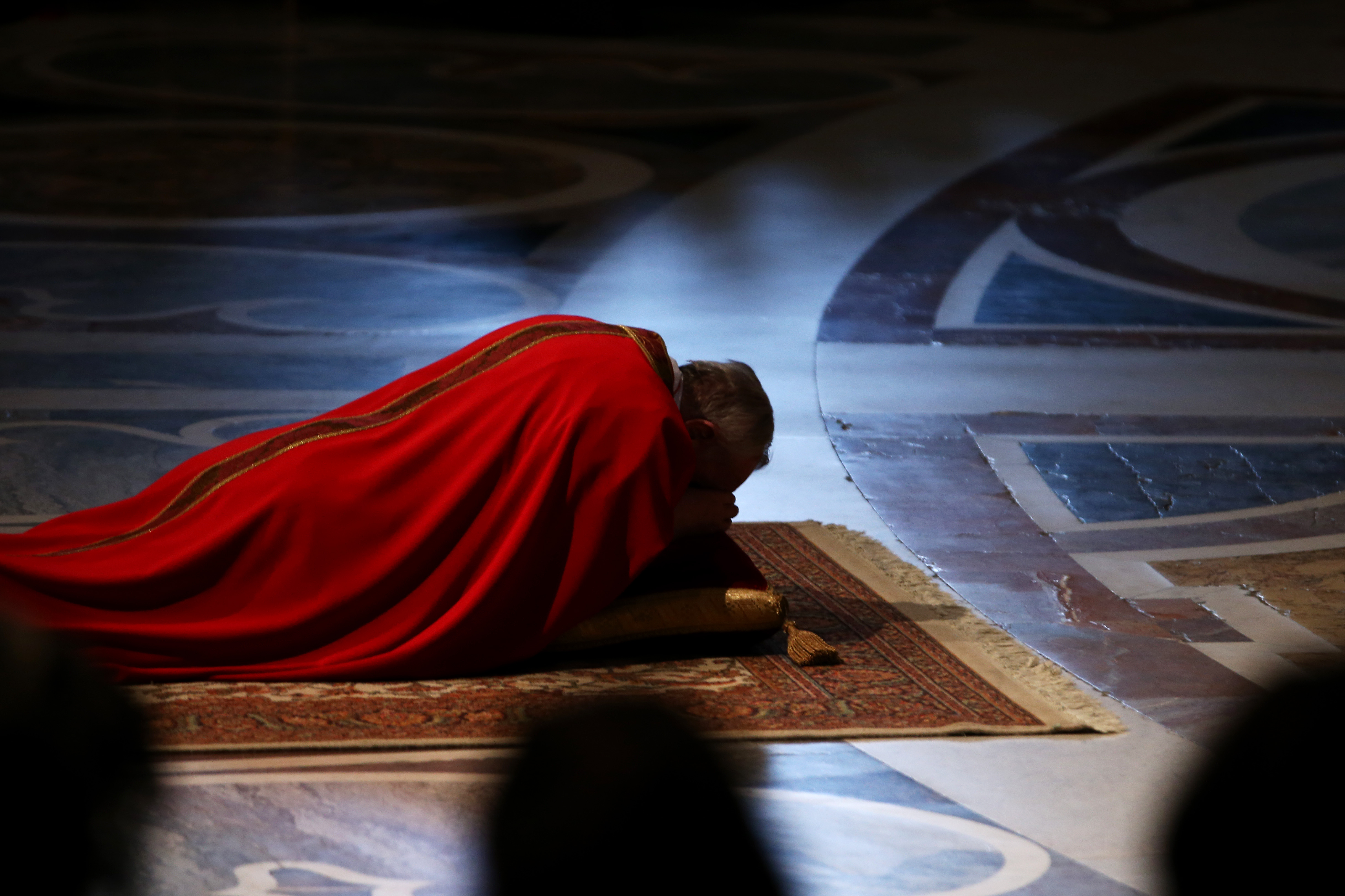
It’s taken almost a year and a half for him to meet with victims themselves, compared to his predecessor Pope Benedict, who was much less popular but met with victims on many trips around the world. This meeting – with victims from Ireland, Britain, and Pope Francis Attends Celebration Of The Lord's Passion in the Vatican BasilicaGermany – has also come under fire from victims’ groups in his native Argentina, who were excluded from this first encounter. And he raised a storm of criticism this year when he defended the church’s actions in general in the scandal. “The Catholic Church is maybe the only institution to have moved with transparency and responsibility,” Francis said. “No one else has done more. Yet the church is the only one to be attacked.” This is the first time a pope has received victims inside the Vatican.

Despite the criticism, Marco Politi, a veteran Vatican observer in Rome and author of the new book “Francis Among the Wolves,” says he believes the pope is continuing the work of his predecessor and forging a new, structural response. He created a commission on sexual abuse, which includes women as well as a former victim, and has taken action to back up his stated goal of zero tolerance. Archbishop Jozef Wesolowski, a Polish bishop recalled from the Dominican Republic last September on claims of sexual abuse, was recently defrocked.

The apology isn’t cutting it for some survivor-activists, who claim the pope isn’t doing enough to protect kids:

 Even though [Survivors Network of Those Abused by Priests (SNAP)], now 25 years old, is the most widely recognized global support group for clerical victims with more than 18,000 members, no one from their leadership was invited to meet with Francis. Ahead of the meeting [SNAP outreach director Barbara] Blaine, who was raped by her parish priest as a teenager, posed a number of topics she would like to discuss with Francis, if only she were given a chance.  First, she says she would like to tell the pope, “Stop talking about the crisis as though it’s past tense, and stop delaying while your abuse panels discusses details. You know the right thing to do. You don’t need a report.”

She said she would also tell the pope to focus first on prevention, instead of forgiveness.  “Wounded adults can heal themselves but vulnerable kids can’t protect themselves,” she says, noting that abuse and sex abuse and the consistent cover up by the Vatican is still ongoing.  She also suggests that the Holy See take “tangible steps to safeguard those at risk” by doing a number of what would seem like fairly simple steps, that are acceptable responses in the secular community when it comes to battling pedophilia, sex abuse, and child rape.

Dreher is on the same page:

Pope Benedict XVI was better. He defrocked 400 abuser priests, and worked harder than John Paul II to clean up the mess. But he never removed a bishop who facilitated abuse in his role as administrator — not even Bishop Robert Finn of Kansas City, the first American bishop ever convicted in the scandal (Finn, who in 2010 covered up for and shuffled around a priest who had child porn in his computer, was found guilty of not reporting the child porn to authorities.) And now Francis. Nice words, but until bishops are held accountable, they will only be words. By now, 12 years after Boston, papal statements absent actual papal governance count for nothing. We’ll know Francis is serious when bishops like Finn start losing their mitres.

I’m with Rod on this. It should never have taken this long to meet with survivors of abuse, or to hold bishops accountable for protecting child-abusers. On this subject, Francis could have provided a powerful symbolic moment of accountability and renewal – as he did in so many areas in his first year as Pope. But for some reason, he didn’t. It pains me.

Waltz With Bashar?

Josh Rogin reports on the internal debate within the Obama administration over whether we ought to reconsider our support for removing Assad:

In effect, the American government has been in a limited partnership with the Assad regime for almost a year. The U.S., Russian, and Syrian governments made a deal last September to destroy Assad’s stockpile of chemical weapons—and relied on Damascus to account for and transport those weapons, in effect legitimizing his claim to continued power. As far back as last December, top White House officials, including Deputy National Security Advisor Tony Blinken, have suggested that the rising threat of extremism was creating a “convergence of interests” between the U.S., Russia, and its allies in the Iranian and the Syrian governments to come to a political deal before the Islamists became too powerful. …

But the view that Assad can somehow be a partner of any kind is vigorously disputed by other senior U.S. officials, especially those who work or have worked on Syria policy. They say the problem of extremism in the region can only be solved by removing Assad from power. Not only is the Assad regime a magnet for terrorism, they argue, but Assad and the extremists inside Syria are working together.

Morrissey is aghast at the prospect that we might end up on the same side as a tyrant responsible for atrocities the State Department has compared to Nazi crimes:

This is what comes from having no foreign policy strategy, other than to get out of Iraq.

Obama does not want to return there even to fight ISIS, which is an offshoot of al-Qaeda, even where we have a straight-up fight militarily — and there are good reasons for that, because we probably can’t arrive in time with enough forces to do the job, thanks to the total withdrawal of 2011. He won’t commit air power to it without forcing the Iraqis to dump Maliki either, which again is not altogether unjustified. However, it leaves us with no strategic or tactical way to stop ISIS, no strategic partner in Baghdad, and no other strategic partners from NATO willing to step in and help. Assad is nothing more than a life preserver tossed into an ocean of bad circumstances, and the rationalizations already arising make it look like an even more ridiculous choice. If we want to fight ISIS, we’d be better off fighting ISIS ourselves. Propping up Assad through Iran is a complete reversal of American foreign policy of the last 35 years, in service to nothing except desperation.

If Morrissey believes that we should have stayed on in serious numbers in Iraq in order to fight yet another Sunni insurgency, he truly has learned nothing from the last decade. As for maintaining the foreign policy of the last 35 years – surely the situation in the Middle East after the Arab Spring requires some major adjustment. If our goal is to stymie ISIS, then I see no problems with tacitly relying on regional powers to do that work if necessary, and the Assad regime is one of those regional powers.

Zooming out, Jack Goldsmith asserts that the situation in Iraq and Syria upends the logic behind Obama’s foreign policy doctrine:

The “training” blueprint is not the only blueprint left in tatters by the insurgency in Iraq and Syria.  So too is the broader blueprint of declaring the “war” against jihadists over.  For a while now the administration has sent signals that core al Qaeda is near defeat and that the AUMF-“war” is nearly over. …

The rise of ISIS in Iraq and Syria, the failure of U.S. trained forces in Iraq to maintain ISIS, the continuing and growing threats to the homeland from AQAP in Yemen (see this scary Ken Dilanian story), not to mention rising jihadist forces in many other places, call this hopeful picture into serious question.  Set aside the legal question whether Article II suffices as a basis for needed U.S. counterterrorism operations to meet these threats after the AUMF is declared otiose (an issue I have discussed many times, most recently here.)  The politics of declaring the war to be over seem fraught as well.  Even if core al Qaeda is entirely defeated, AQ-associated forces like AQAP remain robust, and ISIS is now a huge problem, not just in Iraq, but also potentially in the homeland because (see here and here) thousands of westerners have joined the jihadist fight in Syria and Iraq and can return to the West, including the United States, with relative ease.  Declaring the war to be “over,” even declaring the AUMF-war to be over (which I think is hard to do), will now only highlight how little has been accomplished overall in defeating the jihadist threat.

It seems to me that the issue of returning Jihadists is the most potent one. And there must be ways in which those combatants can be monitored closely in the US or barred re-entry. But the belief that all these Jihadists are focused on attacking the United States and that the fight against Islamist extremism is now back at Square One seems a huge reach. ISIS’ main agenda, as the former MI6 chief has pointed out, is the war within Islam – not the war against the West. And, in fact, the most potent way to make this fight about us is precisely to adopt the rubric of post-9/11 policies, with all the collateral damage they did to us and to the struggle against Islamist violence. I favor roughly what Obama appears to be doing – a few gestures here but essentially nada directly. Nudge the regional powers to tackle ISIS, persuade the Saudis to cut off any funding still going there, insist on a broadly-based government in Baghdad as the sine qua non of any military aid, and steer clear of the entire clusterfuck. We have no bone in the Sunni-Shi’a fight. And the last thing we should do is inject ourselves into it.

Previous Dish on Obama’s Syria plan here and here, and on Assad’s machinations in Iraq here.

The View From Your Window Contest: Winner #212

VFYWC-212

A stumped veteran player writes:

Zambia. I mean why not. You people are insane.

A happier reader:

I have no clue where this is, but I just wanted to say that I love the photo. One of my favorite VFYW photos ever. Thanks for posting. Can’t wait to learn where it was taken.

Another hazards a guess:

The Greenbrier in White Sulphur Springs, WV. This is merely a hunch based upon the details of the balustrade along the roof line and the green ridges in the distance. Never having been there, I am unsure of where in the building the window is located.

A more confident reader:

This is a view from the state capitol in Helena, Montana.  No doubt about it!

Another confident reader:

Has to be Yavin 4:

Yavin-4

That isn’t the view we’re looking for. But that Star Wars base and the White House actually were the most popular incorrect guesses this week. Another nails the right country:

 Happy Fourth of July!!!

Another:

I doubt if you will get a single wrong answer this week, so you will have to start off directly with the right answers.

A bunch of right answers:

The only private residence designated a world heritage site.

Until Frank Lloyd Wright came along, this building was the purest expression of intelligence in architecture in North America.

We hold this house to be self-evident. Life, liberty, and the pursuit of fancy rotunda.

Home of my most favorite dead president evah!

Let’s just let OpenHeatMap get to the point:

212-heatmap

One of those readers who correctly answered Charlottesville, Virginia:

I’ve never been to Monticello, but (noting the date of this particular contest) it was the first thing I googled, and – WHAMMO! – there was the window! Well, eight of them. Figuring out which one was the window in question wasn’t that difficult. I’d be very surprised if this VFYW doesn’t receive the most correct answers ever, based solely on the fact that was able to figure it out, and normally I stink at this. Truly, truly stink.

Indeed, a whopping 587 entries came in this week, the vast majority of them correct, rivaling only VFYW #14 from Brookline as the most popular contest. One entry came from “My Piggy Bank, Hawthorn Woods, IL”:

image

Apparently, the interior is much more expansive than I ever would have imagined!

Another smiles:

THIS IS MY FAVORITE VFYW CONTEST EVER! I mean it was obvious that the window was from Monticello, so I had the location within five seconds of going to the contest page. But who knew that Google streetview had actually had someone walk all over the property so that we could explore the whole area from afar?! I didn’t, until today. Thanks for pointing me towards a virtual tour that I am really enjoying this morning and will continue to enjoy for at least an hour more.

How one reader came to guess the correct window:

Monticello Dome from South Pavilion

When I saw this week’s window, the circular shape and the neoclassical details of the balustrade in the foreground reminded me right away of a window I knew high atop a building across the street from the Basilica in downtown Baltimore, near where I went to college. The story I’d always heard was that the window belonged to the apartment of the “father of American architecture,” Benjamin Latrobe, who’d designed the apartment and the window to give him a good vantage for supervising construction of the cathedral.  I kind of recalled that Latrobe and Jefferson were pals, and given yesterday’s holiday all signs pointed right to Monticello.

A bit of Google-mapping and image searching later and I found the Dome Room and sorted out from the position of the balustrade and the walkway below which of its eight windows the view was taken from. The Dome Room is fantastically cool, with green floors and Mars yellow walls which you can see a little bit of in the photo. And of course all those windows.

Monticello Dome Room

Another features some history:

Pictures make it appear to be a beautiful room, but apparently it had limited use in Jefferson’s time.  According to Monticello’s website:

During Jefferson’s lifetime, the only documented use of the dome room appears to have been as a grandson’s bedroom. Access to the room was reached after climbing steep, narrow stairs and following a low hallway along the third floor. There would seem to be a limit to the practicality of such a chamber, but certainly no argument against the aesthetic beauty of the space. Washington socialite Margaret Bayard Smith wrote, following her visit to the house in 1809, that “it is a nobel and beautiful apartment furnished and being in the attic story is not used, which I thought a great pity, as it might be made the most beautiful room in the house.”

An expert weighs in:

I attended the University of Virginia for six years, and acquired a Ph.D in the history of American architecture there, so I’ve been in the Dome Room many times.  It’s a pity that Jefferson’s most inventive room turned out to be nearly useless to him.  He had planned on making the room his library, but the weight of his thousands of books were too much for the structure of the house.  Had he put all his books there, they would have come crashing down into the Salon below.  So this glorious room because a storeroom and sometimes playroom for Jefferson’s many grandchildren. The library-in-a-dome idea had to wait until he designed the Rotunda at the University about 1819.

Another relays some speculation:

Historians aren’t 100% sure of what the room was built for, but one theory is shared in the comments on Monticello’s website:

Cinder Stanton, Monticello’s Senior Research Historian, suggests that Jefferson might have used this room as his panopticon, where with the aid of his telescope, he could keep an eye on everything, including his slaves. With Jeremy Bentham’s 18th Century book “Panopticon” in his collection and two former slaves noting his use of the telescope, it is a sinister yet plausible interpretation.

Personally, I link to think that Jefferson simply wanted a room to admire such a lovely view.

Another needs to hide his column:

Funny, I spent a couple years doing fine architectural woodwork in Virginia, and although I have never been to Monticello, I knew it in an instant: the restraint, the reason, the measuredness of it all. I could stare at that window all day without ever wanting to look through it. Thanks for posting it on a Saturday, because for me at least, this kind of architectural porn is not safe for work.

The best aerial view we got this week:

monticello_aerial_edits

But this reader is no fan of Jefferson:

In the view you posted, you can see a bit of the pediments’ sloping roof, as well as one of the walkways, below.  Lovely view of the countryside.  Too bad it was a concentration camp (i.e., slave plantation.)

My father’s grandparents supported the renovation of Monticello in 1923, and we have two plates from the inaugural dinner (Thomas Jefferson Foundation.)  I loved to look at them as a child.  They are inscribed with a beautiful cadence: “All my wishes end, where I hope my days will end, at Monticello.”  As I got older, and realized that not only was Monticello built on the backs of slaves, but a good deal of my ancestors’ money and social prominence as well (Maryland, Eastern Shore), I’m glad all we have left of that lucre are two stupid plates.

Another has a more balanced view:

I knew in an instant that this was Thomas Jefferson’s mansion, Monticello. When I was taken there on a family trip at age 8 it made a huge impression on me. At that time I was astonished by his genius as an inventor (such as his “polygraph” machine designed to make copies of his letters – it was two goose-quill pens latched together). Later I was astonished by the breadth of his thinking, and read scores of biographies.  After that I became equally astonished at his inability to deal with the unspeakable depravity of slave owning. It’s all worth contemplating when examining how this nation is so often at cross-purposes.

GIF of the day:

monticello2

For many, the view brought a flood of memories:

Many happy childhood vacations were spend riding around the US to historical sites where my father would bring to life the stories and high ideals of this America adventure. To him, I owe a debt whose payment is rendered as civic responsibility, social conviction, and a well-seasoned sense of Wonder. I was never allowed to visit the upper-floored room where this window reigns, but the picture portrays the view exactly as mustered in my vivid imagination.

Here’s to Life, Liberty, and the Pursuit of Happiness.

And here’s to clever readers:

nickel[1]

Gah! Another one that EVERYONE will get. At first glance I thought it would be really hard. Not much to go on in the photo. But then I realized it was the Fourth of July weekend and that we were probably looking out from a historical building related to the American Revolution, perhaps one of the Founding Father’s homes. Monticello was literally the first one I searched, but even if I hadn’t, how many different famous Founding Father homes are there? I can only think of Mount Vernon and Peace Field off the top of my head. But there are probably no more than five at most?

My only hope of winning is that most people will guess the wrong window. I first thought it was one of the front-facing windows, but a careful examination of the roof railing indicates that it’s the one facing the right side of the building.

Chini chimes in:

Looking at this one on my phone during the Argentina match I was sure it would be hard. Flat forestland, no other buildings, a real nightmare. But it only took a few minutes after the match ended to discover that it was, in fact, as easy as views get. You just had to ask yourself “What view would they pick for the Fourth of July?”

Many contestants had the same question:

vfywc-212-collage

On that note:

What happens when 500 people get the right answer?

Another contestant has a suggestion along those lines:

I expect that so many people will get the correct window, the win will come down to extreme precision. Based on how very deeply the window is recessed into the wall and the position of the distant horizon viewed through the window, one can determine how high the camera was off the floor:

This slideshow requires JavaScript.

Or it might just have been an employee who stood on the only chair in the room (just visible in photo #8) when nobody was around … or some anonymous pituitary case.

An inspired entry, but we’re still giving the prize to the player with the most previous guesses but no wins, especially if they’ve guessed difficult contests in the past. So this long-suffering veteran gets the prize this week:

Screen Shot 2014-07-06 at 4.59.33 PM

I hope my many previous guesses will be enough to win the tiebreaker this time. We are looking out from the south-facing window on the top floor of Thomas Jefferson’s Monticello in Charlottesville, Virginia.

From the view’s submitter:

I think it’s either going to be super-hard or super-easy: you guys are either sadists or chumps!

This shot was taken facing south, overlooking the garden and slave quarters, in the dome room at the top of Monticello. (I’ve attached a photo of the Western facade, showing the window.) The dome is not generally open to the public: it’s part of a “Behind The Scenes” tour that must be reserved in advance, with only a limited number of slots available.

vfywinfo

Jefferson called this vista his “sea view,” and the Piedmont countryside rolling off to the horizon certainly evokes a large body of water – which just might beguile anyone who doesn’t know where the shot was taken!

(Archive: Text|Gallery)

The Revenge Doctrine

The situation in Israel and Palestine continues to escalate, with Israel going all-in on its latest offensive in Gaza to quell renewed Hamas rocket fire:

The Israeli military announced the call-up of 1,500 reservists and the deployment of two infantry brigades along the Gaza Strip. Convoys of trucks carrying Israeli tanks and armored personnel carriers were seen on the highway headed south Tuesday. … Over the last 24 hours, Hamas and other anti-Israel militant groups in Gaza have fired more than 100 mortar rounds and rocket shells at Israel. More than a dozen were intercepted by Israel’s U.S.-supported Iron Dome missile-defense batteries, but many others fell on Israeli soil. Most of the rockets landed in open fields, but some hit structures.

Yishai Schwartz remarks that the torture-murder of Muhammad Abu Khdeir by alleged Jewish extremists last week is a symptom of a growing pathology in Israeli society:

[I]deas have power, and it would also be a mistake to write these murders off as the insane acts of deranged lone wolves. The perpetrators were deranged, but they were not alone. The same pathologies that animated Kahane’s followers and that Wieseltier identified decades ago have not disappeared. Radical nationalism, militant millenarianism, and social resentmentoften tinged with the fundamentalism of religious dogmaare all too alive in Israel’s underclass. And after years of steady Palestinian violence and rejection, too many in Israel shrug off the rhetoric of its own racists as regrettable, but understandable. …

It’s that resignation in the face of racism that scares me, and partly that’s because it comes from a place I understand. There is something beautiful about the belief that because we are Jews, racist rhetoric will never lead to brutal murder. And there is beauty to the genuine shocknot just horror, but surprisewhen it does.

Do you remember when American newscasters and presidents could still honestly declare themselves “shocked” and “unsettled” by mass shootings and school violence? In retrospect, that shock was a beautiful thing. But in the United States, those days are gone. We have grown accustomed to domestic mass shooting. And I fear that a similar thing is happening here in Israelthat this will be the last time that an Israeli defense minister can seem genuinely shaken by the reality of Jewish terror.

Dershowitz remains optimistic that Israel will bring Abu Khdeir’s killers to justice:

I believe the Israeli legal system will be fair, or perhaps even bend over backwards, when it comes to the brutal murderers of Khdeir. Criminal trials in Israel do not involve juries. Accused criminals are tried by professional judges, who are in general selected on a non-partisan basis. Verdicts and sentences are less likely to be influenced by popular opinion than in the United States, where judges are either elected or politically appointed, and where jurors are supposed to reflect the views of the people.

Even if some Israelis might have more sympathy for Jews who killed a Palestinian than for Palestinians who killed Jews, that sort of public bias will have little impact on the trial of those accused of killing Khdeir. The age of the defendants, however, might. There are reports that some may be minors, and Israeli law does take account of the age of accused criminals. But older vigilantes may well be involved as well, either in planning, inciting or protecting the actual killers. The investigation is ongoing and will not stop until everyone who has played a culpable role in the murder is apprehended and brought to justice.

But Saletan has his doubts about Netanyahu’s pledge to treat Abu Khdeir’s murder the same as other acts of terrorism:

It’s not just Netanyahu who has pledged that Khdeir’s killers “will face the full weight of the law.” Naftali Bennett, Israel’s economy minister, says he and his right-wing supporters “will demand the Terrorist Law we put forward be applied to the boy’s killers.” Defense Minister Moshe Ya’alon says the killers “should be treated as terrorists.” Khdeir’s parents point out that there’s a simple way to make good on these promises. “Destroy their houses just like [Israel] destroyed the houses of the suspects in Hebron,” says the boy’s father. “Demolish their houses and give them life sentences,” says his mother.

Some Israelis are already concocting excuses for not applying the policy to Jews. Almagor, a 28-year-old organization that claims to speak “for terror victims’ rights,” says in its mission statement that every victim “is entitled to justice: punishment of the criminal, the psychological closure that comes with punishment, laying down the law in its full force.” But on Monday, in a letter to the Israeli government and members of parliament, the group’s director pleaded that while “we need to deter Palestinian terrorists by destroying houses and exiling their families,” Jews don’t need to be treated this way, because they seldom kill.

The Challenge Of Reform Conservatism

This blog has long been generally supportive of the attempt by a handful of sane and intelligent conservative thinkers to brainstorm some kind of future for the American right. And who wouldn’t be? If the alternative is the brain dead 1979 redux position of someone like Kimberley Strassel, you gotta love Ross Douthat. But it strikes me there are deep challenges for this fledgling group of now Tanenhaus-blessed scholars, and they may be hard to overcome.

The first is the lack of any clear unifying theme or rallying cry that can meld policy to politics. “Reform” seems too vague and goo-goo a thatcherreagan.jpgtheme to catch on. On the core axis of more or less government, the reformicons rightly answer smaller, better government – but the “better” part always ends up a little duller than “smaller”. A child tax credit may or may not be a decent idea – but it’s very hard to fit it into the broader tradition of less government dependency. Ditto attempts to alleviate student debt, or to encourage the hiring of the long-term unemployed, or the block granting of anti-poverty funds to the states. All of them are hard to do when you demonize government itself as regularly as the Republican rank and file.

Perhaps the best scenario for a raft of such small, but potent policy proposals would be a Republican version of the Clinton administration – which bored the pants off ideologues but still connected with the tangible needs and concerns of most people. Alas, it’s hard to imagine a Clintonism of the right without a Clinton. It was Bill’s astonishing charm, loquaciousness, relentlessness and seduction that made these tedious laundry lists so popular. I do not see any such charismatic figure with such a direct and personal grasp of so many policy issues on the right. Maybe he or she will show up as a charismatic and brilliant governor. Or maybe not. If Ted Cruz is the new archetype of a Republican, never.

Within British conservatism, there are, in contrast, two competing traditions – Whig and Tory – that mitigate this problem. The Whiggish triumviratetimsloangetty.jpgfaction had its high watermark under Thatcher, a conservative who embraced market liberalism as the best foil to socialism. But the Tory faction never disappeared completely. Its rallying cry – and historical legacy – is “One Nation” Toryism, rooted in Disraeli’s conservative embrace of the working classes, and abhorrence at the vast social and economic inequalities of his time. It has no problem at all with government and its benefits. This would be a natural and identifiable tradition to embrace in Britain for a set of reformers like the Levin brigade. In America? No Disraeli ever existed – and no Bismarck either. Eisenhower may be the best analogue. And re-introducing Eisenhower to the next generation is a pretty heavy lift. The trouble with American conservatism is that it is, in essence, so new, and so wedded to a particular era, that it doesn’t have the depth and reach of a European conservatism that can provide a leader like Angela Merkel.

And then the reformicons are operating at a disadvantage in a culturally polarized America. It would be great if this were not the case – but since a huge amount of both parties’ base mobilization requires intensifying the cultural conflict, and since the divide is rooted in real responses to changing mores, it will likely endure. And that kind of climate makes pragmatic conservatism again less likely to get a hearing.

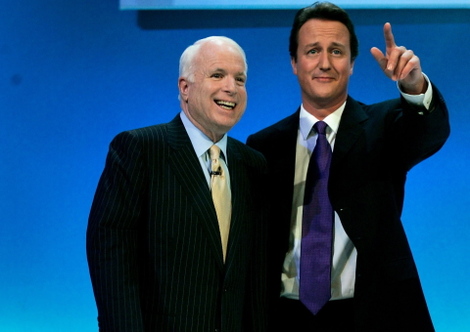
So, for example, I’m perfectly open to new ideas on, say, helping working class families with kids. But some pretty basic concerns about the current GOP on cultural issues – its open hostility to my own civil marriage, its absolutism on abortion, its panic at immigration, its tone-deafness on racial injustice – push me, and many others, into leaning Democrat for a while. And it’s important to note that even the reformicons are die-hard cultural and religious conservatives in most respects. On those questions, there is no airing of the idea of reform. mccameronbrunovincentgetty.jpgDavid Cameron’s post-Thatcher re-tooling of British conservatism took at least two major issues associated with the left-of-center – marriage equality and climate change – and embraced them fully. If the reformicons could do something like that, they would begin to gain traction outside of a few circles in DC and in the country at large. But they won’t; and, given the rigidity of the GOP base on those issues, can’t.

Then there’s the absence of any foreign policy vision. The fixation on domestic policy is welcome – but the greatest disaster in Republican government in the last decade was the Iraq War, and, more broadly, the massive over-reach of big government in trying to re-make the world into a democratic wonderland. To some extent, Rand Paul and Mike Lee have shown an ability to tackle this question – and favor a serious continuation of Obama’s de-leveraging of the US abroad, along with a further dismantling of the Cheney infrastructure for the war on terror. But the reformicons have never issued a clear rejection of Cheneyism, and indeed seem, f0r the most part, like unreconstructed neocons abroad. I can’t see any of them demanding some concessions from Israel for a two-state solution, for example, or any policy toward Iran but war. But they’re mainly silent on these burke.jpgquestions – which also marginalizes them. The most important Republican debate, it seems to me, is about the role of the US in the world in the 21st Century. Hegemon? Democratizer? Or simply great power? On this, the reformicons are silent. Their predecessors in the debates of the 1970s weren’t.

But maybe I’m being too glum. There are always unforeseen events to alter the future. Reagan’s 1980 victory was not seen until a few weeks before the November election. It’s certainly possible, although unlikely, that a Republican could win the presidency in 2016. But what I’d look for in the meantime in the reformicon future is what contribution they could make in the last two years of the Obama presidency. If the GOP controls both Houses, the country might look to them for some legislative action that the president could sign onto. If the country sees signs of actual policy progress, affecting their actual lives, thanks to reform conservative ideas and a pragmatic liberal president, then the atmosphere could change. Alas, I see the likelihood of that, in our current context, and in the run-up to 2016, to be close to impossible. It may take another epic national defeat for the GOP to take the reformers seriously. It took three consecutive lost national elections for the Tories to find Cameron. And part of me thinks that the best hope for the reformicons in the long run will be a Hillary Clinton victory in 2016.

I wonder how many of them, as they go to sleep at night, have quietly agreed with that.