
This Is A Refugee Crisis

EL SALVADOR-POLICE-OPERATION

Amanda Taub illustrates how gang violence in Central America is driving thousands of unaccompanied children to seek refuge in the US:

Children are uniquely vulnerable to gang violence. The street gangs known as “maras” — M-18 and Mara Salvatrucha, or MS-13 — target kids for forced recruitment, usually in their early teenage years, but sometimes as young as kindergarten. They also forcibly recruit girls as “girlfriends,” a euphemistic term for a non-consensual relationship that involves rape by one or more gang members.

If children defy the gang’s authority by refusing its demands, the punishment is harsh: rape, kidnapping, and murder are common forms of retaliation.  Even attending school can be tremendously dangerous, because gangs often target schools as recruitment sites and children may have to pass through different gangs’ territories, or ride on gang-controlled buses, during their daily commutes.

Why now? The Economist‘s take:

El Salvador, Honduras and Guatemala have had shockingly high murder rates for years, however. The reason so many of them have decided to leave at once is a widespread rumour that Mr Obama’s administration has relaxed the barriers against children—and their mothers if the children are young enough—entering the United States.

A leaked border-agency memo based on interviews with 230 women and children apprehended in the Rio Grande Valley concluded that they had crossed the border mainly because they expected to be allowed to stay. Migrants talk of a “permiso” (permit) to stay in the United States, although this may be a misunderstanding of the American immigration procedure in which many children are put in the care of family members while waiting for deportation hearings. Some Hondurans conspiratorially say they think America is preparing for war; that’s why they are letting more youngsters in. Others blame Facebook: it is easy for relatives in the United States to show the trappings of prosperity.

Julianne Hing disputes the notion that Obama’s policies are to blame for the influx:

Republican lawmakers are having a field day casting Obama administration policy, namely DACA—a program initiated in 2012 which gave a narrow class of undocumented youth short-term work authorization and protection from deportation—as responsible for the sudden uptick of new migrants. In early June, Alabama Sen. Jeff Sessions even called Obama “personally responsible” for the influx, Think Progress reported. It’s become popular political fodder for politicians with midterm elections on the mind.

However, humanitarian groups like the United States Conference of Catholic Bishops and the Women’s Refugee Commission have noted the jump in unaccompanied minor border crossings since late 2011 (PDF), long before Obama announced DACA in June of 2012. What’s more, in interviews with hundreds of detained youth, multiple agencies and researchers have found that the vast majority have no idea about the existence of DACA, let alone the notion that they might take advantage of it for themselves.

Dara Lind accuses the administration of getting its response to the crisis backwards:

The Obama administration now believes that the government’s top priority should be swiftly returning a child to his or her home country if it’s not immediately clear that he or she deserves legal status here. That means the administration sees this as an immigration crisis — children coming to the United States because they can, for economic opportunity, family reunification, or to game the system. If that’s the case, a crackdown will deter families from sending their children, because the odds would no longer be in their favor.

It means they don’t see it as a refugee crisis — children will now be assumed not to be in danger unless they can prove otherwise. But if families are currently sending children because they’re genuinely convinced the children are in mortal danger, a crackdown won’t have as much of a deterrent effect.

(Photo: A policeman checks a man during the operation ‘safe house’ at the Maquilishuat neighborhood in San Salvador, El Salvador on January 15, 2014. Salvadorean police make ‘safe house’ operations to search for drugs and gang members in violent neighborhoods. By Jose Cabezas/AFP/Getty Images)


No, ISIS Is Not Al-Qaeda, Ctd

In fact, Aaron Zelin argues, the rise of the Islamic State is pretty bad news for the leading jihadist brand:

The Islamic State hopes to put al Qaeda and its branches in the unenviable position of having to reconcile with the reality of the new caliphate, or oppose it and therefore be viewed by global jihadis as hindering the caliphate project and showing its true nature as a sectarian organization that is not working for the best interests of Muslims. That strategy, however, is a gamble: It could open the Islamic State up for an even bigger fall if it does not follow through on its promise to fight enemies on all fronts, and if it fails in governing newly captured areas. There is already insurgent and noncombatant resistance to the Islamic State’s gains in both Syria and Iraq, so the group therefore has a thin needle to thread.

Jihadists’ reactions to the Islamic State’s re-establishment of the caliphate have so far been mixed.

There are signs that al Qaeda in the Arabian Peninsula foot soldiers are excited about the alleged caliphate coming to fruition, while many within the Nusra Front are condemning it and sarcastically making fun of it, calling it a Twitter Caliphate. Maldivian jihadists in Syria under the banner of Bilad al-Sham Media have released a rebuke, arguing that the announcement strays from the true Islamic way of establishing a caliphate, and noting that it needs to have broader support. Most importantly, a number of top jihadist sheikhs, such as Hamid bin Ali and Hani al-Siba’i, have rebuked the announcement. The key Syrian Islamist rebel groups and Islamic bodies also rejected the Islamic State’s reestablishment of the caliphate.

Dettmer relays the fears of Western security agencies that al-Qaeda may try to reassert itself in the Jihadi rivalry by staging a big attack:

U.S. officials say the Obama administration is preparing to ramp up airport security and has requested Western allies do the same as concerns mount that suicide bombers are in the late stages of planning attacks on American- and European-bound commercial flights. A senior European security official told The Daily Beast there are fears as well that jihadists recently returned from fighting in Syria with al Qaeda affiliate Jabhat al-Nusra are conspiring to detonate bombs on railways and buses in major European capitals such as London and Paris.

It looks like it will be a long, difficult summer for travelers as, at a minimum, the rivalry between terror groups for top-dog status will be felt in the form of longer security lines at airports and a further proliferation of inconvenient rules about what you can carry on a plane.

And another victory for fear. Let’s just hope NSA is listening in all the right places. Previous Dish on the fraught relationship between ISIS/IS and al-Qaeda here.

Mad At The Mainland

Lily Kuo takes a look at what yesterday’s massive pro-democracy demonstration in Hong Kong was all about:

On the July 1 anniversary of Hong Kong’s handover to China, tens of thousands of students and other residents of the semi-autonomous region joined the city’s largest demonstration in a decade, demanding the right to directly elect a leader. The protests were widely followed by international media, and Hong Kong’s dissatisfaction is well-known outside the city, but observers fear they will do little to prod Beijing to allow truly open and direct elections, and could prompt a harsh crackdown by Chinese authorities. …

Last night’s sit-in is merely a trial run for a larger demonstration later this year. Organizers of a protest group called Occupy Central have vowed to bring Hong Kong’s financial district to a standstill if a proposal from authorities—due to be released before the end of this year—doesn’t include public nomination.

William Pesek details the underlying causes of the widespread discontent:

Since July 2012, Leung Chun-ying has stood aside as China clamped down on Hong Kong’s media, tried to make the city less transparent and moved to impose patriotic education on students. His predecessor, Donald Tsang, spent seven years looking the other way, while Tung Chee Hwa, the city’s first leader, enriched a whole class of tycoons, including Asia’s richest man, Li Ka-Shing. When you look at the quality of Beijing’s picks, it beggars belief that the Communist Party can’t see why Hong Kongers want greater democracy. …

For all its wealth, Hong Kong is a potential powder keg. About 1.3 million of its 7.2 million people, or one in five, live under the poverty line. Its Gini coefficient, a measure of income inequality, rose to 0.537 in 2011 from 0.525 a decade earlier, and now is 12th highest in the world. And given the surge in property prices during Leung’s tenure, coming mostly from public servants in Beijing, it’s safe to assume the gap has widened more since then.

Fear And Loathing In The Middle East

Refugees Fleeing ISIS Offensive Pour Into Kurdistan

New survey data reveal that worries about Islamic extremism are on the rise:

Concerns have increased significantly over the last two years in Jordan and Turkey, both of which share a border with Syria. Roughly six-in-ten Jordanians (62%) are concerned about extremism in their country, up 13 percentage points since 2012. Just half of Turks hold this view, but this is up 18 percentage points from two years ago. More than eight-in-ten Israelis (84%) express worries about Islamic extremism, although this view is more common among Israeli Jews (87%) than among Israeli Arabs (66%).

Meanwhile, al-Qaeda is broadly despised, Nigerians hate Boko Haram, and Pakistanis can’t stand the Taliban. Groups like Hezbollah and Hamas are also seeing their popularity decline notably:

More than half in the Palestinian territories (53%) have an unfavorable view of Hamas, with only about a third (35%) expressing positive views. Negative views are higher in the Hamas-led Gaza Strip (63%), up from 54% in 2013. In the Fatah-led West Bank, 47% have an unfavorable opinion of Hamas. Opinions of Hamas have been deteriorating in the Palestinian territories since it took control of the Gaza Strip in 2007. Then, 62% of Palestinians had a favorable view of the extremist group, while a third had negative views. Now, only about a third have positive opinions and more than half view Hamas negatively.

(Photo: Iraqis who have fled recent fighting in the cities of Mosul and Tal Afar try to enter a temporary displacement camp in Khazair, Iraq but are blocked by Kurdish soldiers on July 2, 2014. The families, many with small and sick children, have no shelter and little water and food. The displacement camp at Khazair is now home to an estimated 1,500 internally displaced persons (IDPs) with the number rising daily. Tens of thousands of people have fled Iraq’s second largest city of Mosul after it was overrun by ISIS militants. Many have been temporarily housed at various IDP camps around the region including the area close to Erbil, as they hope to enter the safety of the nearby Kurdish region. By Spencer Platt/Getty Images.)

Perspective, Please, Ctd

A reader writes:

Count me with you in the sanguine camp about the Hobby Lobby ruling. The hysteria over this decision baffles me, though perhaps it shouldn’t – it’s extremely easy for the media to place what happened in the context of pre-existing narratives like the “War on Women” or the nasty bigotry of the religious right than to sift through and explain complex legal reasoning. At any rate, it’s worth pointing out that most of the dissents featured here are factually wrong.

To explain why, let’s turn to Eugene Volokh’s “plain English” rendering of the majority’s decision, which might be the most helpful single explanation of what happened. The entire piece (and it’s not long) should be read, but his final point is this:

Supreme Court Issues Rulings, Including Hobby Lobby ACA Contraception Mandate CaseWhen both the government’s compelling interests and religious objectors’ religious beliefs can be adequately accommodated, Congress said (in enacting RFRA) that they should be accommodated. But Congress also said that these decisions must turn on the facts of each exemption request, and the options available for accommodating such accommodation requests. In future cases — for instance, ones involving race discrimination in employment, or insurance coverage for vaccination or blood transfusions — the result might be different.
So, let’s take a deep breath and walk through this. The reader who claimed that this decision means that “only the religious views of abortion opponents count” is wrong. They counted here because those were the people asking for an exemption. Other types of exemptions will stand or fall on their own merits, and will depend in part on how difficult (or not) such requests are to accommodate. Proceeding in this fashion is what the Religious Freedom Restoration Act requires.

This leads to a second point. Your reader who compared this to the Lawrence decision could not be more off the mark.

That case dealt with matters of constitutional interpretation – it established a precedent in the fullest sense of the term by saying what liberty and privacy meant under the Due Process Clause of the 14th Amendment. As such, its impact really has been sweeping, because when you say what the Constitution means, you provide a standard against which to judge any particular federal or state law. The Hobby Lobby case, on the other hand, dealt with a statutory question – interpreting a law passed by Congress. It makes no big claims about the meaning of religious liberty, or what the First Amendment demands in situations like Hobby Lobby’s. If Congress repealed the RFRA tomorrow, the basis for this exemption would be removed.

Similarly, the reader who panicked that Alito “didn’t actually shut the door on another closely held company making an RFRA claim that mandatory coverage of blood transfusions or vaccines abridges religious freedom” doesn’t know what he or she is saying. Alito couldn’t do that, because, again, the RFRA requires the courts, as Volokh put it, to “sort through religious exemption requests” as they are made. Without the facts of those possible exemption requests, the Court really can’t say much about them. In the future, closely held companies can ask for whatever exemption they want – how you could forbid exemption requests, ahead of time, from simply being made is beyond me – and those requests, again, will be dealt with at that time according to the particulars involved, from the nature of the burden imposed to the reasonableness of the accommodation sought.

I’m convinced most of the people wetting themselves over this decision are doing so because, in their ignorance, they assume all SCOTUS decisions are like Lawrence or Windsor or some other “big” decisions on hot button issues that render a judgment on what the Constitution means. Hobby Lobby was not that type of decision.

Another reader:

Some of the comments regarding the Hobby Lobby decision seem to be driven a bit by emotion and ideology than a understanding of precedent. One reader wrote:

In that majority opinion, Justice Scalia said Smith had no constitutional right to exercise the religious practice in question (use of peyote in a Native American ritual). Or rather, he said the state of Oregon’s interest in preventing abuse of peyote outweighed Smith’s religious freedom.

That’s not the best way to characterize the decision of the Court in Smith v. Oregon.  The litigants in the case were denied unemployment benefits because they were fired from their jobs as drug counselors for the use of peyote in religious ceremonies.  Because they were fired for job-related misconduct, they couldn’t collect the benefits.  The Court held that this generally applicable law would not consider an exception for this religious practice.

Scalia and the Court resurrected what is often called the belief action distinction or dichotomy. Simply, this means that the First Amendment allows individuals to believe what they wish.  But religious activities could be regulated as long as the regulation was neutrally applied.  So the Court did not declare they litigants had no right to exercise the religious practice in question.  They just couldn’t collect unemployment benefits.

Now you can certainly argue that “neutral” laws might prove disadvantageous for minority groups.  But if RFRA had not been passed by Congress as a remedy to this decision, you would need only to apply the Court reasoning in Smith.  Was the ACA a neutrally drafted law?  Likely the Court would have rules yes – the ACA was not passed to force devout Christians who abhor abortion to allow contraceptive practices that seem to promote the end of fetal life.  Hence, Hobby Lobby may have lost today (if of course the Court was consistent).  Hobby Lobby would not have been granted an exception to a neutral law.

But RFRA was passed by Congress to allow for the devout to avoid having to follow general laws of neutral applicability.  RFRA demands that the Court evaluate whether there  has been a substantial burden on the Free Exercise of religion.  If the answer is yes, Congress needs to demonstrate a compelling justification for the burden that is narrowly tailored.  Alito suggested that there was a compelling justification.  But then he argued that the ACA did not use the least restrictive means (narrow tailoring) to fulfill the compelling interest.  Remember, the Court noted that if the federal government wants to provide the benefits, it can.  In that regard, Hobby Lobby still loses. Also remember, the Court was conducting statutory interpretation here – not constitutional interpretation.

The other issue to keep in mind is that in recent years, the Court applied the Free Exercise clause to protect minority religions at the hands of minorities, including Santarians and those who import hallucinogenic for religious ceremonies.

(Photo: Supporters of employer-paid birth control rally in front of the Supreme Court before the decision in Burwell v. Hobby Lobby Stores was announced June 30, 2014 in Washington, DC. The high court ruled 5-4 that requiring family-owned corporations to pay for insurance coverage for contraception under the Affordable Care Act violated a federal law protecting religious freedom. By Chip Somodevilla/Getty Images)

Poetry That Gets A Bad Rap

McWhorter says poetry is more popular than ever, but most people just don’t recognize it:

Rap is indeed “real” poetry. It rhymes, often even internally. Its authors work hard on the lyrics. The subject matter is certainly artistically heightened, occasioning long-standing debates over whether the depictions of violence and misogyny in some of it are sincere. And then, that “gangsta” style is just one, and less dominant than it once was. Rap, considered as a literature rather than its top-selling hits, addresses a wide-range of topics, even including science fiction. Rap is now decades old, having evolved over time and being increasingly curated by experts. In what sense is this not a “real” anything?

The only reason rap may seem to nevertheless not be “real” poetry is a skewed take on language typical of modern, literate societies: that spoken language is merely a sloppy version of written language. “English,” under this analysis, is what’s on a page, with punctuation and fonts and whoms and such. Speech is “just talking.”

That means that to us, poetry is written poetry, that which sits between covers and is intended to be read, quietly, alone, with tea, likely chamomile. Never mind that in fact Jay-Z has released a magisterial volume of his lyrics as a book: generally, rap is intended to be heard on the fly, often in a concert arena. Surely there is a key distinction between that and the strophes of John Berryman or Gwendolyn Brooks? But if there is, it’s a matter of style and tone, not basic classification.

On the above music video:

Let’s not get it twisted—the Cam’ron of the forthcoming Federal Reserve isn’t the same person who, earlier this century, became the central mythological figure of Harlem. But, when you put him in the right hands—in this case, the nimble duo of A-Trak and Just Blaze—the resulting product is more than enough to release a flood of pent-up dopamine. Lines like “Mommy backed up and said she see the difference/ “You’re mature, handsome, mixed with a lot of ignance” will do that to you.

Kurdistan’s Moment? Ctd

The president of Iraqi Kurdistan, Massoud Barzani, has announced plans to hold a referendum on independence:

[A]nnouncing a Kurdish independence vote during an interview with the BBC, Barzani said a referendum would only confirm what is clear already—namely that Iraq has been “effectively partitioned now” following the territorial gains by the self-declared Islamic State (IS), formerly known as ISIS, the al-Qaeda offshoot which has proclaimed an Islamic caliphate in Iraq and Syria. He added: “Are we supposed to stay in this tragic situation the country’s living? It’s not me who will decide on independence. It’s the people. We’ll hold a referendum and it’s a matter of months.”

The Kurdish leader’s remarks drew a sharp denunciation from the central government in Baghdad, which dubbed the planned referendum unlawful. But with Iraq’s security forces in disarray and unable to roll back the Sunni insurgency, there is little Baghdad can do to stop the Kurds from breaking away, unless it receives grater military assistance from Iran.

One of the factors allowing Barzani to make this bold move is that Turkey has softened its longstanding opposition to an independent Kurdistan. Marc Champion puts this down to next month’s presidential election, in which incumbent Erdogan may need Kurdish votes to secure the mandate he’s looking for:

May’s local elections were a dry run for the presidential race, in that both Erdogan and his opponents turned the polls into a referendum on him. Erdogan’s ruling Justice and Development Party won 43 percent of the vote, a good result but not the majority he needs to win the presidency in the first round. The two main opposition parties together won 44 percent.

The even split between Erdogan and the main opposition means that Turkey’s Kurds will be the kingmakers. For them, any concern over Erdogan’s authoritarian bent pales next to securing an independent Kurdish state in Iraq and a better deal for themselves in Turkey. Erdogan is letting them know he is the man to deliver both.

Goldblog urges Obama forcefully to champion the cause of Kurdish “liberation”:

For two decades, the Kurds have shown themselves to be the most mature and responsible entity in Iraqi politics, which is one reason American officials are panicked by the thought of their permanent departure. A Kurdish exit will promote instability, the thinking goes. But what the region has now isn’t stability. What’s there, among other things, is an institutionalized injustice, an injustice at times exacerbated by U.S. policy. …

The Kurdish leadership is far from perfect; corruption is a serious problem, and Kurdish parties are incompletely committed to democratic ideals. But the Kurdish autonomous zone is Switzerland compared to the rest of Iraq, and the rest of the neighborhood.

But Adam Taylor warns that the situation is more complicated than it looks:

The Baghdad government has vocally opposed a referendum (“The government doesn’t accept anything outside the constitutional way, which was voted on by the Kurds,” an adviser to Maliki has told Bloomberg News) and the vast majority of non-Kurdish Iraqis also oppose it. …

Even the Kurdish people don’t necessarily represent a united front. Kurdish groups in other countries, notably Turkey’s Kurdistan Workers’ Party (PKK), have long called for a united Greater Kurdistan rather than separate states. Even Iraqi Kurds aren’t as united as it might appear, with much of the country split between the Kurdistan Democratic Party and the rival Patriotic Union of Kurdistan, both of whom operate their own security forces (the two parties fought a three-year civil war in the 1990s but have a power-sharing agreement now).

Previous Dish on the prospect of an independent Kurdistan here.

Map Of The Day

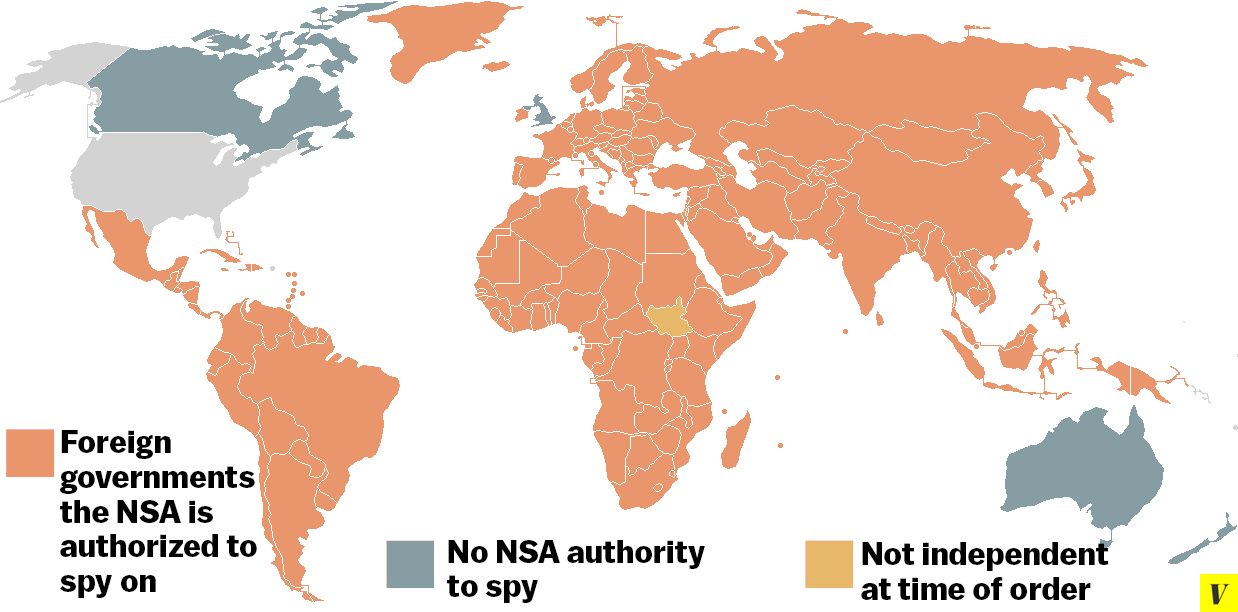
NSA_spying_authority

The latest Snowden leak lists the countries where the NSA is allowed to spy, which is to say pretty much everywhere:

Presumably, the NSA preemptively asked for (and got) authority in most of these countries before it had a specific reason. Although, it’s certainly possible that at some point the NSA decided it really needed explicit permission to spy in San Marino, Saint Lucia, the Grenadies, Samoa, Palau, and other island nations that do not present an immediately obvious intelligence draw.

The second thing you’ll notice is the only four nations not included on the list: the United Kingdom, Canada, Australia, and New Zealand. (There is also a fifth, South Sudan, although it was not yet independent as of 2010 and I’d bet everything I own that they’re now on the list.) Those four countries, all fellow Anglophone nations of significant English descent and former members of the British Empire, are members with the United States in an agreement known as 5-Eyes. … But the vast, vast majority of the world is not part of 5-Eyes, and that means that they’re subject to NSA spying on their government, whether they like it or not.

Waldman considers how the rest of the world must be reacting to this news:

I suspect that when most Americans hear that we’re spying on people’s phone and e-mail conversations in almost every country in the world, they think, well, that’s just what we have to do — we’re the United States. As citizens of the global hegemon, we take certain things for granted, like the fact that our soldiers will be stationed in dozens of countries around the globe, or that everyone everywhere should speak English. …

But we should be aware that if you live in another country and you hear that the United States might be reading your e-mails — or that, in what seems to be a test run for later application in other places, the NSA is recording the audio of literally every cellphone conversation in the Bahamas — you’re going to be uncomfortable, to say the least, about the reach of U.S. power. I’m not talking about violent, flag-burning anti-Americanism, but about a far more common feeling, widespread even among people who like American music and movies and share many of our values. It’s the feeling that the United States treats the rest of the world like its subjects, people whose liberties and sometimes even lives can be swept aside whenever we find it in our interest.

Ukraine Unravels Again

Anna Nemtsova checks in after President Poroshenko cancelled a short-lived ceasefire with Russian-backed separatists on Monday night. His government is now talking about sealing the entire border:

As fighting continues in the east, including within the city of Donetsk, Ukrainian authorities understand that a conventional Russia invasion remains possible, which would represent an escalation of the covert tactics now in play between the Russian army and local militants. Andiy Parubiy, the secretary of the National Security and Defense Council, said on the television show Freedom of Speech: “We understand that it can happen at any monument, on any night.” Despite Tuesday’s presidential phone call to discuss de-escalation, Ukrainian authorities prepared for a more serious military operation to re-enforce the troops fighting in Luhansk region, snug against the Russian border.

Leon Aron doesn’t see what choice Poroshenko had but to end the ceasefire, given the “cat-and-mouse game” Moscow is playing:

Pro-Russia forces attack symbolically high-value targets (e.g. an airport, or an administrative building); Kiev attempts to retake the locations; Russia condemns the efforts as the “killing of peaceful civilians” and demands that Kiev “stop attacking its own people”; Kiev declares a unilateral a ceasefire; Vladimir Putin voices support for “a peaceful resolution of the conflict that would take into account the wishes of the Russian-speaking citizens of Ukraine”; the rebels “ignore” his calls and continue to shoot down Ukrainian planes and helicopters; the ceasefire collapses.

Confronted with a horrible moral choice of ceding sovereignty over its own land or engaging in violence trying to reclaim them, Kiev has chosen the latter. It is hard to see how any government would have acted differently under the circumstances.

There are signs, however, that Putin is unwilling to escalate the situation further:

Some experts say Putin faces internal opposition from pro-war forces who think he should be more assertive in supporting east Ukraine’s beleaguered rebels. “Everybody wonders why Putin isn’t using troops [to back the rebels],” says Sergei Markov, director of the pro-Kremlin Institute of Political Studies and a frequent Kremlin adviser. “But Putin does understand how hard the war is, and wants to do what he can to preserve peace.”

Alexei Makarkin, director of the independent Center for Political Technologies, says that Putin’s recent shift toward a negotiated solution suggests that he recognizes that Ukraine has slipped out of Russia’s sphere of influence forever, and that he must try to salvage what he can of Moscow’s badly shredded relationship with the West.

The Bloomberg editors blast European leaders for not standing up to Putin:

They had set an ultimatum for Putin on Friday: Rein in Russian-backed separatists in Ukraine and agree to seal the border by Monday or face “significant restrictive measures.” The deadline arrived, Putin ignored it and … EU leaders agreed today to think about it. Some European countries, apparently, thought the situation in eastern Ukraine remained too uncertain to make a decision. If so, they’re playing right into Putin’s hands. …

Putin knows the likelihood of the EU imposing meaningful economic sanctions is low — so long as he doesn’t launch an outright invasion of Ukraine. To show Putin he’s wrong, the EU needs to follow through on its ultimatum by sanctioning Russian corporations and other well-defined economic targets, thus demonstrating its willingness to go further. So far, the EU has yet to give Putin a reason to take its threats seriously.

But James Carden argues that Ukraine’s new association agreement with the EU was a mistake that will only exacerbate tensions, and that the US is foolish to stand behind it:

Because of the specific foreign-policy and security protocols embedded within the EU-Ukraine Association Agreement, and because NATO membership usually follows on the heels of EU membership, the agreement will further exacerbate the “security dilemma” vis-a-vis Russia, Ukraine and NATO. And so we can expect Russia to respond in a number of ways, some of which we have already seen in its anticipation of the coming of the Agreement: Russia will align more closely with China; Russia will move to destabilize parts of eastern and southern Ukraine; Russia will increase military and defense spending; Russia will likely move to strengthen the Collective Security Treaty Organization (CSTO), Russia will likely attempt to add a political and security dimension to the Eurasian Union.

A Triumphant Loss

Even though Belgium’s 2-1 victory in extra time yesterday knocked USA out of the World Cup, Kornhaber celebrates our goalie Tim Howard, whose record 16 saves put an American mark on the tournament:

After watching America lose to Belgium in agonizing and thrilling fashion on Tuesday, it’s impossible to deny what I (and I suspect even Coulter) realize, deep down: If you have a problem enjoying soccer or any other popular athletic contest, that’s on you, not the sport.

Exhibits a, b, and c to that effect were Tim Howard, who nuked the notion that soccer is boring, random, and devoid of true stars (Coulter: “Do they even have MVPs in soccer?”). On the page, the fact that the U.S. keeper set a World Cup record for saves in a game (16) is just another statistic that just makes my eyes glaze over. But when I watched the process by which that statistic was achieved—really watch, beer in hand, surrounded by fans, aware of what’s riding on the outcome—the feeling was entirely different.

A compilation of Howard’s saves after the jump:

But Henry D. Fetter, prior to the game this week, tempered any excitement that soccer is finally becoming a major American sport:

Even before the World Cup got underway, soccer historian David Goldblatt told The Economist “football is taking off in America.” And even before that, writers were making predictions:

  • “U.S. soccer on the brink.”
  • “Now everyone believes in soccer’s future, a general belief that soccer has all the irresistibility of a sport whose moment has come.”
  • “Within 10 years ‘soccer will not only be the No. 1 sport in the U.S. but also the major soccer center in the world.’”
  • “Father used to take their kids to the football game. Now the kids, they take their father to the soccer game.”
  • “Soccer is on the verge of exploding.”

An impressive compilation of concurring opinions, to be sure. But, not to spoil the current celebration, those quotes are from 1968, 1975, 1977, 1980, and 1993, respectively.  And even in those years, it was hardly a novelty to be bullish about the prospects for the sport in this country. “Soccer in America is gaining in popularity … the game is established on a firm foundation and the future of the sport in the United States is assured” the New York Times recorded—in 1924.

And Kareem Abdul-Jabbar, in a less Coulterish way than Coulter, says the sport will never really catch on:

[S]occer doesn’t fully express the American ethos as powerfully as our other popular sports. We are a country of pioneers, explorers, and contrarians who only need someone to say it can’t be done to fire us up to prove otherwise. As a result, we like to see extraordinary effort rewarded. The low scoring in soccer frustrates this American impulse.

We also celebrate rugged individualism, the democratic ideal that anybody from any background can become a sports hero. We like to see heroes rise, buoyed by their teammates, but still expressing their own supreme individual skills. Certainly soccer has its celebrated stars, from Pele to Beckham, but those skills seem muted on TV where we’re often looking at small figures on a large field and therefore these feats appear less impressive than they really are.

Could Howard change that? Dunno. But he sure can grow a sweet beard.