European Cabbies Are Uber-Angry

Traffic was worse than usual in Europe’s major cities on Wednesday, as tens of thousands of taxi and limo drivers in London, Paris, Madrid, and Berlin went on strike to protest the competition they are facing from ride-share services, particularly the astronomically valuated Uber, Alison Griswold outlines their beef:

Taxicab drivers throughout Europe are calling for their governments to crack down on Uber with tougher regulations. London has emerged as the epicenter of the demonstrations: Thousands of drivers are rankled that the city’s public transit authority, Transport for London, or TfL, has determined that the smartphone app used by Uber drivers cannot be classified as a meter because it is not installed in the vehicle. That technical distinction is everything because TfL rules state that only licensed taxis can use a meter—a privilege that comes with strict regulatory hurdles. Drivers feel that because Uber’s app determines fare based on time and distance (and the occasional price surge), it functions like a de facto meter and should be regulated accordingly.

But Richard Read argues that the protesters are missing the point, and that “the taxi industry is overdue for a shake-up” anyway:

Many cab companies still operate using a 20th century model: travelers call for service, step outside, and wait for the cab to arrive. That may be appealing to our parents and grandparents, but for folks under 40, it’s a different story. Like newspapers and record labels, the industry has resisted change for so long, it may be too late to fix it. We understand that there are millions of hard-working cab drivers around the world who find this news unsettling. But Uber isn’t booting them out of a job, it’s changing the way they work to be more in keeping with modern technology and lifestyles.

Ultimately, protests like the ones staged yesterday in Europe make for good news stories, but they do little if anything to reform the industry or boost customer satisfaction. As proof, consider this: Uber said that the protests in London alone resulted in an 850% growth in the company’s user base, as frustrated travelers tried to work around the traffic jams caused by cab drivers.

Likewise, Jim Epstein tells the cabbies they’re wasting their time – in more ways than one:

London mandates that its cabbies pass a 149-year-old exam called “The Knowledge” that requires them to master the city’s maze-like streets and know the precise location of museums, police stations, and theaters. As part of the test, they have to verbally recite detailed explanations of how best to travel from one location to another through the city’s roughly 25,000 arteries. Passing “The Knowledge” takes years of study, and most drivers fail at their first few tries. The test causes the gray matter in applicants’ brains to expand, according to one London researcher.

Perhaps the most compelling case for letting Uber thrive is that London’s brainy cabbies should devote their oversize hippocampi to contributing to fields like computer science and medical research. In an age of ubiquitous GPS devices, many of which also incorporate real-time traffic data, circling the city in a car is a profound waste of such exceptional minds. London may as well also require that cabbies master the art of saddling a horse and mending a harness.

Iran’s Soccer Politics

Suhrith Parthasarathy looks at how association football influenced the modern history of Iran:

Drawing links between sport and the larger cultural and political ethos of a nation can often be tenuous and far-fetched. But, in Iran, when soccer returned to the hub of social life in the late 1990s, it served, as David Goldblatt wrote in his book, The Ball Is Round: A Global History of Soccer, as a “rallying point for opponents of the conservative elements in the theocracy.” Tehran’s national soccer stadium, built in 1971 and which can hold more than 100,000 people, is called “Azadi,” meaning “freedom” in Farsi. But ever since the 1979 revolution, which saw the Islamisization of the nation, women were altogether prohibited from watching soccer at Azadi. The boisterous celebrations following the team’s victory in Melbourne, therefore, served as much as a means to help break such shackles as it has to entrench a new form of expressing not only joy but also political protest in the country. Next month, when Iran plays in the 2014 World Cup in Brazil, its matches will reverberate in significance well beyond the soccer pitch.

John Duerden fast forwards to today, when the sport remains just as politically significant:

Popular passion for the game is such that no leader can afford to ignore it. One of the first international figures that President Hassan Rouhani met after taking office last August was Sepp Blatter, the controversial chief of the International Federation of Association Football (FIFA), football’s international governing body, who backed Iran’s bid to host the 2019 Asian Cup.

If Rouhani hadn’t immediately grasped the power of the game, it was made abundantly clear soon enough. Just one week after his historic election inspired thousands to take to the streets, crowds of roughly equal size turned out to celebrate Iran’s qualification for the 2014 World Cup. By scoring political points in his meeting with Blatter, however, the new Iranian president was just following the example set by his predecessor. According to a diplomatic cable published by Wikileaks, Mahmoud Ahmadinejad “has staked a great deal of political capital in Iranian soccer … in an effort to capitalize on soccer’s popularity with constituents.”

Yet Iranians (NYT) don’t seem all that excited about the World Cup this year. That’s no coincidence:

It is more than the daunting competition and the controversies surrounding Team Melli that keep the Iranians from warming to the World Cup. The authorities have been working hard to nix any soccer related excitement.

Tehran’s cinemas have been told by the police that they are not allowed to show World Cup matches to a mixed audience of men and women, “out of respect for Islamic morals.” A plan to show Iran’s games on some of the large electronic billboards across the city was canceled, and on Wednesday, restaurant and coffee shop owners said they had been told by the Ministry of Islamic Guidance and Culture to refrain from decorating their establishments with the national flag or the colors of other countries.

“We want to decorate our restaurant with German flags,” said one restaurant owner who asked to be identified only by his first name, Farhad. “But even that is not allowed. Fun, people gathering in large groups, such things make the authorities nervous.”

Iraq Needs A Political Solution

And Barbara Walter believes it’s a real possibility:

The key to preventing a long and bloody war in Iraq is to create disincentives for Sunnis to fight for complete control over the government. This may not be as hard as it sounds. True, the Sunnis’ number one goal is to regain full control over the government — but Sunnis understand that this is risky and costly. Their second best solution would be to gain a significant voice in government such that Sunnis could ensure that they will not be exploited by the demographically larger Shiite population. This will require a negotiated settlement with al-Maliki and his government that offers real power-sharing guarantees to the Sunni population. A negotiated settlement with moderate Sunnis has the added benefit of undercutting their support for more extreme elements. Studies by Walter 1997 and Harzell and Hodie 2003 have found that civil war combatants are significantly more likely to sign and implement peace settlements that include specific power-sharing guarantees.

But how do you convince al-Maliki to share power when he has shown no inclination to do so to date? As Marc Lynch wrote yesterday, al-Maliki has been urged to build a political accord for a half-decade, but has not done so. The key, I believe, is to make any aid or assistance to him contingent on good behavior. Once it is clear to al-Maliki that he and his army cannot defeat the Sunnis, it will also become clear to him that a deal is his best option.

Walter Russell Mead wonders if Maliki will instead turn towards Iran:

A major thrust of [Obama’s] speech is a political ultimatum to Maliki and his government: we will only help you if you get serious about an inclusive government and system in Iraq that offers real accommodation for the Sunnis.

This means Maliki has a choice. Iran is willing to bolster his government without any requiring any concessions to the Sunnis, having already dispatched two Revolutionary Guard units to protect Baghdad and the Shia holy cities of Karbala and Najaf. So for Maliki, do the advantages of American help offset the concessions he would have to make? If so, he’ll respond positively to Obama and the U.S. will get more deeply engaged in the contest. If not, he will turn to Iran and Iran’s involvement in Iraq will grow exponentially—and in effect the entire war in Syria and Iraq will turn into a war of Iranian expansion.

Peter Van Buren imagines a possible future:

The Kurds are the easy ones; they will keep on doing what they have been doing. They will fight back effectively and keep their oil flowing. They’ll see Baghdad’s influence only in the rear-view mirror.

The Sunnis will at least retain de facto control of western Iraq, maybe more. They are unlikely to be set up to govern in any formal way, but may create some sort of informal structure to collect taxes, enforce parts of the law and chase away as many Shias as they can. Violence will continue, sometimes hot and nasty, sometimes low-level score settling.

The Shias are the big variable. Maliki’s army seems in disarray, but if he only needs it to punish the Sunnis with violence it may prove up to that. Baghdad will not “fall.” The city is a Shia bastion now, and the militias will not give up their homes. A lot of blood may be spilled, but Baghdad will remain Shia-controlled and Maliki will remain in charge in some sort of limited way.


A Well-Oiled Warzone

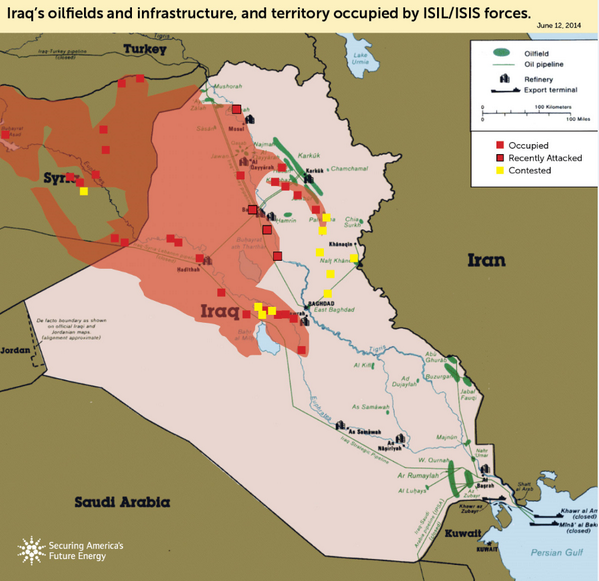
ISIS_control_june_12

Plumer takes a look at a slippery dimension of the Iraq conflict:

Some basics: Iraq has the world’s fifth-largest proven oil reserves. But the country has only very recently begun churning out significant amounts of crude oil again (production dropped sharply during the 2003 US invasion and its bloody aftermath). By April 2014, Iraq was producing an estimated 3.3 million barrels per day — equal to about 4 percent of global supply. And the country was expected to keep ramping up production, with plans to produce at least 5 million barrels per day in the years to come.

Or at least that was the idea. The recent takeover of northwestern Iraq by the Islamic State of Iraq and the Levant (ISIS) has complicated those plans considerably.

True, as the map above shows, ISIS isn’t close to any of the massive oil fields in the southern regions of Iraq, which produce 75 percent of the country’s oil. And ISIS has yet to enter the Kurdish regions in the north, another major oil-producing area. But the fighting has threatened some of Iraq’s other oil infrastructure, including a pipeline that can deliver 600,000 barrels of oil per day from Kirkuk to the Turkish port city of Ceyhan. (That pipeline had been damaged by a 2013 attack and was offline receiving repairs — that work has now been halted.)

In terms of oil as well as land, Iraq’s Kurds stand to benefit from the crisis:

The Kurds have an estimated 45 billion barrels of oil and have a long planned to be exporting 400,000 barrels a day this year, but until now dividends have been limited. Kurdistan and foreign oil companies have managed to export some of the crude, transported first by truck and then tanker, despite the Baghdad government’s declaration that all their activities are illegal. But, although a big export pipeline is now complete and millions of barrels of oil have been shipped through it to the Mediterranean port of Ceyhan, none of these volumes has been actually sold.

Tankers containing 2 million barrels of Kurdish oil are at sea awaiting buyers, who are apprehensive while Baghdad threatens to sue anyone who purchases it. The current offensive by an al-Qaeda affiliate may be the tipping point. Disciplined Kurdish forces now control not only Kurdistan but the disputed, oil-rich region of Kirkuk, which lies just to its west. The region has been autonomous since the first Gulf War in 1991, and its army has steeled itself to defend Kurdistan against Baghdad’s forces.

Previous Dish on the economic angle of the conflict here.

Who Are These ISIS Chappies, Anyway?

In a useful explainer, Margaret Hartmann provides some background on the Islamic State of Iraq and Syria, the jihadist militant group currently overrunning Iraq:

ISIS grew out of Al Qaeda in Iraq, which was founded by Abu Musab al-Zarqawi in 2004 and became one of the most powerful Islamic extremist groups involved in the Iraq War. Shortly after al-Zarqawi was killed by U.S. forces in 2006, Al Qaeda in Iraq merged with several other insurgent groups and became known as the Islamic State of Iraq.

The group was decimated by U.S. forces, but as the last U.S. troops left in 2011, it staged a comeback. Michael Knights, the Lafer Fellow at the Washington Institute for Near East Policy, tells Vox that the group changed its message to focus on Sunni sectarianism, challenging the Shiite majority in Iraq. In an attempt to consolidate power, the Iraqi government persecuted Sunnis and tried to shut down Sunni militias, which “played right into their hands,” according to Knights. He says Iraqi Prime Minister Nouri al-Maliki “made all the ISIS propaganda real, accurate.”

Terrence McCoy profiles the group’s leader, Abu Bakr al-Baghdadi:

Born a Sunni in 1971 in Samarra with the name Awwad Ibrahim Ali al-Badri al-Samarrai, he claims to be a direct descendant of the prophet Muhammad. According to a widely cited biography released by jihadists, “he is a man from a religious family. His brothers and uncles include preachers and professors of Arabic language, rhetoric and logic.” The biography and Arabic-language accounts claim he obtained a doctorate at Islamic University in Baghdad — which is presumably why several of his many aliases include the title “Dr.” Holding degrees in Islamic studies and history, he is believed to have been an Islamic preacher around the time of the 2003 U.S. invasion of Iraq. The chaos of those months drove the 30-something into militancy, and he formed an armed group in eastern Iraq, one that reportedly never rose out of obscurity.

The opacity of his background, analysts say, suggests a broader truth of rising militant Islamists. “The mystery surrounding Abu Bakr al-Baghdadi — at the level of his personality, his movements, or even his relatives, his family, and those close to him — came as a result of what happened to previous leaders, who were killed after their movements were detected,” wrote Mushreq Abbas in al-Monitor. He is the “invisible jihadist,” according to Le Monde.

The CFR follows the money:

Supporters in the region, including those based in Jordan, Syria, and Saudi Arabia, are believed to have provided the bulk of past funding. Iran has also financed AQI, crossing sectarian lines, as Tehran saw an opportunity to challenge the U.S. military presence in the region, according to the U.S. Treasury and documents confiscated in 2006 from Iranian Revolutionary Guards operatives in northern Iraq. In early 2014, Iran offered to join the United States in offering aid to the Iraqi government to counter al-Qaida gains in Anbar province.

The bulk of AQI’s financing, experts say, comes from sources such as smuggling, extortion, and other crime. AQI has relied in recent years on funding and manpower from internal recruits [PDF]. In Mosul, an important AQI stronghold, the group extorts taxes from businesses small and large, netting upwards of $8 million a month, according to some estimates.

Jacob Siegel emphasizes how ISIS relies on allies of convenience in Iraq:

The standoff in Iraq isn’t between a single militant group and the government. There is a broad coalition of Sunni groups—both nationalist and Islamist—who had been plotting against Iraq’s Shia government for years before ISIS’s rise provided the chance to strike. ISIS and its partners are unnatural allies. Maintaining their unity was the key to their early success, and is the only way they can hold the ground they have taken, but that incentive may prove to be weaker than the force of their natural hostilities.

“ISIS control in Mosul is contingent on political alliances they have made with the Baathists and the tribal groups,” said Brian Fishman, a fellow at the New America Foundation, who has been following ISIS since the group’s early days during the Iraq war. “This alliance marching on Baghdad is not a natural one,” Fishman added. “We can understand how it was put together in opposition to the government but what exactly is holding it together, and how sturdy it is, is an open question,” he said.

Michael Weiss also plays up these alliances in a detailed analysis of the group’s strategy:

How did ISIS manage to accomplish so much in a year? Contrary to some media representations, it has had some help in the form of other tenuous Sunni allies, including Jaysh Rijal al-Tariqah al-Naqshabandia, a Ba’ath insurgency that couches its war against Maliki in tribal terms; and Ansar al-Islam, another Sunni Islamist group. The true nature and extent of other actors’ involvement in this conflict has yet to be fully uncovered, but already it seems clear that ISIS is drawing on local support bases. A kind of shadow Awakening is now in evidence, with Sunni tribes, Islamists, and dead-enders of the ancien regime all in league against Iraq’s new Shiite strongman. But what is also clear is that in Syria ISIS has managed to do what other rebel groups have not: effectively if harshly administer municipal facilities, says Pieter Van Ostaeyen, a Belgian analyst of Syrian jihadis. …

ISIS also appears to be drawing on classical “Desert Power” Arab military doctrine that dates back to the 7th century. “The Bedouin army could go out into the Syrian desert and they could strike either the Mediterranean region or the Euphrates valley or what is now Israel-Palestine,” says Col. Joel Rayburn, who served as a strategic analyst for the US military in Iraq. “They could strike at any of the areas on the edge of that desert, as though the desert were an inland sea that they could cross at will. Think of the Jazira [the territory encompassing eastern Syria and western/central Iraq] as the new desert. ISIS can go out there and project Desert Power into the river valleys and settled areas.”

Previous Dish on at ISIS’s strategy and objectives here.

The GOP Still Needs The Latino Vote

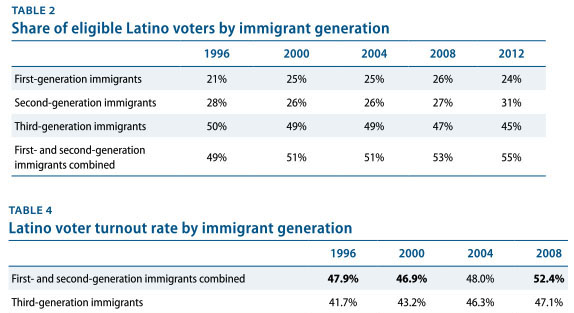
Immigration Turnout

Drum uses the above chart to explain why the GOP establishment is losing sleep over immigration reform:

A new report from the Center for American Progress suggests they’re pretty justified in being scared. Immigration reform is an especially salient voting topic for first- and second-generation immigrants, and that group has two important characteristics: (a) it’s growing as a share of the Latino population, and (b) it’s turning out to vote in ever higher numbers … Republicans may be able to hold onto Congress for a while longer in the face of numbers like these, but winning the presidency is going to get harder and harder. Not impossible. But that’s a mighty big headwind, and it’s getting stronger every year.

Despite Cantor’s loss, Lanhee Chen contends that immigration reform isn’t dead:

[T]he fundamental dynamic that haunted Republicans in 2012 still exists: Unless they are able to demonstrate some leadership on immigration reform, they risk forfeiting the Latino vote in 2016. Even if a perceived moderate on the issue, such as Jeb Bush or Rick Perry, ends up being the Republican presidential nominee, the party will be held liable for inaction. This will have consequences for the nominee and candidates in states with sizable Hispanic populations.

Rand Paul, for one, still supports immigration reform. Allahpundit expects most the other Republican presidential hopefuls to follow his lead:

As traumatized as Republican candidates must be by Cantor’s destruction, they’re more traumatized, I think, by Romney’s margin among Latinos in 2012 after he backed “self-deportation” in the primaries to pander to righties. They’re not going to follow him down the same road, and if they were tempted to, the donor class wouldn’t let them. Unless you’re Ted Cruz or Rand Paul, neither of whom stands a chance of winning the business-lobby primary, your campaign hinges on winning as many rich backers as possible. That means you support legalizing illegals, even if you have to lard up that positions with conditions to stay viable in the primaries. Even Paul, after all, is leery of trying to win a confrontation with the establishment in a national race backed by nothing more than grassroots support. That’s why he’s been moderating his position on foreign policy and why he’s refusing to budge on immigration after Cantor’s beating. He won’t be the donor class’s choice, but maybe he can peel away some members. It’s Cruz, alone among the contenders, who’ll be running a chiefly grassroots campaign. That’ll ensure his status as de facto leader of the tea party, win or lose, but it’s not the obvious path to the nomination in the McCain/Romney era. Because he has little to lose, he’s the only man running who might embrace a firm “security first” position. And needless to say, even he’ll stay away from “self-deportation.”

Chait suspects it’s the “deal” part of an immigration deal that infuriates Republican diehards:

Conservative Republicans may not hate immigration reform, but they hate compromise in general. By an 82-14 margin, liberals want their elected officials to make compromises. By a 63-32 margin, conservatives want elected officials not to compromise. Republicans simply don’t trust bipartisan deals. … The conservative revolt against compromise expresses itself constantly. It comes through in the ever-present trope of citing the length of legislation as a primary reason to oppose it. It likewise comes through in the way conservative intellectuals routinely attack bills as a “stew of deals, payoffs, waivers, and special-interest breaks” — which is to say, they hate the fact that passing bills in Congress requires cutting deals with disparate constituencies, which is how legislation works.

Waldman thinks it’s basically impossible for any Republican to both govern and please the base:

As far as that activist base is concerned, every Republican politician should be nothing but an agent of chaos and destruction, or at least pretend that’s who he is. It’s not only incompatible with governing, it’s barely compatible with holding office. Anyone who actually tries to accomplish anything is quickly turned from hero to traitor, as Marco Rubio was when he attempted to devise an immigration plan; Tea Partiers who once celebrated Rubio now view him with contempt. The only kind of legislator who can stay in their good graces is one who never bothers legislating, like Ted Cruz. Writing laws is for compromisers and turncoats; what matters is that the revolution continue forever.

On Not Taking The Neocon Bait

IRAQ-UNREST-MOSUL

David Harsanyi sees few good options for salvaging the outcomes of the Iraq War:

Some will, no doubt, argue that doing nothing (and we might very well be doing something soon) means that more than 4,400 U.S. troops and over $700 billion had been wasted in a war that ended but was not won. Perhaps. But a more important matter is this: would the death of another 4,000, or 400, or four, bring about a preferable outcome or a set of conditions that allow the United States to convincingly declare victory? If a decade of nation building brought us this, what could we possible gain by seriously reengaging? Clearly, to make it work the American people would need to be prepared to make a generational commitment – and polls don’t tell us that we’re in the mood for an open-ended conflict in the Middle East.

These are horrible choices, indeed. While millions of civilians no longer experience life under the regime of Saddam Hussein, and we should not forget the sacrifice thousands of soldiers made to allow that to happen, it gets increasingly difficult to imagine that the United States has gained anything worthwhile from its invasion of Iraq. It’s difficult to understand how spending another five or ten years sorting out a sectarian civil war can possible be in our best interests.

The UK, for one, won’t get involved. Les Gelb zooms out to see the core question. The fundamental American blind spot remains what it was in Vietnam:

What happened in Iraq was history as usual. The U.S. fights in Iraq and Afghanistan and Libya and Vietnam and other places (maybe next in Syria), provides billions of dollars in arms, trains the friendly soldiers, then begins to pull out—and what happens? Our good allies on whom we’ve squandered our sacred lives and our wealth fall apart. That’s what’s happening in Iraq now.

The alternative – staying in those countries for ever – is just a euphemism for empire in a world that emphatically does not want us, and with an America that rightly wants us to focus on the struggles at home. As for the question as to whether around 5,000 Jihadists can threaten the security of the United States, the Israelis seem utterly unruffled – and they live much, much closer to the threat. There’s something awry when a continental superpower thousands of miles away is more jittery than Jews on the front lines. Keating identifies one good reason why the American people, with any luck, will not rise to the neocon bait yet again:

More than a decade ago, the U.S. public and political establishment supported a war in Iraq partly based on the false pretense that it was allied with al-Qaida. Now, largely as a result of that war and its aftermath, a large portion of Iraq is under the control of an al-Qaida splinter group and America seems largely indifferent. …

There were discussions of “Iraq fatigue”—the sense that the American public is simply tired of hearing about the country’s troubles—as far back as 2006. Supplanted since then by crises from Libya, to Egypt, to Syria, I’d guess that fatigue is even more entrenched now and while I expect some criticism of the White House on this, I doubt we’re going to see a groundswell of public demand for a robust response to Iraq’s latest crisis.

Although the elites will do their best to whip it up. Which is why one should be grateful that the Washington Post wields a clout far smaller now than it did to such devastating effect in 2003. Gordon Lubold and John Hudson offer another reason for why military intervention – even air-strikes – are unlikely to work at all:

[D]espite the crisis, there is little likelihood that the American government would consider putting any troops on the ground. That means that airstrikes are the only real option for a potential U.S. military intervention into Iraq as the crisis there continues to grow. That’s not a simple endeavor, however. … The Iraqi security forces don’t have troops capable of relaying detailed targeting information, which would likely require the Pentagon or the CIA to send small numbers of American personnel into Iraq to handle that difficult mission. Without adequate ground intelligence, the United States could run the risk of accidentally killing Iraqi security forces or, even worse, civilians.

In a splendidly sane piece, Fareed Zakaria shoots down the hawks’ fantasy that Obama could have kept troops in the country if he had really wanted to:

I would have preferred to see a small American force in Iraq to try to prevent the country’s collapse. But let’s remember why this force is not there. Maliki refused to provide the guarantees that every other country in the world that hosts U.S. forces offers. Some commentators have blamed the Obama administration for negotiating badly or halfheartedly and perhaps this is true. But here’s what a senior Iraqi politician told me in the days when the U.S. withdrawal was being discussed: “It will not happen. Maliki cannot allow American troops to stay on. Iran has made very clear to Maliki that its No. 1 demand is that there be no American troops remaining in Iraq. And Maliki owes them.” He reminded me that Maliki spent 24 years in exile, most of them in Tehran and Damascus, and his party was funded by Iran for most of its existence. And in fact, Maliki’s government has followed policies that have been pro-Iranian and pro-Syrian.

And Larison, echoing Marc Lynch’s insight from last night, is at a loss for why we’d want to double down on the mistake of propping up Maliki:

Maliki was already governing in a sectarian and semi-authoritarian manner when the U.S. had a major military presence in the country, so it seems clear that retaining a smaller presence would have had no effect on him and his allies. It is even more doubtful that the U.S. would use this leverage if it had it. This is the trouble with trying to condition future aid on improvements in Maliki’s behavior: when push comes to shove, the U.S. usually refuses to cut off aid because it doesn’t want to “abandon” its client. …

Intervening militarily to prevent further advances by ISIS would commit the U.S. to acting as Maliki’s protector indefinitely, and the more resources that the U.S. commits to this the harder it will be to pull the plug at some point in the future.

Drum simply marvels at those who still think the US can solve problems like these with brute force:

If we committed US troops to every major trouble spot in the Mideast, we’d have troops in Libya, Lebanon, Syria, Afghanistan, and Iraq. Lots of troops. The hawks won’t admit this outright, but that’s what their rhetoric implies. They simply refuse to believe the obvious: that America doesn’t have that much leverage over what’s happening in the region. Small commitments of trainers and arms won’t make more than a speck of difference. Big commitments are unsustainable. And the US military still doesn’t know how to successfully fight a counterinsurgency. (That’s no knock on the Pentagon, really. No one else knows how to fight a counterinsurgency either.)

This is painfully hard for Americans to accept, but sometimes you can’t just send in the Marines.

There are, after all, other options. Instead of a bombing campaign, Nussaibah Younis argues for a political and diplomatic intervention:

The United States must use its assistance as leverage to prevent Mr. Maliki from becoming, in effect, a dictator. Many young Iraqis who join the Sunni militants already see the government as a sectarian oppressor. The Maliki government has targeted senior Sunni politicians, and failed to respond to Sunni demands for reform. Its exclusionary approach has helped enable extremism, and the United States must ensure that Mr. Maliki does not use the new outbreak of fighting to shore up his authority.

Moreover, the United States must compel the Iraqi Army to adopt a sensitive, population-centered approach to reversing the militants’ conquests. If the Iraqi Army sends Shiite militant groups or Kurdish forces to the heart of Sunni-dominated Mosul, or if it carpet-bombs the city and arbitrarily arrests or kills groups, it will alienate the hearts and minds essential to winning this battle.

Henri J. Barkey argues that the spiraling conflict means that now we really have to do something about Syria, but that does not necessarily mean to go in with guns blazing. He suggests we take advantage of the suddenly aligned interests of Iran and its rivals:

Coincidentally, the fall of Mosul occurred during Iranian President Rouhani’s visit to Turkey. Despite the fact that they are deeply engaged on opposite sides of the Syrian conflict, the two countries have agreed to disagree. The reason is simple: They have other important shared interests, such as oil and gas trade and political support for the Iranian nuclear program. Considering Syria’s importance to both regimes, perhaps Turkish-Iranian pragmatism can be bent in the direction of agreement to construct a transitional arrangement for Syria? Both now need face-saving policy options. The trick is to come up with an interim deal that includes Assad’s departure, though perhaps not immediately, in exchange for the safeguarding of some core Iranian interests in a future Syrian political system.

This may sound improbable, and it is. Nonetheless, the fall of Mosul shows that the Syria crisis, which was almost from the beginning an Iraqi crisis as well, requires a regional solution. The Obama Administration was right not to intervene directly in Syria with military force, but wrong to construe its options as either war-making or what amounts to passivity. The perception of Washington policymaking in Syria as dithering and less-than-professional has arguably spread throughout the region. The Administration can begin to reverse this image if it is willing to encourage the region to come up with its own solution. That effort would have to start in consultation with Turkey and Saudi Arabia, and it would have to include Iran as well in the end

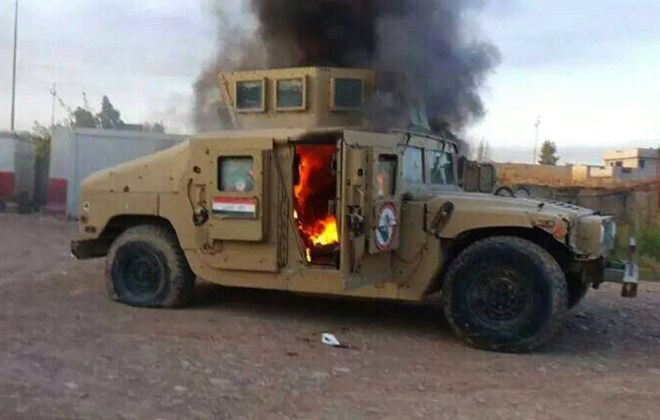
(Photo: A picture taken with a mobile phone shows an armoured vehicle belonging to Iraqi security forces in flames on June 10, 2014, after hundreds of militants from the Islamic State of Iraq and the Levant (ISIL) launched a major assault on the security forces in Mosul. By STR/AFP/Getty Images)
The Neocons Get A War Chubby

Yesterday, Eli Lake breathlessly weighed Nouri al-Maliki’s request for American air strikes to assist in the battle against ISIS that his army appears unwilling to fight. Today, jonesing for more war with Jihadists, he and Tim Mak report that “if Obama changes his mind, U.S. jets could be flying over Iraq in less than a day”:

U.S. air bases, housing dozens of American fighters and bombers, are well within striking distance of Iraq. High-flying spy drones like the Global Hawk can just as easily fly over Iraq as Afghanistan or any other conflict zone in the region. The aircraft carrier U.S.S. George H.W. Bush is a few days’ sail away, in the North Arabian Sea. And it boasts dozens more fighters on board.

That’s why a number of retired high-ranking U.S. Air Force officers, including Lt. Gen. David Deptula, who served as the Air Force’s first deputy chief of staff for intelligence, say any strikes, if ordered, could begin almost immediately. “If you can provide me with the appropriate intelligence we can start doing (air strikes) within 24 hours,” he told The Daily Beast. “There are a variety of means do this, whether you are talking about long-range, high-payload aircraft or smaller aircraft. With the requisite intelligence information you can start again in 24 hours.”

Mercifully, the piece includes some warnings about the unintended consequences of deciding to “re-enter the Iraq War.” Even McCain and Butters are leery of air-strikes, which would sink the US right back into the Iraqi quicksand.

Reihan, meanwhile, has the great idea to see what the architects of the original Iraq catastrophe would have us do, because Ken Pollack and the Kagans – yes, the Kagans! – are still the “experts” we should defer to. He manages to shoe-horn in some Scowcroft while he’s at it, but never addresses the fact that Maliki and the American people were deeply opposed to the occupation continuing, that no protections were even given to US soldiers in such a scenario, and, more crucially, that if our leverage with 100,000 troops had failed to sway Maliki, why would a few hundred be salient now – especially since he has become rightly despised by his Sunni enemies?

In case anyone believed that the right had learned anything from Iraq, the editors at NRO also come out strongly in favor of re-entering the war they helped start:

Maliki needs help now, and the U.S. needs to give it to him. The Obama administration, asked about the country’s impending collapse, noted that it has sent Maliki a few hundred missiles, some rifles, and lots of ammunition. It’s possible ISIS will overextend itself, but all the ammunition in the world may not be enough for the Iraqi army, such as it is, to retake the cities ISIS controls and stamp out the insurgency.

The Iraqi government has a long list of weapons and support it needs. The U.S. ought to meet those requests, at least. The Maliki government may need U.S. advisory support — and possibly even other measures — to stop ISIS’s advance and retake the cities that have been overrun. This is anathema to the Obama administration: It much prefers handwringing to intervention. But deliberation now (not unlike in Syria) will allow the Islamists to solidify their position and amplify their influence.

The Iraqi government has a 250,000 strong army, trained and equipped by the US. But sectarianism meant that, when it came to the defense of Mosul, most of them took off their uniforms and joined the ISIS brigade.Do these delusional partisans actually believe that “advisory support” can somehow reverse this core dynamic?

George Will sums up the position of the right-wing id:

The president is in fact implementing the foreign policy he promised. It was entrenchment by one word, retreat by another. He is implementing the foreign policy that Secretary of State Hillary Clinton facilitated without expressing any qualms. He is implementing a policy that the American public has said in polls it wants right now. It wants it at least until it gets queasy by looking at the pictures they have been seeing tonight.

And one might think an alleged Tory like Will would understand the futility of trying to control an endless sectarian civil war in a country we neither understand fully or could control while occupying with 100,000 troops. But what’s conservative coherence worth when you can bash Obama so easily? In Malkin Award-worthy screed, Robert Tracinski does Will one better and proclaims that Obama wanted America to fail:

So were the Democrats right? Was Iraq a lost cause, inevitably, all along? There’s one big problem with this narrative: Iraq has fallen apart on President Obama’s watch, as a consequence of his own policy of willful neglect. I would say that this was a self-fulfilling prophecy, but that doesn’t quite seem to cover it. Instead, I would characterize this as a wish-fulfilling prophecy. If Iraq is falling to al-Qaeda, it’s because this administration deliberately chose to throw away the victory handed to them by George W. Bush. The left thought we should have lost the war in Iraq, they wanted us to lose it—and finally they’re getting the outcome they wanted.

Yes, the Iraq War was a victory. How on earth did we manage to forget that?

My first take on the debate over whether to re-intervene in Iraq is here.

Will Samarra Be An Inflection Point?

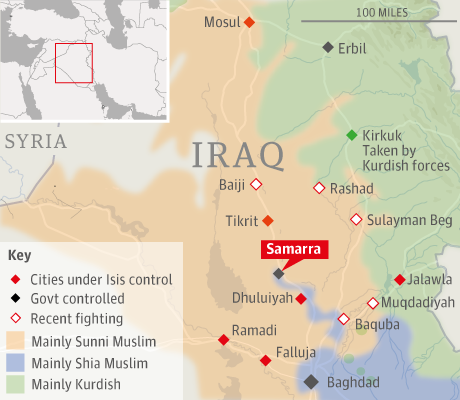
The battle for the city is on, raising both the likelihood and the stakes of an ugly sectarian conflict as Shia militias rush to defend holy shrines that they fear ISIS’s Sunni jihadists will destroy:

iraqisissamarra3Thousands of Shia fighters have rushed to the central Iraqi city of Samarra to defend two shrines that were blown up by insurgents eight years ago, triggering the sectarian war that almost destroyed the country. Convoys of fighters were seen being escorted north by Iraqi police trucks from Baghdad early on Friday and many have now reached the city where insurgents – led by the Sunni militant group the Islamic State of Iraq in the Levant (Isis) – were in control after a lightning strike south.

The volunteer Shia fighters were quickly assembled after Iraqi forces abandoned their positions in most of the area, leaving only a small number of troops to guard the Imam al-Askari shrines. Samarra is the fourth northern city to have all but fallen out of government control. The embattled prime minister, Nouri al-Maliki, appears to have drawn battle lines further south in Taiji, hoping to defend Baghdad against insurgents who have occupied the north virtually unopposed.

How ISIS behaves in Samarra might give us a clue as to its endgame:

ISIS operations around Samarra during this phase of its northern offensive will be an important indicator of its ultimate intent and its estimate of its own capabilities. If ISIS means to continue a blitzkrieg offensive toward Baghdad it will likely need to bypass Samarra to maintain momentum and conserve forces. But Samarra is extremely significant in itself.

Al-Qaeda in Iraq’s destruction of the al-Askari Shrine in 2006 ignited the sectarian civil war that had been simmering before then. Prime Minister Nouri al-Maliki will surely feel a great deal of pressure to prevent a repetition of such an event and may well attempt to concentrate forces to prevent it. Iraqi forces, militias, and Iranian proxies have long been in Samarra precisely to protect the shrine. ISIS could therefore attack the shrine for any of several reasons. It could seek to draw the ISF into a meeting engagement in hopes of defeating arriving ISF troops piecemeal. It could intend to destroy the rebuilt shrine to inflame the sectarian war even further. It could even find irresistible the prospect of fighting the actual Iranian forces and proxies thought to be in the city. Any or all of these conditions could lead to a major battle in Samarra, or the ISIS command might instead decide to bypass the shrine and continue south.

Last night, The Guardian’s live blog ran an account from one Samarra resident who seemed pretty happy to see the ISIS militants:

Everyone in Samara is happy with the fighters’ management of the city. They have proved to be professional and competent. We have water and power; there is a shortage in fuel because Maliki’s forces have cut the bridges between Samara and Baghdad. The fighters themselves did not harm or kill anyone as they swept forward. Any man who hands over his arm is safe, whatever his background. This attitude is giving a huge comfort to people here.

Four days ago, Maliki’s military dirty force raided Al-Razaq mosque in the city, brought a few locals whom they picked up from different parts in Samara and killed them in the mosque. What do you think the people feeling would be towards these military forces? We have lived enough years of injustice, revenge and tyranny and we can’t stand any more.

A Wider Sunni-Shia War?

Unrest in Kirkuk, Iraq

It’s been the most powerful narrative in the region for quite some time – exacerbated a million times by the US invasion, and then inflamed by the Arab Spring in Syria. Simon Henderson believes that the Saudis now want Iraq to host a proxy fight against Iran:

ISIS is a ruthless killing machine, taking Sunni contempt for Shiites to its logical, and bloody, extreme. The Saudi monarch may be more careful to avoid direct religious insults than many other of his brethren, but contempt for Shiites no doubt underpinned his Wikileaked comment about “cutting off the head of the snake,” meaning the clerical regime in Tehran. (Prejudice is an equal opportunity avocation in the Middle East: Iraqi government officials have been known to ask Iraqis whether they are Sunni or Shiite before deciding how to treat them.) …

There is an additional and often confusing dimension, although one that’s historically central to Saudi policy: A willingness to support radical Sunnis abroad while containing their activities at home. Hence Riyadh’s arms-length support for Osama bin Laden when he was leading jihadists in Soviet-controlled Afghanistan, and tolerance for jihadists in Chechnya, Bosnia, and Syria.

Tom Ricks tries to make sense of Iraq’s sectarian future:

It boils down to this: The Shiites act like they are a majority in Iraq, or at least the single biggest group. The Sunnis act like they are a majority in the Arab world. Both are right. The question is: Which is more important inside Iraq?

It boils down to this: The Shiites act like they are a majority in Iraq, or at least the single biggest group. The Sunnis act like they are a majority in the Arab world. Both are right. The question is: Which is more important inside Iraq? Unfortunately, the answer likely will come from Iran, in how it supports Maliki in the coming days. I don’t think the U.S. government will conduct air strikes. I don’t even know how it would be done-the big base at Balad will be a juicy target for ISIS, so you can’t use that. So B-1s out of Diego Garcia? Still hard to do and coordinate with someone on the ground.

My guess: We wind up with a de facto partition of Iraq-a Shiite south extending up to the east bank of the Tigris in Baghdad, a Sunni north and west that begins in the western side of Baghdad, and a Kurdish northeast. The Kurds have played this especially well, hanging back and letting Maliki screw up and also cutting a peace deal with the Turks so they can focus on Iraq.

Allahpundit doesn’t think other Sunni states will join the fray:

One obvious possible response [for containing ISIS] is for Jordan, Saudi Arabia, Turkey, and maybe even Egypt to send troops to Iraq to crush [them]. The jihadis are hugely outnumbered: Combined, the Iraqi army and the Kurdish peshmerga in the country top them more than 30 to one. Add multinational Sunni troops and the ratio would skyrocket. I assume it won’t happen, though, partly because the Sunnis would rather let Iran bleed some more in handling this and partly because they may be nervous about being thin on troops at home at a moment when Islamists are running wild in Iraq.

The local Islamists might seize on the security vacuum as an opportunity for mass protests or worse, which could destabilize the country. In the eternal game of Middle Eastern jihadi whack-a-mole, there are always more moles. And even if the Sunni states managed to keep order at home, what happens once they’re done with ISIS in Iraq? Do they go home, or push on into Syria to fight ISIS there — which could eventually lead to a direct confrontation between Iran, on Assad’s side, and the multinational Sunnis on the other?

I’m not going to pretend I have the expertise to know what’s ahead. But the question to me seems merely at what level of heat the Sunni-Shia war will continue. And continue. And continue. And these fights can go on for ever, especially where order and security are imperiled. Look at how long the Catholic-Protestant fight defined Europe. People were dying over it only a few decades ago in Ireland.

(Photo: Kurdish Peshmerga forces and Iraqi special forces deploy their troops outside of the oil-rich city of Kirkuk, Iraq on June 12, 2014. By Feriq Ferec/Anadolu Agency/Getty Images.)