ISIS Against The World

Workbook5

More Iraqi towns fell to “worse-than-al-Qaeda” overnight. The above chart from Hayes Brown and Adam Peck illustrates how ISIS is really at war with everybody:

ISIS is the most committed to taking on every single other actor. Their single-minded focus on creating an Islamic state in the “Greater Syria” region — which generally is considered to include Syria, Iraq, Lebanon, and parts of Jordan — has led them to completely ignore the borders drawn between the modern states that lie on the territory. As a demonstration of their commitment to the metaphor, ISIS fighters on Tuesday symbolically bulldozed a wall between Iraq and Syria.

Meanwhile, Adam Taylor presents the new rules under which citizens of Nineveh, now effectively a province of the Islamic State of Iraq and Syria, are living. These include amputations as punishment for stealing, a ban on alcohol and cigarettes, a pledge to destroy the graves and shrines that Shia Muslims revere but which Sunni fundamentalists like ISIS view as idols, and instructions to women not to leave the house except when absolutely necessary (in Islamic dress, of course).

If history is any guide, this means ISIS will lose. No Jihadist group as extreme as this has ever managed to sustain popular support for very long. Al-Qaeda collapsed in Jordan because of this – and in Iraq, the insane puritanism of the Sunni extremists actually played a part in creating the Sunni Awakening.

Douglas Ollivant considers how this state of affairs might end:

So what could be game changers?

If the United States (or, perhaps, another Western nation) were to launch airstrikes against ISIS convoys and on support bases in western Iraq (or, for that matter, eastern Syria) it could stop the insurgency in its tracks. However, such a step appears unlikely, at least on a scale that would truly shift the chessboard.

Less dramatic, but probably of greater long-term effect, would be a breakthrough in the political stalemate in Baghdad involving at least one major faction from each of the three ethno-sectarian groups (Shiite Arabs, Sunni Arabs, and Kurds). Should this crisis cause cooler heads to decide it is better to hang together than hang separately, then this may be just the crisis that Iraqi politics needed.

A third possibility, much as we might hate to admit it, would be a resurgence in the Assad government in Syria that permits it to attack ISIS bases on their side of the Iraq-Syria border, forcing ISIS to shift forces from Iraq to defend their safe havens in Syria. The Assad government might truly enjoy the opportunity to turn their rhetoric on fighting terrorism into some sort of reality.

Peter Beamount counts the opposing forces:

Estimates put the fighting strength of Isis in Syria and Iraq at around 7,000 but its numbers in Iraq appear to have been bolstered by other groups, including local Sunni militants and Ba’ath nationalists particularly in Tikrit. Despite claims that they have captured helicopters in Mosul, it seems unlikely they would be able to deploy them. Lightly armed with Toyota pickup technicals, RPGs and small arms, Isis has captured some armoured Humvees, although there are suggestions that some equipment has been sent back to Syria. While they have been able to operate easily in largely Sunni areas where they have some support from a population angry and alienated from the Shia-led government in Baghdad, the capital is a different proposition. One district alone, Sadr City, has a Shia population of some 1 million and since the sectarian war that ended in 2008, the sprawling suburbs have been divided along sectarian lines with checkpoints and barriers.

Malaki controls roughly 250,000 forces of unknown readiness and ability. And the Kurds?

Although some 35,000 Kurdish peshmerga are incorporated into the Iraqi security forces, other peshmerga remain outside with published estimates varying from 80,000 to three times that number. Two years ago a Kurdish official suggested the peshmerga numbered 190,000. Increasingly well equipped – including with 2,000 armoured vehicles and rocket artillery systems – they are regarded as motivated, well trained and experienced.

“The Syrian war,” Totten declares, “is no longer the Syrian war. It’s a regional war”:

It spilled into Lebanon at a low level some time ago. It sucked in Iran and Hezbollah some time ago. Now it is spreading with full force at blitzkrieg speed into Iraq and has even drawn in the Kurdistan Regional Government which managed to sit out the entire Iraq war. This could easily suck in Turkey, Jordan, and Israel before it’s over. Or maybe it won’t.

In the future we might see the events of the last few days as the beginning of the end of Iraq as a state, or at least the beginning of the end of Prime Minister Nouri al-Maliki, whose American-trained army has proven utterly useless. Or maybe he’ll survive in an Iranian-backed rump state. Maliki wants an American-backed rump state. … But we are not going to save Iraq and we are not going to save Syria. It’s over. That’s what the Middle East wanted, and it’s what the Middle East is going to get.

And Aryn Baker notes: “It’s not looking good for the 49 Turkish citizens taken from the country’s consulate in Mosul, or the 31 Turkish truck drivers who were also kidnapped.” But the biggest wild card remains Iran. Thomas Erdbrink (NYT) doesn’t confirm reports that the Revolutionary Guard is already fighting in Iraq, but he relays some Iranian officials’ thoughts on the situation:

Should the Islamic State of Iraq and Syria manage to consolidate its power in northern Iraq, Iran would be confronted with the fresh headache of propping up yet another weak ally, along with Syria. But there is a huge emotional difference between Iraq — the site of the defining battles of the Shiite faith and where the holiest of Shiite saints are buried — and the Syria of President Bashar al-Assad, more an ally of convenience, with only the shrine of Zeinab. “I propose we help Iraq by repeating our good experience,” said Hossein Sheikholislami, an aide to the speaker of Parliament, Ali Larijani, and an important figure in Syrian affairs. “Of course, if they ask officially for our help we can send experts to train the trainers, just as we did in Syria.”

Other analysts dismiss both the militants and the costs of intervening in Iraq. “This group is not as big and powerful as they seem,” said Mashallah Shamsolvazein, a reformist journalist and analyst of Arab affairs. “If needed, we can enter Iraq and wipe out ISIS easily, but that won’t be necessary.”

If this does become a second Iran/Iraq war, as he fears, Juan Cole remarks on how dramatically the US position has changed since the first one:

In the looming second Iran-Iraq War, the US will be de facto allied with Iran against the would-be al-Qaeda affiliate (ISIS was rejected by core al-Qaeda for viciously attacking other militant vigilante Sunni fundamentalists in turf wars in Syria). The position of the US is therefore 180 degrees away from what it was under Reagan. In fact, since ISIS is allegedly bankrolled by private Salafi businessmen in Kuwait and elsewhere in the Oil Gulf, the US is on the opposite side of all its former allies of the 1980s. In some ways, some of the alleged stagnation of US policy in the Middle East may derive from a de facto US switch to the Iranian side on most issues, at the same time that US rhetoric supports Iran’s enemies in Syria and elsewhere in the region.

It is possible that a US-Iran alliance against al-Qaeda-like groups in Iraq and Syria could clarify their budding new relationship and lead to a tectonic shift in US policy in the Middle East. One things seems clear. Without Iran, the US is unlikely to be able to roll by al-Qaeda affiliates and would-be affiliates in the Fertile Crescent, who ultimately could pose a danger to US interests.

Paul Iddon remembers the last time American and Iranian interests coincided:

Iran-U.S cooperation post-1979 isn’t at all unprecedented. In November 2001 the Iranian Qods Force then commanded by Pasdaran commander Yahya Rahim Safavi cooperated with United States Special Operations forces in the liberation from Taliban rule of the city of Herat in Afghanistan. …

Common interests between Tehran and Washington in the immediate post-9/11 period briefly trumped long-held animosities as mutual cooperation was feasible and desirable. Iran was then under the more reformist-oriented Khatami. Its president today is one who was elected on the grounds of his advocacy of more productive relations between his regime and the United States. One could argue the finer points of what such a cooperation between U.S. and Iran in Iraq now could entail but for once one thing is sure in that region, that an ISIL victory today in Iraq is detrimental to the majority of Iraqi’s, the majority of Iranians and the United States.

(Map via The Guardian)

Half-Baked Edibles

The potency of  marijuana edibles varies dramatically:

Colorado lawmakers made allowances for serious marijuana users by allowing recreational edibles to contain up to 100 milligrams of the psychoactive component THC, roughly equivalent to smoking three joints filled with a gram each of 15 percent THC cannabis.

At the same time, however, the law seemed to have pot novices in mind when it defined each serving size of edible marijuana to be just 10 milligrams of THC. So if you’re following serving directions on each edible, a 75-milligram-THC Mile High Mint bar weighing 45 grams should be consumed in 6-gram chunks, not all at once. And an 8.5-ounce bottle of one of Dixie’s 75-milligram-THC elixirs (just over half the size of a grande Starbucks coffee) should be divvied up into 7½ servings. Even if you abide by these directions, it’s hard to know exactly how much—or how little—THC you’re getting in each bite or gulp.

In March, a Denver Post investigation found that some edibles had just a fraction of the THC listed on their labels (a package of 100-milligram-THC Dr. J’s Jelly Stones contained 0.2 milligrams of THC), while others were considerably more potent than advertised (a 100-milligram-THC Mile High Mint bar boasted 146 milligrams of THC).

Steven Wishnia’s primer on edibles is also worth a read:

“In a nutshell, eaten cannabis gets metabolized by the liver, so delta-9 THC becomes 11-hydroxy-THC, which passes the blood-brain barrier more rapidly and has more of a psychedelic effect than standard THC,” says Understanding Marijuana author Mitch Earleywine, a professor of psychology at the State University of New York at Albany. “Smoked or vaporized cannabis bypasses the liver and doesn’t create the same 11-hydroxy-THC.”

Smoking marijuana gets THC into the body much faster and at higher concentrations, but it stays there much longer after eating. With smoking, as much as 50 to 60 percent of the THC in a joint can get into the blood plasma, and peak concentrations come in 5 to 10 minutes. It “very quickly crosses the blood-brain barrier,” explains Paul Armentano, deputy director of the National Organization for the Reform of Marijuana Laws. With orally administered cannabis, only 10 to 20 percent of the cannabinoids reach the blood plasma, and they do so 60 to 120 minutes later, says Dr. Mark A. Ware, an associate professor of family health at McGill University in Montreal.

Recent Dish on edibles here and here.

Their Poor, Huddled, Underage Masses

Fox News is blaming Obama for the massive influx of migrant kids into the US:

Among the policies that allegedly are creating a magnet for illegal immigrants is what’s known as Deferred Action for Childhood Arrivals. The unilateral policy in 2012 allowed some illegal immigrants who came to the U.S. as children to defer deportation — among other criteria, they must have come to the U.S. before they were 16 years old, be younger than 31 on June 15, 2012, and have been in the country since at least June 15, 2007, and have no criminal history.

The administration extended that program earlier this month, allowing the immigrants to apply for protection from deportation for another two years.

Ian Gordon’s reporting tells a very different story:

Many of the kids are coming to help a family in crushing poverty. Some are trying to join a parent who left years ago, before the recession and increased border enforcement slowed down adult immigration. Still others are leaving because of violence from family members and gangs. According to a report from the United Nations High Commissioner for Refugees, 58 percent of the 400 youth the agency interviewed “had suffered, been threatened, or feared serious harm” that might merit international protection. “This is becoming less like an immigration issue and much more like a refugee issue,” says Wendy Young, executive director of Kids in Need of Defense (KIND), a DC-based nonprofit that helps unaccompanied immigrant kids find pro bono legal services. “Because this really is a forced migration. This is not kids choosing voluntarily to leave.”

Bob Ortega hears the same thing:

Gang violence in El Salvador and in urban areas of Guatemala has escalated dramatically in recent months since a weak truce among rival gangs has evaporated, said Elizabeth G. Kennedy, a Fulbright scholar reached Monday in San Salvador, the capital of El Salvador. “Half of them are fleeing for their lives,” she said.

Kids from Mexico are returned across the border, while others are placed in one of eighty temporary shelters, sometimes at military bases, for the duration of their deportation proceedings. Caitlin Dickson parses new allegations by immigrants rights groups that U.S. Customs and Border Protection (CPB) agents have been persistently abusing migrant children under their care:

In addition to the descriptions of freezing cold, overcrowded and unsanitary holding cells, one in four children referenced by Wednesday’s complaint said they were subjected to physical abuse—sexual, beatings, and even torture-style stress positions—by CBP officials. More than half of them reported sexual harassment, death threats, and other forms of verbal abuse. More than half said they were denied medical care and about 70 percent of them say they were detained beyond the 72-hour limit—though many report that it was hard to tell what time of day it was or how many days had passed because fluorescent lights were kept on at all hours.

Over 80 percent of the kids interviewed said they were denied adequate food and water. Many say they became sick after eating the frozen or moldy food the CBP officials gave them. One child said that while he was in custody, the drinking water came from a toilet tank. Many of the children reported being shackled while transported to and from CBP facilities, and 30 percent said that, when they were finally released, money and personal belongings that had been confiscated by CBP officials were not returned to them.

Karen McVeigh adds:

Reports of such abuses have been documented for at least a decade, the groups said, but no reforms have been implemented and agents are rarely held to account. For instance, the AIC found recently that 97% of the 809 abuse complaints – 60% of which involved abuse of migrant children – filed against Border Patrol agents between January 2009 and January 2012 resulted in the classification “no action taken”.

The head of the CBP’s internal affairs unit was removed from his post on Monday. The Obama administration is working on a program offering legal aid to the migrant children.

What’s A Jerk? Ctd

Philosopher Eric Schwitzgebel refines his earlier “theory of jerks”:

I submit that the unifying core, the essence of jerkitude in the moral sense, is this: the jerk culpably fails to appreciate the perspectives of others around him, treating them as tools to be manipulated or idiots to be dealt with rather than as moral and epistemic peers. This failure has both an intellectual dimension and an emotional dimension, and it has these two dimensions on both sides of the relationship. The jerk himself is both intellectually and emotionally defective, and what he defectively fails to appreciate is both the intellectual and emotional perspectives of the people around him. He can’t appreciate how he might be wrong and others right about some matter of fact; and what other people want or value doesn’t register as of interest to him, except derivatively upon his own interests. The bumpkin ignorance captured in the earlier use of ‘jerk’ has changed into a type of moral ignorance.

One of the jerk’s defining features is hypocrisy:

He might rage against the smallest typo in a student’s or secretary’s document, while producing a torrent of errors himself; it just wouldn’t occur to him to apply the same standards to himself. He might insist on promptness, while always running late. He might freely reprimand other people, expecting them to take it with good grace, while any complaints directed against him earn his eternal enmity. Such failures of parity typify the jerk’s moral short-sightedness, flowing naturally from his disregard of others’ perspectives. These hypocrisies are immediately obvious if one genuinely imagines oneself in a subordinate’s shoes for anything other than selfish and self-rationalising ends, but this is exactly what the jerk habitually fails to do.

Keeping A Lowe Profile

Reviewing a new memoir by Rob Lowe, Heather Havrilesky finds that the actor has pulled off the near-impossible – a celebrity book with some humility:

[H]e makes up for … egocentric passages with lovable Diary of an Emo Kid interludes in which our hero is overcome by his surging emotions. On a flight to visit his son during his freshman year at college, for example, Lowe is forced to wear sunglasses and hide behind his newspaper to mask his copious tears. “I am amazed that so much water can come out of the eyes of someone who dehydrates himself with so much caffeine,” he writes, wryly deprecating his sentimental foolishness while also indulging a telltale celebrity Angeleno focus on maximal body maintenance.

Throughout Love Life, Lowe seems attracted to his most demeaning stories:

Jewel wipes her mouth with the back of her hand after she’s forced to kiss him while shooting the short-lived drama The Lyon’s Den. He dresses up as Bigfoot to scare his kids while camping, and ends up getting kicked in the balls. He visits Warren Beatty’s house with his girlfriend; Beatty lightly informs him that he’s been sleeping with her.

Mostly, though, Lowe’s books are a great example of the power of confounding expectations. You wouldn’t think a face off the pages of Tiger Beat magazine would revel in his own humiliation as much as Lowe does. When, in Stories I Only Tell My Friends, a young Lowe goes to a screening of The Outsiders and discovers that his central role in the film has been reduced to an afterthought, it’s impossible not to feel sad for this needy teenager, who desperately hopes for some proof that his big dream hasn’t been a waste of time. Instead, he is humbled, truly.


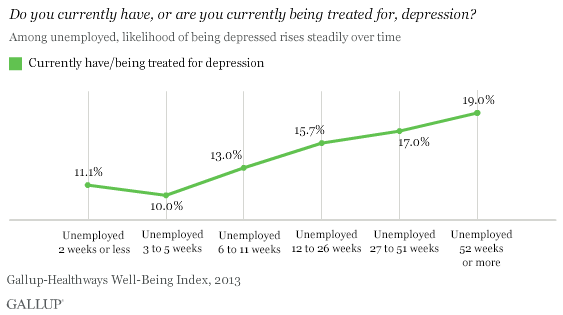
A Depressed Economy

rqtka4o3pue6ozx2zxtjuw

A new survey indicates that out-of-work Americans are twice as likely to suffer from depression as their employed peers. And the long-term unemployed appear to be the worst off:

Gallup also finds that the long-term unemployed spend less time with their family and friends, potentially contributing to those higher rates of depression. The survey notes that we cannot identify causality: “These results don’t necessarily imply unemployment itself causes these differences. It may be that unhappy or less positive job seekers are less likely to be able to get jobs in the first place.” That’s true, but these findings are also consistent previous academic evidence.

Rebecca Rosen mulls over the findings:

[Gallup’s Steve] Crabtree cites a 2011 study by the Heldrich Center for Workforce Development at Rutgers University which found that long-term unemployed people were much more likely to report that they had spent two hours or less being social the previous day.

“Again,” Crabtree writes, “these results don’t necessarily imply unemployment itself causes these differences. It may be that unhappy or less positive job seekers are less likely to be able to get jobs in the first place—if, for example, employers are looking for more upbeat workers. It is also possible that those who spend less time with family and friends are therefore less able to draw on their social networks for employment leads.”

Surely there are people out there who are accurately described by one of those possibilities. But it’s all too easy to imagine a scenario in which all of these act together in a vicious cycle that mires a person in unemployment. That same Rutgers study found much higher rates of reporting “feeling ashamed or embarrassed” or “strain in family relations” for those for whom a loss of a job had had devastating financial consequences. As one reader wrote to The Atlantic in 2011, “I look at my peers who are getting married and having children and generally living life and it’s depressing.  They’ve got jobs, health insurance, relationships, homes; I don’t even have a real bed to sleep on.” Would hanging out with friends and family be very appealing under such circumstances? Not to me, at least. From there, it’s a pretty direct line to isolation, depression, the toll those will have on a job search, to more isolation, more depression, and on and on and on.

George Will Loses The Plot, Ctd

A reader goes out on a limb:

Never have I been more grateful for your anonymous reader-contributor policy …

George Will is wrong in many of the ways people are saying, but he does have a point that no one wants to really face: the power to silence other potential participants in a discussion is a privilege and a powerful one. In our post-Civil Rights era culture, grievance is the optimal position to be in while in argument. Victimhood is desirable when it allows you to win the narrative.

I am not saying this privilege is worth being raped for and that people are intentionally getting raped to win their arguments about gender, but given how often people are silenced by the victimhood of their verbal sparring partner (maybe I see it more because I live in liberal California?), I see why Will had this thought.

I’ll go further:

the story he excerpts, at least in excerpt form, doesn’t sound like rape. The guy is being an asshole for not respecting his recent ex’s wishes but she ultimately cooperated. It’s shitty, yes. It should be discouraged, yes. But “rape”? The point Marcotte and many bloggers make is that it doesn’thave to be “forcible” to be rape; even the absence of consent is rape. Well, okay yes but don’t be surprised when people stop taking “rape” as seriously when it is no longer defined as physically forcing yourself on someone.  I think that’s also one of Will’s two or three somewhat valid points amidst his mountain of old-school BS: the self-proclaimed fighters-of-rape-culture want us to conflate these more ambiguous “absence of consent” situations with the more conventional understanding of rape as a forcing of oneself on another. I think that’s probably a legitimate goal but I don’t think Will is out of line for calling folks on it.

The fact that there are men who are falsely accused of rape doesn’t “cancel out” that women are raped but when one considers the intense fear many men have of being falsely accused of rape, one starts to understand the origins of Will’s thinking as more than just enforcing patriarchy.

I have more on this in the form of anecdote, but I think I’ll wait to see where the discussion goes before I share it.

Another voices a very different view:

Hook-up culture IS rape culture.

There is no place on Earth more progressive than Swarthmore. Every far-left piety is accepted without question, much less criticism. (You’d think that students would be challenged with contrary views to help them burnish their intellectual armor so that when they left Swarthmore they’d be equipped to grapple with people who disagree with them, but you’d be mistaken). “White Male Privilege” means that white guys are automatically wrong, “Rape Culture” is Serious You Guys, and sex is only consensual if the woman has no regrets about it. If under these conditions, women are still getting raped – and not by the College Republicans or Future Patriarchs of America, but by members in good standing of the Privileged-Oppressed Alliance – then the fundamental underpinnings of the college model are completed fuçked, and need to be scrapped.

You want to see “Rape Culture”? Take hundreds of 17 to 22 year-olds, remove them from their parents, give them unrestricted and unsupervised access to alcohol and each other’s bodies, tell them that they’re mature enough to handle adult choices, and teach them that there’s no virtue in sexual restraint. Sprinkle some talk about condoms and consent, and send them back to their coed dorms. THAT is “Rape Culture.” Women are going to get raped, because many eighteen-year-old men aren’t mature enough to understand what “no” means or manage their urges, and many 18-year-old women aren’t mature enough to spot red flags. For all practical purposes, Hookup Culture IS Rape Culture.

You want to get serious about preventing rape? Single-sex dorms, no visitors after ten, doors ajar when there are visitors, room checks by RAs, consumption of alcohol banned, sexual contact beyond first base punished by warning, then formal reprimand, then suspension, then explusion. Yeah, college will be less fun. But you’ll learn more, and there’s no chance that progressive, sensitive, feminist men will ever rape you in your dorm room.

Things may change at Swarthmore. I hope rape victims get better support, because it does sound like the administration’s first instinct has been to wish the problem away when confronted with a rape allegation. (That goes for allegations that are fatuous on their faces; it’s not up to some dean to decide). Regardless, my advice to a relative or friend attending Swarthmore would be to walk down the hill to the police station, and not to trust a system designed to adjudicate academic offenses to competently handle criminal offenses.

But they’re not going to adopt my idea. In loco parentis isn’t coming back, because Swarthmore would never dream of telling eighteen-year-olds who were smart enough to be admitted that they don’t know everything (this being a campus where the prevailing belief is that someone who holds the same position on same-sex marriage that Barack Obama did until May of 2012 is too bigoted to be allowed to speak), or that they’re not yet mature enough to manage decisions about what goes into or comes out of their pelvises.

FIFA Sucks

John Oliver explains why:

Bershidsky longs for FIFA to kick out Sepp Blatter, who he claims “has run soccer’s governing body like an old-school dictatorship” since 1998:

Blatter has been no visionary in sports terms. His tenure has yielded a few minor rule changes, notably one that penalizes players for pulling off their T-shirts after scoring a goal. Some changes were quickly reversed. In 2007, for example, FIFA banned games at stadiums more than 8,200 feet above sea level. It then raised the limit to 9,840 feet and was forced to grant an exception to Bolivia’s main stadium. By contrast, Blatter’s predecessor, Joao Havelange, boosted FIFA’s membership from 142 to 204 federations, and recast the rules in ways that made the game more dynamic and enjoyable to watch — and less rough.

Blatter has also done little to combat the corruption that flourished under Havelange, who was proved to have taken bribes and forced out as FIFA’s honorary president last year.

The Economist identifies deeper problems with the organization:

It would be good to get rid of Mr Blatter, but that would not solve FIFA’s structural problem. Though legally incorporated as a Swiss non-profit organisation, FIFA has no master. Those who might hold it to account, such as national or regional football organisations, depend on its cash. High barriers to entry make it unlikely that a rival will emerge, so FIFA has a natural monopoly over international football. An entity like this should be regulated, but FIFA answers to no government.

All the same, more could be done. The Swiss should demand a clean-up or withdraw FIFA’s favourable tax status. Sponsors should also weigh in on graft and on the need to push forward with new technology: an immediate video review of every penalty and goal awarded would be a start.

Catherine Addington feels the “fundamental problem is that FIFA is self-regulating, which is to say that it doesn’t self-regulate”:

The only things to keep it in check are vaguely uncomfortable sponsors and only nominally responsible participating governments. (Fans for their part have no other organization to turn to. FIFA has a monopoly on international soccer.) Even FIFA’s upcoming Congress, in which each country has an equal vote, is unlikely to make waves. With few checks and balances in sight, FIFA is under no obligation to be transparent about either its policies or its finances.

FIFA has done the impossible: they have made Brazilians hate soccer. But as Brazilians’ anti-government protests over the past few years have shown, this is about much more than soccer. That’s why this World Cup, and the inevitable spilling over of these anti-cronyism tensions, are crucial to watch, even for those uninterested in soccer. FIFA is running an experiment to find out just how many platitudes people will put up with from the crony capitalists running a global entertainment industry.

Ta-Ta To Teacher Tenure? Ctd

Noah Feldman eviscerates the Vergara ruling:

So how did California’s teacher tenure laws violate the state constitution? The court’s two-part reasoning was thin to the point of being emaciated. First, it observed that the state constitution guarantees a right to education and guarantees equal protection of the laws. Second, it “found” that teacher tenure laws can tenure ineffective teachers – which it said was a violation of California children’s right to education.

The logic of this holding is pretty obviously flawed. All sorts of policies and rules affect the quality of what goes on in the classroom. Do all policies that reduce the quality of education violate the state constitution? Obviously not – or the court would have to take over the state school system and review every lesson plan for effectiveness. There was also no precedent supporting this expansive reading of the state constitution.

Eric Posner remains unimpressed by Judge Treu’s reasoning:

One of the reasons that employers – and not just public schools, but regular commercial firms, as well as universities and many private schools – offer job security is that employees value it so much. They’re willing to accept a lower salary in return for job security. The employer faces a tradeoff: it loses some ability to control employees, but it saves a lot of money, which it can use for other things. And so with the schools. If California is no longer allowed to offer job security, it will either need to pay teachers more (leaving less money to spend on students) or hire fewer teachers. Is that going to advance education? The court has no idea, indeed doesn’t seem to have given any thought to these issues.

The long and the short of it is that a judge is in no position to make these tradeoffs.

Kevin Carey – generally a supporter of education reform – argues that the courts are “an inherently problematic venue in which to resolve fundamental education questions”:

Deciding whether schools are providing children with a good enough learning environment requires us to decide what we want our children to learn and what kind of citizens we want them to be. That, in turn, flows from our convictions and values about the nature of just and civilized society. Such questions can never be resolved with legal finality. They represent the unending project of debate in an open society, the balancing of sometimes irreconcilable priorities that we manage with democratic and inherently political institutions. Which means that we should expect more Vergaras in the future – and expect to never be fully satisfied with the result.

Jill Barshay notes that the research underlying the ruling is controversial:

Many researchers are questioning whether test-score gains are a good measure of teacher effectiveness. Part of the problem are the standardized tests themselves. In some cases, there are ceiling effects where bright students are already scoring near the top and can’t show huge gains year after year. In other cases, struggling students may be learning two years of math in one year, say catching up from a second-grade to a fourth-grade math level. But the fifth-grade test questions can’t capture the gains of kids who are behind. The test instead concludes that the kids have learned nothing. In both of these cases, with top and bottom students, the teachers would be labeled as ineffective. Morgan Polikoff of the University of Southern California and Andrew Porter of the University of Pennsylvania looked at these value-added measures in six districts around the nation and found that there was weak to zero relationship between these new numbers and the content or quality of the teacher’s instruction. Their research was published in May 2014, after the Vegara trial ended.

Freddie sighs:

Teacher attrition is sky-high, with best estimates of between 40 to 50 percent leaving the profession within five years of starting. That amounts to something like a thousand teachers quitting for every school day of a given year. Anecdotally speaking, most successful, Ivy League striver-types do not consider teaching as a serious option. But why would they, when there’s so many more remunerative, less stressful, less emotionally grueling, and better respected options out there? If your argument is that a profession’s problems stems from a talent deficit, you should be doing everything to make the job more attractive, not less.

But Ed Morrissey suggests the ruling could be a mark a turning point:

Treu’s ruling does not rely on the US Constitution, and it has yet to be endorsed by a state appellate court as of yet. It is a signal, though, that people are fed up feeding tens of billions of dollars into educational systems that produce poor results, and that disgust over the priorities of the people within the system has reached a level where even the judiciary can no longer ignore it. California’s legislature had better take this lesson and apply it regardless of whether the ruling holds up on appeal.

And Eric Hanushek sees nothing but positives:

A small percentage of teachers inflicts disproportionate harm on children. Each year a grossly ineffective teacher continues in the classroom reduces the future earnings of the class by thousands of dollars by dramatically lowering the college chances and employment opportunities of students. There is also a national impact. The future economic well being of the United States is entirely dependent on the skills of our population. Replacing the poorest performing 5 to 8 percent of teachers with an average teacher would, by my calculations, yield improved productivity and growth that amounts to trillions of dollars.

The Grilling Of Hillary Clinton On Marriage Equality

A tip of the hat to Terri Gross who simply and persistently tried to get out of Clinton why she supported the Defense Of Marriage Act in 1996, and why and when she changed her mind on marriage equality. Listen to the full exchange here:

Clinton says she didn’t support gay marriage in the 1990s but subsequently changed her mind. When and why she changed her mind is what Gross was trying to get at. Had she changed it by the time she and her husband left the White House? Or when George W Bush endorsed the Federal Marriage Amendment in 2004? Was she still opposed to marriage equality when Massachusetts became the first state to enact it legislatively in the same year? The answers to these questions remain mysterious.

But one thing isn’t mysterious: she was not just another evolving American. She was the second most powerful person in an administration in a critical era for gay rights. And in that era, her husband signed the HIV travel ban into law (it remained on the books for 22 years thereafter), making it the only medical condition ever legislated as a bar to even a tourist entering the US. Clinton also left gay service-members in the lurch, doubling the rate of their discharges from the military, and signed DOMA, the high watermark of anti-gay legislation in American history. Where and when it counted, the Clintons gave critical credibility to the religious right’s jihad against us. And on the day we testified against DOMA in 1996, their Justice Department argued that there were no constitutional problems with DOMA at all (the Supreme Court eventually disagreed).

What I’d like to hear her answer is whether she regrets that period and whether she will ever take responsibility for it. But she got pissed when merely asked how calculated her position on this was.

Here’s my guess:

Unlike Obama, she was personally deeply uncomfortable with this for a long time and politically believed the issue was a Republican wedge issue to torment the Clintons rather than a core civil rights cause. I was editor of TNR for five years of the Clintons, aggressively writing and publishing articles in favor of marriage equality and military service, and saw the Clintons’ irritation with and hostility to gay activists up close. Under my editorship, we were a very early 1991 backer of Clinton – so I sure didn’t start out prejudiced against them. They taught me that skepticism all by themselves, and mainly by lying all the time.

So when did she evolve? Maybe in the middle 2000s. Was political calculation as big an influence as genuine personal wrestling? She’s a Clinton. They poll-tested where to go on vacation. Of course it was. But she’s also a human being and probably came around personally as well. She’s not a robot, after all. But I think of her position as the same as the eponymous gay rights organization the Clintons controlled in the 1990s, the Human Rights Campaign. As long as marriage equality hurt the Democrats, they were against it. Now it may even hurt Republicans, they’re for it. So Hillary is for it now. We’ve just got to hope the polling stays strong.