“He Never Admitted He Was Wrong”

Reviewing the new documentary, Gore Vidal: The United States of Amnesia, David Schmader finds that the late writer’s literary achievements are “perhaps given short shrift” – but the politics are plenty:

Born into high privilege to a father who “dreamed of being the Henry Ford of aviation” and taught his son to pilot a plane by age 10, Vidal followed most naturally in the footsteps of his grandfather, a US senator who overcame his blindness by having his young grandson read him all necessary documents. Vidal came away with a lifelong fascination for the workings of the American political system, which he explored from the inside during two unsuccessful runs for office and investigated from the outside through a lifetime of ferocious writing and commentary.

As the subtitle suggests, [director Nicholas] Wrathall’s film focuses on the decades Vidal spent denouncing the American political machine, from a jarring critique of the presidency of his beloved friend JFK (whose photo Vidal kept framed in his office as a reminder to never again fall for a politician’s charm) to endlessly articulate screeds against the “American Empire” and beyond. (Forget 9/11—Vidal believed Pearl Harbor was an inside job.)

Hence the sad, twisted embitterment of an American scion. I’d like to admire Vidal – and his early novels are breathtakingly good. But the precious posturing, the all-too-defensive lambasting, and the cheap sneers always force me to keep my distance. As for Pearl Harbor, well, sheesh. And we’re supposed to admire someone for this conspiratorial nonsense? (My own review of his novel on the American mid-century, The Golden Age, is here.) Meanwhile, Ted Scheiman marvels at Vidal’s precocious early writing about homosexuality:

At 19, he wrote his first novel, Williwaw, while convalescing in the North Pacific, where he served for three years during World War II. Writing in the Times in 1946, Orville Prescott gave a triumphalist review, and Vidal had arrived, terribly young, in the world of letters. The glittering accomplishments of Vidal’s youth are more impressive, even moving, when we consider that Vidal published The City and the Pillar just two years later, in 1948—an explicitly gay novel that the Times refused to review.

In his earliest television appearances, culled here with sensitivity by Wrathall, the young Vidal is remarkably composed and confident as he declares the difference between gay and straight to be “about the difference between somebody who has brown eyes and somebody who has blue eyes.” He was an outspoken pioneer on dangerous territory despite being—to believe Jay Parini, Vidal’s literary executor and the documentary’s M.C.—“really quite shy” at the time.

Except, of course, that he subsequently insisted that there was really no “gay” and no “straight.” My own direct experience of him on the matter was his steadfast opposition to marriage equality in the 1990s and 2000s. Even the director of this fawning film, Nicholas Wrathall, notes Vidal’s crankiness on the subject in the years after The City and the Pillar‘s publication:

I think he felt that was a fight he fought at a different point in his life. He had written The City and the Pillar, and he had been outspoken at the time. He’d never been in the closet. He had a lifelong relationship with Howard [Auster], which was a sort of marriage in its own way. He has been criticized for not being at the forefront in the fight against AIDS and now, more recently, in the marriage equality situation. But I think he had let go of it a little bit and didn’t want to be pigeonholed—although it was a big part of his life—but I think marriage was something he didn’t have a lot of fondness for. His parents’ marriage had been a disaster. I asked him about marriage equality and he said: “Why shouldn’t everyone share in the misery of marriage.”

Zooming out, Tricia Olszewski wasn’t impressed as some with the documentary, calling it “hagiography”:

Archival footage of Vidal’s television appearances, photos of his mingling with 20th-century glitterati, and interviews with the man are punctuated—a little too often—with his Oscar Wildean bons mots. Every element showcases Vidal’s quick wit, eloquence, and astoundingly insightful, often prescient editorials on whatever hot topics the zeitgeist offered. There are also documentary-requisite comments from fans and colleagues (including Tim Robbins, literary executor Jay Parini, and, naturally, Hitchens) that tend toward drooling (except, naturally, Hitchens).

The cumulative effect is worship overload. Vidal was undoubtedly an impressively well-rounded and accomplished human being—though it should be noted that he was born into privilege—and he all but says so in the film. It would be surprising if he ever admitted he was wrong. And while such confidence may have drawn people—a lot of people—in, it’s nearly unpalatable here. Vidal spoke regally (a missile was a “miss-aisle”) and expected to be regarded that way, too.

Read our coverage of Vidal’s death, in 2012, here, here, and here.

Should Parenthood Be Pleasurable?

Zoë Heller reviews Jennifer Senior’s All Joy and No Fun: The Paradox of Modern Parenthood. As a Brit, she challenges what she sees as Senior’s American approach to the question:

Parenthood curtails the pursuit of certain kinds of pleasure, she observes, but it also puts those pleasures in perspective, by revealing the deeper, more meaningful satisfactions of connection, attachment and service to others:

Indeed, one could argue that the whole experience of parenthood exposes the superficiality of our preoccupation with happiness, which usually takes the form of pursuing pleasure or finding our bliss. Raising children makes us reassess this obsession and perhaps redefine (or at least broaden) our fundamental ideas about what happiness is. The very things Americans are told almost daily to aspire to may in fact be misguided.

This is a troubling paragraph. It seems reasonable enough for Senior to want to correct some of her fellow Americans’ more callow, entitled attitudes. And she is not to be faulted for pointing out that fun is more usefully regarded as an occasional by-product of experience than as an end in itself. (British readers, who tend to have more modest expectations of life’s fun quotient, may be forgiven for finding her progress towards this revelation a little ponderous.) But there’s something grim about asking parents to resign themselves to the end of paltry bliss-seeking in order to concentrate their energies on the higher satisfactions of duty, service and sacrifice. Let’s by all means concede that parenthood isn’t a trip to the funfair, but does it have to put the funfair off-limits? And can it only be appreciated if the funfair is dismissed as having been a rather childish and squalid diversion?

The 800-Pound Gorilla In Education Policy?

According to the WaPo, the Gates Foundation spent more than $200 million winning political support for Common Core:

The Gates Foundation spread money across the political spectrum, to entities including the big teachers unions, the American Federation of Teachers and the National Education Association, and business organizations such as the U.S. Chamber of Commerce — groups that have clashed in the past but became vocal backers of the standards.

Money flowed to policy groups on the right and left, funding research by scholars of varying political persuasions who promoted the idea of common standards. Liberals at the Center for American Progress and conservatives affiliated with the American Legislative Exchange Council who routinely disagree on nearly every issue accepted Gates money and found common ground on the Common Core.

Common Core foe Diane Ravitch is distressed:

The idea that the richest man in America can purchase and — working closely with the U.S. Department of Education — impose new and untested academic standards on the nation’s public schools is a national scandal. A congressional investigation is warranted. The close involvement of Education Secretary Arne Duncan raises questions about whether the federal government overstepped its legal role in public education.

Freddie deBoer detects “a palpable sense of worry among a lot of education researchers and people in the education nonprofit world, around the Gates Foundation”:

They’re just so dominant in funding and, through funding, influence. That manifests itself in a fear of publicly criticizing the foundation and its policy preferences. That may be a small fear, it may represent itself subtly, but if you multiply it across the broad world of education research and policy, it can have a major impact on what gets studied, how results are reported, and what is considered realistic policy. It’s easy to make this sound like some kind of explicit corruption, but it’s not that simple or that easy to judge. It isn’t so much a matter of people saying “I want that sweet Gates cash, I better get in line on charter schools.” It’s a matter of identifying what kind of research gets funded, of worrying about funding in the future, of recognizing that plummeting state and federal research dollars can make private foundations like Gates the only game in town. It’s not sinister, on either side of the equation, but it can have pernicious effects.

Andrew J. Rotherham has a very different perspective:

1) There is money on all sides of this. Pro-and con.  The opposition did start out pretty diffuse and unorganized but that’s not the case now. I doubt there is parity between the pro-and anti-Common Core factions but this isn’t David and Goliath either.

2) In education there is very little change absent an infusion of marginal dollars and outside pressure. It’s not for nothing that we call them “Carnegie” units. That’s not a pro-Gates point or an anti-Gates point, it’s merely context about change in education. Related, Gates has spent a great deal on Common Core, but some context on all the other philanthropic dollars flowing into education would be useful, too.  The lion’s share, mostly from much smaller and localized foundations mostly buttresses the status quo. Philanthropic dollars aimed at leveraging broader changes have increased over the past decade but are still not the dominant force in overall education philanthropy.

Hillary The Indispensable?

Douthat’s Sunday column proclaimed Clinton the only thing holding the Democratic party together, pointing to Obama’s dwindling approval ratings and the party’s “ramshackle” coalition of constituencies:

If her party is Austria-Hungary, she might be its Franz Josef — the beloved emperor whose imperial persona (“coffered up,” the novelist Joseph Roth wrote, “in an icy and everlasting old age, like armour made of an awe-inspiring crystal”), as much as any specific political strategy, helped keep dissolution from the empire’s door …  But without her, the deluge.

I found it a sprightly piece – and certainly a helpful reminder of how Clinton’s ascendancy has marginalized many other potential Democratic leaders. But I tend to agree with Larison, that the diversity of the Democrats’ Austrian-Hungarian empire is a strength, not a weakness:

The Democratic Party has long been “a sprawling, ramshackle and heterogeneous arrangement,” but that hasn’t stopped it from winning the popular vote in five of the last six presidential elections.

It cobbles together majorities by being “sprawling” and “heterogeneous,” and doesn’t depend on a particular nominee to do this. The extremely narrow margin of Bush’s re-election in 2004 points to this. Democrats have a coalition of competing, sometimes opposing interest groups and constituencies, but then they usually don’t pretend to be anything other than that. One of the stranger conceits that many Republicans have about their party is that it is a so-called “real party”: it supposedly represents some coherent set of beliefs that makes it substantially different from being an “incoherent amalgam” of interest groups. Perhaps because Democrats don’t try to paper over the contradictions and tensions in their coalition as much, they are able to appeal to a wider variety of voters than their opponents.

Danny Vinik reminds Ross that the Republicans’ policy problem is much more damaging than the Democrats’ lack of an alternative to Hillary:

Whether you like his policies or not, Obama has governed. The same cannot be said of the GOP. For instance, as the Washington Post’s Greg Sargent has often written, House Republicans are unable to pass any type of immigration reform, because they cannot agree on what it should look like. Republicans never had any jobs agenda to help us recover from the financial crisis. On health care and tax reform, political promises have made it almost impossible for them to propose conservative ideas. Americans have not greeted Obama’s policy platform with cheers, but they recognize the dearth of policies in the current GOP agenda.

And I’m not sure that even the best collection of reform conservative ideas, even if they get a chance to be enacted, has a real appeal to voters. Ross responds by looking on the bright side:

The recent springtime for reform conservatism may be just a few shoots in a barren field … but that’s still more shoots than at this time four years ago, and nearly everything that’s pushed through the ground, whether it’s been Mike Lee or Dave Camp on taxes or Marco Rubio on the safety net or various senators on health care reform, would have been an improvement on the party’s non-message in 2012. The roster of presidential hopefuls may not be as impressive as it looked before Chris Christie’s scandal and Marco Rubio’s immigration reform detour … but we’re still very unlikely to see a replay of the “9-9-9″/Bachmann Overdrive nonsense, and much more likely to see a group of plausible nominees having a relatively-serious debate.

At some point, you’ve got to admire his optimism. But I’ll tell you this: the Republicans will have a far more interesting primary race than the Democrats. And while that can be bad news at times, it will ensure that the GOP is front and center on the question of “change”. What they don’t have yet is a candidate to pierce through the clutter, or a policy proposal that can address real problems and win wide support. Absent that, it will be ressentiment and Clinton-hatred all over again. Can’t wait.

The Calculus On Unconditional Welfare, Ctd

Reihan responds to Dylan Matthews on the merits of unconditional cash assistance to the poor, arguing that the findings that Matthews cites don’t carry over from international development to domestic welfare programs:

The trouble is that there is a big difference between the conditions that give rise to poverty in a domestic context, where brute survival is not generally at stake, and in a global context, where it is. My argument rested in large part on the legitimacy of the welfare state. Work requirements for the able-bodied poor help ensure that the beneficiaries of public assistance are perceived as deserving. This matters in societies in which a broad base of employed middle-income taxpayers help finance transfers. It matters less in societies in which transfers are largely funded by outsiders, via government-to-government transfers from affluent countries, or through the exploitation of point-source natural resources, like oil and gas. …

In weak states that aren’t funded by local tax revenues, the “legitimacy” question doesn’t arise in the same way, particularly when it comes to the disbursement of public assistance. The communities that benefit from direct assistance aren’t divided between those who fund direct assistance, and who work, and those who benefit from it, and who might or might not work. Rather, it is more common that the funds are coming from outside of the community, and virtually everyone “works,” albeit in the informal sector. That said, norms around “conditional reciprocity” do indeed obtain in many poor societies — but these norms operate through the kin-based social networks that the dominant mode of social organization in traditional societies. Modern societies, in contrast, are dominated by non-kin-based social networks, and the most successful states, or rather the states that do the best job of cultivating solidarity among citizens, appear to be, and this is my subjective judgment, those that build in norms of conditional reciprocity into their institutions.

Taliban On A Tear

Its Pakistan-based militants have launched two attacks on Karachi’s Jinnah International Airport since Sunday night:

On Tuesday, a number of gunmen on motorbikes opened fire on a training academy run by the Airports Security Force and located about a half mile from the airport. “We accept responsibility for another successful attack against the government,” Taliban spokesperson Shahidullah Shahid told Reuters, adding, “We are successfully achieving all our targets and we will go on carrying on many more such attacks.” …

The death toll from Sunday’s attack, meanwhile, has jumped. The BBC has updated its count to 38 deadReuters to 34, and the Associated Press to 36.

Saba Imtiaz highlights the security deficit that allows the Taliban to attack such high-value targets:

The attacks in Karachi underscore not just the intensity of the militants’ renewed campaign, but also Pakistan’s inability to effectively counter such threats in advance. Analysts and security experts have long bemoaned Pakistan’s inability to get its intelligence and security services to share intelligence.

Pakistan has a number of intelligence agencies, including the Inter-Services Intelligence agency and Military Intelligence, the civilian-run Intelligence Bureau, and the police’s Special Branch. A counter-terrorism strategy developed by the interior ministry this year envisages better coordination between intelligence and security agencies, but has yet to spur much change.

On Tuesday, Interior Minister Chaudhry Nisar Ali Khan told parliament that his ministry had warned the provincial government in March that the gate used by militants to attack the airport was not properly secured. Similar claims have surfaced after previous militants attacks in Pakistan.

Ishaan Tharoor analyzes the strength of the Pakistani Taliban:

What began as a low-level militancy in Pakistan’s tribal belt along the porous border with Afghanistan has now metastasized into a sprawling insurgency that has tapped into nationwide networks of criminal syndicates and other terrorist organizations. The Pakistani Taliban’s profile in Karachi has grown in recent years, highlighted by a spate of brazen attacks, including the 17-hour siege of a Pakistani naval base near the airport in 2011.

Despite its effectiveness, the Pakistani Taliban operates in a fashion that is “not as hierarchical as one terrorist group may be,” says Hassan Abbas, author of the new book “The Taliban Revival: Violence and Extremism on the Pakistan-Afghanistan Frontier.” Pakistan’s government, Abbas says, has struggled to adjust to the threat posed by the militants, who have claimed thousands of lives. “The Pakistani Taliban are as dangerous as al-Qaeda once was,” he says. “People think they’re just Pashtun tribals. But it has become a much more complicated crisis.”

Hillary, The Neo-Neocon?

Hillary Clinton Awarded The 2013 Lantos Human Rights Prize

Kim Ghattas paints Hillary Clinton as a secretary of state much more concerned than her boss with upholding American power and prestige around the world, and as her new book would have it, more realistic about the need to deal firmly with international threats:

Clinton was loyal and discreet, but within the confines of that loyalty, she sometimes chafed at Obama’s policy, perhaps never more so than over Syria. In Rabat in February 2012, we chatted after an interview that had focused on Syria’s revolution and Washington’s hands-off approach. She shook her head as she told me that Russia, Hezbollah, and Iran were all in, supporting Assad.

Her implicit question was: Where is the United States? We know now she was advocating internally for more robust support for the rebels, because she understood that America was leaving too much empty space for spoilers like Hezbollah to fill (there’s a separate debate to be had about whether it would have been the right policy). And with regard to dealing with Russia more directly, Clinton emphasizes in Hard Choices that she was more clear-eyed about Vladimir Putin than Obama, advising the president to turn down a summit with the Russian leader months before Obama ended up doing just that.

For me, it’s one fundamental worry about her: an instinct to meddle, and a barely reconstructed mindset about interventionism straight from the hubristic 1990s. Then there’s the question of Israel/Palestine and the settlements that continue apace. Aaron Blake pulls from the book one key foreign policy issue on which Clinton and Obama disagreed:

Clinton says that she differed with Obama on his push for a 2009 freeze on the construction of new Israeli settlements in disputed regions. Clinton suggests she wouldn’t have adopted such a hard-line stance and says that it increased tensions between the two sides. “I was worried that we would be locking ourselves into a confrontation we didn’t need,” she writes. Still, she says she toed the line as a loyal Cabinet secretary. “So that spring I delivered the President’s message as forcefully as I could, then tried to contain the consequences when both sides reacted badly,” Clinton writes.

The upshot: Obama’s occasionally rocky relationship with Israeli Prime Minister Benjamin Netanyahu is no secret. This sounds like Clinton saying she’s a little less likely to rock the boat with the United States’ top ally in the region.

My fear is that this is tantamount to surrender to the Greater Israel lobby and to the entire project of Greater Israel. Thomas Wright praises Clinton for using her term at State to “shape the international order.” But Chotiner shrugs at her record:

It’s true that she put an admirable focus on women’s rights, and played a role in isolating Iran. But the Afghanistan surge didn’t seem to have a huge effect; Syria policy has been a failure, even if the alternatives were all bleak; Iraq has collapsed since our departure (again, good alternatives did not clearly present themselves); she was probably too cautious about the Egyptian people’s overthrow of Hosni Mubarak, although that didn’t keep him in power; she backed the Libyan campaign, which currently must count as a mixed bag …

Still, even if you want to argue that Clinton had no huge successes, her tenure had no gigantic managerial failures either. Her competence has rarely been called into question by anyone except those on the extreme right still frothing at the mouth over Benghazi. (She could have handled the fallout more adeptly, it is true.) If it seems odd that her most high-profile job tells us so little about what sort of president she would be, remember that Obama’s Senate career told us very little about his presidency.

Here’s the record: support for the disastrous intervention in Libya and for getting involved in one side in the Syrian civil war. Christian Caryl notes that Burma isn’t the success story Hillary is trying to sell it as:

After the initial euphoria of Thein Sein’s early moves toward change, Myanmar has stagnated. Aung San Suu Kyi and her small group of pro-democracy colleagues sit in parliament, but they have little real power. Aung San Suu Kyi has launched a campaign to amend the current constitution, which was designed by the military to allow for a liberalization of national political life that would nonetheless leave it firmly in charge of the parliament and all the other national institutions that count. But so far the generals show no inclination to budge — leaving the pro-democratic forces little chance of fielding a viable candidate in next year’s presidential election. In a word: The military remains firmly in control. Democracy remains a theory.

Noah Millman hopes for a dovish opponent to challenge Hillary in the primaries:

Hillary Clinton is going to run as an extremely hawkish Democrat, because that’s who she actually is. This is not what the country needs, and probably not what the country wants, but it may well be what the country is going to get. If Clinton runs essentially unopposed in the Democratic primary, and faces a mainstream Republican in the fall, voters will likely have a choice between two hawks. …

There’s good reason, therefore, for voters who favor a more restrained foreign policy to hope that Clinton faces at least token opposition in the primaries focused primarily on that issue. Then there would at least be one forum where the topic would be raised, and raised seriously, for Clinton to address. In the best-case scenario, such opposition would get more press attention than it deserved, which would force Clinton to make some kind of gesture to placate the doves in her coalition.

I really don’t like that hawk-dove paradigm. The real paradigm should be between those who have fully absorbed the terrible lessons of the first decade of the 21st century and those who see it as a mere, unfortunate blip in the maintenance of American global hegemony. And it looks distressingly likely we have have a choice between two candidates who intend to return to the meddling, expensive and counter-productive past.

(Photo: Win McNamee/Getty)

Engaging The T, Ctd

A reader follows up:

In your response to my letter, you dismissed my argument, claiming that it’s important that all trans advocates be willing to discuss their genitals because “reassignment surgery is often intrinsic to a full trans identity.” I am going to ignore the issue of whether surgery is intrinsic and what the words “full trans identity” mean and instead deal with the bigger issues: who has the right to know about our genitals, and why this is considered a personal subject.

The only people who have the right to know about our genitals are our intimate partners, and potentially anyone who needs to provide medical care directly related to our genitals. Beyond that, it is personal, and I will attempt here to give a non-exhaustive list of reasons why it is personal.

Part of the reason our genitals are a sensitive subject is that even people who want surgery may be denied it due to gatekeeping, lack of funds, or other medical reasons. The Medicare ban on GCS [gender confirmation surgery] was only lifted two Fridays ago. This is important not just for those on Medicare, but more broadly for trans people in the US, as many insurance companies base their coverage on Medicare policies. Without the possibility of insurance coverage, GCS is out of reach for many, including many middle-class trans people.

Additionally, there are many trans people who do not feel the need to have GCS or opt not to have surgery for other reasons. We are not any less trans and our gender is not any less real simply because our genitals do not align with the picture someone might have in their head. In fact, nobody beyond our partners and physicians would not even know what our genitals are if people weren’t so insistent on asking (and sexually assaulting us in public, often under the guise of curiosity).

In addition to being a personal issue, the question of genitals is also a distraction from other, more important issues. When every interview with a trans person, even those on completely unrelated subjects, turns into questions about their genitals, it is derailing the conversation and distracting from other issues. It is not possible to have the conversations we need to have when all the interviewer seems to care about is genitals.

These are exactly the points that Laverne Cox explained in her interview, and this is why questions about genitals are an invasive distraction. And at a personal level, people’s desire to satisfy their curiosity does not supersede my right to keep information about my genitals private.

Another agrees:

I underwent sex reassignment surgery in my early 20s. For the subsequent 15 years, I have had to field questions about the most intricate details of my sex life and the function and appearance of my new plumbing. Complete strangers have offered me money to see or touch my vagina. Other men propose sex “so I can see what it’s like”. This is the harsh reality of being a MTF trannie – we get to experience all the lecherous advances that regular women do, plus the even more brazen and thoughtless objectification from those who see us as little more than fetish toys. I can completely understand high-profile trannies not wanting to go there.

The truth is, although getting surgery seems like the most important thing in the world during transition, after it’s over it becomes such an insignificant part of who we are. We are not defined by our junk. Post-transition we are just normal people with normal lives and everyday problems. I don’t want to talk to strangers about my genitalia any more than any other woman – or man – would. I’m no prude, but honestly, there are way more interesting things going on in my life.

As a general rule, I agree with you that the trans-whatever community has become overly neurotic and that it spends way too much energy policing language and trying to distance itself from “gay culture”, but wanting to take the public focus away from surgery is not a part of that. Sure, gay guys fuck other men, but they aren’t asked in high-brow interviews what it’s like to take it up the ass. Why should transsexual women be asked what it’s like to have a vagina? Leave that for the tabloids and the medical journals.

I’m really grateful for my readers explaining this in more detail and I better see now why a trans identity is what matters, not how radically that identity has been implemented physically. And of course I can see how those questions can seem invasive and violating. I get it better now. Which is why a provocative but sincere debate as we’ve been having here can lead to greater understanding.

Between Iraq And A Hard Choice

Unrest in Iraq

In her campaign book Hard Choices, Hillary Clinton offers a mea kinda culpa on her vote in favor of the Iraq War:

According to CBS News, which obtained a copy of her book, she says: “I wasn’t alone in getting it wrong. But I still got it wrong. Plain and simple.”

Note the lack of an outright apology – or a broader statement about the appalling human cost of that wrong call. And that’s particularly worth pondering as Iraq returns to the entropy of endless, sectarian warfare in the wake of the US invasion and occupation. Civilian deaths doubled in 2013 and show no signs of abating. Larison looks at Clinton’s broader instincts in foreign policy and remains unimpressed:

One might think that a supposedly chastened Iraq war supporter would be considerably more skeptical about pursuing regime change overseas or more reluctant to support the use of force after having erred so badly on the biggest foreign policy vote of her Senate career, but that hasn’t happened. In every internal administration debate, Clinton sided with the hawks that wanted the more aggressive policy, and this also conveniently aligned her with whatever the purveyors of conventional wisdom in Washington thought ought to be done.

Her explanation that she cast that vote “in good faith” troubles Beinart, who interprets that to mean that she probably didn’t read the National Intelligence Estimate on Iraq’s WMDs:

Would reading the classified NIE have changed Clinton’s vote? Maybe not. Even after reading the classified version, Rockefeller and Dianne Feinstein still voted to authorize war. And some intelligence analysts familiar with the classified NIE claim it was a biased, shoddy document that, like its unclassified cousin, bent over backward to prove that Iraq was pursuing WMD. Perhaps most importantly of all, Clinton’s own national-security confidantes—including Iraq expert Kenneth Pollack—believed the WMD claims. It’s hard to imagine she would have overruled them, even if the classified NIE had given her pause.

Still, Clinton’s failure to read the document means her book’s claim that she “made the best decision I could with the information I had” is probably untrue. … How could someone renowned for doing her homework have failed to do so on the most important vote of her Senate career? Clinton’s Iraq apology notwithstanding, it’s a question worth asking if she runs for president again

To which Larison drily replies:

For someone in Clinton’s position in 2002, there was nothing easier than to fall in line with other liberal hawks and vote yes. There was no incentive for her to “do her homework” and probably not much interest, because it was taken for granted among all “serious” people in Washington that Iraq still had WMD programs and that Hussein had to be removed from power. This is what makes Clinton’s preferred phrase of “hard choices” so laughable: on the most significant foreign policy vote she cast as a member of Congress, Clinton took the easiest way out.

PM Carpenter asks what took her so long to admit this:

To this day I’m perplexed at how such a mighty political machine as Clinton’s could have got so much so wrong.

Hillary’s Iraq war vote was not, politically speaking, what she got wrong. It’s a sad reality–always has been, always will be–that all too many pols are willing to sell others’ lives for an ephemeral bit of a jingoistic self-bump. Hillary scarcely invented cold-heartedness. No, politically speaking, what she got wrong, what she utterly misread, was 1) the potential power of the opposition (Obama) and 2) the deep current of antiwar temperament in her own party and 3) the price she’d pay for refusing to admit error, as, it seems, she’ll do next week upon release of her memoirs.

That’s a lot to get wrong, which is worrisome. The long delay in getting it right is also worrisome. But at least it’s a start.

(Photo: According the spokesperson of Fallujah General Hospital, Wissam al-Issawi (not seen), 4 bodies and 5 people, injured in an operation staged by Iraqi forces to the civilian targets, are taken to the hospital in Fallujah, Iraq on June 8, 2014. A view of the attacked area is seen. By Stringer/Anadolu Agency/Getty Images.)

The View From Your Window Contest: Winner #208

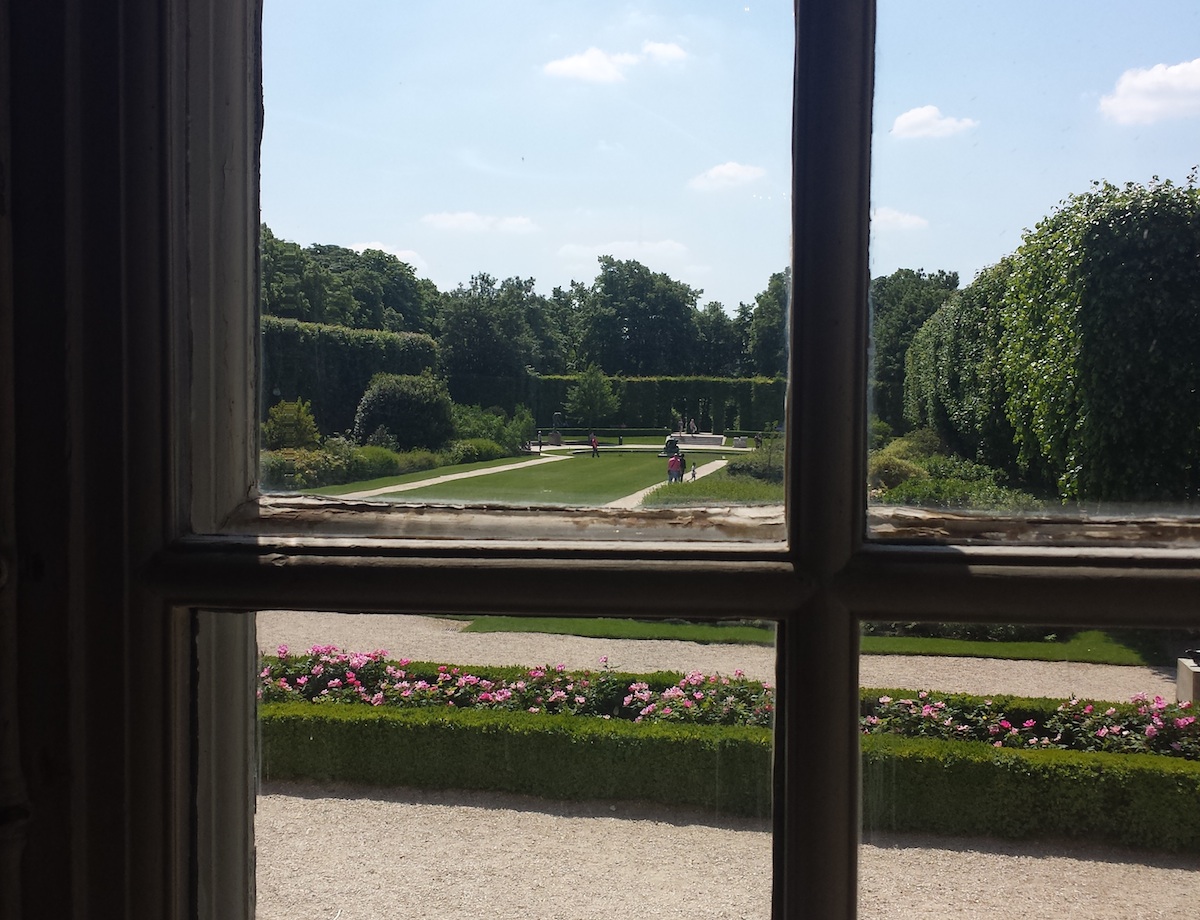
VFYWC-208

A reader writes:

Unlikely is one thing, impossible another. If someone gets a correct answer to this, there is devilry at work.

Another sees himself in the photo:

I think that’s me in the pink shirt.  Wish I could remember where I was.

Another:

Because no European would dress like that guy in the pink shirt, this must be America and not France (Versailles) or Austria (Schonbrunn). Thus, I go with the one European-style palace in America: The Vanderbilt’s Biltmore Estate, in Asheville, North Carolina.

Another surges into first place:

I knew right off the bat where this was, since I’ve spent many hours racing around the topiary bushes here with Mario and Luigi. This is obviously the garden at Princess Peach’s Castle in the Mushroom Kingdom (Mario Kart Wii). I can even point out the window from which the photo was taken:

PPG

Another looks to cinema:

I’ve never actively participated before, but when I saw this picture I immediately was reminded of Kenneth Branagh’s film version of Much Ado About Nothing. I am probably wrong – but in case I’m not, my guess is Villa Vignamaggio in Tuscany, Italy.

Another gets the right country:

The window in need of repair, with the garden looking immaculate, brings back memories of Versailles, France, and the righteous anger rising inside at the excessive opulence, which no doubt contributed to the unrest and eventual revolution. Yes, I say Versailles! Now let me calm down and foster thoughts of Jean Valjean.

Another makes an important discovery:

pandaI’m pretty sure that this will be the most popular wrong answer this week. After a weekend learning about formal gardens, I couldn’t find the location in the picture, but while glancing at the screen, my wife noticed that a section of the gardens at Versailles looks like a panda from the air. So there’s that.

Another reader, although far too brief, nails the city:

Paris, France

Another gets the right location in Paris:

thinker

I’ll make this short and sweet because I’m leaving to take my wife in for spinal surgery:

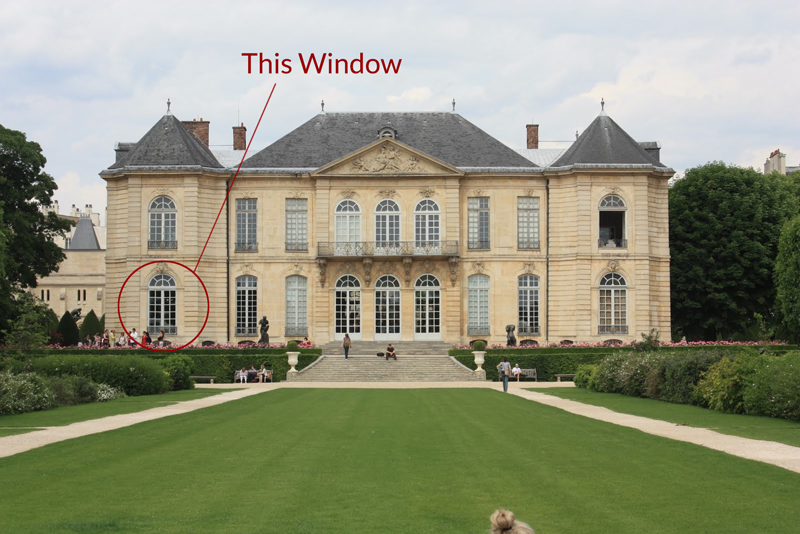
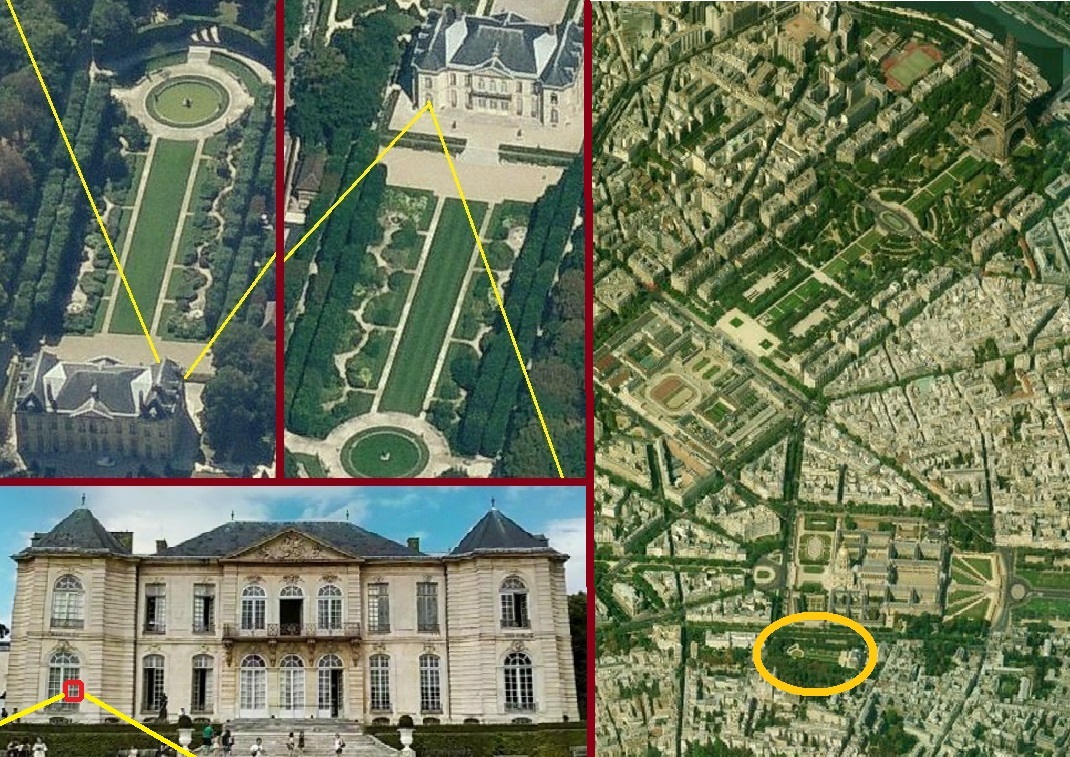
The photo was taken from the far left window overlooking the gardens at the Musée Rodin in Paris. 79 Rue de Varenne, 75007 Paris, France. More specifically:
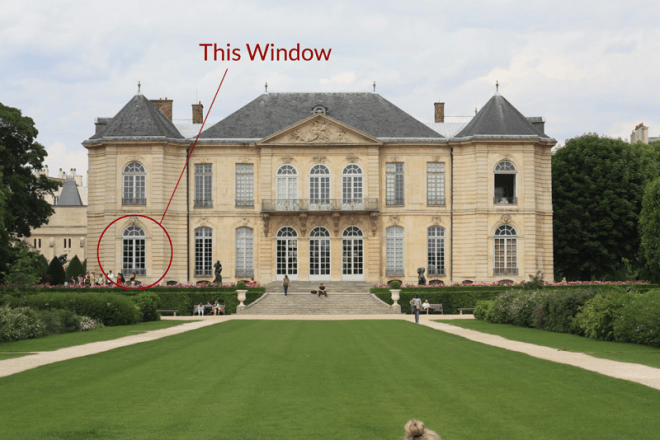
musee

That’s also the right window, which most of our correct guessers picked this week. Below is an OpenHeatMap of all of the entries (zoom in by double-clicking an area of interest, or drag your cursor up and down the slide):

This embed is invalid


Another reader goes into greater detail:

This is definitely France, given the particular kind of molding on the window frames, the fact they are French windows and not sash windows, and the way the roses are surrounded by trimmed box hedges. This could be any one of many 18th century manoirs/hotels particuliers/chateaux, but I would bet it’s the formal gardens in back of the Hotel Biron in the 7th arrondissement of Paris, aka the Musee Rodin.

Another walks us through the garden:

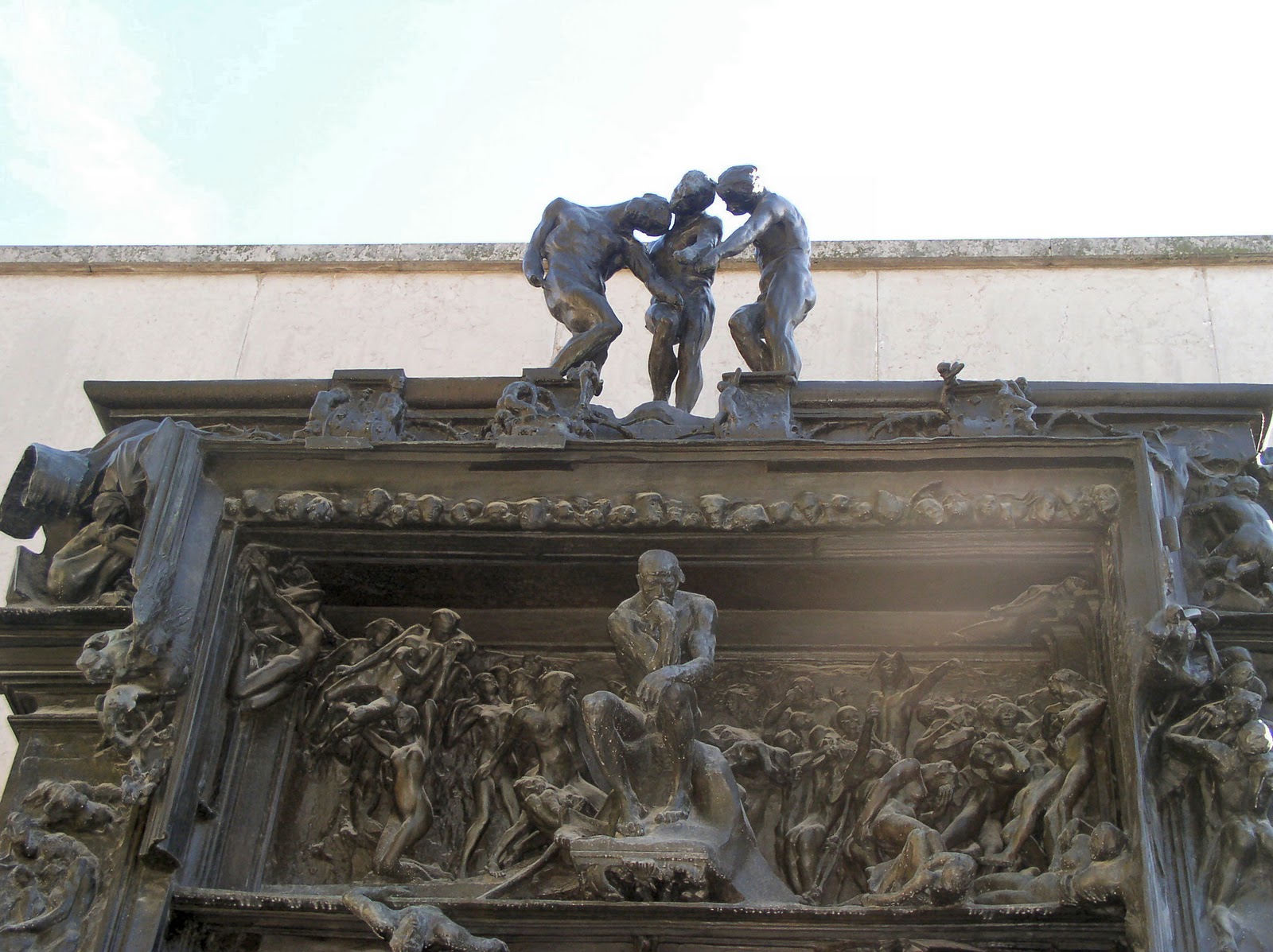
It contains characters from Dante’s Inferno, each depicted in a separate sculpture that Rodin brought together in his Gates of Hell.  In the contest picture, for example, sitting in the fountain is Rodin’s Ugolino before he devours his children:

IMG_9092

I bet the family walking down the path in the contest photo will have a great time discussing that sculpture over dinner.  Also, one of the Shades which Rodin later combined with two others to create The Three Shades is off on the left of the fountain. Rodin placed a small version of The Three Shades at the top of his Gates of Hell above The Thinker.

Another:

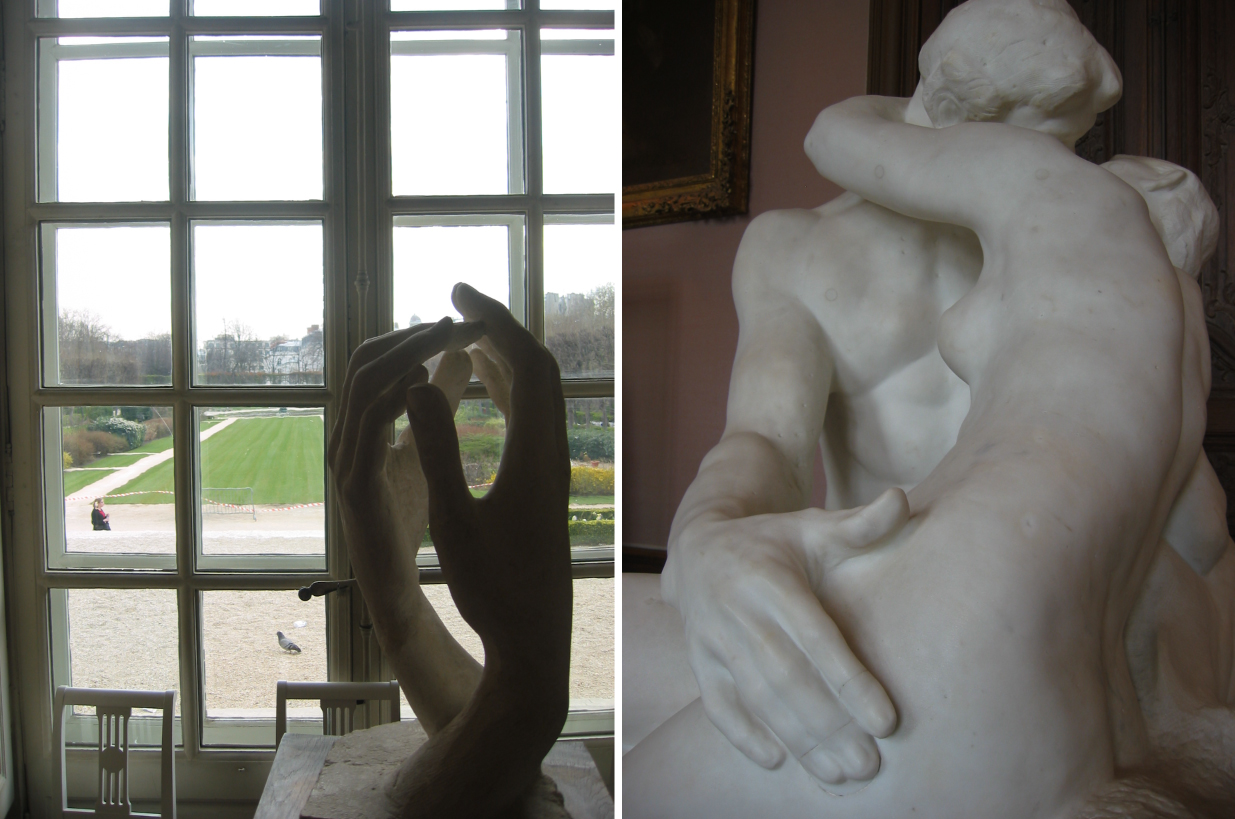
I went to the Rodin museum in my stumbling early twenties and it absolutely transformed the way I thought and felt about art. Rodin had such a unique and powerful gift for capturing emotion and form, and to be surrounded by so much of his work was simply overwhelming in a way no previous museum or gallery had ever been for me. In particular there was something about the raw, eros-charged physicality of Rodin’s pieces that I practically had to restrain myself from reaching out and touching them:
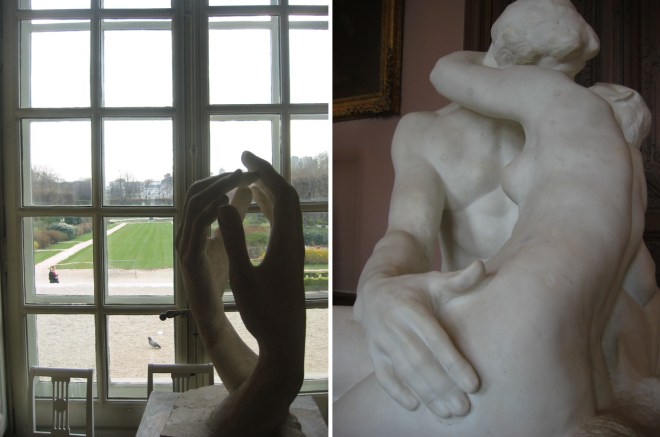
IMG_0534

His impressive private art collection is housed there as well, as is some of the work of his lover and muse Camille Claudel, which truly emphasizes the intimacy of the place. What an incredible, unforgettable experience. Everyone should go.

Along those lines, a few people mentioned the museum was on their bucket list, but none more movingly than this reader:

I immediately recognized the surroundings, as this is, along with Musée image208d’Orsay and Musée du Louvre, among my very favorite places in the world. Rodin’s most famous works are found in the elegant surroundings of the Hôtel Biron  where from inside this photo was taken  and the surrounding gardens.
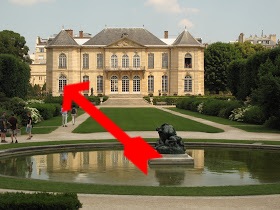
On a personal note: You’ve detailed my health situation in the past, as I deal with an eventually terminal illness. My “bucket list” trip while I could still travel was to Paris with my wife last year, to visit these places one more time  and the first time with her.

This contest gives me something to fill my time and look forward to each week, and I would be lying to say that this week hasn’t been a little more special. The memories that seeing this window evokes have made this week’s contest a trip outside of my everyday reality. I’ve been hoping for a win, but this is (almost) just as good. Thanks.

On a very different note:

In the course of investigating this view on Google Streetview, I found what appears to be a lesser known Rodin work. Looks like Jared from Subway:
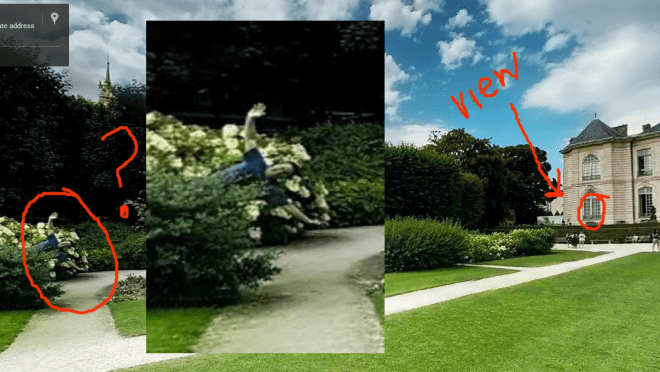
jared-rodin

Another examines the image for more useful clues:

It’s not much past midday, judging from the shadows, a beautiful temperate day, the quality of light, the flowers, and the tourists’ choices of attire, yet very few tourists have chosen to spend this lovely day in this garden. Might that suggest that the garden has lots of competition for tourists’ attention just beyond the hedges?

Therefore we have a garden attached to a museum, probably a museum of statuary, which is probably in a great city. Since it isn’t the Galleria Borghese in Rome, because I’ve been to it, then it must be the Musée Rodin, 79 rue de Varenne, Paris. And the three statues visible in the frame are “Adam” to the left, “The Meditation” to the right, and between them, just above mister pinkshirt, is “Ugolino [kneeling over] and [about to chow down on] his children” in the center of a difficult-to-discern pool.

Tourists avoiding this garden may be a mile to the east perched at a table outside Café de Flore, nursing un p’tit rouge and trying to be existentialists. Or a mile and change to the west at the top of the Eiffel Tower, gazing east toward Les Invalides (and so, incidentally, over the hedge into this very jardin).

2014-06-07_1041

I only wish that was how I identified this window. But no. I Googled “sculpture garden hedges” and the 134th image looked remarkably similar to that tri-arch hedge in the background. It took seconds. After that it was just a matter of picking out the panes of the window (not the window itself, because that’s obvious). Ground floor, west wing, south side, second and third pair of panes up from the bottom, on the right half of the window when viewed from the garden.

2014-06-07_1236

A reader living in Paris:

I bet this one will get plenty of correct answers. Or, at least I hope so! The tiny bronze forms on the horizon are unmistakeable: Rodin. I recognized them at first sight.

Six months out of every year, I teach drawing from 16th – 18th c. sculpture at the Musee du Louvre, to art students from all over the world, in a private program that I founded myself. I’m American but have lived in France for the last 13 years, and in Paris for the last 4.5 years. My wife and I are both artists, and the gardens of the Musee Rodin are a favorite place to visit. The museum has been in renovations for years, and the last time I visited there was last winter. The first time I went was as a student, in 1994 as seen in this embarrassingly earnest pic:

tws.rodin.museum.feb.1994

They are currently hosting a fine exhibition on the influence of Rodin’s sculpture on the photography of Robert Mapplethorpe. I hope to go this weekend.

Another:

How I WISH I could be one of the Dishheads who goes scouting the location of the VFYW this week. This is not just a sculpture garden, it is the sculpture garden. (If you want to mess with all the NSFW-phobic folks, you can post this image, which the museum is using to promote the current Mappelthorpe/Rodin exhibit. It’s effing culture, people!)

Personal story? I first visited the Rodin Garden in 1998 after a term studying in England; my mother and I spent a week touring Paris and climbing all the stairs we could find in the city. Not too many stairs in the Musée Rodin, but I thought it was the most romantic place I’d ever been and dreamed of proposing to a girl there one day. Fast forward fifteen years and … my brother proposed to his girlfriend there. Younger brothers always steal your best ideas.

Another:

As an architect I’ve taken my kids – they would say dragged – to many of the worlds great kidsmuseums and buildings. Since I never got a chance to go anywhere when I was a kid, I hoped they would appreciate it and enjoy learning about Art & Architecture as I did during my studies.
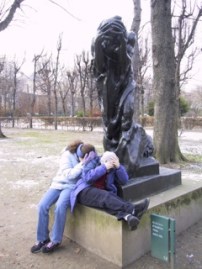
More often than than not, though, they would just melt down. We visited the Musee Rodin over the holiday break in 2005. To express their displeasure with having to walk through another museum in Paris they decided to reenact the pained pose of Andrieus d’Andre Vetu, one of Rodin’s Burghers of Calais. Oh well, what’s a dad to do?

Another learns to never doubt the spouse when it comes to Paris:

I spent several hours yesterday sifting through approximately one jillion pictures of formal gardens. No luck, although I did learn some gardening jargon (have you ever wondered what a parterre or a pelouse is?).  Just when I was losing all hope, my wife walked over and said “Hey, isn’t that a Rodin?”  I took a closer look at the sculpture near the left side of the circular walkway, but it just looked like a little gray smudge.  I told her she was crazy, we could barely tell that it was a sculpture, let alone who the artist was. Oops.

Chini yawns:

Some of these VFYW searches would take forever to explain, but my thought process this week was pretty short: “Hmm, hedges, looks like it’s gonna be a garden hunt … hey, that statue looks like a Rodin … kinda like The Burghers at the Met, but in a garden … oh wait, it can’t be … <google searches> … oh darnit, it is. And I didn’t even get started on my latte … ”

Another reader owes Rodin a beer:

I’ve never visited here, nor do I have any particular interest in gardens or sculpture. BUT I did once have a framed print of Rodin’s The Kiss in my apartment when I was in college, and the air of worldly sophistication that it afforded me certainly helped with the ladies. Maybe. But it definitely helped tonight, when I realized that those fuzzy globs sort of looked Rodin-esque.

A former winner shows how it’s done:

vfyw_Rodin_collagetext_6-7-2014

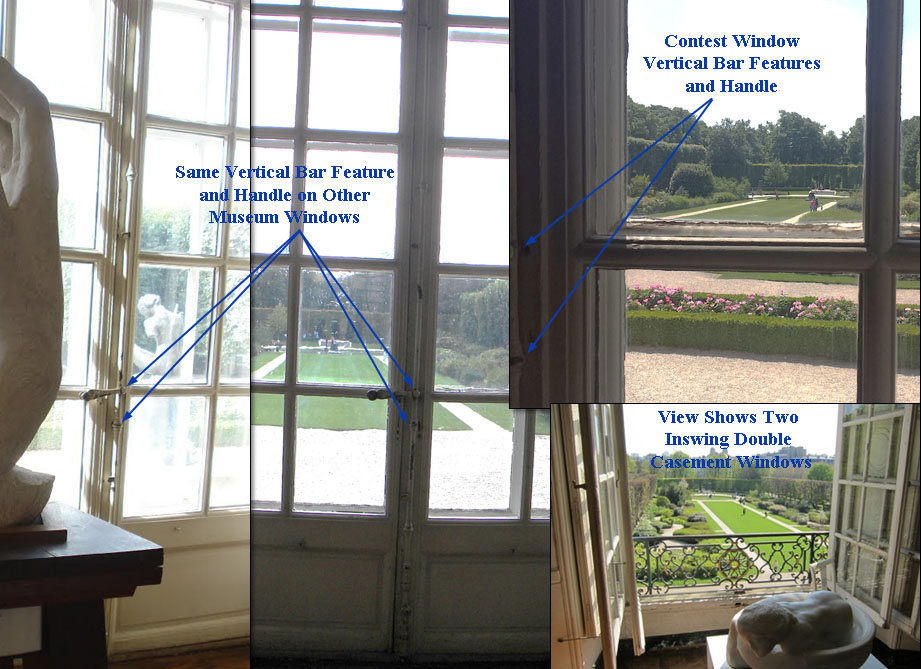
Attempts to identify the window panes in the photograph assumed that they were above the decorative wrought iron window grill (because it is not in the photograph) and at the height of someone standing. The window hardware barely visible in the darkened left side of the contest photograph places the panes on the western casement of the double casement window (actually two double casement inswing windows as found throughout the museum). The visible hardware includes components of the vertical rod and locking device that hold the two casements shut and is therefore located where the two join when closed. The round component is probably the handle connected to the locking device and vertical rod. Attached is a collage comparing hardware found on other museum windows with that visible in the contest window.

Speaking of collages, here’s another Dish original:
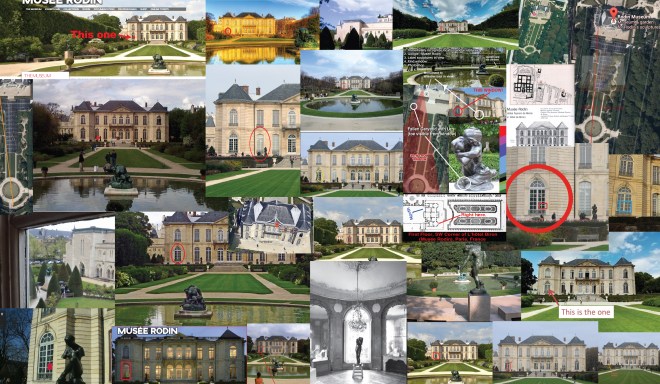
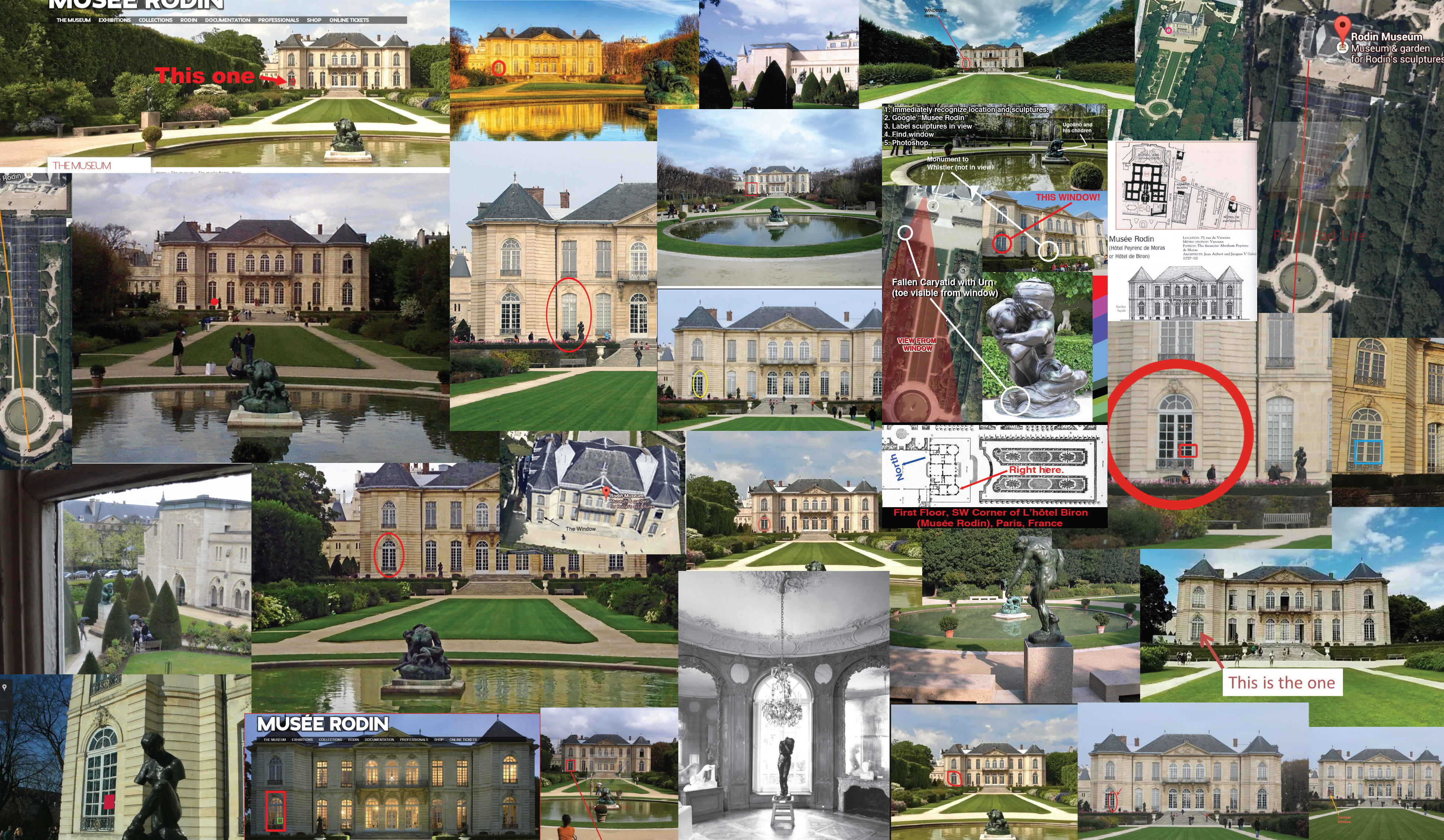
vfywc-208-guess-collage

This week’s tiebreaker goes to a reader on our list of previous contestants who have correctly guessed difficult contests but never won. A process walkthrough:

No buildings? No skyline? You’ve got to be kidding me. Google Earth isn’t going to be a help on this one. So what do we know? Looks like it could be the gardens at Versailles, couple of sculptures can be seen but its hard to make out what they are. Since there doesn’t seem to be a lot of other clues, what the heck, let’s just Google: “Sculpture Garden”. For some reason, when you do, you come up with an inordinate number of images for this Spoon with a Cherry in the Minneapolis Sculpture Garden:
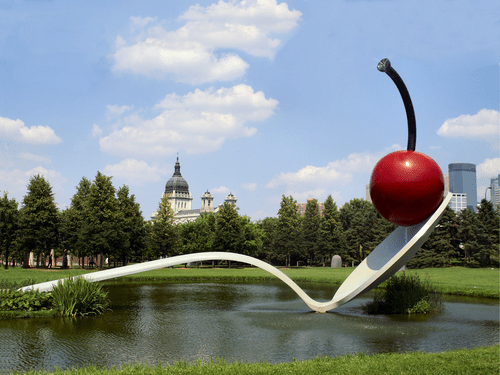
208-ar1

But the window really doesn’t look like it is in Minneapolis, so what else do I know? There really isn’t a lot there. I guess there are a bunch of hedges. So why not, I’m feeling lucky, let’s unleash the power of Google: “Sculpture Garden Hedge”. And Boom! Just like that. By the magic of the internet there it is. On the first page of image results … it’s the hedge with three arches from the from the back of the photo along with a caption specifying Gardens of Rodin! And so, the Musée Rodin in Paris.

With a three-word Google search, this week’s window goes from completely impossible to getting my weekend back in the span of just 10 minutes! My guess:
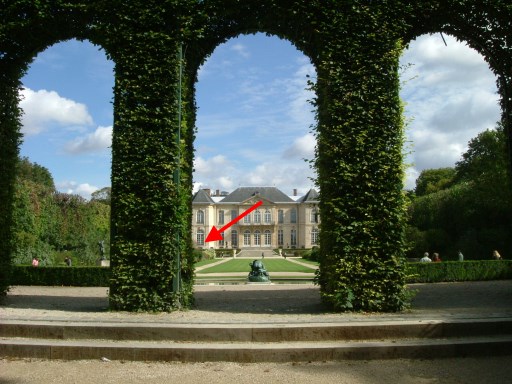
Paris_Musée_Rodin_Gartenaansicht

Congrats, and with a cherry on top! From the submitter of the window view, an artist:

It’s one of my favorite places in Paris, though nothing like it was in Rodin’s time, when it was more of a pastural paradise in the city. What an amazing place it must have been to have had a studio.

(Archive: Text|Gallery)