That Time The Clintons Ran Out Of Money

wealth2

In her interview with Diane Sawyer last night to plug her new book Hard Choices, Hillary claimed that she and Bill were “not only dead broke but in debt” when they moved out of the White House, and that the couple needed the millions of dollars they accrued in speaking fees to pay down those debts. Philip Bump fact-checks:

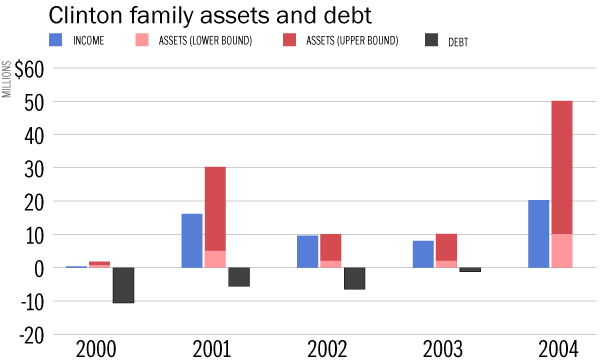
Clinton left the White House to head to the Capitol as New York’s junior senator in 2000, meaning that she had to file annual disclosures of how much she and her husband earned, owned, and owed. We took a look at those filings, via Open Secrets. And this is what the Clinton’s wealth looked like for the first four years after they left office in early 2001. We considered three things: what the Clintons reported as income on their taxes, what they reported as assets in Hillary Clinton’s mandated disclosures, and what was listed as being owed. The disclosures only give broad boundaries for the value of the assets owned, so the true value of their assets lies somewhere within the dark-red bar.

So, yes, it is technically true the Clintons left office in debt. But, a year later, the couple’s assets had soared. And, as was reported at the time, the Clintons’ debt was entirely gone by the end of 2004 — well before Hillary Clinton left the Senate and well before she left her position as secretary of state.

Indeed, Zeke Miller adds, by the time she left the Obama administration last year, Hillary was a wealthy woman even without her husband’s millions:

While the former first family’s precarious financial situation in 2001 was well known, the situation was very different when Clinton stepped down as Secretary of State in early 2013. She had reported on an government financial disclosure form assets in the millions, including between $5 million and $25 million in cash—meaning she left the State Department with at least $5 million in the bank, before her speaking gigs started and before she made millions more from her new book Hard Choices. Last year CNN calculated that the former President has taken in more than $106 million on the speaking circuit since leaving office in 2001. In fact, in their first year after leaving the White House, the Clintons earned a combined $16.1 million—the bulk of it coming from the former president’s speaking and author fees.

The inevitable walk-back arrived this morning:

“Let me just clarify that I fully appreciate how hard life is for so many Americans today,” Clinton said in a live interview on ABC’s “Good Morning America.” “I want to use the talents and resources I have to make sure people get the same chances.” Host Robin Roberts asked Clinton if she can understand why people are questioning why she’d describe her family’s finances as a struggle.

“Yes, I can, but everything in life has to be put into context. As I recall, we were something like in $12 million in debt,” said Clinton, adding that she soon entered the Senate and couldn’t do much to help reverse that at the time.

The Bonnie And Clyde Of The Far Far Right

Caroline Bankoff reviews what we know about Sunday’s bizarre shooting spree in Las Vegas:

Late Sunday morning, a man and a woman identified as Jerad and Amanda Miller barged into a Las Vegas restaurant called CiCi’s Pizza, shouted “This is a revolution!” and fatally shot two police officers who were having lunch. The pair stripped the officers of their weapons and ammunition and covered their bodies with a swastika and a Gadsden flag (that’s the one with the coiled snake and the words “Don’t Tread On Me”). They then took off for a nearby Walmart, where they shot and killed Joseph Robert Wilcox as he attempted to confront them with his own gun. After exchanging gunfire with the police, the Amanda shot her Jerad and then herself in what was described as “an apparent suicide pact.”

“What precipitated this event, we do not know,” Sheriff Douglas Gillespie told reporters after the attack. However, neighbors told the Las Vegas Sun and the Las Vegas Review-Journal that the couple was known for talking about their racist and anti-government views, and bragging about their  ties to libertarian hero and fellow racist Cliven Bundy.

Jesse Walker observes how the media narrative is coalescing around the Millers’ ties to Bundy and the militia movement, noting how the distinction between the Millers’ beliefs and those of most militia members gets lost in the fray:

As I’ve noted before when writing about the militia movement, violence on the far right often comes from hotheads who have been kicked out of the more mainstream militias. (Is “mainstream” the right word? It’s all relative, I suppose.) When actual organizations talk up non-defensive violence, they are often isolated and despised within the larger militia milieu. Yet these divisions are frequently missed in public discussions of the issue, which often lump all the “extremists” together—and, as a result, look in the wrong places for terrorist threats. Even when analysts argue that lone wolves acting on their own are a more likely source of violence than militias acting as groups, there’s a mistaken tendency to treat “radicalization” as the problem and to ignore all the cross-currents within a particular radical community. (J.M. Berger offers some strong arguments against that habit here.)

Paul Waldman makes the inevitable connection with the over-the-top rhetoric of the right:

The most obvious component is the fetishization of firearms and the constant warnings that government will soon be coming to take your guns. But that’s only part of it. Just as meaningful is the conspiracy theorizing that became utterly mainstream once Barack Obama took office. If you tuned into one of many national television and radio programs on the right, you heard over and over that Obama was imposing a totalitarian state upon us. …

To take just one of an innumerable number of examples, when GOP Senator Ron Johnson says that the Affordable Care Act is “the greatest assault on freedom in our lifetime,” and hopes that the Supreme Court will intervene to preserve our “last shred of freedom,” is it at all surprising that some people might be tempted to take up arms?

David Harsanyi  this argument away:

Yes, of course it would be surprising. Fortunately, despite the active imagination of pundits, no one has taken up arms to repeal Obamacare — ever.

Now, some of you would-be enablers of terrorism might argue that an individual mandate that allows government to coerce all citizen to purchase a product on the open market is, as far as policy goes, unprecedented. So it could be argued, reasonably, that it constitutes one of the most serious “assaults” on individual freedom in recent memory. Nothing in that statement, though, intimates that Americans should ambush their local police officers. Nothing in that statement implies that that you “harbor anti-government ideology.” We’re just debating the size of government. Harboring a desire to cut the budget to 2008 levels does not, despite what you may have heard, make you an anarchist.

Dissents Of The Day

Collier may have missed our airing of dissents from transgender readers here. The Dish doesn’t duck from strong criticism. Another reader:

I disagree with your view on language as being harmless and that people should just get over being offended by the use of “tranny,” “faggot,” or whatever. We could have an interesting back-and-forth discussion about the power of language and it wouldn’t bother me if we vehemently disagreed.

What does bother me, and the reason I’m writing, is your use of your blog as a bludgeon against a college student who represents not the antithesis to your argument, but simply a young, naive strawman used to convey your disgust. Here’s how you describe them: “What I am interested is condemning this pathetic excuse for a student.” What I think is pathetic is your savaging of a random, young college student who embarrassed themselves rather than representing an honestly defensible position. If you’re going to attack and rant against a position, take on someone who can strongly defend it. Instead of boosting the strength of your argument, it makes you come off as a bully.

I think that’s condescending to the student. If you want an example of bullying, check out the petition organized by the student and their allies:

On Thursday May 22, The Institute of Politics hosted a seminar with Dan Savage, a gay advice columnist who has a history of making numerous misogynstic, biphobic, transphobic, and racist comments.

Note that these students have absolutely no compunction about accusing someone of being a racist and misogynist, but cower and complain that they don’t live in a safe space if someone neutrally uses a term they have decided is now verboten. I don’t have much sympathy for this kind of hypocrisy, intimidation and cant. Another reader:

I am with you when you say that trans folks (and lesbians, gays and everyone else) should get over the over-sensitive word policing. Yes, it is appalling that a student ran crying out of a lecture. I too dislike the idea of trigger warnings in lectures. And yes, Savage seems to be using this in an appropriate context. That being said, let me remind of your posts against one Alec Baldwin. You seem to argue that trans folks should just get over themselves when being presented with language that they don’t much like at the same time that you take Baldwin to task for deploying homophobic language. Want to explain that? Are you not living up the same standard that you expect of trans people?

You can read the blog for many years and find my position on free speech, including offensive speech, clearly and consistently applied. The Baldwin case was about the double standards of liberals. If you are going to present yourself as a crusading gay rights activist, then it’s perfectly legit for me to call someone out when he uses terms like “cocksucker” and “faggot”. Baldwin’s outbursts were also linked to physical threats, using the term “faggot” and “toxic little queen” to directly intimidate gay people. (Even then, as in the Jonah Hill case, I’m totally cool if someone acknowledges what they said and offers a clear apology – which Baldwin refused to do.) But none of that is the same as being able to use terms freely in a non-aggressive form, not directed as a slur at someone, but as part of a lively or challenging discussion. As I wrote yesterday:

I’m not talking about deliberate demonizing of others or threats of violence; I’m not talking about prejudice or bigotry. I’m talking about being able to say words freely in order to think more freely.

The student was engaged in an attempt to prevent that, to dictate by emotional blackmail which words can and cannot be used in a university. And its [sic] confreres tried to get Dan Savage indicted for a hate crime because he refused to obey. I’m sorry but this tendency is anathema to a liberal society. Another reader goes into greater detail on the college student and trigger warnings in general:

Wasn’t there some sort of famous quote from James Madison or John Adams or something, that he studied politics so that his descendants might study poetry? I’m glad the Stonewall Rioters did what they did, but it might also be that our ethical conversation about what can and cannot be done within the world of LGBT rights has progressed to the point where there is at long last some space for a new generation of campaigners to give thoughts to our emotions and our human selves. Human selves that are sometimes traumatized and re-traumatized by sloppy language – human selves which are thankfully now free enough of the oppressions of a world before Stonewall, but are still subject to the bare difficulties of living psychically in a world arrayed against us, even if only in subtle and often-invisible ways.

I don’t mean to defend this particular student – the description of the situation does seem to suggest Savage has the right way of it in this context – but your blanket condemnation of any respect given to the concept of a trigger warning itself is silly. Not only that, but it assumes that a trigger warning is given so that people can avoid ever having to see something that offends them.

For instance, I can get triggered by fat hatred. But you know what? This doesn’t mean that I don’t read things that contain it! If I’m reading a post that says “(TW: fat hatred)”, I steel myself. I know that I may get bothered; I know that my anxiety levels might jump through the roof; I know that I might feel my heart start to beat faster as memories of my abuse flood my psyche. But I read on anyway. And quite often I find that material that would have drained my emotional reservoirs had it come upon me as a surprise is actually easier to manage and sort through because I had just a moment or two to prepare myself.

Your idea about what a trigger warning is and why people want them is abject caricature. Very few people ask for them because we want to wall ourselves off from all possibility of taking offense. We ask for them because sometimes, just sometimes, going into a difficult situation knowing it will be difficult gives us the mental and emotional space to make fruitful contributions to the discussion and explore the subject matter with the correct distance required for academic, dispassionate perspective. While I lack any sort of study to prove this is the case, I know from my own anecdotal experience that no one in my wide circle of TW-savvy acquaintances and friends actively avoids all posts that contain their triggers. They might sometimes skip one because they’ve already engaged 10 that day and don’t have the energy for another one, but the idea that trigger warnings exist to wall off academic or critical inquiry is absurd. Trigger warnings exist because they often give people the mental and emotional space to actually engage in such inquiry with aplomb.

Previous Dish on trigger warnings here.
Catholicism’s Crimes Against Humanity, Ctd

OLYMPUS DIGITAL CAMERA

Further reporting has somewhat taken the most appalling edges off the story of the 796 dead children, buried without markers in one of the 20th Century Irish gulags for the sexually sinful and their children. No one is disputing the missing 796 toddler corpses, nor that they were probably buried in a mass grave. But the septic tank where some children were buried may only have had a couple dozen corpses, with the rest buried elsewhere:

Barry Sweeney, now 48, who was questioned by detectives about what he saw when he was 10 years old, said: “People are making out we saw a mass grave. But we can only say what we seen: maybe 15 to 20 small skeletons.”

The historian who uncovered the tragedy also insists that she never used the word “dumped” to describe the bodies. What we obviously need right now is a full and objective investigation into the former home and grounds, and a much wider inquiry into all the other institutions where young women and their babies were made invisible and often ended up dead. Mercifully, that will now happen:

Irish Minister for Children Charlie Flanagan has announced a statutory Commission of Investigation into mother and baby homes in Ireland … Mr Flanagan told Irish state broadcaster RTÉ that the government will receive an initial report from the investigating team by 30 June. On Sunday, one of the most senior figures in the Catholic Church in Ireland said a full inquiry was needed. Archbishop of Dublin Diarmuid Martin said the truth must come out.

With any luck, we will get more clarity on the nature of the entire ghastly enterprise. Meanwhile, Fintan O’Toole has a must-read on the broader cultural context for the atrocities. In the Catholic mindset of the time, illegitimate children were regarded as physically and mentally weaker than other “virtuous” toddlers:

In 1943, the Joint Committee of Women’s Societies and Social Workers compiled a well-meaning memorandum on children in institutions. It noted of those in mother-and-baby homes that “These illegitimate children start with a handicap. Owing to the circumstances of their birth, their heredity, the state of mind of the mother before birth, their liability to hereditary disease and mental weakness, we do not get, and we should not expect to get, the large percentage of healthy vigorous babies we get in normal circumstances. This was noticeable in the institutions we visited.”

So the children were blamed for the consequences of their own mistreatment. It’s an insight into how Christianity’s sex-phobia so distorted the faith that it actually demonized children and excused their early deaths. And that, of course, was the reason for their not being buried individually, with markers. They were regarded as subhuman.

I repeat my view that when a doctrine begets this evil, there is something deeply wrong with the doctrine itself. When it leads to an inversion of Christianity’s deeper call to empathy, care for the vulnerable and love of children, it is objectively disordered.

(Photo: headpiece of the High Cross in Tuam, Ireland, by Clint Malpaso via Wiki)

Did The IMF Save The Global Economy?

Tim Fernholz discusses Daniel Drezner’s new book, The System Worked: How the World Stopped Another Depression. In it, Drezner posits that the global system of economic governance was to thank for preventing a major catastrophe in 2008. Fernholz:

But wait—wages, growth and jobs are still lagging in the United States and the European Union. That has a lot of those countries’ citizens blaming globalization and the institutions that support it, such as the International Monetary Fund. Don’t blame globalization, Drezner says: Blame your governments.

In the recovery stage of a financial crisis, growth is expected to be slow—clearing debt off balance sheets takes longer than responding to other kinds of shocks. Hastening growth requires policies that were not fully adopted in either the US or Europe, as austerity dominated policy debates. (It’s worth noting that the IMF was long a critic of US fiscal policy, calling for more near-term stimulus and longer-term efforts to deal with debt.) And the EU, with its mixed record of addressing its own debt crisis and recession—Drezner calls it “an unmitigated disaster”—is more of an actor in global governance than an example of it. …

There are good signs that global governance will get stronger. For one, institutions are adapting: the IMF has relaxed some of its traditionally neoliberal arguments and is a more broad-based institution; the G20 provides a platform for the BRICs and the G7 nations to coordinate; Basel III has put a floor on bank regulation. For another, countries are recommitting to the global system with a flurry of bilateral and regional trade deals under discussion, even if Edward Snowden’s revelations have clearly chilled US talks with Europe.

Where Did Rhode Island Go Wrong?

Aaron Renn contends that over-regulation and generous government benefits have hampered the state’s economy:

Depending on the month, Rhode Island has either the worst or second-worst unemployment rate in the nation: 9.3 percent, according to the latest Bureau of Labor Statistics figures. Since 2000, the state has lost 2.5 percent of its jobs, and what jobs it has created are mostly low-paying. The job situation is so dire that entire local economies have become dominated by the benefits-payment cycle. In Woonsocket, for example, one-third of residents are on food stamps.

Rhode Island boosters cite its per-capita income of $45,877—4.9 percent above the national average and 14th-best in the country—as evidence of the state’s economic strength. But this number is misleading. It’s driven in part by high levels of government-transfer payments: everything from retirement and disability insurance to workers’ compensation and unemployment, veterans’ benefits, and the whole panoply of federal grants (Medicaid, food stamps, SSDI). Rhode Island ranks third in the country in such transfers per capita. Incomes have also been stagnant for decades. As late as the 1930s, Rhode Island’s per-capita income was nearly 50 percent greater than the national average. By the mid-1940s, though, it had declined to just a tick above the U.S. average, where it remains.

The Man Behind King

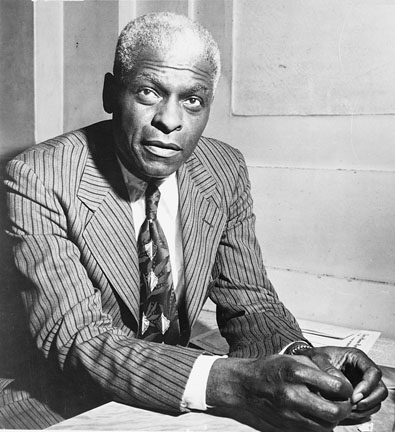
In an interview, Randal Jelks discusses his biography, Benjamin Elijah Mays: Schoolmaster of the Movement, about the Morehouse College president whom MLK Jr. considered his spiritual and intellectual father. How Mays laid the theological groundwork for the civil right movement:

He went to India and met and interviewed Gandhi in 1936 and came back and wrote about 19-301his encounter. He talked with Gandhi about what a nonviolent social movement looks like and how it should take place.

Martin King was 15 when he came to Morehouse. The war was beginning to affect enrollment, and Mays, at an all-men’s college, used early admissions to find talented teenagers to enroll. King and other students were often invited to Mays’ house to sit at table when dignitaries were visiting. The students had to learn about the visitor beforehand and were expected by Dr. and Mrs. Mays to ask questions. The great civil rights activist Dorothy Height remembers meeting Martin King at 15 sitting at the Mayses’ dining room table. This was not peculiar to King. Many other students tell you the same.

If Jelks’ biography discusses what came before Dr. King, Matthew J. Cressler argues that the religious dimension of debates about racial justice didn’t end with his death, but extended to what came after it – including the Black Power movement:

Journalists were quick to contrast what they took to be the irrational rage of urban youth shouting “Black Power!” with caricatures of a more palatable southern Christian nonviolence – needless to say, neither of these characterizations approximated the reality of either.

The first generation of post-civil rights scholarship reproduced this juxtaposition between secular anger and religious love, black violence and Christian nonviolence.  Even as more recent scholars have challenged many of the classic binaries separating Black Power from civil rights, the secular/religious divide usually persists since it serves as a convenient category for marking the elusive shift from one style of social justice struggle to another. (The convenience of this argument depends on presuppositions about the inherent peacefulness of “real” or “proper” religion that are built into the modern study of religion itself, but that is a conversation for another time.)

Convenience notwithstanding, Black Power was actually taken up by a number of black religious communities almost immediately after its first iteration.  On July 31, 1966, not long after Carmichael’s famous statement, the National Committee of Negro Churchmen published their own statement expressing deep disturbance over the manufactured controversy surrounding “Black power” and what they called the media’s “historic distortions of important human realities.”  They argued that “what we see shining through the variety of rhetoric is not anything new but the same old problem of power and race which has faced our beloved country since 1619.”  They identified the hypocrisy of “the assumption that white people are justified in getting what they want through the use of power, but that Negro Americans must, either by nature or by circumstance, make their appeal only through conscience.”  Two years later this same committee, now named the National Committee of Black Churchmen, officially affirmed emergent Black Theology as a “theology of black liberation.”

Even the Black Panthers – often presented as the paradigmatic foil for (the popular, sanitized version of) the Christian nonviolence of Martin Luther King – met in churches and collaborated with religious people and communities from the get-go.

(Photo of Mays via Wikipedia)

Pulverizing Peaks, Ctd

An expert writes in (with a few updates below):

As a geologist, I’m surprised that the discussion of extensive mountain-flattening in China has so far ignored the most scary potential consequence: widespread earthquake damage. The danger doesn’t come from removing the mountains; it comes from filling in the valleys. In brief, soils that are being placed for future building construction need to be deposited in thin “lifts” a few feet thick and compacted carefully before the next layer is placed. Soils that are just dumped into valleys, in layers tens of meters thick, can not be properly compacted. They are very likely to turn into Jello when shaken, especially if they’re wet when the shaking occurs.

If you want to see a marvelous example of this, look at the damage to the Mission District in San Francisco during the Loma Prieta quake. Buildings constructed on thick layers of poorly compacted fill were far more heavily damaged than those a few blocks away, which were built on native soils.

The scale of what the Chinese are doing dwarfs any comparison with San Francisco.

Some of these cities could double in area, with nearly all of the additional construction space consisting of poorly compacted soil. Even if the new buildings stay up for a few years, the soils at depth will remain uncompacted and may liquefy during the next earthquake. And central China, where this work is being conducted, is subject to frequent massive earthquakes, at least as frequent and as intense as anything California has to offer.

Update from a reader:

Mine is a small correction: it’s the Marina District that was built on landfill, not the Mission, and the damage from the ’89 earthquake was worst in the Marina. I was living on Telegraph Hill at the time. My home was shaken, a few books and records knocked out of their cabinets, but there was no real damage to my house or to those of anyone around me on the hill. We lived on rock. Most of the Mission, if not all of it, is solidly on land.

But the Marina and much of the Embarcadero are on landfill. (There’s a fine poem by Robert Hass about how some of this came about, called “The Harbor at Seattle“.) Currently our home is at the beach, built on sand, and everyone knows what that means, or thinks they do. But it’s survived two temblors with just one crack, a minor one, in the basement walk way. Liquefaction is a potential problem.

But the “give” of sand, in an earthquake, might be advantageous. It’s the tsunamis we have to watch for. There are signs everywhere out here instructing you where to run. (“To the hills!”)

Another:

Your first update was correct, in part: It was the Marina, not the Mission, that the first reader probably meant to reference. But the Mission did have soil failures in 1906, and we have liquefiable soil around the entire Bay edge and along old Mission creek.

But while we’re correcting earthquake references in the 25th anniversary year of Loma Prieta, may I just note, as a structural engineer in San Francisco, how often I have to shake my head when clients say “My building is on rock” or worse, point out how little damage they sustained in 1989 – from a short earthquake centered 50 miles away! When our earthquake comes, rock sites are going to shake plenty too, and a lot harder than they did in ’89. Soil can explain why a distant site still feels strong shaking, but the real culprit is a weak or ill-conceived structure above the ground. (San Francisco has a new mandatory retrofit program addressing the worst of these. Come here in the summer of 2018, and you won’t be able to walk to the nearest google bus stop without seeing a dozen retrofits in progress. Meanwhile, both the A’s and the Giants are currently in first place …)

As for the uncompacted fill (the first reader’s point about China), the earthquake issue there is not just amplified shaking, but settlement. Shake all that loose soil, and if it slumps or settles just a few inches, that’s enough to crack foundations, roads, runways, buried pipelines, etc. It doesn’t kill as many people as structural collapses, but it can really mess with your local and regional economy.

Has Griffin Struck Again?

I haven’t seen The Case Against 8 yet, because they won’t send me a screener, but this review is a beaut. Two passages stand out:

Chad Griffin, founder of AFER and since 2012 the president of the Human Rights Campaign, wonders—when the group faces initial opposition from other campaigning groups who think in 2010 it is “too early” to pick marriage as the central gay rights fight to have—why gay groups spend more time fighting each other than “right-wing nut jobs.”

One hopes this is just a misunderstanding. Marriage had been the central gay rights fight since president George W. Bush announced support for the Federal Marriage Amendment in 2004. No one ever disputed that. The only question at issue by 2010 was whether it was worth trying to get the Supreme Court to issue a federal ruling on the entire matter at that juncture. Griffin, Boies and Olson bet on that – and lost, when their case was dismissed on the minor ground of standing. Which brings one to the following paragraph from the review as well:

The directors told me the most difficult scene to film was the last. The couples had just won their 2013 ruling in the Supreme Court, which struck down the Defense of Marriage Act and rejected Proposition 8, and now they wanted to get married—the women in San Francisco and the men in Los Angeles.

But the couples in Perry did not succeed in striking down DOMA; and one hopes the Beast will run a correction. The review tells us that there is no account of the other side in the case, there is no criticism of the Prop 8 team –  “We are not only on the side of the good guys, but we are only ever on the good side of the good guys”, and that there is nothing actually revealing on the couples involved. In other words, it appears to be exactly the propaganda Griffin tried to peddle through Becker.

Well, I guess they’ll let me see the film at some point, won’t they?

“An Epic Of The Human Body”

But first, a very NSFW reading of one of James Joyce’s love letters to his wife:

This embed is invalid


In his about-to-be released The Most Dangerous Book: The Battle for James Joyce’s Ulysses, Kevin Birmingham offers new evidence that the author was going blind from syphilis:

The Harvard scholar decided to “turn over every stone” to find out what might have caused Joyce’s deteriorating vision, compiling references to every symptom and treatment the author had. One item in particular sparked his curiosity: Joyce’s reference in two separate 1928 letters to the injections of arsenic and phosphorous he was receiving.

“It wasn’t too long before I found a medication that fit: galyl, a compound of arsenic and phosphorus that doctors injected multiple times. Galyl was only used to treat syphilis,” said Birmingham.

The drug is obscure, and Birmingham believes Joyce opted for this treatment, rather than the more effective drug salvarsan, because one of salvarsan’s side effects was that it could further damage his eyesight – and Joyce hated the idea of having to dictate his work.

As John Lingan’s review of The Most Dangerous Book makes clear, sex also figured into the obscenity trial that Ulysses sparked:

Fancying his book “an epic of the human body,” he filled it with every conceivable excretion and referenced a panoply of sex acts, from the mundane to the surreal. Moreover, its opening lines, a mock invocation of the Catholic mass over a shaving bowl, announced Joyce’s intention to revel in heresy.

Obscenity was the lifeblood of Ulysses, the proof that it truly comprehended all human experience. “To artists like Joyce,” Birmingham writes, “who considered free expression sacrosanct, censorship epitomized the tyranny of state power. … To publish a gratuitously obscene text—to deny ‘obscenity’ as a legitimate category altogether—was a way to expose and reject the arbitrary base of all state power. It was a form of literary anarchy.”

The novel was eventually published in 1922 by Shakespeare and Company, another literary institution (this one in Paris) run by a strong-willed American woman. Sylvia Beach had opened her store in 1919, and it quickly became the Lost Generation’s literary locus, functioning as a library and mailing address for itinerant artists. Her version of Ulysses, with its iconic blue cover and monolithic title font, was priced up to 10 times higher than the normal rate for a new book, but was nevertheless so popular that she had to remove a copy from her store window to prevent mob scenes.

In a detail that will resonate with anyone who’s tried to make it all the way through Ulysses, James Longenbach notices one of the defenses of the book during the obscenity trial – that no one actually would read it:

John Quinn, a powerful New York lawyer who was a friend of Pound’s and a patron of many modernist writers and painters, represented the editors at the Jefferson Market Courthouse. No passage from Ulysses was read into evidence; the New York Society for the Suppression of Vice argued that it would violate the law to do so, since the book was “so obscene, lewd, lascivious, filthy, indecent and disgusting that a minute description of the same would be offensive to the Court and improper to be placed upon the records thereof.”

Cannily, Quinn based his defense on the Hicklin Rule (formulated by a British judge in 1868 and still current at the time), which maintained that the “test of obscenity” was whether or not the language in question would tend to “deprave and corrupt those whose minds are open to such immoral influences.” Language could not deprave and corrupt, Quinn argued, if nobody read it: “You could not take a piece of literature up in an aeroplane fifteen thousand feet into the blue sky, where there would be no spectator, and let the pilot of the machine read it out and have it denounced as ‘filthy,’ within the meaning of the law.” Quinn was himself an avid reader of Joyce’s prose, but in court he argued that Ulysses was like the entry on “and” in theOED: Who would get through it?