Contemplating Confession

Twenty years after the murders of Nicole Brown Simpson and Ron Goldman, Morgan Meis reviews If I Did It, the bizarre hypothetical recounting of the incidents O.J. Simpson published in 2007. Rather than dwelling on the salacious details of this “extremely confusing book written by an extremely confused man,” Meis connects the confessor’s impulse to the Western canon, comparing Socratic and Augustinian approaches to guilt:

There’s a long tradition in Western culture of responding to accusations with an affirmation of the self. Think of it as the Socratic impulse. It is the need to give an apology — not in the sense of saying “I’m sorry,” but in the sense of the Greek word apologia. An apologia is not an admission of guilt or an expression of regret. It is, literally, a “talking back.” It is a response to an accusation in which the accused tells his side of the story. That’s what Socrates does in his apology. He tells his side of the story. He affirms who he is and what he is about. Let’s not forget that Socrates was guilty of his crimes. Just read I. F. Stone’s The Trial of Socrates. Socrates was, in fact, corrupting the youth of Athens. Socrates’ students and admirers — men like Alcibiades — were, in fact, being taught by Socrates to have contempt for the structures of Athenian democracy. Some of Socrates’ students did, in fact, overthrow and abolish Athenian democracy. So Socrates, in his apology, is not protesting his innocence so much as asserting himself, affirming his own point of view. “This is who I really am,” says Socrates, “this is what I am about.”

O. J. was grasping at something similar when he said, “I did what all accused men do at the moment of truth: I proclaimed my innocence.” Defending the truth or falsity of the accusations against him didn’t matter as much to O. J. The important thing to defend when you stand alone, accused, is your self. This is when you have a chance to say, “Here’s who I am, here’s my story and I will not surrender this story.” But there is another side to O. J.

This side does want to confess, wants to be able to discuss and come to terms with the actual murders. This side of O. J. wants to be released from the burden of self that he affirms in the Socratic impulse. In his confessional mode, O. J. doesn’t want to be responsible for his story. He wants to be able to give his story away. This desire to confess is the Augustinian impulse and it is fundamentally incompatible with the Socratic impulse.

Augustine’s Confessions are the writings of a man unburdening himself. Augustine wants to find himself by throwing himself away. He wants to loosen the bonds of self. He wants to find relief from his own story by giving it away to God. “For behold,” Augustine writes, “Thou lovest the truth, and he that doth it, cometh to the light. This would I do in my heart before Thee in confession: and in my writing, before many witnesses.” That is, more or less, what O. J. tries to do by embedding a confession in the sixth chapter of his strange book. Except that he cannot do it completely. He does it by way of a hypothetical, and then toggles back into Socratic mode for the rest of the book, in an attempt to reclaim his “self” once more.
Having Faith In Overfishing

Adam Weymouth traveled to Alaska to cover “the trial of 23 Yup’ik fishermen who had violated a ban on the fishing of king (or Chinook) salmon”:

In court, the fishermen’s civil disobedience has been framed as a First Amendment issue: The Yup’ik believe they have an obligation to continue their ancestral traditions. As Jim Davis summarized it, in a brief submitted before the trial: “If Yup’ik people do not fish for King Salmon, the King Salmon spirit will be offended and it will not return to the river.”

But collapsing fish stocks have put those beliefs in conflict with conservation efforts:

“Nobody here knows the weather,” said 66-year-old fisherman Noah Okoviak, speaking from the witness stand in the Bethel courtroom. “Nobody here knows how many fish will come. Only the creator.”

Judge Ward listened to Okoviak’s defense and found his beliefs to be sincere. But as with the other 22 fishermen, he found Okoviak guilty. The state had sufficient reason to impose the ban, the judge explained, and the fishermen had violated it. But the sentences were lenient—a year of probation and a fine of $250 apiece (in one case, $500) to be paid over the course of a year or sometimes two. At times, the judge was openly sympathetic. “When this case goes up for appeal,” he said, as Okoviak took his seat, “the cold transcript will not reflect that everyone in the courtroom was standing, and that record will not reflect that there are a number of people in the courtroom with tears in their eyes.”

The fishermen’s cases have indeed moved on to the Alaska Court of Appeals, where their oral arguments may be heard as early as this summer. There, state-appointed judges will grapple with the same question the court faced in 1979, when an indigenous hunter named Carlos Frank was charged with illegally transporting a newly slain moose. Frank argued that he had needed the animal for a religious ceremony. Two lower courts found him guilty, but the Alaska Supreme Court reversed the verdict, calling moose meat “the sacramental equivalent to the wine and wafer in Christianity.”

The Trial That Saved A Town

Rachel Maddux visits Dayton, Tennessee, to check out the town’s annual Scopes Festival, which celebrates the famous trial over the teaching of evolution in public schools that took place there. She finds that the episode just wasn’t about religion:

[T]he real story of the trial, like Dayton itself, began with the mines: they were dwindling, the town was suffering, and a group of local boosters—including drug store owner and school board president F. E. Robinson and school superintendent Walter White—were looking for a pick-me-up. Meanwhile, the fledgling ACLU was offering pro-bono legal representation for any teacher accused of breaking Tennessee’s recently passed Butler Act. Soon as the boosters got a whiff, they pounced. The trial was bound to be a big to-do somewhere, so why not Dayton? A willing defendant was found in John T. Scopes, a teacher and football coach at Rhea County Central High School. “I wasn’t sure if I had taught evolution,” Scopes wrote in his 1967 memoir. “Robinson and the others apparently weren’t concerned with this technicality. I had expressed willingness to stand trial. That was enough.”

The prospect of tourism still drives the town’s relationship to the trial – spurred by the fact that William Jennings Bryan, who argued for the prosecution that the state was justified in keeping evolution out of schools, died there just five days after the verdict:

If Bryan hadn’t died here and made way for [Bryan College], the town might have unraveled completely—the mines closed in 1930, just before the Great Depression rolled in. Dayton eventually came back as a manufacturing town, which it remains today, lately cultivating a sprawl of strip malls and chain stores. Bryan College hosts 1,300 students every year, or retains them—many are local and many more settle in Dayton after graduation to raise their own kids here. There are lakes and hills and woods all around, old coke ovens turned into nature preserves. Niche tourism is on the rise, so there’s even a chance the old boosters’ scheme might finally pay off. Coal isn’t the best source of metaphors for sustainable industry, but some things do need time to sit under great pressure before they can be of use. The Scopes Trial Museum, housed in the courthouse basement, brings in a few thousand visitors each year; in 2013, a few hundred attended the festival. Not quite Disney World, but it’s more appealing than blinkered silence.

Conservative Churches: The Exception To Secularization?

Pivoting off the news that the conservative Southern Baptist Convention saw its membership decline for the seventh year in a row, Molly Worthen argues that it might be time to discard the idea that “the churches that grow are the strictest, most demanding churches”:

If you step back and assess the big picture, few conservative churches are growing anymore (the Assemblies of God is, but by less than 2 percent per year). Evangelicals’ recent strategies—ranging from a hipster makeover to appeal to the Millennial crowd to the mistaken hope that millions of Latinos are leaving Catholicism and becoming conservative Protestants—cannot hold off the world-historical forces of secularization. As the historian David Hollinger has argued, even if liberal churches have lost the battle for butts in the pews, the steady advance of civil rights, the sexual revolution, and gay liberation suggests that they are winning the wider culture.

You’ve probably heard that the United States has been the exception to the decline of organized religion in the developed West over the last 200 years, and that’s true. But American exceptionalism has merely delayed secularization, not halted it. Poll numbers—rising numbers of “nones” who say they have no religious affiliation; slowly falling rates of church attendance—suggest that even if Americans continue to believe that life has a supernatural dimension, many may be drifting out of institutionalized worship. Traditional religious organizations are losing their grip on the public sphere and their influence in the lives of individuals.

As Emma Green reports, however, Southern Baptists aren’t responding to the news by rethinking their approach to an issue many believe are hurting them with young people – gay marriage. She quotes Russell Moore as proclaiming “there is not space in Southern Baptist churches for someone who is unrepentantly engaged in homosexual conduct.” Her take on the matter:

As laws on marriage change, popular belief may change, too, and that may affect the strength of the Southern Baptist movement. But no matter what environment the denomination is operating within, Moore seems to be saying, the core of their beliefs remain the same. Sex is a procreative act, defined by the intention of giving life. Marriage is biblically circumscribed, a union created by God, not the state. And Southern Baptists believe it is their duty to evangelize, to share these views with the world. Insofar as they succeed in creating converts, they will have persuaded those people that this is the right way of seeing marriage and sexuality, just as gay-marriage advocates have persuaded others that theirs is the right view. This doesn’t have to be a “war,” with one winner and one loser; people can have a variety of opinions that are fundamentally at odds, and Moore seems to believe that can happen with civility. As he said at a recent discussion held by the Ethics & Public Policy Center:

I don’t think that what we’re seeing is a move within evangelicalism … away from, for instance, a Christian sexual ethic. I do think, though, that we’re seeing an era in which Christianity is able to be clear. Nominal, cultural, almost-gospel Christianity is going away, and with it, the impulse to try to make Christianity marketable by making Christianity normal.

The creative question is not whether Southern Baptists will finally “admit defeat” and cede their views, now that many states are starting to allow gay marriage and many people are having pre-marital sex. It’s how Southern Baptists will live side-by-side with those who live and believe differently than them.

The Christians Who Said No To Nazism

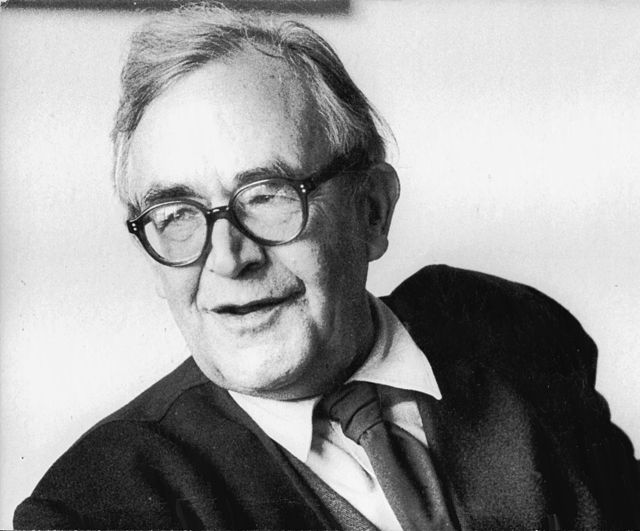
Wikipedia-karlbarth01

On the 80th anniversary of its signing, Dale Coulter looks back at the Barmen Declaration, a statement largely written by the theologian Karl Barth “on behalf of the German Evangelical Church, a federal union of Lutheran, Reformed, and United churches” that proffered a “resounding ‘no’ to the political agenda of the Third Reich.” One of its insights? Everybody worships something:

To frame everything in terms of acts of worship, as [the Barmen Declaration] does, places the situation squarely in terms of competing claims to lordship. As social animals, humans enter into a web of relations that make claims on their lives. In Augustinian terms, humans are made to love and whatever they do love functions authoritatively in their lives. Humans break the grip of one authority by finding another love, which is how conversions occur. Simply put, there is no neutral ground from which humans form moral and political judgments because such decisions embody an embrace of this authority or that authority. Since there is no freedom from authority, the question becomes what authority offers a genuine freedom—a freedom to live in the truth.

In its structure, the Barmen Declaration proclaims that genuine freedom is found in the message of grace from Jesus Christ who is the Lord of the church. This message flows through Barmen’s movement between affirmations of the Lordship of Christ and denunciations of other claims to lordship. There can be only one Lord of life, one true lover of soul and society. The state oversteps its boundaries and encroaches upon human dignity when it seeks to extend its authority into all areas of human life in the same way that the church ceases to be true to its own commission when it becomes an organ of the state. In its own way, the Declaration argues for religious freedom as not simply entailing private acts of worship, but also the guarantee of a public space for the institutional expression of religious commitment. To guarantee religious freedom is to acknowledge the limitations of the authority of the state to define the lives of its citizens. Part of the proclamation of the gospel is that the state cannot be Lord of life without turning into the beast.

Read the entire Barmen Declaration here.

(Photo of Barth via Wikimedia Commons)

Going Back To Where Christianity Was Defined

During his recent trip to the Holy Land, Pope Francis prayed with Ecumenical Patriarch Bartholomew I, the primary leader of Eastern Orthodox Christians, at the Church of Holy Sepulchre in Jerusalem. Afterward, Bartholomew announced that he and Francis were planning an ecumenical gathering in Nicaea in 2025, marking the 1700th anniversary of the Church council that gave Christians the Nicene Creed. Emma Green tries to decipher the news:

That’s a pretty big deal; in 1054, theological disagreements led to a schism in Christianity, which is how Roman Catholics and Eastern Orthodox Christians became separate faith traditions. This is a call back to a time before the schism, before the fundamental disagreements that kept popes and patriarchs from talking to each other for more than 900 years.

But the specifics are still pretty fuzzy. Will it be a formal ecumenical council, with leaders from the two faiths earnestly trying to reconcile their theological differences? Or will it be just what Bartholomew said—a celebration, full of meaningful dialogue but little actual change? Hard to tell, says Rocco Palmo, the author of the blog Whispers in the Loggia. 

“It’s 12 years away,” he pointed out. Trying to predict what will happen in 2025 is like an extreme version of confidently declaring who will be president of the United States in 2016—there’s just no way to know. Plus, Francis and Bartholomew are both in their 70s. Bartholomew said the pair wanted to leave this council “as a legacy to ourselves and our successors,” which seems like an acknowledgment that they could both be dead—or retired—11 years from now.

Michael Peppard adds:

The ongoing Catholic-Orthodox dialogue will be intensified in preparation for the event. What began in Jerusalem in 1964 and was celebrated last week at the Holy Sepulchre will continue in the holy city this fall, when, in Bartholomew’s words, “a meeting of the Catholic-Orthodox Joint Commission  will be held hosted by the Greek Orthodox patriarch Theophilos III. It is a long journey in which we all must be committed without hypocrisy.”

In all the attention to the Pope’s gestures toward political peace in the Holy Land last week, the joint event with the Orthodox got a bit lost in the mix. But Francis and Bartholomew didn’t lose focus. And they’ve got a date on the calendar to prove it.

Bart Gingerich, however, downplays what might happen at Nicaea 2025:

[B]efore my fellow Christians of a more traditionalist persuasion get too fired up, they must remember that this is not an ecumenical council itself. There is no heresy at stake. There is no summons from an emperor. Indeed, unless there is a very distinct order of business, Nicaea 2025 could possibly become a tremendous photo-shoot, with little effective action aside from some high-profile handshakes.

We must keep in mind that there is still much theological plaque that church leaders need to deal with in order to achieve a some kind of organic unity. First of all, the East and West have different views of sin and the Trinity. This fundamental disagreement comes in part to the influence of the Cappadocian Fathers on the East and St. Augustine of Hippo on the West.  Moreover, both communions have the “OTC syndrome.” The Roman Catholic Church and the Eastern Orthodox churches claim to be the exclusive “One True Church (TM)”; both are going to have to admit “We have been wrong for centuries” in order to have actual union. This takes no small amount of humility and may even open the door to the legitimacy of other communions and denominations. However, the more difficult issues may arise at the grassroots and in the local pulpits of the two communions. While Rome has developed and fallen in love with the concept of papal infallibility, outspoken critiques of “western rationalism” have become a homiletical staple in Orthodox circles.

A reminder of the theological issues separating east and west:

The two theological sticking points are the same now as they were in 1054. One is the pope. Orthodox Christians are happy with him as a figurehead, like the Queen, but are alarmed at the idea that he might intervene in their affairs or boss around their patriarchs. Catholic teaching, meanwhile, holds that the pope has “full, supreme and universal power”. The way around this is to define clearly the limited situations in which he might exercise jurisdiction over the east.

The other problem is the filioque. This refers to the words “and the Son” added unilaterally by the western church to the Nicene Creed (the summary of the Christian faith agreed on in the fourth century). This inflamed east-west relations so much that in 867 AD, Patriarch Photius of Constantinople called the pope who approved it a “heretic who ravages the vineyard of the Lord”. The change itself is a subtle one. It annoyed the Orthodox church though, because it believed that any amendment to such a central part of the faith should be agreed by consensus at a council. Most theologians now think the filioque issue is minor – that it is an acceptable variant between east and west. Yet that relaxed approach won’t go down well with many Orthodox Christians, for whom it is still a serious heresy.

Too Soon?

A reader replies to this thread on faking orgasms:

Your reader wrote: “You really want to get people talking? Start a thread about people who come too fast instead of not at all.”

I’m one of those guys, sometimes. My wife likes to sneak off to the bathroom at work and send me naughty snaps when she’s wanting to have some naked fun time that night. She keeps me primed all day to the point that, when we finally get down to it, I’m so hot I pop in sometimes less than a minute.

This was a big problem for me for a long time, assuming that my wife wasn’t getting satisfaction from our sex life. I always went down on her before the actual sex, so I comforted myself knowing she was at least having an orgasm. Finally, I asked her about it just to clear the air, and I was the only one with an issue. She loved that I came so fast, when it happened. Knowing that SHE got me that hot, that it was HER that I was so excited about, it made it even better for her even when it was short. She did confess that, occasionally, she would be disappointed with the brevity, but not often enough for it to be an issue. Still, now that we’ve talked about it, if it happens, we just wait awhile for the batteries to recharge (with lots of cuddling and continuing foreplay) and go at it again. “Problem” solved.

Another can relate:

I am apparently a rare creature  – a woman who often comes “too early.”

I’m also one-and-done on orgasms, which my husband knows. So if it happens too soon, I fake that I’m not having an orgasm; I hide it. Definitely being a woman is an advantage here. I have sometimes then faked a later orgasm, but usually I just show enthusiasm up until my husband finishes, at which point he often asks if I came, and I assure him yes, because I did. Not a lie! He does not ask for details on timing. I justify this act on the basis that I do not want him to feel rushed. I’ve tried to adjust him to my speed, and I’ve tried to get him on board with moves that slow me down, but neither of those worked, so the act continues.

Another female reader ventures into new territory:

I am so happy to see other women writing in to say they are not able to have orgasms during normal sexual intercourse. I’m not happy for them but I’m happy to hear it is not just me. I spent most of my 20’s believing something was seriously wrong with me. I can get myself there, but no one else was able to. I don’t think it’s psychological for me. I don’t get all up in my head when I’m having sex. I can usually let go and enjoy it pretty well. I just never orgasm unless I take matters into my own hands, so to speak.

In my late 20’s I met a man who is now my husband. After many months of being intimate I agreed to let him try anal sex with me. I had tried it before, but it was painful and not anything I wanted to try again. We started slow but eventually got there. I orgasm every time. Every single time. But only during anal sex. I can’t get my vagina to operate normally (at least that is how it feels in my head), but at least my butt is on board. It’s something. I often wonder if there are other women out there that can’t hit the big “O” vaginally but can with anal penetration.

Chris And Don’s Love Story

When he first started reading The Animals, the recently published love letters of Christopher Isherwood and Don Bachardy, Matthew Gallaway rolled his eyes at the couple’s pet names for each other – Isherwood was a variation on “horse” and Bachardy “kitten.” But he eventually saw something deeper was at work:

Isherwood and Bachardy were living openly in a society that was hostile to their relationship on several fronts — besides being gay, Isherwood was also more than 30 years older than Bachardy, who was only 18 when they met — and so they needed to create an imaginary world, one that (in [editor Katherine] Bucknell’s words) was “safe” and “entertaining” to the two men, when so many others in their situation succumbed to bitterness and self-loathing.

The animal device also allowed them to address issues of infidelity or — since they weren’t really cheating — “sexual freedom” that might otherwise have pulled them apart.

With Isherwood’s blessing, Bachardy spent many months away from their home in Santa Monica — in London, in New York, in continental Europe — in order to develop his artistic career and to see the world; Isherwood understood that to constrain the much-younger Bachardy would almost certainly have resulted in a breakup. That said, Isherwood was also not shy about inviting others he found attractive into his bed. Both men enjoyed many different lovers during the course of their relationship, but the letters are never graphic. The language they used helped them to navigate waters that are always dangerous, even — or especially — where both parties are being honest, and we see how it can perhaps soften the blow to Isherwood when Bachardy refers to other men as “bowls of cream” he may or may not reject during the course of his travels. To witness a couple, under this twee façade, balancing such obligations of commitment and desire feels very contemporary and somehow important, given how the conformity of marriage so often means that such things — even in the gay world — are still discussed in disapproving whispers, if at all.

In an earlier review of the book, Olivia Laing noticed the letters also contain all the gossip you’d expect from a prominent Hollywood couple who knew just about everyone worth knowing:

Although work is a regular topic of conversation (particularly Bachardy’s sometimes anguished attempts to find his métier), the keynote here is gossip. On Auden at 59, Isherwood notes, “Wystan can never possibly look older,” while Bachardy memorably describes Vanessa Redgrave as a “pod-born replacement for real humans”. Observations on the love lives of the beau monde are traded back and forth like cigarette cards (a pearl for the susceptible: Vivien Leigh’s private number in the 1960s was Sloane 1955).

Gossip is a leveller but one of the oddities of this capacious book is how similar the two voices sound, considering the vast gulf in age and experience, background and nationality. The struggle to bridge these gaps forms the great underlying drama of the letters.

And it turns out Bachardy holds his own as a man of letters when compared to his novelist partner:

One of the best surprises of the collection is what an excellent writer Bachardy is — wry, sharp and funny. In one letter, he describes the aftermath of an attempted suicide of a friend’s father, who left blood splattered on the carpet. Isherwood replies, “Your letter, with the truly horrendous diary excerpt, just arrived. I enjoyed it so much I quite forgot to feel sorry for anybody. Honestly, this is literature! The things you put in! Like Marguerite saying, ‘She’ll never get it out of the carpet!'”

Watch a video of Bachardy reading some of the letters here.

(Video: Trailer for the 2007 documentary Chris & Don)

Poems Are Not Selfies

Daniel Johnson traveled to Oxford to profile Geoffrey Hill, the university’s Professor of Poetry, describing him as a man born out of time:

By the time Hill came on the scene … the landscape had been transformed: the line between poetry and prose had been blurred, the laws of prosody had been suspended and poets were marginalised by or subsumed into other art forms, such as popular music. Poems too became primarily vehicles of self-expression. Like everybody else, poets had to compete for attention and celebrity. As schools no longer taught their pupils poetry by heart, the handful of verses that retained public affection acquired the status of secular icons. New poetry seldom achieves such recognition, for the very good reason that is rarely memorised or indeed memorable. Poets instead strove to reinvent their functions: as performance art for highbrows, icing on the secular wedding cake, or therapy for the deserted, the desolated and the dumped.

Against this, Hill champions a poetry of ideas:

“It is public knowledge that the newest generation of poets is encouraged to think of poems as Facebook or Twitter texts — or now, I suppose, much more recently, as selfies.” The mention of such an improbable neologism from such a source elicited an embarrassed titter from the audience, as if Hill had caught his academic peers indulging a secret vice.

“The poem as selfie is the aesthetic criterion of contemporary verse,” he continued. “And, as you know, in my malign way I want to put myself in opposition to this view. That is to say, the poem should not be a spasmodic issue from the adolescent or even the octogenarian psyche, requiring no further form or validation.” Hill came back to the theme in his vindication of [Gerard Manley] Hopkins, whose sonnets did not, he expostulated, deserve the condescension of posterity: “I do not think that they are Hopkins’s selfies.”

The underlying reason for Hill’s rejection of poetry as pure self-expression is that he sees such narcissism as beneath the dignity of his calling. He preaches, rather, what he has practised ever since his youth: a poetry of ideas. It is this determination to place ideas at the heart of his work that sets him apart from even his most celebrated contemporaries.

In a Paris Review interview over a decade ago, Hill defended “difficult” art in similar terms:

We are difficult. Human beings are difficult. We’re difficult to ourselves, we’re difficult to each other. And we are mysteries to ourselves, we are mysteries to each other. One encounters in any ordinary day far more real difficulty than one confronts in the most “intellectual” piece of work. Why is it believed that poetry, prose, painting, music should be less than we are? Why does music, why does poetry have to address us in simplified terms, when if such simplification were applied to a description of our own inner selves we would find it demeaning? I think art has a right—not an obligation—to be difficult if it wishes. And, since people generally go on from this to talk about elitism versus democracy, I would add that genuinely difficult art is truly democratic. And that tyranny requires simplification.

The Political Burroughs

The Junky author defied the red-blue divide:

[T]he young Burroughs’ hatred of the New Deal liberals who held power in North America didn’t keep him from embracing the anti-feudal, anti-imperial liberals dish_burroughs he encountered in South America. In Colombia he even gave his gun to a guerrilla boy. “Always a pushover for a just cause and a pretty face,” he wrote to [Allen] Ginsberg in 1953. “Wouldn’t surprise me if I end up with the Liberal guerrillas.”

In later years, conversely, he still didn’t have much praise for the federal government. In The Job—Daniel Odier’s book of interviews with Burroughs, published in various forms between 1969 and 1974—the novelist denounced the income tax (“These laws benefit those who are already rich”) and allowed what began as a rant about money to evolve into an attack on inflation. (“Money is like junk. A dose that fixes you on Monday won’t fix you on Friday. We are being swept with vertiginous speed into a worldwide inflation comparable to what happened in Germany after World War I.”) When Odier inquired about the assassination of Sen. Robert Kennedy, Burroughs began his answer with the sort of conspiracy theory you might expect from a hip ’60s liberal—”It seems likely that the assassination was arranged by the far right”—but then veered in a different direction, declaring that “the arrangers are now taking this opportunity to pass anti-gun laws, and disarm the nation for the fascist takeover.” On the rare occasion that Burroughs did manage to say something nice about the feds, he still couched his comments in libertarian language. In 1982, when Isaac Asimov’s Science Fiction Magazine asked him how he felt about the space program, he replied that it was “practically the only expenditure I don’t begrudge the government.”

Turns out he marched to the beat of a very different drummer:

Jack Black was a former hobo and burglar whose memoir You Can’t Win engrossed the teenaged Burroughs, leaving a lasting impact on both his outlook and his literary voice. … It was Black’s description of an underground code—and his scattered references to the beggars and outlaws who embraced that code as an extended “Johnson Family”—that gave Burroughs’ rebellious streak an ideological framework. A Johnson “just minds his own business of staying alive and thinks that what other people do is other people’s business,” Burroughs wrote in his 1985 book The Adding Machine. “Yes, this world would be a pretty easy and pleasant place to live in if everybody could just mind his own business and let others do the same. But a wise old black faggot said to me years ago: ‘Some people are shits, darling.'” In 1988, penning a preface for a reprint of Black’s book, Burroughs offered this account of the world’s core conflict: “A basic split between shits and Johnsons has emerged.”

Previous Dish on Burroughs here, here, and here.

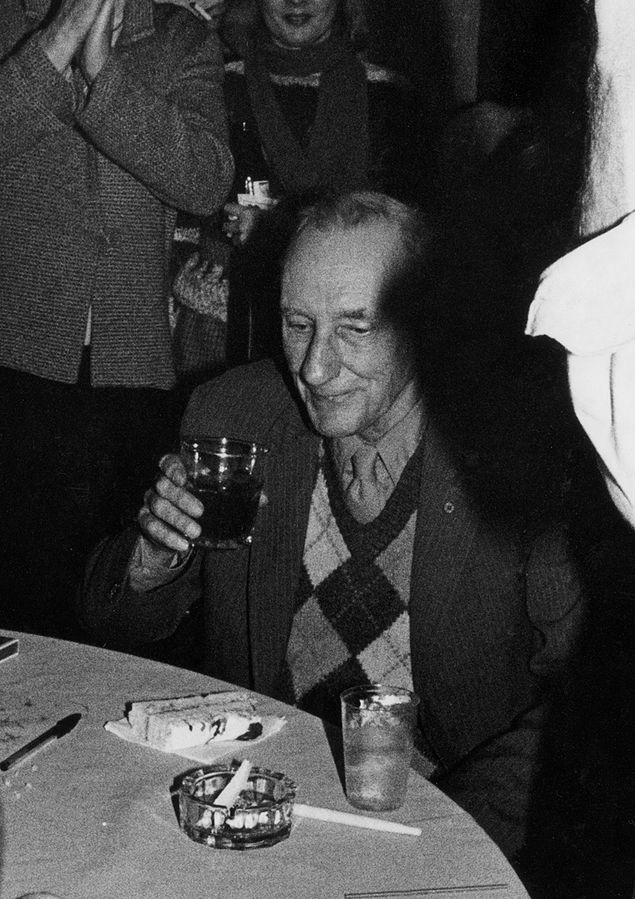
(Image of Burroughs at his 70th birthday party via Wikimedia Commons)