Feminism For Men

Noah Berlatsky wants more of it:

I don’t think feminism is only about women’s empowerment – or, at least, there have been other feminisms, too. Specifically, feminism often takes the form of critique, especially of misogyny. This is often defined as the hatred of women, but in her book Whipping GirlJulia Serano provides a broader definition. She says that misogyny is the “tendency to dismiss and deride femaleness and femininity.” In part, this involves deriding and devaluing women, but it also means devaluing any expression of femininity, no matter the gender of the person in question.

For example, misogyny means that people see bosses or those with hugely successful careers as being more important than those who stay home and care for their kids, because caring for kids is seen as feminine. Empowerment feminism tends to argue that women should be able to do anything that men can do. But there have also been versions of feminism that argue that what men do isn’t necessarily so great; that maybe, instead of leaning in to be the man, we should try to see if we can get to a place where no one has to be the man at all.

So one thing feminism is about, and has been about, is questioning what it is to be a man, which obviously affects men pretty directly. Women are the main victims of misogyny, because women are inescapably associated with femininity. But other people can suffer, too. Gay men, for example, are stereotypically seen as feminine, weak, frivolous, and helpless: “A pansy has no iron in his bones,” to quote the author Raymond Chandler in one of his more misogynistic and homophobic moments. Similarly, femininity is often seen as fake or inauthentic—a trope that is especially damaging for trans women and men, whose gender identities are often seen as unmanly, false, fake, or performed.
“Where Bad Taste Becomes Great Art”

It’s schlock music, according to Jody Rosen, who pens an impassioned defense of a tradition that “has given us our most indestructible songs, a tradition as time-honored, as sturdy, as it is maligned“:

Schlock is music that subjugates all other values to brute emotional impact; it aims to overwhelm, to body-slam the senses, to deliver catharsis like a linebacker delivers a clothesline tackle. The qualities traditionally prized by music critics and other listeners of discerning taste — sophistication, subtlety, wit, irony, originality, “experimentation” — have no place in schlock. Schlock is extravagant, grandiose, sentimental, with an unshakable faith in the crudest melodrama, the biggest statements, the most timeworn tropes and most overwrought gestures. Put another way: Schlock is Rodgers and Hammerstein, not Rodgers and Hart. It’s “Climb Ev’ry Mountain” and “You’ll Never Walk Alone,” not “Manhattan” and “My Funny Valentine.”

The word comes from the Yiddish shlak,meaning secondhand, or damaged, goods”:

Schlock has a close relative in another Yiddishism, schmaltz — a label often given to music that is swamped by goopy sentimentality, as a roast chicken is swamped by rendered fat. Much schlock music qualifies as schmaltz, or is at least very schmaltzy. But schlock is a broader category than schmaltz; it makes room for songs that are grandiose but less reliant on lachrymose sounds and sentiments. (Toto’s “Africa” is schlock but not schmaltz, concealing its torch-ballad bombast beneath a placid easy-listening arrangement.)

Other terms are sometimes used interchangeably with schlock: kitsch, cheese, camp. Schlock contains elements of these, but none are true synonyms. Schlock is more dignified than kitsch like “How Much Is That Doggie in the Window?” or Red Sovine’s tearjerker trucker ballad “Teddy Bear.” It is weightier, more substantial, than pure pop cheese like the Spice Girls’ “Wannabe” or novelty-song cheese Los del Rio’s “Macarena.” And while certain listeners embrace schlock, with both affection and condescension, as camp, schlock itself is allergic to the irony that is a prerequisite of camp. A karaoke singer might perform “The Rose” or “Every Rose Has Its Thorn” or “Kiss From a Rose” as a campy sendup, but Bette Midler and Poison and Seal take those songs seriously — offer up those roses on bended knee.

Schlock is earnest and solemn; it’s ambitious and aspirational and exalted. It shoots for the moon or, at least, for the penthouse suite.

(Video: “Until the Night,” Billy Joel’s surprisingly singular mention on Vulture‘s list of the 150 greatest schlock songs)

The Unfunny Fake News Racket

Emmett Rensin exposes it:

The Daily Currant is a fake-news site of a different stripe: one entirely devoid of jokes. Whether this humorlessness is intentional or notthe site’s founder contends his critics don’t have a sense of subtletythe site’s business model as an ad-driven clickbait-generator relies on it. When Currant stories go viral, it’s not because their satire contains essential truths, but rather because their satire is taken as truthand usually that “truth” is engineered to outrage a particular frequency of the political spectrum. As Slate’s Josh Voorhees wrote after Drudge fell for the Bloomberg story, “It’s a classic Currant con, one that relies on its mark wanting to believe a particular story is true.” …

The creators of these sites, when they can be identified at all, aren’t talking. With the exception of National Report, these sites don’t have mastheads. When they allow contact at all, it’s through blind submission formsnot always in Englishor generic email addresses. Most also use third-party services to mask the identity of the domain owner. Despite attempting to reach out to dozens of sites, I got only two replies. One was from Empire Sports News’s Aaron Smith, who said he was “possibly” willing to talk, but went silent at the first mention of ad revenue. Barkeley, of The Daily Currant, responded to my request for an interview with a brief email that read, “You’re more than welcome to do a takedown piece on our website. But you’ll have to do it without help. Good luck.” He ignored my follow-ups.

Daily Currant editor Daniel Barkeley writes in:

The passages you quoted seem to imply that we aren’t open with the media. That is 100% not true. I have done at least a dozen interviews with major news publications in the past few years. In this particular case, however, the journalist behaved in a manner I did not consider to be professional and wanted no part of the article.

It should be said that the Daily Currant has had some great parodies of Palin over the years – Dish links here and here.

Soviet Union 2.0?

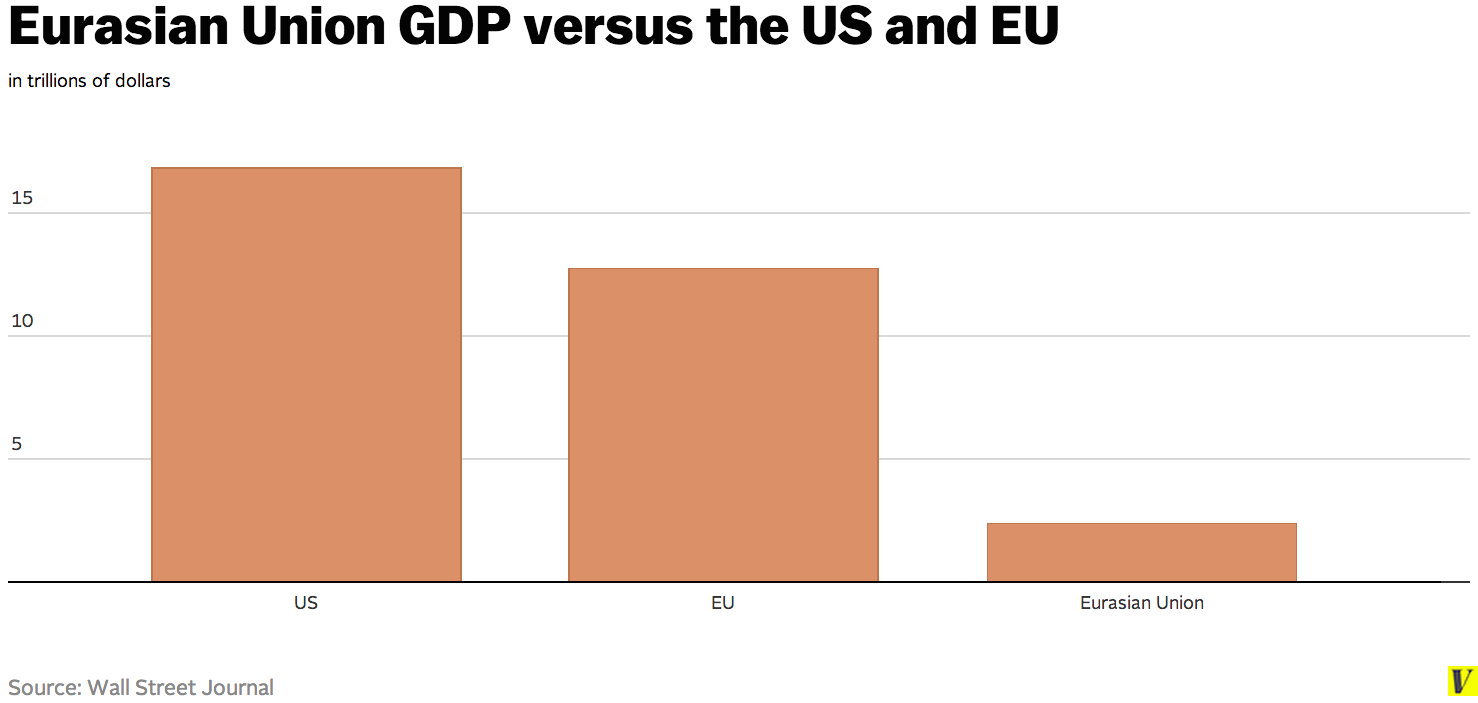
Eurasian_Union_GDP

The Eurasian Economic Union was officially founded last week with a treaty signed by Russia, Belarus, and Kazakhstan. Casey Michel doubts the new institution will do much to shake up the world order:

Modeled on the European Union’s economic constructs, the new union will represent a market of 170 million, and will boast a total GDP of nearly $3 trillion. The EEU will serve as the maturation of the current customs union shared by the three nations, and will allow further economic integration — increased free movement of goods, streamlined trade regulation, unified macroeconomic policy — between member states. And the EEU has potential to keep growing. If Putin somehow manages to woo the remaining post-Soviet (non-Baltic) nations, the EEU’s market could jump to some 300 million members and just under $4 trillion in combined GDP.

But that swell is far from plausible. Even before the EEU became official, members had many doubts about its benefits. Kazakhstan, Central Asia’s most dynamic economy, has failed to procure the expected benefit from membership in the customs union, and the EEU looks to continue the trend. Involvement with the current customs union has continued to delay Kazakhstan’s accession to the World Trade Organization, with the WTO citing “discrepancies” surrounding the external tariffs that will continue under the EEU. Meanwhile, Russia joined the WTO on its own, rather than as the bloc originally proposed.

Beauchamp is also skeptical, calling the union “weak and doomed”:

[I]f this is really Putin’s big plan, Brussels can probably breathe easy. The Eurasian Union is weak. It’s not much more threatening than Russia on its own is — which is to say, far less threatening than people seem to think.

Let’s start with wealth, the simplest point. Even including the two countries who haven’t joined yet but plan to — Armenia and Kyrgyzstan — the Eurasian Union mounts about a sixth of the European Union’s GDP. The vast majority of that wealth comes from Russia, so it’s not like Putin is getting access to huge new markets by signing this deal.

What’s more, Russia’s economy is suffering mightily in the wake of its Ukraine adventure: Western sanctions have sent its stock exchange and the value of its currency against the dollar in free fall. There’s just no way an expanded economic relationship with a series of much smaller countries could help Russia weather more economic punishment if it decides to expand its expansionist ambitions in Ukraine or outside of it.

Today’s Online Journalism Update, Ctd

A reader writes:

Regarding your brief reference to Copyranter’s piece on native ads, I’m more than a little shocked you didn’t focus on the other parts of his piece that seem to perfectly validate many of the accusations you’ve made against sponsored content and Buzzfeed’s business model. Here is how Copyranter characterizes the company’s ad strategy (and let’s not forget this is coming from a bonafide ad expert who wrote copy for 20 years):

… BuzzFeed’s native advertising runs directly against what makes a great ad great—an execution that memorably presents a product benefit (or the brand’s image). A great ad stands out and grabs you and entertains and informs you while delivering a message you remember, branding the brand’s name into your brain.

But more and more big brands are robotically onboard the BuzzFeed buzz saw, because they get to attach their commercials at the end of listicle posts that have nothing to do with their product’s benefit and, often, have nothing to do with their product at all (click the Kia ad). But lost-at-sea marketing managers get to show off an online thingamajig to their bosses with their brand name on it that has tens, and sometimes hundreds, of thousands of views. “Look at that viral lift, baby, massive eyeballs!”

And your readers should check out this completely damning personal account regarding Buzzfeed’s professed separation of their editorial and business departments:

But really: How “seriously” does BuzzFeed take the “separation of church and state?” During my 18 months working in their editorial department as an ad critic —what I was hired to be—I (the “state”) was emailed three times by three different staff account reps (the “church”) to “do anything I could” to help promote a new video ad by a then current BuzzFeed client. I was even emailed by Peretti (the “Pope”) to post about a Pepsi ad, where he helpfully included a suggested (positive) editorial direction.

As I was still fairly new at BuzzFeed, I figured I had to do the Pepsi post, right? I didn’t like the ad, I didn’t hate the ad, I would not have reviewed the ad, but the fucking CEO sent it to me! I wrote about it, positively, and posted it.

Later that same day, my post went to the front page, and there it sat, right below a “yellow” “featured partner” ad post about the same Pepsi video—written by a BuzzFeed in-house creative—with the same exact take on the ad. The headlines were even almost identical. Did Peretti know about the in-house ad? I don’t know. Ask him.

Sorry, I didn’t save a screen shot of this rather egregious church/state violation, or the email from Peretti, because I don’t think like a scumbag lawyer when I’m working for somebody. But I did delete my Pepsi post, immediately. It seemed the Mad Men thing to do.

“Traditional Masculinity Has To Die” Ctd

Douthat belatedly pushes back against DeBoer’s declaration that the “association of male value with aggression, dominance, and power is one of the most destructive forces in the world, and so it has to be destroyed”:

[H]e’s making an argument about “traditional masculinity” as something distinct from “sexism,” as a cultural problem unto itself — an unworkable model for male aspiration, a life-ruining ideal, that straitjackets today’s young men with its toxic, sex-and-violence-saturated demands.

And I just don’t quite know what he’s talking about, because in our culture — Western, English-speaking, American — the traditional iconography of masculine heroism doesn’t really resemble this “Grand Theft Auto”/”Scarface” description at all. I mean, yes, if the “tradition” you have in mind is Pashtun honor killings, then I agree, traditional masculinity would be better off extinct. But where American society is concerned, when I look at the sewers of misogyny or the back alleys of “bro” culture, I mostly see men in revolt against both feminism and our culture’s older images of masculine strength and self-possession, not men struggling to inhabit the latter tradition, or live up to its impossible/immoral demands.

I’m with Ross on this one, and largely because I’m convinced that many of the traits that Freddie wants to eliminate are integral to any creature, male or female, with high levels of testosterone. Now perhaps it’s worth elaborating on that a bit. The thing about testosterone is that it is affected by environment and can diminish in certain contexts. One of those contexts is fatherhood:

Among all of the fathers [studied], testosterone levels fell right after birth, and men who showed greater concern for and responsiveness to baby stimuli or had couvade symptoms [morning sickness] had larger drops in testosterone and larger increases in cortisol and prolactin. Men’s hormone levels correlated with their partners’; that is, in a man, testosterone and fellow travelers respond to the biosocial context—in this case the partner’s hormonal state.

There’s also evidence that marriage also lowers testosterone. In other words, it is possible to use culture to shift underlying biology to some extent. The disciplines of fatherhood, responsibility, marriage, domestication: all these help mitigate the ordeal of maleness. At the same time, the huge gap in testosterone levels between men and women means that the core reality will never go away: aggression, risk-taking, egotism are just part of the male package, to be mitigated but never erased.

And that’s why I have a core objection to the attempt to abolish what makes men different. In many ways, it’s an attack on our nature, a position of extreme prejudice against the essence of maleness. Yes, it’s sexist, demonizing an entire group of people for something over which they have no ultimate control. And I’m kinda tired of it, to be honest. Yes, it’s vital that male impulses be channeled and disciplined and educated in ways they tragically are not. But it’s also possible, even necessary, to celebrate male identity, to see in much of it the dynamism that fuels our societies and families and lives. Testosterone exists as the sole real distinction between men and women. And we would be far worse off without it.

Earlier Dish on the Freddie’s post here and here.

Modern Day Mary Magdalens?

The trailer for God’s Daughters, a documentary exploring the lives and ministries of Roman Catholic Womenpriests:

http://vimeo.com/90878911

In an interview, director Luc Novovitch considers the Vatican’s view of these women:

We have to be honest: the Catholic Church has never be a beacon of progressive or even open-minded thinking. They decided centuries ago that it was a men’s affair, and they will cling as long as they can to their power. Womenpriests must be a direct threat. They are open, simple, and authentic in their faith. They favor a loose and open organization. And they are qualified to be priests. One needs a Master of Divinity to be considered as a candidate. And if admitted, it takes years before being ordained.  Womenpriests are capable and serious, and that is competition for the male-dominated church!

JoAnne Viviano recently attended an ordination service by the Association of Roman Catholic Women Priests:

Bishop Bridget Mary Meehan, who presided over the ordinations on Saturday, said women served as leaders during the first 1,200 years of the church, that Jesus had many apostles who were women, and that it was a woman — Mary Magdalene — to whom he first appeared upon his Resurrection, instructing her to spread the good news.

Meehan told those gathered that “justice is rising up in the church” and that the women-priests movement ministers to people who do not have a spiritual home, including the divorced and remarried, gay people and women excluded from leadership roles.

“Jesus’ trademark is inclusiveness. There are no outsiders. All that is required is that we worship in spirit and in truth,” Meehan said.

The Calculus On Unconditional Welfare

Reihan rightly worries about New York mayor Bill de Blasio’s plan to ease the strict work requirements Michael Bloomberg had placed on the city’s food stamp program:

Is this a badly needed correction from the bad old days of Bloomberg? It is important to understand that, for better or for worse, the Bloomberg administration was very accommodating when working poor applicants sought to enroll in the food stamp and Medicaid programs. A big part of the reason was simply that the city government didn’t set the eligibility rules for these programs, and the federal and state governments had grown more permissive over time. But it also reflected a public philosophy that the billionaire mayor was never very good at articulating—that those who can work and choose not to do so are different from those who do not.

This is a distinction that advocates of an unconditional basic income see as pernicious and that those who want to ease up on work requirements see as needlessly punitive. But it is a distinction that makes eminent public policy sense.

Dylan Matthews tries to push back by defending the very “just give poor people money” approach that Reihan decries in his article, citing evidence from the field of international development:

A recent randomized trial found that Kenyans who received no-strings attached cash from the charity GiveDirectly built more assets, bought more goods, were less hungry, and were all-around happier than those who didn’t get cash. But voters and politicians generally prefer giving people specific goods — like housing, food, or health care — rather than plain old cash, for fear that the cash might get misused by unscrupulous poor people. Maybe the recipients will just blow the cash drinking! …

Now, the World Bank’s David Evans and Anna Popova are out with a new paper reviewing what evidence is out there about aid to the global poor and alcohol/tobacco consumption.* They found 19 studies which attempted to measure the effect of cash transfers — both no strings attached ones and ones families receive if they fulfill certain conditions, like school attendance — on the purchase and consumption of “temptation goods”; the studies contained a total of 44 estimates of cash’s effect in various contexts. 82 percent of those estimates showed that the transfers reduced consumption of or spending on alcohol and tobacco. The vast majority of those weren’t statistically significant, so the best conclusion is that there’s no evidence transfers affect drinking or smoking behavior.

All Is Not Well In Libya

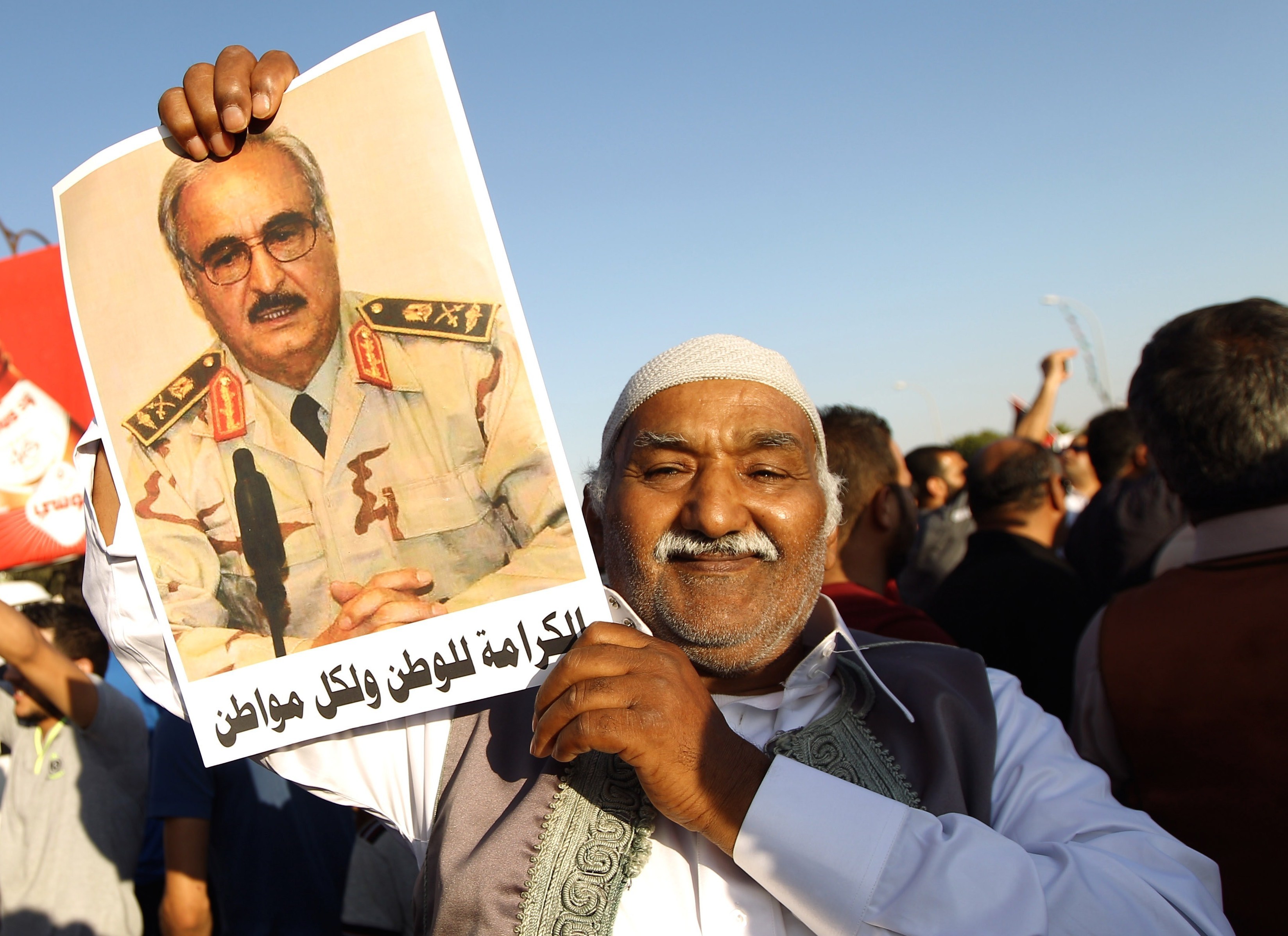
LIBYA-POLITICS-UNREST-DEMO

Ariel Zirulnick provides an update on the rogue Libyan general’s campaign to stamp out the country’s Islamist militias:

On Wednesday, that former general, Khalifa Haftar, survived an assassination attempt outside Benghazi, Libya’s second city. Meanwhile, in Sirte, a Red Cross worker was killed, and in Tripoli, a rocket-propelled grenade was fired at the prime minister’s office. Ahmed Maiteeq has only been in office since last month, and is Libya’s fifth prime minister since the removal of former dictator Muammar Qaddafi in 2011. Mr. Maiteeq was elected during a chaotic parliamentary session. Today he lost a court ruling on the legality of that election, Reuters reports.

Libya’s political instability has allowed armed groups to become as pivotal in the country’s direction as its elected leaders. Mr. Haftar says his unsanctioned campaign against Islamist militias is needed because the government is too weak to bring them to heel, but the government has decried his actions – which including airstrikes – as a coup. Haftar’s forces also stormed the parliament last week.

Mary Fitzgerald takes a closer look at Haftar’s motivations:

In interviews with Western media, Haftar has divulged few details on the goals of his campaign. The septuagenarian general refers to his effort as a “war on terrorism” and speaks vaguely about how this battle is “on behalf of the whole world.” When Haftar speaks to Arab media, however, it is evident he is targeting Islamists more generally.

“The main enemy,” he told the Saudi-owned newspaper Asharq Al-Awsat, “is the Muslim Brotherhood,” whose affiliated political party holds the second-largest number of seats in Libya’s elected national congress. Haftar vowed to purge the Islamist movement from Libya, referring to it as “this malignant disease that is seeking to spread throughout the bones of the Arab world.” He insisted he does not want to seize power, but would run for president if “the people demand it.”

As Hanan Salah sees it, Haftar’s campaign is a product of Libya’s total security breakdown, especially in Benghazi:

The steady drumbeat of violence over the past three years has undermined the authority of successive governments, and laid the groundwork for Haftar’s campaign. The earliest attacks were straightforward, targeting the Qaddafi-era state security forces and judiciary. But that has now changed: The victims now include journalists and activists who opposed former dictator Muammar al-Qaddafi during the 2011 uprising, but who dare to criticize the militias, Libya’s new masters.

I have heard dozens of judges, activists, and journalists in Benghazi express helplessness and fear of being next in line. Many have fled as a result. Some have also voiced concerns that inaction by authorities means acquiescence. “What are they [the government] waiting for?” one prominent former judge asked me. “Do they want us all to get killed before they respond?”

Noting that Haftar’s Islamist foes have labeled him an American agent, Wayne White warns that now might be a good time to evacuate the US embassy in Tripoli:

If the very core of governance can be struck so easily, any thought of meaningful local assistance to resist a violent attack against the US embassy is misplaced. And, with embassy staff shielded by defensive walls only meant to slow down attackers, plus a small US Marine security guard contingent not meant to resist a determined attack, reliable local government security is needed for protection. This is true for US embassies around the world. Moreover, aside from the endemic violence that’s now pervasive, it’s not even clear which parts of the government — let alone militias supposedly working for the government — currently answer to whom.

Previous Dish on Libya’s security woes here.

(Photo: A Libyan carries a portrait of retired general Khalifa Haftar during a rally in support of the rogue former general whose forces have launched a ‘dignity’ campaign to crush jihadist militias on May 23, 2014 in Benghazi, eastern Libya. By Abdullah Doma/AFP/Getty Images)

Why Do Dads Stay Home?

The number of stay-at-home fathers is on the rise. But reasons for that increase aren’t all positive:

Stay At Home Reasons

Olga Khazan mentions the fact that “mothers are still more likely to stay at home because they think it’s the best way to raise the kids; fathers are more likely to do it because they physically can’t work outside the home”:

These fathers’ lack of options reflects in their educational attainment and on their families’ financial situations: Dads who stay at home are twice as likely to lack a high school diploma as working dads, Pew found, and they’re far more likely to be ill or disabled than stay-at-home mothers (35 percent to 11 percent). Importantly, nearly half of stay-at-home dads live in poverty (47 percent), while only 34 percent of stay-at-home mothers and 8 percent of working fathers do.

But Yglesias contends that the trend isn’t all economic:

Each time the economy recovers, the share of stay-at-home dads declines. But it doesn’t decline all the way back to where it was before the recession started. The business cycle, in other words, seems to intersect with shifting gender norms. If the economy keeps recovering, we should expect to see more and more dads reenter the labor force (moms too) but there likely will be a more lasting impact.

Claire Cain Miller agrees:

[T]aking a longer view shows a marked increase in the number of stay-at-home fathers, to 2 million in 2012 from 1.1 million in 1989, according to Pew. Even if fathers who can’t find jobs are excluded from the data, there is still a notable increase since 1989 in stay-at-home dads, said Gretchen Livingston, a senior researcher at Pew and an author of the report.

The most telling change is that just over a fifth of at-home fathers say the main reason they are home is to care for family, up from 5 percent in 1989, and that segment is the fastest-growing.