Lady In Waiting

Hillary Clinton Awarded The 2013 Lantos Human Rights Prize

Here’s a question to send shudders up anyone’s spine:

Will new Whitewater papers reveal that the real estate deal was really a conspiracy to sell heroin?

That’s a throwaway line in a classically judicious piece from the greatest-ever Clinton-watcher, Joe Klein, as he challenges Hillary Clinton’s “inevitability” before her new (probably unreadable) book launches next week:

She can be prohibitively “political” and far more cautious than she needs to be. The trouble is, presidential campaigns can’t be managed like book tours. They tend to be overwhelmed by events and trivialities. There is a constant gotcha contest with the press. In a recent Politico article about Clinton and the press, one of her advisers is quoted: “Look, she hates you. Period. That is not going to change.” To make things worse, her top communications adviser, Phillippe Reines, argued that Clinton didn’t really hate the press. She brought bagels to the back of the bus. But bringing bagels to the back of the bus is an embarrassingly transparent ploy. Bringing candor to the back of the bus might be a little more successful. I’ve seen her candor more than once, but always off the record. That will have to change. If Hillary Clinton hopes to succeed, she’s going to have to drop the veil–spontaneously, quite possibly in a crucial moment, like a debate–and trust the public to accept who she really is. Absent that, there is no such thing as inevitability.

Keep the veil, Madame president. Just give us some indication that you are not calculation through and through. And, yes, dear reader, I’m doing my best to remain upbeat about the coming campaign, but Joe’s description of his own feelings mirror my own (and not for the first time):

I approach the coming spectacle with a combination of obsession, exhaustion, dread and exhilaration.

I’d also add deja vu. Alas, despite recent Brian Schweitzer boosterism, Kilgore fails to see which Democrat can beat Clinton:

The last crosstabbed assessment of HRC’s popularity was conducted by Public Policy Polling back in March. Her favorability rating among self-identified Democrats stood at 83% (Obama’s is currently at 79%, according to Gallup). Among those calling themselves “very liberal,” HRC’s at 91%, and at 77% with “somewhat liberal” voters (Obama’s at 70% among “liberals” of every variety, though he’s up to 81% among “liberal Democrats.”). Among African-Americans, HRC’s favorables are at 80%, and among Hispanics, 60% (Obama is now at 87% and 51% in these demographics, respectively).

Do you see a leftward path to the Democratic presidential nominations against HRC in any of these numbers, particularly if it involves trashing Obama as well as HRC? I sure don’t. Yes, Obama was able to significantly cut into HRC’s high standing among African-Americans in 2008 for obvious reasons; if Brian Schweitzer has any documented appeal to minorities other than perhaps Native Americans, I must have missed it.

(Photo: Win McNamee/Getty Images)

“An Architecture Of Containment”

The Irish government is considering a wider inquiry into the possibility of many more mass graves for abused and neglected children across the island. The legacy of this evil system – deeply rooted in the church and the state – could emerge as something even darker than we have Tuam Crossjust witnessed. What we’re looking at is an entire society designed to make undesirables invisible – the “wayward” young women, and their stigmatized illegitimate children. And the point of that forced invisibility and, in the case of children, mass death, was to uphold the Catholic doctrine that regards sex as something so dangerous, that any exception to the one-partner-for-life-and-babies rule had to be extinguished from view. And that, of course, also applied to the other unmentionable class of people who could not live up to this rigid, punitive ideology: gay people. In Ireland, homosexuality was decriminalized as recently as 1993.

This is the social architecture necessary to ensure that the godly republic of Rod Dreher’s dreams actually could exist in the modern world. This is what you need to prevent fallible human beings from infecting society with their Satanic impulses. The Magdalene Laundries were really a kind of gulag for sexual miscreants:

[Boston College professor and activist] James Smith refers to it as Ireland’s “architecture of containment,” and that’s exactly what it was. You had these industrial schools, the Magdalene laundries, the mother and baby homes, all with different remits, but the basic model was to contain and segregate anything that was deemed morally inferior by society, whether that’s children, unwed mothers, the women in the Magdalenes, etc.

The mother and baby homes were different in that they were regulated by the state and had to be accredited adoption societies, at least by 1952, which is when that became legal in Ireland. They received stipends from the day they opened, from the government. They were receiving the equivalent of an industrial wage at that time for each mother and baby, from the state. If that were the case, why were so many of these women, like my mother or Philomena Lee, expected to earn their keep if the state were in fact funding that? It really doesn’t make a whole lot of sense. Obviously there was some profit being made there, not to mention what half of our parents paid. That’s another story unto itself. Adoptive parents were “donating” huge amounts of money.

So these homes were both labor and internment camps. And the inmates were deemed beneath any empathy or decency. What’s impressive about the thoroughness of this vision of theocon perfection is that it extended even to the children of such wicked women.

The sexual theology was so all-important no other values – not even protecting the innocent and vulnerable – could be allowed to dilute it. At the apex of this system, of course, is the celibate priesthood, whose sexuality is also simply regarded as non-existent, whose human needs and urges are made invisible as well, even as their damaged psyches – damaged by the same theology that created the gulags – led them to the mass rape and abuse of other children.

This is a form of Christianity which treats children as objects to be raped, neglected or left to die. It is a reminder of how foul and dangerous the union of church and state can be, and of how utterly distortive sexual repression and delusion can be. Here’s what the Catholic church is when its sexual repression is its first and fundamental value: a church that essentially aborted its unwanted children – but only after brief wretched lives of abuse, neglect and sickness.

The Snowden Year

dish_snowden

Yesterday marked one year since The Guardian published the first of Edward Snowden’s NSA leaks. The Electronic Frontier Foundation lists 65 things we have discovered about the NSA since last year. But, for Elizabeth Goitein, what’s striking is how little has changed in terms of the law and how the NSA does its business:

[B]ulk collection – the NSA program that has been most controversial among Americans and that has the weakest security justification – continues. Last month, the House was poised to approve a bill, the “USA Freedom Act,” which would have ended the practice. But in 11th-hour talks behind closed doors, intelligence officials prevailed on House leadership to introduce a loophole, allowing the government to choose the “specific selection terms” it would use to identify records for intake. It is now unclear, at best, how “bulky” the government’s collection might be under the bill. There has been even less progress toward ending so-called “back door searches” of actual communications content.

And the damage to America’s international reputation – especially among allies – endures:

Prior to these disclosures, the United States was considered a world leader in promoting Internet freedom. It made it a signature part of American foreign policy and spent millions of dollars supporting new tools to protect the digital privacy of human rights activists globally. But the last year has deeply undermined global trust in U.S. leadership in this area, not to mention its commitment to the rule of law and transparency in government. If this trust continues to erode, it will have huge ramifications for U.S. business and foreign-policy interests. Technology companies are already losing billions of dollars and overseas customers who want their data stored away from the snooping eyes of the U.S. government.

Timothy Lee looks into how Reset the Net, a DIY data privacy campaign supported by big tech companies and organizations like the EFF, is advising us to protect ourselves:

For your cell phone, Reset the Net recommends ChatSecureTextSecure, and RedPhone.

As the names suggest, these products enable users to communicate securely over instant messaging, text messaging, and voice calling. Reset the Net also encourages users to set a password on their phone so its contents can’t easily be accessed by criminals or the police.

For your Mac or PC, the bundle includes secure instant messaging software (Adium for Mac or Pidgin for PC) as well as Tor. Tor is software that helps preserve your anonymity by allowing you to browse your address without revealing where you’re browsing from. Users are also encouraged to activate full-disk encryption. Finally, Reset the Net has tips for improving password security. You should avoid re-using the same password on multiple sites. Instead, keep track of your passwords with a password manager or just write them down on paper.

Madeline Karr provides some critical perspective on the campaign:

It is perhaps questionable whether this campaign offers a real solution, despite the big names involved. There are more than 2 billion people online and an awful lot of them will have to install encryption and privacy tools for this campaign to have any meaningful impact on mass surveillance programmes such as Prism. It may well be that Reset the Net will be the very thing it doesn’t want to be – a public pressure movement rather than a practical solution.

It’s also interesting to see the campaign neglecting to address the role of the  in hoovering up our data in the first place. The relationship between internet giants like Google and the US intelligence community remains ambiguous so their advice about locking out spies might be a little hard to swallow. Prism couldn’t exist without the sea of  that these corporations collect and redistribute hourly as part of their commercial activity.

But how, pray, are these not also guides to potential terrorists to avoid the NSA dragnet? I remain of the view that Snowden’s leaks have largely justified themselves. But I still cannot get too exercized by the US government trying to stymie and prevent terror attacks using the West’s only real ace card: our technological superiority. It sure beats rendition, invasion, occupation and torture. It’s only if you believe that the Islamist threat is a fiction, as some in the civil liberties brigade do, that you can dismiss this argument. For me at least, it remains dispositive.

(Photo by Flickr user ubiquit23)

Americans Hate Deserters

bergdahl1

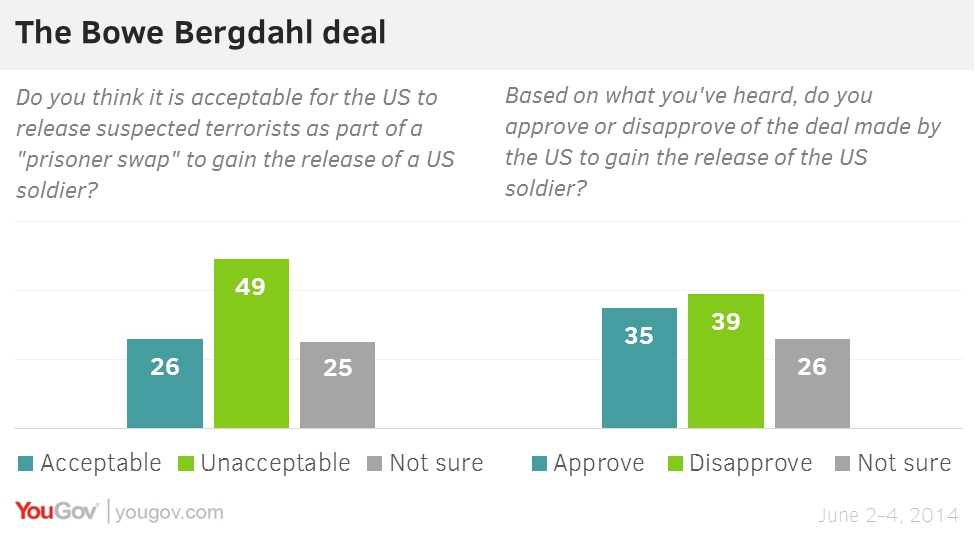
A YouGov poll finds the public split on whether trading five Taliban for Army Sgt. Bowe Bergdahl was a good idea. The opposition stems entirely from Bergdahl’s alleged desertion:

If the allegations about how Bergdahl was captured turn out to be true, support for the deal could fall even further, particularly among Republicans. Only 24% of Americans think that the government even has a responsibility to try and rescue a deserter who is captured by enemy combatants. This compares to 82% for soldiers that get lost and captured, 87% for soldiers who are wounded and captured. Even for soldiers that surrender to the enemy, most Americans (57%) think that the government has a responsibility to rescue them.

But how can you know if someone deserted if you cannot even question him? That question wasn’t asked. Meanwhile, Jonathan Bernstein doubts the controversy will affect the midterm elections:

My guess is that the flap here already had its desired effect. Getting a captured soldier home was a potential rally-around-the-flag moment that might have lifted the president’s approval rating. However, political scientist Richard Brody found long ago that the rally effect depends on one variable: whether the out-party praises or criticizes the president. So the immediate Republican attacks surely had the effect of preventing an approval boost. Not that it matters much anyway; the whole idea of the rally effect is that it’s a temporary boost. So that didn’t and won’t happen. After a few weeks, approval will be back to where it would have been anyway.

I remain of the view that the administration’s attempt to milk this for approval ratings is the one abiding, dumb-as-a-post misjudgment of the whole thing.

The Known Unknowns About Bowe Bergdahl

Scrutinizing Bergdahl’s last e-mail to his parents before he allegedly fled his unit, John Cassidy doesn’t see the right’s preferred story about Bergdahl holding up:

Does this e-mail prove that Bergdahl was a deserter or even, as some right-wing commentators are suggesting, a traitor who aided Screen Shot 2014-06-03 at 1.10.34 PMand abetted the Taliban? No, it doesn’t. If anything, he sounds more like Captain Yossarian, the antic antihero of Joseph Heller’s “Catch 22”—who considers his superiors to be nuts and eventually goes AWOL—than Sergeant Brody, the double-dealing protagonist of “Homeland.” In his early twenties, engaged in a war on the other side of the world that many people, including his Commander-in-Chief, would ultimately decide was counterproductive, Bergdahl, seemingly, had had enough.

And that, for now, is about all we know. “As for the circumstances of his capture, when he is able to provide them, we’ll learn the facts,” General Martin Dempsey, the chairman of the Joint Chiefs of Staff, said in a statement on Tuesday. “Like any American, he is innocent until proven guilty.”

Also complicating the narrative is a military report from 2009 suggesting that Bergdahl was known to wander off:

It happened both in Afghanistan and while he was training in California. The report concludes that Bergdahl was likely wandering around off-base the night he disappeared in June 2009, says the Timeswhich spoke to people briefed on the 35-page document.

As for whether the disappearance was due to carelessness resulting in capture or willful desertion, the report doesn’t say. It does, however, lend credence to the former theory, criticizing lax security and poor discipline among Bergdahl’s unit that would allow his tendencies to wander to go unchecked. Perhaps most significantly, the report makes no mention of the letter Bergdahl reportedly left in his tent announcing his desertion. Nor does it corroborate claims from Bergdahl’s former squadmates that he was making radio calls trying to get in touch with the Taliban.

Tuccille sympathizes with Bergdahl, arguing that it should have been easier for him to leave the Army when he became disillusioned with the mission in Afghanistan:

American troops have engaged in continuous war in Afghanistan since 2001, so nobody can claim that they don’t know that military service might require actual military service. Then again, military recruiters focus on the young not just because they’re physically fit, but also because they have little perspective on what they’re getting themselves into. More than a few studies have found that recruiters tend to be a bit shaky on the details and potential consequences of enlisting—a choice that, at least potentially, locks enlistees into a situation with high stakes.

Even in the age of the Internet and non-stop news cycles, concepts like combat, injury, and death can be abstract concepts for an 18-year-old. So if Bowe Bergdahl decided that the bill of goods he was sold didn’t live up to the advertising—especially if he began to have moral qualms about his duties—I’m pretty sympathetic.

Sanity Breaks Out On The Right On Bergdahl

Screen Shot 2014-06-03 at 1.10.34 PM

Put Krauthammer‘s and Brooks’ columns together today and you have – finally – a sane conservative response to the unsavory necessity of the Bergdahl deal. There are several core arguments. First, the importance of leaving no soldier behind as a critical rampart of national solidarity and military tradition. Second, the tough, rough and cold-hearted calculus of exchanging POWs as something that commanders in chief have to do from time to time. Third, the use of executive power here, as I have argued, as about as defensible a use of it as any. Krauthammer is very good on this:

Of all the jurisdictional disputes between president and Congress, the president stands on the firmest ground as commander in chief. And commanders have the power to negotiate prisoner exchanges.

Then on the question of Bergdahl’s conduct itself, the obvious response is to get the man home, investigate fairly and exhaustively, and subject him, if necessary, to military justice. I suppose Krauthammer feels the need to placate the spittle-flecked with this line:

If he’s a defector — joined the enemy to fight against his country — then he deserves no freeing. Indeed, he deserves killing, the way we kill other enemies in the field, the way we killed Anwar al-Awlaki, an American who had openly joined al-Qaeda.

But the sequence of events is right. There’s no way to investigate a possible deserter or defector until you have him stateside. The right cannot have it both ways: either he should be disciplined as a traitor or he should be left behind to the Taliban’s clutches. You have to choose – which, of course, the GOP never does.

So what are we left with, after all this sturm and drang? I’d say one genuine criticism – that the announcement of the POW exchange was far too celebratory, and that the tone was seriously off.

And it’s hard not to agree with that. It may have been an accident of circumstance – the family readily available. Or a function of genuine sentiment of a commander-in-chief for the parents of a soldier lost for five years. But it was dumb and smacked of some notion of political gain for a necessary act of war.

What is Obama’s long-term strategy on this? That’s the shoe that hasn’t dropped. But he’s set a precedent: the departure from Gitmo of five prisoners not cleared for release. Once that bar has been set and the ugly reality of having to end this failed war becomes more widely felt, the possibility of releasing innocent prisoners or those deemed low-level functionaries (at best) becomes, perhaps, a little more feasible. Slowly but surely, the president is fulfilling his election promises: economic recovery (with the workforce now back to its pre-recession level), the end of both wars, universal healthcare, action on climate change, and a civil rights revolution for gays. Is it too much to dream that, eight years after his executive order was stymied by a scaredy-cat Congress, in the closing of Gitmo, Obama may have been saving the best for last?

Against Grading Colleges On Their Perks

Pivoting off the Dish’s conversation regarding college rankings, Freddie rails against “the Gyms, Dorms, and Dining Halls school of recruiting top students to your college”:

It’s a truly misguided waste of resources from an educational standpoint, and a massive mistake, but it’s also perfectly rational from the standpoint of administrators trying to attract the most competitive students: these things work. Having the best faculty doesn’t work. Having a great graduation rate doesn’t work. Placing lots of students in jobs doesn’t work. What works is the “Club Med plus classes” approach. I have a lot of friends in the academy, in many different schools and positions, and what my admissions officer friends tell me is that internal surveys and research find again and again that students on visits comment on those facilities — gyms, dorms, and dining halls — more than any other aspect.

He goes on to argue that, “if our discussion of student loan debt and the cost of college is to be useful, we have to start to interrogate how undergraduates themselves contribute to these problems”:

Clearly, these students are part of a larger system that has failed many of them and many of the people like them, and ultimately accountability resides with the whole system. But it’s remarkable how much pushback I get from the very students who risk being saddled with huge student loan debt in their near future. When I wrote that piece about Purdue’s gym, I got praise and encouragement from professors, from administrators, and even from Purdue president Mitch Daniels himself. The people who didn’t like it were Purdue undergrads. I got quite a few nasty emails when that piece came out, from undergrads. The general sentiment was to ask, so you think we don’t deserve a good gym? I simply responded that it seemed sensible to me to build, say, a $15 million gym and save the $75 million to keep tuition down, maybe build a new English building to replace our current crumbling monstrosity. There was a total disconnect from the fact that a $90 million gym represents a huge opportunity cost, one that ultimately, they pay for, even if the gym was funded largely by outside funding.

For The Narcissist In Your Life

New research suggests a way to get them to feel empathy:

Psychologists have long thought that narcissists were largely incorrigible—that there was nothing we could do to help them be more empathetic. But for a new study in the Personality and Social Psychology Bulletin, [Erica] Hepper discovered a way to measurably help narcissists feel the pain of others. …

Hepper and her co-authors asked a group of 95 female undergrads to take the same narcissism quiz, and then later to watch a 10-minute documentary about Susan, a victim of spousal abuse. Half were told to try to put themselves in Susan’s shoes (“Imagine how Susan feels. Try to take her perspective in the video…”), while the others were told to imagine they were watching the program on TV one evening. The subjects who were told to take Susan’s perspective were significantly more likely to score higher on empathy. In fact, the more narcissistic they were, the more the trick seemed to work.

“I think what’s going on here is that people who are low on narcissism are already responding to people—telling them what to do it isn’t going to increase their empathy any further,” Hepper said. “But the higher on narcissism you get, the less empathy [you feel]. By instructing them to think about it, it activates this empathic response that was previously much weaker.”

Israel’s Marriage Laws

Ariel David explains them:

There is no civil marriage. Jews can only be married in a religious ceremony, by an Orthodox rabbi under the authority of the Chief Rabbinate, the top religious authority for Jews in Israel. This means there is also no interfaith marriage between Jews and non-Jews, since Orthodox Judaism does not allow mixed unions.

Israelis who belong to other streams of Judaism, such as Reform or Conservative, must still tie the knot in front of an Orthodox rabbi in a traditional ceremony if they want their marriage to be recognized by the state.

Other religious authorities recognized by Israel, including those of Muslims and of Christian denominations, also do not perform interfaith marriages, so a Jew cannot marry a Muslim or a Christian unless one member of the couple converts to the faith of his or her partner. (Islamic law technically allows for a Muslim man to marry a Christian or a Jewish woman, as long as their children are raised Muslim, but Muslim clerics and scholars frown on the practice.)

What Tiananmen Meant To Moscow

Sergey Radchenko places the 1989 Tiananmen Square protests and ensuing massacre in geopolitical context, focusing on Soviet premier Mikhail Gorbachev’s visit to Beijing just weeks before the event:

The Soviet delegation was stunned by the scale of the protests. “This is a revolution,” concluded Gorbachev’s confidant Yevgeny Primakov, who had been a prominent advocate of rapprochement with Beijing. “Could it not be,” wondered Teimuraz Stepanov-Mamaladze, an official at the Soviet Foreign Ministry, “that we normalized relations with political dead men?”

Gorbachev himself was worried and relieved in equal measure — worried because he had found himself in the epicenter of a national upheaval, and relieved because at least it was not his nation. “Some of those present here,” he told members of his delegation on May 15, “have promoted the idea of taking the Chinese road. We saw today where this road leads. I do not want Red Square to look like Tiananmen Square.”

Jay Ulfelder considers how things could have turned out very differently both in China and in the USSR, where reactionaries in the government attempted to stop Gorbachev’s reforms with a clumsy putsch in August 1991:

That August Putsch looks a bit clowny with hindsight, but it didn’t have to fail. Likewise, the brutal suppression of China’s 1989 uprising didn’t have to happen, or to succeed when it did. In a story published this week in the New York Times, Andrew Jacobs and Chris Buckley describe the uncertainty of Chinese policy toward the uprising and the disunity of the armed forces tasked with executing it—and, eventually, the protesters in Tiananmen Square.

“At the time,” Jacobs and Buckley write, “few in the military wanted to take direct responsibility for the decision to fire on civilians. Even as troops pressed into Beijing, they were given vague, confusing instructions about what to do, and some commanders sought reassurances that they would not be required to shoot.” Seven senior commanders signed a petition calling on political leaders to withdraw the troops. Those leaders responded by disconnecting many of the special phones those commanders used to communicate with each other. When troops were finally given orders to retake the square “at any cost,” some commanders ignored them. At least one pretended that his battalion’s radio had malfunctioned.

As Erica Chenoweth and Maria Stephan show in their study of civil resistance, nonviolent uprisings are much more likely to succeed when they prompt defections by security forces. The Tiananmen uprising was crushed, but history could have slipped in many other directions. And it still can.