Sex-Selective Abortion In America? Not So Much.

Molly Redden calls attention to new research that debunks the rationale behind bans like the one South Dakota enacted in April:

Notably, [the authors] examine two papers that comprise the only empirical support that proponents of the ban can point to for their arguments. These two 2008 papers, by economists Lena Edlund and Douglas Almond, show that when foreign-born Chinese, Korean, and Indian women have two daughters, their third child will tend to be a son—a trend that suggests sex-selective abortions are being performed, ban proponents say. Both papers rely on census data that is nearly 15 years old. The University of Chicago study, using newer data from the 2007 and 2011 American Community Survey, found that when all their children are taken into account, foreign-born Chinese, Korean, and Indian parents actually have more daughters than white Americans do.

The study also notes that India and China are not, as proponents of these bans claim, the only countries with male-biased sex ratios. In fact, the countries with the highest ratios are Liechtenstein and Armenia.

“This really should come as no surprise,” Emily Bazelon writes:

If you want to control the sex of your child, the easiest way to go is a method called sperm sorting. If legislators really cared about preventing this, that’s what they’d try to ban. And yet, as Hanna Rosin pointed out a few years ago, American parents who turn to sperm sorting increasingly are trying to have …

girls. “A newer method for sperm selection, called MicroSort, is currently completing Food and Drug Administration clinical trials,” she wrote in the Atlantic. “The girl requests for that method run at about 75 percent.”

In Liechtenstein, Armenia, Hong Kong, Azerbaijan, China and India, the problem of parental preference for boys is a real one. But in the United States, it’s a canard. And there is nothing feminist about invoking it to make abortions harder to get.

And Callie Beusman underscores that making abortions harder to get was the point of these bans all along, adding that their proponents have even said so explicitly:

[I]n a 2008 article quoted by the study, an influential conservative thinker wrote that “key to eroding Roe v. Wade. . . is to pass a number of state or federal laws that restrict abortion rights in ways approved of by at least fifty percent of the public,” such as “a ban on abortion for sex selection.” Many anti-choice groups have taken up this call and created model legislation to ban sex-selective abortion. Meanwhile, after Illinois and Pennsylvania enacted bans in 1984 and 1989, the ratio of boy to girl babies being born in those states remained totally unchanged. So these laws literally accomplish nothing, save for subjecting women seeking abortions to undue scrutiny.

Keeping women from having autonomy over their own bodies is ghastly and retrograde. Cloaking these intentions in rhetoric that feigns to protect women while spreading harmful untruths about Asian American communities is simply unconscionable.

Previous Dish on South Dakota’s sex-selective abortion ban here and here. Further Dish on the issue more generally here.
Yeah, Secret Service, Like That’s Gonna Happen

The agency is looking for an intrepid software developer to create a sarcasm detector for social media. Mary Beth Quirk sums it up thus:

Basically, the Secret Service would love it if someone would explain the Internet so it doesn’t go around arresting sarcastic people with itchy social media trigger fingers.

Another thing that sounds a bit weird?

The software will have the “functionality to send notifications to users.” Because that wouldn’t freak someone out to get a popup window from the Secret Service just being like, “Hey, did you mean that like, for real? Or are you being sarcastic? Thanks, juuust checking in!”

But Jesse Singal doubts they’ll come up with anything:

One study from 2011 (PDF) used tweets that had been specifically hashtagged #sarcasm or #sarcastic, stripped those hashtags, and then dumped them into a virtual pile with a bunch of other straightforwardly positive and negative tweets. At their best performance, the computer programs the researchers used could only correctly separate sarcastic from non-sarcastic tweets about 65 percent of the time — and this was in a rather controlled setting.

Bing Liu, a University of Illinois at Chicago computer scientist who authored a book about sentiment analysis (that is, extracting emotional context from text), expressed skepticism that anyone yet has a good handle on this problem. “I am not aware that anyone has a satisfactory algorithm or system that can detect sarcastic sentences,” he said in an email. And the stuff the Secret Service would be looking at would be a particularly uphill battle: “In discussions about politics [sarcasm] is fairly common and very hard to deal with because it often requires some background knowledge which computers are not good at.”

Bringing Some Diversity To A Galaxy Far, Far Away

Lupita Nyong’o (12 Years a Slave Oscar winner) and Gwendoline Christie (Brienne of Tarth in Game of Thrones) have been cast in the next Star Wars movie:

That’s hardly gender parity — with Carrie Fisher and newcomer Daisy Ridley the only other females currently announced — but it’s certainly a substantial and necessary improvement for a traditionally boys-heavy franchise entering the post Hunger Games universe. Thus far, the only significant female Star Wars characters in six episodes have been a princess and a queen — but Abrams has a solid reputation for strong, well-drawn female characters, from Felicity to Alias to Fringe. 

Alyssa is thrilled:

Beyond the simple joy of getting to see Nyong’o and Christie together on the big screen, there is also something exciting about the fact that these particular actresses are taking their first steps into this particular world.

Because Nyong’o made her international reputation in a socially significant historical drama, she easily could have been stuck there, relegated to playing characters whose experience of abuse is their most salient characteristic. That she is joining “Star Wars” instead, and has optioned Chimamanda Ngozi Adichie’s novel “Americanah,” a contemporary story about Nigerian immigrants who return home, suggests that Nyong’o will not let herself be limited to stories about the American past. Instead, she will stake out territory for herself that stretches from a galaxy far, far away to a part of the present with which many American audiences are unfamiliar.

This makes Nyong’o the first black woman to appear in a Star Wars film, while the entire franchise has only featured two black characters (Lando Calrissian and Mace Windu). Alex Abad-Santos notes why there’s no excuse for this:

There aren’t any rules or constrictions about race or gender in galaxies far, far away. And at the heart of it, Star Wars revolves around an allegory about an outsider.

Other sci-fi/fantasy/superhero franchises have traditionally challenged the way we’ve thought about and perceived race. Perhaps there’s no better example than Star Wars’s rival franchise: Star Trek. Characters like Uhura (Nichelle Nichols) and Sulu (George Takei) contributed to a vision of the future in which positions of power aren’t solely held by whites. Star Wars, on the other hand, has more ewoks with speaking roles in Return of the Jedi than it does black characters with speaking roles in the entire franchise.

Update from a reader:

You’ll probably get a deluge of emails from Star Wars geeks, but I hope I’m not halfway down the pile.  There is at least one other black character in Star Wars: Quarsh Panaka, from Episode 1. He was Padme Amidala’s head of security. He’s a minor, supporting character, but he does have a speaking role.

Another:

Lupita Nyong’o won’t be “the first black woman to appear in a Star Wars film.” That honor goes to Femi Taylor, who portrayed the green-skinned Oola in Return of the Jedi. An understandable mistake!

Shoring Up The Shores In NYC

[vimeo https://vimeo.com/90759287 w=580]

As part of a $60 billion federal aid package for states hit by 2012’s Hurricane Sandy, New York and New Jersey are getting nearly $1 billion to protect their coastlines, particularly in and around Manhattan. Katie Valentine looks at where that money is going:

The $920 million is being distributed to resilience projects that were decided upon through a federal competition called Rebuild by Design. The competition awarded money to six projects, with the largest chunk going to a project called “the Big U,” which aims to build a 10-mile protective barrier around lower Manhattan. The point of the barrier, which will be composed of levees and berms, will be to protect the region from storm surge and flooding, but the project’s creators — architecture firm Bjarke Ingels Group — are also focusing on the utility and aesthetics of the wall, factoring in greenspace and protective walls that would be “decorated by neighborhood artists” into their proposal. …

Another of the winning Rebuild by Design projects will install breakwaters, or partially submerged barriers, off the south shore of Staten Island.

The “Living Breakwaters” will dull the severity of storm surge and create new habitat for fish, oysters and lobsters. The proposal also plans on building a network of “water hubs” on the shore near the breakwaters. These would act as recreational parks, providing opportunities for kayaking and other activities in the calm water created by the breakwaters, along with providing space for birdwatching and outdoor classrooms and labs.

Justin Davidson breaks down how much of that cash is going to each project:

The keeper of the purse strings was Shaun Donovan, the Obama administration’s housing secretary and Sandy reconstruction czar, who recently became budget chief — and it was Donovan who popped up yesterday to announce the awards: $355 million for those lower Manhattan berms, designed by the Danish architecture firm BIG and its partners; $230 million for a full package of strategies to protect Hoboken, from a team led by the Dutch firm OMA; $60 million for those Staten Island reefs; $20 million for a plan to safeguard the Hunts Point Market — and so on.

Even with all that promised money, pushing some of these projects closer to reality won’t be easy. In Hoboken, public funds will need to leverage a much larger pile of private investment, which makes the plan vulnerable to economic fluctuations. The Manhattan project, a multi-stage piece of green riverside infrastructure, will mean whipping together a fractious choir of bureaucrats, community boards, the Army Corps of Engineers, activists, obstructionists, NIMBYites, and environmentalists. Still, Henk Ovink, the tireless Dutch water management expert who runs the program, claims to relish the obstacles.

(Video of the “Big U” via Rebuild by Design)

The Dilemma Of Deafness, Ctd

Several hearing-impaired readers share their stories:

I read your thoughtful piece about transgender issues and Laverne Cox and then scrolled down and see “The Dilemma of Deafness.” I actually said out loud, “Nooo!”

The first part that made me say that: “Ellie could join their world, the hearing world, if she received cochlear implants.” The post does go on to say that “implants don’t work perfectly,” but that’s an understatement at best. They’re wildly variable. And that is frequently where the resistance comes in, rather than the common notion that deaf people would just prefer to be deaf.

For work, I keep an eye on any news related to deafness. So I see a whole lot of those cochlear implant activation and miracle hearing aid stories. They often have something like, “And he could hear the birds!” That sentence has an obvious translation; people who can hear read it and think that the deaf person can hear, you know, birds. The trilling and chirping, the lovely musicality and cheer that is birdsong. Wow, that’s awesome! Technology is the best.

But I’ve had a very active interest in this subject for a long time – I lost my hearing at age 13 – and whenever this comes up in a conversation I press further. What does that mean, exactly, to “hear the birds”?

For example, one person I talked to told me that she was laying in bed one morning, turned on her cochlear implant, and heard this horrible racket. She was alarmed and woke up her (hearing) husband, who listened and said he didn’t hear anything weird. Yet the racket persisted! Loud, annoying, like some sort of broken machinery … how could her husband not hear it? This went on for a while until they figured out she was hearing the birds outside.

She was thrilled – she could hear the birds! And that’s definitely a reliable use for cochlear implants: hearing noise, knowing when something is making a sound. They can be really good for knowing when a car is coming, for example.

But they are simply not the equivalent of glasses. When you have terrible vision, and you see a tree as a green undifferentiated mass, and then you put on your new glasses and suddenly you can see each individual leaf, it’s amazing and wonderful and what you’re seeing is equivalent to what someone with perfect vision can see.

With a cochlear implant, it’s activated and the green undifferentiated mass may stay a green undifferentiated mass. Or it may be a pulsing, neon-green mass that hurts your eyes. Or it may even have leaves – just about 50 times bigger than regular leaves, and black. Or it may be a pretty good approximation of an actual tree, but it just will not be the same tree that other people see. So when you see things like, “He could hear birds!” or “She could hear water!”, please keep that in mind.

Another sighs, “Why are some members of the Deaf community making this an either/or choice? (For that matter, why is the hearing community?)”:

I have experienced “hearingism” by this faction of the Deaf culture because I am late deafened and spent much of my life in the hearing world. Having experienced both worlds, I know for a fact that, as unfair as it is, the inability to hear and understand speech negatively impacts an individual’s ability to find and maintain gainful employment, get promotions, and receive critical information that affects one’s health and safety.

I love American Sign Language, but I have become hesitant to work on improving it because of I’ve experienced ASL snobbishness. We cochlear implant wearers can be the bridge group that strengthens the awareness of ASL in the hearing world, but this will not happen if the ASL Deaf extremists take an openly hostile stance.

The reality is this: the vast majority of deaf children are born to hearing parents. Most of these parents will, for the reasons I mentioned, choose to implant their children. They want their offspring to have every opportunity for success in the world. But here is the catch, which many in the Deaf community do not seem to grasp: Cochlear implant recipients are deaf! We will not, at least in the near future, be true “hearing people.” Reach out to us, Deaf community; embrace us; fully share your expressive and unique language and forgive us our often clumsy attempts at expressing ourselves when we do sign.

In my opinion, the hostile attitude towards cochlear implants and those who have them gains nothing and will pave the way for the extinction of ASL and Deaf culture.

Another takes a darker view:

I am completely deaf in one ear and a bit impaired in the other; nonetheless, I have always managed to function in the hearing world. My state has a combined deaf/hard-of-hearing state agency (woefully underfunded) on which I served as a volunteer board member for several years. I encountered this “deaf culture” thinking early and often, and it still perplexes me.

Sure, folks who are deaf have nothing whatsoever to be ashamed of, and their creation of a “deaf culture” is not only natural, but surely a source of happiness and community for so very many. But the truth is that deafness is a profound disability. We evolved hearing for vital reasons, as have nearly all animals. If we could cure all deafness tomorrow, would we not, even if “deaf culture” disappeared as a consequence?

The biggest tragedy that I encountered during my service was when a deaf couple would have a deaf baby because of a shared genetic defect, and then deliberately choose not to give the helpless baby a cochlear implant so that he or she could grow up deaf. I found it appalling. Language acquisition with a cochlear implant is like all language acquisition – easier for babies and small children than for adolescents or adults. So the parents who deny their babies this opportunity to live a hearing life are making an essentially irreversible decision. To deny that opportunity to one’s own child strikes me as the most foolish sort of pride, and perhaps even spite.

It’s A Revolutionary Era After All

Demonstrations Continue In Tunisia As Calls Come For Dissolution Of Ruling Party

In an analysis of autocratic exits since 1948, Andrea Kendall-Taylor and Erica Frantz find that popular revolts have become much more common than coups and tend to have better outcomes:

The proportion of autocrats ousted via coup — which accounted for as much as half of all autocrat ousters in the 1960s and ‘70s, for example — has fallen to less than 10 percent in the last decade. Revolts have now overtaken coups as the most common way in which autocrats exit from power.

So why does this trend matter? The way that an autocrat exits office affects the political trajectory of a country. The underwhelming performance of democracy in the wake of the Arab Awakening and pessimism about Ukraine’s future after President Viktor Yanukovych’s ouster have led some to claim that people-powered revolutions are overrated. While it is true that autocratic ousters lead to democratization only 20 percent of the time, our research shows that the prospects for democracy are actually highest when ousters occur via revolt.

These findings, they argue, have implications for how the West should go about supporting democratization:

In the past, the West has worked with political opposition or local democracy advocates, including by publicly backing opposition movements to enhance their domestic legitimacy (as was the course in the Philippines under Ferdinand Marcos, in South Korea under Syngman Rhee, and in Chile under Augusto Pinochet). This strategy may have limited applicability in today’s environment. By offering overt support for the political opposition in many autocracies, Western countries would risk undermining local pro-democracy efforts.

Instead, the United States will have to pay more attention to public sentiment in autocratic countries. It must put forth greater effort to neutralize anti-Western attitudes and frame U.S. cooperation with autocracies in ways that highlight the benefits to the local population. Another effective strategy would be to leverage the rising threat of the masses through indirect engagement. For example, sustained international media attention to regime abuses increases the likelihood that autocrats will avoid actions that could breed public discontent or elicit domestic backlash.

In addition, autocrats are likely to be attuned to the public perception of their legitimacy, which, even in autocracies, is largely shaped by citizens’ views of procedural fairness. Efforts to publicize government failures to comply with their own legal system, to track the unjust application of laws (including the use of tax collectors or health inspectors to shut down the opposition), or to criticize new legislation that threatens domestic rights could be particularly effective.

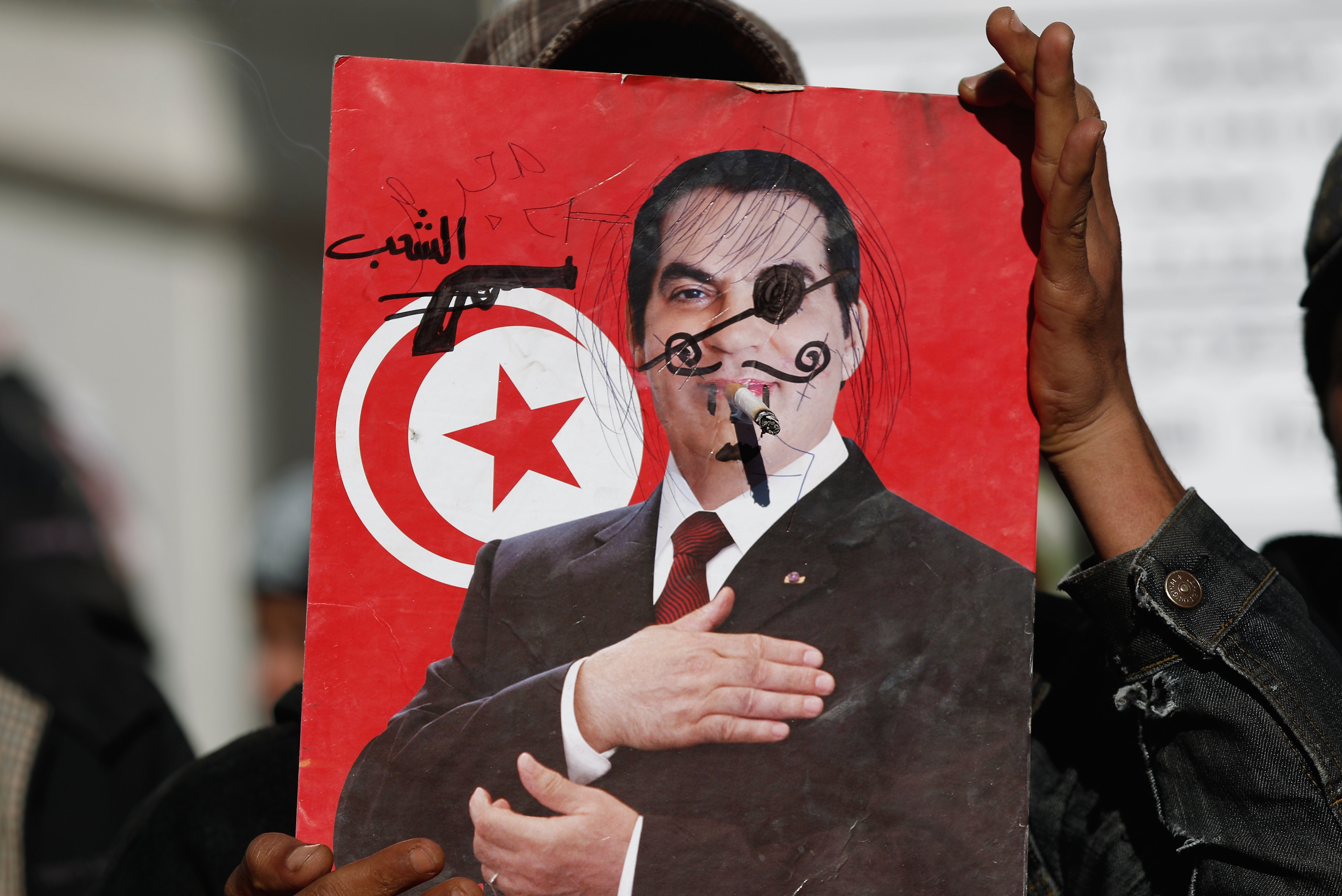
(Photo: A protester displays a defaced portrait of ousted president Zine al-Abidine Ben Ali outside the Tunisian prime ministers office on January 24, 2011 in Tunis, Tunisia. Protesters from the countryside and the hamlet of Sidi Bouzid, the town where the ‘Jasmine Revolution’ started, walked through the night to descend on the prime minister’s office, where they tore down razor wire barricades. By Christopher Furlong/Getty Images)

Selfie Defense, Ctd

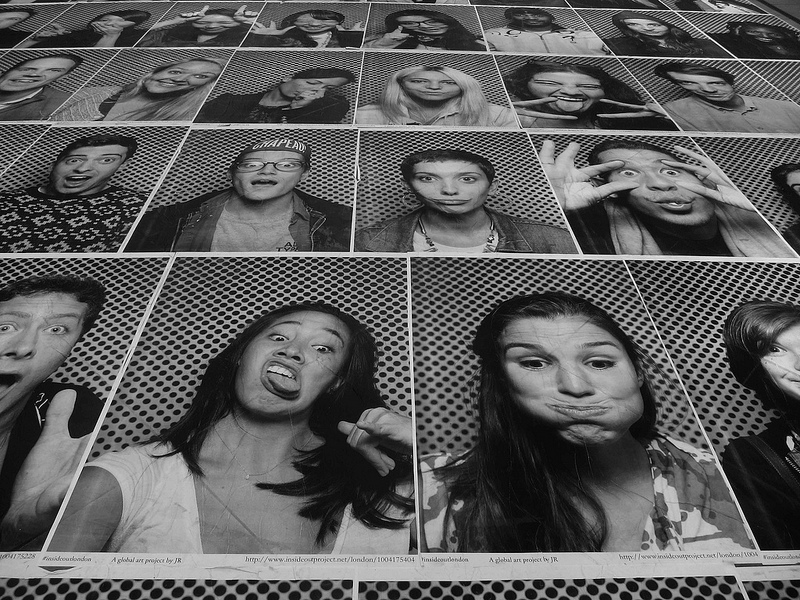
dish_jrlondon

Citing the work of the French artist JR, Julian Stallabrass offers a highbrow defense of the selfie:

It would be easy to slip into seeing the instantly shared photographic self-portrait, along with snaps of things bought and consumed, as a register of a complete surrender to commercial image culture: the preening necessary to emulate commodified beauty ideals, the apeing of celebrities, the internalising of values of professional self-presentation, the erasure of experience and memory through an obsession with moment-to-moment recording, and the distribution of the results on websites that mine images and metadata for commercial value.

Yet the daily practice of photography gives people detailed knowledge about the way standard images of beauty and fame are produced; they learn considerable sophistication in the making of images and scepticism about their effects. The artifice of commercial imagery is understood through practical emulation. Most selfies are pastiche and many tip into parody. With this increase in awareness potentially comes a shift in power: from the paparazzi to their prey; and from the uncles, corporate and otherwise, to their nieces and nephews.

Despite appearances, the digital image is much more complex than a snapshot: it is an amalgam of processed visual data, descriptive tags and the particular social network into which it is launched. One group of activists in Pakistan has used JR-style portraits of children, greatly magnified and laid out on the ground, to bring home to drone operators that they are killing individuals. When circumstances allow, the digital image can swiftly be turned to more radical uses than recording a night out with friends.

The Dish covered that Pakistan project here. Previous Dish on selfies here, here, and here.

(Photo of JR’s work at Somerset House, London, by Julian Stallabrass)

The Myth Of Social Mobility

Stephanie Mencimer presents the results of a 30-year study showing that most poor kids end up as poor adults:

Of the nearly 800 school kids [Johns Hopkins sociologist Karl Alexander has] been following for 30 years, those who got a better start—because their parents were working or married—tended to stay better off, while the more disadvantaged stayed poor.

Out of the original 800 public school children he started with, 33 moved from low-income birth family to a high-income bracket by the time they neared 30. Alexander found that education, rather than giving kids a fighting chance at a better life, simply preserved privilege across generations. Only 4 percent of the low-income kids he met in 1982 had college degrees when he interviewed them at age 28, whereas 45 percent of the kids from higher-income backgrounds did.

Perhaps more striking in his findings was the role of race in upward mobility. Alexander found that among men who drop out of high school, the employment differences between white and black men was truly staggering. At age 22, 89 percent of the white subjects who’d dropped of high school were working, compared with 40 percent of the black dropouts.

This study isn’t particularly new or surprising. In a post last month taking rich conservatives to task for professing sympathy for poor children but not poor adults, Matt Bruenig reminded them that the entrenchment of class status across generations is well established in social research:

Not all poor kids wind up as poor adults obviously, but you can’t seriously look at these aggregate figures and not see pretty straightforward life-cycle class continuities. If poor children are sympathetic for some reason owing to unluck, then it’s hard to understand why poor adults seem to elicit so much disdain and disparagement when it’s clear that the unluck of being born poor doesn’t disappear at age 18.

Perusing another new study of wages, Neil Irwin discusses how the link between economic growth and poverty reduction fell apart sometime in the mid-1970s:

[I]f you adjust for the higher number of hours worked, over the 1979 to 2007 period (selected to avoid the effects of the steep recession that began in 2008), hourly pay for the bottom 20 percent of households rose only 3.2 percent. Total, not per year. In other words, in nearly three decades, these lower-income workers saw no meaningful gain in what they were paid for an hour of labor. Their overall inflation-adjusted income rose a bit, but mainly because they put in more hours of work.

Recent Dish on the stagnation of socio-economic mobility here.

Who Needs A “Guardian Angel”?

First there was anti-rape underwear. Now this:

One push of a secret button on this necklace gives women an instant escape from awkward situations: The jewelry automatically triggers a call to a woman’s cell phone, so she has a convenient excuse to walk away from unwanted attention at the bar or a bus stop. If things change from annoying to dangerous, holding down the button sends an emergency message to a friend with the victim’s exact GPS coordinates.

The Guardian Angel technology was designed by ad agency JWT Singapore, who were originally asked to create an educational campaign about date rape, but decided to go further than the usual series of ads and try to solve the problem more directly.

Adi Robertson believes the pendant “symbolizes some of our worst ideas about women and sexual assault”:

I understand the reasoning. If you want people to use something, you should make it look like it will seamlessly integrate into, then improve, the rest of their life. I want a smartwatch to feel like a more useful version of what’s on my wrist now. I want checking a fitness tracker to feel like a natural part of my routine. But this reasoning is fundamentally, grossly, offensively unsuited to rape prevention. You are asking civilian women to wear body armor or an emergency alert system in order to go to a bar, restaurant, or party. If this is the place we are at – and we are, it seems, still at that place — then that is not something to be streamlined and minimized. It is something to be deeply concerned about.

And that’s what’s wrong with the Guardian Angel’s gauzy, stereotypical femininity: it ends up normalizing rape as an unremarkable, if unfortunate, part of the female experience. The soothing language – making women “feel less vulnerable” so they can “live their lives to the fullest” – smacks of the vagaries in tampon commercials. It’s something everyone knows about but nobody wants to hear about, and certainly nothing that we want to acknowledge is a shamefully common plague in our schools, our prisons, our armed forces, and almost every other social institution.

Update from a reader:

Guardian Angel seems like a failure on all fronts. It’s not actually pretty or subtle. It’s casually offensive. It doesn’t call 911 or some other protective service. How dense do the creators have to have been to think that rapes are happening because women don’t have a polite excuse to leave? Stranger rapists will likely be undeterred by a phone call. Maybe it’s a closer call with date rape, but it seems unlikely to be useful in a situation where any party is drunk beyond reason or where physical force is being used.

At best, it seems like Guardian Angel usefully transmits your GPS location to use as evidence when your abduction is reported to the police. Which raises the question: Is this something advertisers actually don’t expect women to buy for themselves but want parents to buy for their teenage daughters? Presumably the device can be set up to call any phone and not just your own cell phone. The message is certainly much more consistent with a parent’s fear than women’s empowerment. Because really, what woman is looking is to buy ugly -jewelry-Life Alert but without the emergency services?

Another has a different view:

I think Adi Robertson is a) over reacting and b) not aware of other products on the market that perform a similar function.  This thing is mostly going to be used exactly as it says in the blurb: to ring your phone giving you a convenient way to get out of an uncomfortable situation.  Haven’t most of us pretended to be on a call just to avoid talking to someone we didn’t care for?  Haven’t we even pretended our phones vibrated, signalling an incoming call?

This simply creates an actual ring the other person can hear.  It makes a commonly used (by men and women) dodge a bit more believable.  As to being able to use it to call for help, well, that’s one reason we carry phones in the first place, isn’t it?  To be able to notify someone in case of an emergency.  Why is moving that from your phone to around your neck a huge step in ” normalizing rape”.

Finally, there is at least one product on the market right now, the 5Star Responder, which offers a similar level of protection.  While large numbers of their customers are elderly, they promote their product as “peace of mind” for everyone from children coming home to an empty house to women walking to their cars in an empty parking lot.  I can’t find it now, but in the original marketing material they specifically suggested women call and talk to a representative while walking to their cars after dark.

How women or anyone taking actions to make themselves feel safer can be viewed as a negative is beyond me.

Seattle Maxes Out The Minimum Wage, Ctd

Earlier this week, Seattle’s city council approved a measure to raise the city’s minimum wage to $15 over the next seven years. Jordan Weissmann revisits the debate over whether this is a good idea:

The economics literature suggests that moderate increases in the minimum help workers more than they hurt them, because the raises outweigh the cost of lob losses. At $15, the effects might well be different. Some businesses may cut jobs. Others simply might not choose to open or expand in Seattle. Others could try to find ways to automate jobs. But, as Reihan Salam has written, the effects may also be more subtly damaging. As wages rise, businesses could simply seek to hire better educated and skilled employees, some of whom may well live outside the city limits but suddenly find themselves happy to commute for a fatter paycheck. … The upshot: the $15 minimum doesn’t have to turn Seattle’s labor market into a flaming wreck for it to cause harm.

Kevin Roose calls the minimum wage hike “a Kennedy School study in shifting the Overton window on contentious issues”:

Supporters of the bill are hoping it will spread. Already, labor activists in cities like Milwaukee, Providence, Chicago, L.A., San Francisco, and New York City are calling for similar wage hikes.

And crazier things have happened — even though economists warn that raising the minimum wage by such large amounts could wreak havoc in the labor markets, it’s still a political slam-dunk for progressive politicians hoping to play up their populist bona fides.

But taking the $15 minimum wage nationwide won’t be easy. Seattle’s experiment had a lot of factors in its favor: a progressive voter base; an already-high minimum wage above $9 an hour, which made $15 seem like a lesser jump; the timing of a mayoral race in which both candidates found it politically advantageous to back the wage hike. Not every city can replicate that. And on a federal level, the minimum wage seems stuck in the single digits — Congress and big business have so far successfully fought President Obama’s attempt to phase in a $10.10 minimum wage.

In the short term, it appears that the minimum-wage battle will be fought on a city-by-city basis. Which makes it much more interesting to watch.

Paul K. Sonn is hoping for that trend:

Looking abroad, Australia has a minimum wage of more than $15 per hour yet enjoys low unemployment and strong growth. Closer to home, Washington, D.C., instituted a substantially higher minimum wage and benefits standard for security guards in 2008, successfully transitioning an $8 occupation to one where guards now earn $16.50 in wages and benefits without evidence of ill effects on the commercial real estate industry, which pays the guards’ wages.

Similarly, Los Angeles, San Jose and St. Louis have all phased in minimum wages and benefits of more than $15 for airport workers without adverse effect. And San Francisco already requires all employers to provide minimum wages and benefits that together total $13.18 per hour for large employers, yet the restaurant industry has seen stronger growth in the city than in surrounding counties. Equally significant, it is not just workers but also growing numbers of business voices that are backing the need for transitioning our economy to a $15 minimum wage.

But Scott Shackford doesn’t approve:

There’s … already some information about how a $15 minimum wage may affect the area. Voters set a minimum wage for jobs at hotels and parking garages serving the Seattle-Tacoma International Airport to $15 last fall. The change went into effect with the new year. The Seattle Times looked at some of the impact in February. While acknowledging that it’s still too soon to truly evaluate the consequences, the paper noted some price increases and “casualties” …  Several business leaders in Seattle’s Asian community submitted a commentary to the weekly warning about the terrible impact of the wage increase on immigrants and minority-owned small businesses. Read it here.

Scott Sumner, who prefers a low minimum wage supplemented with wage subsidies, explores some counterintuitive outcomes that may arise from the wage hike:

Liberals tend to argue that low wages are a huge problem for the poor.  Thus a $15 dollar wage would offer significant improvements in living standards (BTW, I agree with this, although I’d prefer the government paid the bill.)  Let’s say liberals are correct, and that the Seattle policy is a huge boon to the poor.  In that case low wage workers from other cities should flood into Seattle looking for one of those precious jobs.  Yes, the cost of living is high, but no higher than some other bigger affluent cities with minimum wage rates that are far lower.  The low-skilled workers will park themselves in the informal economy, or live off welfare, until they find one of those jobs.  Thus we have the odd situation where the law will be a boom to low wage workers if and only if it leads to a large rise in Seattle’s unemployment rate.

“But in the longer run,” John Aziz writes, “I highly doubt that a higher minimum wage is the right policy to ensure a decent standard of living for the poor”:

The key factor is the emerging economic phenomenon of robotics. Robots have already taken over many roles in the manufacturing industry, and are now moving into roles including food servers, bank tellers, telephone operators, receptionists, mail carriers, travel agents, typists, telemarketers, and stock market traders. The higher the minimum wage goes, the lower the threshold will go for robots to replace humans in many minimum wage roles.

While there are sure to remain many jobs that still require a human touch — think personal assistants, janitors, home health aides, and security personnel — and while lots of new human professions will likely emerge, the automation revolution is already putting lots of people out of work. To me, this suggests a better approach is universal basic income, a version of which was first advocated in America by Thomas Paine.

Previous Dish on Seattle’s minimum wage hike here and here.