The War On Coal’s Economic Casualties

coal_mine

Reacting to yesterday’s EPA announcement, Waldman downplays the potential economic damage of going after the coal industry:

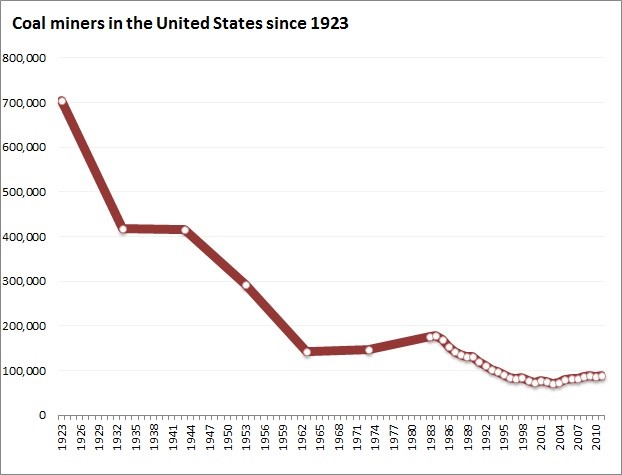
One argument against waging war on coal—that it will cost too many jobs—isn’t really persuasive, because there just aren’t that many coal miners anymore. The National Mining Association has data on the number of miners going back to 1923, when there were over 700,000 Americans doing this work (the data are once a decade until the 1980s, after which they have figures for every year) …

Today, there are fewer than 90,000 Americans mining coal; depending on how you count, there are more people working in the solar power industry. That figure doesn’t include people who work for coal companies but aren’t involved in mining (clerks, accountants, etc.), and of course it doesn’t include people whose livings are dependent on the coal industry, like those who own businesses in mining towns. But the point is that in terms of manpower, coal has become a tiny industry. In the 1920s, one out of every 150 Americans was a coal miner; today it’s one out of every 3,600 Americans.

Cassidy cheers Obama’s war on coal:

In all likelihood, the ultimate fate of Obama’s plan will hinge on the 2016 Presidential election. For now, though, he has taken the initiative and put the onus on other countries that have used the lack of U.S. action as an excuse for doing nothing, or very little, to reduce their carbon emissions. China and India, for instance, are both building coal-fired power plants. If the new policy goes into effect, the United States, at long last, will be able to tell them “Do as I do” rather than just “Do as I say.” Since climate change is a global problem that can only be solved at the global level, that is an important step forward.

Daniel Gross tells the energy industry to quit whining:

The EPA doesn’t plan to proscribe coal generation. It’s simply setting a new standard, telling states that they have to reduce emissions related to energy use—but it is leaving the implementation up to them. Closing coal plants and/or installing carbon-scrubbing technology are only two of many ways to reach that goal. Many of the alternatives have a lower cost, some of them have no cost, and virtually all of them will prove economically beneficial over time. In effect, this standard, like so many other hotly contested standards relating to energy use—the 2007 light bulb rule, new standards for vehicle gas mileage or for appliances—is simply a diktat to the industry to stop being so lazy.

Ronald Bailey is skeptical about the EPA’s claims that these regulations will save money:

The EPA calculates that the maximum cost for implementing the new regulations amounts to $7.5 billion in 2020, while the maximum net climate and health benefits range from $27 to $50 billion at a 3 percent discount rate or $26 to $46 billion at a 7 percent dicount rate. On it’s face, that sounds like a pretty good deal. But as I reported last August in my article, “The Social Cost of Carbon: Garbage In, Garbage Out,” anyone can pretty much conjure whatever number one wants when it comes to cranking out the social cost of carbon through integrated assessment models that combine econometric and climate prognostications.

But Chris Mooney expects the plan to pay off:

There is a long tradition of cost overestimates for new environmental regulations. At the Huffington Post, Pacific Institute President Peter Gleick provides an extensive documentation, going back to the 1970s, arguing that such claims of huge costs not only have a long history, but that they are “always wrong.”

Among other things, Gleick links to a 2011 EPA study finding that the benefits of the 1990 Clean Air Act amendments (which, of course, were attacked on grounds of supposed cost) “exceeded costs by a factor of more than 30 to one.” That’s not the only such study. In fact, as the World Resources Institute’s Ruth Greenspan Bell has noted, from 1999 to 2009, EPA water and clean-air regulations overall were clear cost-benefit winners. The total costs, according to a 2010 Office of Management and Budget report, were some $26-$29 billion, while the benefits were far greater: $82-$533 billion.


The Palin Tendency And Bowe Bergdahl

Tomasky today predicts that the Bergdahl prisoner swap may well become the next Benghazi on the fetid horizons of the Palinite right. I hope he’s wrong, but I’ve learned not to under-estimate the extremism of the Dolchstoss brigade. The Benghazi and Bergdahl “scandals”, after all, are both rooted in the assumption that the president is in some way anti-American, that his loyalty is somehow not to the United US-POLITICS-OBAMA-BERGDAHLStates, but to some other abstract but foreign authority, and so he would obviously be happy to leave Americans to perish in an undefended consulate and lie about it afterwards to cover his negligence up … or be content to deal with the Taliban on behalf of another “anti-American”.

Beneath the intricacies and easy emotional manipulation, this McCarthy era paranoia is what drives both obsessions. The contradictions are, of course, bleeding obvious. Obama is to be excoriated for abandoning Americans in the line of fire in Benghazi and then excoriated for rescuing a servicemember in enemy captivity in the matter of Bowe Bergdahl. You’ll see that, not for the first time, the president cannot win. You’ll also note that one of the American right’s heroes, Bibi Netanyahu, released more than a thousand Palestinian prisoners, some of whom had actually murdered Israeli civilians, in order to retrieve Gilad Shalit. Somehow Netanyahu is not regarded as a terrorist-sympathizer by the Tea Party.

And it is an outright calumny, of course, to impugn this president’s patriotism, the kind instinctually propagated by Palin and her spittle-flecked confreres. Barack Obama is, au contraire, a uniquely and proudly American story. He has been relentless in pursuing the enemy in Afghanistan and Pakistan in his period in office. He killed bin Laden and Anwar al -Awlaki. His emergence as a biracial president would give any sane American a reason to be proud, not squeamish. And what he did, in the case of Bergdahl, requires no further explanation than that a commander-in-chief’s task is to leave no servicemember behind enemy lines, especially as a war comes to a close. (There’s also a strong argument to be made that, as the war in Afghanistan comes to a close, the Taliban commanders at Gitmo had a right under international law to be exchanged.)

I’m not saying, of course, that robust pushback against this tough call is not legitimate. That’s embedded in the very notion of a tough call. There are powerful questions that need addressing:

Was the deal a good one? How effective will the monitoring of the Taliban commanders be? Did the president comply with the letter of the law? But I’d argue vehemently that Bergdahl’s personal politics and Obama’s core motivations aren’t among them. Whether Bergdahl was a deserter or not, whether he was “anti-American” or not, whether he may have cooperated with his captors under duress or not: these questions should be dealt with by the regular process of military justice and investigation. But none of that can truly happen without Bergdahl himself to question and interrogate. And if we are going to rescue a service-member depending on our assessment of his politics or character, we have undermined a key principle of military justice and discipline. You wear the uniform, you get rescued if captured. Period. No other questions need to be asked or answered until after you’re safe and in US custody.

One final thing about the 30-day notification of Congress requirement. The one exception to the executive’s deference to the legislative in statutory matters such as this are contingent, time-constrained executive actions that require immediate implementation. A quick military response, a drone strike, a raid, or a rescue: these fall into the most solid executive area of legitimate, unilateral executive action. For the Republicans who only recently defended a far greater degree of executive power to cavil at this almost text-book case of executive expedition is a triple lutz in hypocrisy and inconsistency. But this, alas, is not news. They will use any weapon at hand, even if they have to trash some of the most important military principles to indict him.

(Photo: Jani Bergdahl, the mother of freed US soldier Bowe Bergdahl, walks through the Colonnade with US President Barack Obama to speak in the Rose Garden of the White House on May 31, 2014 in Washington, DC. Obama spoke after the release of Bergdahl by the Taliban in Afghanistan. By Mandel Ngan/AFP/Getty.)

When “Good Enough” Is Best

In an essay exploring the pitfalls of FOMO, Jacob Burak advocates making do with “good enough” rather than trying to maximize our opportunities – in both business and love:

In business, sacrificing maximisation in favour of a predefined ‘good enough’ is known to be the best strategy in the long run. As the saying goes, ‘Bulls make money, bears make money, pigs get slaughtered’: greediness that looks to maximise doesn’t pay.

Business people also know to ‘leave something on the table’, especially in deals leading to long-term partnerships. Experienced capital market investors understand that aiming to ‘sell at the peak’ will ultimately be less profitable than selling once a satisfactory profit is gained. Corporate graveyards are full of companies that did not stop at a ‘good enough’, profitable product that they could easily market, surrendering instead to ambitious engineers with sophisticated specifications and unrealistic plans. …

Even when it comes to emotional intimacy and love, ‘good enough’ works best. It was the British psychologist Donald Winnicott who gave us the concept of the ‘good-enough mother’ – a mother sufficiently attentive and adequately responsive to her baby’s basic needs. As the baby develops, the mother occasionally ‘fails’ to answer his needs, preparing him for a reality in which he will not always get exactly what he wants, whenever he wants it. The child learns to delay gratification, a key to any form of adult success. As we mature, we make do with ‘good enough’ partners almost by definition. Yes, out there is someone probably more suited to our needs – but we might not live long enough to find him or her.

Go Ahead, Don’t Have Kids

Screen Shot 2014-06-02 at 1.30.10 PM

The Economist wonders whether countries with shrinking populations should stop worrying so much about it:

In a recent study Erich Striessnig and Wolfgang Lutz, of the Vienna University of Economics and Business and the International Institute for Applied Systems Analysis in Laxenburg, Austria, argue that in predicting dependency ratios (the number of children and pensioners compared with people of working age), education should also be taken into account. And that makes optimal rates much lower than previously thought.

Not everyone of working age contributes equally to supporting the dependent population. Better-educated people are more productive and healthier, retire later and live longer. Education levels in most places have been rising and are likely to continue to do so. Using projections by age, sex and level of education for 195 countries, the demographers conclude that the highest welfare would follow from long-term fertility rates of 1.5-1.8. That excludes the effects of migration: for countries with many immigrants, the figure would be lower.

Educating more people to a higher level will be expensive, both because of the direct costs and because the better-educated start work later. But they will contribute more to the economy throughout their working lives and retire later, so the investment will pay off. Moreover, fewer people will help limit future climate change.

Puffin Got Problems

Puffin

The birds are struggling to adapt to a warming world:

[Stephen] Kress [who set up a “Puffin Cam” to live-stream baby Puffin Petey’s development] soon noticed that something was wrong. Puffins dine primarily on hake and herring, two teardrop-shaped fish that have always been abundant in the Gulf of Maine. But Petey’s parents brought him mostly butterfish, which are shaped more like saucers. Kress watched Petey repeatedly pick up butterfish and try to swallow them. The video is absurd and tragic, because the butterfish is wider than the little gray fluff ball, who keeps tossing his head back, trying to choke down the fish, only to drop it, shaking with the effort. Petey tries again and again, but he never manages it. For weeks, his parents kept bringing him butterfish, and he kept struggling. Eventually, he began moving less and less. On July 20, Petey expired in front of a live audience. Puffin snuff.

“When he died, there was a huge outcry from viewers,” Kress tells me. “But we thought, ‘Well, that’s nature.’ They don’t all live. It’s normal to have some chicks die.” Puffins successfully raise chicks 77 percent of the time, and Petey’s parents had a good track record; Kress assumed they were just unlucky. Then he checked the other 64 burrows he was tracking: Only 31 percent had successfully fledged. He saw dead chicks and piles of rotting butterfish everywhere. “That,” he says, “was the epiphany.”

Why would the veteran puffin parents of Maine start bringing their chicks food they couldn’t swallow? Only because they had no choice. Herring and hake had dramatically declined in the waters surrounding Seal Island, and by August, Kress had a pretty good idea why: The water was much too hot.

The big picture:

Life would go on without puffins. Unfortunately, these clowns of the sea seem to be the canaries in the western Atlantic coal mine. Their decline is an ominous sign in a system that supports everything from the last 400 North Atlantic right whales to the $2 billion lobster industry.

(Photo by Andy Morffew)

Creepy Ad Watch, Ctd

mexico-city-breastfeeding-hed-2014

Adding to this reader’s comments, a Colombian reader further contextualizes the debate surrounding the racy breastfeeding campaign in Mexico City:

Many of the protesters of the campaign were against it because it stigmatized those women who choose not to breastfeed for valid reasons. In Spanish, the expression used has multiple meanings that were intentional: Rebecca Cullers’ literal translation fails to capture the contrast meant. Giving your back is equal to be selfish or lazy, and giving your breast also means to be brave (dar el pecho = to face a problem).

Meanwhile, Mya Frazier suggests that bra manufacturers could hold the key to normalizing public breastfeeding:

Fantasy and lust, as embodied in its annual televised Fashion Show, define the Victoria’s Secret brand, but it is also an innovator in bra design, with new product launches a key part of its marketing efforts. Yet while Victoria’s Secret works on a bra with “improved nipple concealment,” other companies appear to be dominating innovation in the nursing bra category. There’s a patent application for a nursing bra that would hold a thin circular heating/cooling device to provide “relief from engorgement, plugged ducts, mastitis and other general nursing pain.” There’s even a patent for a device to connect a breast bump to nursing bra for “hands-free” pumping.

In her book, Breastwork: Rethinking Breastfeeding, Alison Bartlett argues for the acceptance of breastfeeding as a potentially erotic experience, asking: “If it’s generally acceptable or even desirable in Western culture to have sexy breasts available for public viewing, what would be the effect on that set of values and meanings if we regarded lactating breasts as sexy?” Could a brand like Victoria’s Secret use its multi-million dollar advertising budget to disrupt the carefully constructed borders between the sexualized breast and the maternal breast? Millions of babies and their mothers might be better off for it.

To widen the thread further, here’s an excerpt from Chavie Lieber’s piece on “men who drink breast milk”:

Some men who drink breast milk, like Anthony, cite reasons of health or nutrition. Jason Nash, a 55-year-old father of four, started drinking breast milk after the birth of his first child. “It occurred to me that breast milk could be just as healthy and tasteful for adults as infants,” Nash said. “I believe it has kept me from getting sick all these years.” His wife isn’t thrilled, but doesn’t mind as long as the milk comes from a safe source.

For other men (not least those in adult-nursing relationships), breast milk is a kink. “All I’ll say is it’s a fetish for me,” wrote another man, whose post on Only the Breast identified him as a “nice, harmless man in New Jersey seeking breast milk from healthy, non-smoking mom.”

An Accounting Of American Racism, Ctd

A reader protests:

Did your readers, who I look to as a refreshingly open-minded community, even read Coates’ article? To quote him:

Broach the topic of reparations today and a barrage of questions inevitably follows: Who will be paid? How much will they be paid? Who will pay? But if the practicalities, not the justice, of reparations are the true sticking point, there has for some time been the beginnings of a solution.

And we devolve into half-serious talk about half-black children and then curl up in the fetal position and say, “It makes my head hurt”?

Coates himself realizes, I think, that we may never have a day when white folks are writing checks to black folks. And that’d probably do more harm than good anyway.  But what we can do is help the people who have been harmed decade after decade with jobs and healthcare and whatever else we can think of to bridge the gap. But importantly – acknowledge aloud that we are acting out of a sense of obligation to right a wrong we have the capacity to try and fix.

Another passes along “three handy tips to help you suss out folks who haven’t actually read” TNC’s essay. Number one: “They talk a lot about slavery.” Another concurs:

I admire what Ta-Nahesi Coates is doing by revisiting the argument for reparations. And I am also deeply disappointed reading comments on The Dish and around the internet that can’t get past the year 1865. This is not just about slavery. If I understand him correctly, this is a thought exercise to update the reparations claim through the 20th century (and 21st) that moves past slavery to implicate North and South, as well as immigrants who arrived after the Civil War. Sharecroppers working white land after a landless emancipation, black maids and sharecroppers denied Social Security, decades of African Americans paying taxes for FHA loans they couldn’t have and for freeways to those white Levittowns that tore through black neighborhoods and forced African Americans into projects.

I believe Coates wants his reader to look at every stop on this reparations tour and make his or her case for where they would get off, to argue where they would draw the line. But once they see the route he is taking, all I read is, “Oh, slavery, that’s my stop. Would’ve been nice for money back then, but what can you do?”

Another is on the same page:

In synthesizing for his readers the tremendous work done over the past two decades by historians about how suburbia was created as a white’s-only domain, Coates is making two different arguments about the logic for reparations that we normally hear when slavery’s at its center. He’s arguing first that the material effects of racial inequality, effects underwritten by federal policy, are far more recent than the usual “slavery was a long time ago” argument. There are no antebellum slaveowners alive, but there are millions of people who were suburban homeowners between 1938 and 1968.

Second, he’s showing, again mainly in the Lawndale sections, how suburban segregation created the conditions whereby blacks could be defrauded by contract sellers who dramatically increased home prices and held the deed so they could evict people on any pretenses in order to resell their homes, multiplying their profit many times over. Beryl Satter, whose work Coates is drawing from, estimates that contract selling stripped one million dollars a day out of Lawndale alone.

People asking Coates how reparations would work have a duty to actually consider the argument he’s making. Are so many unwilling to do so, and so willing to fall back on “75 percent of southern whites didn’t own slaves,” because it’s too uncomfortable to look at their parents’ or grandparents’ houses as spaces of Jim Crow?

Previous Dish on the reparations discussion herehere, and here.

Where Self-Driving Cars Will Take Us

Thinking about how driverless cars will influence how we think about driving, Eric Jaffe wonders if it would be possible to program one for road rage:

I posed that question to Chris Urmson, head of Google’s self-driving car program, when I rode in the car on city streets in late April. In a strict technical sense, sure, the car could be programmed for aggression. But in line with the safety points mentioned above, Urmson said it’s “probably not the right thing to emulate all the human behavior” in programming driverless cars. … Urmson believes self-driving cars might have a therapeutic effect on aggressive driving styles. Slowly you’ll stop noticing the things that once made you irate on the road, and eventually you’ll forget they even existed. That’s a huge change in how we travel. Riding in cars, in this case, would become more like riding on trains or subways: the occasional unexpected stop will be annoying, but largely outweighed by the chances for diversion.

John Michael McGrath expects self-driving buses to be a more promising innovation than self-driving personal cars:

I strongly suspect sitting in traffic isn’t actually going to be more amusing just because your car is a robot. (Or at least, not after the first few times.) We will still need to find ways to move people more efficiently than any single-passenger vehicle can. That’s why people are mistaken when they say autonomous vehicles are going to mean the end of traditional mass transit.

Rather, the same kind of technology that allows self-driving cars should also allow transit operators to introduce self-driving buses, if voters (and transit unions) will accept it. Buses will continue to make more efficient use of the road due to physics and geometry than even the slimmest self-driving cars. Voters can be leery of driverless transit, but it can offer much higher frequency in off-peak times than systems relying on higher labour costs.

T.C. Sottek posits that driverless cars could be a boon for privacy as well, by eliminating one of our most common encounters with the police:

Privacy is about more than just data collection. It’s also about feeling secure against someone searching through your belongings. While the Bill of Rights protects citizens against unreasonable searches, it’s no guarantee that your rights won’t be violated — just ask David Eckart. Eckart’s example is extreme, but the kind of traffic stops that led to his ordeal are very common. Forty-two percent of involuntary encounters with police in the United States happen in cars, and many of these encounters lead to searches. …

In total, violations based on driver behavior accounted for 68.1 percent of traffic stops by police. In other words, human beings were pulled over in most cases because they’re human: they break the rules of the road and sometimes make mistakes. In some cases, like obeying speed limits, there’s even a cultural expectation that most people will routinely break the law. As the ACLU’s senior policy analyst Jay Stanley tells The Verge, this means that roads are quasi-authoritarian spaces that give police huge discretion in choosing who to punish. But in a world with self-driving cars, things would look much different. “The latitude of the police to pull people over would be much reduced,” Stanley says. “People wouldn’t be subject to so much arbitrary enforcement.”

And Camille Francois hopes they will get people to pay more attention to surveillance:

It’s quite clear: for most people, the link between government surveillance and freedom is more plainly understood by cars, rather than personal computers. As more and more objects become connected to the Internet these questions will grow in importance. And cars in particular might become, as Ryan Calo puts it in a 2011 article on drones, “a privacy catalyst”; an object giving us an opportunity to drag our privacy laws into the 21st century; an object that restores our mental model of what a privacy violation is.

When my grandmother starts to consider technologically-enabled constraints on how she can drive; or people knowing exactly where she can go—abstract issues of “autonomy” and “privacy” become much more real. … And that is important because in order for our society to shape the rules that will make the future of self-driving cars one in which we want to live, we need all members of society to contribute to the conversation. We need to ask: what happens when cars become increasingly like computers? With self-driving cars, are we getting the best of the computer industry and the car industry, or the worst of both worlds?

Previous Dish on self-driving cars here and here.

He Likes To Be, Under The Sea …

Fabien Cousteau (grandson of Jacques) and five other ocean scientists are spending 31 days living in an underwater habitat off the coast of the Florida Keys. Svati Kirsten Narula interviewed Cousteau about the project before he went under:

Ocean scientists have made enormous strides in underwater research, but the 20th century’s love affair with outer space means we know far more about the moon than we do about the sea floor. Cousteau sees Earth as a “little brown veneer,” compared with the vastness of the sea—and he gets frustrated when people marvel at the Earth’s oceans by saying that 70 percent of the planet is covered by water. “[That’s] talking about the world in a two-dimensional way, and the planet is three-dimensional,” he said. “So if you’re talking about a three-dimensional system, the oceans represent 99 percent of our world’s living space. And yet we’ve explored less than 5 percent of it.”

This is something of a sore subject for ocean scientists, who point out that public funding for space exploration dwarfs the money that undersea researchers get. …

Mission 31 is concerned with how the oceans are changing—namely, what we humans are doing to them. We’ve been using them as a carbon sink, a garbage dump, and simultaneously, a garden from which to harvest. Three broad subjects of study for the Mission 31 scientists are ocean acidification (as it relates to climate change), ocean pollution (with an emphasis on the effects of plastics), and declining biodiversity (attributed to overfishing). This is a bona fide research expedition, but it’s also a publicity stunt. Cousteau wants to drum up enthusiasm for the sea, which helps explain why he’s letting celebrities like rapper will.i.am and billionaire entrepreneur Richard Branson dive down to Aquarius for short 45-minute visits, and auctioning off similar experiences to the highest bidders. The idea, Cousteau says, is to spark the interest of a population of people who haven’t previously gotten excited about the ocean—and to change the way they think about the planet.

“It’s really about engaging audiences young and old to dream, to aspire—the way we used to with the Apollo mission.”

China’s War On Terror

Details of the brutal bombing in Urumqui last week:

Jiayang Fan maintains that “it has become clear that terrorism is no longer a foreign phenomenon”:

It was the deadliest massacre in recent memory, and the fourth in the past month—another sign of the increasingly volatile relations between Uighurs, the culturally distinct minority native to northwest China, and the Han majority, who constitute ninety-five per cent of the country’s population. Unlike many of the previous attacks, which took aim at state entities like police stations or security offices, the Urumqi bombing deliberately targeted civilians. If the assailants intended to maximize casualties, generate publicity, and radicalize Uighurs and Hans who had previously been ambivalent about this conflict, they succeeded spectacularly. …

Thirteen years ago, terrorism seemed almost exotic to the Chinese, entirely confined to a world outside their borders. Today, citizens are clamoring for recognition of its grave implications in their own nation. Yet the inherently political nature of the crime—particularly when it is framed as a violent protest against state injustice—makes its handling problematic. Especially in a country known for its imperious style of one-party rule, and censorship of opinions that run contrary to the official script.

It’s hard to pinpoint who is responsible for these acts of violence:

The East Turkestan Islamic Movement (ETIM) is the group whose name is bandied about the most — though it’s sometimes referred to as the Turkestan Islamic Party. ETIM is thought to have links with terror groups elsewhere, particularly in Uzbekistan, Afghanistan and neighboring Pakistan. Chinese authorities say ETIM has ties to al-Qaeda and training camps in the tribal area along the Pakistani-Afghan border. Uighurs were among the hundreds of supposed foreign fighters swept up and detained by the U.S. at Guantanamo Bay following the 2001 U.S.  invasion of Afghanistan.

But all this doesn’t amount to a direct causal link between organized transnational terror networks and the current epidemic of violence in Xinjiang. China blamed a bombing at a train station a month ago that killed three people on ETIM, but has now been more circumspect in pointing the finger at specific groups. It’s unclear what kind of real operational capacity ETIM and other like-minded outfits have inside China and to what degree attacks like Thursday’s are far more local actions.

James Millward discusses China’s problems with its Uighur population in depth, exploring how grievances over civil rights intersect with the rise of extremist ideologies:

Chinese policies and never-ending crackdowns, especially since the 2009 riots, have created a climate in which some Uyghurs are more likely to heed twisted, pseudo-religious ideologies that advocate killing innocents to send a political message. But even if we accept the Chinese position that religious extremism, leading to terrorism, is mainly an exogenous force, why then campaign domestically against features of Uyghur culture, nonreligious as well as religious, that have been part of Uyghur life and Xinjiang’s social landscape since long before the Taliban and al-Qaeda emerged elsewhere? Why then the repeated gratuitous insults against Uyghur culture — false claims that Uyghur is a primitive language, thoughtless dismantling of Uyghur-language education, suspicion and persecution of private Uyghur-language instruction, compulsion of government workers to eat during Ramadan, prohibition of doppa caps and scarves?

I suspect that the Chinese leadership and some Chinese scholars who advise them are uncomfortable with Uyghur cultural uniqueness. They increasingly feel that this distinctiveness is itself a source of the problem.

Rachel Lu observes that Beijing is resurrecting its Mao-era reliance on volunteer patrols and informants in response to the threat of Uighur extremists:

“People’s war” is one of the core components of former Chairman Mao Zedong’s strategic theory and a tried-and-true tactic for the party, which used it to win China’s gruesome civil war in 1949. But in the ensuing decades under Mao, the rhetoric of a people’s war was often used against the so-called “class enemies” or “counterrevolutionaries” who had upset the party in one way or another. During the Cultural Revolution in the 1960s and 1970s, the phrase was often invoked by so-called red guards, mostly young Chinese then empowered to perpetrate massive destruction and strife. After subsequent leader Deng Xiaoping instituted market-oriented reforms in 1979, the mention of a people’s war became increasingly rare.

Now that the Chinese government is facing a new threat, it seems ready dust off the old trope. In a May 24 editorial, the Hong Kong-based pro-party Wen Wei Po newspaper called for the use of a people’s war to defeat terrorism by “mobilizing the masses to uncover the terrorists and their behind-the-scene puppet masters.” The minister of public security, Guo Shengkun, also vowed to use the power of the masses to avert terrorism in a May 22 speech in Xinjiang.

The Dish covered a previous attack attributed to Uighur separatists in March here and here.