Engaging The T

There are few topics I feel nervous to write about on this blog, as you might have surmised over the years. But one of them is the question of transgender people. It’s a fascinating topic, but remains so completely fraught and riddled with p.c. neurosis that no writer wants to unleash the hounds of furious, touchy trans activism. And that’s the first thing to note here, I’d say. Any minority – especially a tiny one like gays or TV Academy Presents 10 Years After The Prime Time Closet - A History Of Gays And Lesbians On TVtransgender people – has, at some point, to explain itself to the big, wide world. That’s not entirely fair but it’s unavoidable if you want a change in attitudes or an increase in understanding. And my view is that there is no need to be defensive about it. Most people are just completely ignorant, and have never met or engaged a trans person, and so their misconceptions and misunderstandings are inevitable and not self-evidently a matter of bigotry or prejudice. I think we should be understanding of this, as open as we can be, and answer the kinds of questions some might feel inappropriate or offensive. That’s the basis for dialogue, empathy and progress.

But this has not, alas, been the way in which the transgender movement has largely sought to engage the wider world (with some exceptions). Kevin Williamson notes how Laverne Cox, appearing as a trans person on the cover of Time, nonetheless refused to answer a question about whether she had had her genitals reassigned as too “invasive.” Sorry, Laverne. But if you’re out there explaining yourself, you’ve gotta explain all of it. And the elaborate and neurotic fixation on language – will writing “transgender” rather than “transgendered” reveal my inner bigot? – is now so neurotic even RuPaul has been cast aside as politically incorrect. The insistence that the question of transgender people is essentially the same as that of gay people – when they are quite clearly distinct populations with very different challenges – is also why we have the umbrella term “LGBT”. And so Kevin Williamson is not wrong, I think, to note the way in which politics has eclipsed the English language here and that language itself has become enmeshed in a rigid ideology:

The obsession with policing language on the theory that language mystically shapes reality is itself ancient — see the Old Testament — and sympathetic magic proceeds along similar lines, using imitation and related techniques as a means of controlling reality.

But Williamson is just as wrong in his brutal, even callous, denunciation of transgender people as acting out “delusions”. And he’s wrong not because he politically incorrect, but because he’s empirically off-base. He too is creating his own reality. For Williamson, it seems, you can only have one sex and it is dictated by your genitals. End of story. Naturally, he doesn’t address the question of what biological sex is when you are born with indeterminate genitals that are not self-evidently male or female. The intersex are a small minority – from 0.1 to 1.7 percent, depending on your definition – but in a country of 300 million, that adds up. And the experience of those people – especially those have been genitally mutilated to appear as one sex, while feeling themselves to be the other – is a vital part of understanding what gender and sex are.

Kevin may not like this – but it’s complicated.

We can see crucial differences between male and female brains, for example, and they do not always correspond to male and female genitals. Since by far the most important sexual organ is the brain, the possibilities of ambiguity are legion. And this is not a matter of pomo language games. The experience of a conflict between self-understood gender and assigned gender is real, and a source of great anguish. That human anguish is what we should seek to mitigate, it seems to me, rather than compound as Williamson does.

And as J. Brian Lowder notes, the insistence of many transgendered people on the need to permanently reconcile their physical bodies with their mental states is in some ways a rather conservative impulse. There’s a reason that Iran’s theocrats allow for sex-change operations but not gay relationships. The transgender desire not to be trans-gender but to be one gender physically and mentally is actually quite an affront to queer theorists for whom all gender and sex are social constructions. Many of these people want testosterone and estrogen and surgery to end their divided selves. And it doesn’t get more crudely biological and not-social than that.

Which means that there are also divisions within the trans world between those who might be able to pass completely as another gender, after reassignment surgery, and those whose visual ambiguity or androgyny will remain. Lowder quotes a trans artist thus:

If you don’t wish to own [tranny] or any other word used to describe you other than “male” or “female” then I hope you are privileged enough to have been born with an appearance that will allow you to disappear into the passing world or that you or your generous, supportive family are able to afford the procedures which will make it possible for you to pass within the gender binary system you are catering your demands to. If you’re capable of doing that then GO ON AND DISAPPEAR INTO THE PASSING WORLD!

This is the perennial question of a minority’s anxiety about sell-outs – whether it be expressed in the fights over how light-skinned some African-Americans are or how “masculine” gay men are or how feminine lesbians appear. In other words, this is a very complicated and sensitive area. But if we are to make progress in understanding  – and Williamson’s piece shows how far we have yet to go – we have to let go of these insecurities and defensiveness and accept that no question about the transgendered is too dumb or too bigoted to answer.

Is the transgender movement mature enough to accept this and move forward? I guess we’ll soon find out.

(Photo: Actress Laverne Cox arrives at ’10 Years After The Prime Time Closet – A History Of Gays And Lesbians On TV’ at Academy of Television Arts & Sciences on October 28, 2013 in North Hollywood, California. By Valerie Macon/Getty Images.)


The Dilemma Of Deafness

Sujata Gupta profiles the Reid family, who faced an unexpected ethical quandary when they realized their daughter Ellie was deaf:

Parenting is full of big decisions. But in the first year or so of Ellie’s life, when other parents are focused on helping their kids to walk and talk, Christine and Derek had to think about an issue that many parents never even contemplate: They had to decide which culture their daughter should be a part of. Ellie could join their world, the hearing world, if she received cochlear implants. Yet implants don’t work perfectly. Everyday conversation can remain a challenge, for instance, especially when there’s a lot of background noise. What’s more, implants might cut Ellie off from a community that, some would argue, is her birthright: the Deaf world, where lack of hearing is an identity to be celebrated, not a disability to be cured. As Derek puts it: “How do you explain that she was fine the way she was born when the first thing we did was change her?”

Why many deaf people advocate resisting the technological fix:

For those in the Deaf world, many of whom were born with hearing loss, the very existence of cochlear implants wrongly presupposes that a deaf person is in need of fixing.

In 1993, when the technology was in its infancy, journalist Edward Dolnick explained the Deaf cause to the hearing world in an article in the Atlantic Monthly titled “Deafness as Culture.” Dolnick quoted Deaf Life magazine: “An implant is the ultimate invasion of the ear, the ultimate denial of deafness, the ultimate refusal to let deaf children be Deaf.” In this view, the Reids, should they implant Ellie, would be perpetrating a horrific crime.

Discrimination against the deaf is termed “audism.” When I ask members of the advocacy group Audism Free America how they feel about a “cure” for deafness, they equate it to a cure for being black or female or gay. I counter that the analogy might be a stretch, since deafness is the absence of a key sense. Karen Christie, one of the group’s founders, rejects the notion. “People aren’t absent of whiteness,” she writes to me over Skype. “I am a woman but I am not absent of a penis.”

When Your Parents Divorce Late In Life, Ctd

Readers join Katie Crouch in sharing their stories:

My parents divorced when I was in my mid-30s and they were about 60. It wasn’t a mutual thing; my Dad fell in love with another woman. But as I approach my mid-40s, I understand more and more how limited our time is on this planet and how spending it trapped in a relationship that isn’t working makes little sense.

However: this may sound bratty, but I refused to call my father’s new wife my “step-mother.” I even went so far as to correct people – especially him – when that term was used. I felt that at 35+ years old, I got to determine who was in my family. She was his wife and I liked her a great deal, but it seemed insulting to my mother, who was there for the actual difficult child-raising years, to call this woman who I met as an adult my step-mother. If my dad had married her when I was eight years old, and she’d driven me to Little League and taken me to the emergency room when I broke my arm, that would be a different story.

On the other hand, my younger brother and sister can’t throw out that term enough, and it bothers me. This came to a head because she passed away, and the “sorry your stepmother died” e-mails and Facebook messages started in earnest. You don’t correct the Facebook message about a woman who just died of cancer in her early 60s, and of course I feel sorry for my father and her children and grandchildren. But she still wasn’t my stepmother – I will never have one.

Another:

As an adult of 42 when my parents divorced, my biggest reaction was absolute shock. My parents had always been Ozzie and Harriet, Ward and June Cleaver, or Mr. and Mrs. Baxter. Turned out my Dad had a mistress for some 15 years, and she was getting restless.

The divorce went rather amicably under the circumstances. Even the division of the considerable assets went well after I stepped in and did it for them. However, my mother absolutely refused to meet or even be in the same room with the mistress, until the fateful day when my niece was christened. Mom was not going to miss that and she saw the mistress for the first time. Mom, like me, had always been overweight and had struggled with it all her life. She knew Dad had left her for a much younger woman. However, the mistress was significantly heavier, by over 100 pounds, and, after learning this key fact, mom was OK. Dad could leave for a younger woman, just not a thinner one.

Mom developed Alzheimer’s about two years after the divorce and eventually didn’t really remember she and Dad were divorced. She’d show up at his house (which was on the same street as hers) and chat with the mistress and Dad like they were all family, even have breakfast together. The mistress was very good about the whole thing and we went from having two of every holiday back to one with everybody together like nothing had happened except there were all these new people (more or less, as far as Mom was concerned, like they had always been there).

However, when I was a kid, I had the safety and security of a completely intact, loving family. It didn’t stop me from screwing up my life, mind you, but I still had a great childhood, something I don’t think would have been the case if the whole thing had happened when I was 12, not 42.

A brief intermission:

I can’t help thinking of the joke about the elderly couple (he 93, she 92) who go to see the divorce attorney.

“You’ve been married over seventy years, raised five children together, and now you want a divorce?” said the attorney.

“Well,” said the wife, “the first few years weren’t bad, but things went downhill after that and we haven’t been happy in decades.”

“But why now?” asked the attorney.

Answered the man, “We wanted to wait until all the kids were dead.”

Another reader’s story:

My parents divorced when I was in my late 20s. After my brother left for college, they looked at each other and asked, “Who are you?” They had been married just out of college/law school and plunged into having four kids in five years. They lost track of each other over the next 20 years and couldn’t remake what they once had, perhaps, before the hullabaloo of our family arrived.

I made it clear that my affections could be purchased by the highest bidder, but neither took me up on the offer. To their great credit, we have remained a close family, now with four spouses and eight grandchildren. My father’s second wife and her child were folded into the mix a few years after the divorce and not a beat was missed. It was a bit unnerving that my stepmother was, and is, a Republican and a Catholic. We are a tribe of agnostic/atheist Dems, but we have all come around a bit – and it made conversations at dinners and the end of docks much less monochromatic.

My mother was liberated by the divorce, traveling to Washington, D.C. for a time, then Johannesburg and Addis Ababa, where she taught ethics to local government officials, until finally ending up in Traverse City near the lake that gives her, and me, such solace and energy. She has never remarried.

My three siblings and I are all on our first spouses, each of us a decade or two into our relationships. I think watching our parents divorce when we were old enough to have a mature perspective – where it wasn’t ruining our lives or tearing apart our homes – is part of why we’re all still together. We have talked about the importance of keeping in touch with our wives and husbands, of keeping the relationship new, of not subsuming our marriages into kids.

But who knows? We’re all approaching the age when our parents split. We, too, may harbor the unhappiness that they felt and that could not be fixed, but I don’t feel it. Time will tell.

Treating PTSD With Brain Implants?

DARPA is working on it:

The hope is to implant electrodes in different regions of the brain along with a tiny chip placed between the brain and the skull. The chip would monitor electrical signals in the brain and send data wirelessly back to scientists in order to gain a better understanding of psychological diseases like Post-Traumatic Stress Disorder (PTSD). The implant would also be used to trigger electrical impulses in order to relieve symptoms.

It’s just one facet of an emerging therapeutic field:

The program is inspired by deep brain stimulation, a surgery that implants a brain pacemaker to treat movement disorders like Parkinson’s and essential tremor as well as paralysis and or patients who are missing limbs.

Similar implants have been used in small trials to treat disorders like major depression but have yet to be widely approved for wider use. SUBNETS plans on demonstrating the technology it develops and then submitting those devices for approval by the U.S. Food and Drug Administration. Deep brain stimulation spans approximately 100,000 worldwide patients. But it still has its glitches. The treatment recently sparked headlines when a Dutch man being treated for severe obsessive compulsive disorder developed a strong urge to listen to American country singer Johnny Cash.

Patrick Tucker explains what the program hopes to accomplish:

If the DARPA program is successful, it will yield new brain-monitoring capabilities that are exponentially cheaper smaller, more useful and that collect data when the patient is most likely to actually encounter traumatic stimuli, not just when he or she is in a lab-making data collection much easier and the data more useful. “With existing technology, we can’t really record anxiety level inside the brain. We can potentially record adrenaline and cortisol levels in the bloodstream to measure anxiety. However, if a deep brain implant is to be used (as proposed in this project), it might be possible to monitor activity in the amygdala, and this would be a direct way of monitoring anxiety,” said [University of Arizona neuroscientist Charles] Higgins.

Using that data, the researchers hope to create models and maps to allow for a more precise understanding of the electrical patterns in the brain that signal anxiety, memory loss and depression. The data from devices, when they come online, will be made available to the public but will be rendered anonymous, so records of an individual test subject’s brain activity could not be traced back to a specific person.

What’s A Press Secretary Good For?

Following Jay Carney’s resignation, Weigel isn’t sure we need a White House press secretary:

Carney’s many ways of dodging questions became so infamous that former Slate-ster Chris Wilson compiled them into a usable chart format. In that exercise, he highlighted one of Carney’s most meta dodges.

We have a team here that works really hard trying to anticipate the questions you’re going to ask. The problem is, there’s a lot of you and you’re good at your jobs and you’re smart.

This basically gave the game away. The tragedy of the White House beat, as hacks like me keep pointing out, is that the White House is forever innovating ways to make it useless.

Kenneth T. Walsh observes that “the White House press secretary has increasingly become a flak catcher, policy and political debater, and public relations strategist for the president rather than the conveyor of straightforward information to the media and the public”:

During Carney’s tenure, journalists raised frequent objections to what they considered reduced access to Obama and his senior advisers. They complained that Carney sometimes didn’t seem to know the president’s thinking or what was happening in the administration on key issues. There was distress within the media over the administration’s attempt to crack down on unauthorized leaks. And there was concern among White House correspondents that White House officials were shunting them aside and dealing instead with new media or communicating directly with key constituencies via the White House website and the Internet.

Reid Cherlin contrasts Carney’s tenure with Gibbs.’ His bottom line:

The good news for Carney is twofold. As soon as his successor, Josh Earnest, assumes the job, Carney’s reputation will undergo a rehabilitation, just as Gibbs is now remembered with nostalgia by White House reporters. More important, Carney will get to step out of one of Washington’s most fruitless positions and go make more money doing something rewarding.

Tumblr Of The Day

tumblr_n501dbcdCH1rrqskho1_500

Prepare to lose half your afternoon, poring through Terrible Real Estate Photographs. The captions push this one over the edge into edgy. So for the one above:

If you’re the sort of person who doesn’t mind defecating in a kitchen, then you probably won’t mind doing it next to a large window either.

Another fave:

tumblr_n5f7cfUZuJ1rrqskho1_500

Of the two options, “bless this house” is the more popular.

Reports Of His Meditation Have Been Greatly Exaggerated

Followers of the Hindu spiritual leader Ashutosh Maharaj, who died of a heart attack several months ago, insist that he is not in fact deceased, but rather “in a state of transcendent bliss called samadhi, a central tenet of traditional yoga in which a yogi becomes one with the universe”:

This would seem to be at odds with the assessment of a team of local physicians who examined Maharaj in February. After performing an ECG that showed no heartbeats, noting that he had no respiratory movements, and seeing that his pupils were fixed and dilated, the physicians declared him “clinically dead.”

The sect’s website states, “His Holiness Shri Ashutosh Maharaj Ji has been in a deep meditative state (samadhi) since January 29, 2014.” Though, a representative from the sect did say on February 3, “About 4:00 PM yesterday, some changes were noticed in his skin (it became greenish). The body was then shifted to a freezer,” which may or may not be part of the traditional protocol for transcendent bliss.

The guru’s son and wife corroborate that he died of a heart attack in January, and that his followers are keeping his body in order to retain control of his financial empire, including the ten billion rupee ($170 million) estate where the corpse resides.

He is, of course, just pining for the fjords.

The Post-Shinseki VA

Shortly after a damning Inspector General’s report revealed widespread fraud and unacceptable wait times in Phoenix’s VA clinics, Eric Shinseki resigned on Friday. Jacob Siegel is saddened at his ouster:

The VA’s problems didn’t start with Shinseki and they won’t be solved by his resignation—in fact, they may get worse. The secret waiting lists discovered in VA hospitals exploited a lack of oversight that made cheating easy and profitable. But beneath them there are underlying structural issues that will be even harder to fix.

As I wrote last week, it didn’t have to be this way. The VA didn’t learn about treatment delays and falsified schedules when the national press picked up the story last month. This is a problem the VA has known about for years. The same “scheduling schemes” that placed 1,700 veterans on secret waiting lists in Phoenix have been extensively documented since 2005 and no one, including Shinseki, yet explained why it took so long to act.

Cassidy even thinks Obama should have kept him on:

As he demonstrated during the Iraq war, when he warned the Bush Administration that it would need a lot more troops to occupy the country than the Pentagon was deploying, Shinseki is a man of honor. Despite this scandal, he has done a number of positive things in his time at the V.A., such as expanding the treatments offered to victims of past wars, including the war in Vietnam, and helping to reduce the number of homeless veterans by a third. His remarks on Friday were made before the National Coalition for Homeless Veterans, which gave him a standing ovation.

The underlying problems facing the V.A. are well known in Washington, and they go back at least a decade. As the number of wounded veterans has increased sharply, the agency’s budget hasn’t been raised in line with the increased demand for medical services. That’s why there are such long waiting lines: there are too few doctors and beds available for all the patients that need them.

Gordon Lubold and John Hudson ponder potential replacements:

Members of Congress, individuals associated with veterans groups and others were disinclined to name publicly individuals who should replace Shinseki, but a handful of names have emerged, including a slew of retired general or flag officers, from Mike Mullen to Stanley McChrystal or Peter Chiarelli. John McHugh, a former Congressman and now the sitting Army secretary, and Navy Secretary Ray Mabus were also on the lips in Washington on Friday. And Gen. Raymond Odierno, the Army’s chief of staff, and James Webb, the former senator, Marine, and Navy secretary have all been mentioned as a possible successors. Someone with corporate leadership experience, coupled with a military background, could also be seen as a good fit. That very short list would include someone like Fred Smith, the chairman and CEO of global mailing giant FedEx, who served as an officer in the U.S. Marine Corps from 1966 to 1970.

Kleiman argues that Shinseki was felled by his preoccupation with metrics:

Apparently the systematic fudging of the waiting-list numbers was known to the Bush the Lesser administration and had started even earlier, but Shinseki was a strong advocate of numerical goal-setting, and in particular the strategy of setting “stretch” (i.e., impossible-to-satisfy) goals as a way of motivating extra effort. (One VA health-service provider, a sound progressive, told me back in 2010 that she was so frustrated at having to deal with idiotic goals imposed from DVA headquarters that planned to vote for any Republican against Obama in 2012.)

In fact, what “stretch” goals motivate is mostly deception.  If there’s no honest way to “make your numbers,” cheating seems like the only sensible strategy.

An audit released on Friday backs up this notion that the VA’s goals were simply unattainable:

Thirteen percent of staff were instructed to schedule appointments without regard to a patient’s desired date, which could indicate an attempt to falsify records. At least one instance of the practice was detected in 64 percent of the surveyed VA facilities. The survey, however, did not determine whether these activities were intentionally fraudulent behavior. The audit also acknowledged that the VA’s goal of seeing patients within two weeks of a desired appointment date “was simply not attainable given the ongoing challenge of finding sufficient provider slots to accommodate a growing demand for services.” The report also criticized other complications and technicalities in the VA scheduling system, many of which have been known for years.

Phillip Carter thinks the department’s problems won’t be easy to fix:

The VA is the second-largest cabinet agency, and the nation’s largest health care and benefits provider, with an overall fiscal 2015 budget of $165 billion (greater than the State Department, USAID, and entire intelligence community combined), including $60 billion for health care. The VA employs more than 320,000 personnel to run 151 major medical centers, 820 outpatient clinics, 300 storefront “Vet Centers,” more than 50 regional benefits offices, and scores of other facilities. This massive system provides health care to roughly 9 million enrolled veterans, including 6 million who seek care on a regular basis.

It’s hard to overstate the challenges of leading this massive agency: The ideal candidate would probably fuse the best traits of a general like Shinseki, a politician like Bill Clinton, and a businessman like Lee Iacocca or Mitt Romney. The systemic integrity problems in the VA’s health care system, coupled with the broader resource allocation problems they were masking, will remain for the next secretary, whoever he or she is.

Yuval Levin blames the disjunction between the administration’s ability to identify the problem and its willingness to fix it:

Centrally run, highly bureaucratic, public health-care systems that do not permit meaningful pricing and do not allow for competition among providers of care can really only respond to supply and demand pressures through waiting lines. It happens everywhere, but when it has happened at the VA the response has been to criticize waiting times rather than to reconsider how the system is organized.

There is no question that the quality of the VA system has improved significantly over the last three decades, thanks to a series of modernization efforts launched (and very well executed, I should note) by the Clinton administration and continued by both the Bush and Obama administrations. But these efforts began from an extremely low baseline and they have achieved improvements by essentially modernizing the infrastructure that supports a very inefficient bureaucracy. The potential of these kinds of changes to dramatically reduce waiting times was always going to be limited, and the increasingly unrealistic targets set for waiting times put pressure on the system without giving administrators any way to release it.

Byron York pans Bernie Sanders’ bill that would give the VA an additional $20 billion to expand its services:

The bill would essentially offer VA health care services to all veterans, including those who do not have service-related problems and have incomes above current cutoff levels. It would also greatly expand a program that pays caregivers of disabled veterans a monthly stipend. Congress originally passed the measure for veterans of post-Sept. 11 wars; Sanders would expand it to all veterans.

The caregivers provision is one of the single most expensive features of the bill, and it was put into the legislation over the objections of the Department of Veterans Affairs itself, which believes it would cost even more than Sanders estimated. “VA believes the expansion of benefits to caregivers of eligible veterans of all eras would make the program more equitable,” the agency noted in a statement on cost. “Unfortunately, core health-care services to veterans would be negatively impacted without the additional resources necessary to fund the expansion.”

But Beutler warns Republicans against trying to score points on the VA scandal without offering a meaningful alternative:

This isn’t a familiar Congressional impasse where Democrats want to spend a certain amount of money on something while Republicans want to spend less money. Those sorts of fights are destructive, too. In a way they’ve defined the Obama presidency. But they’re also resolvable. Veterans health care is differentthe story here is 100 percent ideological, and zero percent fiscal.

It’s not that big government foes are after spending less money on the VA, per se, or want to isolate efficiencies within its existing structure and ply the savings into building out capacity within the department. They instead want to spend more money on veterans by transitioning them into an entirely different, private-sector oriented system of care. This includes House Speaker John Boehner.

Previous Dish on the VA scandal herehere, here, and here.

The Scandal Of The GOP And Climate Change

Screen Shot 2014-06-02 at 12.03.24 PM

Chait has a great little jab at the Republican “I’m not a scientist” schtick when trying to square objective reality with the denialism or fantasy of their own coalition. I’m not a scientist either. I have no expertise in measuring carbon levels back thousands of years; I have no clue how to balance measurable heat in the oceans as opposed to the deserts; I cannot say what would likely shift in weather patterns if we keep boiling our planet like the proverbial frog; and on and on. But I can read temperature charts and I can read the IPCC report and I can glean something relevant from the crushingly overwhelming majority view of the relevant climate scientists.

And that simple act of amateur reasoning is all we ask of ourselves as citizens, and it is all we can ever ask of our elected representatives. We elect them to make decisions about the future of Afghanistan, the sectarian conflict in Syria, the intricacies of Internet regulation, and any number of complex questions usually grasped only by experts. Sometimes, they can become kinda experts themselves. But what’s vital is that they simply use reason – a core democratic practice – to figure stuff out.

On this important issue, one entire party in our system has simply decided to opt out of these basic demands of democratic life. And this is not restricted to Christianist congressmen who believe the earth was created 6,000 years ago. It’s deep in the bones of what’s left of the intelligentsia as well:

In a recent hearing before Congress, the U.S. Chamber of Commerce refused to take a position on whether anthropogenic global warming is real. “Room to Grow,” the new policy manifesto by a coalition of non-crazy Republicans, has one chapter on energy, which omits any reference at all to climate change. It doesn’t deny climate change, nor does it concede it — it merely treats the energy debate as if the question of whether to price carbon emissions does not exist at all.

A figure as respected on the right as Charles Krauthammer has been reduced to claiming that no reigning scientific theory should be taken seriously because it might one day be adjusted in light of new data or new experiments.

This is what happens when reason becomes anathema in one hermetically sealed party:

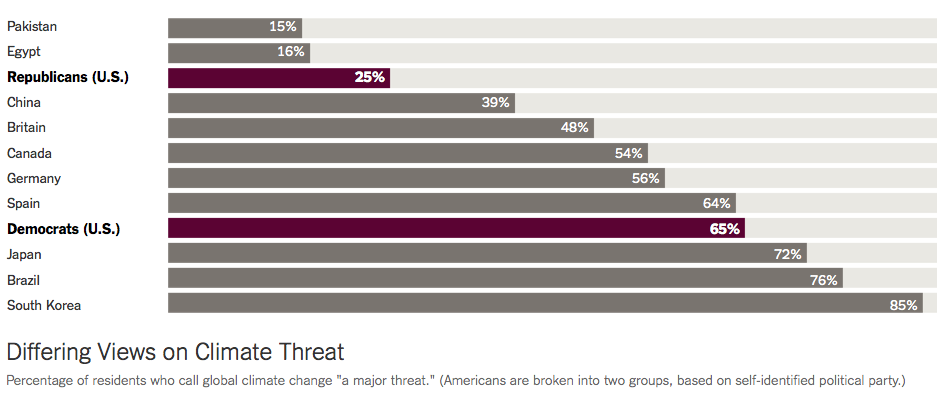
According to Pew Research Center surveys conducted last year, 25 percent of self-identified Republicans said they considered global climate change to be “a major threat.” The only countries with such low levels of climate concern are Egypt, where 16 percent of respondents called climate change a major threat, and Pakistan, where 15 percent did. By comparison, 65 percent of Democrats in the United States gave that answer, putting them in the same range as Brazilians (76 percent), Japanese (72 percent), Chileans (68 percent) or Italians and Spaniards (64 percent).

It matters when one major party refuses to accept reality – when it refuses to grasp the fact that you cannot raise revenue by cutting taxes, that the United States practiced torture, or that human-made climate change is real. When one side engages in this surreal debate, the country becomes incapable of engaging in any real debate. I know we’ve become used to this – and the press has found a way to write about the GOP as if they are not a reckless, know-nothing, post-modern fantasy machine. But it doesn’t mean we shouldn’t remain capable of shock and anger at this pathetic excuse for a political party, at the unique idiocy of this party of the right in the Western world.

A Problematic POW

The last American prisoner of war in Afghanistan, Army Sgt. Bowe Bergdahl, was freed on Saturday after five years in Taliban captivity:

Bergdahl, 28, is believed to have slipped away from his platoon’s small outpost in Af­ghanistan’s Paktika province on June 30, 2009, after growing disillusioned with the U.S. military’s war effort. He was captured shortly afterward by enemy ­forces and held captive in Pakistan by insurgents affiliated with the Taliban. At the time, an entire U.S. military division and thousands of Afghan soldiers and police officers devoted weeks to searching for him, and some soldiers resented risking their lives for someone they considered a deserter.

Bergdahl was recovered Saturday by a U.S. Special Operations team in Afghanistan after weeks of intense negotiations in which U.S. officials, working through the government of Qatar, negotiated a prisoner swap with the Taliban. In exchange for his release, the United States agreed to free five Taliban commanders from the military detention center at Guantanamo Bay, Cuba.

Eli Lake and Josh Rogin name the bad guys we traded for Bergdahl:

A senior U.S. defense official confirmed Saturday that the prisoners to be released include Mullah Mohammad Fazl, Mullah Norullah Noori, Abdul Haq Wasiq, Khairullah Khairkhwa and Mohammed Nabi Omari. While not as well known as Guantanamo inmates like 9-11 mastermind Khalid Sheikh Mohammed, the Taliban 5 were some of the worst outlaws in the U.S. war on terror. And their release will end up replenishing the diminished leadership ranks of the Afghan Taliban at a moment when the United States is winding down the war there. “They are undoubtedly among the most dangerous Taliban commanders held at Guantanamo,” said Thomas Joscelyn, a senior editor at the Long War Journal who keeps a close watch on developments concerning the detainees left at the Guantanamo Bay prison.

I’ll be honest here and simply report that I am deeply conflicted about this event. I totally see the importance of maintaining the ethic of never leaving a soldier behind on the battlefield. Equally, it’s depressing that we had to release serious Taliban prisoners of war to get him back. This is an excruciating choice – but if Bergdahl’s health was in jeopardy, the administration made what strikes me as the right move. Even the Israelis do this kind of thing quite regularly.

Then there’s the question of the actual soldier in question and the circumstances of his capture. Was Bergdahl really a deserter? Nathan Bradley Bethea, who served in his battalion, says yes:

He is safe, and now it is time to speak the truth.

And that the truth is: Bergdahl was a deserter, and soldiers from his own unit died trying to track him down. On the night prior to his capture, Bergdahl pulled guard duty at OP Mest, a small outpost about two hours south of the provincial capitol. The base resembled a wagon circle of armored vehicles with some razor wire strung around them. A guard tower sat high up on a nearby hill, but the outpost itself was no fortress. Besides the tower, the only hard structure that I saw in July 2009 was a plywood shed filled with bottled water. Soldiers either slept in poncho tents or inside their vehicles.

The next morning, Bergdahl failed to show for the morning roll call. The soldiers in 2nd Platoon, Blackfoot Company discovered his rifle, helmet, body armor and web gear in a neat stack. He had, however, taken his compass. His fellow soldiers later mentioned his stated desire to walk from Afghanistan to India.

The Daily Beast’s Christopher Dickey later wrote that “[w]hether Bergdahl…just walked away from his base or was lagging behind on a patrol at the time of his capture remains an open and fiercely debated question.” Not to me and the members of my unit. Make no mistake: Bergdahl did not “lag behind on a patrol,” as was cited in news reports at the time. There was no patrol that night. Bergdahl was relieved from guard duty, and instead of going to sleep, he fled the outpost on foot. He deserted. I’ve talked to members of Bergdahl’s platoon—including the last Americans to see him before his capture. I’ve reviewed the relevant documents. That’s what happened.

Morrissey believes the White House erred in bringing Bergdahl home with fanfare:

[T]here is a big difference between swapping for a man who’s accused of desertion (and whose disappearance cost at least six soldiers’ lives, and possibly more), and cheering his release in a presidential Rose Garden speech along with his family. That is a return for a hero, not a potential deserter (who, we should stress, has not yet been charged with that crime, let alone convicted). Did no one at the White House bother to check into the details of Bergdahl’s disappearance, or calculate what that might mean politically in this trade? Everyone from Obama on down seems to have been caught flat-footed in a controversy of their own making … again.

House Republicans are promising hearings, of course, but not because Bergdahl might have deserted:

On a series of Sunday talk shows, Republican lawmakers slammed the decision to carry out the prisoner swap as a dangerous concession to the militant group and a violation of long-standing U.S. policy not to negotiate with terrorist groups. They also said the White House had violated a law requiring the administration to give Congress 30 days notice before such a swap. “The question going forward is have we just put a price on other U.S. soldiers?” Sen. Ted Cruz, the Texan Republican, said on ABC’s “This Week.” “I do not think the way to deal with terrorists is through releasing other violent terrorists.”

With Republicans blasting the Obama administration for, in their view, surrendering to terrorist hostage taking, the White House is defending the move as an effort to bring back a prisoner of war and show other troops the lengths to which Washington will go to ensure that none are left on the battlefield. On Sunday, administration officials said the swap was in line with the military’s commitment to see all its soldiers return from war, as a reflection of its “leave no man behind” ethos.

But Lt. Col. Robert Bateman reminds critics that exchanging prisoners with the enemy, no matter how unsavory the enemy, isn’t a novel concept:

As George Washington did, as James Madison did, as Abraham Lincoln did, our current president decided to make a trade. Sergeant Bowe Beghdahl, promoted in absentia twice since his capture in Afghanistan, is now free. We let loose five of theirs to regain the only American held by the enemy. This is not something new, it is a return to the old. Those who oppose the idea are taking offense with George Washington, James Madison, and Abraham Lincoln.

Martin Lederman addresses the complaint that the administration broke the law in carrying out the swap without notifying Congress beforehand:

Secretary Hagel’s statement suggests that he did comply with the substantive requirements of Section 1035, but that he notified Congress today, not 30 days ago.  It’s difficult to imagine that Congress would have intended to insist upon such a 30-day delay if the legislators had actually contemplated a time-sensitive prisoner-exchange negotiation of this sort; but the statute does not on its face address such a rare (and likely unanticipated) case.  Note that the President wrote this in his signing statement:  “Section 1035 does not . . . eliminate all of the unwarranted limitations on foreign transfers and, in certain circumstances, would violate constitutional separation of powers principles. The executive branch must have the flexibility, among other things, to act swiftly in conducting negotiations with foreign countries regarding the circumstances of detainee transfers.”  Perhaps he had the prospect of a Bergdahl negotiation in mind . . . .

Josh Rogin sees the deal as a possible first step by Obama toward clearing out Gitmo by executive fiat:

In his 2014 State of the Union address, Obama promised to shutter the prison built on Cuban soil by the end of the year. Obama now has seven months to fulfill his latest promise to shut down Guantanamo—or come as close to it as he can. During that time, Congress will be unable to prevent the release of the 149 prisoners still there.

“This whole deal may have been a test to see how far the administration can actually push it, and if Congress doesn’t fight back they will feel more empowered to move forward with additional transfers,” said one senior GOP senate aide close to the issue. “They’ve lined up all the dominoes to be able to move a lot more detainees out of Guantanamo and this could be just the beginning.”

That’s what I take away from this. We’ve just released five actual enemy combatants by executive order. Why not release the innocent ones by the same rubric? When you contemplate this move – and the EPA’s tough stance on coal along with the zero option in Afghanistan – you begin to see Obama re-take the initiative in his last two and a half years. Imagine the legacy: no troops in Iraq or Afghanistan; Gitmo closed; universal healthcare entrenched; Iran’s nuclear threat defused; marriage equality in all fifty states; the end of marijuana Prohibition; and carbon energy cut down to size.

Repeat after me: meep meep, motherfuckers.