Obama Gets Serious About Climate Change

EPA Admin Gina McCarthy Announces New Regulations Under Obama's Climate Action Plan

Yglesias calls today “the most important day of Obama’s second term”:

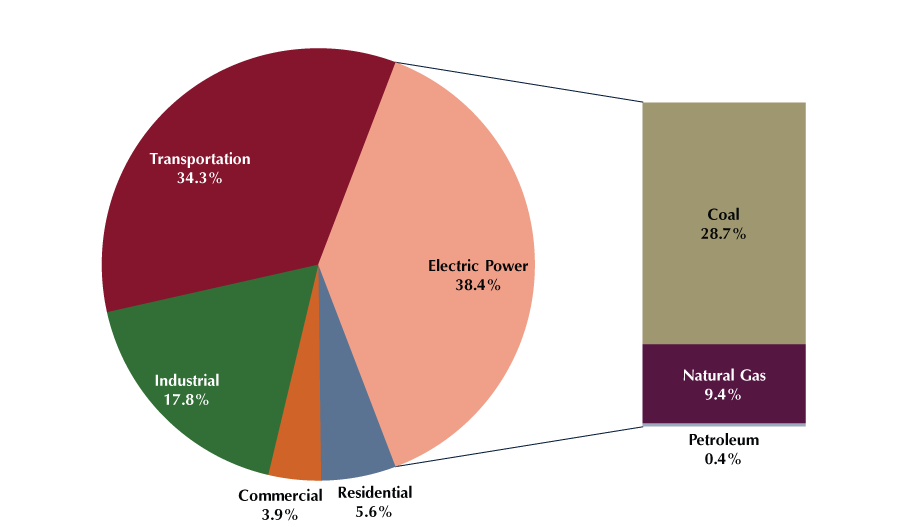
It’s important not only because climate change is an issue of enormous significance, but because the text of the Clean Air Act really does give the executive branch power that matters. The White House can’t unilaterally change the wage structure of the United States or create a path to citizenship for unauthorized immigrants, but it really can revolutionize the environmental practices of the electricity sector — a sector that, as seen [here], is responsible for about 38.4 percent of America’s total carbon dioxide emissions.

Ryan Koronowski declares that this is “the most significant move any U.S. president has made to curtail carbon pollution in history”:

There are many opinions of what method is best to lower emissions: carbon tax, cap-and-trade, clean energy incentives, direct regulation. All that matters for those concerned about climate change, in the end, is whether emissions drop, and how quickly. The Council of Foreign Relations’ Michael Levi points to EIA analysis of the likely impact of a carbon tax and other climate bills on power plant emissions. A $25-per-ton carbon tax would be far more effective, dropping emissions 47 percent by 2020 and 66 percent by 2030 — and the cap-and-trade bill passed by the House would have lowered emissions 56 percent by 2030 according to the EIA. The EPA’s proposed target, however, achieves reductions comparable to a far lower carbon tax, the Senate’s 2010 American Power Act, and 2012′s Clean Energy Standard Act. Levi suggests that the 2030 could be seen as a moving target — it could be ratcheted down through additional legislation or new regulation.

Indeed, the EPA could finalize this rule next year with a stronger target, especially if it receives a great deal of feedback from the public. Many environmental groups will be pushing for more ambitious targets later in the decade, even as they nearly unanimously applauded the regulations.

Ben Adler is hearing complaints from environmentalists. He also wonders about the international reaction:

The big question on the minds of many environmentalists is whether this will be enough to encourage other major polluting countries to make significant climate commitments. While the CO2 reduction will be significant by historical U.S. standards, it won’t get emissions down anywhere close to what’s needed to avert catastrophic global warming, nor even get the U.S. to the goal it agreed to at U.N. climate talks in Copenhagen in 2009: a 17 percent reduction in greenhouse gas emissions from 2005 levels by 2020. The hope is that it will signal enough progress to get the rest of the world to agree to binding emissions reductions in the next round of U.N. climate talks, which is supposed to culminate in a new climate treaty signed in Paris in December 2015. Will these proposed rules be good enough?

Plumer has a full explainer on the new EPA regulations. On whether the rules will survive legal scrutiny:

[T]he regulations could get knocked down in court. Industry groups and conservative states are sure to challenge the power-plant rule as soon as humanly possible. Environmentalists, for their part, have argue that the EPA’s flexible approach to regulation is defensible. Other legal experts think it’s a closer call. But it would all come down to whatever the DC Circuit Court or the Supreme Court decided.

If the EPA’s power-plant rule did get struck down in court, the agency might have to start all over again — raising the possibility that it wouldn’t be able to craft a new rule until Obama left office in 2017.

Jason Mark labels the EPA move “Obamacare for the air”:

If the “job-killing EPA regs” and “Obama overreach” soundbites seems to echo the political script from the Obamacare battle, there are some key differences. For starters, Republican-controlled states won’t have the ability to opt out of the system, as many have with the Affordable Care Act’s extension of Medicaid. If a state fails to submit a plan for lowering emissions from its power plants, the EPA has the authority to impose one—a scenario most states will choose to avoid.

More importantly, corporate opposition to the new rules isn’t as unanimous as it may appear. Several major electric utilities —including Dynergy, American Electric Power, and First Energy — have expressed cautious optimism about being able to thrive within the new regulations. Electricity generation is a capital-intensive industry that works on planning horizons of 30 to 50 years, and the utilities would prefer certainty and clarity as opposed to the policy purgatory they’ve been in the for the last decade.

Michael Grunwald sees the regulations as part of Obama’s war on coal:

It’s filthy stuff. When Obama said Saturday that his carbon rules will prevent 100,000 asthma attacks in Year One, he wasn’t describing the health benefits of emitting less carbon dioxide; he was describing the health benefits of burning less coal.

So let’s face it: When Obama talks up his “all-of-the-above” energy strategy, he really means all-of-the-above-except-the-black-rocks-below. In the 21st century, any national leader that takes environmental protection and the fate of the planet seriously will need to launch a war on coal, and Obama takes it very seriously. He hasn’t advertised his war on coal—it would be questionable politics in swing states like Ohio or Virginia, and even his home state of Illinois—but he’s fought it with vigor.

Tom Zeller Jr. thinks the plan may boost the economy:

While some jobs will almost certainly be lost if companies decide that it’s not worth it to outfit their aging coal plants with new pollution-control technologies, those losses will almost certainly be offset by the creation of new jobs elsewhere, as the new regulations drive investment in cleaner technologies, efficiency upgrades and other areas. A recent analysis from the Natural Resources Defense Council estimated that new greenhouse gas limits on power plants could reduce electric bills for U.S. households and businesses by as much as $37.4 billion by 2020, and create more than 274,000 jobs.

Sure, the NRDC isn’t exactly an impartial observer, but then neither is the API or the U.S. Chamber. The larger point is that most regulations have upsides and downsides, and short-term pain is often offset to some degree by long-term benefits that industry likes to ignore.

McArdle has low expectations:

As with any new Environmental Protection Agency rule, a lengthy comment period will ensue. After the comment period, the EPA presumably has discretion about the deadlines they set. With a big election coming in 2016, and some nice, big, coal-consuming swing states on the line, I would wager cash money that those deadlines are set no earlier than Dec. 31, 2016.

Whenever the deadlines do kick in, the new president will be besieged with desperate legislators and governors pleading to keep electricity prices from rising in these hard economic times. I can imagine a steadfast Democratic president standing up for the environment against utility lobbyists, coal-mining districts and electricity users, telling them that we need to do what’s best for the planet, not some narrow economic interest. But I can also imagine a beautiful world where everyone rides around in carriages driven by unicorns, angels sing in the trees, and purple raspberry pie grows on bushes outside your backdoor.

Ann Carlson reminds everyone that Obama is following the law:

Obama’s proposed rules are not a power grab. Nor are they an end run around Congress. Rather, the rules are reactive, a legally-required response to a petition filed when Bill Clinton was still president. I hope this part of the story — that Obama is following, not skirting or flouting, the law — gets highlighted in what is already a big press story.

Here’s the backdrop for those who don’t know it. In 1999, the International Center for Technology Assessment and a number of other non-profit organizations filed a petition with the Clinton EPA arguing that EPA should regulate greenhouse gases from automobiles under Section 202 of the Clean Air Act. In 2003, after George W. Bush became President, EPA denied the petition. A coalition of states and environmental groups then challenged the denial of the petition in the case that resulted in the landmark decision Massachusetts v. EPA. The Court held in Mass v. EPA that the agency erroneously denied the petition. The Court also ruled — and this is key — that greenhouse gases are an “air pollutant” as defined in the Clean Air Act and that EPA must decide whether, under Section 202 of the Act, greenhouse gases endanger public health and welfare. The Court’s ruling triggered a cascade of regulatory actions by EPA, all required by the Court’s substantive holdings.

And Ezra Klein points out that the new regulations “are far less ambitious than the proposal McCain offered in Oregon in 2008”:

They’re less ambitious than the proposals Newt Gingrich championed through the Aughts. They’re far less than what’s required to keep the rise in temperatures to two degrees Celsius.

But they’re probably at the outer limit of what can be done so long as the Republican Party refuses to even believe in climate change, much less work with the Obama administration on a bill. The good news, if there is any, is that the Republican Party hasn’t always refused to believe in climate change. There was even a time when its key national leaders were committed to doing something about it. Those leaders are still around today. They could still do something about it today.

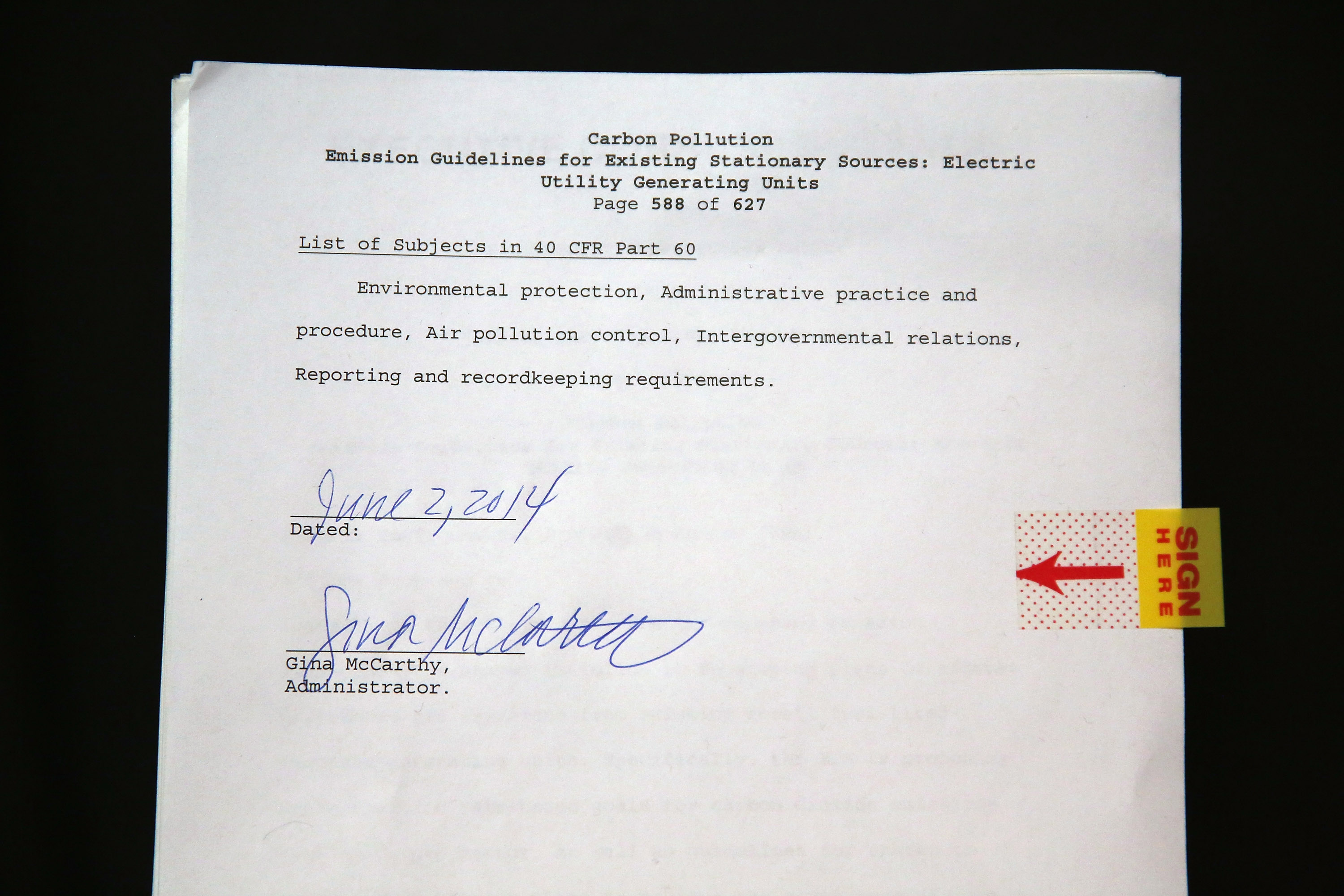
(Photo: U.S. Environmental Protection Agency Administrator Gina McCarthy’s signature is shown on new regulations for power plants June 2, 2014 in Washington, DC. By Chip Somodevilla/Getty Images)

Can Republicans Win Black Voters?

Bouie thinks it’s possible, if not likely:

[W]hen it comes to analyzing black voters, conservatives need to stop treating them as irrational or stuck on some kind of “Democratic plantation.” Like any coherent group of citizens, black Americans have a strong sense of their individual and collective interests. And in their correct view, they do better under Democratic presidents, which contributes to their overwhelming support for Democratic politicians. Put another way, if conservatives want to make inroads with black Americans and other minorities, they have to show them they’ll succeed under Republican governance and have to deliver when the opportunity comes.

Unfortunately for the GOP, research suggests that African Americans have good reason to vote Democratic:

According to a recent paper from Zoltan L. Hajnal and Jeremy D. Horowitz – both political scientists at the University of California–San Diego – there’s clear evidence that when the nation is governed by Democrats, black well-being “improves dramatically” across multiple dimensions. Specifically, looking at data from 1948 to 2010, Hajnal and Horowitz found that “African Americans tend to experience substantial gains under Democratic presidents whereas they tend to incur significant losses or remain stagnant under Republicans.” On average, under Democratic presidents, blacks gained $895 in annual income, saw a 2.41 point drop in their poverty rate, and a 0.36 point drop in their unemployment rate. By contrast, under Republicans, blacks gained $142 a year, along with a 0.15-point increase in poverty and a 0.39-point increase in unemployment.

Giving A Whole New Meaning To “Computer Worm”

OpenWorm, an informal collaborative group of biologists and computer scientists from several countries, aims to create a complete digital model of a simple organism:

On May 19th this group managed to raise $121,076 on Kickstarter, a crowd-funding website. The money will be put towards the creation of the world’s most detailed virtual life form—an accurate, open-source, digital clone of a critter called Caenorhabditis elegans, a 1mm-long nematode that lives in the soils of the world’s temperate regions. … The idea, says Stephen Larson, a neuro- and computer scientist, who is the project’s co-ordinator, is to model the biochemical behaviour of every one of the worm’s cells, and how they interact with each other. If that can be done, then movement—and all the beast’s other behaviour patterns—should emerge by themselves from that mass of interactions.

George Dvorsky reviews the brief history of virtual organisms and why scientists are eager to create more of them:

To be fair, scientists have already created a computational model of an actual organism, namely the exceptionally small free-living bacteria known as Mycoplasma genitalia. It’s an amazing accomplishment, but the pathogen — with its 525 genes — is one of the world’s simplest organisms. Contrast that with E. coli, which has 4,288 genes, and humans, who have anywhere from 35,000 to 57,000 genes. Scientists have also created synthetic DNA that can self-replicate and an artificial chromosome from scratch. Breakthroughs like these suggest it won’t be much longer before we start creating synthetic animals for the real world. Such endeavors could result in designer organisms to help in the manufacturing of vaccines, medicines, sustainable fuels, and with toxic clean-ups.

There’s a very good chance that many of these organisms, including drugs, will be designed and tested in computers first. Eventually, our machines will be powerful enough and our understanding of biology deep enough to allow us to start simulating some of the most complex biological functions — from entire microbes right through to the human mind itself (what will be known as whole brain emulations).

Saving The Whales For Ourselves

dish_whale

Simon Lewsen traces “our whale fixation [to] the fraught, shifting relationship between humans and the non-human world”:

Anthropologist Arne Kalland explains that, with the rise of the green movement, cetaceans became icons of environmental utopianism. They epitomized the complexity of the natural world: a realm that could teach us a thing or two, if we didn’t destroy it first. Whales were imagined as highly sensitive creatures swimming peacefully through rarified water. Many whale behaviours jibe with human notions of compassion: they sing to each other, nurture their infants into maturity, and care for their wounded and elderly. Given their longevity (they predate humanity by at least 25 million years) and brain size (larger than that of any other creature), it is possible to envision them as sage-like and profound—a species that has outgrown our territorial and violent impulses. Their ability to communicate across hundred-mile expanses seemed to indicate an otherworldly, near-telepathic sensitivity.

As Kalland makes clear, this eco-utopian “super whale” is actually a mash-up of different species-specific traits:

the grey whale’s friendliness, the sperm whale’s braininess, and the humpback’s phenomenal ability to project sound across large ocean basins. In ecological terms, this hybrid creature is every bit as mythical as the unicorn.

Lewsen adds that a global whaling moratorium in 1982 shifted the real threat from human hunters to more complex problems, such as industrial pollution:

Some whales, like the humpback and blues, really do need our protections; other species, like the minke, could probably sustain a limited harvest. Of course, the thought of an intelligent mammal being brutalized with harpoons is obscene, but from a conservation perspective, there’s little to be gained from scapegoating small-time hunters for global problems. The super whale became the sacred cow of the green movement, and after the 1980s moratorium, many pods regenerated briskly; meanwhile, carbon emissions continued to rise.

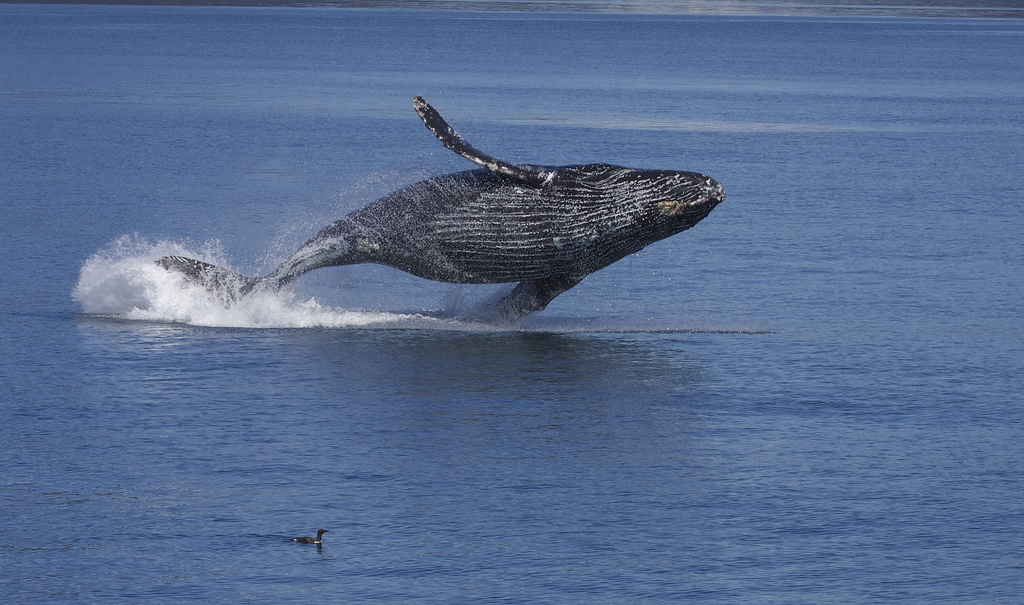
(Photo of breaching humpback whale by Gregory “Greg” Smith)

Trafficking Lies

In Newsweek‘s latest cover-story, Simon Marks exposes the exaggerations, inconsistencies, and outright fabrications of Cambodian anti-sex trafficking activist Somaly Mam:

At the heart of the questions surrounding Mam is a debate within the nonprofit sector on the acceptable tactics for fundraising and educating the public. For a long time, there has been a strong push to move away from using children to raise funds. … Experts in sex trafficking say that while it is a serious problem, the scale and dynamics of the situation are often misunderstood, in part because of lurid, sensationalistic stories such as those told by Mam and her “girls.” In 2009, 14 organizations and academics, including George Soros’s Open Society Foundations, wrote a letter to Salty Features, an independent film production company based in New York, to thank it for its interest in making a film about Mam’s work in Cambodia. But they advised against having the documentary focus on Mam due to [her organization’s] lack of understanding of the sex industry. In an interview for Euronews in 2012, Mam said girls as young as 3 are being held in Cambodian brothels. Experts in the field say that is almost unheard-of.

The accumulated allegations have effectively ousted Mam from her own foundation. Erik Loomis rips into Nicholas Kristof for having taken Mam’s bait:

Wait, Nic Kristof? No! You mean, Mr. Helicopter Rich White Man Rescuer was ready to buy lurid, falsified stories hook, line, and sinker? Who could have guessed! Here’s a 2011 Kristof article lauding Mam and her story, in what has to be the most prototypical Kristof column. Here’s another, on Pross, entitled, “If This Isn’t Slavery, What Is?” Oh, I don’t know. Maybe something that actually happened. …

The history of prostitution reform in Progressive Era America tells a similar story.

There were Kristof’s then too, freaking out about the white slavery traffic. They wanted to hear the most lurid stories possible and then publicize them to make points about the evils of prostitution. They didn’t bother fact-checking either. And time and time again, these stories about young women didn’t pan out. The impact of this movement was to make sex work illegal, making it far more dangerous, as it largely remains today.

Elizabeth Nolan Brown is disturbed at the revelations:

Perhaps the story is indicative of nothing more than how motivated, mentally ill manipulators can really thrive if they find the right angle. But some say it highlights the downside of nonprofits using tragedy porn to raise funds. “If your goal is fundraising, you actually have an incentive to pull out the most gory story,” one activist told Marks, “and so we get completely false realities of the world.”

These false realities are then used not just to tug at the heart and purse strings of potential donors but to launch initiatives and make lawmakers weepy-eyed at Congressional hearings. They inspire policy, and that’s scary. Boogeymen make frighteningly good lobbyists.

But Marcotte offers a somewhat more sympathetic take:

It’s easy to see why non-profits trying to fundraise, as well as the media industry used to raise attention to various social justice issues, are drawn to the “heroes beating the odds” stories that Mam told not only of herself but of the various girls she used for media and fundraising appeals. It’s simply easier for audiences to connect with the story of an individual than to examine dry, statistical data charting economic, public health, or educational outcomes. The fantasy of being able to rescue some beautiful, charming girl from the hell of sex slavery and put her on the road to a “normal” life has the kind of power that a chart detailing maternal health outcomes after various public health interventions will never have. The faces of young heroes who have overcome adversity make for good magazine covers. All the economic incentives are in place.

Unfortunately, the need to hear a relentless drumbeat of tales that start in horror and squalor and end in uplift and hope also creates incentive to fudge the facts, as Mam’s story shows. It might also mislead people about what problems are most pressing.

Evolution’s Expressions

dish_crichtonbrowne

Stassa Edwards calls Darwin’s 1872 work The Expression of the Emotions in Man and Animals “the most accessible of Darwin’s books”:

Far from a dry scientific text, it’s rich with colorful anecdotes drawn from theater, painting and, of course, photography. In it, he argues that man’s emotional expressions—his smiles, snarls, and frowns — are the result of natural selection. If facial communication stems from natural selection, then man must share it with other mammals. “With mankind some expressions, such as bristling the hair under the influence of extreme terror, or the uncovering of the teeth under that furious rage, can hardly be understood,” he wrote, “except on the belief that man once existed in a much lower and animal-like condition.”

Darwin looked to photography for evidence, which led him to the work of James Crichton-Browne, a neurologist who photographed the mentally ill:

The mentally ill, as Victorian mores held, were emotionally uninhibited and unconstrained. Unable to conform to social norms, the insane were hardly concerned with the suppression of emotion required by the cultured and the sane. To Darwin, Crichton-Browne’s photographs represented something more useful than marketable trinkets. The raw emotion of the inmates at West Riding Lunatic Asylum was primitive, more authentic, and certainly closer to man’s evolutionary ancestors. Crichton-Browne’s project, his interest in capturing the true look of mania, proved a valuable discovery for Darwin. …

Darwin found in Crichton-Browne a fellow scientist sympathetic to his theories and ready to expound on his observations. The correspondence between the two men is colorful…. Though Crichton-Browne refers to very few of his photographs specifically, his letters flesh out the otherwise vacant personalities captured by his camera. In a single letter, he describes the “hilarity” of sexually perverse women; the “remarkable lachrymal secretion” of “melancholics, who sit rocking themselves rhythmically backwards and forwards”; and “a stereotyped smile” of “many idiots and imbeciles who are constantly smiling and laughing, who are ‘pleas[ed] with a rattle, tickled by a straw.'”

(Image: Woman Suffering from Chronic Mania, c. 1869, by James Crichton-Browne, via Wellcome Library, London)

Rejecting Roth

Will Philip Roth ever shake his critics who accuse him of anti-Semitism? Judith Thurman checked in with the author as he recently received an honorary degree from the Jewish Theological Seminary:

The spectre of “outside” voices objecting to his recognition by a bastion of Jewish learning and Conservative theology couldn’t spoil Roth’s pleasure in the morning’s lovefest, but it rankled him. “Look,” he said, “‘Portnoy’s Complaint’ was published ten years after ‘Defender of the Faith,’ in 1969, and the Jewish reaction to it was completely understandable. I can’t say I didn’t expect it. I had no objection to it, either. I’ve always had literate Jewish readers, even if my most virulent enemy was the greatest scholar of Jewish mysticism, Gershom Scholem, who reviewed ‘Portnoy’ in Haaretz, where he wrote, ‘The writer revels in obscenity’ and ‘This is just the book that anti-Semites have been waiting for.’ And I also can’t say that, when ‘Defender of the Faith’ was published, I didn’t know that Jewish nerves were raw. I was not insensitive to the rawness, because I knew where it came from. World War II had ended only thirteen years before, and I came of age in the single most anti-Semitic decade in human history. But rabbis denouncing me from the pulpit, and in their Saturday sermon columns—well, that was disgusting, and it stung.”

The next day, the Forward published an article about the commencement—”PHILIP ROTH, ONCE OUTCAST, JOINS JEWISH FOLD” (it’s a fold that also includes Martin Luther King, Jr., who received an honorary doctorate in 1964)—and Roth sent it to me without comment. But he had one last red-light reflection:

That these displays of narrow-minded literary stupidity that first erupted in response to my work in 1959 should continue to emanate from the McCarthyite right of the Jewish establishment in 2014 is more than a little shameful. Do you think that African-American readers of James Baldwin are still up in arms, if ever they were, because in his fiction Baldwin vividly portrayed black prostitutes, drug addicts, and pimps? Do you think the African-American readers of Ralph Ellison are still up in arms, if they ever were, because in the great opening section of his masterpiece “Invisible Man” Ellison permits a southern black sharecropper to speak with relish of how he routinely has sex with his own young daughter? It’s beginning to appear that I, for one, will not live to see these disapproving Jewish readers of mine attain that level of tolerant sophistication, free from knee-jerk prudery, that has long been commonplace among African-Americans when reading their own writers.

Previous Dish on Roth and religion here.

Gauguin’s Tahitian Eden

In a review of MoMa’s Gauguin exhibit, Daniel Goodman contemplates the painter’s religious influences:

In Mata Mua, Tahitian women dance, play instruments, and worship a statue of Hina, the Tahitian moon goddess. The women frolic in a lush, idyllic landscape dish_matamua in the foreground, while purple mountains protruding out of an off-white sky loom over them in the background, and a large cross-shaped bluish-gray tree (the Tree of Life in this Tahitian Eden?) centers the canvas. What may be most interesting about Mata Mua is that, even though the Polynesian religious ritual is the central subject matter, Gauguin limits the scene to the left corner of the painting and places the cross-shaped tree squarely in the center, subtly reminding us of Gauguin’s abiding interest in Christianity.

In fact, despite his fascination with Polynesian religion, and his dissatisfaction with Roman Catholic doctrine and institutional religion, Gauguin remained interested in Christianity and the Bible. … Of course, Gauguin experienced his own paradise lost when he arrived in Tahiti and discovered that it was not the unspoiled paradise of his imagination. Many of his paintings depict not what he actually saw but what he had wanted to see. Mata Mua is Gauguin’s vision of paradise. He created the pristine world he wanted to experience, rather than the fallen one he had to experience. It’s a “romantic, idealized, but ultimately false” vision of Tahiti, say the MoMA curators; but though Gauguin’s vision of Tahiti was objectively false, it was entirely true in the realm of Gauguin’s imagination. And from the perspective of artistic surrealism, nothing could have been truer than Gauguin’s Tahitian Eden.

Update from a reader:

Left unmentioned in the discussion of Gauguin’s, “Tahitian Eden,” is his well-documented pursuit and abuse of underage Polynesian girls.

During a brief stay on Hiva Oa (I was trapped there for two weeks in 2003 after quite literally jumping ship), it is common knowledge that the nuns in charge of the local girls school were forced to take drastic measures to keep the artist (who is buried on the island) away from the children. Alas, Gauguin eventually ‘married’ three of the local girls, all between the age of 13 and 14.

Gauguin was (and is) widely recognized as a pederast and sexual libertine. Frankly, I find Goodman’s reflection on the, “pristine world he wanted to experience, rather than the fallen one he had to experience,” to be sad and hysterical in its wrongness.

Another also doesn’t see paradise:

I’m neither an art historian nor an art critic, so if an expert says the Gauguin painting is supposed to be idyllic or some kind of Eden, then I’m inclined to try to see what they mean.  But I have to say that I laughed out loud when I looked at the paintings and then read the Gauguin interpretations.  When I see the painting, I definitely do not see a happy place, much less an Eden.  That painting is creepy.  What’s with all the dark and muddy colors? To me, people think it’s a kind of Eden because you look at the women in white right away.  But look around them and at everything else.  What’s with the dude walking toward the two women dancing by the statue?  Does he have his hand behind his back?  Is he carrying a knife?  Maybe that’s why the tree is sorta shaped like a crucifix, the Christian symbol of sacrifice.  The creepy vines curl near the women in white.  What exactly is surrounding them?  The woods in the background are also ominously dark  and the bright yellow tree in the background gets less so one the left side of the tree, almost like it’s curling around the tree to look.  I look at this painting and think, this is a place of terror.

(Image: Mata Mua by Pual Gauguin, 1892, via Wikimedia Commons)

Resurrecting Hope

dish_Holbein_the_Younger

Brian Bouldrey, editor of the collection Wrestling with the Angel: Faith and Religion in the Lives of Gay Men, reflects on Hans Holbein’s painting The Body of the Dead Christ in the Tomb:

[F]or me, the painting looks clearly like something else I knew quite well: Christ looks like another death from AIDS. Has nobody made this connection before? I’ve looked in libraries and on line, but nothing. My partner Jeff, who died in 1993—it’s the spitting image. The Dead Christ looks like the man I love and loved and all those other men dead from HIV. The bruises like kaposi’s sarcoma, the gaunt drawn face and slack downturned mouth. That painting is for me a grenade of past experience made horribly fresh and present. When I look at it, it sends me back to that moment, and I despair, I have to grieve all over again, I have to start all over, I have to do all the work to reflect upon that experience. …

Nobody wants to talk about the AIDS era any more, even and especially the ones who survived it, watched our lovers and friends suffer, die, and get buried, but never rise again, a great game of hide and seek in which nobody ever got found.

It was terrifying and hopeless, we survivors are all children who still look into clothes hampers and closets and hope they will suddenly just be there, still hiding. Here: look what I’m doing: making a narrative of something that has no story left to it. There was no romance to AIDS, though I think the foolish young me wanted it to be romantic, just as those who want a messiah are romantics. I loved the romantic stories of the saints, which drew me into their useful mythology the way demigods do in Greek myths—men and gods are inert, but the demigods, not quite of this world or that, little monsters, they get the ball rolling. It was God, then, that I had the hardest part with, way up there, just being, rather than doing.

I keep thinking that I have to restore myself in order to honor those who suffered like the man who is the Dead Christ, if you accept that the dead man in Holbein’s painting is the Dead Christ, which is, in itself, a declaration of faith, at least the beginning of one. But what I must instead do is lose myself and dig myself out from the moment. Resurrection, rebirth cannot happen until one dies. Hope dies every time I look at the Holbein. That is the strangest kind of resurrection story.

(Image of The Body of the Dead Christ in the Tomb, with detail below, via Wikimedia Commons)

The Texas Exorcists

Julie Lyons pens a captivating profile of Larry and Marion Pollard, who perform exorcisms in their West Texas ranch home. Lyons describes witnessing the exorcism, or “deliverance session,” of a woman named Ruth:

“Get up and face me,” [Larry] commands, in a Texas drawl. “I want the one that is trying to intimidate, to act like the big boss. Get up here and face me right now. I call you to judgment.”

Genial, wisecracking Ruth vanishes. A metamorphosis takes place, with subtle changes in voice, movement, and expression. Her head begins to shake and bob. Her arms tense up and straighten. Her fingers stiffen and arch upward. Her head jerks to the left, avoiding Larry’s steady, unsmiling gaze.

Marion, 65, looks on beside them, praying quietly.

“Turn the head right now and look at me,” Larry demands. “Who are you?”

The head snaps forward and drops. The mouth lets out a long sigh—ahhhhh. A robotic, vaguely masculine voice responds: “What do you want?”

“What is your function?” Larry asks.

“I have no function except to torment,” the voice answers. The eyes are fixed in a way that is glaring yet vacant.

“Do you have a right to her? Yes or no?” Larry asks.

“Yes, I have,” the voice says, in a clipped, mocking tone.

“What is your right?”

“Her sexuality,” the voice groans, drawing out the consonants with a hiss. “I take all of their reproductive organs. Everyone gives to me.”

“How long have you tormented her?” Larry asks.

Foreverrrr,” the voice says, breaking into a growl. “As long as I want to.”

“That ain’t the answer,” Larry interjects. “Do you want me to punish you?”

“No,” the voice says, growling again. “Noooooo.”

As he does many times on this April day, Larry calls on the angels of God to torment the demons with flaming swords until the spirits speak truthfully or depart altogether. After considerable interrogation, and after Larry repents on Ruth’s behalf for the sins that allowed this demon to take residence in her, the thing apparently leaves. Ruth bobs her head and exhales.

She plucks a tissue from the box and dabs a tear.

“I felt it leave,” Marion says, speaking for the first time. “Thank you, Jesus.”