
A Little Book’s Big Impact

Citations_du_President_Mao_Tsetoung_Livre_rouge-1966_photo_Mao

Reviewing Mao’s Little Red Book: A Global History, a collection of academic essays about the text that some claim is second only to the Bible in terms of print circulation, John Gray revisits where the collection of the Chinese leader’s sayings came from:

Originally the book was conceived for internal use by the army. In 1961, the minister of defence Lin Biao – appointed by Mao after the previous holder of the post had been sacked for voicing criticism of the disastrous Great Leap Forward – instructed the army journal the PLA Daily to publish a daily quotation from Mao. Bringing together hundreds of excerpts from his published writings and speeches and presenting them under thematic rubrics, the first official edition was printed in 1964 by the general political department of the People’s Liberation Army in the water-resistant red vinyl design that would become iconic. With its words intended to be recited in groups, the correct interpretation of Mao’s thoughts being determined by political commissars, the book became what Leese describes as “the only criterion of truth” during the Cultural Revolution. … Long terms of imprisonment were handed out to anyone convicted of damaging or destroying a copy of what had become a sacred text.

Gray goes on to express disappointment that the contributors “seem anxious to avoid anything that might smack of a negative attitude towards the ideas and events they describe” – and basically ignore the human costs of Maoism:

Reading the essays brought together here, you would hardly realise that Mao was responsible for one of the biggest human catastrophes in recorded history. Launched by him in 1958, the Great Leap Forward cost upwards of 45 million human lives. “When there is not enough to eat, people starve to death,” Mao observed laconically. “It is better to let half of the people die so that the other half can eat their fill.” He did not specify how those condemned to perish would be made to accept their fate. Ensuing events provided the answer: mass executions and torture, beatings and sexual violence against women were an integral part of a politically induced famine that reduced sections of the population to eating roots, mud and insects, and others to cannibalism. When Mao ordered an end to the horrific experiment in 1961, it was in order to launch another.

In a recent interview, however, the volume’s editor offered a more positive assessment of Mao’s writing:

I think one thread that does come through is because it is an authoritative text, in some ways we describe it almost like a religious text, even in its circulation. The only books that are comparable to it are things like the Bible and the Koran. As a religious text, you can imagine that maybe it holds a kind of power over the believers. But on other hand, you can see in places where the book was adopted, including in China, there is almost a religious reformation. It is almost like an education in the liberal arts, and education in rhetoric. Because the text can be used to argue for so many things, in a way it breaks down that kind of authority and allows people to begin to articulate their own desires, their own beliefs in a way to begin to speak freely. We can view this text as a tool of totalitarian dictatorship. But it has this ironic quality of emancipating people’s minds and teaching them how to think and speak freely.

(Photo of a 1966 French edition of Mao’s Little Red Book, via Wikimedia Commons)
Antibiotics Are Messing With Us

… in ways we don’t even realize. Debora McKenzie reviews Martin J. Blaser’s Missing Microbes, which explores the manifold effects these drugs have had on our bodies:

Missing Microbes is partly about [the rise of antibiotic-resistant bacteria]. But it is mainly a story you may not know, about the damage antibiotics do when they actually work. There have already been reports that antibiotics may cause obesity by disrupting gut bacteria that play a role in nutrition. Farmers use antibiotics to fatten livestock; we’re not so different, it seems. This book explains that such microbial disruption is widespread, often irreversible, and surprisingly damaging.

Antibiotics may also have made us taller. And by disrupting immune reactions, they may be involved in modern plagues such as diabetes, allergies, some cancers, maybe even autism. … We evolved with loads of microbes, especially in our gut; our bacteria outnumber our own cells 10 to 1. These complex communities are the delicately balanced results of long evolutionary struggles. We disrupt them at our peril.

Yet every time we take a typical antibiotic, we carelessly wipe out masses of innocent bacterial bystanders. Experiments in mice and epidemiology in humans implicate these losses in autoimmune disorders such as asthma, type 1 diabetes and Crohn’s disease. Meanwhile, babies delivered by Caesarian section are not colonised by the right bacteria, from their mother’s birth canal. And gut microbes affect nerves and immunity in ways that have led researchers to investigate potential links to autism.

But, after watching Blaser’s interview with Jon Stewart, Derek Lowe finds Blaser’s advocacy of narrow-spectrum antibiotics – which target specific families of bacteria – misguided:

The market for a narrow-spectrum agent would necessarily be smaller, by design, but the cost of finding it would … be greater, so the final drug would have to cost a great deal per dose – more than health insurance would want to pay, given the availability of broad-spectrum agents at far lower prices. It could not be prescribed without positively identifying the infectious agent – which adds to the cost of treatment, too. Without faster and more accurate ways to do this (which Blaser rightly notes as something we don’t have), the barriers to developing such a drug are even higher.

And the development of resistance would surely take such a drug out of usefulness even faster, since the resistance plasmids would only have to spread between very closely related bacteria, who are swapping genes at great speed. I understand why Blaser (and others) would like to have more targeted agents, so as not to plow up the beneficial microbiome every time a patient is treated, but we’d need a lot of them, and we’d need new ones all the time. This in a world where we can’t even seem to discover the standard type of antibiotic.

Democracy, Sold To The Highest Bidder

Kenneth P. Vogel is disturbed by the rise of political mega-donors:

In past elections, most major donors boosted candidates or causes closely aligned with the Democratic or Republican establishments. Now it’s just as likely that the biggest checks will be spent bucking the system (witness the Tea Party movement). At a time when wealth is increasingly coalescing in the bank accounts of the richest 1 percent of American citizens, members of this mega-donor community—and the consultants who spur them on—are wresting control from the political parties and their proxies. In a perverse kind of way, the new system is more democratic, but only for those with the cash to buy in.

The 2012 election was a tipping point in this evolution—the first in the modern campaign finance era in which independent groups like those powered by the mega-donors spent more money, $2.5 billion, than the political parties themselves (which spent $1.6 billion). Some of the implications of this trend will likely take years to become apparent, but it has already profoundly reshaped the political landscape. The parties are losing the ability to pick their candidates and set their agendas, as fewer and fewer politicians rely on the financial support of their party to win. In fact, it can be preferable to have the backing of a sugar-daddy donor or a group with deeper pockets willing to spend unlimited cash to fight the party.

And You Thought Your Job Search Was Tough

Michael Bérubé documents his efforts to find steady employment for his 22-year-old son Jamie, who has Down Syndrome:

What is Jamie capable of doing for a living? Our first checklist filled us with despair: factory work, nope; food service, nope (not fast enough); hotel maid service, nope; machine and auto repair, nope. (Though Jamie expressed interest in auto repair — not a moment of astonishing self-awareness.) With one agency, Jamie had two CBWAs followed by detailed five-page write-ups: one doing setup for conferences and meetings (tables, chairs, A/V), the other doing shelving at a supermarket. Neither went well. He had trouble stacking chairs, dealing with the duct tape for the A/V setup, and attaching skirts to tables. At the supermarket he had trouble with the U-boat, the device that carts dozens of boxes out into the aisles — and besides, they were only hiring graveyard shift.

The result?

For two months, it was basically YouTube in the basement, as Jamie gradually realized (with what I think was a kind of horror) that I hadn’t been kidding about that part. Finally, the local sheltered workshop for people with disabilities offered him an 8:30-2:30 slot twice a week — and then three times a week.

On top of that, I sent out a few emails and got him an afternoon of volunteering once a week at the children’s museum. And most recently, another agency set up a six-month trial volunteering at the Y, doing janitorial work twice a week in two-and-a-half-hour shifts. If the trial goes well, we are told, he will be hired. They like him enormously at the Y. The only question is whether he will learn how to do the vacuuming, sweeping and cleaning on his own; right now, the people at his agency are very generously and carefully supervising him minute by minute. …

I knew Jamie would not grow up to be a marine biologist [as he’d once dreamed]. And I know that there are millions of non-disabled Americans out of work or underemployed, whose lives are less happy than Jamie’s. I don’t imagine that he has a “right” to a job that supersedes their needs. But I look sometimes at the things he writes in his ubiquitous legal pads when he is bored or trying to amuse himself — like the page festooned with the names of all 67 Pennsylvania counties, written in alphabetical order — and I think, isn’t there any place in the economy for a bright, gregarious, effervescent, diligent, conscientious and punctual young man with intellectual disabilities, a love of animals and an amazing cataloguing memory and insatiable intellectual curiosity about the world?

The recent Dish thread on Down Syndrome is here.

The Many Meanings Of Wikipedia

Disambiguation

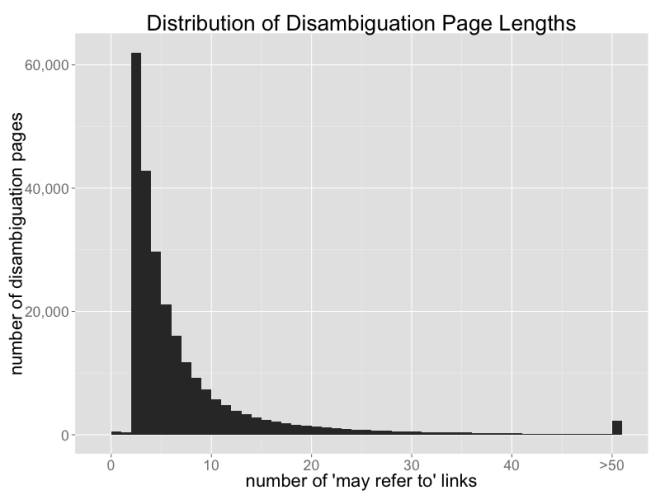
Todd W. Schneider dug through Wikipedia to discover the terms with the highest degree of ambiguity:

Have you ever found yourself looking up John Smith on Wikipedia, only to discover that there are 205 different John Smiths with Wikipedia pages? It’s a testament to the breadth of knowledge on Wikipedia, but it can also be kind of annoying: what if you just want to know the real deal about the English explorer John Smith’s encounter with Pocahontas?

I found myself in the above situation recently, and decided that it’d be interesting to know what is the longest disambiguation page on all of Wikipedia. John Smith has 205 entries, which seems like a lot, but maybe there are other generic terms that have even more Wikipedia entries?

St. Mary’s Church (584 pages) was the winner, followed by the Communist Party (569 pages) and Aliabad (520 pages). Meanwhile, Mona Chalabi created big chart of Wikipedia’s most edited entries:

Many of these subjects are controversial, such as No. 24, global warming, and we can imagine Wikipedia editors in a never-ending tug-of-war. Others pages simply cover sprawling subjects — when will the No. 6 entry, “list of total drama characters,” be complete?

George W. Bush has been by far the most contested article among Wikipedia editors: Through September 2013, the page had been revised 45,273 times. That’s three revisions for every word in the article.

Not surprisingly, Bush isn’t the only political figure to attract factual controversy. The Wikipedia entry on Barack Obama has been revised 23,514 times — just slightly ahead of Adolf Hitler (23,499 revisions). Ronald Reagan, Abraham Lincoln and Bill Clinton all make it into the top 100 (Sarah Palin falls just short, in 104th place).

The American Way Of Punishment

A few weeks ago, David Cole reviewed Robert A. Ferguson’s Inferno: An Anatomy of American Punishment:

“Inferno” ranges widely to offer a fascinating “anatomy of American punishment,” drawing on such diverse sources as Kant, Ursula K. Le Guin and Jack Henry Abbott, among many others. (In one of Le Guin’s stories, Ferguson writes, a utopian society “depends for its happiness on one innocent desperate child imprisoned in horribly cramped, filthy conditions at the center of its city.”) Ferguson surmises that people have a drive to punish, that we are generally unable to understand the pain and suffering of others, and that America’s traditions support an especially virulent “logic of severity.”

Richard Posner found much to agree and disagree with in the book. He believes that the “only realistic solution to deplorable prison conditions is to reduce the number of prisoners”:

Sentences even for serious crimes are too long.

A bank robber, convicted of his latest bank robbery at the age of thirty, may find himself sentenced to life in prison. Yet like other crime that is violent or potentially so (many bank robberies are committed by unarmed criminals who hand the teller a threatening note, or brandish a fake gun, yet even robbery by note frightens bank employees and customers and can end in a dangerous high-speed chase), bank robbery tends to be a young man’s crime, one that criminals age out of. Our thirty-year-old bank robber will be unlikely to commit bank robberies, or for that matter other serious crimes (he may have no aptitude for criminal activity other than robbery), after he turns fifty. Then the only possible social benefit from imprisoning him for the rest of his life will be to deter others from committing bank robberies. But if we bear in mind that potential bank robbers, like most violent criminals, tend not to be intelligent or imaginative, and often have serious problems of impulse control, we may wonder whether the incremental deterrent effect of threatening a potential bank robber with a sentence of more than fifteen or twenty years will be great enough to offset the direct and indirect costs that the much longer sentence will impose on the criminal justice system.

Burnout is a general characteristic of a career in crime; and it is not limited to violent crimes. Often a criminal will realize after having served several prison sentences that crime really doesn’t pay, and he will either find lawful work or live on welfare, charity, and cadging from relatives and friends, in lieu of continuing a life of crime.

Likewise, Balko observes that “crime statistics show that arrest rates peak at around age 20, then quickly drop in the decades that follow“:

One easy way to ensure that criminals re-offend is to make it as difficult as possible for them to integrate into society upon their release — be it through registries, restrictions on where they can live and work or parole programs that keep them buried in fines and chained with restrictions.

The [National Association of Criminal Defense Lawyers] recommends specific policy changes to address these problems. But the more important message from this report is to get people thinking about the very idea of redemption. One NACDL suggestion, for example, is to make criminal records less public, which would make it more difficult for employers to discriminate against ex-prisoners. That’s also the thinking behind the “ban the box” movement, which is trying to get prohibitions on putting the criminal history question on job applications.

But here’s a more radical thought: Maybe we start to see, say, a couple of drug convictions not as a reason to dismiss a job applicant out of hand but as an opportunity to display humanity — perhaps to give that person extra consideration.

Epic Longing

Joan Acocella detects a melancholic strain in J.R.R. Tolkien’s recently released translation of Beowulf:

When Beowulf goes to meet the dragon, the poet tells us fully four times that the hero is going to die. As in Greek tragedy, the audience for the poem knew the ending. It knew the middle, too, which is a good thing, since the events of Beowulf’s 50-year reign are barely mentioned until the dragon appears. This bothered many early commentators. It did not bother Tolkien. The three fights were enough. Beowulf, Tolkien writes in his essay, was just a man:

And that for him and many is sufficient tragedy. It is not an irritating accident that the tone of the poem is so high and its theme so low. It is the theme in its deadly seriousness that begets the dignity of tone: lif is læne: eal scæceð leoht and lif somod (life is transitory: light and life together hasten away). So deadly and ineluctable is the underlying thought, that those who in the circle of light, within the besieged hall, are absorbed in work or talk and do not look to the battlements, either do not regard it or recoil. Death comes to the feast.

According to Tolkien, Beowulf was not an epic or a heroic lay, which might need narrative thrust. It was just a poem—an elegy. Light and life hasten away.

Katy Waldman sees a shared sensibility linking translator and text:

Tolkien’s assessment of the Beowulf poet is revealing:

“It is a poem by a learned man writing of old times, who looking back on the heroism and sorrow feels in them something permanent and something symbolical.” Tolkien himself was a “learned man” who, gazing on ancient things, felt acutely, even as he brought worlds of erudition to bear on his responses. Probably, the project of scholarship refined and deepened those responses. Nostalgia and regret, so central to Beowulf, are presumably familiar mental states for someone who spends much of his time sifting through the past. So the new translation seems especially attuned to transience and loss, from Beowulf’s premonitions before he fights the dragon (“heavy was his mood, restless hastening toward death”) to a gorgeous passage about the last survivor of an ancient civilization burying his gold.

Meanwhile, Jeremy Noel-Tod reminds us of the critical role Tolkien played in securing Beowulf’s place in the canon:

Almost lost to fire in 1731, the contents of the tattered 10th-century manuscript were first published in 1815.  For over 100 years, The Beowulf, as it was known, was regarded as a valuable historical source by scholars, but held no interest for critics seeking narrative skill or poetic subtlety.

J.R.R. Tolkien changed all that. “Beowulf: the Monsters and the Critics” (1936), a paper he delivered to the British Academy shortly before the publication of The Hobbit, strapped a patriotic rocket to the poem’s reputation. It was, Tolkien argued, the work of “a mind lofty and thoughtful”, “a greater man than most of us” and (importantly) “an English man”, whose Christian-era evocation of a pagan past “moves in our northern world beneath our northern sky”. Tolkien’s critical championing of Beowulf was a manifestation of his desire – partly born out of the trauma of the Great War – to create an English treasure-chest of North European mythology. This found a literary home in Middle Earth, the fictional land elaborated by the Lord of the Rings trilogy.

When The Doctor Knew Best

James Hamblin interviews Dr. Barron Lerner about his new book The Good Doctor: A Father, a Son, and the Evolution of Medical Ethics:

Hamblin: The book begins with this story of an elderly patient that your father prevented from being resuscitated.

Lerner: This is one of those patients that had been in the hospital for months and wasn’t getting any better and was in pain and suffering, daily. My dad basically thwarted the rules that said you have to resuscitate someone if they don’t have a Do Not Resuscitate (DNR) order. It was the height of his paternalism. And he even acknowledged that.

My initial response was to feel pretty appalled because I was teaching bioethics at the time, and here was my own father violating one of the cardinal rules of bioethics. But part of the journey of my book was to immerse myself in his journals and understand his whole mindset about doctoring in patients, and in that context even though most people would say that what he did was illegal and unethical, I entirely understood his reasoning. It was just a completely futile resuscitation and just inappropriate, and he took it upon himself to prevent it.

Speaking with Terry Gross, Lerner notes that his father wasn’t always honest with cancer patients about their condition:

His decisions were based on what I think he would’ve called “knowing the patient incredibly well.” So he didn’t have hard and fast rules. In some cases, when he felt that patients wanted the information and wanted to be involved in decision-making, he would give the information. But in other instances, he sort of quietly decided not to or he parsed out information in various ways.

Again, this was not uncommon in that era. In fact, oncologists routinely didn’t tell patients they had cancer; they used all sorts of euphemisms. My dad rationalized this by his intense involvement with the patients and their lives and their families. He felt, indeed, that it was his duty as a doctor to obtain the information that would help him guide their decisions. He felt, for example, just telling patients what they had and what their options were was a dereliction of his duty as a doctor.

The World Is Fat

So says a new global study, which finds that 2.1 billion people are now overweight and 671 million clinically obese. The Economist visualizes some of the report’s findings:

20140531_gdc156_2

The gist:

new report published in the medical journal The Lancet found that the highest rates of obesity are in the Middle East and North Africa, but the United States is home to 13 percent of the world’s obese population, a higher proportion than any other country. Lead author Christopher Murray told CBS News that the findings are “pretty grim,” adding that “when we realized that not a single country has had a significant decline in obesity, that tells you how hard a challenge this is.”

To compile the data, researchers combed through surveys, reports and studies from 1980-2013 listing height and weight information for people throughout the world. They found that the percentage of adults with a body-mass index (BMI) of 25 kg/m2 or higher — the threshold for being overweight — rose, for men, from 28.8 in 1980 to 36.9 in 2013, and for women, from 29.8 to 38.

Adrianna McIntyre weighs the report’s implications:

It’s estimated that 3.4 million deaths were caused by overweight and obesity in 2010. The conditions are associated with cardiovascular disease, cancer, arthritis, and kidney disease. Modern medicine can mitigate the symptoms of these diseases — there are drugs that help control blood pressure and cholesterol, for example — but substantial health effects remain, reducing life expectancy and quality of life. …

Science can’t agree on what’s driving the global obesity crisis.

The obvious culprits are higher-calorie diets paired with less active lifestyles — this certainly seems to be the case in the United States — but it’s not clear that those are the only factors driving the global trend. An alternative hypothesis suggests that changes in human microbiomes (the bacteria that line the intestine) could be changing in ways that cause people to gain weight. These bacteria influence the way food is digested; studies have shown that you can make a mouse obese by implanting gut bacteria from an obese mouse. Research into the association between obesity and human microbiomes is still preliminary.

But Keating wonders if the obesity rate isn’t peaking:

It’s not exactly news that the world is getting fatter, and that no country has yet been able to reverse this trend. But, intriguingly, the report also points out that the biggest growth in the prevalence of obesity took place between 1992 and 2002. Since then, it’s been slowing down …

There’s not really data to say for sure yet, but perhaps at a certain level of economic growth, the relationship between affluence and weight gain—caused by more food intake, more prepared food, and less physical activity—starts to change. Or maybe there’s just a saturation point for how overweight a society can get.

And Uri Friedman pulls out one important, troubling detail:

[W]hile some progress has been made in wealthy nations, none of the 188 countries in the Lancet study have recorded significant declines in obesity since 1980. There are “no national success stories,” the authors note. That’s the challenge facing governments around the world. How do you develop a strategy to reverse obesity rates when no country has successfully implemented one yet?

The EPA Goes After Dirty Energy

This could be big:

President Obama will use his executive authority to cut carbon emissions from the nation’s coal-fired power plants by up to 20 percent, according to people familiar with his plans, which will spur the creation of a state cap-and-trade program forcing industry to pay for the carbon pollution it creates.

Plumer previews the plan, which will be released Monday:

The EPA has a fair bit of leeway in designing this rule, and the precise details will matter a lot. A strict rule that cuts power-plant pollution sharply could help the Obama administration achieve its goal of cutting overall US greenhouse-gas emissions 17 percent below 2005 levels by 2020. Officials hope that meeting this goal will help persuade other countries like China to do more to address climate change.

But there are risks, too. A rule that’s too stringent or badly designed could impose high costs on power plants and hike consumers’ electric bills. That, in turn, could trigger a backlash from Congress — which has the power to take away the EPA’s authority. What’s more, the EPA is entering uncertain legal territory with this rule, and there’s always a chance that the courts decide the agency has exceeded its legal mandate and strike down the regulation.

Ben Adler expects Big Coal to put up one hell of a fight:

Whatever the specifics of the EPA’s plan, there is no question that it will create winners and losers among different industries. And since coal is the most carbon-intensive fossil fuel, there is no question that the coal mining industry will be among the latter. That’s why it plans to come out swinging at the new regulations.

The US Chamber of Commerce released a report Wednesday predicting that the new rules could cost the economy $1 billion a year in lost jobs and economic activity. The National Mining Association is running radio spots claiming they will lead to an 80 percent jump in electricity bills. The pro-coal group ACCCE conducted its own study, and concluded that the rules could run up $151 billion in additional energy costs for consumers by 2033.

The trouble with such predictions, counters the Environmental Defense Fund’s Ceronsky, is that the economic impact of the rules will depend entirely on how states chooses to implement the standards,  “They have the flexibility to make this as cost-effective as they can,” she says. British Columbia’s carbon-tax system, for example, has netted more than $5 billion in revenue since 2008, while carbon emissions plunged seven times more than they would have otherwise. And although the NRDC predicts that full implementation of the most rigorous version of the rules could cost up to $14.6 billion nationwide, it predicts savings of up to $53 billion in avoided health and climate impacts, and $121 billion in energy efficiency and renewable energy investments pumped into local economies.

Cohn predicts a Republican freak-out about the return of cap-and-trade:

Of course, this is another case in which the right’s anger will be at odds with policy positions mainstream conservatives once professed to hold. Cap-and-trade is a market-based alternative to a more straightforward carbon tax, which is the solution that many liberals would prefer. It was actually part of John McCain’s 2000 presidential campaign and Mitt Romney, as governor of Massachusetts, played a key role in setting up the market now operating in the Northeast. If states have the flexibility most experts expect, the conservative anger will be doubly ironic, because this is precisely the way that most conservatives think federalism should work—by giving states freedom to solve problems in ways that best suit their resources and preferences.

And Chait gleefully gives Mitt Romney credit for laying the groundwork:

As governor of Massachusetts, Mr. Romney was a key architect of a cap-and-trade program in nine northeastern states, the Regional Greenhouse Gas Initiative. … Officials with the northeastern regional cap-and-trade program that Mr. Romney initially endorsed have played a significant role in shaping the new rule. In frequent trips to Washington over the last several months they have consulted with [EPA administrator Gina] McCarthy [who designed Romney’s cap-and-trade program in Massachusetts] and other top E.P.A. officials.

It’s Cap-and-Mitt!