Reading Rainbow‘s Pot Of Gold

On Wednesday, LeVar Burton launched a Kickstarter campaign to fund a digital version of Reading Rainbow. It surpassed its $1 million goal in less than a day:

The original fundraising target was to raise $1 million by July 2nd, and is sweetened with many incentives (or “perks”) to donate, including meet-and-greet appearances, private dinner with Burton, and even a once-in-a-lifetime chance to wear the actual chrome visor of Geordi La Forge, the blind character that Burton played in Star Trek: the Next Generation. Not only has the goal been surpassed on the first day, but at the time of this article’s publication, the campaign has more than doubled its donations, steadily creeping towards the $2.5-million mark; according to the Kickstarter page, new stretch goals are to be added soon.

But Caitlin Dewey isn’t celebrating:

[W]hen Reading Rainbow began in 1983, the big question was, “how do we get kids interested in reading?” By 2009, that question had become, “how do we teach kids to read, period?” Unfortunately, it’s unclear how the new, digital Reading Rainbow will address that disparity — if it chooses to at all.

The current Reading Rainbow app, which the Kickstarter claims it will expand on, is built on the foundations of the classic show: book read-alongs, “video field trips” — the stuff that worked wonders in the ’80s, and requires lots of bandwidth in the present day. In fact, while the Kickstarter promises to deliver more books to low-income kids, there are already some hints that it’s not totally up to speed with those same kids’ digital realities. It’s well-documented fact, for instance, that low-income households are disproportionately more likely to access the Internet by cellphone. And yet Reading Rainbow wants to put its app on desktop computers first — which requires both computer ownership and high-speed Internet access. …

All this adds up to a criticism that has been levied at high-profile Kickstarter campaigns before: Crowdfunding is theoretically supposed to bolster charities, start-ups, independent artists, small-business owners  and other projects that actually need the financial support of the masses to succeed. It’s not supposed to be co-opted by companies with profit motives and private investors of their own … which, despite Burton’s charisma, is exactly what the Rainbow reboot is.

Kelly Faircloth pushes back:

This line of argument fundamentally misunderstands the point of Reading Rainbow, painting it as, frankly, kind of a luxury. That’s B.S. The program wasn’t about how to read, but rather why. … It’s sad that the American educational system is in such massive crisis that, apparently, we have to pick one approach to literacy, as though this were the climax of Indiana Jones and the Last Crusade. Pick the wrong one and America shrivels into dust and blows away and nobody ever learns to read again.

But it’s also a little naive to act like that million dollars was raised at the expense of other programs. Most of the people who’ve enthusiastically forked over their hard-earned cash probably didn’t wake up with $25 earmarked for the most deserving literacy initiative that came along. At lot of that money probably would’ve gone to Forever21 and Seamless Web. As for the for-profit approach, maybe that’s just a safer prospect in these days of slashed budgets and reformers focused on test results. You don’t begrudge textbook companies for making money, do you?

How To House A Hundred Thousand

David Bornstein looks at how a campaign successfully placed 100,000 homeless Americans into permanent housing:

When I first reported on the 100,000 Homes Campaign in December 2010, it struck me as an audacious vision: the human welfare equivalent of the race to put a man on the moon. Was it achievable? …

[Campaign leaders] developed a kind of blueprint: Mobilize volunteers to get to know homeless people by name and need in the wee morning hours, prioritize certain homeless people based on a “vulnerability index,” bring housing advocates and agency representatives together to streamline the placement processes, and share ideas about how to cut through red tape. It worked. The question was: Could these innovations take root in cities across the country?

Apparently they have; Noelle Swan reports that the Housing First approach has led to a 17 percent decline in homelessness since 2005:

The new data come from the National Alliance to End Homelessness, which sees the recent success as the “giant untold story of the homelessness world,” according to Stephen Berg, vice president of policy and programs. The shift comes as the prevailing wisdom that homeless individuals need to get a handle on other social problems in their lives before they can receive housing gives way to new thinking. In recent years, many states have started to flip that idea and have adopted what’s known as a “housing first” approach.

“Instead of trying to fix all the problems that homeless people have while they are homeless, [housing first] gets them into housing right away, then they end up taking care of a lot of other problems from a stable home,” Mr. Berg says.

And yet another study came out in support of the model just last week, finding that housing the homeless also saves money:

Late last week, the Central Florida Commission on Homelessness released a new study showing that, when accounting for a variety of public expenses, Florida residents pay $31,065 per chronically homeless person every year they live on the streets. … The most recent count found 1,577 chronically homeless individuals living in three central Florida counties — Osceola, Seminole, and Orange, which includes Orlando. As a result, the region is paying nearly $50 million annually to let homeless people languish on the streets.

There is a far cheaper option though: giving homeless people housing and supportive services. The study found that it would cost taxpayers just $10,051 per homeless person to give them a permanent place to live and services like job training and health care. That figure is 68 percent less than the public currently spends by allowing homeless people to remain on the streets. If central Florida took the permanent supportive housing approach, it could save $350 million over the next decade.

Recent Dish on homelessness here, here, and here.

Did Snowden Try To Blow The Whistle?

In his interview with Brian Williams on Wednesday night, Snowden claimed that he had tried to raise concerns within the NSA about the legality of its intelligence programs while he was working there, but to no avail. Yesterday, in an effort to prove him wrong, the Office of the Director of National Intelligence released what it said was Snowden’s only e-mail to the agency’s legal office:

“NSA has now explained that they have found one e-mail inquiry by Edward Snowden to the Office of General Counsel asking for an explanation of some material that was in a training course he had just completed,” the agency wrote. “The e-mail did not raise allegations or concerns about wrongdoing or abuse, but posed a legal question that the Office of General Counsel addressed.” The ODNI went on to say that there were “numerous avenues that Mr. Snowden could have used to raise other concerns or whistleblower allegations.”

However, Snowden tells the WaPo that the release is “incomplete”:

He said it did not include his correspondence with NSA compliance officials and concerns he had raised about “indefensible collection activities.” He repeated claims that he had shown colleagues “direct evidence” of programs that they agreed were unconstitutional.

“If the White House is interested in the whole truth, rather than the NSA’s clearly tailored and incomplete leak today for a political advantage, it will require the NSA to ask my former colleagues, management, and the senior leadership team about whether I, at any time, raised concerns about the NSA’s improper and at times unconstitutional surveillance activities,” Snowden said in response to questions from The Post. “It will not take long to receive an answer.”

Beauchamp calls this “a very risky play by the NSA”:

If they’re lying, and Snowden can prove he reached out in some way other than this email, then it’s almost impossible to trust any other claims they make about their former employee. On the other hand, if they’re telling the truth, the email is very bad for Snowden. It hurts his credibility, and makes it seem like he didn’t try internal channels before arguably damaging American intelligence capabilities by leaking the documents to the public.

But Timothy Lee contends that it doesn’t matter whether Snowden raised concerns through internal channels, because he wouldn’t have been listened to either way:

Remember, the NSA’s position is that it hasn’t done anything wrong. The agency claims that its domestic surveillance programs comply with the law, and that it gets plenty of oversight from both the courts and Congress. The NSA has stuck to this position despite a year of pressure from Congress and the public. Why would it have been any more receptive to the concerns of a lowly contractor?

Maybe Snowden should have brought his concerns to sympathetic members of Congress? That wouldn’t have done any good either, because key members of Congress already knew about the program. And some of them were outraged about it! Sen. Ron Wyden, for example, was already telling anyone who would listen in 2012 that voters would be “stunned” if they knew how the government was interpreting the Patriot Act. But Wyden couldn’t disclose the details without jeopardizing his seat on the Senate Intelligence Committee, so his comments didn’t get much attention.

The Williams interview touched on a few other subjects. Max Fisher calls bullshit, for instance, on Snowden’s claim that he has no relationship with the Russian government:

It would be pretty difficult for Snowden to avoid having a relationship with the Russian government when its security services are physically surrounding him and “circumscribing his activities” at all times. Most famously, in April, Snowden appeared on Russian state TV alongside Putin, of whom he asked a softball question about whether or not the Russian government spies on its citizens (there is abundant evidence that it does, Putin said they do not). Snowden asked his question via video, so the two were not physically adjacent, but surely to have engineered his public question on Russian state media, of the Russian president, there would have been some sort of negotiation with the Russian government, some sort of relationship.

And Benjamin Wittes doesn’t buy Snowden’s claim that his actions were harmless:

Show me the evidence, he protests, that anyone was really hurt by anything he did—and Williams does not call him on the point. But it’s a mug’s game to acquit oneself of doing harm by simply defining all of the harms one does as goods. If one calls democratic debate and sunshine the blowing of sensitive intelligence programs in which one’s country has invested enormous resources and on which it relies for all sorts of intelligence collection, the exposure is of course harmless. If one regards as a salutary exercise the exposure of one’s country’s offensive intelligence operations and capabilities to the intelligence services of adversary nations, then of course that exposure does no harm. And if one regards the many billions of dollars American industry has lost as merely a fair tax on its sins for having cooperated with NSA, then sure, no harm there either.

Snowden is too smart to actually believe that he did no harm to the U.S. What he means, rather, is that he regards harms to U.S. intelligence interests as good things much of the time and that he reserves for himself the right to define which harms are goods and which harms are real harms.

Not A Measly Number

Screen Shot 2014-05-30 at 9.46.21 AM

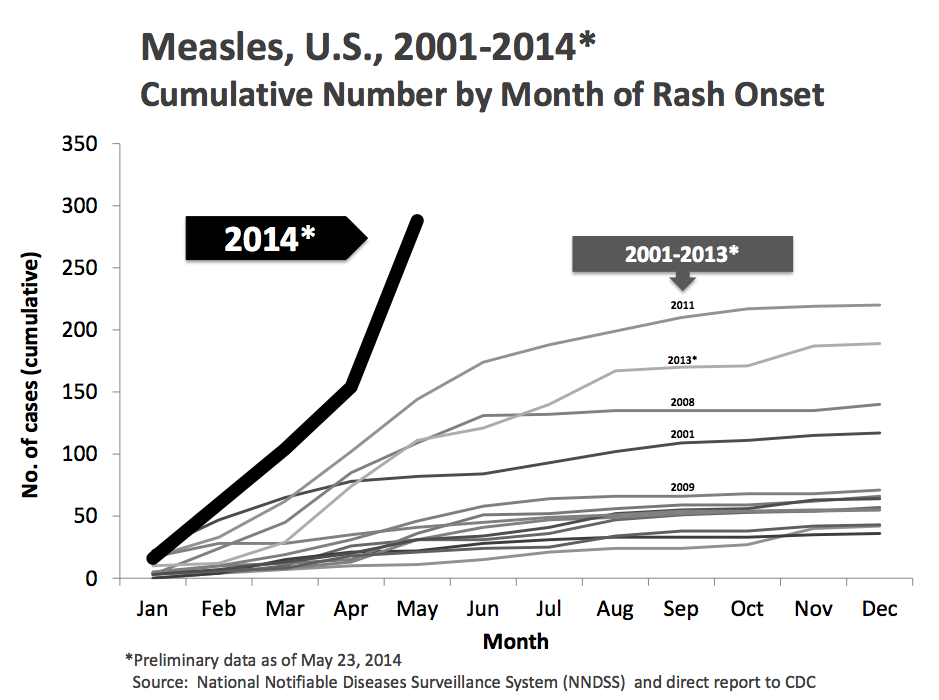
288 cases of measles have been reported to the CDC so far this year, “the largest number of measles cases in the United States reported in the first five months of a year since 1994.” You can probably guess who’s to blame:

“The current increase in measles cases is being driven by unvaccinated people, primarily U.S. residents, who got measles in other countries, brought the virus back to the United States and spread to others in communities where many people are not vaccinated,” said Dr. Anne Schuchat, assistant surgeon general and director of CDC’s National Center for Immunizations and Respiratory Diseases. “Many of the clusters in the U.S. began following travel to the Philippines where a large outbreak has been occurring since October 2013.”

Schuchat also notes in the press release that American doctors are having a hard time diagnosing these outbreaks because they “have never seen or treated a patient with measles” before. Jeffrey Kluger interjects:

Of course, you can bet any first year medical student could have spotted the disease a few decades ago—

and the same was true with mumps and whooping cough and polio and smallpox and rubella and all of the other diseases that we don’t have to see anymore because we have, in this country at least, vaccinated them all but out of existence. What was true in the U.S. then is still true in the developing world, where those diseases and more still run riot.

The people in those countries would not play cute with disease. The people in those countries would not have the time for rumors and lies and celebrity dilettantes who take up the anti-vax cause because they’ve grown bored with the anti-carb or anti-gluten or pro-cleanse fads. Being this close to eliminating a disease is not the same as truly being done with it. That’s something all those new measles patients learned this year. And that’s something we’ll all have to keep learning until we wise up.

And indeed, as Jacob Kastrenakes reminds us, the anti-vaxxers stand to do a lot more damage in the developing world, where measles is still widespread:

Though measles is reaching a relative peak in the US, it’s still far lower in the United States than elsewhere across the globe. There’s estimated to be around 20 million annual measles cases worldwide and about 122,000 deaths stemming from it. Still, the rise in the United States is sharp. The CDC reported that measles cases had spiked in 2013 too, and 2013 saw only 175 confirmed cases in total by early December. In that report too, the CDC said a failure to vaccinate was the issue, with 98 percent of cases being in unvaccinated patients.

Elsewhere in the world, widely disproven concerns that vaccines are linked to autism are said to have been the cause of measles outbreaks. At least one isolated instance of this led to a small outbreak in Texas last year, though the CDC doesn’t break down the exact reasons why measles patients turned down vaccination.

David Gorski fears that history is repeating itself:

Specifically, I have to wonder whether British history is going to be repeated in the US. Remember how in 2008 measles was declared endemic again in the UK, after having been declared eliminated a mere 14 years before, thanks largely to the MMR-autism scare precipitated by Andrew Wakefield’s fraudulent work? … It took fourteen years for the UK to go from having eliminated endemic measles, thanks to the MMR vaccine, to having measles return as an endemic disease. Here we are now, around fifteen years after measles was declared eliminated in the US, and we now have the highest number of measles cases in 20 years.

Reefer Sanity Watch

Late yesterday, the House passed a measure that would prevent the feds from interfering with state medical marijuana laws. German Lopez remarks that this is “the first time in history that any chamber of Congress has acted to protect medical marijuana businesses and users”:

The vote, while historic and a bit surprising even to advocates, is part of the federal government’s ongoing shift toward more liberal marijuana policies. Just a few weeks ago, the feds increased how much marijuana can be grown for medical research. President Barack Obama and his administration have also taken steps to mitigate prosecutions against marijuana businesses that operate legally under state laws.

Sullum is encouraged by the bill’s bipartisan support:

Similar meaures have failed in the House six times since 2003. This year the amendment attracted record support from Republicans, 49 of whom voted yes, compared to 28 last time around. “This measure passed because it received more support from Republicans than ever before,” says Dan Riffle of the Marijuana Policy Project. “It is refreshing to see conservatives in Congress sticking to their conservative principles when it comes to marijuana policy. Republicans increasingly recognize that marijuana prohibition is a failed Big Government program that infringes on states’ rights.” Before the vote, Grover Norquist, president of Americans for Tax Reform, and Ethan Nadelmann, executive director of the Drug Policy Alliance, argued in Politico that it “ought to be an easy ‘yes’ vote for members of the 10th Amendment Task Force on Capitol Hill and other believers in limited government and federalism.”

Thoughts On Kagan

US-POLITICS-MILITARY-OBAMA-WEST POINT

The Atlantic and The New Republic have both been on a roll lately, proving that long-form writing remains a vital part of our now-digital conversation. But I have to say I was underwhelmed by Bob Kagan’s endless piece, “Super-Powers Don’t Get To Retire.” The very title is simply wrong. Super-powers have retired again and again in world history – and it’s usually compulsory retirement. The retirement of both the British super-power in the twentieth and the previous Spanish super-power in the seventeenth came about because of imperial over-reach, in which the fiscal and economic costs of empire bankrupted the imperial motherland. And one of the striking lacunae in Kagan’s worldview is any sense that the US has limits, any awareness of the massive debt under which this country still labors, preventing all sorts of vital investments in education, infrastructure, and the like. The perpetual pattern of super-powers finding themselves hollowed out domestically, while for ever moving forward abroad, is one you would think Kagan would at least nod to. But like the neocons in the Bush administration for whom “deficits didn’t matter,” Kagan simply waves away the crippling cost of maintaining a military power greater than the ten next countries.

You can see this in the gob-smacking way in which some Beltway warriors casually want to the US to stay longer in Afghanistan, already the longest war in the history of the United States, costing the US, by some estimates, $10 million an hour. An argument for the eternal maintenance of American global hegemony that has no real accounting for that cost – in an age when most Americans are themselves struggling to retain their standard of living – is the definition of unserious.

Then, in Kagan’s view, there is the notion that there really isn’t much difference in the US confronting globally expansionist totalitarian empires and dealing with the usual tin-pot autocrats who have littered history for ever. The distinction between authoritarianism and totalitarianism – once made famous by Jeane Kirkpatrick – doesn’t seem to feature in Kagan’s worldview. But the only reason why the United States, after centuries as a Western hemisphere regional power, became the world’s policeman was totalitarianism – of the Nazi and then the Communist variety. Both the Axis powers and the Soviets harbored a universalizing ideology that demanded conquest, mass murder, and a huge modern military machine that reached Hawaii, all of which necessitated an American response. It is simply ludicrous to put Putin’s weak strutting around in his near-abroad in the same category of threat as the decades-long conquest of all of Eastern Europe by a totalitarian state. The uniqueness of the totalitarian threat was once a pillar of neoconservative ideology. Now that it might counsel a policy of prudent retrenchment, it’s suddenly absent from their rhetorical arsenal.

Then there is Kagan’s simply shameful refusal to note the catastrophes of over-reach that we just experienced in the Bush-Cheney era. You can read the essay and find not a scintilla of reckoning with that nightmare that Kagan himself did so much to promote. So we get an essay that deliberately and disingenuously says far more about America in the twentieth century than about America in the 21st. This after close to a hundred thousand dead in a broken, failed state called Iraq, thousands of fatalities of young Americans, and staggering costs. There is also no understanding at all that the United States can no longer argue that it may be a pain in the neck at times – but at least it’s better than the Soviets/Nazis. Growing up in another country, I can assure you this was a rampart of the case Americanophiles (including me) made in Europe for the US alliance for years. It was our logical ace. But that “lesser of two evils” defense of global hegemony has now disappeared, torturebehrouzmehriafpgetty.jpgrendering US hegemony far less legitimate than it only recently was.

Kagan also refuses to acknowledge another key aspect of the Bush administration legacy – and his own. The United States no longer has a leg to stand on when it comes to basic, universal moral norms that undergirded the entire internationalist system the US set up. The US is the only democratic power, apart from Israel, to violate the Geneva Conventions at will. This country perpetuated a regime of brutal torture and has never reckoned with it. This country still detains innocent prisoners of war indefinitely without trial and still subjects them to the torture of foul force-feeding. This country seized and brutally tortured one of its own citizens, without any trial, and with no due process, in the case of Jose Padilla. Its former vice-president and a large chunk of a major party aggressively want to bring back torture as a formal instrument of American democracy. If you think the world sees America as it once did – either as the lesser of two evils or as a paragon of democratic norms – you are deluding yourselves. Kagan did his part in helping destroy that core legitimization of global hegemony. He cannot now pretend it hasn’t happened, even as TNR has shamefully ducked the question of torture for the past decade.

Then there is the simple conservative wisdom that meddling in countries you do not understand is usually a recipe for disaster. Take the one intervention many liberal internationalists liked and argued for – Libya. The solipsistic idea that all that was at stake was preventing a possible massacre in one city has led to a failed state where Islamist terror is now widespread. Today David Brooks waxes lyrical about Kagan, just as he might have before the Iraq War – while completely ignoring the core conservative insight that these foreign and alien cultures and societies are simply beyond our ability to control or direct with any real practical wisdom. No admirer of Oakeshott can possibly believe that the US’ attempt to coax and mold other countries into our political model would lead to anything but tears. What staggers me is that, after Iraq, this point still hasn’t been absorbed by the neocons. There has been no chastening. There is no humility. And there is precious little conservatism.

David also used a really revealing phrase.

He writes of American foreign policy in the 20th Century that “presidents assertively tended the international garden so that small problems didn’t turn into big ones, even when core national interests were not at stake.” America tends the international garden. The world is ours to trim and tweak, plant and grow, mow and cut. The idea that we are actually tending other people’s gardens does not seem to occur to Brooks. The imperial over-hang is that great.

Mercifully, the American people disagree quite strongly and have so far acted as a restraint on the Beltway’s desire for more war, more meddling, and more intervention. Mercifully too, we have had a prudent, conservative president whose vision is both far more in tune with the realities of this interdependent world – far more advanced, wealthy and self-confident than the destroyed vistas of 1945 – and with the American people, whose rock-solid support is still essential for any intervention in the world to have the slightest chance of success. But these are weak constraints against the forces in Washington that still hanker for the hegemon’s swagger. I fear that the wisdom of Obama may not prevail in a future Clinton White House; and I fear that non-interventionists in the GOP will be neutered by the military-industrial complex and the Cheneyites who still drink the Kool-Aid of post-Cold War hubris.

You want American power to regain legitimacy? A prudent retrenchment would help. You want America to retain the option of global military power? Put the US on a path to fiscal balance and economic growth again. You are afraid of autocrats? Why? They will be with us always and they almost always fail. What succeeds is the democratic economic model – which is much more imperiled today by the centrifugal forces of technology and inequality than in a century. What we need to do now is focus on restoring the core economic and democratic health at home before clinging to a role whose legitimacy is in tatters. Restoring our luster as a global model would do far more to encourage democracy around the world than top-down meddling in other people’s business. That is what Obama has done or tried to do. And if you want a sustainable form of prudent, US intervention in global conflicts, it should be your top priority.

(Photos: President Obama at West Point; Seen through splintered bullet-proof glass, US soldiers from 2-12 Infantry Battalion examine their damaged Humvee after an Improvised Explosive Device (IED) detonated on the vehicle, following a patrol in the predominantly Sunni al-Dora neighborhood of southern Baghdad 19 March 2007; posters on the streets of Iran, after the Abu Ghraib revelations. All by Getty Images.)

The Economy Shrank Last Quarter

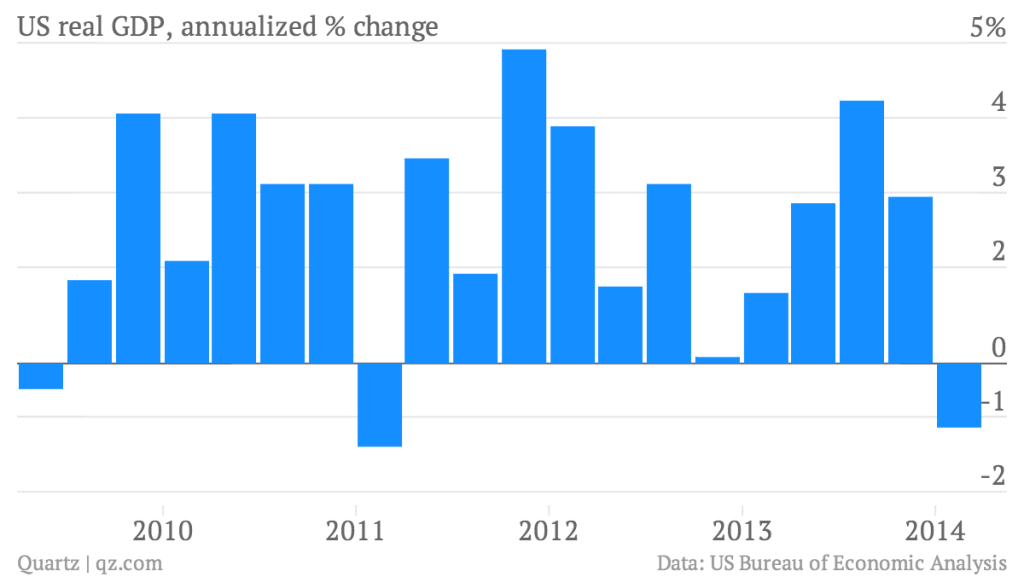
GDP Change

Bummer:

First quarter GDP slowed at an annual rate of -1.0% — worse than the initial estimate of 0.1% growth. It’s the first time since early 2011 that the economy has shrunk, mostly due to business inventories, construction and exports last quarter. Consumer spending actually rose by 3.1%, bolstered by strong health-care spending.

Ylan Q. Mui adds:

Businesses depleted their inventories and cut back on investment in the first three months of the year, while harsh winter weather curtailed construction. … The decline highlights the fragility of the nation’s recovery but is not likely to derail it altogether. Several forecasts for the current quarter show the economy growing at a healthy 3 percent annual rate or faster.

Matt Philips, who provides the above chart, finds that the markets are unfazed:

And that’s as it should be. For one thing, this is old news. Everyone already knew, from a string of previous data, that a brutal stretch of bad weather had hit consumption and other bits of the economy. And the fact that people stayed home to keep warm for the first three months means there’s a bunch of pent-up demand that should bolster the economy going forward. We’re already seeing that play out in the US job market, which has posted employment growth of over 200,000 a month for the last three months. (In April the economy created a particularly peppy 288,000 jobs.)

Ben Casselman puts the report in context:

This kind of contraction isn’t unheard of, but it is unusual. This is just the 10th time since World War II that GDP growth has been negative outside of a recession. Three of those negative quarters immediately preceded recessions. (The National Bureau of Economic Research defines a recession as “a significant decline in economic activity spread across the economy, lasting more than a few months.” A common rule of thumb is that a recession involves two consecutive quarters of economic contraction, although that isn’t part of NBER’s official definition and not all officially recognized recessions have met that test.)

McArdle sees this as “a sign of an economy that is still very weak”:

It has been six years since the financial crisis. Federal government spending is still around 21 percent of GDP, up from 19 percent in 2007, and the Federal Reserve still has a very expansive monetary policy. Under those circumstances, a quarter of negative growth is pretty unsettling.

The most recent jobs numbers are more encouraging — but not all that stellar this far away from the crash. Six years in, employment is barely back to where it was, which means that it hasn’t even kept pace with population growth.

Reihan joins the conversation:

The federal government is not directly responsible for the overall growth rate of the American economy, regardless of what politicians claim. It does, however, play a large role in creating the conditions for business enterprises to invest and grow. And it’s not doing its job well.

Daniel Gross examines the big picture:

We live in an age of long business cycles. The last two economic expansions lasted 73 months and 120 months, respectively. Within those long stretches of growth, there were quarters when the economy grew rapidly and quarters in which it shrank or flat-lined. A bar chart showing quarterly GDP growth resembles the teeth of a saw, not a picket fence. The key is to focus on the long-term. And the long-term trend of growth—unsatisfying, sub-par, sub-optimal, and insufficient growth—is still intact. Next week, the expansion will enter its 59th month since the end of the Great Recession.

The Kids Are Alright Already!

teen_birth_rate

Sarah Kliff voxsplains:

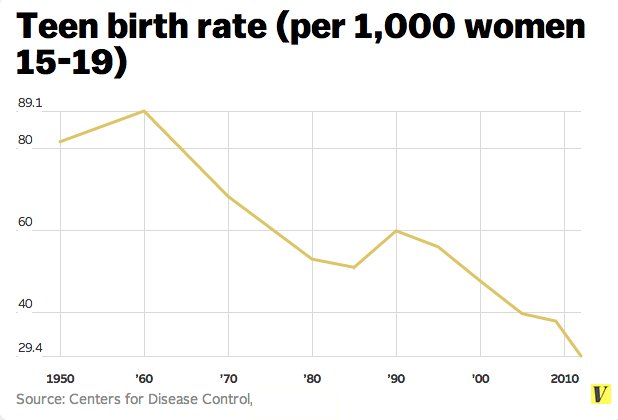
The Centers for Disease Control released a monster report last week on the state of Americans’ health. The 511-page report makes one thing abundantly clear: teens are behaving better right now than pretty much any other time since the federal government began collecting data. The teen birth rate has plummeted in recent decades. Separate data shows this has coincided with dramatic drops in the teen abortion rates. The decline in teen births has also happened at a time when teenagers have gotten better at using contraceptives.

Russell Saunders cheers:

What this says to me is that, despite their reputations as hell raising hedonists with an immortality complex, teenagers are capable of absorbing information about keeping themselves safe and healthy. It speaks to the importance of comprehensive sex education programs, which provide teenagers with the facts they need to take care of themselves.

But he has a bone to pick with Vox:

In presenting those data, they summed it up with the headline “Today’s teenagers are the best-behaved generation on record.” However, the report contains no information about how frequently today’s adolescents call their grandmothers or turn in their homework on time. They haven’t collectively sat through a poetry reading and clapped politely at the end—they’ve demonstrated healthier choices than their parents’ and grandparents’ generations. Presumably health information about those latter age groups wouldn’t be framed in such a condescending manner.

Meanwhile, Drum speculates about the role lead exposure may have played:

What’s happening today isn’t an aberration. Teenagers from the mid-60s through the mid-90s were the aberration. We managed to convince ourselves during that era that something had gone permanently wrong, but it wasn’t so. The ultra-violent gangs and reckless behavior that became so widespread simply wasn’t normal, any more than expecting teenagers to sit around in kumbaya circles would be normal. Nor had anything gone fundamentally wrong with our culture. It was the result of defective brain development caused by early exposure to lead.

I’ll never be able to prove this. No one ever will. The data is simply not rich enough, and it never will be. Nevertheless, what evidence we do have sure points in this direction.

Much more Dish on Drum’s pet issue here.

Ukraine’s Refugee Crisis

Maxim Eristavi shines a light on it:

The death toll in eastern Ukraine, where the vast majority of the fighting has taken place, has climbed to well over 200, making this the most violent crisis Ukraine has seen since World War II. The number of internal refugees also continues to rise rapidly. The United Nations High Commissioner for Refugees (UNHCR) says the crisis has displaced an estimated 10,000 civilians; most are from Crimea, and almost one-third are children. Ukrainian activists in Donetsk say that the amount of internal refugees from their region might also be in the thousands, but it’s harder to measure because unlike Crimeans, internal refugees don’t have to cross a border.

The internally displaced Ukrainians can’t count on the state to help them, either:

The Ukrainian parliament has taken some steps to ensure that refugees have access to basic social services and shelter. For instance, a new law regarding the rights of displaced persons helped thousands of refugees from Crimeathe vast majority of whom are Crimean Tatarssettle in other parts of Ukraine. But those who have fled eastern Ukraine can’t turn to the government for help. If the Rada were to vote on a bill helping displaced persons from within Ukraine’s borders, it might be taken as a sign that Kiev has lost control over eastern Ukraine once and for all. So refugees from the east must count on friends or strangers for help.

Ways The World Is Getting Better

Income Developing World

Here’s one:

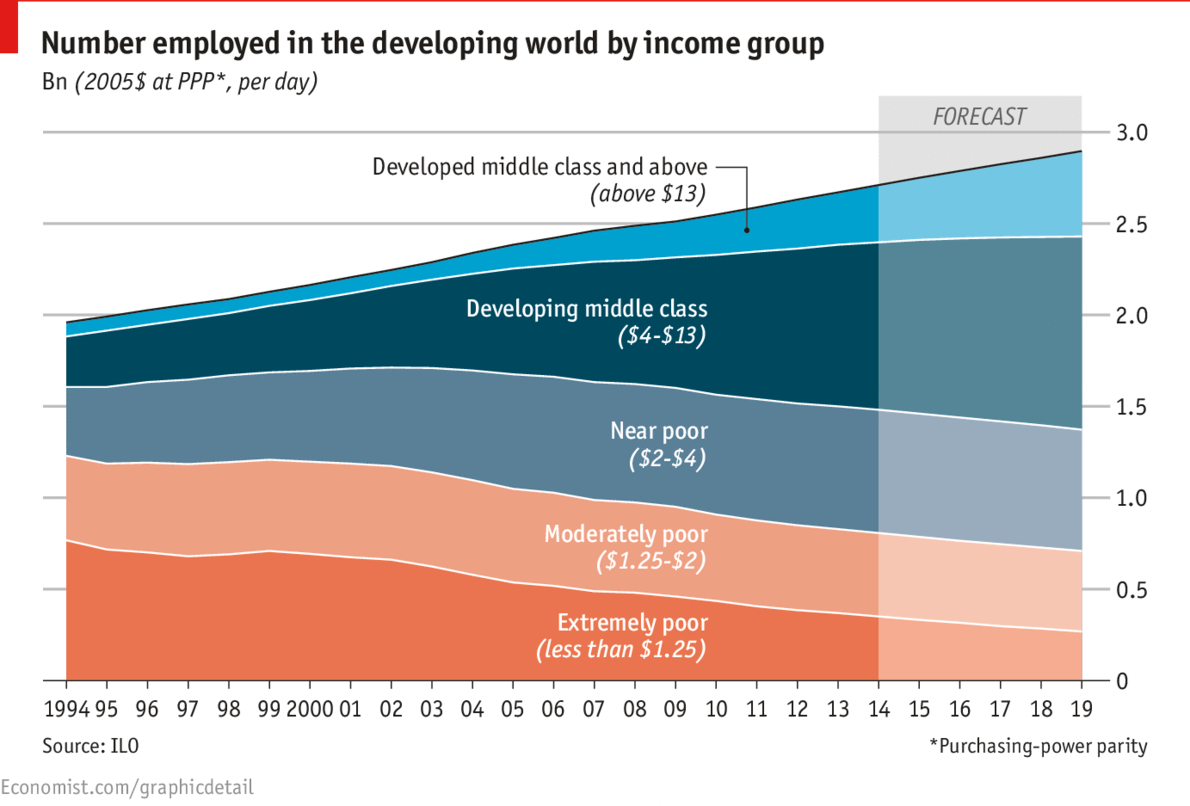
 “For the first time in history, over the next several years, most new jobs in the developing world are likely to be of sufficient quality to allow workers and their families to live above the equivalent of the poverty line in the United States,” states the [International Labour Organisation].

Relatedly, reviewing Bjørn Lomborg’s How Much Have Global Problems Cost The World?: A Scorecard from 1900 to 2050, Yevgeniy Feyman concludes, “There has never been a better time to be alive”:

The doubling of human life expectancy is one of the most remarkable achievements of the past century. Consider, Lomborg writes, that “the twentieth century saw life expectancy rise by about 3 months for every calendar year.” The average child in 1900 could expect to live to just 32 years old; now that same child should make it to 70. This increase came during a century when worldwide economic output, driven by the spread of capitalism and freedom, grew by more than 4,000 percent. These gains occurred in developed and developing countries alike; among men and women; and even in a sense among children, as child mortality plummeted.

Why are we living so much longer? Massive improvements in public health certainly played an important role. The World Health Organization’s global vaccination efforts essentially eradicated smallpox. But this would have been impossible without the innovative methods of vaccine preservation developed in the private sector by British scientist Leslie Collier. Oral rehydration therapies and antibiotics have also been instrumental in reducing child mortality. Simply put, technological progress is the key to these gains – and market economies have liberated, and rewarded, technological innovation.