China’s And America’s Common Enemy

In the fight against global warming, Jonathan Cohn sees room for cooperation:

In recent years, the Chinese have imposed fuel mileage and appliance efficiency standards, similar in many respects to those in the U.S. Just this week, officials in Beijing announced that the government would be taking another 5 million aging cars off the nation’s road. China has also set up pilot versions of tradable pollution permits—in other words, “cap-and-trade” schemes—for various industries. Officials say they hope to make these nationwide soon. And one reason the Chinese government was so eager to sign that massive new deal with Russia, allowing the import of natural gas, was because it’s desperate to find alternatives to coal. “For a long time, opponents [of new regulations] said we’ll get hoodwinked, because China won’t do anything,” says David Doniger, director of the Climate and Clean Air Program at the Natural Resources Defense Council. “That’s just not true.”

China’s behavior may seem surprising. It shouldn’t. China has a major air pollution problem, causing all kinds of very immediate and very tangible health and economic problems. Efforts to reduce the sources of these noxious particles dovetail naturally with efforts to reduce carbon emissions.

Gwynn Guilford points out that China is already sacrificing economic growth to combat pollution:

[R]ecent analysis of economic data by Wei Yao, an economist at Société Générale, found that “Chinese policymakers are getting serious about air pollution.” So serious, in fact, that those efforts are already hurting GDP performance—something the government has so far shown to be its biggest priority. Yao says GDP will slow 0.35 percentage points cumulatively from 2014 to 2017 because of air pollution mitigation efforts, and she expects the economy to take the biggest blow this year.

Kate Galbraith rattles off reasons why eliminating pollution is such a priority for China:

Beyond individuals’ physical and mental health, the pollution fiasco matters because China wants to transition its cities to modern, service-oriented economies filled with software entrepreneurs, health experts, and international financiers. “Under the old plan, where China’s get-rich plan was based on dirty manufacturing,” environmental concerns didn’t matter, says Matthew Kahn, a professor at UCLA’s Institute of the Environment and Sustainability.

Now, China wants to send manufacturing inland and lure Davos and Silicon Valley types to its big coastal cities. But such people have choices, says Kahn, and Beijing’s allures of cuisine and culture, universities and government, will matter far less if people are afraid for themselves and their children. Even Shanghai, thought to be cleaner than Beijing, suffered its own Airpocalypse in December, a few months after the government grandly established a Shanghai Free Trade Zone to woo the foreign financial sector.

Mariam The Martyr, Ctd

Paul Bonicelli wants Obama to take up the cause of Mariam Yahia Ibrahim, the Sudanese woman sentenced to death for apostasy because she refused to renounce the Christianity of her upbringing and embrace the Islam of her absentee father:

During the last several decades we have witnessed the rise of regimes of armed groups that claim a foundation in Islam to establish an order characterized by cruelty. They hijack one of the world’s major religions to practice a form of governance that uses brutality to enforce control and intimidation, particularly of women. A regime that is willing to torture and execute a woman recently delivered of her child simply because she holds religious views different from the regime’s dictates is truly barbaric.

And it is a direct challenge to all who have advanced civilization and serve as its guardians, whether they do their work unilaterally or via multilateral forums such as the United Nations. Bashir’s government in Sudan is the latest example; its current persecution of Ibrahim and her American husband and unborn child is a calculated and direct threat to the role the United States has been playing in the world. We should make no mistake about why Khartoum has chosen this time and circumstance to shock the world. The regime is bitter at the United States’ role in the loss of what is now South Sudan. The persecution of Ibrahim is a lashing out at the world that the United States has helped to produce. It is a challenge the United States and the West cannot afford to tolerate.

Ibrahim gave birth to a baby girl in a prison clinic on Tuesday and will be allowed to nurse the child for two years before her sentence is carried out. Her 20-month-old son is also in prison with her. Jonathan Fisher considers how the US government might go about securing their release:

The truth is that western governments have few cards to play in Sudan. This has been even more so since the election of fellow ICC indictee Uhuru Kenyatta to the presidency in Kenya and the outbreak of civil war in South Sudan in 2013, two events which have strengthened al-Bashir’s hand regionally and internationally. Threats and condemnations from the West will sadly do little to change Ibrahim’s fate. But western officials have other diplomatic tools at their disposal, notably flattery and face-time. Even the tyrants of North Korea have been known to offer clemency to prisoners when personally lobbied by former US presidents. Indeed, in 2007, al-Bashir himself pardoned a British schoolteacher imprisoned for blasphemy (naming her class’s teddy bear “Muhammad”) after a visit from British legislators. Instead of lobbying John Kerry to grant Meriam Ibrahim asylum, the two US senators from New Hampshire – home state of Ibrahim’s husband – might be better off catching the next flight to Khartoum.

An Accounting Of American Racism, Ctd

Readers sound off on the controversial subject:

Though I haven’t thought it through in any detail, in principle, I’m open to the idea of reparations for slavery and would be perfectly willing to see my hard-earned tax dollars used for it. But I always remember that US history harbors not one, but two monstrous racial crimes. Of course African-American slavery is one, but the genocide (or ethnic cleansing, if you prefer) and dispossession of the American Indian is the other, and it is just as terrible. How would we pay reparations to them? For every square inch of this land. How much would that tab be?

Another adds more complexity:

What’s interesting about this idea is that reparations would be paid by “America,” not “White America.” So, not only would the Vietnamese Boat Person have to chip in, but so would middle-class blacks, in the form of federal taxes.

J.D. Vance asks about whites who weren’t slaveowners:

[Coates] makes no mention of the 75 percent of the southern white population that didn’t own slaves, their wages so depressed by slave labor that they lived in arguably the most unequal society in world history—with slave owners earning a median of $23,000 per year while other whites fetched about $1,500. Nor does he cite the North’s two-to-one advantage in per capita income, evidence of its superiority in every economic pursuit that didn’t require enslaved workers. There’s no mention of the literature showing that slave labor sustained the Southern economy but also retarded it. How can we decide whether reparations are due, or which portion of American society should pay them, without untangling this economic story?

Another reader doesn’t see how reparations could be carried out:

I don’t have an issue with the idea of our government providing reparations to a specific group of people for institutionalized discrimination, but in this case I think there are insurmountable practical problems. Intellectuals like Ta-Nehisi Coates love to focus on the question of whether or not reparations are deserved while avoiding the hard questions like how much is enough and who should receive them.

Assuming some set amount could be agreed upon, who should receive the reparations?

Descendants of slaves? Most people would have a difficult time proving their lineage. Even if you could prove you were descended from slaves, how much should they receive? Should someone who is half black and half white get as much as someone is who isn’t “mixed”? How about someone who may have very light skin color and European facial features? How about people who are descended from more recent immigrants?

The amount would also be an issue. I could see someone like Coates being satisfied with a symbolic official letter of apology and acknowledgement from the government along with $1.00, but I think most people would say “you owe us more than that, this isn’t good enough, you’re trying to weasel out of paying us.” For Coates reparations may mean “spiritual renewal,” but I’d bet if you asked most of your every day people on the street what “reparations” means, most of them would say a significant payout and nothing less.

Another reader wonders what reparations would mean for his family:

As the white adoptive father of two mixed race kids, I’m trying to figure out who would owe who what under TNC’s call for reparations. We have no information about their birthfathers, so I can’t be sure of their background, or indeed if one of my sons is even part-black or some other admixture. Will we have to submit them for genetic screen to determine just how black they are? Do we get an added bonus if he has Native American background as well (as many folks who see my oldest think)? Will we lose the bonus if my younger ends up half Pacific Islander rather than African (as we also think)?

Institutionalized racism has taken a horrible toll on far too many Americans, but I honestly don’t see how this is supposed to work.

Lastly, Damon Linker focuses on Coates’ larger mission:

[I]t would be a very good thing for Americans to do the hard and truthful work of reconciling “our self-image as the great democratizer with the facts of our history.”

But that, I’m afraid, is exceedingly unlikely to happen, precisely because (as Coates also notes) it would require that America become nothing less than “a new country” with a radically different form of patriotism — one much more like the national culture that has developed in Germany in the decades since its total defeat in World War II. That is a culture self-consciously devoted to collective self-examination and atonement for the sins of the country’s past.

Coates is surely right that the development of a more complicated, ambivalent form of national self-love “would represent America’s maturation out of the childhood myth of its innocence into a wisdom worthy of its founders.” But I, for one, see little evidence in the American past or present to indicate a widespread willingness to leave behind childhood myths, to grow into maturity, and to accept that the United States is somewhat less unambiguously good than we would prefer to believe.

Recent Dish on reparations and the associated debate here, here, and here.

The Case For Eating Bugs, Ctd

4135669974_66b88a4fba_z

Hal Hudson envisions how bug eating could become more popular:

Paul Rozin, who studies the psychology of disgust at the University of Pennsylvania, says new and unusual foods tend to make their way into popular culture from the top down, starting with those who can afford to dine in expensive, adventurous restaurants.

Sushi is one example of this trend. The idea of eating raw fish was largely foreign to people in the US before the 1960s, but now sushi restaurants can be found almost anywhere. “Sushi originally started with Japanese businessmen in Los Angeles. It was just a local ethnic thing for them, but then they would invite their American counterparts,” says Rozin. “It’s true of most unusual cuisine – people who are wealthy and adventurous do something, and then it becomes trendy.”

Hudson details some efforts to make insects more flavorful:

Chefs around the world are hard at work experimenting with insects to make new and appetizing foods. Nordic Food Lab – a non-profit spun out from Danish restaurant Noma – began a project to make insects delicious to the Western palate in May last year. Their chefs believe that making insects tasty could spark a wave of interest in entomophagy (see “Taste test“).

Nurdin Topham, now head chef at Nur in Hong Kong, was involved in the work, and noticed that the flavor of the insects changed depending on what they had been fed. “The diets that the insects were fed made quite a significant difference to the quality, taste and freshness, in the same way as shellfish or prawns,” he says. “There was a definite difference.”

Indeed, Tiny Farms in Austin, Texas, is already doing this. It uses a process called gut loading – in which crickets are fed certain flavored or nutrient-rich foods just before they are killed – to rear crickets that taste like honey and apples, or that are high in vitamin C.

Previous Dish on entomophagy here.

(Photo: Salted crickets mashed with huitlacoche and wrapped in homemade tostadas over tomatillo sauce, finished with pomegranate seeds. By Flickr user Carnaval King 08)

The Great Wiki Hope?

Carl Miller suggests that Wikipedia could be a model for policymakers:

[R]ealizing digital democracy is hard. Iceland’s attempts to do so for their constitution descended into acrimony. As Matthew Hindman has argued, the Internet hasn’t really broadened political discourse much at all – rather it has empowered a small set of elites. While hundreds of thousands of people blog about politics, only a handful of these blogs are actually read. Anyone can be on Twitter, but celebrities and journalists are more likely to be followed than you or me …

Amid these challenges, Wikipedia stands out as a twinkling beacon of hope. …

The English version [of Wikipedia] alone is 60 times larger than the last great repository of human knowledge in the English language, the Encyclopedia Britannica, and nearly as accurate. But it is also a model for how to turn an elite-driven process into a democratic one. Britannica is written by 100 full-time editors and a few thousand contributors. Wikipedia has 21,395,915 accounts on Wikipedia and 270,000 are active on a monthly basis. It has achieved something that mainstream politics has cause to envy: the routine, active engagement of hundreds of thousands of willing volunteers of often radically different background and opinion to create something used, supported, and trusted by millions. There is an exciting opportunity here: to see whether Wikipedia and Wikipedians can teach us how to improve engagement with formal politics.

The Need For Nowness

In case you missed it, Elizabeth Minkel is bothered by “ICYMI”:

I’ve lost track of the number of times I’ve seen someone apologize for sharing something “old” that was published 48 hours prior. I’ve lost track of the number of times I’ve seen something interesting and completely un-timely and thought about sharing it, only to stop myself when I noticed it had been published a year or two ago. And I’ve lost track of the number of times when I’ve seen a piece – or, for that matter, written a piece – that seems to fall flat because it came out a week or two after the bulk of an internet maelstrom.

“In Case You Missed It” makes the feeling explicit. It’s hard for a lot of us to fight the compulsion to stay up-to-the-minute – in reality, it’s impossible, but it somehow seems achievable. ICYMI makes staying connected feel like a constant game of catch-up, like finding things at a slower pace warrants some kind of disclaimer.

I’m not the first to complain about the unrelenting pace of information online, or the method of its delivery.

“The Stream,” the chronological endless scrolling nature of the present web—one new notification, one new notification – rose to prominence about five years ago. Alexis Madrigal wrote beautifully about our sense of time online last December, the valorization of “nowness,” how the next tweet inherently trumps what came before it: … We feel overwhelmed because we crave endings, and the Internet has no end. “And now, who can keep up?” Madrigal writes. “There is a melancholy to the infinite scroll.” ICYMI is a tacit acknowledgement of that psychological finish line, always being moved an inch more out of reach – I can feel it now, chipping away at me.

The Dish makes a habit of posting new material as quickly as possible after its publication, to bring you the freshest yet most comprehensive take on an issue. If we get around to certain pieces too long after their publication date, we often pass on them. But that drive towards nowness is balanced by our constant linking back to material from the archives, to feature the old alongside the new.

Who Works In Silicon Valley?

You’ll find the whole spectrum of humanity, from white guys to Asian guys to – well, that’s about it:

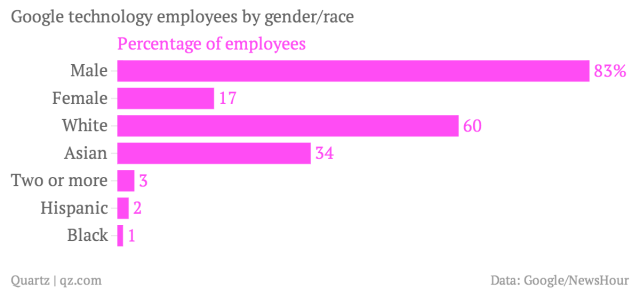
The industry has been known to have a serious diversity problem. But on Wednesday, we got a peek at just how bad it is. Google released statistics about the make-up of its work force: Men and Asians are overrepresented, and women and blacks are drastically underrepresented as compared to the overall United States work force. Most startling: Just 17 percent of Google’s technical employees are women and just 1 percent are black. In the software industry over all, according to the Labor Department, 20 percent of engineers are women and 4 percent are black.

At the entire company, when nontechnical roles are included, women account for 30 percent of employees. That is 17 percentage points below the share of women in the work force, and about equal to women’s representation among lawyers, surgeons and chief executive officers.

This chart really drives the data home:

google-technology-employees-by-gender-race-percentage-of-employees_chartbuilder-3

Alison Griswold adds, “In a blog post addressing the statistics, Google tries to defend its figures by putting them in a broader context”:

“Women earn roughly 18 percent of all computer science degrees in the United States. Blacks and Hispanics make up under 10 percent of U.S. college grads and collect fewer than 5 percent of degrees in CS majors, respectively,” writes Laszlo Bock, Google’s senior vice president of people operations. It’s a fair point: The systematic education barriers to increasing diversity in tech are great. But that doesn’t mean companies like Google can’t strive to do better. (Yahoo’s Marissa Mayer has been among the prominent female executives to call for more women in tech.) Bock adds that Google is “miles from where we want to be” and wants to be more candid about its diversity issues.

While disappointed by the numbers, Victoria Turk cheers the company for disclosing them in the first place:

As the company admitted in a blog post, “We’ve always been reluctant to publish numbers about the diversity of our workforce at Google. We now realize we were wrong, and that it’s time to be candid about the issues.” Hear, hear. While the numbers might not be too optimistic, it’s great to hear a tech company—especially one with the import of Google—at least own up to their record on diversity and recognize the need to improve.

And to be sure, Google is not the only tech company with this problem. As Josh Harkinson argues, Silicon Valley is “actually doing worse than it was a decade ago, diversity-wise”:

Google is far from the only Silicon Valley firm that has been tight-lipped about its demographics. Though large companies are legally obligated to report race and gender stats to the federal government, tech firms such as Google, Apple, and Oracle long ago convinced the Labor Department to treat the data as a “trade secret” and withhold it from the public. Mike Swift of the San Jose Mercury News sued the department to get the numbers. In 2010, following a two-year legal battle, he ultimately settled for stats for a handful of the Valley’s largest companies. Swift’s data went through 2005.

To get an update, I filed a Freedom of Information Act request a few months ago asking the Labor Department for its latest race and gender data on the top 10 firms. In order of largest to smallest by market capitalization, it now consists of Apple, Google, Oracle, Cisco Systems, Intel, Gilead Sciences, eBay, Facebook, Hewlett-Packard, and VMware. When I reached out for comment, most of these companies didn’t get back to me. Google responded that it intended to make its stats public, as it now has.

The data I obtained provides some much-needed context for Google’s diversity numbers.

(Chart via Quartz)

Amazon’s Hit List, Ctd

Polly Mosendz analyzes Amazon’s escalating war with publishing giant Hachette:

As Amazon works to negotiate prices for e-books with Hachette, they are exercising a number of powerful tactics: pulling pre-orders, buying less inventory, extending shipping time, and not offering promotional pricing. You can still buy Hachette books from Amazon, it will just take longer and cost more. In a statement released today, Amazon said that if book buyers don’t like it, they’re welcome to shop elsewhere. They are flexing their business muscles. They’ve used that muscle before, and they’ll do it again.

Hachette’s authors are understandably upset, because this fight is hurting their sales. Now the seller is reminding Hachette and their authors why they wanted to do business with them in the first place: Amazon moves books. Negotiating for acceptable terms is an essential business practice that is critical to keeping service and value high for customers, both in the medium and long-term. Amazon is squeezing Hachette with all their might, because, as they said in statement today, “when we negotiate with suppliers, we are doing so on behalf of customers.”

Richard L. Brandt argues that the dispute will end well for consumers:

Jeff Bezos is once again using ruthlessly self-serving tactics to pressure book publishers into lowering prices. In an attempt to force Hachette to lower its wholesale price of e-books, Bezos has started delaying delivery of some hard- and soft-cover Hachette books and raising prices on others. Will his move further weaken book publishers, which are already operating under whisper-slim margins and are looking to e-books to save them? As the author of three books myself, all published by mainstream publishers, I worry about that myself.

But I very much doubt that will be the outcome. The ultimate winner of this battle will be buyers and readers of books. If Bezos wins this battle, I would bet that publishers and book authors may just come out ahead as well. And, yes, Amazon most certainly will, too.

But Jeremy Greenfield imagines “a scenario where [Amazon] controls three-quarters of all book sales in the U.S.”:

Long-time industry consultant (and partner in Digital Book World, my employer) Mike Shatzkin explained to me what would happen next:

Let’s say Amazon goes to 70 percent and they’re basically the pipes for everything and they’re indispensable and you can’t publish a book without them. So, what do they do then?

If they’re still trying to maximize profits, we’ll still have lots of romance books and James Patterson will still write his books. But serious nonfiction books won’t get published. Those are the books that will go first.

Nonfiction books, like Walter Isaacson’s biography of Steve Jobs, are expensive and risky to produce and rarely sell well, yet many of these books drive intellectual thinking in the U.S. Robert Caro’s latest book on Lyndon Johnson The Passage of Power: The Years of Lyndon Johnson took nearly a decade to write—and that means investment and risk.

Jack Shafer has decided to close his Amazon account:

[W]hile Amazon may have captured my wallet, its recent behavior has convinced me to take my business elsewhere. As long as the company’s high-pressured negotiating tactics served my interests — lower prices, expansive selection, superb service — I was on board. But the company has erred in this dispute. It would have been okay with me if it had hard-balled the publisher by refusing to discount its books or even insisted on selling them at a premium. In that case, I could do what I usually do — make individual decisions about where to buy stuff based on price and availability.

But by essentially banishing many Hachette titles from its stock, Amazon, which ordinarily puts its customers first, has put them last, telling them they can’t buy certain titles from it for any price. If Amazon prevails in this clash, will it put me and my material needs last whenever a supplier resists its will? I don’t know for sure, but I can guess.

However, Martin Shepard, a small publisher, gives Amazon “a four star review for not only their efficiency and work they do, but for leveling the playing field”:

In truth, everyone wants more of the pie. We’ve been publishing literary fiction for 35 years, and in the past found that the chain bookstores took few if any of our titles, that distributors like Ingram demanded bigger discounts from us than they charged the conglomerates, or that despite winning more literary awards per title than any other publisher in America we could not match the print review coverage afforded to authors of the five big conglomerates. But we’re not calling these other organizations Mafia inspired or asking for government intervention. Surely one  must come to recognize that all these companies are—and should be—free to set their own terms based on their bottom-lines, and publishers like Hachette might consider tempering their  complaints about Amazon’s discrimination or restraint of trade. Jeff Bezos didn’t create Amazon for Hachette, and Hachette isn’t forced to use Amazon for distribution. What is Amazon anyway, other than an incredibly successful on-line store that sells almost every product  one can think of. …

I always have a lingering suspicion that when one of the large publishing cartels complains they are being treated unfairly by Amazon, it’s probably good for most all of the smaller, independent presses.

Is Obama Getting Serious About Syria?

Zack Beauchamp highlights the president’s new agenda for the Syrian crisis, which he laid out in his West Point commencement address yesterday:

The section on support for Syrian rebels seems to mean US military training for the more moderate anti-Assad factions, like the comparatively secular fighting forces coordinated by the Supreme Military Council. The Wall Street Journal reports that Obama is “close” to authorizing the US military to help out moderate rebels, and post-speech comments from a senior Obama aide confirmed that option was on the table.

We know roughy what this training would look like because the CIA is already doing it.

Syrian rebels told PBS Frontline that CIA operatives have trained them in military tactics and the use of heavy American-made weapons. “They trained us to ambush regime or enemy vehicles and cut off the road,” a rebel identified as Hussein explained.

The big difference between this ongoing CIA operation and Obama’s potential new policy is that training would be overt instead of covert: uniformed US troops, not CIA spooks, will train Syrian rebels. That’ll likely mean more extensive training for the rebels. But, without a truly massive effort, it’s unlikely that this will fundamentally change the military balance of power between the rebels and Assad.

Leslie Gelb fears that Obama has “jumped out of the Afghan frying pan only to leap back into the Mideast fire”:

Obama’s instincts are wrong if he’s letting himself be pushed into a renewed effort to unseat Syrian President Assad without a plausible plan to do so. Perhaps Obama thought that a new anti-terrorist emergency fund he was asking Congress to fund would distinguish his approach. It’s to be a $5 billion barrel to support friends and allies with arms, training and the like. But Obama and President George W. Bush provided Afghans and Iraqis with hundreds of billions in arms and economic aid to a very modest effect indeed.

Obama will have to explain much more to demonstrate that his strategy is truly new and that it can be effective—and also that his small steps approach won’t lead to bigger ones later on in the face of likely failures—much as happened in Iraq and Afghanistan.

A Vote Against Putin

Motyl sees last Sunday’s successful presidential election as a huge defeat for Russia’s ambitions in Ukraine:

First, Ukraine is hardly the unstable almost-failed state that Putin and his Western apologists say it is. The terrorist violence was confined to two provinces—Luhansk and Donetsk. In the rest of the country, the voting proceeded smoothly. On top of that, Ukraine’s security forces were able to maintain law and order in much of the country, a positive development that builds on the armed forces’ creditable performance in their “anti-terrorist operations” in April and May.

Second, Ukraine is anything but the illegitimate state Putin and his western apologists say it is. Voting participation for the entire country was high: about 60 percent. Not including the two provinces that were terrorized by Putin’s commandos, participation was even higher. Everyone knows that the only thing that kept Ukrainians in the Donbas from voting was Putin’s terrorists.

Third, Putin’s terrorist commandos have been outflanked by the elections. People want stability; they want a return to normality. And they know that elections can bring about both.

But Marc Champion doesn’t believe for one second that Putin intends to back off, noting the presence of Russian citizens, including Chechens, in this week’s fighting in Donetsk:

Although transparent, Russia’s subterfuge is useful. It provides Europe’s leaders cover to avoid imposing costly economic sanctions on Russia. Putin withdrew troops from its border with Ukraine just before Sunday’s election there, the failure of which German Chancellor Angela Merkel had set as a trip wire for broader sanctions. European Union leaders who met on Tuesday were plainly relieved that they would not have to follow through on her threat.

However, the clash in Donetsk demonstrates that Ukraine’s presidential election alone will not stabilize the country. The decision by the city’s separatist leaders to declare martial law and send troops to seize the airport the next day showed they saw the vote as a starting pistol to renew hostilities rather than a signal to de-escalate.

Anna Nemtsova analyzes the discrepancy between Russia’s words and deeds:

Why would the Kremlin embrace Poroshenko’s victory with one hand, and feed violence and atrocities with the other, if indeed that is what’s going on?

Igor Bunin of the Center for Political Technologies, a think tank in Moscow, told The Daily Beast on Tuesday that the Kremlin gave up on the previous designs to annex the southeast regions of Ukraine (Plan A); or make them independent from Kiev (Plan B). “Now,” says Bunin, “we see the realization of Plan C: turning the east of Ukraine into a region of chaos and lawlessness, so neither the European Union nor NATO would dare to ever put their bases in that region.” It is this chaos by design that may become the biggest challenge for Poroshenko’s presidency, Bunin explains, “unless he finds a way to agree with the Kremlin.”

In the end, what has Putin gained from all this, Drum wonders. What he comes up with:

Crimea. And possibly a slowdown in the pace of Ukraine’s integration with the West. That’s about it. But I wouldn’t underestimate the cost of this to Putin. Threats of military force are flashy, but unless you’re willing to back them up regularly, they do a lot more harm than good. I’m not sure why so many people who are generally clear-sighted about the drawbacks of military action suddenly get so smitten by it when it’s wielded by a thug like Putin. Hell, he doesn’t even use it well.

When the dust settles, it’s hard to see Putin gaining much from all this in the places that count.