All Toddlers Are Hyperactive

by Tracy R. Walsh

Pediatrician Russell Saunders is alarmed by the finding that thousands of American two- and three-year-olds take medications for ADHD:

Because the behaviors that typify ADHD are common and normal in toddlers, thus contraindicating treating them with medication, there is little study on the effects of treatment at this age. However, the side effects of these drugs are well known. Among others, they include interference with sleep and suppression of appetite. Toddlers and preschoolers typically need lots of sleep, including daytime naps, so giving a medication that throws their ability to sleep into disarray is ill-advised. (Sleep deprivation can make ADHD-like behaviors even worse.) Further, they are often picky eaters under the best of circumstances, and curbing their appetite during a period of crucial growth can have a significantly negative outcome.

What’s more, using medication rather than consistently and patiently helping these children learn self-control robs them of a necessary part of cognitive development. Parents need to help their kids learn boundaries, behavioral expectations, and how to control their own impulses (I usually recommend a simple and sensible approach like “1-2-3 Magic”), and replacing this education with Ritalin does them a grave disservice with potentially long-term behavioral ramifications.

KJ Dell’Antonia notes that poor children are “disproportionally represented” among the medicated:

Medication for some toddlers can seem like a cheap and fast fix, and one that parents who are probably already struggling may welcome. Many toddlers on Medicaid live in single-parent homes, where the time to put into alternative programs may be as scarce as the programs themselves. For black parents, other considerations come into play: even in preschool, black students are more likely to be suspended; children with ADHD behaviors often find school difficult; and parents of children on Medicaid who are lucky enough to have a preschool placement for their children (particularly during working hours) may have a lot at stake if that place is lost.

It’s not hard to see what may lead a parent and a doctor to choose to medicate a toddler’s ADHD-like behaviors under those circumstances. What is difficult is addressing the vast set of inequalities that underlies this particular example of the increasingly large gap between the childhoods of low-income children and those of children whose circumstances are more fortunate. For now, we’re left with one of the ironies of income inequality: a rare instance of poor children getting more of something than they need.

Recent Dish on ADHD here.

A Historic Victory For India’s Nationalists?

By Jonah Shepp

Screen_Shot_2014-05-16_at_11.23.16_AM

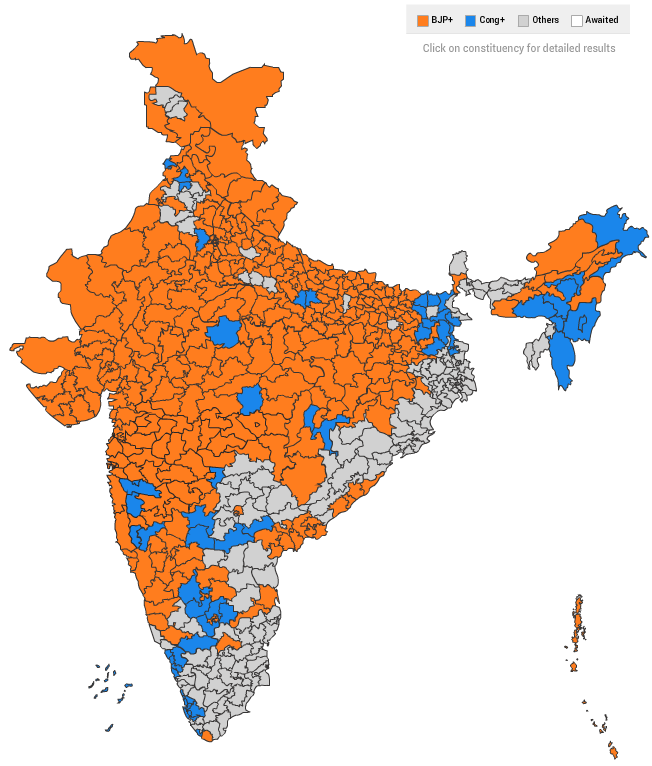
Passing along this map of India’s election results, Max Fisher comments on just how big the Bharatiya Janata Party’s victory was:

We knew from polls that BJP was almost certainly going to win. And it’s been clear for a few years that the Congress Party, as India’s economy slowed and middle-class Indians suffered, was losing popularity. But the extent of orange on this map, and the dearth of blue, is just stunning. Doug Saunders, a respected international affairs columnist at the Globe and Mail, called it “one of the biggest electoral routs I’ve ever seen.”

The results aren’t completely in yet [as of Friday afternoon] and BJP has already won an outright majority of 280 out of 545 seats. Typically, several parties have to form coalitions to get a majority, so the fact that BJP has a majority all on its own is a big deal.

But Adam Ziegfeld disputes this narrative, attributing the BJP’s lopsided majority in parliament to India’s electoral system:

First, as of the most recent counting, almost 70 percent of Indians did not vote for the BJP.

Commentators such as Max Fisher at Vox claim that the BJP “dramatically … swept the vote.” In fact, the BJP won about 31 percent of the vote, a new high for the party. Although this is the first national election in which the BJP has ever won more votes than any other party, less than a third of Indians voted for it. The BJP’s legislative majority is largely a function of India’s single-member district (SMD) electoral system, the same system used in American, British, and Canadian legislative elections. In an SMD system, votes rarely translate proportionally into seats. This system rewards parties that are the largest in each electoral district. The BJP’s vote is patchily distributed across India, which works to its advantage. …

Meanwhile, in states where the BJP won few seats, it did quite poorly. Thus, relatively few of the BJP’s votes were wasted—that is, cast in electoral districts where the party ultimately failed to win a legislative seat. As a result, the party won a legislative majority on a fairly small vote share.

Taking a long look at Prime Minister-elect Narendra Modi’s career, William Dalrymple comes away with some concerns:

Today Modi remains the most polarising figure in Indian politics. Many intellectuals and urban liberals view him as an almost satanic figure pushing India towards fascism. They point to his record with dissent: journalists from the Times of India who wrote against his government had sedition charges brought against them; Rahul Sharma, a policeman who helped convict many of the 2002 rioters, had his promotion blocked (“due to misspellings”); Teesta Setalvad, the lawyer who brought riot cases against him, had charges of embezzlement slapped on her. Most sinister of all, Haren Pandya, Modi’s former home minister, who agreed to give evidence against him to an independent commission of inquiry into the riots, was first made to resign his position, then deprived of his seat and finally murdered in mysterious circumstances in 2003. Modi, the argument goes, displays all the signs of becoming an Indian Putin.

Despite his image as a successful economic reformer, John Cassidy points out that this is not a fact universally acknowledged:

Many, though not all, economists believe the Indian economy needs another wave of liberalization that builds upon the one that Singh introduced in the nineteen-nineties, when he was minister of finance. Those measures cut the budget deficit, stripped away some of the country’s infamous licensing restrictions, and made it easier for foreigners to invest in Indian companies. Jagdish Bhagwati, the Columbia University economist who is one of Modi’s most prominent supporters, has criticized Singh for not following up on these reforms during his time as Prime Minister.

It has been widely reported that Bhagwati and his Columbia colleague Arvind Panagariya, another supporter of free-market reforms, will play some role in the new Indian government. Modi, however, also has his critics in the academy. Some studies suggest that Gujarat, despite enjoying stronger than average growth, has a questionable record relative to other Indian states in reducing poverty, improving child nutrition, and promoting education and social inclusion. Last year, Amartya Sen, perhaps India’s most famous economist, came out strongly against Modi’s candidacy, criticizing his failure to protect religious minorities, and saying, “His record in education and health care is pretty bad.”

Daniel Twining sees Modi’s pro-growth agenda as good news for Indian-American ties:

The greatest momentum in U.S.-Indian relations came during the 2000s, when India was growing at rates approaching 10 percent. The growth Modi promises should restore energy to the bilateral relationship. A flourishing India undergoing vigorous reform will be a better business partner for American firms than one limping along under state socialism. A dynamic India is more likely to have the confidence to engage the United States as a diplomatic partner, rather than retreating into the old shibboleths of non-alignment and third-worldism. A surging India is also more likely to pursue the kind of activist foreign policy that makes it a shaper, rather than a victim, of world events.

But comparing Modi’s worldview with Obama’s, Tunku Varadarajan doubts the two will get chummy:

Obama and Modi are from two different planets, and each, in his heart, is likely to have vigorous contempt for the other. The former is an exquisitely calibrated product of American liberalism, ever attentive to such notions as “inclusiveness.” He is the acme of political correctness (notwithstanding the odd drone directed at “AfPak”). Modi, by contrast, is a blunt-spoken nationalist, opposed to welfare, and to the “appeasement” of minorities. …

Modi’s keenest ally—potentially his BFF—is likely to be Japan’s Shinzo Abe, who was one of the first to send his congratulations to the Indian politician when it became apparent that he would be the next prime minister. Abe and Modi are, in many ways, made for each other: Ardent nationalists yearning to break free from their respective nations’ patterns of international passivity, they both face the terrifying challenge of a China that plays by its own unyielding rules, a maximalist hegemon which has the economic and military heft to dispense with diplomacy as the primary means of dispute resolution.

And Tanvi Madan considers what issues are likely to define Modi’s foreign policy:

The relationship with Pakistan is perhaps the biggest wild card. It is not known whether Modi will essentially take the line that India needs stability in its neighborhood to ensure economic growth and development, which is the primary and perhaps sole objective for which he will have a clear public mandate. Such an assessment could mean Modi would reach out to Pakistani Prime Minister Nawaz Sharif and take confidence-building measures further, especially in the economic realm. There are some who think he’ll go further—in the Nixon-going-to-China vein. …

There’s a possibility that Modi will take a more hawkish line instead. This is especially likely if, in the first six months or so of his government, there is a major terrorist attack in India or on Indians abroad that can be traced to elements in Pakistan. This is not a far-fetched scenario—terrorist groups might see the period of political transition as an opportunity to derail any chance for peace. And in the event of such an attack it is unlikely that any Indian government will sit back and do nothing or essentially act in a post-Mumbai-like manner—especially if there is little cooperation from the Pakistani government.

Previous Dish on Modi and the election results here and here.

A Debate Over A Troublesome Book

by Patrick Appel

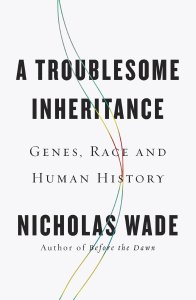
Nicholas Wade’s A Troublesome Inheritance: Genes, Race and Human History, which I finished reading last night, is a deeply flawed examination of human genetic difference. Andrew, who is more sympathetic to the notion of race as a biological construct than I am, often does not see eye-to-eye with me on matters of race and genetics. But he encouraged me to critically examine Wade’s book during this guest-blogging stint in order to move the conversation forward. Andrew will likely respond to the debate when he returns next week.

The best refutation of the book I’ve seen is comes from Agustín Fuentes, a professor of anthropology at Notre Dame. In an hour-long webinar hosted by the American Anthropological Association, Fuentes debates Wade and takes a jack-hammer to the factual foundation of Wade’s book. Alex Golub summarizes the Fuentes-Wade exchange for those who don’t have time to watch it. A key part:

Fuentes pointed out that “genes matter” but that “they’re just a small part of a whole evolutionary picture” which results in behavior. He also argued that Wade was imprecise in his terminology. “Wade uses cluster, population, group, race, sub-race, Wadeethnicity in a range of ways with few concrete definitions, and occasionally interchangeably throughout the book” he said.
Fuentes then went on to deal with the topic of human genetic variation. Humans share all of their genes and 99.9 percent of variation, he said, so what was being discussed in the webinar was just “0.1 variation of all the variation in the genome.” He emphasized that “most variation in human genetics is due to gene flow and genetic drift, which basically mean that the further apart two populations are, the more differences there are going to be between them.” Wade relied on a study which showed differences between people in Nigeria, Western Europe, Beijing, and Tokyo which showed differences between these groups but, Fuentes claimed, if you studied people from Liberia, Somalia, and South Africa you would get similar variation. “So for zoologists,” Fuentes concluded, “no human populations are different enough from one another to be called subspecies.”

Fuentes argued that the color-coded clusters of genetic data that Wade used in his book were a product of arbitrary choices made by Wade and scientists, and did not emerge automatically in the data themselves. In one study, the computer program Structure was asked to cluster data into 3, 4, 5, and 6 groups. Fuentes claimed that Wade noticed the arbitrariness of this scheme in his book and decided on a five-race scheme because it was “practical for most purposes” and not because it was naturally there in the data.

Another important point:

[Debate host Ed] Liebow asked Fuentes to talk about how biological evolution is linked with social evolution. Fuentes stresssed that “rather than just the environment shaping organisms and their gene pool, we know there’s interaction between organisms and the environment, which actually changes the way natural selection works. Evolution is ongoing over time and complex, it’s not just the environment targeting genes.”

For Fuentes complexity was clearly important. “The representation of little teeny minor differences in some areas of the DNA and connecting that to large sociopolitical and historical differences as Nicholas Wade did in his book, it’s misleading because it’s not giving true credit to the complexity of evolutionary biology and the complexity of understanding how things evolve.”

Pete Shanks comments on the webinar:

It was not so much a discussion as a debate, and in my view Fuentes defeated Wade thoroughly, though it was all very polite (too polite). Fuentes was well prepared, and able to identify, cite and comment on every study that Wade brought up to support his thesis. More important, he kept hammering away at the definition of “race” — as in, Mr. Wade, can you tell us, what is it? If you are going to claim that certain kinds of genetic variation between populations constitute a racial grouping, how do you define it?

Mostly Wade ignored the question. To the extent that he addressed it, he dismissed it as unimportant. Whether there are three or five races, or more, and where the boundaries are drawn: these are mere details until we admit the possibility of discussing race. (I’m being a little kind to him here myself; he burbled.)

Wade is full of factoids; the impressive thing about Fuentes’ performance was that he was familiar with all of them. That inevitably led to some points of agreement. For instance, at one point, Wade started to speculate about what percentage of genetic divergence would constitute a sub-species, and zoologically, they were in broad theoretical agreement. However, Wade seemed to be edging towards very dangerous waters when it came to the concept of human sub-species. Unfortunately, Fuentes and moderator Liebow were too polite to shove him in.

Over at his blog, Fuentes writes that “dialogue on such an important topic should be encouraged and as open minded as possible, but it must also be accurately informed by the science of human biology.” He provides a “mini-primer on what we what we know about human genetics to help such a discussion”:

1) Genes matter, but they are only a small part of the whole evolutionary picture and focusing on DNA segments won’t get you very far in understanding human evolution. The roundworm C. elegans has about 20,000 genes and humans have about 23,000 genes—it is pretty obvious that humans are more than 15% more complex than roundworms.

2) When making scientific argument about genetic variation you need to focus on populations–and be clear about your definitions (a common one for “population” is a geographical cluster of people who mate more within the cluster than outside of it). Many people talking about this subject use the words cluster, population, group, race, subrace and ethnicity in a range of ways, with few concrete definitions and occasionally interchangeably.  If you do not define something then you cannot measure it, test for it, or try to construct and refute or support hypotheses for it—in short you can’t do science.

3) Humans all share 100% same genes and 99.9% of the variation in the DNA. So the variation we are interested in is .1% of the entire genome. And yes, understanding that variation is important

4) Most genetic variation is due to gene flow and genetic drift so the further apart two populations are the more likely they are to have more differences

5) Nearly all the genetic variation in our entire species is found in populations just in Africa, with most of the variation found in all populations outside of Africa making up a small subset of that variation.

He ends his post with these words:

We do need to talk about Race without fear and with clarity. We certainly need more public discussions on Race, not less. But in doing so we need to accurately represent what the social and biological sciences actually tell us about genetic variation, about race, and about evolution.

That is exactly the kind of discussion I hope to engage in over the course of this week’s guest-blogging. Readers are invited to help me deconstruct Wade’s book. Even though A Troublesome Inheritance is hugely problematic, the reviews and debate surrounding it are worth examining in detail. I will follow up on this post with a series of posts focused on individual fault-lines within the larger debate.
The Big Winners Of Climate Change

by Jessie Roberts

Insurers:

Outside of government agencies, the insurance industry is the primary funder of climate-change research.

A trade group is sponsoring studies on how climate change affects tornadoes and hail. Another is backing university research on land ecosystems in a warming world, especially forests and crops. A British company is focusing on hurricane intensity and temperature rise while an insurer in Bermuda researches cloud seeding to see whether the storms can be stopped before making landfall. A.I.G., for example, just released a climate report of its own, noting “a disproportionate increase in the number of extreme weather events” in North America. [Berkshire Hathaway CEO Warren] Buffett is right: in ten years, if not sooner, calculations are bound to change. Those paying for the best research will get it first and, when they see an immediate risk, they’ll immediately price it in. For their own survival and for the sake of their shareholders, they will have to. Insurance rates will go up. And, if the risk is deemed too high or regulators block massive rate increases, as took place in coastal Florida some years ago, insurers will exit the market.

If profits equal progress, however, the insurance industry is on the right track. While researching a book that I wrote on the topic, I found that, when Hurricane Andrew landed in Florida and Louisiana, in 1992, insurers were caught unprepared, disbursing $1.27 in claims for every dollar of premium earned, for a total of twenty-three billion dollars. Those insurers started paying attention, and raised rates accordingly. Total claims were almost twice that when Hurricane Katrina hit Louisiana thirteen years later—but insurers still came out ahead, losing just 71.5 cents per dollar of premium. Industry profits were forty-nine billion dollars that year. We continue to gamble with our environmental policies. But the insurance industry, year after year, keeps winning.

Finding New Antibiotics Isn’t Easy

by Patrick Appel

The past few decades have lacked major antibiotics discoveries. Derek Lowe shifts blame away from the drug companies:

There’s a persistent explanation for the state of antibiotic therapy that blames drug companies for supposedly walking away from the field. This has the cause and effect turned around. It’s true that some of them have given up working in the area (along with quite a few other areas), but they left because nothing was working. The companies that stayed the course have explored, in great detail and at great expense, the problem that nothing much is working. If there ever was a field of drug discovery where the low-hanging fruit has been picked clean, it is antibiotic research. You have to use binoculars to convince yourself that there’s any more fruit up there at all. I wish that weren’t so, very much. But it is. Bacteria are hard to kill.

How McArdle sees the issue:

Antibiotic resistance is one of the few policy areas where everyone agrees that something should be done. Well, maybe except for some nutcases in the Voluntary Human Extinction Movement. Even more rarely, it is an area where we all agree on what we would like to see done. Unfortunately, the folks who actually have to do it seem to have no idea how to make it happen.

And you know what? That’s not an accident. If we knew how to find lots of great new antibiotics, this wouldn’t be a policy argument; we’d have lots of great new antibiotics, and we wouldn’t need to worry about resistance. The very existence of a policy issue tells you that it is difficult to solve, either politically or technically.

Commencement Speakers Are Dropping Like Flies, Ctd

by Chris Bodenner

Several readers dissent:

Your selection of commentary on the rash of protests against commencement speakers seemed really one-sided and off base to me. Some of it was also dripping with contempt for the millennial generation. As a Rutgers alum who is currently an assistant professor at a large state university, I followed the Condi Rice story with interest and think the criticism of protesting students misses the boat.

Protest is a form of speech that is often the only available method of expressing dissent to those in power. As a college instructor, I’m thrilled to see politically engaged students speaking out against awarding honorary degrees and, in some cases, massive speaking fees (Rice was set to be paid $35K) to individuals who they believe do not represent their values. We can’t wag our fingers at millennials for being self-absorbed and then simultaneously criticize them for protesting powerful political figures, which is an inherently social and political act.

Also, at Rutgers, they protested and Rice decided to bow out. That’s a crucial distinction to me.

RU did not rescind its invitation; Rice decided not to attend. Myself, I’ll take vocal dissent over apathy every day of the week. And the likes of Condi Rice and Christine Lagarde should have thicker skin, show up to the event, and directly engage the substance of the dissenters’ point of view. Those dissenters are less powerful, less wealthy, and yes, maybe could learn something new from the engagement. But my sense is the Rices and Lagardes of the world are too privileged and too insulated to seriously entertain the notion of taking a little criticism. They’ll do the event only if everyone kisses their butt on their way to and from the podium.

Another reader makes another key distinction:

Commencement is unique. There is no opportunity for dialogue with a commencement speaker, no debating issues, no public forum where you can criticize them for their errors and try to get them to respond. Their very role of commencement speaker implies that an honor is being bestowed on them by the college, by that graduating class, for their accomplishments in the world outside the campus. And their role on the dais is to shed the value of their status on those about to graduate.

I applaud these students for making their voices heard. They have done the work and paid the price. It is not a false sense of entitlement to believe they do not have to put up with someone as commencement speaker they don’t believe is worth the honor. They are truly entitled to that. They have earned it. I nearly boycotted my own commencement in 1981 because the speaker was George Will. I wish I had had the courage of my convictions to do so at the time, and I salute these students for standing up and making their voices heard on this.

Another suggests that the would-be commencement speakers are the entitled ones:

I’m headed to my 40th Smith College reunion this weekend. I am disappointed that Christine Lagarde has withdrawn as speaker simply because some 400 or so people signed an online petition. Is that really all it takes? I fault Lagarde and the other withdrawing speakers more than the students who signed the petition. I mean really, I get asked to sign online petitions every day, and sometimes I actually do. It doesn’t take much effort, nor does it necessarily mean I’m going to take some further action, like, heaven forfend, hold up a protest sign at a speech or throw rotten tomatoes.

Lagarde’s excuse for withdrawing was that she wanted to “preserve the celebratory experience” of the commencement. There is no indication that there were any threats by petition signers to take any actions that would hamper the celebrations. A few protest signs, if there were going to be any, wouldn’t have done any harm. I feel that these last-minute withdrawals by Lagarde and the other speakers doing so are going to have a chilling effect on the exercise of future student protesters’ first amendment rights to voice their protests. They are in effect saying, “If you complain about me or the institution I represent, I’m going to pack up my marbles and refuse to play.”

If the college and the speaker feel the speaker has something useful to say to the students, they ought to be willing to say it and take a little flak if necessary. I think she’s a coward.

The Very Slow Death Of The Death Penalty

by Patrick Appel

Death Penalty Polling

Enten examines public opinion on capital punishment:

Overall, support for the death penalty is dropping in the U.S., but at a slow rate. When we look at the 70 polls on capital punishment in PollingReport.com’s database taken since 2000, we see that the drop has averaged only 0.4 percentage points per year. The trend suggests that, at this point, about 61 percent of Americans support the death penalty. Some polls (such as a 2013 Pew Research Center survey) put support lower, and some (such as the YouGov survey) put it higher.

If the trend continues, a majority of Americans will support the death penalty for an additional 30 years.

And there isn’t much reason to expect the trend to pick up speed anytime soon. Unlike issues such as same-sex marriage and marijuana, where a large age gap favors the more progressive position, young Americans aren’t all that more likely than older Americans to oppose the death penalty.

Meanwhile, David R. Dow explains why Texas leads the nation in executions:

As a law professor in Texas who, along with my team, has represented well over 100 death row inmates over the past 20 years, I am often asked why Texas executes so many people. This is what I say: Texas executes so many people because it executes so many people. I’m not being flip. What I mean is simply that killing people is like most anything else; the more you do it, the better you get. If killing people were like playing the violin, Texas would have been selling out Carnegie Hall years ago.

To understand how the adage that practice makes perfect applies to the execution of a prisoner, it is helpful to understand the stages and legal intricacies of a death penalty case. The law surrounding the death penalty is complex and often must be dealt with swiftly, as court deadlines and execution dates loom. The more familiar lawyers, government administrators, prison wardens, executioners and the many other relevant actors are with the process, the better they are at seeing it all the way through until its lethal end.

What Made Camus Great?

by Matthew Sitman

Reviewing Robert Zaretsky’s A Life Worth Living: Albert Camus and the Quest for Meaning, Ian Marcus Corbin attributes it to the writer’s “singular commitment to concrete reality” and “determination to not just think, but also to look“:

There is no way for a thinker—or indeed, a user of language—to eschew abstraction entirely, of course, but Camus was deeply attuned to the dangers of excessive abstraction. This may not sound particularly heroic, but it can be, and it certainly was in Camus’s day. Camus’s peers, mid-century French intellectuals, were all too susceptible to the raptures of abstraction. The Left Bank bien pensants were, with few exceptions, stalwart armchair Marxists, obliquely aware that the divine dream of the worker’s paradise was exacting a brutal toll on the actual humans of the Soviet bloc, but blissfully unmoved by this fact. Camus publicly, angrily, charged that their fixation on beautiful ideas made them insensate to the ugly cost such ideas imposed on the much-beloved proletariat. And indeed, it is now difficult—impossible—to think Camus wrong.

Zaretsky quotes the French philosopher Maurice Merleau-Ponty, who writes of the Stalinist horrors with chilling coolness, explaining that only the unfolding of history will “give us the final word as to the legitimacy of a particular form of violence.” Camus righteously fumes in response that “man has been delivered entirely into the hands of history … because we live in a world of abstraction, a world of bureaucracy and machinery, of absolute ideas and of messianism without subtlety.” Camus’s rejection of blood-draining Stalinist abstraction put him far out of favor with his peers, most notably his once-close friend Jean Paul Sartre, who publicly denounced him for his political apostasy.

Claire Messud picks up on another aspect of Camus’s thought – his complicated relationship to Christianity. She praises Sandra Smith’s recent translation of The Stranger for realizing the subtly religious aspects of his prose:

Camus, of course, was more complex in his atheism than we might commonly expect: he was an atheist in reaction to, and in the shadow of, a Catholicism osmotically imbued in the culture (of the French certainly, but of the pieds noirs in particular). The inescapable result is that his atheism is in constant dialogue with religion; in L’Étranger no less than in, say, La Peste.

Sandra Smith has, in her admirable translation, plucked carefully upon this thread in the novel, so that Anglophone readers might better grasp Camus’s allusions. Here is but one key example: the novel’s last line, in French, begins “Pour que tout soit consommé,...” which [Matthew] Ward translates, literally, as “For everything to be consummated.” But as Smith points out, the French carries “an echo of the last words of Jesus on the Cross: ‘Tout est consommé.’” Her chosen rendition, then, is “So that it might be finished,” a formulation that echoes Christ’s last words in the King James translation of the Bible.

Previous Dish on Camus here, here, here, and here.

How Unfair Is Being The Fat Girl? Ctd

by Chris Bodenner

A reader sees “a couple of glaring holes” in this monologue from Louie:

First, lots of fat girls have boyfriends. Maybe that one fat girl can’t get one she finds acceptable, and her frustration is well-expressed, but the idea that being a fat girl means you CAN’T get a boyfriend is simply false. This country is full of fat women (and fat men) who are dating and married and popping out fat kids. We have an obesity epidemic, remember?

Second, when she goes into the thing about how he can just talk into the microphone about being overweight and it’s adorable – well, yeah, but he’s a famous comedian. Again, it works great in the scene, and for those characters, but trying to generalize that point is insane. Lots of fat guys get girlfriends (just like lots of fat girls get boyfriends), but tons more fat guys have absolutely no success with women. They can’t all just get on stage and have a persona. Lots of them end up with crippling anxiety and social phobias because they can’t get an iota of positive female attention.

So, as usual with Louie, it’s an amazing show with a fresh perspective and characters that seem to intimate universal truths. But also as usual, under close investigation those universal truths turn out to be closer to polemics that are just really well-written. Louis CK doesn’t intend them to be philosophical arguments, but expressions of his own very narrow, very personal perspective, and we should read them that way.

Another is much less forgiving and makes some solid points:

Wow. What a pathetic mix of self-pity and self-indulgence. “How is that fair? And why am supposed to just accept it?” Should I mention the obvious: during this whole scene a number of people pass the whining lady actually running. Yes, exercising.

So, here is my reaction to this lady:

No, you are not supposed to just accept it. Stop whining about fairness, put a pair of sneakers on and start doing something about your weight if it is your real concern. And no, you don’t have to if it does not get in the way of your fulfilling, happy and productive life – but that’s not what you sound like. So if you excuse my bluntness, either make your inner peace with your fat arse or do something about it.

And no, I am not some arrogant prick with good genes. It requires constant efforts for me to stay fit, and it has been that way for my entire adult life. I am a middle-aged man whose weight has been fluctuating around the “dreaded” BMI of 25 separating “normal” from officially “overweight” for as long as I remember. For the last 2 years I managed to stay below that mark, but not through some genetic luck or “fairness”. As I said, I was not dealt particularly good genes as far the waist size is concerned. All it will take for me to go back over that BMI 25 waterline is stopping to pay close attention to what I put in my mouth and starting to skip my every-other-evening swims and Sunday soccer games. And it will not take long to get there, no more than a month.

And by the way, I work long hours. I have to – I am a sole bread-winner in the family. Heading back from work at 7 pm I always have a choice to make: go home, have dinner and relax, which sounds incredibly appealing every bloody evening, or get over it and head to the swimming pool for an hour first. Trust me, the latter is never an easy choice, and I routinely find excuses not to do it and yet I also know that it feels very rewarding afterward whenever I don’t listen to my own excuses.

I also realise that my choices are not for everyone: small children at home or a number of other very real priorities may skew the balance and make my personal “good” choices not so good for someone else. But my point is exactly that: for many of us with with “susceptible” waistlines the actual girth is merely a matter of priorities. If it really bothers you, make it a priority. If you’d rather spend that extra hour at home with kids and/or indulge in sweet treats – it’s a legitimate choice, but then don’t whine.

And by the way, you want to know what is really unfair as far as the dating market is concerned? Try talking to short men. Or better yet, short bald men. No, I am not bringing any personal complaints here: I am 5’9” – definitely not tall but not pathologically short either, and in any case I am happily married to a beautiful woman. Yet I observed on many an occasion the short end of the dating stick reserved for short men. I understand that for many women these are unconscious decisions rooted deeply in biology (height + full head of hair may signal some genetic superiority), but that does not make it any fairer to the recipients of such unconscious attitude. And guess what: we can’t change our height or simply regrow a full head of hair while the chances are, you actually can change your waistline. So just knock it off please.

Losing The Ring, Ctd

Readers offer advice to go along with the stories:

Sounds like a great opportunity to renew your vows.

Another:

My little suggestion: think about what you want to leave behind, and let the ring symbolize that shedding, and then decide what you want the new ring to bring in to your lives, and make the loss a renewal of your commitment. Hope that helps.

Or maybe a little bit of both. Another idea:

I am so sorry about your ring. This may be a crazy idea, but what if Aaron agreed to donate his ring to a pool of gold from which two new rings were cast?  Then some of that gold on your finger would also date back to your wedding.

Maybe a little too much work. Several more readers sound off:

So sorry to hear about your loss.  You, of all people, earned that ring. Not sure this is what you want to hear, but you might tell your other readers that a hospital will not likely INSIST that you take off your ring.

You can request that they secure it in place with adhesive tape.  My wife and I have been married nearly 28 years, and I’ve been in the hospital many times (cancer, chemotherapy, several other surgeries and been anesthetized 12 – 15 times) at six or seven hospitals, and have never taken off my ring.  They ask, I say no, they cope.

It helped that my wife is a registered nurse who had worked in several hospitals, who knew that I didn’t want the ring off and who knew the ropes.  She was able to prime me.  Hospitals are worried about loss of the ring or (in the case of diamond or other jewels) injury to the ring, loss of the stone, etc. Taping fixes that.

A labor and delivery nurse agrees:

This should not have happened.  No married person should be asked to remove a wedding band prior to surgery.  The band should be secured in place with tape during the pre-op prep in the anesthesia area.

You may have limited energy for taking on a new cause, if you are recovering from surgery.  But, the pre-op procedure at your hospital is NOT standard, and should be changed.  The thought that a wedding band could cause either contamination in the OR or loss of circulation to the ring finger is absurd and has been debunked.  It is indeed rare, and very outdated, for any hospital to have a protocol requiring patients entering surgery to do without the most important object they own – their wedding band.

Another offers a permanent solution:

Get one tattooed on. They aren’t going to ask you to take off your finger …

Another suggests having stand-ins:

I know I would feel terrible if I lost mine. I’ve even become attached to a secondary wedding ring I have. On our honeymoon in Hawaii, my wife and I got inexpensive rings to wear while snorkeling or doing other beach activities, lest our wedding bands fall off in the water. Mine is made of palm wood. I’ve worn it during all of our beach vacations during our four years of marriage.

Recently I thought to myself that if I lost it while swimming, I’d be just as upset as if I lost my wedding band. The wooden ring holds so much meaning and so many wonderful memories itself.  So, truly, I’m sorry for your loss.

One more reader:

I feel for you.  A couple years after our commitment ceremony in 1998,  I took my wedding ring off, laid it on the bathroom sink so I could wash my hands, was distracted by something and wandered off.  Two hours later I did what you did – grabbed with my right hand for my left ring finger and panicked when I found it bare.  I TORE THE HOUSE APART looking for it, to no avail.  My husband came home from work and found me weepy-eyed and distraught on the front porch. He was so understanding – “It’s just a ring; Tiffany makes more.” but I was bereft.  Another two hours of searching, then a flash – “THE BATHROOM!” A search around the sink. Nothing.  Did it fall down the drain?  Removed the sink trap. Nothing.  A trip to the basement to figure out if I could break into the cast-iron waste stack to … what?  I had no idea, but as I was staring at the pipes, a shout from upstairs: “FOUND IT!”  I had knocked it off the sink and my husband found it wedged under the toilet.  I cried.

My husband has put that ring on my finger three times.  First at the commitment ceremony in front of a hundred family and friends in Detroit.  Then in San Francisco City Hall in 2004, soaking wet from a night spent on the sidewalk in the rain, when we joined 4,000 other couples who married that glorious Valentines Day weekend.  That marriage was voided, though we have the certificate framed on our bedroom wall.  The last time he handed me the ring was in 2010 in Boston, surrounded by parents and siblings, nieces and nephews (none of whom were alive in 1998), when we married, for good, on the 6th anniversary of our San Francisco adventure.

Every morning I swim a couple miles.  And every morning I take my wedding ring off and clip it to my keyring.  The water compresses my fingers and, because of my swimming, the ring fits a little looser on my finger than it did in 1998.  My fear is that it will fall off and get sucked into a drain I can’t open.  So I keep it secure and slip it back on after I shower.  It is just a gold band, but it’s also a talisman, a symbol not just of our love, but of the journey and adventure we have shared for nearly 20 years.  It is what I reach for when I’m worried or sad or excited.  It is what reminds me of what’s really important.  I am so sorry for your loss.