Where It’s Really Hard To Come Out As An Atheist

In Saudi Arabia, the government deems “calling for atheist thought in any form” a terrorist act. Nesrine Malik comments:

In my experience, when it comes to atheism in the Muslim world, there is a conspiracy of sorts, akin to the [former] “don’t ask, don’t tell” principle on homosexuality in the US military – if a Muslim has lapsed, and no longer believes in God, there is no censure of that as long as one does not proselytize. Indeed, a 2012 poll by WIN-Gallup International found that up to 5 percent of Saudis polled identified as atheist, according to Sultan al-Qassemi, a number “comparable to the US and parts of Europe.” However, these atheists are almost anonymous in the public sphere, only “out,” at most, to their families and friends.

Some atheists have taken to describing themselves as “ex-Muslims,” adopting a stance similar to that of the New Atheists:

Few people define themselves as “ex-Christian” or “ex-Jewish.” The “ex-Muslim” tag is an identity, a refuge, a political statement that is not to be confused with simple lack of belief in God. It is also one that finds common cause with a new tradition of western atheism, one that couches its position more in the public rejection of religion than simple non-belief. The difference is that the former can thrive in a secular society, where communities have become weaker and individuals revel in self-expression. Muslim societies are quietly tolerant of rebellious acts of all kinds, from the sexual to the religious. But because religion, family, society, and politics are built around community, to be a declared atheist in the public space is to make a stand against the fabric of society.

Previous Dish on the atheist closet in the West here.

No Gold Stars For America’s 12th Graders

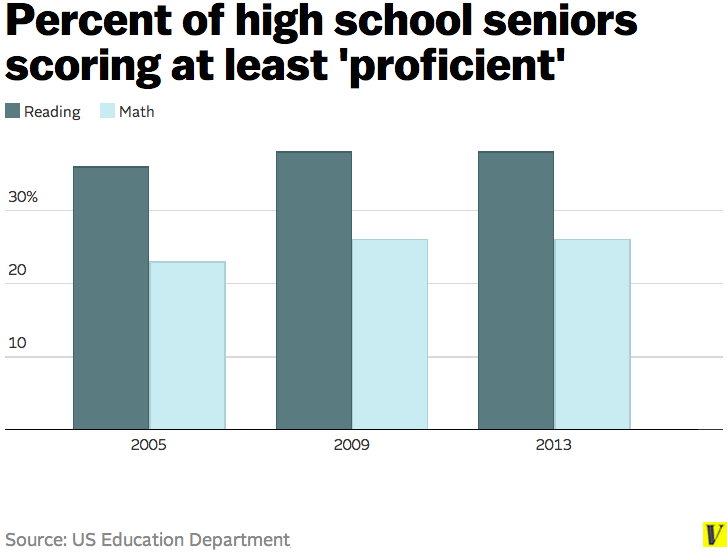
Screen_Shot_2014-05-07_at_9.02.45_AM

Libby Nelson finds “little good news” in the latest National Assessment of Educational Progress (“the nation’s report card”), which the DOE released yesterday:

Just 26 percent of 12th-grade students scored as proficient or better in mathematics in 2013. In reading, 38 percent were proficient or better. And there has been no improvement in 12th-graders’ scores since 2009, the last time students took the tests. … Scores released in December showed that fourth-grade and eighth-grade students have slowly improved their performance in reading and math, even though less than half of them score as proficient in those subjects. But Wednesday’s data show high school seniors haven’t even made incremental progress.

Why are seniors doing so poorly, when younger students are improving? Demographics might be a factor:

One change that probably has influenced the 12th-grade scores somewhat is the demographic changes of America’s seniors since testing began in 1992, as well as an upward trend in graduation numbers. The percentage of students who are Hispanic has risen from 7 to 20 percent in that time, and the percentage of students with a disability has doubled, from 5 to 11 percent, while the portion of students who are white has dropped from 74 percent to 58 percent. At the same time, the average freshman graduation rate has risen from 74 percent to 81 percent, meaning more students who might have dropped out in the past are now included in the sample that are tested.

But Jill Barshay is unsatisfied with that explanation:

[H]ere’s the thing. When you look at top achieving students in the top 75th and 90th percentiles. Their scores are FLAT. … High achieving students aren’t improving at all. So you can’t blame the infusion of more low performing students in the testing pool for the disappointing test scores. Even if we hadn’t introduced a greater number of weaker students into the mix, the scores of our high school students would still be stagnant.

Indeed, when you drill down by percentile, it’s the weakest students who are showing modest improvements. If not for their improvements, the national average would have declined!

Also, Maya Rhodan notes that, in the longer term, minority students’ scores are improving faster than those of white students:

Between 2005 and 2013, African-American students’ math scores jumped by five points and white students saw their scores go up by four points. Asian/Pacific Islander students and Hispanic students experienced the highest gains, with math scores increasing by 10 and seven points, respectively. Yet achievement gaps persist between racial groups and genders. Boys scored an average of three points higher than girls in math, and girls scored about 10 points higher in reading than boys. Whites scored 30 points higher than blacks in math and 21 points than Hispanic students. In reading, whites scored 30 points higher than blacks and 22 points higher than Hispanics.

Do I Sound Gay? Ctd

Readers keep the popular thread going:

I’m deaf and I read lips. I’ve definitely noticed that someone’s speech can “look gay.” Sometimes this seems to trump how the person actually sounds. Occasionally I’ve mentioned something to a hearing person who says, “What? That person doesn’t sound gay at all.” Then, a little down the line, the person in question comes out of the closet. (This has only happened with gay men, not with lesbians.)

Another offers a “gay4pay perspective”:

I’m a straight male sex worker who has mostly serviced male clients. Most of my experience was in Canada but I have since moved to the US. My educational background is in the social sciences and law. At the end of nearly every session I conduct an informal, oral survey to find out some basic information about the client’s sexuality and his/her marital status and, where relevant, their “out” status (i.e. Are you “publicly” gay?)

One of the things that struck me quite early on in my experience as a sex worker was how many of my self-identified gay male clients had NO hint of a “gay voice”. At one point it was definitely a majority of them, but since moving to the US it has evened out a bit. I can tell you with absolute confidence that I did not notice any relationship between the client’s “out” status and their voice type.

Where I did detect a relationship was with age; the younger gay clients were much more likely to possess a voice that would at least hint at their sexuality. Most of the older ones (I stress these were mostly “out” clients) sounded much straighter than me, which brings me to my next point.

At least since high school, people have seriously questioned my straightness. It died down considerably during undergraduate school, but when I began law school it resumed. I have fun with the ambiguity much of the time, but there comes a point where I start wondering if it is actually affecting my prospects with women. When I ask people why I come off as gay, they point out a number of things that include my voice. Now, I personally don’t think I have a gay voice, but I do think it sounds “anti-macho” – sort of like a lot of European voices sound to Americans. I was born and raised in a part of the Arab world where anyone with some measure of civility would differentiate themselves from others with more “tribal” leanings. I speak with tremendous care, as though I love every word I say. I think it’s a terrible shame that doing so associates me with a specific sexual orientation.

My personal experience and what I’ve witnessed in my sex work, anecdotal as it is, really reinforces my view that a person’s voice and speech are things they are socialized into having.

You Can’t Feed Your Family With A New TV, Ctd

A reader explains why it’s so much cheaper to buy goods than services:

Three words: Baumol’s. Cost. Disease. The basic idea is that as productivity increases over time (i.e., more widgets built, more burgers flipped), it can’t increase over time for work that is denominated in … time. Hours of child care. Hours of surgery. Hours of psychotherapy. Credit hours in education. You can’t cram more hours into an hour. So as wages rise, the per-hour cost of an hour has to just plain rise, in order to keep up.

His own example:

My wife and I have two small daughters. At present, full-time care for both costs about $1,600 a month. For comparison, our modest apartment costs us $1,800 a month. And the child care is modest, too! It was modest in a preschool until recently, and currently in a home daycare. The preschool was one of the cheaper day-care centers. The home day care is a little on the high side at the same price.

And here’s the rub: daycare workers are badly undervalued, undertrained, and underpaid. And even at that price they’re this expensive! I know a preschool that really pays and trains its teachers well. It costs about twice as much as ours did.

So my position is that good child care is fundamentally unaffordable. In the past, it was subsidized at the cost of women’s futures. Now, it is less and less subsidized – and less and less affordable.

Another reader takes issue with Derek Thompson:

Now consider education, health, and childcare, the blue sectors above where prices are rising considerably faster than average. These are service industries that employ local workers. They are not, to use the economic term, “tradable.”

Wrong! Education does not always employ local workers. I can send you evidence to show that STEM teachers are being imported by the dozen from India. I know them personally, I know the agency, and how it was investigated by DOL. Many years ago, tutoring, or doing your homework for a fee, was off-shored to India.

Healthcare was off-shored even before that: medical transcription, reading radiological reports. That trend reversed a bit because of the quality, but even then that has depleted the economy, rather than create value. I think the right explanation is that electronic consumable and durables become cheaper over time, like generic drugs, because the initial investment has been recouped. It is just economies of scale.

A “Judicial Coup” In Thailand

Thailand’s Constitutional Court has ordered Prime Minister Yingluck Shinawatra and nine members of her cabinet to step down:

Lennox Samuels situates the order within what critics call a “rolling silent judicial coup” against the Shinawatras’ political movement:

The ruling comes weeks after the same court nullified the February 2 national election, which Yingluck’s Pheu Thai party was expected to win. The party won the last election, in 2011, routing the opposition Democrat Party. Ever since that 2011 victory, anti-government elements have been agitating to topple Pheu Thai. … “This is a full-blown version of a judicial coup, with long-lasting impact on the balance of powers,” legal expert Verapat Pariyawong tells The Baily Beast. Previous rulings were among the principal reasons that led to the rise of an anti-Thaksin government and the 2010 massacre of the Red Shirts. “One can only hope that the political outcome will be different this time,” said Pariyawong. “But to be realistic, once the rule of law in the chamber is gone, all that is left is probably violence on the street.”

Keating remarks that, for all they are reviled by their opponents, “no party with one of the Shinawatra siblings at the top of the ballot has lost a Thai election” since 2001:

None of this is necessarily to defend the Shinawatras. Thaksin was a populist tycoon with an authoritarian streak who was accused of human rights abuses including extrajudicial killings and detentions during the country’s war on drugs. Yingluck was fairly transparently acting has his proxy by pushing an amnesty bill that would have allowed him to return to the country. A scheme to hoard rice to drive up global prices has been an economic disaster.

But it’s fairly apparent that any time Thai voters are asked, they vote Shinawtra—particularly in the country’s less developed north. But any time one of them or their allies gets into power, the judiciary and the military figure out a way to remove them. The opposition, whose supporters are drawn primarily from the urban middle class, are now advocating that the country’s electoral democracy be replaced with a vaguely defined “People’s Council.” If the Shinawatras are removed from power again, we could also see the return of massive and occasionally deadly street protests of years past.

Adam Pasick looks ahead:

Niwattumrong Boonsongpaisan, a cabinet minister, was named as acting prime minister, and much of Yingluck’s cabinet will remain in office, preventing the political vacuum that some had feared. But that’s only a stopgap, since the entire government has been in caretaker mode since Yingluck dissolved parliament and called for elections last year. The vote in February was boycotted by the anti-Thaksin (and misleadingly named) Democrat Party and the results voided by—you guessed it—the constitutional court. …

Previous setbacks have resulted in violent street clashes between security forces and Thaksin supporters known as “red shirts,” who have scheduled a protest for May 10 in response to Yingluck’s ouster. The outcome of that rally may determine whether Thai politics are yet again about to swing from absurdity to violence. In any case, chaos seems certain.

The Bloomberg editors slam the Thai opposition, which is still refusing to participate in the upcoming elections:

The courts have now satisfied one of the opposition’s central demands by getting rid of Yingluck. For weeks this spring, the army allowed protesters great leeway as they tried to blockade Bangkok’s streets. Yet neither the judges, the generals nor the king — the third leg of the traditionalist establishment — has stepped in to replace Yingluck’s government, for at least one obvious reason: No undemocratically chosen administration would command legitimacy among a majority of Thais or the international community.

The opposition’s continued refusal to stand in the elections — even with more than two months to prepare — simply cannot be justified. There’s little reason to suspect that the July vote won’t be largely free and fair. If the Democrats and their allies lose again, as they have repeatedly over the past two decades, it will be because they have still not crafted a message that appeals to most of their countrymen, nor built a strong political organization that extends to all parts of the country.

Previous Dish on Thailand here and here.

What Is The Ulysses Of Romance Novels? Ctd

The debate continues:

Your reader claiming that explicit writing about sex in romances makes those romances porn and then saying the writing about sex is “orthogonal to true art – it suppresses rather than invites reflection” irritates me. Look, for me, violence in television shows, movies, video games, and some books is also “orthogonal to true art.” Nevertheless, reviewers review and discuss violence (such as Jaime Lannister raping his sister Cersei in Game of Thrones) and do so in thoughtful ways, exploring the nuances of the violence, the sex, and their effects. There is no similar, serious, thoughtful writing in quantity about romance novels in the mainstream press. In fact, it’s my belief that the reason a lot of romance has unnecessary or uninspired writing about sex is that there are no sympathetic yet analytical reviews that could have helped shape the skills of writers and the tastes of the audience from the beginning.

Another reader:

Speaking as an erotic romance writer, and an acquisition editor for a romance publisher, I can assure you that erotic romance novels are not at all ONLY pornography. In fact, if you throw the word “porn” into a gathering of romance authors, you’d better get the hell out of there quickly before they eat you for breakfast! Only someone who has not read a well-written romance novel would say something so obviously dismissive and condescending.

I could list the many romance novels I’ve consumed that have influenced my ethics and morality (for the better), but the number is too unwieldy for this email. I’ve learned about racism, miscegenation, rape, slavery, consent, dub-con, homosexuality, ageism, history, polyamory, and most importantly, hope and acceptance, from romance novels. The kind of subject matter some authors routinely tackle is stunning. I’ve also learned how not to write from the badly written romances (just as I have learned that same lesson from crappy literary novels, of which there are many).

Romance is easily one of the most widely-read category of books. As an industry, it is booming. Yet I am continually amazed at the lack of respect these novels receive. Thank you for once again highlighting how little progress we have made in our world when it comes to what we allow women to be – because it’s just not cool to read something romantic, is it? In order to be a real woman, a smart woman, a perfect woman, you can only read The Odyssey.

Oh wait, what was Ulysses trying to do? Get back home to the woman he loved? Hmmm …

Meanwhile, another reader – who is writing a book about the cultural response to romance – puts forth a canon that stretches back hundreds of years:

The word “romance” originally referred to a relatively lengthy, fictional narrative, in poetry or in prose, written in “romanz” – that is, the romance language, which, in this case, was Old French. Romances could treat topics out of classical or French history, but they are most famous nowadays for treating matters of British history, especially the stories of King Arthur and the knights of the Round Table. So, the first “romance novels,” in a sense, are the accounts of the loves Lancelot and Guinevere and Tristan and Iseut in the twelfth century, which are the ancestor of the love stories we know today.

While classical culture knew erotic love, such as the passion of Dido for Aeneas, it is often argued that “romantic” love as we know it – with its emphasis upon the lovers’ suffering and their exaltation through suffering – originated in these “romanz.” The “canonical” works of this genre would include Chrétien de Troyes’ Lancelot; Béroul’s, Thomas’, and Gottfried von Strassburg’s romances of Tristan; Marie de France’s Lais; and the lengthy Vulgate and Post-Vulgate Cycles, with their compendia of Arthurian lore.

Medieval romance is followed by Renaissance romance epic. I would recommend Ludovico Ariosto’s Orlando Furioso, which contains enough bodice-ripping to satisfy any Harlequin reader, and Torquato Tasso’s Jerusalem Delivered.

While the English made a distinction between medieval “romance” and the modern “novel” (which they claim to have invented in the eighteenth century), most other Europeans use the same term (“roman,” “romanzo,” “Roman,” etc.) for the two genres. Even in England, Gothic novels were often subtitled “A Romance,” in order to link them with the earlier, medieval tradition. I can’t speak to modern romances, but I suspect one can’t do much better than Emily Bronte’s Wuthering Heights.

While there is very much a “romance canon,” it is also true that, from the 12th century to the present day, the genre has been criticized for suggesting that amorous relationships should be passionate and, typically, outside the boundaries of marriage. Emma Bovary reads too many romances, and we see what happens to her …

Why Atheists Need To Come Out, Ctd

A reader says the call for a kinder, gentler atheism is long overdue:

Bill Maher, Richard Dawkins, and other New Atheists are like gay dudes in assless chaps dancing on a dildo float. They put their atheism in everybody’s face and make no apologies. While I understand why New Atheists do that (I sometimes metaphorically put them on when faced with the worst in religious lunacy), they aren’t changing minds with their tactics. It will be the mundane atheists who live across the street or work in accounting or coach your kids’ soccer team who will eventually make the religious realize that there is nothing amoral or sinister about people who don’t concern themselves with deities. It’s hard to fear somebody when you know they have to buy toilet paper and cornflakes just like everybody else.

Another sets a good example:

I know people who have been through grievous life events – the loss of a child, loss of a parent at a young age – and according to their belief system, they will see that person again some day. My grandmother lost a son to a drowning at a young age, and she would always say that when she got to heaven, she would at last understand why he had been taken.

Why would I want to aggressively go around telling people that none of that is likely to happen, that their loved one is just as dead as a squirrel on the road? That may be my belief, but I don’t know it to be a fact. Life is difficult enough – why take away a source of comfort to some? It’s not my goal to convert other people to my beliefs any more than it’s your goal to convert other people to being gay. All I would like is acceptance.

But another argues that society needs both pleasant and pissed-off atheists:

Religious leaders have slandered atheists for centuries as being evil incarnate, and we need quiet kind atheists to show that one can not only be good without God, but also the sweetest, most inoffensive person on the planet. But you need in-your-face New Atheists as well. You need these people to challenge the posting of the 10 Commandments in schools, courthouses, and town halls. You need these people to point out that U.S. law is based on English Common Law, which in turn is based on pagan Roman law. You need these people to expose people to the arguments against religion so it isn’t accepted fact that the supernatural is real or that Christianity was born in its current form straight from Jesus.

I’d also like to challenge the notion that nobody was converted to Atheism by the New Atheists. It was the works of Sam Harris and Richard Dawkins that provided the final push for me on my journey from a skeptical Christian to a loud, proud atheist. Now I suspect that your reader is right that their works will fail to convince a devout Christian. Heck, I’ve seen you, Andrew, acknowledge historical and scientific truths that directly contradict your beliefs, only to brush them aside to claim a “higher truth” that cannot be proven. The ultra-rationalist New Atheists will never win you or other devoted believers over. However, they can and do win over people who are already skeptical of their beliefs.

Previous Dish on the need for atheists to come out herehere and here.

Is Putin Pulling Back?

Yesterday, Russian President Vladimir Putin claimed that Russian forces had withdrawn from the Ukrainian border and urged separatists in Donetsk and Luhansk to postpone a referendum on autonomy scheduled for Sunday (a call they rejected today). Marc Champion is cautiously optimistic that Putin is starting to see reason:

Here is what I hope his statement signifies: First, that Putin doesn’t want to invade Ukraine. It has always seemed unlikely that invasion was his goal, but with forces ready on the border, it could never be ruled out. (Indeed, although Putin said today that Russian troops had withdrawn from the border, NATO officials said they had not.) …

I hope, secondly, that having decided not to invade Ukraine, Putin also doesn’t want to trigger a civil war there. Putin will be well aware that a disputed status referendum can act as a trigger for conflict. The spark for the war in Bosnia, for example, was a 1992 referendum on independence from Yugoslavia that Bosnian Serbs were bound to lose, because they were less numerous than Bosnian Muslims and Croats.

But Ioffe doesn’t buy it:

Putin isn’t really hiding a very good reason for postponing the referendum.

He asked “representatives of southeast Ukraine and supporters of federalization to hold off the referendum scheduled for May 11, in order to give this dialogue the conditions it needs to have a chance.” (emphasis mine) Because eastern and southern Ukraine is not Crimea, and it is not at all clear that, were a referendum held in just four days, the results would come out in Russia’s favor. The unpopularity of the new government in Kiev here has not translated to favoring he idea of independence or joining up with Russia. Polls put the number at just 30 percent of people in the region supporting annexation. To get the right result, Russia would have to pull off a stupendous amount of fraud, thereby risking a massive backlash—and further violence—in these regions.

New numbers from Pew back her up:

The poll, from Pew Research’s Global Attitudes Project, shows that a vast majority — 77 percent — of those polled want the country to remain united, compared to only 14 percent who want to allow regions of the country to secede. The split between attitudes in the east of the country, where most of the Russian-speaking population resides and has faced unrest from pro-Russian separatists for the last two months, and the Kyiv-backing west are readily apparent in the breakdown of the question: 93 percent of western Ukrainians want to keep the country together, compared to 70 percent in the east. That number dips lower to 58 percent when Russian speakers are split out, but still constitutes a majority.

Daniel Berman suspects Putin is actually trying to call attention to the referendum:

[D]espite having specifically scheduled their own referendum for May 11th, two weeks before national elections, neither Western governments, nor the media have taken the bait. The obsession has remained on Ukraine’s own elections on the 25th; accusations against Putin have focused on his efforts to disrupt those elections. No one seems to have expected much from this Sunday’s vote, or feared much from its aftermath. The idea that a 99% or so vote for union with Russia would immediately be followed by annexation has not seriously been raised. In such a circumstance, Russians troops following up such a vote with an occupation of the Oblast would be seen as an invasion, no different than a move on Kiev.

Clearly therefore the referendum gambit was not working for Putin, and this explains his request for a delay. At best, not only does Putin come across as a reasonable figure working towards a settlement; rescheduling the referendum will provide another opportunity, along with additional time to build up expectations about its significance. In the worst case, if he fails to achieve the delay, he has still refocused international attention on it, increasing its importance, and hopefully its significance.

Bershidsky doubts the separatists will be able to pull off a credible vote anyway:

The referendum, and a similar one planned in the neighboring region of Lugansk, was a ridiculous idea from the start. The rebels do not have the skills, the numbers or the control necessary to organize a real vote. All they have managed to do is to print some highly ornamented ballots. With the Ukrainian military, police and national guard conducting a bumbling “anti-terrorist operation” in the rebellious regions, not even the semblance of peaceful balloting is feasible. Russia recognized the farcical secession referendum in Crimea in April, because a high degree of local support was there for all to see. In Donetsk and Lugansk, the referendum is such a bad idea that even Russia won’t touch it with a barge pole. …

Putin’s move is not being offered as a trade for concessions. His gambit is, more likely, meant to open an important line of questioning about what exactly the West needs from him if Russia is to avoid serious economic sanctions.

Keating downplays the other part of Putin’s statement, about moving the Russian troops away from the border:

[G]iven that the existence of these troops, where exactly they’re located, and what they’re doing have been matters of dispute throughout this crisis, Putin’s latest assurance may not mean very much. It would also seem to contradict earlier statements suggesting that the military units in the area had already returned to base or hadn’t been there in the first place, though all of these statements have been somewhat ambiguously worded.

I’m not sure how much the location and composition of these troops will really matter. Russian may not need to actually use them—at least in the short term—given that pro-Russian separatists likely assisted by Russian special operations forces seem to be doing a perfectly fine job resisting Ukrainian government efforts to regain control over the country’s southeast.
The View From Your Obamacare: Gay Men’s Health

Several more readers share their stories:

I have a “Dish Double” for you! First, thanks for your recent series on Truvada. Somehow I hadn’t been aware of the Truvada PrEP. I’m a 47-year-old gay man who is HIV negative but I had recently found President Obama Visits Boston To Talk About Health Caremyself engaging in riskier behavior. After all these years, condom-fatigue had set in and with AIDS becoming a manageable disease, the fear that once kept me from indulging in barrier-free sex has passed.

Don’t get me wrong; I was and am not seeking to become positive. I just was finding myself in a position where the idea of using condoms forever was no longer an option for me. In other words, I’m a perfect candidate for a Truvada PrEP regimen.

Which brings me to the view from my Obamacare.

I’m one of the people who was not able to keep my old insurance policy and is now paying more than double each month for my policy. I should mention a few things about my old policy. When I first purchased it back in 2002, I was 35 and had never had any major health issues, so it seemed like a great policy. The premiums were low. Sure, it had a $3500 deductible and no prescription coverage, but so what. I was young and healthy.

Until I wasn’t.

Just before I turned 40, I experienced some medical issues that resulted in hospitalization and ongoing care. Everything is fine now, but for about six months I was seeing doctors once a week. While my insurance did cover most of it, I still faced some large bills due to the deductible and prescription costs. The experience revealed the severe limitations of the policy. It was basically a catastrophic coverage plan. Of course now that I was the proud new owner of a “pre-existing condition”, it was the plan I was stuck with up until this year.

The view from my Obamacare is that my new policy has a premium that is a bit more than twice what my old insurance cost. My new policy also has prescription coverage and a very low deductible. I added things up and with my new policy, I am expecting to save thousands of dollars each year. My Obamacare may cost me more in premiums but it will offer significant savings elsewhere.

Which brings me to my “Dish Double”. After your articles about Truvada, I made an appointment with my doctor to see about starting a PrEP regimen. My doctor was immediately open to it. I had the required blood tests and my doctor called in the prescription. When I went to pick it up, I was expecting the worst. I wasn’t sure if my new Obamacre would cover it but If I had to pay the full $1,700 monthly cost I would. It was just too important to me. When I got to the counter, I discovered that my monthly cost for Truvada is …

$15

Right now the view from my Obamacare is fantastic, and as of last week I’m on the pill.

Another is paying even less:

I’m just writing to say that thanks to the recent thread on the Dish, I just took my first dose of Truvada for PrEP. There are a lot of reasons I’d been skeptical of it in the past, and my HIV risk these days is not nearly what it was when I was, say, 23. But I’m still single and gay and sexually active. I use condoms, but on those occasions where it doesn’t happen for whatever reason, I can quit torturing myself for the next two weeks worrying. I do not expect it to change my behavior (although time will tell), but it will liberate me from these cycles of excruciating worry.

So thank you. Bonus: It is costing me precisely $0.

Update from a reader:

Thank you for your post on gay men’s health. I feel compelled to say that I definitely relate to the 47-year-old man who wrote to you. As a 47-year-old man myself, I am also considering going on Truvada. I think we need to have an adult conversation in the gay community about widespread use of this drug as a HIV-prevention strategy, rather than just relying on someone just using the same, tired 30-year-old safer sex campaign, and wagging his finger at younger gay men saying “use a condom every time”. Even if I go on Truvada, I still plan to use condoms for there are other STIs out there that I don’t want any more than HIV.

That said, “condom fatigue” is a REAL issue in HIV prevention campaigns in the gay community. When many of us were working on safe sex campaigns in the 1980s, most of us never imagined we’d STILL be telling people to simply “use a condom” three decades later. I know gay men of my age who had been practicing “safer sex” for twenty to thirty years and eventually just got sloppy with safer sex, a handful of whom then seroconverted even after two straight decades of having safe sex. Truvada might have been of help to them.

Also, with crystal meth use being a tragic problem in the gay community, if Truvada can help spread the stop of HIV in these cases, where the crystal overwhelms any safe sex message, and most people I meet nowadays who have seroconverted admitted to drug use as a contributing factor, how can we not spread this drug as widely as possible?

For those who say that Truvada will only encourage unsafe sex, I laugh at them as much as those who preach abstinence-only birth control; both are people who have no connection with real life or the real world.

Another dissents:

So we’ve heard over and over again in the press coverage concerning Truvada PreP that it doesn’t lead to riskier behavior. This evidence comes from a single study (though it was conducted on a variety of gay male populations around the world). Your two emailers in the Obamacare post, and my own experience so far in the gay community, give the lie to this claim (at least for gay men in the US). I’m not saying I disagree with PreP – but it is simply dangerous to be anything less than honest about what PreP means to many gay men like your reader with “condom fatigue” who will now engage in riskier behavior because of the protection of Truvada. There is danger down this road …

All of your Views From Your Obamacare are here.

(Photo by Yoon S. Byun/The Boston Globe via Getty Images)

The GOP’s 2016 Headwinds

Nate Cohn claims that, if “the country’s growing diversity dooms the modern Republican Party, then Florida will be the first exhibition of the party’s demographic death spiral”:

The problem for Republicans is that Mr. Obama was a terrible fit for the state’s eclectic mix of white voters. The Florida Panhandle is full of the culturally Southern white voters who rejected Mr. Obama, as they did across Dixie. Mr. Obama also struggled with older whites over age 65, who represent 30 percent of the state’s white voters, and among Jewish voters, who represent about 15 percent of self-identified white Democrats in Florida. Mr. Obama’s strengths — like his appeal to young, socially progressive voters in well-educated metropolitan areas — lack pull in Florida.

All of this will be reversed if the Democrats nominate Hillary Rodham Clinton, who is a good fit for the state’s odd combination of Southerners, New York expats and older white voters. Mrs. Clinton doesn’t even need to outperform Mr. Obama among Florida’s white voters anyway, as she’ll benefit from four more years of demographic change.

Ben Highton clarifies the GOP’s 2016 disadvantage:

While swing state trends look good for the Democrats, the same is not apparent in the rest of country.  In the remaining states, there is more movement toward the Republicans than the Democrats.  In the 23 safely Republican states, continued movement toward the Republicans is occurring at a rate about 25 percent faster than the average movement toward the Democrats in the 14 safely Democratic seats.  In fact in 10 of the 12 states that are changing fastest, the movement is toward the Republicans, not the Democrats.  However, these trends have virtually no influence on the chances of victory in a presidential election because with a winner-take-all system like the Electoral College, additional votes in a state that is already safe for one party are “wasted.”

His model finds that “that to have a 50 percent chance of winning the Electoral College the Republicans would have to win the popular vote by a margin of between one and two percentage points.” Jonathan Bernstein ponders the Democrats’ apparent advantage in the Electoral College:

I’m increasingly convinced this is something real, and it’s a pretty big deal. As Ben says, that large a bias would almost certainly have flipped the 2000 election to the Democrats; other elections close enough to have been affected by a bias this large would include 1976, 1968, and 1960 (if the losing party had been helped by an Electoral College bias of this size).

If these results hold up through 2016, expect the parties to begin flipping their positions on the Electoral College, perhaps very rapidly.