Can Creationism Be Debated?

When it comes to discussing evolution with creationists, philosopher Helen De Cruz is doubtful that debate can be effective. She ponders communication strategies for empiricists:

[J]ust presenting people with arguments and evidence will not make them change their minds. This has been demonstrated for several issues where opinions are highly polarized, such as climate change, gun control and vaccines. What happens instead is that people think that the person in the debate who defended their viewpoint has won the debate. So if anything, debates entrench and further polarize beliefs.

But, picking up on De Cruz’s points, Tania Lombrozo worries about abandoning debate altogether:

One approach is to tackle issues about the bases for belief head on. Besides discussing the evidence for evolution, for example, you might talk about the nature of evidence and how science works. In fact, in a 2008 study, my collaborators and I found that understanding something about how science works, and in particular the status of scientific theories, was correlated with accepting evolution. This suggests — but only suggests — that conversations at this higher level might be a more effective way to bridge the divide between creationists and evolutionists.

She also acknowledges the limits of this strategy. Another reason she doesn’t want to give up on debate is because “alternatives to rational debate seem deeply problematic”:

The project of changing minds, or even trying to converge on substantive common ground, becomes one of indirect persuasion or manipulation. If evidence and argument won’t do it, how about appeals to authority? Indoctrination? Secret ? Subliminal priming? Not in my democracy, please.

Previous Dish on debating creationism here, here, and here.

A Better Way To Talk About Hell

Damon Linker laments that “the way many American Christians think and talk about hell” keeps those who might otherwise embrace the faith, especially young people, from doing so:

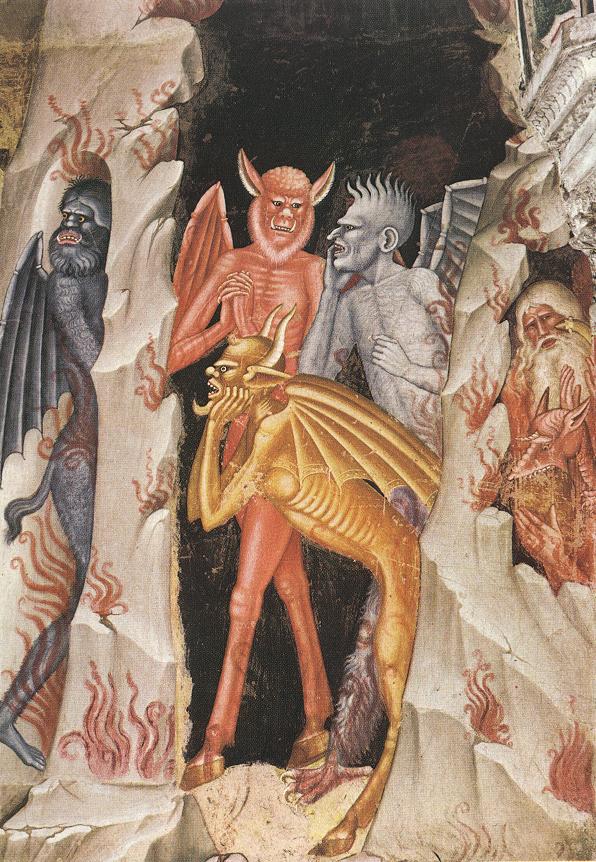
[T]he most theologically cogent view of hell found in classical Christianity maintains that it is the state Andrea_di_bonaiuto,_cappellone_degli_spagnoli_05of mind (or soul) of someone who is alienated from God. Living a life that is out of harmony with God is painful, and to die and be confronted so decisively with the error of your ways — to be made to see that you made a wreck of your life by separating yourself from God, and to have to learn to shatter your pride by reforming yourself in his divine presence — is, one imagines, excruciating. But it is intrinsically painful, not externally imposed by torturers in some fire-and-brimstone-filled dungeon.

Or in the words of theologian David Bentley Hart, “What we call hell is nothing but the rage and remorse of the soul that will not yield itself to love.” In refusing to “open itself to the mercy and glory of God, the wrathful soul experiences the transfiguring and deifying fire of love not as bliss but as chastisement and despair.”

This is what hell must be if God is truly good.

I, for one, find this far more plausible than the popular vision of hell as a torture chamber run by sadistic demons. And I suspect that at least some young religious skeptics might, too, if only committed Christians would rise to the challenge of making the case.

Jonathan Merritt finds that some shifts already are underway, claiming that “many Christians have begun to refine their message to attract new followers and not repel skeptics,” and so downplaying the idea of a literal hell. One reason why:

[One reason] people are hesitant to discuss hell, [pastor Brian] Jones says, is because the only people who talk about it are hateful Christians like those associated with Westboro Baptist Church and “creepy Christians that no one wants to hang out with.” By contrast, he says, most modern believers want to be perceived as kind, loving, and gracious.

“There aren’t very many models out there for how to talk about hell winsomely, so Christians are frozen in their tracks. It’s hard to do something when you haven’t seen it modeled well,” says Jones.

Jason Boyett, author of “Pocket Guide to the Afterlife.” Echoes Jones’s sentiment: “I think some people hesitate to talk about hell because they don’t want to continue to deliver only bad news instead of something that is encouraging and inspiring. The existence of hell is difficult and a challenging part of Christian theology. If you think too much about it, it is really kind of frightening.”

(Image: Andrea di Bonaiuto’s “Descent of Christ to Limbo” via Wikimedia Commons)

How Many Atheist Kids Convert To Belief?

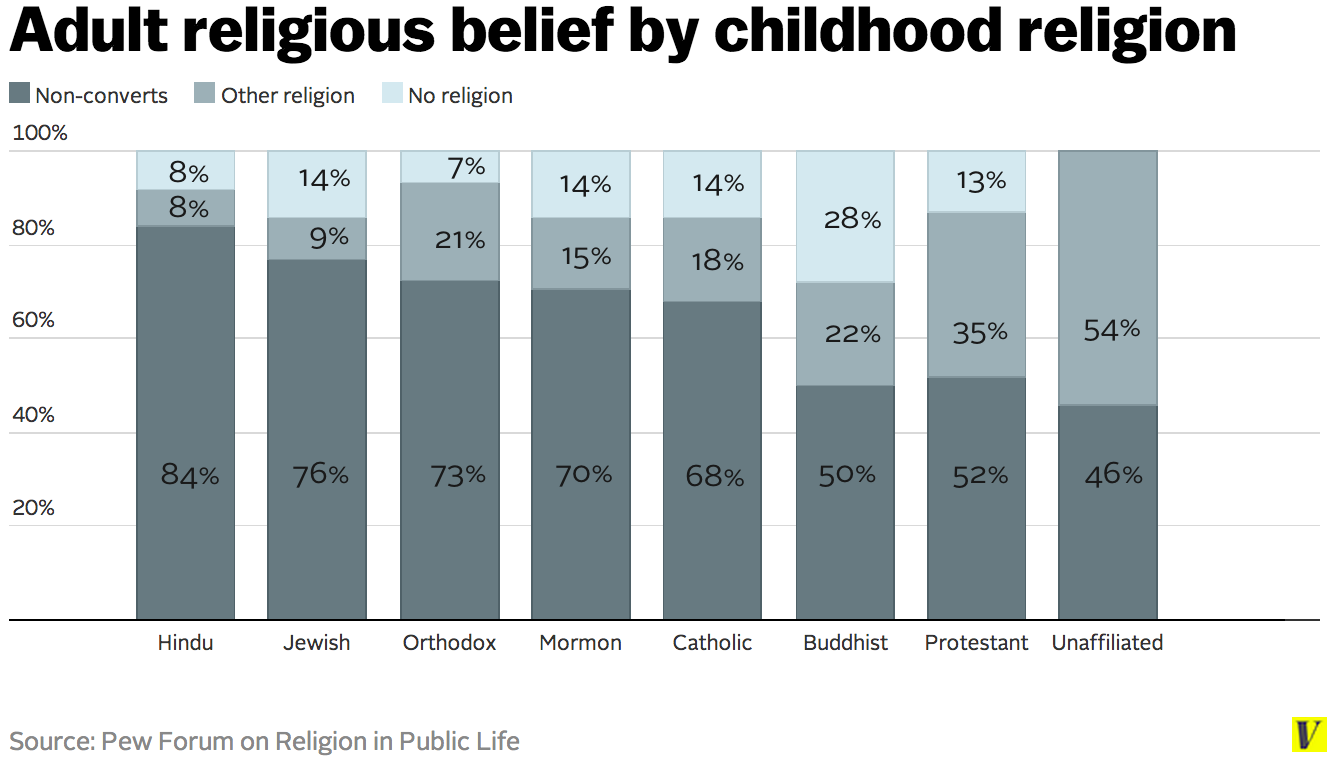
dish_chart

Dylan Matthews investigates whether the children of atheists rebel against their unbelieving parents by seeking out religion:

As it turns out, yes. The most recent data on this that I’ve come across comes from Pew’s 2008 Religious Landscape Survey, which finds that only 46 percent of people who are raised religiously unaffiliated (which includes atheists, agnostics, and those who say they’re “nothing in particular”) remain unaffiliated as adults. By contrast, 68 percent of Catholics and 52 percent of Protestant stay with their childhood religion, and only 14 percent and 13 percent (respectively) stop subscribing to any religion at all.

Sarah Posner casts doubt on Matthews’s data:

Matthews admits the data he uses is imperfect, but that it “does suggest that religion has a somewhat easier time transmitting across generations than irreligion does.”

This struck me as a bit off the mark, so I posed the question to Phil Zuckerman, a professor of sociology at Pitzer College, founder of that institution’s unique Department of Secular Studies, and author of, among others, the forthcoming book, Living the Secular Life. Zuckerman told me he found the data “sort of bizarre” and that it “runs counter to all that I know on the topic.”

In the upcoming book, Zuckerman notes that while there is a paucity of research on secular parenting, there are longitudinal studies on the future impact of a secular childhood on adult religiosity are out there, and they show that retention rates of irreligiosity are very high.

Prayer And The Penitentiary

Aaron Griffith analyzes the evangelical desire to convert prisoners and the mainline Protestant desire for prison reform:

One commonality in how American Protestants from across the theological spectrum think about prisons is their reliance on Jesus’ discussion of “the least of these” in Matt. 25:31–46. These verses have been and continue to be everywhere in prison ministry rhetoric. They were quoted in a statement in the 1787 constitution of the Philadelphia Society for Alleviating the Miseries of Public Prisons. In recent years mainliners have used the passage to justify their broader social justice outlook, while evangelicals take it more literally to validate their in-prison proselytization.

But both those interpretations may be off target.

The general consensus of many in biblical studies circles as well as most of the Church Fathers is that “the least of these” are not the oppressed, hungry, or imprisoned masses that the church goes out and helps. Instead, the phrase refers simply to Christians. Those who are being judged before the throne of God are non-Christians, evaluated by how they treated Christians living among them.

Why have both mainliners and evangelicals in America missed this insight? Probably in part because this reading requires a relatively technical understanding of Greek phrases at work in the passage. But perhaps it also has something to do with the fact that evangelicals and mainliners, despite their differences, both understand their prison work as bringing something badly needed to prisoners. Yet they hesitate to see the convict and prison as a person and place that are close to the heart of the crucified God.

How Islam Defines Hell

Qasim Rashid outlines seven arguments for his claim that “Islam does not teach eternal damnation for anyone.” One of them? “Islam does not monopolize salvation”:

It is not for humans to say how God will judge. Indeed, no guarantee or promise exists that every Muslim will go directly to paradise after death or that every non-Muslim is automatically hell-bound. Islam is the only ancient religion that does not monopolize salvation exclusively to its adherents. Instead, Islam teaches that non-Muslims can and shall attain paradise.

The Qur’an declares in 2:62, “Surely, the Believers, and the Jews, and the Christians and the Sabians — whichever party from among these truly believes in Allah and the Last Day and does good deeds — shall have their reward with their Lord, and no fear shall come upon them, nor shall they grieve.”

Islam also teaches that hell is not designed for torment, but reform. All must first be cleansed of sin before entering paradise. This cleansing may be of incorrect beliefs — held by non-Muslims and misguided Muslims — or for sinful actions. Hell is the reformatory abode for purification after death. Qur’an 101:9-10 declares, “But as for him whose scales are light [upon judgment], hell will be his nursing mother.” This verse makes no distinction between a believer and a nonbeliever. Yes, Islam teaches that hell is a painful experience, but Islam defines hell as a nursing mother designed to purge sin before admitting a soul to paradise.

Atheism’s Creation Story

Julian Baggini reviews Nick Spencer’s book Atheists: The Origin of the Species, calling the author “the kind of intelligent, thoughtful, sympathetic critic that atheists need, if only to remind them that belief in God does not necessarily require a loss of all reason.” He goes on to write that although “there is plenty here for infidels to argue with, there is much more that is undeniably true and important to know, if you want to understand the complex histories of both present-day religion and atheism”:

What is … debatable is the contention that “the history of atheism is best seen as a series of disagreements about authority” rather than one primarily about the existence of God. “To deny God was not simply to deny God,” writes Spencer. “It was to deny the emperor or the king who ruled you, the social structures that ordered your life, the ethical ties that regulated it, the hopes it inspired and the judgment that reassured it.”

This is certainly true. But it does not follow that the tussle between religion and atheism is political rather than philosophical.

Baggini feels that it’s “a false choice to say that the battles must ‘really’ be either political or metaphysical: the messy reality is that they are jumble of both.” Where Spencer is on firmer ground:

[H]e is right to say that there is something odd about the kind of secular humanism that says all we need to do, to quote the famous bus campaign slogan, is accept “There’s probably no God. Now stop worrying and enjoy your life.” Believing that human beings are special is natural if you believe God created us apart from other animals, not if you believe we are higher primates whose brains evolved to help us survive and reproduce. This should certainly call into question naive atheist faith in the power of secular reason, even if Spencer goes too far when he suggests it ends up undermining its very basis, “sawing through the branch on which the atheist sat”.

If Heaven Is For Real, What About Hell?

probably about 1475-6

Surveying some of the controversy sparked by the film Heaven is for Real, which suggests everyone will end up there, Peter Berger considers how Christians through the centuries have grappled with the question of hell:

However the details of hell were imagined (Christian art was busy for centuries depicting such images), there can be no doubt that both Testaments proposed a day of judgment that would segregate the blessed from the damned. Jesus himself is identified as the judge who effects the segregation—heaven this way, hell the other way. Arguably Islam puts the day of judgment at the center of the faith more than the other two “Abrahamic” religions. Yet from early times there were Christians who believed in the apokatastasis/ ”restoration”—when the entire universe would be restored to what God intended it to be. In this ultimate climax of redemption there would be no more place for hell. One could put this in rather vanilla-seeming terms: Everyone would really be in heaven then! Obviously this raises the question of the worst evil-doers, and different answers were given. One of the great if controversial Church Fathers apparently believed in the “restoration”—Origen, who taught in Alexandria in the 3rd century CE. There is disagreement about just what Origen really meant—did he believe that eventually even the devil would be saved?—did he believe in the transmigration of souls? But there were enough doubts so that, despite the esteem he was held in, he was not canonized by either the Eastern or the Western Church.

Berger goes on to note the mystic Julian of Norwich’s uncertainties about hell:

More than any other mystic, the English nun Julian of Norwich (1342-1462) kept repeating over and over again that God is love, that he created the world out of love, and that this love keeps the world in being every moment. Julian was preoccupied with the question of how even the devil could be kept in hell forever in a world fully restored to God. She knows that this is what the Church teaches, and she is an obedient daughter of the Church. But she asks God how this can be. He replies that what she cannot understand, he can do. In her little book “Showings”, where she tells of all the things that God showed her in her visions, there follows the passage for which she is best known. I am not quite clear, whether these are supposed to be words spoken by God himself, or Julian’s own words responding to him. They are in the literary form of a lullaby, such as a mother might sing to soothe a frightened child; I guess one might call it a cosmic lullaby: “And all will be well. And all will be well. And every manner of thing will be well.”

(Image of Francesco Botticini’s 15th century painting The Assumption of the Virgin, which offers a glimpse into the heavens, via Wikimedia Commons)

Why Atheists Need To Come Out, Ctd

A reader writes:

I’m enjoying the discussion about atheists and morality. Unlike some of your other atheist readers, I’m not particularly offended that we’re often seen as immoral. It’s fairly obvious that the reason we’re viewed that way by the faithful is that they haven’t had much real-life contact with good, moral atheists. It reminds me very much of how conservatives who haven’t interacted with a real gay person often call that community immoral. It’s simply fear of the unknown. My own experience speaks to this.

I grew up a Christian in the Bible Belt, surrounded by a conservative peer group. In my Christian elementary school, atheism was literally unthinkable – it didn’t even occur to me that people didn’t believe in God. In high school, I met my first atheist, and he was one of the warmest, kindest people I’ve ever met. He was super nerdy like me, and we bonded over our similarities. The fact that someone could be so kind and also not believe in God was somewhat shocking to me at the time.

As I slowly deconverted to atheism during college, I would always think back to him as my model of a truly good atheist.

My own view of morality slowly evolved away from needing a God and towards a naturalistic explanation. We are social animals in a harsh world. To survive, we needed to establish rules of conduct that allow us to work together against the elements – a moral code. No God needed. I do hope that, eventually, this will become the prevailing view.

In order for this to happen, we need more people like my high school friend. We need more atheists who are soft-spoken and genuinely good, loving people who can demonstrate by example that atheists aren’t frightening anarchists. Conversion doesn’t happen in debates or through legislation – evangelicals have known this for a long time. Conversion occurs through many personal interactions over years.

I dislike the approach of the New Atheists not because I disagree with their views, but because their methods push the faithful away from atheism. It’s insanely counterproductive. Who wants to be friends with the self-righteous bully? As much as I love Hitchens’ passion, clear-mindedness, and brutally logical arguments, I think my high school friend was a much better advocate for atheism than Hitchens. And don’t get me started on Dawkins. What a fucking asshole. In the same way that the gay community slowly won the argument by being out and showing that they’re just like the rest of us, we atheists need to be out and demonstrate kindness and love to our neighbors.

By the way, the fact that I’m not completely out tears me apart. My mother is a very devout Christian with an anxiety disorder. I fear that telling her about my true beliefs would cause her enormous emotional strife. She might truly believe I’m going to Hell. Who could put that sort of burden on his mother? I hope that, eventually, our religions will evolve to a more accepting view of atheists, so that people like me won’t have to be in the closet.

Previous Dish on the need for atheists to come out here and here.

Loving Ladies, Banging Bros, Ctd

A reader writes:

Hi Andrew and Dish team. I’m a bisexual, heteroamorous guy, and I absolutely agree with Dan Savage’s and Charles Pulliam-Moore’s call for bisexual men to be forthright with their partners. The trouble is, as a bisexual, you can’t necessarily know that you’re heteroamorous until you’ve tried and failed – perhaps multiple times – to be bi-amorous. As a younger guy just coming out as bisexual, I genuinely thought I might be romantically attracted to both sexes and that I just hadn’t found the right guy yet. I was very inexperienced with both women and men, and I ended up hurting a couple of guys that I really enjoyed being around (and hooking up with) because the romantic spark I was hoping for never materialized.

That isn’t to absolve bi guys who treat people like shit, or simply with carelessness. I’m guilty of some the latter myself. (Not the former, I hope.) But I think that the emotional scars that some gay men bear from their interactions with bi men can sometimes be attributed to youth and inexperience, rather than dishonesty or fear. Raising awareness of a more accurate definition of bisexuality – one that includes heteroamorousness – is very important, as Savage says. But if forthrightness is bi men’s special responsibility, then I think we can ask for understanding in return, especially for our youthful transgressions.

Another:

I’m a bisexual man in a gay marriage.

My (very gay) husband and I have been together for 12 monogamous years, but prior to that time I dated both men and women in high school and college. My porn and fantasy life continue to include both genders. When someone turns my head on the street, or when I crush on someone at a party, it may be either a woman or a man. I would say that I’m equally bisexual and bi-amorous.

I am definitely not one of those men with “an internal incompatibility between [his] romantic desires and his fear of social judgment,” as your reader put it. If my marriage were over tomorrow, I have no idea whether my next long-term relationship would be with a man or a woman. But either way, social judgment will have nothing to do with it. I was privileged to grow up in a time and place where I was safe and comfortable being completely open from age 16 on about my relationships with both men and women. And today I live in a state that gives my relationships equal footing under the law regardless of who I fall in love with, in a city that practically celebrates my marriage. Thanks to the activism of you and many others who broke down the closet door and showed the world that queer folk are “virtually normal,” in my daily life I experience no social judgment whatsoever about being in a gay relationship.

That makes me wonder whether the traditional-marriage rearguard left a plausible argument on the table in their legal battles. In the string of court cases in recent years, the opponents of marriage equality repeatedly came up with no rational justification whatsoever to keep marriage a heterosexual-only institution. But the argument never really acknowledged the existence of bisexuals.

If “fear of social judgment” is a major factor driving bisexuals into child-producing heterosexual marriages (or keeping them in those marriages) rather than long-term same-sex romances, isn’t it reasonable to expect that tearing down that social judgment will result in fewer child-producing marriages? If I had graduated from high school in the ’70s or ’80s, rather than the late ’90s, isn’t it likely that a bisexual, bi-amorous man like me would have kept my gay trysts secret and ended up married to a woman like the men your reader has been banging?

Excluding gays from marriage has no real rational arguments to back it up, as several courts have held and as a majority of Americans now seem to understand. But doesn’t excluding bisexuals from gay marriage leave them only one available, socially acceptable romantic option, which happens to be the option that may result in bearing children? And if we accept a bisexual, bi-amorous model of human sexuality/amorosity, isn’t that a rational reason to adhere to traditional heterosexual-only marriage?

A female perspective:

I’m a “straight” woman, but the post seemed to be talking about me. It has helped me understand an experience that has left me reeling and confused about my sexuality. I would definitely say that I am “bi-sexual but hetero-amorous.” I’m 29 and I’d never had a sexual experience with a woman, not even so much as a kiss, but I’d always been open to it. It was such a part of me that I sort of thought that everyone felt this way. How could you not want to kiss women? They are so soft and beautiful!

However, it wasn’t something that ever made me question my sexuality, because I was so obviously attracted to men and the thought of dating a woman did nothing for me. I had no desire for it whatsoever. I was perfectly romantically and physically satisfied by men.

A few weeks ago, however, I had a threesome for the first time (two girls and one guy) and it was one of the most satisfying and eye-opening experiences of my life. It was a great experience, but it left me with a lot of questions. I kept wondering: Am I bisexual now? But I have no desire to date a woman, even though having sex with one was amazing and satisfying. Am I terrible person? Someone who only wanted to have sex with women but didn’t want to date them? Reading that other people have experience this same kind of disconnect between their emotional and sexual desires has helped me put this experience in context.
The Rise And Fall Of The Gay Novel

Caleb Crain ponders the reasons why, after gay literary figures broke into the mainstream in the 1980s, their work has been a harder sell of late:

Gay novels do sell, and gay people do buy novels. But capitalism is a numbers game. Self-identifying homosexuals are not an enormous population, and, in general, they don’t buy literary fiction about themselves at a rate that would compensate for their small numbers. It can’t have helped that AIDS decimated the generation of gay men who, in the nineties, would have been in their forties, fifties, and sixties—prime ages for reading and buying books. It might also be the case that AIDS brought the attention of straights to gay voices in the eighties and early nineties, according to the principle that John of Gaunt set forth in “Richard II”—“O, but they say the tongues of dying men  / Enforce attention like deep harmony”—and that interest in the gay novel faded in tandem with journalistic coverage of the AIDS crisis.

Whatever the cause or perceived cause, I suspect that, nowadays, a mainstream publishing house rarely takes on a gay novel unless an editor believes that the book will find straight readers, too. Because some straights still find homosexuality disgusting (cf. comment trolls across the Internet) and a larger number fail to find gay characters “relatable,” a gay novel faces steeper odds from the start. “It’s a non-homosexual world, and the majority of those who are buying, selling, and reading literature are non-homosexual,” the journalist Tyler Coates wrote for Flavorwire last summer, in an article that riveted my attention because it happened to appear the week before the release of my own novel, “Necessary Errors,” whose main character is gay. Or, as Cunningham put it, even more trenchantly, in 2000, while reflecting on the success of his novel “The Hours,” “I can’t help but notice that when I finally write a book in which there are no men sucking each other’s dicks, I suddenly win the Pulitzer Prize.”

Previous Dish on gay literature here and Crain’s own novel, Necessary Errors, here.