Artisanal Everything

Brianne Alcala observes how fast-food chains are jumping the shark and onto the bandwagon:

McDonald’s is not the first to co-opt “artisan.” Its rival Subway has “sandwich artisans”; Domino’s offers ARTISAN™ pizzas, such as Tuscan Salami & Roasted Veggies; Dunkin’ Donuts promoted Artisan Bagels; and Wendy’s sells the Artisan Egg Sandwich. No doubt the fast-food giants are trying to muscle into the higher-priced foodie realm, and sure, the ad copy is enticing. Wendy’s description of its “Artisan Egg Sandwich”: “fresh cracked Grade A Eggs, natural Asiago cheese, freshly cooked applewood smoked bacon or all natural sausage and Hollandaise sauce all atop a honey-wheat artisan muffin toasted to order.” What does “fresh cracked” eggs even mean? …

This copy writing taps into two modern cravings:

1) the desire for “real food,” for reassurance that something quick, cheap, and mass-produced is in the same family as the egg we cracked open on the frying pan last Saturday morning—hence, the “natural,” “all natural,” “freshly cooked,” and “fresh cracked.” 2) the desire for hand-crafted, that real people, not robots, made this sustenance—hence, “toasted to order.” The gourmet, bespoke, personalized, and designed just-for-you creation is so appealing on this planet of 7 billion people. You are not just a number. You are special. Even your burger roll is artisan.

The Myth Of Opting Out

Princeton sociologist Janet Vertesi tried to keep her pregnancy offline, hidden from “the bots, trackers, cookies and other data sniffers online that feed the databases that companies use for targeted advertising.” Though she steered clear of social media, avoided baby-related credit card purchases, and downloaded Tor to browse the Internet privately, she failed to escape the reach of big data:

Attempting to opt out forced me into increasingly awkward interactions with my family and friends. But, as I discovered when I tried to buy a stroller, opting out is not only antisocial, it can appear criminal. For months I had joked to my family that I was probably on a watch list for my excessive use of Tor and cash withdrawals. But then my husband headed to our local corner store to buy enough gift cards to afford a stroller listed on Amazon. There, a warning sign behind the cashier informed him that the store “reserves the right to limit the daily amount of prepaid card purchases and has an obligation to report excessive transactions to the authorities.”

It was no joke that taken together, the things I had to do to evade marketing detection looked suspiciously like illicit activities. All I was trying to do was to fight for the right for a transaction to be just a transaction, not an excuse for a thousand little trackers to follow me around. But avoiding the big data dragnet meant that I not only looked like a rude family member or an inconsiderate friend, I also looked like a bad citizen.

Her bottom line:

The myth that users will “vote with their feet” is simply wrong if opting out comes at such a high price. … It’s time for a frank public discussion about how to make personal information privacy not just a series of check boxes but a basic human right, both online and off.

In an interview, Vertesi explains why she quit using Google two years ago: “When Google knew I was engaged before anybody else did, that did it for me”:

Google reads your email, reads your chats. It knows what you’re searching for. It sees you when you’re sleeping and knows when you’re awake. And the server is economically incentivized to remember. The way to make money on the internet these days is to get people to exchange personal information for free, and you get them to do that by making them think they’re just interacting with the service: sending an email or searching or chatting with a friend. But there’s this underlying architecture there. …

[This experiment] was one of the first times that I thought about what it would take to opt out from collection. Because you hear all the time: if people don’t like it, they’ll stop using the service. But people don’t stop using the service. And I know a lot of people really don’t like it, and it’s not just that they’re upset because Facebook made some change to its layout. I think the deep, underlying reasons that people are uncomfortable is how these interactions are being tracked. They don’t like being stalked by a pair of shoes they looked at once on the internet two years ago.

A Grim Climate Milestone

FT-co2_800k.png.CROP.promovar-mediumlarge

Eric Holthaus notes that, as of last month, carbon dioxide concentrations in the Earth’s atmosphere exceeded 400 parts per million for the first time in human history:

Over the very long term, taking data from ice cores in Antarctica, paleoclimatologists have determined that there’s never been as quick a spike in carbon dioxide levels in at least the last 800,000 years … These data are painstakingly compiled by finding tiny air bubbles trapped in the ancient ice, and then analyzing their chemical composition. By this method, scientists have literally measured nearly a million years’ worth of the Earth’s atmosphere. Of course, looking at historical data, scientists could have made the same statement—we’re at levels not seen in human history!—in any year since about 1914 and would have been accurate. Problem is, the data didn’t exist then.

In fact, Brad Plumer notes, scientists believe CO2 levels haven’t been this high since long before humans even existed:

Indeed, some studies go further and estimate that carbon-dioxide levels may be at their highest point in 4.5 million years. During the Pliocene era, scientists have found, carbon-dioxide levels appeared to be around 415 ppm. (This rise was likely caused by wobbles in the Earth’s orbit — humans weren’t around then.)

The climate of the Pliocene was much warmer and wetter than it is today. Global average temperatures were 3°C or 4°C hotter (that’s 5.4°F to 7.2°C) and sea levels were between 5 and 40 meters higher.

That doesn’t mean we’ll get exactly those things today — the Pliocene isn’t perfectly comparable, since a variety of different factors were at play. But it’s the best guide we have to a fairly unprecedented situation.Other features of the Pliocene era: more frequent and intense El Niño events in the Pacific Ocean, intense flooding in the western United States, and severe coral reef extinctions as the oceans warmed.

Email Of The Day

collage

A reader writes:

I just read your “The Best of The Dish Today” with all its great news about the Dish’s relative financial health and wellbeing. Congratulations, mazel tov, salud, and all those great good wishes.

However, the reason I moused over to your page moments ago was a more somber one, but one that left me feeling deeply grateful to you and your intrepid crew for the work you do creating a space on the web – the fucking web of all places! – that is enriching, thoughtful, and never cynical in that particularly despicable, webby way. Earlier today I received the troubling news that a college student from the tight-knit community I grew up in attempted suicide late last night. He’s a bright, sweet guy, and my dad’s been something of a mentor to him, so the story sent me reeling. A dear friend lost his father to suicide last summer, and if I’m honest, I’ve had depressions that I stubbornly wouldn’t treat that probably brought me closer to thinking about it than I ever care to be again. So the issue’s close to me (as it is for so many).

I thought back a month or so to Jennifer Michael Hecht’s incredible first Ask Anything video and needed to find and re-watch it. Andrew, I wept. As she offered her gratitude to those who choose to stay with us despite their pain, I wept for joy over Jennifer’s compassion, brilliance, and fierce moral intelligence. And I wept for joy that we have in you a man with both the pugnacity to make it in the rough-and-tumble world of media and the sensitivity to recognize the importance of conversations like that one; you’re a rare breed, Sully.

And as I sat there weeping and pondering the mystery of intrinsic, immutable human worthiness (which, to bring in another thread, if Jesus had any point it surely was that), I felt more grateful than ever for the community that you’ve made with the Dish, since, as Hecht’s work on suicide has taught us, community is the whole point, in the end.

Have you ever noticed that for all that the web’s social media networks and listservs and affinity groups and message boards claim to be “virtual communities,” they always fall short? That the web – but not the Dish – is actually terrible at community? I think what others miss and that you haven’t is that you can’t form a real community just by sticking together a bunch of people who like the same stuff or think the same way or have the same friends. Real community isn’t a place at all, but something more like thecomposite-staff phenomenon of people experiencing respect and love and admiration for others they might not share much with, or might not even particularly like. Being forced in with people unlike you is a necessary condition. Real community needs dissent and diversity.
And, my god, is that the Dish. When you’re taking a big, clear stand against the hypocrisy of our Church or teaching the tao of meep meep, I could kiss you on your beautiful, bearded mouth. When you’re prattling on about The Bell Curve or getting weirdly defensive about some untenable position you’ve staked out while readers kick your rhetorical ass, I could whack you on your shiny, bald pate. But either way I’m so glad that you’re here and that I get to read your work. That you’ve made a place for so many of us to share in this together is even more amazing. I’d bet a whole lot that the community you’ve made is the one that some readers most want to “stay” for. And I hope you’re damn proud of that.

So all of that’s to say please keep doing what you do. Please keep talking about suicide and the other impossible questions. And more importantly: thank you. For all of it.

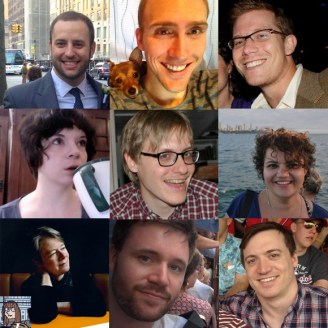
(Top photos of Dish readers used with their permission. Bottom photos of Dish staff, clockwise from top-left: Matthew Sitman, Patrick Appel, Chris Bodenner, Katie Zavadski, Brian Senecal, Chas Danner, Alice Quinn, Jessie Roberts (inset), Tracy Walsh, and Jonah Shepp in the center square. Read a bit about each of them here.)

The Science Of DJing

Virginia Gewin checks in with a couple of scientists who bring data to the dance floor:

It may just seem like people having simple fun at a club, but there’s something deeper going on. “We use the crowd to communicate with each other,” says [DJ Johan] Bollen. “We’re encoding information in the crowd.” Bollen cites a technical term for this: stigmergy, a form of indirect coordination of actions. The term describes, for example, how ant colonies make effective “decisions” in complicated situations, even though each ant’s behavior is very simple. The ants use pheromones to exchange information; the environment serves as their shared memory. Complexity spontaneously emerges from simplicity.

Bollen and [Luis] Rocha are experts on stigmergy—for real.

They DJ by night, but by day they study cybernetics—how people, animals, and machines control and exchange information—at Indiana University in Bloomington. A focus on feedback runs through their both their research and DJing. And while they really just want to orchestrate a raging party, the crowd is, in a sense, an experiment. …

Songs are categorized along two primary dimensions: energy level (bpm) and “valence”—the feeling of the music, consisting of a spectrum of universal emotions, from dark or edgy (cold) to inviting or velvety (warm). At [a] February show, for example, Bollen picked up on the crowd’s vibe, ramped up the energy level, and, at 124 bpm, played “The Feeling” by Eden—a warm, inviting song that signaled that the party was truly underway. “Our research—the notion of feedback and complex systems—informs everything we do,” says Bollen. “A DJ and an audience are a cybernetic system, controlling each other’s state.”

(Video: Live mash-up of “Pop Culture” by Madeon)

The Terror Report Is Terrifying

terrorism_figures

Catherine Traywick looks over the State Department’s annual terrorism report, which came out on Wednesday:

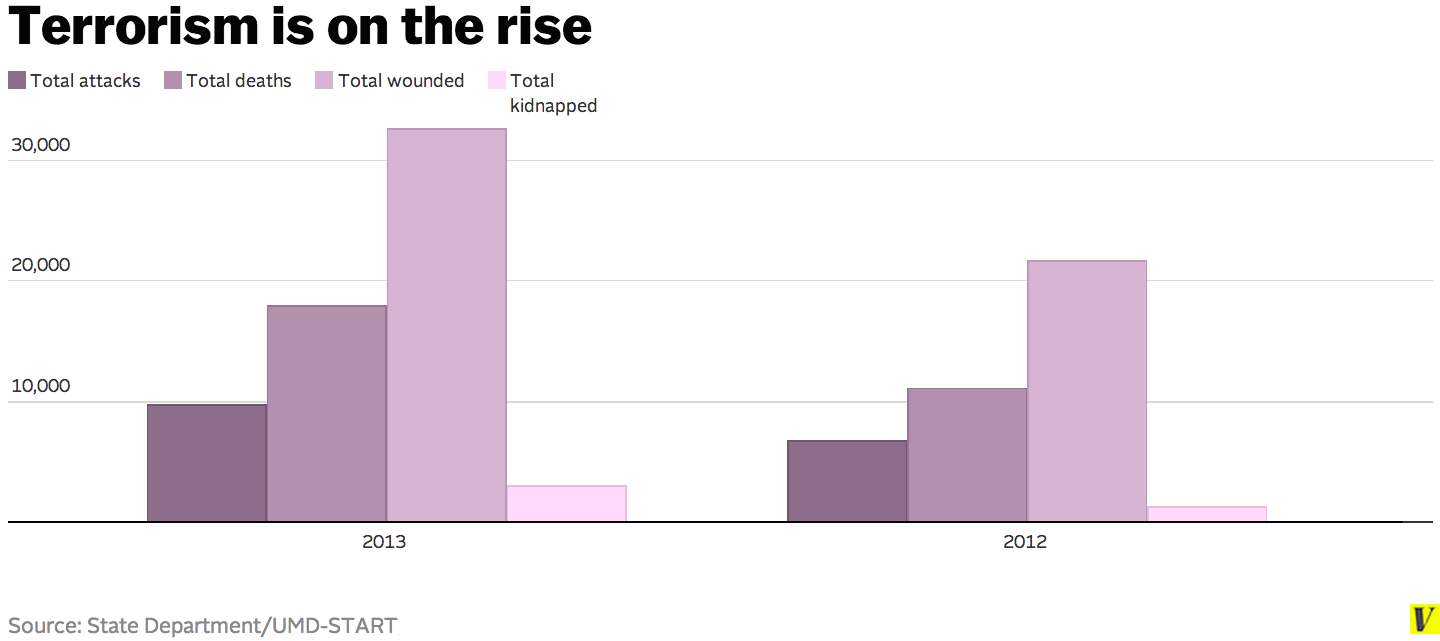
All told, the State Department found that worldwide terrorist attacks rose by 40 percent over the past year, from 6,771 in 2012 to 9,707 in 2013. Two-thirds of the strikes occurred in Iraq, Pakistan, Afghanistan, and India, resulting in the deaths of more than 11,000 people. A total of 17,891 people died in terrorist attacks in 2013, up from 11,098 in 2012.

The report attributed much of the violence to sectarian strife in Syria, Lebanon, and Pakistan, which have been riven by brutal fighting between the countries’ religious and ethnic populations. Iraq has been hit particularly hard, with Sunni militants slaughtering thousands of Shiite civilians, but Syria’s brutal civil war has begun to morph from a rebellion against Syrian strongman Bashar al-Assad to ongoing communal violence between the country’s Alawite and Sunni populations. Islamist militants in Syria, the report says, are increasingly “motivated by a sectarian view of the conflict and a desire to protect the Sunni Muslim community from the Alawite-dominant [Assad] regime.”

Providing the above chart, Zack Beauchamp digs deeper into what the report has to say about Iraq and Syria:

“The [country] that accounts for nearly half of the increase in the two years is Iraq,” Gary LaFree, the University of Maryland researcher whose institute compiled the raw data for the State Department, told me. Moreover, since attacks in Iraq were more frequent and deadlier than in the other 9 nations with the most terrorist attacks, it’s responsible for much larger percentages of the increases in deaths and injuries.

LaFree told me his numbers undercounted attacks in Syria, as it’s hard to verify responsibility for any one attack in the midst of a civil war. But the State Department sees a classic al-Qaeda pattern. “Thousands of foreign fighters traveled to Syria to join the fight against the Assad regime,” the 2013 report warns. According to State’s counterterorrism coordinator, Tina Kaidenow, “we’re concerned over the long term that [Syria] will attract individuals who will be radicalized.”

China’s Demographic Timebomb

An aging population, rapid urbanization, and a skewed sex ratio could spell trouble down the line for the world’s largest country:

China is different from the other aging countries of the world in that a) it is not yet fully developed, b) most of its population is still poor, and c) it has the highest sex ratio in the world.

By 2055, China’s elderly population will exceed the elderly population of all of North America, Europe and Japan combined, and this is exacerbated by the now declining working-age population. China’s impressive economic growth has been facilitated by its expanding working-age population: The population ages 15-64 increased by 55 percent between 1980 and 2005, but this age cohort is now in decline due to the declining fertility rate. In 2012, the working age population declined by 3.5 million and is expected to continue to decline unless there is a dramatic shift in China’s fertility rate.

Aging will have a negative effect on economic growth through higher pension and healthcare costs, fewer low-income jobs, increased wage depression, slowing economic growth and job creation, declining interest from foreign investors, lower entrepreneurship, and higher budget deficits. Labor force declines also translate into lower tax revenues for governments, and if these governments are tempted by deficit financing, global financial stability may be compromised, according to the Center for Strategic and International Studies (CSIS) Commission on Global Aging.

Testosterone Ad Absurdum

It still amuses me to read blank-slate lefties insisting that gender difference is a function of culture alone. To me, it’s the same kind of scientific know-nothingism that you find on the right with respect to evolution. Note I’m not saying that culture has nothing to do with it – that would be know-nothingness of a reverse kind. But the power of testosterone as a hormone should never be under-estimated.

And the funny thing is: testosterone exists across the entire animal kingdom and correlates very highly with what we think of as culturally masculine attributes: physical strength, risk-taking, competitiveness, ego and the constant desire to fuck. So when I came across this fascinating article on the marsupial, antechinus, I had to chuckle. During the mating season, the males’ testosterone levels go through the roof. The result is sexual mayhem:

Males relentlessly bound from partner to partner, as massive hormone releases in their bodies cause their immune systems to crash and their fur to fall out. They bleed internally. Some males even go blind, yet still stumble around the leaf litter hoping for one last tryst. In a few short weeks, every single male lies dead, leaving the females to raise their offspring …

While [testosterone] mobilizes all the sugars in the antechinus’ body so it doesn’t need to feed for the three-week orgy, it also glitches the mechanism responsible for regulating the production of cortisol, a stress hormone that in small amounts results in bursts of energy and higher pain tolerances. With runaway levels of cortisol, though, the males’ bodies literally begin to fall apart. Bone density plummets and blood-sugar levels go nuts. Their immune systems essentially degrade to worthlessness, as open sores form and never heal.

That’s a dystopian vision of untrammeled maleness if ever there was one. It reveals what we cannot deny about our nature almost as baldly as it wants us to keep it under control.

Escalation In Ukraine

The Ukrainian military has launched its first offensive against pro-Russian separatists, conducting operations around the eastern city of Slavyansk:

The Ukrainian Defence Ministry said two Mi-24 attack helicopters had been shot down by shoulder-launched anti-aircraft missiles while on patrol overnight around Slaviansk. Two airmen were killed and others wounded. Other Ukrainian officials and the separatist leader in Slaviansk said earlier that one airman was taken prisoner. A third helicopter, an Mi-8 transport aircraft, was also hit and a serviceman wounded, the Defence Ministry said. The SBU security service said this helicopter was carrying medics. …

The SBU said the deadly use by the separatists of shoulder-launched anti-aircraft missiles was evidence that “trained, highly qualified foreign military specialists” were operating in the area “and not local civilians, as the Russian government says, armed only with guns taken from hunting stores”. Ukrainian officials said their troops overran rebel checkpoints and Slaviansk was now “tightly encircled”.

Kevin Rothrock thinks through what might happen next:

Irregular militia marching on Slaviansk and other southeastern cities in Ukraine could present Kiev with a tricky legal situation. Though Moscow exercises de facto control over Crimea, the national government refuses to recognize Russia’s annexation, complicating Kiev’s classification of any combatants marching into the Ukrainian mainland from Crimea, which formally remains a part of Ukraine. Would these soldiers be Russian troops? Or are they more Ukrainian “terrorists,” as Kiev now identifies combatants throughout the southeast?

In other words, the Kremlin might project its power into Ukraine’s mainland by encouraging, and perhaps arming, Crimean militia, who in turn would advance on Slaviansk. In theory, Moscow might succeed, if only semantically, in “laundering” an armed intervention in this way.

Meanwhile, as the following video, photos, and tweets illustrate, clashes have erupted in the city of Odessa, with at least seven 38 people reported dead and many more injured:

https://twitter.com/MaximEristavi/status/462243274808627201

https://twitter.com/PaulSonne/status/462282086729383937

The Ground Game Only Goes So Far

Voter Turnout

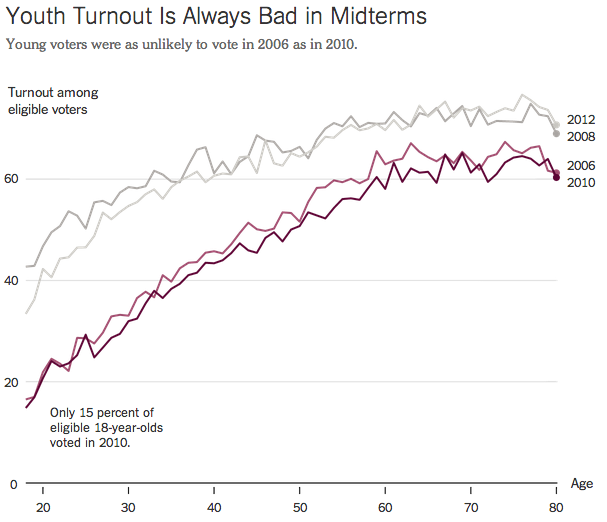
Nate Cohn drives that point home:

Much of the optimism on Democratic turnout stems from Mr. Obama’s successful turnout operation in 2012, or from experiments showing large increases in turnout when voters receive targeted mailers or contacts. But political scientists and campaign operatives found that even Mr. Obama’s impressive ground operation was worth less than one point in his presidential elections. And those experiments are usually conducted in extremely low turnout elections, like a local mayoral race, in which there are many more marginal voters. Finding people who are potential voters but not existing voters in a national election is harder.

Even Democratic operatives know the limits of the ground game. In a New Republic cover article that otherwise suggested that a strong turnout operation could solve Democratic problems, Guy Cecil, executive director of the Democratic Senatorial Campaign Committee, conceded that field operations would “only solve our problem if the election is a close one.”

Charlie Cook expects Democrats to have a rough election:

[A]n array of new polling from a variety of sources suggests that Democrats have no reason to be encouraged at this point. Things still look pretty awful for the party. Especially meaningful to consider is that—no matter how bad the national poll numbers appear for Democrats—eight of their nine most vulnerable Senate seats this year are in states that Mitt Romney carried in 2012. Further, nine of the most competitive 11 Senate seats in both parties are in Romney states; the numbers in these states will likely be considerably worse than the national numbers.