Noting that the slumlord Donald Sterling “has profited enormously from the tendency of liberal cities in California to limit housing permits,” Reihan asks why the left sees a higher minimum wage as more important than expanding the housing supply:
Even if you believe that a higher wage floor will have absolutely no impact on employment levels or on net job growth, it seems sensible to first focus on limits on housing supply. If you believe that a higher wage floor might lead to the exclusion of some non-trivial number of less-skilled workers from the formal labor market, the case for focusing on limits on housing supply is even stronger, as it’s not at all clear that relaxing these limits will hurt anyone at all … Some homeowners might have to sacrifice spectacular views as they are surrounded by new housing developments. Yet this hardly seems like a compelling reason to force low-income households to pay much higher rents to be within easy commuting distance of employment opportunities. It turns out that for affluent liberal voters living in picturesque cities, it is cheap to back minimum wage hikes that might reduce employment levels for the less-skilled or raise prices for the kind of people who frequent quick-service restaurants and other establishments that employ low-wage workers while it is very dear to back policies that will increase housing supply.
Douthat sees this issue as a rare opportunity for some left-right convergence:
Reasonable people can disagree, but on the merits, if you care about working class opportunity and mobility, there is at least some public policy justification for policies (like a minimum wage set at $7.25 rather than $10.10) that try to maximize low-wage hiring even if it means some of those workers will rely on safety-net programs. Where the policies that protect and enrich the petits rentiers class are concerned, however – and seriously enrich literal rent-collectors like Donald Sterling – no such opportunity-enhancing justification exists. So when the urban left organizes around an agenda that targets low-wage employers and leaves the petits rentiers alone, it’s both embracing policies whose costs might exceed their benefits and leaving more deserving targets untouched.
This is why the anti-cronyist, anti-rentier, libertarian-populist idea that many conservatives have raised of late, both in response to all the Piketty excitement and as a reformist case in its own right, deserves more than just a dismissive sneer from egalitarian liberals.
Your original question, “Can Christianity survive modernity?” has two dimensions to it, only one of which is addressed in Ehrman’s book. That’s the question of how modern scholarship sees the scriptural and historical record of Jesus and his age. But another, overlapping issue is also brought to bear by modernity. The Christian tradition about who Jesus was, and how his Divinity can be defined, is bounded by a very particular set of notions about God that in an earlier era were either forcibly isolated from the rest of the world’s religious cultures, or only passively separated by the limits of those times.
But in the modern age, when vast amounts of historical knowledge of not just Christianity, but the rest of the world is readily available, we now know what multiple branches of Hinduism thinks, what the various sects of Buddhism understand, what Bahai believes, what Taosim grasps about the nature of the cosmos, what shamanism discovers, even what secular mystical and hallucinogenic experience has to offer, and and so on. The modern mind isn’t just confronted with scholarly knowledge of Christianity’s real past; it’s also confronted by a whole range of experiential and conceptual knowledge about God, Divinity, and ultimate reality, including of course modern science itself. And the two can’t be separated anymore. That’s the dilemma of Christianity’s confrontation with modernism in a nutshell.
Another:
In arguing that Ehrman’s book does not “effectively debunk Christianity’s core claims in modernity,” I am struck by how elastic and indefinite the responses of you and your readers of faith are as to the notions of truth and Christian doctrine generally. That is not meant as criticism, just an observation. One reader valued “the messiness and contradictions in the gospel accounts” as a virtue itself. Another reader said the “literal truth or untruth [of the story of Christ] is of little to no interest,” and the practicing Catholic reader believes that the foundational doctrines of his church are “of course” not accurate because the truth of Jesus’s life and message can’t be known. An earlier reader explicitly advised you “to consider steering clear of words like ‘truth.'”
Is it then the better question to ask “whether postmodernism can save Christianity?” And does the new historical research require a postmodern religious approach? If so, what are the implications of that? It could strengthen and deepen Christianity’s core message and appeal. But maybe not. It seems certain to be consequential though. Will this approach favor liberal Protestant faiths but pose a greater challenge to the more institutional Catholic Church? If Christian doctrinal truths are admittedly unknowable and subjective to both Gospel writers and readers, does that mean that choosing between different Christian denominations is ultimately only a matter of personal comfort and/or inertia? Or might this approach – as fundamentalists would argue – logically and inevitably weaken Christianity’s claim against competing faiths?
Another:
I’m an engineer and a recent convert to Catholicism (although I was always careful to say that I followed Dorothy Day, not Paul Ryan). I know that my conversion process was not rational. My overwhelming experience of something I can only call Grace has shattered every conviction I had about who I was, who/what God was, and my place in this universe.
I get impatient with those, on both sides, who try to use evidence to prove or disprove religious concepts. A scientist used modern tissue analysis as proof that a Eucharistic Miracle happened. I felt that same impatience reading Ehrman’s book. None of these investigations have any relevance in comparison to my lived experience of Christ.
It’s not that I don’t think such investigations have value. I just see them as belonging to a realm of inquiry that is disconnected from my relationship with God. If the Eucharistic Miracle turns out to be pig blood or the disciples had hallucinations of Jesus brought on by grief, it just doesn’t change anything about what happens when I pray. It seems to me that a faith resting on such proofs is disconnected from the Source of faith. For myself, I am better off learning how to tap into that Source more deeply and regularly.
I recently went on a pilgrimage to Assisi, the home of St. Francis and St. Claire. They were declared saints soon after their deaths. Many artifacts of their lives were preserved within the lifetimes of those who knew them, and the town itself has been a place of pilgrimage ever since. Pilgrims can be assured that the artifacts are real. When you walk the streets of Assisi, you are walking in the paths of the millions of pilgrims who came there to worship, contemplate and pray. Even my agnostic husband felt the presence of so many souls seeking peace.
On the same trip, we saw a piece of wood that St. Helena claimed to be part of the table from the Last Supper, now preserved in the papal basilica of St. John Lateran. She found it in the early 300s. Who knows if it’s real? For 1700 years, the faithful have venerated it as a connection back to the last peaceful moments Jesus had with his community of disciples, moments we recall every time we celebrate the Eucharist.
That veneration makes it holy. The pilgrims make Assisi holy. We make Christ holy. First the disciples and then the 2,000-year-old Christian community of the faithful experienced Jesus as someone extraordinary. Jesus brought a powerful message that has come down through the ages and drawn millions of souls towards a stronger connection with the Source of faith, and more just, loving and care-taking relationships with each other. How could the manifestation of such a person not be celebrated as miraculous?
Another:
You wrote, “I cannot rationally reconcile the divine and the human as single concept. But my faith, my personal experience of Jesus, forces me to accept it.”
And in so doing you are essentially recapitulating the experience of the disciples and the church. They tried every other explanation for what they had seen and heard, and none of them captured the length and breadth and depth and height of this man’s life. So they were forced to come up with a formulation that made no sense, because it was the only thing that MADE sense. Like the scientists who have to hold the absurd formulation that light is BOTH a particle and a ray, because only under those circumstances can they actually use their mathematics to make the equations correspond with the observed facts.
Alexandra Gutierrez argues that ballot initiatives, including one on marijuana legalization, could hand Democrats an Alaskan Senate seat:
Three initiatives that were supposed to appear in the August primary have been bumped to the general election. So now, on top of deciding whether they want reelect a Democrat in a year where Republicans could seize control of Congress, Alaskans will be voting on initiatives to increase the minimum wage, to allow the sale of marijuana, and to make it harder to build an unpopular open-pit mine near the world’s largest salmon run.
Any one of those initiatives could be seen as a gift to Democrats. Together, they could boost turnout by up to 5 percent, according to political scientist Caroline Tolbert.
But Harry Enten doubts the marijuana initiative will play a big role:
[A] closer look at the evidence suggests Begich might not stand to benefit. Overall, past marijuana ballot measures haven’t meant that more young people come out to vote. This year’s senate race in Alaska would likely have to be very close for the marijuana ballot measure to make a difference.
Lastly, Bernstein points out that, if “there’s one thing certain about public policy issues, public opinion and vote choice, it’s that we don’t know why we vote the way we do”:
Issues may matter on the margins, and it’s possible that an issue will push marginal voters to show up at the polls (though we should be careful, it may be that whatever issue one’s party focuses on will do the trick). But the relationship isn’t straightforward. And just asking people about it won’t help us understand.
The headline number on this morning’s jobs report – 288,000 jobs added in April – looks pretty good on its face:
The hiring spree surpassed most analysts’ expectations and is the strongest showing in more than two years. Businesses added workers across a broad array of sectors, including business services, retail and construction. The unemployment rate plunged to 6.3 percent — the lowest level since 2008 — though part of that was due to workers leaving the labor force.
The upbeat report provided a convincing counterpoint to data released earlier this week that revealed economic growth was virtually flat during the first quarter. Many analysts attributed that weak reading to the unusually cold winter and argued that a spring thaw is already underway. The Labor Department also increased its estimates of hiring during the previous two months by 36,000 net jobs. Wall Street opened higher on the news.
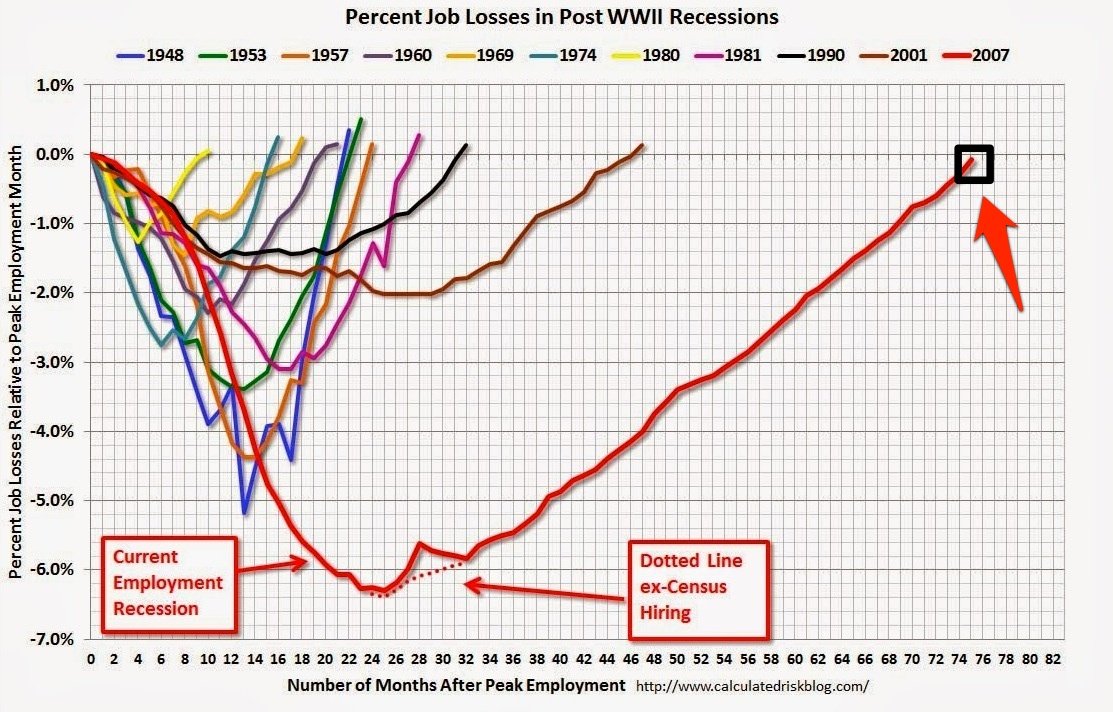
The chart above, via Joe Weisenthal, shows that we have almost made up the job losses from the recession. But as Neil Irwin points out, there’s a huge downside:
The number of people in the labor force fell by a whopping 806,000, wiping out the February and March gains and a bit of January as well.
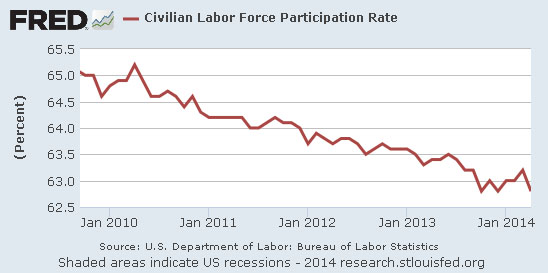
The labor force participation rate fell by 0.4 percentage points to 62.8 percent, returning to its December level. And the number of people reporting they were unemployed fell by 733,000, which sounds good on its surface, but paired with the similar-sized decline in the labor force points to job seekers giving up looking rather than finding new employment.
It would be irresponsible to draw any definitive conclusions from a single month’s data, but this isn’t the only area in which this report has some soft underbelly. Both hours worked and wages were unchanged. If the economy is to ever expand more robustly, it will require workers to make more money, giving them the income to buy more goods, services and houses; in April at least, there was no progress on wages.
David Leonhardt adds that the business and household surveys are extremely divergent:
The monthly survey of businesses showed that the economy added 288,000 jobs last month — and 238,000 on average over the last three months, the best such pace in more than two years. The monthly survey of households showed that the economy actually lost 73,000 jobs; the only reason the unemployment rate fell is because people dropped out of the labor force, no longer looking for work and thus not counted as officially unemployed.
It’s tempting to try to combine the two surveys into one neat package and claim that the economy added jobs, albeit not enough to bring people back into the labor force. But that’s not right. If you believe the household survey, the economy lost jobs. If you believe the business survey — which is much larger than the household survey — job growth was quite strong. They cannot both be right.
Drum advises against freaking out about the declining labor force participation rate:
[T]here are two things to keep in mind: (a) the participation rate has been shrinking steadily for a long time, and (b) it’s a pretty volatile number from month to month. The chart below shows both things. The participation rate has been steadily shrinking since 2000, and it’s been shrinking even faster ever since the end of the Great Recession. And the big drop in April? As you can see from the tail end of the chart, the participation rate hasn’t actually changed since October. It’s just been bouncing up and down.
Bottom line: Don’t take the April numbers too seriously. The long-term trends are important, but there’s so much noise in the month-to-month numbers that you can’t draw too many conclusions from them.
What’s to explain the decline? Patrick Brennan thinks it could be Obamacare:
If the early-February CBO report that predicted that in a few years, 2.5 million fewer Americans will be working than otherwise would because of the Affordable Care Act is right, that’s going to start showing up in a big way this year. In one sense, this is a good thing: Many people have access to affordable health insurance outside of holding a job for the first time. But when we’re worried about a secular decline in labor-force participation, this is a worrying trend.
Another explanation: We could be seeing the delayed effect of the expiration of unemployment benefits for those out of work for (about) 27 weeks or more. You might expect that to be the argument laid out by supporters of extending those benefits, though I haven’t seen much of it.
In response to Matt K. Lewis’ “conservative case” for the death penalty we posted yesterday, Balko points out that the practice is “susceptible to the same problems Lewis points out when criticizing the things governments do that he believes aren’t legitimate”:
When it comes to the trappings of public choice and political economy, the corruption of power and tunnel-visioned public officials, the criminal justice system is no different than, say, the Environmental Protection Agency, the Department of Education or the Occupational Safety and Health Administration. Actually, there is one important difference: The consequences of government error in the criminal justice system are far more profound. …
Lewis makes clear that he only supports the death penalty for the most heinous of crimes, and only for those crimes for which the defendant’s guilt is certain. At first blush, it’s hard to quarrel with that position. The rub is that we’ll always need to draw that line somewhere. How heinous must the crime be? And how certain of guilt must we be? There have been more than a few exonorations in cases in which it seemed unimaginable that the accused people could possibly have been innocent. And yet they were. We now know that prosecutors and police are capable of fabricating and planting evidence. Not that it’s necessarily common, but it happens. That means that even DNA cases aren’t necessarily iron-clad. The science behind the testing may be certain, but the gathering and testing of evidence will always be done by humans and be subject to all the biases, imperfections and temptations to corruption that come with them.
In fact, research suggests than criminals are mainly concerned about whether they’ll be caught, not what might happen to them afterward. “It’s the certainty of apprehension that’s been demonstrated consistently to be an effective deterrent, not the severity of the ensuing consequences,” said Daniel Nagin, a professor at Carnegie Mellon University. Nagin led a committee at the National Research Council that reviewed the evidence on executions and crime and concluded that the existing research is inconclusive. In any case, he argues, effective law enforcement is most important in preventing crime. People are more likely to break the law when they feel they can get away with it. “The police are really at the center of the action in terms of deterrence,” Nagin said.
Yes, you definitely sound gay. But not super gay, if that makes sense. Somewhere between Neil Patrick Harris and Dan Savage on a scale of zero to George Takei.
Another:
You don’t sound “stereotypically” gay. You sound … British. Which to American ears is a touch fey.
One way of testing this was to ask my old high school friends whether they knew I was gay in my teens. I reunited with a few dear old friends last year. They all told me they had no idea. But I think for them, my nerdiness obscured my gayness. Another reader:
“Poohsticks”! That isn’t gay so much as just twee as fuck. The biggest straight creepers I knew in the ’80s were indie boys who would wear their cardies to cakewalks and go on the pull.
Ah, yes, those were the days … Another reader:
You don’t sound gay; you sound European. Yes, I realize this might be even worse for a Brit.
It is. Another shifts focus:
Yep, I have a gay voice. And I hate it, but I don’t worry about it too much, unless I’m watching video of myself. Straight people have acknowledged my voice sounds gay. When I worked for a French oilfield services company, I met a woman who had me figured out, though she didn’t realize it, when she commented that I sounded gay when I spoke French. I was startled, given that I wasn’t really out then. It dawned on me that my voice simply sounded Southern and American to her when I spoke English, but the gay came out when I spoke French. So apparently my voice is definitely gay in any language.
Many others sound off:
Thanks for starting this discussion! I’m straight, but I’m a musician/artist and tend to move among gay circles a bit more frequently than others at my day-job or in my family. As a singer, and a vocal pedagogist, this topic has always fascinated me.
I know gay men with no perceptible lilts or lisps, and others that are ostentatious caricatures of that type of diction. The well-trained gay singers I know don’t tend to bring their accents into sung music in their native language (almost exclusively English, since I’m in the Midwest), possibly because in voice study, diction is part of the regimen. During the course of an art song or choral piece, you often have a long time to plan how that “s” is going to sound, and the melodic line obscures any lilt. Even with those who maintain sibilant s’s in sung English language music, it will often disappear when they’re singing in a non-native language.
I hope you get input from speech pathologists or other singers on this thread. As I said, I’ve long been fascinated by why sexual orientation in men leads to this unique set of accents/dialects.
Something else that occurred to me: there’s no “lesbian” accent, and few women sound anything like the effeminate-ish brogue of some gay men like Tim Gunn. So these men are not affecting a female cadence; it’s something else.
Another is on the same page:
I know your post was focused on the voices of gay men, but I believe that many lesbians have a unique tone, timbre, or whatever you call it to their voice as well. I would love to see someone do a study that does a technical analysis of the voices of straight and gay women to see if there’s a quantifiable difference.
And another:
The “gay voice” issue is utterly fascinating to me. I’m a (straight, female) bankruptcy attorney and part of my job involves meeting with a fairly large number of new clients each week for consultations. It’s an interesting and unusual interaction because I get to ask complete strangers about some pretty intimate details of their personal lives, including a lot of things people generally don’t tell their family members and best friends, within a few minutes of meeting them. One of the things I’ve discovered is that I always, ALWAYS know that a guy is gay before we get to the section of the questionnaire where I ask for the names of any “spouses or significant others” residing in his household. I usually know it within about a second of the time he walks through the door. It’s both something in the voice and also something in the whole way gay guys move that is different from straight guys. I’ve never been able to pinpoint exactly what it is, but I instantly know it when I see it.
But ironically, I have absolutely no clue when it comes to lesbians. I went to lunch three times with an attorney friend who talked nonstop about her “partner” Susan and I honestly thought she was talking about her law partner (who she oddly seemed to really enjoy taking cooking classes with), until she actually posted something on Facebook starting with “As a lesbian…” So much for my A+ gaydar.
One more:
Thank you for addressing the issue of gay voice. Growing up gay and full of shame, I realized early on that I could consciously avoid overtly acting like a sissy. At age three my aunt, when I asked her to paint my toenails red like hers, informed me that “little boys don’t do that, only little girls.” So I never asked again. It was a bit like a conscious and successful attempt to improve my left-handed handwriting after getting bad marks in penmanship.
After hearing my own recorded voice for the first time, however, I was stunned. It not only sounded like a sissy but, to my ultimate horror, it sounded like Liberace. I don’t mean to bash poor Lee, but realizing that I could only grow up to be like him moved me to suicidal ideation at age 11. I did try hard to sound less queer, even acting in high school plays so I could be someone else, but with only partial success. I knew my voice gave me away.
Since I hated and feared this type of voice, when I matured sexually I found it a total sexual turn-off in others. I didn’t know that there were gay men with a “normal” voice and for years limited myself to anonymous casual sex with no tell-tale speaking. Ultimately, some sort of inner strength I didn’t know was there, coupled with changing times, enabled me to come out and seek a relationship with a man. (And I share your experience of the universe shifting with that first kiss – it felt like falling backward through infinite bliss.) But it had to be someone who sounded straight. And I did find someone. I entered a relationship with him because I liked him and because of his boring, straight-sounding, Midwestern voice. He was not my “type” physically and the sex was never the greatest, but we’ve been together for 35 years and, partially thanks to lovely you, we were married in New York in November.
I know this may sound rather sad and pathetic and self-loathing coming from a 66-year-old retired physician, but there it is. By the way, I don’t think you sound gay, but it may just be the residual British accent that obscures deeper indications. Patrick in “Looking” has total gay voice, but his British boss (with the delectable ears) does not. The mysteries of sexuality are infinite and fascinating.
The World Health Organization has issued a lengthy report (pdf) rounding up the best available international data on drug-resistant bacteria and warning that the post-antibiotic era of our nightmares could be coming soon:
The WHO report, “Antimicrobial resistance: global report on surveillance”, collates data from 114 countries, looking at the seven most common bacteria responsible for serious disease and regional levels of resistance. … Avoiding the proliferation of antibiotics resistance should have been easy. WHO’s recommendations are, as ever, for people to use their prescriptions as instructed by their physician and to not share antibiotics. We know that not finishing a course of antibiotics can leave bacteria in the body and help it towards building a resistance. It should be avoidable. But there are other issues, such as overuse with livestock. In all cases, WHO is urging for “harmonised global standards”.
Another problem is that drug companies don’t put much effort into developing new antibiotics:
[R]esearch in this area has largely stalled, and only a handful of new antibiotics have been created over the past decade. That’s partly because it isn’t as profitable for pharmaceutical companies to invest in creating new drugs. Last year, the U.S. government formed a partnership with a pharma giant in the hopes of spurring innovation. Some infectious disease experts are urging Congress to pass tax credits to encourage the development of new antibiotics.
Susannah Locke reminds us why this is a really, really big problem:
It’s easy to forget what the world was like before the first antibiotic was discovered in 1928. Diseases like pneumonia and simple scrapes and infections could often cause death. Today, antibiotics have become indispensable for modern medicine — they’re used for surgeries, transplants, kidney dialysis. Without antibiotics, giving birth would be much more dangerous. Without antibiotics, an estimated one in six hip replacement patients would die.
The short story is that we really, really don’t want this to happen. You can read more about what the post-antibiotic world would look like in Maryn McKenna’s story here.
Russell Saunders, a pediatrician, can’t imagine “what it would be like to practice medicine without recourse to antibiotics”:
I get immensely frustrated when I encounter lazy medical providers who scribble out a prescription for a Z-Pak for every patient who smiles the right way. Even though I know it makes some people happy to leave my office with a script, I am professionally obligated to be parsimonious with a resource as precious as effective antibiotics. Hopefully, with increasing awareness of the antibiotic-resistance problem will come less pressure on providers to err on the side of treating disgruntled patients.
Previous Dish on antibiotics here, here, and here.
Brian Doherty praises William Easterly’s Tyranny of Experts for how it tackles the follies of the international development industry:
Easterly is particularly sharp on the looseness of much of the “data” that development experts rely on. He mocks Bill Gates, the Uncle Pennybags of modern development econ, for crowing about a five-year improvement in Ethiopian child mortality rates. Easterly convincingly describes a confusing data landscape, marred by lack of well-kept vital records in shoddy states, and wildly varying estimates from different independent sources doing the best they can with the bad source material they have to deal with. In fact, we have no way to get an accurate picture about infant and child death in the Third World. Our macro data on the economies of the poorer parts of the world are too unreliable and inconsistent to use as much of a measure of anything.
But he sees flaws with the book:
[F]or a book trying to make the case that poor, autocratic governments harm their citizens’ rights with the connivance of western development experts, Tyranny of Experts lacks sufficient specifics of how and why that is so, or enough vivid stories demonstrating the specific human costs of development hubris. It’s almost as if Easterly thinks his claims are so obviously true that he doesn’t have to get bogged down in the details of proving them.
The Economist is not so sure about Easterly’s big-picture ideas:
Mr Easterly is at his trenchant best when demolishing various bits of received wisdom about development, whether about the role of strong leaders or the idea that policymakers actually know how to choose the right policies. Often they do not; nor do economists. This makes it harder to share his confidence that securing individual rights will do the trick. Rights clearly matter, but there is also a lot of evidence that individuals, like policymakers, do not make efficient use of all the information available. Instead they often rely on quick, flawed rules of thumb to guide their decisions. Securing rights may be necessary, but it is unlikely to be sufficient.
Mr Easterly claims that the “difference between individualist and collectivist values” is one of the great divides that explains why Western Europe prospered in the early modern age as the rest of the old world fell behind. True, Westerners today stress things like self-reliance, where East Asians might value group loyalty. Yet history surely matters here.
Eric Posner came to similar conclusions in a review he wrote last month:
Which rights should we advocate? How should we insist that they be implemented? What should we do to governments that refuse to take our advice? I suspect that if he gave these questions some thought, he would realize that any serious effort to compel or bribe poor countries to recognize rights would look like the development activities that he criticizes. Indeed, his bête noir, the World Bank, famously tried to implement “rule of law” projects that were supposed to enhance rights. These projects failed for all the reasons that all the other development projects failed.
In March, the Dish highlighted an excerpt from Easterly’s book.
My husband and I are both self-employed and work from home, and for the first time, our entire family has health insurance – thanks to Obamacare. My husband was uninsured for years, because he just couldn’t get health insurance that wasn’t exorbitant. In 2012, he tried to get health insurance from three different health insurance companies and got turned down from each one for minor health issues. The reason for his last rejection was – I kid you not – “impending fatherhood.” When a health insurance company declared that my pregnancy (which was covered under my insurance) somehow became a pre-existing condition for him, we gave up on the whole Kafka-esque scenario and just waited for 2014.
But I mostly want to highlight another Obamacare benefit that hasn’t been mentioned much: mental health coverage. I have PTSD, which my pre-Obamacare policy didn’t cover. As a result, I could get 10 group or individual therapy sessions per calendar year, and I could see a shrink once every two months for ten minutes for medication management, and that was it. I could never switch policies because no one else would cover me. (Put PTSD on a health insurance application and they couldn’t write the denial letter fast enough.)
I spent $18,000 out of pocket to treat my PTSD (and four years after completing therapy, I’m STILL paying off the resulting credit card debt.) EMDR was worth every damn penny, because while I still have some remaining symptoms, I can actually sleep through the night, I don’t have to manage multiple flashbacks a day, and I’m not crawling out of my skin with anxiety twice a day. I’m grateful that my therapist offered a no-interest payment plan and that I had the resource of a high credit limit, but not having health coverage for my PTSD treatment was a huge financial hit at a time when I was already struggling to get by.
Like a lot of people with a mental illness, I don’t broadcast my PTSD diagnosis – mostly because I don’t necessarily want to discuss my abusive childhood in public. But access to mental health treatment is a big deal for a lot of people like me, and I’m grateful that I have options now that I didn’t have before.
Another also touches on mental illness:
I love this thread, and I thought I’d chime in because the policy has meant a lot to me and my family. My mom is very well employed and well insured. However, prior to Obamacare her coverage only covered her 7 children if they were under 18 or in school full time and under 25. This was without a doubt a luxury plan in comparison to the vast majority of Americans.
Cue disaster 1. My brother had to drop out of college after a suicide attempt and diagnosis of bipolar disorder. He was in inpatient care for weeks, and then seeing multiple doctors to find the right treatment plan to manage the illness. For years.
Now, again, my family was in a relatively secure position prior to this. But the fact that the Obamacare clause for children 26 and under came into effect just six months before this disaster means that my mother didn’t have to make a choice between bankruptcy or leaving one of her children to homelessness or death. Because that’s what the options were pre-Obamacare. And I’d like to point out that no matter how well you raise your kids, no matter how much money you have or how hard you work, you can’t prevent bipolar disorder. You don’t get a choice as an individual to have a mental illness (or cancer, or asthma, or allergies …). How can anyone want to go back to a world where your financial security depends on the luck of the genetic draw?
Once that had (mostly) settled down, we hit disaster 2. My other brother graduated from college, unemployed, and came home to work. He was working three jobs to make ends meet when he got in a motorcycle crash that left him inches from death. He was in the hospital for the better part of a day before they were even able to identify my mother and call her. He woke up two days later and but for the grace of god was not just alive but didn’t lose any brain damage. He spent weeks in inpatient rehab, several more in outpatient rehab, and a year later had the final surgery to fix his hip.
To be clear, my brother was working three jobs and none of them offered insurance. He is the epitome of a the “hard working American.” And once again, if it weren’t for Obamacare, he would have spent decades of his life trying to come back from financial ruin. Or my family would have gone bankrupt.
If there’s anything I learned from my family’s story, it’s the crushing economic impact of not having health insurance. Without that one clause, my family would have gone from gone from solidly upper middle class to near-poverty in a single generation. We would have gone from drivers of the economy – spending money on restaurants, vacations, college, homes – to the paycheck to paycheck existence that too many Americans endure. I am aware of just how lucky we are, and I wish other people who think Obamacare is only the rich subsidizing the lazy poor would realize just how much security and wellbeing Obamacare has brought all Americans.
Andrew McGarth considers the difficulties of translating Joyce’s byzantine final novel into Chinese:
Dai Congrong started translating the book in 2006, but didn’t publish the first part of her translation until early 2013. Part of the reason it took so long is that Finnegans Wake, while challenging enough to read in English, is even more difficult to translate, owing to James Joyce’s puns, allusions, and multi-layered meanings which baffle most native English speakers and often lose their meaning in translation. The novel has been deemed “untranslatable” and the translations that are successful tend to be consuming: the Polish version took 10 years to finish, the French version 30 years, and the Japanese version took three separate translators after the first disappeared and the second went mad. …
Dai’s translation only covers the first third of the book and clocks in at 775 pages; for comparison, the full English text is 676 pages long. Most of the extra pages can be attributed to footnotes and annotations, which were needed to make sense of the novel. According to the Wall Street Journal, the first sentence of Dai’s translation is accompanied by two definitions, five footnotes, and seven asides that explain the possible intended meanings for the word “riverrun” and the allusions to an 18th century academic named Giovanni Battista Vico, and for later sentences in the book Dai had to create new Chinese characters to capture sounds from the novel. Talking to Reuters after the book’s release, she said she started having doubts early on, when after two years of work she had yet to translate one word.
Relatedly, illustrator Stephen Crowe, who is translating Finnegans Wake into images for his project Wake In Progress, discusses how the book has changed his approach to reading:
Most books develop their themes through the plot and the way the characters change over time. Finnegans Wake uses those techniques to some extent, but mostly [Joyce] uses others. The most important one is probably the leitmotif. He marks out different ideas with certain words, letters, numbers or rhythms, so you can trace the development of each idea according to the way he develops the motif. Like in music. Repetition is what powers the whole thing. But reading the Wake teaches you to read in a Wakean way. After a while, you find yourself reading conventional books with half an ear for all the words they repeat and the images they reuse. After all, any story is basically a collection of themes organized in a certain way. That’s one thing that you can definitely take from reading the Wake: it makes you re-evaluate everything you think about reading and writing.