Eastern Ukraine Descends Into… What, Exactly?

This doesn’t look good:

Ukraine has sent in troops to clear out occupied government buildings in the city of Sloviansk, sparking a new round of violent clashes in the eastern part of the country. The fighting comes one day after President Oleksandr Turchynov announced that Kiev would move forward with “counter-terrorism” efforts in the east. Some outlets are reporting that a number of Russia separatists have been killed in clashes with Ukrainian soldiers. …

Russian President Vladimir Putin, not surprisingly, appears to be seizing on the event as justification both for the previous annexation of Crimea, and a pretext for further incursions into Ukraine. He said using the army against the Ukrainian people is “a very serious crime” that would have “consequences.” The Russian army claims they’ve been “forced” to launch news military drills along their border with Ukraine as a response.

Civil war expert James Fearon of Stanford tells Zack Beauchamp why he wouldn’t call this a “civil war”:

What we’re seeing is not so much civil war as an intervention by a very powerful neighbor who’s interested in annexation, but now there’s an interesting question as to what’s sort of path there will be towards actual annexation or will they be content with something formally short of that. The Russian Army is so strong that, relative to anything Ukraine could put up against them, I don’t see them starting a war against the Russian forces. And since that appears to be who’s there in the east, I don’t see what the fight would be.

If [Putin] extends this program further west, you could imagine the development of a terrorist or violent guerrilla movement that could someday get to civil war levels. There just isn’t much evidence right now that, at the core, this is a conflict between Ukrainians.

The War Over The Core, Ctd

Jennifer Rubin sighs over growing right-wing distrust of the Common Core:

The rationale for Common Core is that state standards, even the best of them, are far too low, leaving our kids in the dust behind international competition. (“A 2009 study by the National Assessment of Educational Progress (NAEP) found no state had reading proficiency standards as rigorous as those on the highly respected and internationally benchmarked NAEP 4th grade exam. Only one state, Massachusetts, had an 8th grade test as rigorous as the NAEP exam. Worse still, a large number of states had reading proficiency standards that would qualify their students as functionally illiterate on NAEP.”)

At a dinner with a group of journalists a year or so ago, [Jeb] Bush explained to us that while middle-class families in good school districts may think they are getting a good education, a significant percentage of their kids are not college ready and, in any case, match up poorly against foreign competition.

Jamelle Bouie, who doesn’t agree with Rubin very often, describes the opposition from conservatives as “near-senseless”:

Common Core was a bipartisan initiative, with support from the vast majority of governors, including Louisiana’s Bobby Jindal, who has since reversed course as he preps for a potential 2016 presidential run. What happened to make Common Core an object of hate for conservative activists? The answer is easy: “The Republican revolt against the Common Core,” noted the New York Times on Saturday, “can be traced to President Obama’s embrace of it.” This near-senseless Republican reaction is just one part of a growing tribalism that’s consumed the whole of conservative politics.

Steve Benen points out:

It’s become so bad that in January, Common Core supporters practically begged the White House not to mention the standards in the State of the Union address, fearing it would necessarily push Republicans further away.

“It’s imperative that the president not say anything about the Common Core State Standards,” Michael Petrilli, executive vice president of the Thomas B. Fordham Institute, said at the time, adding, “If he cares more about the success of this initiative than credit-taking, he will skip over it.”

Obama obliged, but it didn’t help.

But as Catherine Gewertz observes, the Common Core is a fait accompli in most states, “all but a handful” of which are set to administer exams based on those standards for the first time next year:

The two state consortia designing new tests for the standards – with the help of $360 million in federal aid – have sought to fundamentally reshape the way learning is assessed. And yet, over time they have scaled back some of their original testing plans in the face of political, economic, and technical constraints. Those realities have led consortium officials – who once made lofty promises about the revolutionary nature of their forthcoming tests—to represent them more humbly as “version 1.0” of assessments that are a vast improvement over what most states currently use, and will keep getting better in the coming years.

Meanwhile, Stephen Sawchuck reports that college education programs are not all on the same page when it comes to integrating the Core standards into their teacher training:

Teacher education has been under many pressures of late, including calls to improve student-teachingclassroom-management courseworkinstruction, and program outcomes. The addition of the Common Core into that mix promises to be especially volatile, because it stands to reshape teacher education curricula to a greater degree than the other efforts. And that fuels concerns about academic freedom, as well as long-standing debates about whether programs’ main duty is to prepare teachers capable of carrying out specific, state-approved courses of study – or, as others argue, to prepare teachers to be knowledgeable about competing theories and to be critical actors in education policy.

Update from a reader:

Not only right-wing people are opposing Common Core. I am a former public school teacher and as liberal as they come.  I put my kids into school this year, after home schooling them for many years. I have to say that the Common Core math instruction is truly insane.  Parents can’t even help their child with homework half the time because getting the right answer is not enough.  You have to do it the “right way”. And the right way is often crazy and filled with multiple steps well beyond anything needed to get to the answer. I have friends who are teachers or just parents and vote Democrat or even Green that feel the same way. I am waiting to see if it gets better or improvements are made, but we might be going back to home schooling in the future.

Previous Dish on the Common Core here and here.
Fathering In The Mother Tongue

After speaking only Hebrew to his daughter for three years, Noam Scheiber explains why he decided to stop trying “to mold her in the Israeliness that shaped me as a kid”:

[T]he older my daughter got, the less plausible the whole routine felt. Last fall, she started going to pre-school five days a week. Like any parent, I was keen to know what she’d been up to all day. We’d turn out the lights at bedtime and lie on her bed, and I’d pump her for information. In English, my natural sensibility is patient and understated. My style in Hebrew was hectoring and prosecutorial. At some point it occurred to me that I was mimicking an Israeli. It also occurred to me that I was getting nowhere—my daughter was clamming up.

One night a few months ago, I finally switched languages. The effect was magical. I hear my daughter speak English all the time and still I was shocked by her verbiage. She would riff about what she’d done at the playground and what she’d concocted in art class. As is her wont, she would also tell me who’d bitten whom that day, and who’d broken down in tears. Part of it, surely, was that she is much more fluent in English.

But that couldn’t have been the whole story. After all, she would answer me in English even when I spoke to her in Hebrew. It was hard to avoid the conclusion that, just as I felt more myself in English, I felt to my daughter more like her father.

“Justice” Under Occupation

west_bank_all_cases

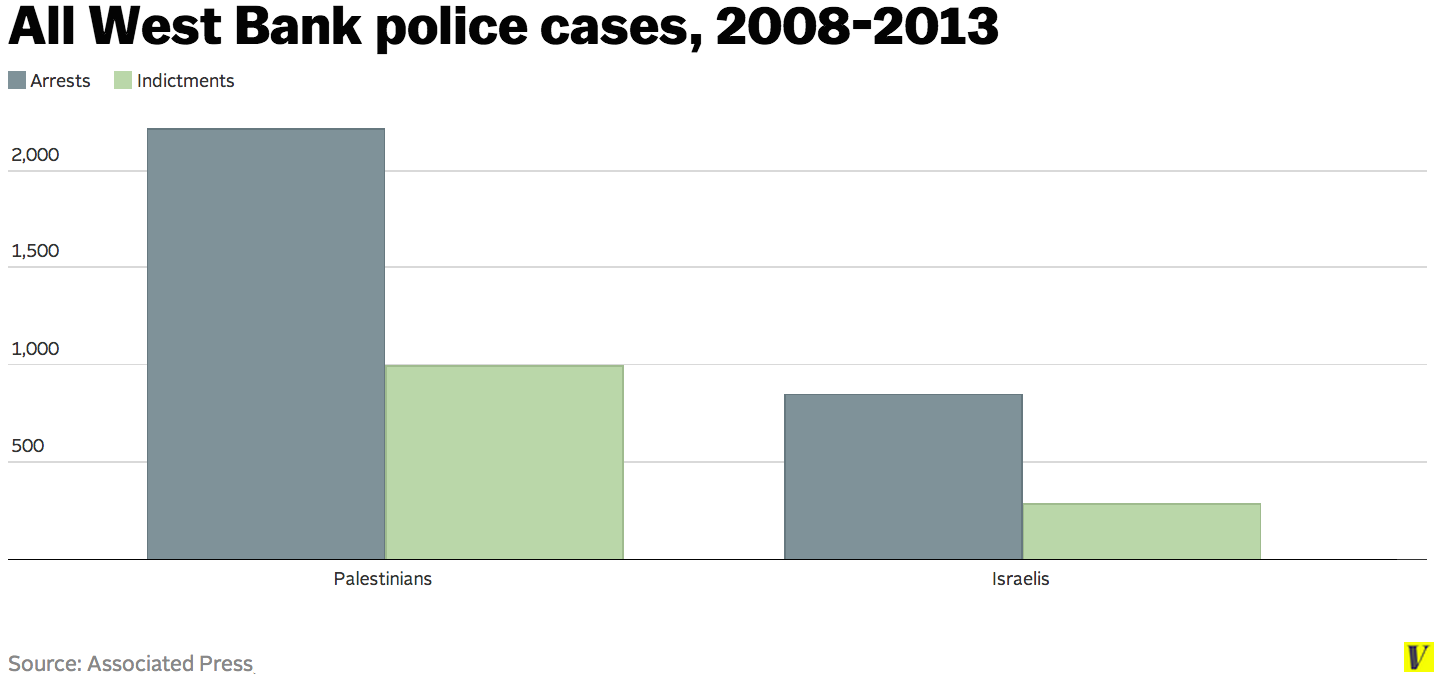
Dish alum Zack Beauchamp illustrates the consequences of the West Bank’s two-tiered criminal justice system on young Palestinians:

Take stone-throwing, a historically common Palestinian attack on Israelis that some Jewish settlers have adopted. 45 percent of all Palestinians arrested were convicted, and exactly zero of the 54 arrested Israelis were. … Now, since most stone-throwers are likely Palestinians, it makes sense that many more Palestinians would be arrested for that particular crime. However, it turns out that Palestinians are also more likely to be indicted (conviction data wasn’t available) than Israelis in general. Once again, the difference in legal system is the clearest explanation. It’s much easier to arrest and detain Palestinians in military courts than Israelis in civil ones. That makes it correspondingly easier for prosecutors to get what they need for indictments.

Roi Maor provides more background that complicates the picture a little:

The most important fact overlooked in the article is that the Israel Police, which provided the figures, does not investigate crimes committed by Palestinians against other Palestinians. These investigations are carried out by the Palestinian Authority. On the other hand, the Israel Police investigates all crimes committed by Israelis in the West Bank, regardless of the nationality of the victim. It is only natural then, that Israelis will be massively overrepresented in its arrest statistics. This overrepresentation is exacerbated by the fact that many crimes committed by Palestinians against Israelis are also investigated by the Palestinian Authority, depending on the nature of the crime and the residence of the perpetrator.

Second, Beauchamp seems to have missed the fact that the figures provided to AP are solely about minors. Admittedly, AP does not do a good job of highlighting this distinction, but it does mention it twice in the same short piece. Why does it matter? Because until October 2010, Israel defined the age of minority differently for Israelis and Palestinians. For the former, it was up to the age of 18, for the latter it ended at 16. The figures provided by the Israel Police are for 2008-2013, and it is unclear which definition the police used. Knowing their record-keeping practices, I would venture to guess it is based on a chaotic mix of both definitions.

An interactive feature from Al Jazeera explores the matter of youth detention in more depth:

About 700 Palestinians under the age of 18 are detained in the occupied territories annually. Since 2000, more than 8,000 Palestinian youth have been arrested. Most are detained on charges of throwing stones. As of March 1st, 210 Palestinian youth were held in Israeli detention. A 2013 UNICEF report concluded that the mistreatment of Palestinian children in Israel’s military detention system is “widespread, systematic and institutionalised”.

Where The Males Have (Little) Vaginas And The Females Have (Big) Penises, Ctd

A reader calls the headline of this post “offensive and biologically wrong”:

A new sexuality is found in nature if it gets crunched down to chicks with dicks? Bullshit! The gynosome is an amazing discovery; it is not like anything else ever found. But to reduce it to human sexuality removes the wonder of the diversity on this earth.

She points us to Annalee Newitz, who asserts that “the gynosome isn’t a penis”:

As Jason Goldman explains in an article about the gynosome, this is a hitherto unknown form of sexual organ in the animal kingdom. When female members of the Brazilian bug species Neotrogla mate with males, they insert their gynosomes into the male’s sexual organ. Once inside the male’s body, the gynosome inflates and grows spines, then absorbs both sperm and nutrients from the male for several days.

I’m sorry, but does this sound like a penis to you? When was the last time you found a penis that grew spines, absorbed nutrients, remained erect for 75 hours, or allowed its owner to get pregnant? Pretty much the only thing this organ has in common with a penis is that it’s used to penetrate a partner during sex.

She scoffs, “when it comes to sex, humans are still hopelessly in thrall to our anthropomorphic urges – which is to say, our urge to see every animal’s behavior as a reflection of our own.” Ed Yong, on the other hand, defends the characterization:

As Diane Kelly, who studies penises, points out:

“As a technical term, a penis is a reproductive structure that transfers gametes from one member of a mating pair to another.” Which is exactly what is happening here.

Newitz points to differences. “When was the last time you found a penis that grew spines, absorbed nutrients, remained erect for 75 hours, or allowed its owner to get pregnant?” Actually spines are pretty common; long sexual bouts are pretty common; and the gynosome doesn’t absorb nutrients—it collects sperm packets that contain nutrients, which the animal then eats in the normal way. The key difference is that rather than delivering sperm, it collects it—as I stated right up top. And the only reason we think of penises as sending sex cells in that direction is that we never knew any other set-up could occur. Now we do, which either forces us to introduce a new term and demand that it be used, or to expand the bounds of our old term. I prefer the latter. I’m generally a lumper, rather than a splitter.

TWSS?

Happy Bard Day

Daniel Hannan notes the occasion:

Four-hundred-and-fifty years ago today, in a village in the West Midlands, the greatest imaginative intelligence evolved by our species was born. Lawrence Olivier called Shakespeare “the nearest thing in incarnation to the eye of God”. John Dryden wrote that, of all the poets, “he had the largest and most comprehensive soul”. Thomas Carlyle asserted, “I know not such a power of vision, such a faculty of thought, if we take all the characters of it, in any other man.” For Harold Bloom, “Bardolatry, the worship of Shakespeare, ought to be even more a secular religion than it already is. The plays remain the outward limit of human achievement: aesthetically, cognitively, in certain ways morally, even spiritually.”

Bob Duggan traces the spread of bardolatry:

Once the modern taste for the individual took hold … Shakespeare found a home beyond England’s shores. American colonists staged plays by Shakespeare as early as 1750. “There is hardly a pioneer’s hut that does not contain a few odd volumes of Shakespeare,” Alexis de Tocqueville wrote in 1835 in Democracy in America. From the very beginning of the American experiment in democracy, Shakespeare and his individualized characters inspired a government of, by, and for the people, to paraphrase the Gettysburg Address of that notorious Shakespeare lover Abraham Lincoln. As kings fell and democracies rose throughout Europe in the 19th and 20th centuries, Shakespeare (often in vernacular translation) showed the way, sometimes in the form of music, as in Giuseppe Verdi’s operas Otello and Falstaff, which provided the popular soundtrack to the political movement by which modern Italy was born.

Noting that Virginia Woolf wrote “man has Shakespeare & women have not” in an early draft of To the Lighthouse, Stefanie Peters considers what the playwright’s works have meant for women:

What has changed in 450 years of performing, reading, writing Shakespeare? The history of women interacting with Shakespeare’s plays is also the history of women’s rights, suffrage, and of the feminist movement. It is a history of women being silenced and of finding ways to speak out anyway. Shakespeare has been, and is, an uneasy ally in this history. He complicates but also enriches our idea of what a woman is. Too often we are still Katherinas, forced to compromise our dignity in order to retain our voice, or else our insistence on speaking is blamed for our tragedies, like Juliet. But the reason why we still read Shakespeare’s women, is that they are women. Goneril, Juliet, and Katherina are finally not ciphers. Whatever else they may be, they are true women, and they have true voices.

Meanwhile, Stephen Marche reflects on the best modern adaptations, Julia Fleischaker assesses booksellers’ recent claims to have discovered a dictionary Shakespeare annotated, and Roy Peter Clark shares the Shakespeare-penned sentence that changed his writing. Zooming out, Claire Hansen remarks on the author’s mystique:

Shakespeare knew very well that the spirit of a man – the reputation and fame that lingers on – jars imperfectly with the physical being of the body. That is what leads to the assassination of Julius Caesar in Shakespeare’s play: his physical limitations, his humanity, cannot match up to the imagined godliness of his mind and spirit.

In celebrating Shakespeare’s birth-date this year, it is well worth distinguishing between man and colossus. The fertile and imaginative potential of Shakespeare’s plays will continue on “so long as men can breathe or eyes can see” (Sonnet 18) – as long as there are hands and minds to enjoy them and to experiment with them, remaking the plays for the times and places of now and the future.

But this is a different phenomenon to Shakespeare the man; and any attempts to reconcile the two will always prove wanting. That, perhaps, explains the ongoing impulse to both worship and to question William Shakespeare.

Previous Dish on Shakespeare here, here, here, and here.

A Pivotal Visit?

As Obama begins an East Asian tour, Keating asks whether the much-touted “pivot to Asia” is a real thing:

[T]here doesn’t seem to be much evidence that the administration is spending more of its energy on Asia, or less of it on the Middle East, than it did previously. As Gideon Rachman argues, the fact that the pivot hasn’t been much in evidence doesn’t mean that the idea wasn’t a sound one. The Pacific is an area of growing strategic and economic importance and the U.S. position still carries a significant amount of weight there.

But the fact is that more attention tends to be paid to the places where things are blowing up on a regular basis. Thankfully, despite tensions running high on the Korean peninsula and the East China Sea, Asia is not yet that place. But it means that the region is often going to be pushed to the back-burner when more obvious crises present themselves

Dan Blumenthal thinks the pivot was a bad idea from the get-go:

Yes, Asia is of emerging consequence in world affairs. All post-Cold War presidents have recognized this. And China has had the potential to pose the greatest challenge to the United States since it became the prime actor in world affairs. Without a doubt, Asia needs more U.S. attention and resources. But the United States is a global superpower with vital interests in several interlinked regions. There can be no Asia policy without a global strategy.

For example, Japan gets most of its energy from the Middle East, where Washington has played a stabilizing role. And what about India? How will Delhi play the role Washington imagines for it in Asia if the United States mishandles Afghanistan? Furthermore, all Asian powers watch Washington’s handling of the other revisionist states — Russia and Iran — for clues about its fortitude in Asia. U.S. grand strategy must account for these facts.

The editors at Bloomberg take a more nuanced line, saying the idea was good but the implementation was fumbled:

The notion of prioritizing Asia should hardly be controversial. The region, as one of the pivot’s original architects noted recently, exerts an “inescapable gravitational pull.” It is home to half the world’s population, and before the middle of this century it should account for half the world’s economic output. Already the U.S. exports 50 percent more to Asia than to Europe. The U.S. and almost every country in Asia share an overwhelming interest in ensuring a free flow of goods, information and ideas to and from the region.

But it’s obvious now that all the trumpet-blaring back in 2011 about a coming Asian Century raised expectations too high and too fast. China naturally assumed the pivot was designed to thwart its rise and grew emboldened when budget cuts slowed the movement of U.S. military assets to the region. Japan, the Philippines and other countries that had assumed the same thing now fret about U.S. staying power. From Myanmar to Vietnam, small nations lament that they haven’t received the kind of attention and money once showered on the likes of Djibouti or Tajikistan. Clearly, the White House overpromised and underdelivered.

But Michael Mazza wonders whether Obama can still pull it off:

The president will not save his pivot by racking up frequent flyer miles. “Showing up” is important, but not nearly as important as what the president has in hand upon his arrival. Assuming that “success” is defined as preservation of the peace in Asia and the establishment of relative stability, the president’s presence in the region will certainly be insufficient to achieve it.

The president has a long to-do list. He needs to reassure allies that the United States will live up to its security obligations in Asia. He likewise needs to assure them that he will not fiddle while the rest of the world burns. He needs to convince capitals across Asia that “21stcentury” America can play hardball with the world’s “20th century” powers—and play to win. He needs to demonstrate that he has a strategy for winning the peace in Asia, that the pivot is more than a slogan. This is a tall order.

Clapper’s Clampdown

This embed is invalid


Jack Shafer criticizes the gag order (seen above) that James Clapper recently placed on the entire intel community:

The nation’s top spy has prohibited all of his spies from talking with reporters about “intelligence-related information” unless officially authorized to speak. … Directive 119 increases the insularity of the national security state, making the public less safe, not more. Until this directive was issued, intelligence community employees could provide subtext and context for the stories produced by the national security press without breaking the law. Starting now, every news story about the national security establishment that rates disfavor with the national security establishment — no matter how innocuous — will rate a full-bore investigation of sources by authorities.

Tina Nguyen has more on how far the order extends:

From now on, all communications between US intelligence officials and media must be authorized in advance, and no one is allowed to discuss anything deemed “covered matters” (nebulously defined as “intelligence-related information, including intelligence sources, methods, activities, and judgments”). Any violation of these rules “will be handled in the same manner as a security violation” and offending parties will likely lose their clearances, get fired, or even get investigated by the Department of Justice.

Is that reasonable? Not particularly in this case, as the Guardian lays out: the new rules are “agnostic” as to the degrees of classified information his employees can give the press. In addition, “unplanned or unintentional contact with the media” must be reported immediately to the employee’s relevant agency — even if the employee hadn’t disclosed any “substantive information.” From the looks of it, if I accidentally ran into a high school friend who now works with the NSA — not that I have a friend like that — and we talked about nothing more than the weather, he would have to immediately notify the NSA that we’d been in contact.

Marcy Wheeler’s take-away:

I guess James Clapper, whose credibility is already shot to shit for lying to Congress and spending 10 months uttering transparent lies, wants to doom the [Intelligence Community’s] credibility entirely. After all, from this point forward, we can assume that any statement citing an [Intelligence Community] source is approved propaganda. Thanks for clearing that up, Clapper.

Kidnapped In Slovyansk

Pro-Russian forces in the eastern Ukrainian city have abducted American reporter Simon Ostrovsky (whose latest Vice dispatch from Slovyansk is above):

Ostrovsky, a veteran reporter for a number of outlets, had been filing regular video reports from the region for Vice, including the one above on Ukrainian forces’ botched attempts to retake Slovyansk, which was posted on Sunday. This just the latest is a series of attacks on the press by pro-Russian forces in the area, including the arrest of journalist and activist Irma Krat. [Ostrovsky’s cameraman Frederick] Paxton himself was beaten by a pro-Russian crowd last week. The Committee to Protect Journalists has documented multiple cases of journalists being “assaulted, detained, or obstructed from reporting” in Russian-controlled Crimea.

It seems the insurgents have no plans to release him anytime soon:

“He’s with us. He’s fine,” [the group’s spokeswoman] Stella Khorosheva told The Associated Press, adding, “(We) need to be careful because this is not the first time we’re dealing with spies.” Khorosheva also told The Daily Beast that Ostrovsky is being held according to the “laws of war” because “he was not reporting in a correct way.”

Perhaps more worrisome, the spokeswoman said that the militants had planned the journalist’s kidnapping. “We knew where he was going and the men manning the checkpoint were told to look out for him,” Khorosheva said of Ostrovsky. Sloviansk’s self-declared “mayor” told a journalist that he was holding the Vice News reporter “as is their right, will release him whenever he deems fit.” Speaking to the Russian outlet Gazeta.ru, Vyacheslav Ponomarev said, “We won’t release Ostrovsky any time soon. We need hostages — small change to trade with Kiev.”

Joe Coscarelli suspects the pro-Russians didn’t appreciate his brand of gonzo journalism:

He was … reporting in the Vice and Ostrovsky way, which one reporter described as “poking the bear with a video camera and seeing what reaction he gets.” A dual citizen of the U.S. and Israel, Ostrovsky has spent weeks in Ukraine aggressively covering the conflict by getting in the middle of it. In one clip, he approaches the Russian insurgents only to get roughed up. “Stand fucking still,” the soldier tells him as the camera gets jostled. “I said stand still. I’ll shoot to kill!” (The video has since been made private by the Vice News YouTube channel, but can be seen here.)

Robert Mackey puts the kidnapping in the context of the volatile situation in the city (NYT):

Tensions in Slovyansk spiked over the weekend, when a gun battle late Saturday left at least three men dead in murky circumstances. On Tuesday, Ukraine’s acting president, Oleksander Turchinov said in a statement that government forces would relaunch the operation to quell the separatist movement after it was revealed that one of the “brutally tortured” bodies discovered near Slovyansk was a government official from the president’s own political party.

Before his disappearance, Mr. Ostrovsky reported on Monday via Twitter that Vyachislav Ponomaryov, a pro-Russian activist and the town’s de facto mayor, had berated journalists for “provocative” questions about the town’s former mayor, and a woman pressed reporters to make donations toward the funeral expenses of the separatists killed in the shootout.