A Blow To Race-Based Admissions, Ctd

John Cassidy worries that yesterday’s SCOTUS ruling in Schuette will have widespread consequences:

Without saying so explicitly, [the ruling] appeared to give its approval to ballot initiatives designed to roll back affirmative action in other areas as well, such as hiring employees, awarding contracts—and ending racial segregation. In effect—and, in the case of the Court’s conservatives, surely in intention, too—the justices on the majority suggested that if voters in individual states want to throw out laws designed to counter America’s long history of racial discrimination, that’s fine by them, and perfectly constitutional.

Bazelon is disturbed by what she sees as Roberts’ blindness to the enduring problem of racism in America:

I still think there is a difference between a local ordinance that bans busing or fair housing, which aim for equal treatment, and a ballot initiative that takes away a preference based on race. That’s how I made my peace with the outcome today. But I had my doubts when I got to a telling exchange between Roberts and Sotomayor. It’s over the basic underlying question that is nowhere resolved in this case: Whether affirmative action—or any awareness of race—is still needed or valid. …

I can’t read this without noting that in previous cases, Roberts has expressed his preference for color-blindness. This is where the conservatives on the court lose me. Good faith or no, it is at odds with reality to imagine that race no longer matters. I hope the states that ban affirmative action continue to enroll more low-income students as they also find ways to admit black and Hispanic applicants. But we still live in a world of race and class considerations. Not either/or.

The Bloomberg editors, on the other hand, support the court in letting the public decide:

On the issue of affirmative action, the court’s reluctance to be clear may be wise. (And if it’s not reluctance but inability, then it’s welcome.) As the court dithers over whether affirmative action is allowed, the public is increasingly deciding that it’s not necessary — not just in Michigan, where the 2006 vote was not close, but in the U.S. as a whole.

The public may well be wrong about that. Affirmative-action programs still have a crucial role to play in helping public institutions reflect America’s diversity. Yet they are not the only way. Programs that focus on class instead of race can have similar benefits. And there is evidence that colleges that make a concerted effort to attract poor and minority students can achieve results. Whether affirmative action has outlived its usefulness, however, is not a constitutional issue.

However, what the public really thinks of affirmative action isn’t always clear. Allison Kopicki finds that it depends on how the question is framed (NYT):

Using the phrases “special preferences” or “preferential treatment” in a question tends to reduce support for affirmative action. Americans want life to be fair: They generally don’t mind assisting groups that need help, but they don’t like the idea of that help coming at the expense of others. A 2007 Pew Research Center survey, for instance, found that when the question included the word “help,” 60 percent of Americans favored affirmative action; in a question that used the word “preferences,” support fell by 14 percentage points.

Specifying groups that would benefit from affirmative action also tends to reduce support for the policies. When specific groups — such as women, African-Americans or gays and lesbians — were named, support for the practice of affirmative action fell significantly, for all groups but one, as a 2009 Quinnipiac University survey found.

The only exception was people with handicaps. In the question that mentioned them, support for affirmative action was higher than for any other groups, and higher than on a broader question that didn’t name any group.

Dirty Corn

7896779532_ccbf9b33ab_b

Corn stover, or the stuff left over when a corn crop is harvested, has become a popular source of biofuel, partly because it doesn’t affect the food supply the way that corn or sugar-based ethanol does. Unfortunately, this type of fuel may actually have a bigger carbon footprint than gasoline:

It used to be that the stalks, leaves, and detrital cobs would be left on fields to prevent soil erosion and to allow the next crop to feast on the organic goodness of its late brethren. Increasingly, though, these leftovers are being sent to cellulosic ethanol biorefineries. Millions of gallons of biofuels are expected to be produced from such waste this year — a figure could rise to more than 10 billion gallons in 2022 to satisfy federal requirements.

But a new study suggests this approach may be worse for the climate, at least in the short term, than drilling for oil and burning the refined gasoline. The benefits of cellulosic biofuel made from corn waste improve over the longer term, but the study, published online Sunday in Nature Climate Change, suggests that the fuel could never hit the benchmark set in the 2007 U.S. Energy Independence and Security Act, which requires that cellulosic ethanol be 60 percent better for the climate than traditional gasoline.

Michael Byrne explains what the problem is:

The problem comes in a trade-off: while the actual fuel burning is cleaner, the process of removing the stover from a field releases carbon dioxide from the soil to the tune of 50 to 70 grams per one megajoule (about a BTU) of energy produced. … There’s more to it than just carbon dioxide. Corn stover doesn’t just go to waste if left on a field post-harvest. It helps protect against erosion and it keeps nutrients in the soil. Removing the stuff means soil loss (you know, Dust Bowl) and an increased need for fertilizer. Lead researcher Adam Liska, a professor at the University of Nebraska, notes that his team made numerous attempts to poke holes in their study, only to come up with the same disappointing results. There’s no such thing as free energy.

Jon Terbush chimes in:

That finding puts some hard numbers behind an interesting note in the U.N.’s latest climate change report, which said “indirect emissions” from biofuels “can lead to greater total emissions than when using petroleum products.”

That said, the EPA dismissed the study because it assumed all of a corn field’s waste would be used for ethanol production, an assumption the EPA said was “an extremely unlikely scenario that is inconsistent with recommended agricultural practices.” And the study did note that emissions could be offset by planting cover crops, so it’s not guaranteed that cellulosic ethanol production using corn would have to be more harmful to the planet than gasoline.

(Image courtesy of Idaho National Laboratory (INL) Bioenergy Program, via Flickr)

Inserting Slavery Into The Climate Debate

Chris Hayes compares the fight against fossil fuels to the abolitionist movement. He states plainly that “there is absolutely no conceivable moral comparison between the enslavement of Africans and African-Americans and the burning of carbon to power our devices.” But he sees economic parallels:

[I]n the decades before the Civil War, the economic value of slavery explodes. It becomes the central economic institution and source of wealth for a region experiencing a boom that succeeded in raising per capita income and concentrating wealth ever more tightly in the hands of the Southern planter class. During this same period, the rhetoric of the planter class evolves from an ambivalence about slavery to a full-throated, aggressive celebration of it. As slavery becomes more valuable, the slave states find ever more fulsome ways of praising, justifying and celebrating it. Slavery increasingly moves from an economic institution to a cultural one; it becomes a matter of identity, of symbolism—indeed, in the hands of the most monstrously adept apologists, a thing of beauty.

And yet, at the very same time, casting a shadow over it all is the growing power of the abolition movement in the North and the dawning awareness that any day might be slavery’s last. So that, on the eve of the war, slavery had never been more lucrative or more threatened. That also happens to be true of fossil fuel extraction today. …

[T]he parallel I want to highlight is between the opponents of slavery and the opponents of fossil fuels. Because the abolitionists were ultimately successful, it’s all too easy to lose sight of just how radical their demand was at the time: that some of the wealthiest people in the country would have to give up their wealth. That liquidation of private wealth is the only precedent for what today’s climate justice movement is rightly demanding: that trillions of dollars of fossil fuel stay in the ground. It is an audacious demand, and those making it should be clear-eyed about just what they’re asking. They should also recognize that, like the abolitionists of yore, their task may be as much instigation and disruption as it is persuasion.

He goes on to argue that avoiding “planetary disaster will mean forcing fossil fuel companies to give up at least $10 trillion in wealth.” Barro sees “reason for somewhat less despair than Mr. Hayes shows, because there are crucial political and economic differences between abolition and carbon limitations”:

In the case of slavery, slaveholders had an enormous economic interest in maintaining their property, while white abolitionists were mostly seeking moral improvement. Those who stood to gain most economically from abolition were slaves, who were excluded from the political process.

An effective carbon limitation policy should bring large economic gains to people who are not in the business of fossil fuel extraction, in the form of reduced economic disruption due to climate change. While owners of fossil fuels have a strong economic impulse to extract, the rest of us should have a strong economic impulse to limit extraction — and we should be willing to buy off the resource owners, if necessary, to enforce those limits.

Warner Todd Huston raises other objections:

[T]oday’s issue is a worldwide problem, not one centralized and isolated in the U.S. Even if we Americans stopped using fossil fuels this very minute, it wouldn’t matter even a tiny bit to the actual global warming problem as the warmists perceive it. That is because India, China, and every other nation would continue using their fossil fuels, making our purportedly heroic efforts not just pointless, but self-destructive.

Imagine if we fought the Civil War, losing 650,000 Americans in the process, thought we eliminated slavery, and then millions of slaves from other nations just flooded back into our country. It would have made the great loss a pointless exercise, for sure. This is what would happen if we destroyed ourselves over global warming while the rest of the world dallied.

In other climate change commentary, Brad Plumer chronicles the failure to meet our climate goals:

The idea that the world can stay below 2°C looks increasingly delusional. Consider: the Earth’s average temperature has already risen 0.8°C since the 19th century. And if you look at the current rapid rise in global greenhouse-gas emissions, we’re on pace to blow past the 2°C limit by mid-century — and hit 4°C or more by the end. That’s well above anything once deemed “dangerous.” Getting back on track for 2°C would, at this point, entail the sort of drastic emissions cuts usually associated with economic calamities, like the collapse of the Soviet Union or the 2008 financial crisis. And we’d have to repeat those cuts for decades.

What more warming might do:

Four degrees (or 7.2° Fahrenheit) may not sound like much. But the world was only about 4°C to 7°C cooler, on average, during the last ice age, when large parts of Europe and the United States were covered by glaciers. The IPCC concluded that changing the world’s temperature in the opposite direction could bring similarly drastic changes, such as “substantial species extinctions,” or irreversibly destabilizing Greenland’s massive ice sheet. … Here’s an analogy that Hans Joachim Schellnhuber, who helped compile some of the research for the World Bank, likes to use. “Take the human body. If your temperature rises 2°C, you have a significant fever. If it rises 4°C or 6°C you can die. It’s not a linear change. You’re pushing a complex system outside the range it’s adapted to. And all our assessments indicate that once you do that, the system’s resilience gets stretched thin.”

The Ones Who Really Forced The Spring

A timely reminder of how old the struggle for marriage equality really is in the US:

And this is how revolutions begin:

But, of course, as I noted in my 1998 anthology on the subject, the issue of gay marriage goes back much, much further in time. We even have martyrs executed for the cause. From Montaigne’s notebook as long ago as 1581:

On my return from Saint Peter’s I met a man who informed me humorously of two things: that the Portuguese made their obeisance in Passion week; and then, that on this same day the station was at San Giovanna Porta Latina, in which church a few years before certain Portuguese had entered into a strange brotherhood.

They married one another, male to male, at Mass, with the same ceremonies with which we perform our marriages, read the same marriage Gospel service, and then went to bed and lived together. The Roman wits said that because in the other conjunction, of male and female, this circumstance of marriage alone makes it legitimate, it had seemed to these sharp folk that this other action would become equally legitimate if they authorized it with ceremonies and mysteries of the Church.

Eight or nine Portuguese of this fine sect were burned.

Update from a reader:

The videos you posted remind me that I saw first-hand how the revolution was truly underway well before 2008.  When I was in graduate school, my close friend and research partner invited my wife and me to her wedding at a little farm up in the Berkshires of Western Massachusetts.  This would have been some time around 1996 or 1997.  It was a beautiful service, conducted by a former Catholic priest using a traditional marriage liturgy that was quite familiar to me as an Episcopalian and to my formerly Catholic wife. The only thing that was unusual was that my friend and her partner were lesbians. Both families were there, along with a few close friends.  It was a small, joyous affair and we celebrated them, their love, and their commitment to each other.  In that way it was just like any other wedding I’ve ever attended, including my own.  Virtually normal indeed.

So to whom does credit for the “revolution” belong? Not to the lawyers and political activists that Becker lionizes. Not to you, despite your early advocacy. It belongs to women (and men) like these, the courageous clergy who blessed their unions, and their families who loved and supported them and continue to do so.  That would be a much more human story to tell.

A Global Tax On The Super Rich? Ctd

The debate over Piketty’s Capital in the 21st Century continues to rage throughout the blogosphere. Weissmann thinks it will be the millennials’ liberal manifesto:

Conservatives have long had an easy framework for their economic ideas: The free market cures all. Liberals, instead of nebulously arguing that they’re fighting for the middle class, now have a touchstone that clearly argues they’re fighting against the otherwise inevitable rise of the Hiltons.

Capital will change the political conversation in a more subtle way as well, by focusing it on wealth, not income. Discussions about income can become very muddy, in part because Americans don’t like to begrudge a well-earned payday, and in part because it can be tricky to decide what should count as income. If you start adding health insurance and government transfers such as food stamps into the equation, as some do, the top 1 percent don’t dominate quite so severely.

Wealth is a different story. Americans don’t like the idea of aristocrats—there’s a reason campaigning politicians bring up family farms and steel mills, not Shelter Island vacation homes, when they run for office. Moreover, you can’t save food stamps or a health plan, and because wealth only includes what you can save, it’s a measure of who wins in the economy over the long term.

Robert M. Solow supports Piketty’s proposal for a global wealth tax:

Annual revenue of 2 percent of GDP is neither trivial nor enormous. But revenue is not the central purpose of Piketty’s proposal. Its point is that it is the difference between the growth rate and the after-tax return on capital that figures in the rich-get-richer dynamic of increasing inequality. A tax on capital with a rate structure like the one suggested would diminish the gap between the rate of return and the growth rate by perhaps 1.5 percent and would weaken that mechanism perceptibly.

This proposal makes technical sense because it is a natural antidote to the dynamics of inequality that he has uncovered. Keep in mind that the rich-get-richer process is a property of the system as it operates on already accumulated wealth. It does not work through individual incentives to innovate or even to save. Blunting it would not necessarily blunt them. Of course a lower after-tax return on capital might make the accumulation of large fortunes somewhat less attractive, though even that is not at all clear. In any case, it would be a tolerable consequence.

But McArdle doubts it would solve the real problems of the poor and middle class:

If we look at the middle three quintiles, very few of their worst problems come from the gap between their income and the incomes of some random Facebook squillionaire. … Crime is better, lifespans are longer, our material conditions have greatly improved — yes, even among the lower middle class. What hasn’t improved is the sense that you can plan for a decent life filled with love and joy and friendship, then send your children on to a life at least as secure and well-provisioned as your own.

How much of that could be fixed by Piketty’s proposal to tax away some huge fraction of national income from rich people? Some, to be sure. But writing checks to the bottom 70 percent would not fix the social breakdown among those without a college diploma — the pattern of marital breakdown showed up early, and strong, among welfare mothers.

Deploying the more standard attack from the right, Harsanyi calls Piketty a Marxist:

Like many progressives, Piketty doesn’t really believe most people deserve their wealth anyway, so confiscating it presents no real moral dilemma. He also argues that we can measure a person’s productivity and the value of a worker (namely, low-skilled laborers), while at the same time he argues that other groups of workers (namely, the kind of people he doesn’t admire) are bequeathed undeserved “arbitrary” salaries. What tangible benefit does a stockbroker or a Kulak or an explanatory journalist offer society, after all? …

The thing is, some of us still believe that capitalism fosters meritocratic values. Or I should say, we believe that free markets are the best game in town. Not that long ago, this was a nearly universal position. A lot of people used to believe that even the disruptions of capitalism — the “caprices of technology” as Piketty dismisses them— that rattle “social order” also happen to generate mobility, dynamism and growth. Today this probably qualifies as Ayn Rand-style extremism.

Douthat, meanwhile, bets that America will “tax enough, and redistribute enough, to maintain the richest nations’ social peace, and avoid violent labor-capital conflict by making even the relatively poor feel like they have too much to lose from such upheaval.” Among his evidence:

[T]axes on high incomes bottomed out in the mid-1980s (when our Gini coefficient was much lower) and have bounced around, and upward, in the two decades since; taxes on capital went down steadily from the ’80s into the 2000s, but for high incomes they’re now back where they were in the 1990s (with an Obamacare surcharge on top); our corporate tax rates were cut in the 1980s but haven’t much budged since. Meanwhile, the non-defense budget has been on a consistent upward trend (see figure 3 here) since, again, the mid-1980s, and elite-driven causes like entitlement reform and immigration reform have been repeatedly defeated by populist rebellions, left and right. And notwithstanding liberal anxieties that the Bush Republicans had found a way to push the whole political debate “off center,” the post-2000 trend toward stagnant incomes helped drive a leftward swing in public opinion, leading to the election of President Obama, an unprecedented surge of stimulus spending, a large expansion of the federal safety net, a significant increase in upper-bracket taxes, and so on.

Now it’s true that post-2010 budget cuts have counteracted some of these leftward policy shifts, and it’s also true if enacted as written Paul Ryan’s safety net cuts would send U.S. policy swinging in a direction favored by (some Republican) oligarchs. But Ryan was on the ticket that lost the last presidential election, and nobody (the Wisconsin congressman included, I would say) believes that his party is well-positioned to win future elections running on an austerity platform alone.

Earlier coverage of Piketty’s book hereherehere, and here.

Why Rand Paul Matters

David Corn, who dug up the video footage above, notes:

These days, Paul, who is stuck in a civil war within the GOP over foreign policy issues, is trying to Reaganize himself and demonstrate that he’s not outside the Republican mainstream. (His Senate office did not respond to requests for comment.) But not long ago, Reagan was a foil for Paul, who routinely pointed out that the GOP’s most revered figure actually had been a letdown. It’s no surprise that denigrating Ronald Reagan—and commending Jimmy Carter—is no longer common for Paul. Such libertarian straight talk would hardly help him become one of the successors to the last Republican president who retains heroic stature within the party Paul wants to win over.

For me, though, these clips make Paul’s candidacy more appealing, not less. What the GOP needs is an honest, stringent account of how it has ended up where it is – a party that has piled on more debt than was once thought imaginable and until recently, has done nothing much to curtail federal spending. Reagan was a great president in many ways, as Paul says explicitly in these clips.

But Reagan introduced something truly poisonous into American conservatism.

It was the notion that you can eat your cake and have it too, that tax cuts pay for themselves and that deficits don’t matter. This isn’t and wasn’t conservatism; it was a loopy utopian denial of math. And the damage it has done to this country’s fiscal standing has been deep and permanent. It is one of modern conservatism’s cardinal sins. And Paul is addressing it forthrightly – just as he is addressing the terrible, devastating consequences of neo-conservatism for America and the world in the 21st Century.

What we desperately need from the right is this kind of accounting. It’s what reformers on the left did in the 1990s – confronting the failures of their past in charting a new future. Taking on Reagan on fiscal matters may be short-term political death, as Corn suspects and maybe hopes, but it is vital if the GOP is to regain some long-term credibility on the core question of government solvency. Compared with the ideological bromides and slogans of so many others, Rand Paul is a tonic. And a courageous one at that.

Capital Accounting

Piketty’s new book is already a huge financial success:

The unlikely bestseller, clocking in at nearly 700 pages, is already serving as an interesting case study for modern book publishing. One of the hallmarks of the book’s success is that it is sold out on Amazon, even though there is a digital version available on Kindle, too. … “You can have it on your e-book reader, but that’s not the same as having the book,” said [Harvard University Press sales and marketing director Susan] Donnelly. “I’m not saying this book is a Tiffany’s bag, but nobody goes to Tiffany’s and buys something and doesn’t get that little blue bag. I think there’s still some of that about books.”

The bestseller is already poised to become the most popular book ever for Harvard University Press. Donnelly predicts it will become akin to another classic for the publisher, John Rawls’ “A Theory of Justice.”

Yglesias points out that the book’s success is itself an example of inequality:

Piketty’s best-seller status — though well-deserved — also highlights one of the drivers of contemporary economic inequality. Superstar effects.

People like to buy great books and listen to great songs and watch great movies and TV shows. But people also like to be part of the “in crowd” and “the conversation.” So when certain things reach a certain level of popularity, other people check them out precisely because everyone is talking about them. That means that being the book on economic inequality is much more lucrative than being the fourth-best book on economic inequality.

These kind of disproportionate rewards for superstars have probably always been with us. But as the number of people who could conceivably buy a book grows — because of a mix of population growth and economic progress in poor countries — the returns to being the superstar grow disproportionately fast and inequality rises.

Earlier coverage of Piketty’s book hereherehere, and here.

The Senate Could Go Either Way

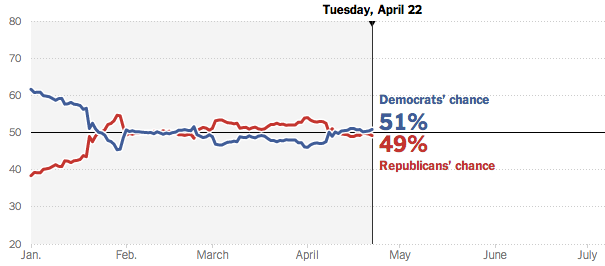
Senate Odds

The Upshot calculates the Democrats’ current chances of holding the Senate:

Every day, our computer churns through the latest polls and reams of historical data to calculate both parties’ chances of winning control of the Senate. Although the Democrats currently have a 51 percent chance, that doesn’t mean we’re predicting the Democrats to win the Senate — the probability is essentially the same as a coin flip.

Nate Cohn looks at the role incumbency plays:

Democrats’ hopes of keeping their Senate majority this November may well hinge on the ability of three of their incumbents to hold onto their seats deep in enemy territory: the South. To take the Senate and consolidate their control of Congress, Republicans need only extend their stranglehold on Dixie to Arkansas, Louisiana and North Carolina, all of which voted for Mitt Romney in the 2012 presidential election.

Yet the hopes of these three states’ incumbent Democratic senators — Mark Pryor, Mary Landrieu and Kay Hagan — are still alive. That may be surprising in light of the region’s lurch to the right, but it shouldn’t be: Incumbency is powerful. In the South, Democratic incumbents have won 85 percent of the time since 1990, and 77 percent since 2000.

The big Republican gains in the South have come mainly in open contests without an incumbent, often after a longtime Southern Democrat retires. Republicans have won 84 percent of open races in the South since 2000 — and three of their four losses came in Virginia and Florida, states that are different from the rest of the region.

The “War” In Global Warming

Last month, in an op-ed for Fox News, retired Navy Rear Admiral David Titley made a national security-based case for worrying about climate change. Eric Holthaus interviews Titley about his belief that the changing climate will be a main driving force for conflict in the 21st century:

Q. What’s the worst-case scenario, in your view?

A. … You could imagine a scenario in which both Russia and China have prolonged droughts. China decides to exert rights on foreign contracts and gets assertive in Africa. If you start getting instability in large powers with nuclear weapons, that’s not a good day.

Here’s another one: We basically do nothing on emissions. Sea level keeps rising, three to six feet by the end of the century. Then, you get a series of super-typhoons into Shanghai and millions of people die. Does the population there lose faith in Chinese government? Does China start to fissure? I’d prefer to deal with a rising, dominant China any day.

Titley thinks it’s time for conservatives to start grappling with the problem:

Where are the free-market, conservative ideas? The science is settled. Instead, we should have a legitimate policy debate between the center-right and the center-left on what to do about climate change. If you’re a conservative – half of America – why would you take yourself out of the debate? C’mon, don’t be stupid. Conservative people want to conserve things. Preserving the climate should be high on that list.

Sean McElwee thinks that environmentalists could probably garner more support on the right if they framed the issue differently:

Republican support for environmental causes is stronger than it might appear. Two Ph.D. students at the University of California Santa Barbara, Phillip Ehret and Aaron Sparks, found that a quarter of individuals self-identifying as “very conservative” or “conservative” support environmental regulations, even if they risk harming the economy. A Yale Study finds that 85 percent of Democrats and 55 percent of Republicans favor “regulating CO2 as a pollutant” and majorities from both parties favor investing in renewable energy. If Republican voters are concerned about the environment, haven’t we seen an action?

One explanation is that the framing of environmental issues is often anathema to conservatives. Matthew Feinberg and Robb Willer’s important paper on the subject, “The Moral Roots of Environmental Attitudes,” finds that liberals view environmental issues as moral concerns informed by a harm principle, while conservatives view environmental issues through the lens of purity, and particularly for religious people, stewardship.

One great challenge for environmentalists is finding a way to frame the issue in terms real conservatives intuitively grasp. To wit: If you love this land, why would you want to see it changed irreparably by our behavior? If you believe, as Christians do, that conserving the planet is our sacred duty, why would you treat the earth as disposable? Should we behave like Noah and conserve the earth – or ransack it for material ends? The trouble, of course, is that these deep conservative themes have been displaced on the right by know-nothing hatred of anything defined as “liberal”. And so you get outright mockery of concerns for the planet and too-clever-by-half attempts to deny the reality and moral challenge of climate change.

In the end, that is a crisis for conservatism, as much as environmentalism.

The $84,000 Cure

Earlier this month, Polly Mosendz covered the debate over Hepatitis C drug Sovaldi:

[I]nsurers cannot stand this life saving, revolutionary medication. That’s because it runs $1,000 a day and the average patient requires a 12-week treatment of Sovaldi.That’s $84,000 for one cycle. For patients with a strain that is more difficult to treat, the regiment is 24 weeks. That comes in at $168,000. It is projected to rake in between $5 billion and $9 billion in profits in the United States this year alone. There are an estimated 4 million Americans with Hepatitis C, and 15,000 are killed each year by untreated chronic infections.

Unfortunately, there is not much insurers can do about the price. A comparable drug is not yet on the market.

Dr. Frank Huyler fumes:

The low cost of manufacturing the drug means that it can be sold all over the world. Only the price varies, and that price is set by Gilead executives and protected by patent law and the FDA. At the moment, Gilead has a monopoly.

In poor countries, such as Egypt, they can’t sell many $1,000 pills. But they can sell a lot of $10 pills. So that’s how much Sovaldi costs in Egypt — and Gilead Sciences is still making a profit. Thanks to the FDA, the Egyptian version of the drug can’t be imported.

This sort of blood money is nothing new. But it is among the worst of recent examples; yet another evil act, yet another predation on mostly poor, mostly desperate people, who inevitably will ask taxpayers to save them.

“Blood money?” “Evil act?” I have to say I find that rhetoric appalling.

A miracle drug like this does not appear out of thin air. Developing these kinds of drugs can be hugely risky – so many end up as duds – and extremely expensive. If there were no real return on the few that make it to market, the economic incentives that make them possible in the first place would disappear, along with the drugs. And these drugs really do save lives – as Tim Mullaney, who has Hepatitis C, notes:

After two bouts with cancer, I can check hep C off the list of things that may kill me, thanks to virus-clearance rates of 97% in cases like mine. I’ve had no side effects. Prior therapies had much lower cure rates, and so many complications that patients refused treatment. Including me.

Surowiecki uses the outcry over Sovaldi to discuss drug pricing more generally:

Price restrictions have always been a political non-starter here, but at some point the math of the situation will be hard to resist. According to a study by the research group I.S.I., by 2018 spending on “specialty drugs” like Sovaldi could account for half of all drug spending in the U.S. Furthermore, one traditional argument against price controls is looking weaker: biotech companies claim that prices need to be high to reward risky and expensive innovation, but the fact that they’re churning out drugs and profits so consistently seems to undermine that claim. Biotech, in other words, may become the victim of its own success: the bigger the profits, the bigger the likelihood of regulation.

You might think that this prospect would encourage companies to be more cautious. But, if you assume that price controls are coming, the rational play is to squeeze out all the profits you can now.

I think there’s a trade-off here. Price controls on drugs in existence could make them far more affordable for the healthcare system as a whole. And there is a strong, moral argument for doing that. But the trade-off is that the innovation that occurs outside the NIH – and the bulk of all drug research is done by the pharmaceutical industry – would inevitably suffer. At some point a society has to navigate these two goals – innovation and access. And both matter.