Forced Arbitration Is Cuckoo For Cocoa Puffs

General Mills found itself in a PR nightmare last week when word got out of its new policy that essentially prevents customers from suing the company if they had downloaded a coupon, subscribed to an e-mail newsletter, or taken advantage of a promotional offer:

In other words: It just became nearly impossible to get a deal on a General Mills product without forfeiting your rights to sue the company. Even if your kid with a peanut allergy eats a Fiber One bar with trace amounts of peanuts and gets sick. For this reason, the Times reports that the new terms could come under strict legal scrutiny.

The outcry quickly forced the corporation to back down, but Leah Libresco points out that these policies are becoming more common, even though they’re often illegal:

In 2010, a British gaming company parodied the contractual creep of end user license agreements (EULAs) by adding a clause to theirs that stated that customers must sign over their souls in order to play; some companies have slipped in language almost equally absurd. Dentists using contracts from a company called “Medical Justice” inform their customers that, in order to have their teeth cleaned, they must surrender their ability to write bad reviews of the practitioner. …

Each of these provisions is about as unenforceable as the gaming company’s claim on your soul, but the legality of the language only matters if a customer actually plans to contest the contract in front of a judge. A suited representative from the company saying, “You did sign” can have a chilling effect on victims, who back away from a dispute and never learn that the provisions would have been voided.

Alison Griswold adds that General Mills’ policy probably wouldn’t have been enforceable:

AT&T, Sprint, eBay, Amazon, and Dropbox are just a handful of the companies that have introduced arbitration clauses and class-action waivers into their terms of service—aka those dense pages of legalese that only the rarest of users ever bothers to read in full. “Class action waivers are everywhere,” says Florencia Marotta-Wurgler, a professor at New York University School of Law. Her research shows that fewer than one in 1,000 people will click on website links to view the full terms of a contract before hitting “I agree.” …

When consumers aren’t made to explicitly agree with terms of use, a major change like a class-action waiver won’t be considered enforceable unless the company can demonstrate it gave “reasonable notice.” This notification needs to be fairly prominent, so the initial update on the General Mills website may not have made the cut.

And Adam Serwer looks at the role SCOTUS has played in shielding corporations from lawsuits:

In 2010, the Supreme Court ruled in Rent-A-Center v. Jackson in favor of a company that compelled its employees to sign a forced arbitration agreement as a condition of employment, even if the employee had no meaningful way of refusing the agreement other than by walking away from the job. In 2011, in AT&T v. Concepcion, the high court made it far more difficult for consumers to file class-action lawsuits against companies ruling that federal law protected the fine print in a cell phone contract that barred consumers from bringing them.

So companies know that those agreements that we tend to gloss over when we’re buying a phone or signing up for a credit card, that set up terms through which the company itself will rarely lose, are perfectly safe.

Is The Ukraine Deal Dead Already?

The agreement signed last week to restore calm in eastern Ukraine quickly unraveled over the weekend, with clashes at a checkpoint in Slovyansk on Sunday that left three pro-Russian separatists dead:

The Russian Foreign Ministry quickly seized on the Easter Sunday clash as evidence that the new Ukrainian government could not keep order. The new mayor of Slovyansk, meanwhile, begged Russian President Vladimir Putin to send “peacekeepers” to protect the people. Ukraine’s leaders fear that Putin is looking for any excuse to take more direct action in the nation’s east, where many residents speak Russian and distrust the central authorities in Kiev. The Security Service of Ukraine called Sunday’s attack a “cynical provocation” staged by pro-Russia elements.

Daniel Berman thinks the Kremlin is looking to sink the agreement:

So why sign an agreement and then immediately torpedo it?  Well, perhaps the Kremlin wants to “demonstrate” to the West that they do not control the separatists, and that the West will have to meet their minimum demands in order to gain a lasting cease-fire. Hitherto Kiev, Brussels, and Washington have tried to deal through Moscow on the assumption that Putin, because he had turned on the faucet of unrest could also turn it off.

By “disclaiming” responsibility for the unrest Putin puts Kerry and Ashton in the unfortunate position of having to talk with the separatist, which at a minimum involves recognizing them as legitimate actors who are genuine representatives of their communities. This wold be a devastating concession for Kiev even if the fragmented and chaotic nature of the separatist leadership and almost certain Kremlin sabotage would not render such negotiations futile.

There is a time aspect of this as well. Vice President Biden is arriving in the Ukraine today. Staging supposed Ukrainian “violations” of the cease-fire puts pressure on him in his meetings with Ukrainian leaders to keep the Ukrainian army out of the East, and makes proposals to supply weapons, ammunition and other military aid non-starters, as with a “truce” nominally in place, such efforts would be hostile acts.

On Friday, Michael Crowley saw this coming:

On the pro-Russian side, agitators occupying government buildings in Donestk and other eastern cities and towns seem uninterested in those words. “Lavrov did not sign anything for us,” Denis Pushilin, head of the self-declared Donetsk People’s Republic, told reporters. And why would he? Moscow has denied coordinating with the likes of Pushilin, even if almost no one believes it. The question is whether Pushilin and his ilk are truly independent—or just obeying Moscow’s orders to ignore the deal.

On the pro-European side, the demonstrators who have been encamped in central Kiev for months aren’t about to abandon the tent-city infrastructure where dozens of them died. It’s not clear whether Moscow ever considered that a realistic outcome of the Geneva deal or is simply drawing the equivalence to defend the antics of its supporters in the east. But almost nothing Moscow does can disband Kiev’s Maidan.

Ed Morrissey isn’t surprised:

It’s no accident that Russia accused Ukraine of being unable to keep order. That will be the context of their eventual intervention in that region — to protect the Russian-speaking populations in the Donetsk and other eastern regions, and potentially all the way across to the Transnistria region of Moldova. Just as in Crimea, they need the pretext to mature, while attempting to maintain deniability until it becomes more politically advantageous to take credit for it.

Max Fisher sums up Putin’s strategy in Ukraine:

The Russian playbook in eastern Ukraine appears to be this: instigate local separatist forces who will seize government areas and send in Russian commandoes, posing as local volunteers, to bolster them (this is what they did in Crimea). Simultaneously warn Ukraine not to use force against the separatists while putting Ukraine in a position where it has to use force against the separatists if it wants to keep control over its own territory. Mass Russian troops on the border and issue lots of subtle threats about how you might have to intervene if the violence you helped to instigate spirals out of control. …

If Russia does invade, its military is so much stronger than Ukraine’s that it seems likely that Ukrainian forces will simply pull back, as they did in Crimea. That would mean a Russian-occupied eastern Ukraine, which could well end with Russia annexing the territory through a Crimea-style rushed-through referendum. But it’s also possible that Ukrainian forces would stand and fight, or that the situation would slip out of control, and that could mean open war.

But Michael Totten explains why even a successful invasion could be a losing proposition for Putin:

He’d lose all his leverage over Kiev. Even an unspoken threat of invasion, occupation, and annexation is enough to make Ukraine act with tremendous caution toward Moscow, but if Putin pulls the trigger, Kiev would have nothing left to lose.

And the odds that Ukraine, shorn of nearly all its ethnic Russians, would ever again elect a president who’s soft on Moscow would be virtually nil. Ukraine would slip from Putin’s sphere of influence so utterly that the only way he’d be able to get it back into his orbit would be by invading and conquering the whole country.

Never mind the price he’d pay internationally for that kind of stunt; invading and occupying the largest country in Europe would require more than a half-million troops and God-only-knows how much money. And for what purpose? Ukraine poses no national security threat whatsoever to Russia.

The Legal Status Of Lab Rats

David Grimm, author of Citizen Canine: Our Evolving Relationship With Cats And Dogsnotes that the recent successes of the animal personhood movement have medical researchers worried:

In what way have dogs and cats moved beyond the status of property?

They can inherit money, for one thing. And since property cannot inherit property, that makes them different. Legal scholars say that is the biggest change. About 25 states have adopted the Uniform Trust Code, which allows animals to inherit. Also judges have granted owners of slain animals awards of emotional damages. You cannot get emotional damages from the loss of a toaster. In 2004 a California jury awarded a man named Marc Bluestone $39,000 for the loss of his dog Shane; $30,000 of that was for Shane’s special and unique value to Bluestone.

But why is that a problem for biomedical researchers?

They see this as a slippery slope, because there is no reliable legal distinction between companion animals and lab animals. The National Association for Biomedical Research [NABR], the leading medical research lobby group, has been very much on edge about animal law since the Bluestone verdict. They’ve started an animal law–monitoring project. What worries them is how lawyers, like the Animal Legal Defense Fund, could use some of these cases to expand rights for animals crucial to research. If a cat or a dog becomes closer to a legal person, it has a say in what you do to it. A lawyer could argue that a lab rat would not consent to being injected or cut open.

Previous Dish on animal personhood here, here, and here.

The View From Your Obamacare: Small Business Owners

The thread continues:

I still cannot understand how the advocates of Obamacare have failed to use one of the strongest President Obama Visits Boston To Talk About Health Careconservative arguments for the program: the elimination of one of the principal roadblocks that innovative Americans face in starting their own businesses.

My wife is an instructive example.  She’s a medical writer who edits journal articles and consults on New Drug Applications for experimental new drugs.  She’s been the project lead for the approval of several new drugs that you’ve probably heard of.  When she went into business for herself at age 45, you couldn’t have named a better example of the can-do spirit that the GOP claims to support.

But she has high blood pressure and a child with autism.  Neither of these conditions has had any significant effect on our healthcare costs, but BOTH of them are considered pre-existing conditions. Without the healthcare coverage I have from my full-time job, she literally could not have obtained coverage at all.  This isn’t idle speculation on my part; I considered starting a full-time business of my own a few years ago but found that it was simply impossible to obtain insurance.

Why on earth isn’t there some Democrat somewhere shouting this pro-business message from the rooftops?

Several more readers share their stories:

I just read your piece on the meep meep that is Obamacare and I am surprised that I haven’t heard more about how it is helping small business owners like the two of us.

I left my job with benefits several years ago and started my own psychology practice, enabled in part by my wife’s insurance through her job at Duke. She was overworked and underpaid, but they provided us with good health insurance, so she stayed. At the beginning of this year, she was finally able to leave to start her own private practice. Now she is her own boss making more money and we are much happier all around. We chose to continue with her previous policy because it is slightly cheaper but could have easily gone on the marketplace and found a comparable policy. And we will in 18 months when COBRA runs out.

But the real boon had been to my employees (I am fortunate to have two wonderful colleagues who work with me). While the small business policies with only three employees were cost prohibitive, the individual policies are not. So they get good health coverage and an extra little bit in their checks each month that I contribute to cover some of their costs. It costs my company a little extra a month but I’m happy to pay it. They save about $400/month each on top of that. I’m in the process of hiring another well-qualified psychologist. She can afford to work for a small business because she can get affordable health coverage and I can provide a benefit to hire the best qualified candidate.

I can afford the types of employee retention policies that I have implemented because of Obamacare. My employees get good health coverage. And I can keep growing my business attracting the best clinicians from the likes of Duke and UNC. Best of all, our patients can also afford good coverage and will get good care. It’s a win-win all around.

If the Republicans really cared about small business owners, they would be supporting this law. Surely there are some left? I know the answer to that question and it’s unfortunate. Maybe in a couple election cycles the GOP will come wake up – if they’re still around.

Another:

My brother is 62 and the owner of a small garden center that employs about six people.  It’s a seasonal (April thru November) business that is subject to the whims of Maine’s weather.  Some years he can cover expenses and turn a small profit; other years it’s touch-and-go. As a result, he never felt like he could afford health insurance. Luckily, his health has been good and regular check-ups were paid for out-of-pocket. But a catastrophic injury or illness probably would have spelled bankruptcy, the end of his business, and the loss of those jobs.

ACA made it affordable for him to buy health insurance this spring. Now he is not at risk of losing his business because of injury or illness.  A small business, the kind that Republicans supposedly hold so dear, has been made just a little more secure and stable precisely because of Obamacare. Shouldn’t this be something the GOP is 100% behind?  Meep meep indeed.

A less straightforward story:

I run a small business with few dozen employees in California, Michigan and Washington. We cover 100% of employee health insurance premiums. We have always had robust plans with low deductibles. I did not think that we would be affected at all by ACA.

However, in December our insurance brokers called asking if we wanted to renew our group health insurance with the same provider for one more year at the same rate, or risk paying more when our insurance policy expired in June. There was a vague warning that under ACA our insurance rates may go up dramatically. But the catch was we wouldn’t be able to tell what the new rates/plans were until sometime in March. We had to make that decision to renew in December with incomplete information. I wasn’t entirely happy with our current insurance provider and wanted to shop around. I also didn’t really believe the hype that our rates were going to be rising, so I decided I’d rather shop around new plans when they became available.

It turns out the ACA did shake up the market for small group insurance. Anthem, our current provider, eliminated their low deductible plans for small businesses. The closest similar plan through them called for a 300% increase in deductibles. This came at an 8% savings to our company over the previous year. However, I didn’t think this savings at the expense the employees would do much for morale.

After viewing a large number of options, we decided to go with Blue Shield, which has a zero deductible plan with better coverage than our previous plan. The cost of the new plan is about 9% more than we were paying in the previous year. This increase was acceptable to me and is less than our insurance costs had increased in previous years for lower coverage.

I am happy with paying a little bit more for our new insurance. Our employees are happy to be paying a bit less. It is true, as the Republicans warned, that we didn’t have the opportunity to keep our previous insurance. But being forced to look at different vendors allowed us to buy something that was of better value. Overall, I think the ACA has been a net positive for this small business.

(Photo by Yoon S. Byun/The Boston Globe via Getty Images)

8 Million Sign-ups, Ctd

David Hogberg expects the ACA exchange enrollment number to be revised downward:

One factor that the CBO did not include was enrollees who leave the exchanges because their income enrollmentshrinks thereby qualifying them for Medicaid. The U.C. Berkeley Center for Labor Research and Education recently estimated that just under one-fifth of enrollees on Covered California would leave the exchange for Medicaid. Combined with people who left because they gained employer-based coverage, the Center found that Covered California would retain about 57.5 percent of current enrollees.

If that occurs across all exchanges, then the final enrollment number will be closer to 4.6 million. Of course, not every state is California (thank goodness), so the amount of churn due to Medicaid and employer-based coverage will vary across the nation.  Yet those factors will cause the eight million figure to be revised downward as the year goes on. Each time that happens in the coming months, the media will hark back to the President’s victory dance.  For a public that doesn’t much trust Obama on health care, each revision will likely erode that trust a little further.

Jaime Fuller also suggests that Democrats shouldn’t get too excited by the 8 million figure:

Despite the relatively sunny past month Obamacare supporters have had, it’s not clear that Republicans are misguided in basing their electoral futures against this one policy that has had a bit of a comeback. First, there is little correlation between a state’s approval of the Affordable Care Act and how many people signed up for health insurance in that state.

The latest polling on Affordable Care Act approval ratings were released on April 11 by Gallup. Kentucky residents have had an average Obamacare approval of 32 percent since 2010. However, the state was one of the biggest successes in signing up the uninsured. North Carolina also attracted many Obamacare sign-ups, yet average approval of the law is 38 percent. The law may continue to rack up successes, but they seem to be completely untethered to opinions of the law. This works to Republicans’ advantage.

And to further complicate things, Ezra explains how “Obamacare” doesn’t mean the same thing everywhere:

Obamacare isn’t an iPhone; it’s not a single, carefully tended experience controlled by a central authority. It’s more like the Android operating system. Obamacare powers hundreds of different health systems. Many of those systems are off to an incredible start. Others are struggling.

This is the problem with trying to say whether Obamacare is a success or a failure. The program will end up seeding many huge successes — and some painful failures. It depends on who you are, and where you live. … In California, for instance, there are 19 different regions, each with its own insurance options and prices.

Beutler is still optimistic about the ACA’s impact for Democrats this fall. Meanwhile, Drum runs through other ways to gauge the success of Obamacare:

I’d say a reduction in the uninsured of 25 million is a pretty good metric. If, by 2023, the number is substantially below that, it would be a big hit to the law’s success. Getting people covered, after all, has always been the law’s primary goal. What’s more, I’d be surprised if more states don’t expand Medicaid and get more aggressive about setting up their own exchanges by 2023. At some point, after all, Republican hysteria about Obamacare just has to burn out. (Doesn’t it?)

On health inflation, I think running below the post-WWII average is a pretty aggressive standard. That would require health care inflation of about 1 percent above overall inflation. If we manage to keep it to around 2 percent, I’d call that a reasonable result.

But my biggest issue is with the age-adjusted mortality rate. I know this is a widely popular metric to point to on both left and right, but I think it’s a terrible one. Obamacare exclusively affects those under 65, and mortality just isn’t that high in this age group. Reduced mortality is a tiny signal buried in a huge amount of noise, and I very much doubt that we’ll see any kind of clear inflection point over the next few years.

Taking Control Of Your Biological Clock

Emma Rosenblum discusses the growing trend of professional women freezing their eggs in order to have children later in life, when they are more established in their careers and have more time to parent:

Imagine a world in which life isn’t dictated by a biological clock. If a 25-year-old banks her eggs and, at 35, is up for a huge promotion, she can go for it wholeheartedly without worrying about missing out on having a baby. She can also hold out for the man or woman of her dreams. Doctors hope that within the next 30 years the procedure will become a routine part of women’s health, and generous would-be grandparents will cover it as they would a first-mortgage down payment. “If you’re going to give your daughter a college graduation gift, what would you rather give her—a Honda or the chance to make a decision about when she’s ready to have a baby?” asks Dr. Geoffrey Sher, the medical director of the Sher Fertility Clinics, which has eight locations around the country and the Web address haveababy.com. And because it’s done before fertility issues arise, “the potential market for egg freezing is exponentially larger than that of in vitro fertilization,” he says.

Jessica Grose praises Rosenblum’s piece:

The reaction to the piece so far has largely been about the misleading coverline, which says “Freeze Your Eggs, Free Your Career.” “Solution to all of your problems, ladies,” Jezebel’s Erin Gloria Ryan tweeted this morning, “simply be rich enough to freeze your eggs.” But that’s really not what Rosenblum is arguing in the piece.

All of the women in her story wish they could have had kids earlier—it just wasn’t in the cards. And Rosenblum is careful to point out that freezing one’s eggs is a very expensive proposition: It can cost up to $12,000, not including storage fees. She also mentions two companies that are trying to democratize egg freezing, charging a $1,500 down payment and then $250 a month for the next 24 months, which Rosenblum describes as putting “eggs on layaway.” …

If we want more women to be able to have high-powered jobs and families, and if we want women to be able to raise children with partners, we should welcome this option. That egg-freezing technology has evolved and the practice has become less stigmatized is a very good thing.

The Writer’s Better Half

Koa Beck explains why Vera Nabokov “remains a revered figure” – and often a source of envy – among writers:

Vera not only performed all the duties expected of a wife of her era—that is, being a free live-in cook, babysitter, laundress, and maid (albeit, she considered herself a “terrible housewife”)—but also acted as her husband’s round-the-clock editor, assistant, and secretary. In addition to teaching his classes on occasion (in which Nabokov openly referred to her as “my assistant”), Vera also famously saved Lolita, the work that would define her husband’s career, several times from incineration, according to Stacy Schiff ‘s Pulitzer Prize-winning 2000 biography, Vera (Mrs. Vladimir Nabokov). With Vera by his side, Nabokov published 18 novels between 1926 and 1974 (both in Russian and English). Through 1976, the year before his death, he also published 10 short story collections and nine poetry collections along with criticism, plays, uncollected short stories, and translations.

She goes on to describe other literary partnerships:

As Laura Miller recently pointed out in Salon, Virginia Woolf and Edna St. Vincent Millay each benefited greatly from truly anomalous marriages of their time, in which their respective husbands assumed a Vera-esque role. Millay’s husband, Eugen Boissevain, reportedly described himself as a feminist and “married the poet Edna St. Vincent Millay with the express purpose of providing her with a stable home life and relieving her of domestic tasks so she could write.” By the time Millay died, she had written six plays and more than a dozen books of poetry. While Leonard Woolf cared for Virginia during her bouts of mental illness, he also managed the household, tended to the garden, and co-founded the couple’s literary press.

But not all gifted writers are blessed with Veras (or Leonards or Eugens for that matter). At a promotional reading of Bark at Congregation Beth Elohim in Park Slope, Brooklyn, [Lorrie] Moore clarified to me—and a room’s worth of fans—that she absolutely does not have a Vera. “I do every little thing myself,” she said.

Previous Dish on the spouses of writers here.

Theology For Hedonists

David Sedley delves into the philosophy of Epicurus:

Hedonists are ethical thinkers who hold that things are good precisely in so far as they are pleasant, and bad precisely in so far as they are painful. Epicurus was, more specifically, an “egoistic” hedonist, in that he took it to be obvious that the good for each individual, from the moment of birth, is that person’s own pleasure, not other people’s: in other words, your life is a good one if, and only if, you yourself enjoy it. Although an enjoyable life must, according to Epicurus, be centred on moral virtue, what makes it worth living is in the last analysis your enjoyment of it, and not the morality for its own sake.

Moreover there are, besides moral propriety, other factors equally indispensable to enjoying your life.

In particular, because the fear of the gods and the fear of death do more than anything else to blight lives, overcoming these is the essential starting point of Epicurean living. And almost equally important is the moderation of your desires, gastronomic and otherwise, restricting them to the most basic and readily satisfied ones. Extravagant pleasures – even that of meat-eating – threaten to make us their slaves, yet their satisfaction brings no more pleasure than living on the simplest fare. Epicurus was no epicure!

Sedley goes on to explain why the thinker valued a tranquillity “simply incompatible with the world-governing role that popular religion attributes to the gods”:

According to Epicurus, our innate conception of god is simply that of an immortal and blessedly tranquil being. Reduced to moral terms, this means that the ideal that from the moment of birth we all intuitively seek is a life of tranquillity totally unmarred by the fear of death. Unfortunately in most of us this basic aspiration has been distorted by superimposing the values of a corrupt society, so that our ideal role models come to be characterised by vindictiveness, greed, belligerence, lust, tyrannical rule and so on. This plausibly accounts for the popular worship of deities (Ares, Aphrodite, etc.) whose profiles distort true moral values.

Dwelling Together In Love

Michael Brendan Dougherty reflects on the way Christians celebrate Easter, finding that the patterns of Holy Week reveal “a larger, more comprehensible story about God’s covenant with man.” How he describes the movement from Good Friday to Resurrection Sunday:

We gather at the edge of sanctuary, which is the symbol of the heavenly Holy of Holies, and re-enact the part of the vicious mob in Jerusalem who called for the death of God for the sake of God’s name. We become the Roman torturers who mocked the King of the universe with a crown of thorns. We play the roles of the screaming and vain religious men, who work themselves into a fury. Our pastor intones the hysteria of the chief priest who condemned God Himself as a blasphemer. We once more present to God (and to ourselves) the bitter betrayals, laziness, and weakness of the Apostles after whom our priests are modeled — and who too often imitate their bad example.

And after all this, our own Via Dolorosa, we are finally prepared to hear the words, “Father, forgive them for they do not know what they do.”

This re-enactment — in which reality is suffused with divine meaning — does not end with the liturgy at our Church and is not reserved for the devout or even the believing. Once this vocabulary for understanding the universe seeps into the imagination, the world takes on the same patterns.

After God builds a three-story home at Creation he deputizes Adam as a kind of junior architect, another gardener who will “till and keep it,” verbs used later to describe the duties of priests in the Temple. We are to imitate God, to build our houses and make covenants with one another. To create children and make them our sons and daughters, to gather the orphans into our own homes, to dwell together in love, to sacrifice for each other, to fight for each other as God has for us. And we’re to have fun, too; to sweat over the ovens and feast together.

On this Good Friday morning I will go to the butcher and buy racks of lamb at an extortionate price. On Sunday, we will return from Mass to my father-in-law’s home, which, like the sanctuary, is a place of love. And I’ll prepare the offering. The ribs will remind me of Christ’s side, the side of the Temple, and the smoke will come like a wild offering from the oven. The devout and prodigals of our family will gather together for the holiday and to mark a few birthdays. We will put aside any previous hurts. There will be inside jokes, more good food, more games to play, more communion than any of us could have on our own. And around my father’s table, well-fed, well-loved, and well-understood, we will have made an image of the heavenly banquet, of a New Jerusalem, of a paradise filled with laughter, forgiveness, the smell of spices, with play and rest. Heaven is a homecoming.

American Is A Christian Country

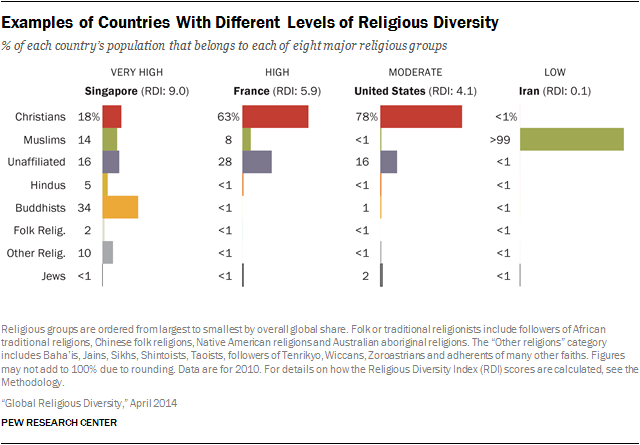
At least when it comes to demographics:

religious-diversity-2

Max Fisher unpacks the above chart from a Pew study, which shows that the US is “lower than most Western European countries [in religious diversity] and 68th in the world overall”:

Maybe the most surprising thing here is that most of the US’s religious diversity comes not from religious minorities, who in total are only 5.3 percent of the population, but from the 16 percent of Americans who are unaffiliated. Part of that has to do with the fact that, for all of the US’s racial diversity, many of those racial minority groups tend to Christian: most African-Americans, certainly most Latinos, and a significant share of Asian-Americans.

Now compare the US to France and you’ll see two things: that France has almost twice as many unaffiliateds, as a share of … overall population, and eight times as many Muslims. This comparison also gets to a shortcoming in Pew’s metric, though. Something this data does not show is intra-Christian diversity: the US has lots of different Christian groups, whereas French Christians are overwhelmingly Catholic. Diversity between Catholics and Protestants alone has been hugely important for US religious history. While Americans may not be super-diverse along broader religious categories, that intra-Christian diversity has been a real challenge in the US, and one that the country has done an unusually good job of dealing with.

Emma Green connects these findings to another Pew study on religious violence, noting that “some of the least religiously diverse countries also experience some of the most religious violence”:

According to Pew’s recent analysis of religion-related social hostilities, Pakistan, Afghanistan, India, Somalia, and Israel top the list of countries with the most conflicts motivated by faith, which include “armed conflict or terrorism, mob or sectarian violence, harassment over attire for religious reasons, or other religion-related intimidation or abuse.” In terms of religious diversity, Afghanistan and Somalia are among the 10 least-diverse countries in the world, and Pakistan was also given a rating of “low” diversity. Israel and India are both considered only moderately diverse. …

This trend seems to be the most prevalent in Southeast Asia and the Middle East. Countries like Bangladesh, Indonesia, Papua New Guinea, and Thailand have among the lowest levels of religious diversity and highest levels of religious hostilities in the world. Similarly, Egypt, Iraq, Sudan, Syria, and Yemen rank at the bottom of the global diversity ranking but at the top of the religious hostilities list.