In Search Of A Well-Credentialed Egg, Ctd

A reader shares her experience:

Your reader noted that models and actresses get a premium on their donated eggs, and that reminded me that there’s also a Jewish premium.

I seriously considered donating my eggs as a way to pay off some grad school debt. I knew from the frequent ads in my undergrad newspaper (a prominent liberal arts school) that there is a high premium not just for the characteristics of being tall, slim, and with high SAT scores, but also for being Jewish – especially on the mother’s side since the ethnicity is traditionally matrilineal. Based on what I saw at the time, I could get about 40% above average (an extra $3K+) just for being ethnically Jewish.

It was interesting to think about my genes as high-priced commodities in this way – both flattering and uncomfortable. But it certainly makes sense in economic terms that low supply leads to high demand. And in this case, it’s not just a matter of wanting a baby that looks like you (as with the ad you posted specifying a Caucasian donor), but of wanting a baby that is part of your culture in a very deep and irreplaceable way.

Ultimately I decided against donating because the process sounds so unpleasant. I also have reservations about going to such lengths to bring new children into the world when there are so many already born who need a loving home.

Update from a reader:

“I seriously considered donating my eggs ….I could get about 40% above average (an extra $3K+) just for being ethnically Jewish.”

That’s not donating; that’s selling.

The reader responds:

It absolutely is selling. So is most sperm donation. Though actually one could look at the money for egg donation as being compensation for the months of physical discomfort, as opposed to the egg itself.

The Case For Soaking The Rich

Yglesias makes it:

Very high taxation of labor income would mean fewer huge compensation packages, not more revenue. Precisely as Laffer pointed out decades ago, imposing a 90 percent tax rate on something is not really a way to tax it at all — it’s a way to make sure it doesn’t happen. If you believe systematically lower CEO compensation packages would mean a mass withdrawal of talent from the business world and a collapse of American industry, then those smaller pay packages could be an economic disaster. But the more plausible theory is that systematically lower CEO compensation packages would mean systematically higher compensation spending elsewhere in the corporate structure. Either more frontline workers or better-paid ones. The new tax code would redistribute value inside the corporate structure without anyone actually paying the new sky-high taxes.

But Zachary Karabell doubts that taxing the bejesus out of CEOs will solve our problems:

The top 100 CEOs in the [NYT’s] survey took home a total of $1.5 billion. That’s rather nice for them, but redistributing, say, $1 billion of that would do almost nothing to help the 100 million people at the bottom of the economic pyramid in the U.S.

Even if you included upper management and got to, let’s say, $100 billion, the extra income distributed across American society would barely improve living standards. Boards could mandate that, say, Larry Ellison of Oracle should be less wealthy so that Oracle employees could be more wealthy, but Oracle employees are already on the winning side of the global economic equation. They are not the ones who need help. …

No matter what redistributive measures we took, we’d still be faced with an economic system in dramatic flux based on the erosion of traditional wage industries in the developed world over the past decades. It is not inequality that has caused the middle class to lag and suffer. Inequality rather is a symptom of a system that reached the limit of what it could provide wage earners performing jobs tied to 20th-century manufacturing.

Danny Vinik counters Karabell:

[I]f he thinks $100 billion in additional redistribution “would barely improve living standards,” he does not understand the federal budget. President Obama’s plan to expand the Earned Income Tax Credit (EITC) would cost $60 billion over 10 years and lift half a million people out of poverty while helping another 10.1 million Americans in deep poverty. You could fund that and still have $940 billion to spend on antipoverty programs over the next decade. The federal government spent $61 billion in total on the EITC last year. On the Child Tax Credit, it was $57 billion. In January, Republicans and Democrats bitterly fought over food stamp cuts that ended up totaling $9 billion over a decade. An additional $100 billion in annual federal spending would have an immense effect on the living standards of low-income Americans.

In another post, Yglesias flags a study suggesting that higher taxes on the rich could boost the economy by redirecting talent out of the financial sector:

The career choices talented people make matter not just for themselves, but for the rest of society. Jobs differ in the extent to which success helps others. Major scientific breakthroughs help a scientist advance her career but are also broadly beneficial to society. A great teacher may impact a smaller circle of people, but is still helping many people beside herself.

By contrast, lawyers and traders seem to largely compete with each other in zero-sum games. If high taxes push talented people into careers where their work helps others that could raise the growth rate and increase human welfare completely apart from revenues. The authors show that under a variety of plausible assumptions the socially optimal top marginal income tax rate is very high — in the 70 to 90 percent range — largely because high tax rates would deter talent entry into finance and encourage talent entry into research/academia and teaching.

For The Love Of God

Ryan Jacobs flags a study that suggests people grow closer to God amidst relationship troubles:

In a new study published in Social Psychological and Personality Science, researchers recently tested how threats to romantic relationships affected people’s intimacy with God. The results suggest that the divine can act as a sort of rebound during moments of romantic desperation or trouble. The researchers exposed mostly religious subjects to psychological exercises that “threatened their romantic relationship” and then asked them about their connection to God. A control group just answered the God questions. Across three experiments, those in the experimental group reported stronger connections or a greater interest in God. The experiments also showed that those under the threatened relationship condition were “more willing to accommodate God’s transgression,” like not answering prayers. The researchers write that the results indicate that there is “considerable overlap between people’s divine and interpersonal relationships.”

But the study indicates a flip side:

[Researcher Kristin] Laurin’s team found that participants sought to enhance their relationship with God when under threat of romantic rejection – but only if they had high self-esteem. This fits with past work showing that people high in self-esteem seek social connection when their relationships are threatened. It’s a sobering finding, Laurin says: “We find that high self-esteem people, who already are the ones who take constructive steps to repair their relationships when they are under threat, have yet another resource they can turn to: their relationship with God,” she explains. “Low self-esteem people, who are the ones who retreat and protect themselves at the expense of the relationship when the relationship is under threat, don’t seem to be able to use this new resource either.”

Our Tentativeness Toward Future Tech

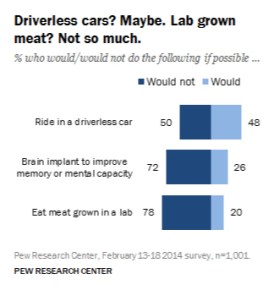
Last week, Pew released a study measuring American attitudes toward future technologies. While the majority of respondents expressed significant reservations about most of the tech, Emily Badger is glad that the driverless car was among the most accepted:

Transportation geeks generally love the idea of autonomous cars because they’ll make ownership unnecessary. When cars no longer need people to drive them, they can drive around all day, transporting one passenger after another after another — in a network PI_2014.04.16_TechFuture_driverless_cars-dish-cropthat might look a lot like personalized public transit. The resulting transportation system would be tremendously efficient. Cars wouldn’t spend the vast majority of their lives parked. We wouldn’t need to devote so much of our land to parking spots. We could get rid of the urban congestion that’s caused purely by people driving around looking for parking. …

Maybe you own a car because you need it, for mobility. But you own that car because you want it for some more intangible reason. In the future, however, the arrival of mass-market autonomous cars will force us to confront the difference between these two ideas. When you no longer need to own a car for mobility, will you still want one anyway for the love of cars, or for what they say about you, or for some other deeply personal reason?

Elsewhere in the study, 65% of respondents felt “it would be a change for the worse if lifelike robots become the primary caregivers for the elderly and people in poor health.” Waldman, on the other hand, welcomes the age of the robo-sponge-bathing:

Part of the reluctance people have may come from the associations we have with the word “robot,” and not just that they might rise up and exterminate us. When you hear the word, what do you think of? Something made of metal and plastic, probably. Not something with gentle hands that could, say, turn you over carefully and apply a soothing salve to your bedsores. But when they actually start designing caregiving robots, you can bet they’ll make sure to make them soft.

That industrial design will be one important part of gaining acceptance for helper robots. But more important will be the fact the need is so great, and they’ll be really, really handy. We already have a glaring need for caregivers for the sick and elderly, and as the Baby Boomers age, it will only increase. There are never going to be enough people to meet the need, unless half the American population is made up of nurses, orderlies, and home health aides taking care of the other half. And that of course would be prohibitively expensive. Robots will be pricey at first, but the price will drop over time, and Medicare will gladly pay a few grand for a bot that can do work that would end up costing tens of thousands of dollars a month if it were done by humans.

Adi Robertson parses more of the study:

Despite our categorical optimism about “technology,” it turns out that we’re sometimes more conservative about things that are actually on the horizon. 63 percent of Americans, for example, think that it would be a change for the worse if US airspace was opened to “personal and commercial drones.” 22 percent thought it would be a change for the better. … 66 percent think that it would be a bad thing if parents could alter a child’s DNA “to produce smarter, healthier, or more athletic offspring,” compared to 26 percent in support.

The most popular advance was a world where “most people wear implants or other devices that constantly show them information about the world around them,” which 53 percent thought would be a change for the worse and 37 percent thought would be an improvement.

Jason Koebler asked bioethicist Jonathan Moreno to explain all the anti-tech anxiety:

“I’m not impressed that this tells us very much how people will respond in a real case,” Moreno said. “If you go back and look at historical change, people were terrified of horse and carriages, they were shocked you could go 10 miles per hour on a train. But then, once you get them on it, we got very comfortable going from 10-40 miles an hour.” The point, Moreno said, is that people adjust to new tech very quickly. …

It’s not hard to think of more recent examples. At first, people were horrified that someone could reach them at any time on a cell phone—now, we can’t live without them. By generally trusting that “technology” as a whole is a force that’ll make people’s lives easier, the public doesn’t have to pick and choose which ones to throw their proverbial support behind. And, maybe it doesn’t even matter what people want—innovation is going to happen regardless.

The African Way To Bank

Noting the widespread use of mobile payments in Africa, Bright Continent author Dayo Olopade thinks through whether similar efforts could succeed in the US. She sees need for the technology because “the poorest 30 percent of Americans were, to use an industry term, underbanked—unable to access credit and financial services within their means”:

Exporting mobile money to the United States, however, entails a slew of challenges that its creators did not face in Africa.

Need drove the invention of M-Pesa and its counterparts, but regulatory ambiguity ensured it could scale. Even today, mobile-banking laws in Africa are evolving slower than the technology itself. One hazard, regulators believe, is that mobile payments can be used for money laundering. While much of this risk is diffused by ID cards, PINs, and caps on transfers, it was not until 2011 that Kenya legislated capital requirements for mobile banking, and only in 2013 did the government begin to tax mobile transfers. Other countries in Africa have been stricter about which entities can serve as mobile financial institutions, but since telecoms are not traditional banks, they fall into a regulatory gray area.

In the United States, however, banking laws are much less malleable, and any activity that smells like banking is subject to a significant burden of compliance with post-crash policies designed to protect consumers. Allowing telecoms or tech companies to act like banks may involve new legislation. Given this headache, mobile money in the U.S. might end up looking different than it does in Africa, perhaps involving partnerships among wireless carriers, hardware companies, and banks. But the bar has been set, and the West now finds itself in the unfamiliar position of looking to Africa for technological inspiration.

Dayo’s “Ask Anything” series is here.

Was Jesus God?

I’m in the home-stretch of the book, Bart Ehrman’s How Jesus Became God, the first selection for the Dish’s resurrected (!) Book Club. I know many readers are, as well. We’ll start the conversation this week – so hold your emails for a bit. I’m going to try and structure debate on the book into some clear, distinct questions, rather than trying to grapple with it all at once.

But as an appetite-whetter and encouragement to finish reading, here are some early reviews. First up, Fr. Robert Barron attacks the core of Ehrman’s thesis – that “explicit statements of Jesus’ divine identity can be found only in the later fourth Gospel of John, whereas the three Synoptic Gospels, earlier and thus presumably more historically reliable, do not feature such statements.” Barron calls this idea “nonsense”:

In Mark’s Gospel, Jesus addresses the crippled man who had been lowered through the roof of Peter’s house, saying, “My son, your sins are forgiven,” to which the bystanders respond, “Who does this man think he is?  Only God can forgive sins.” What is implied there is a Christology as high as anything in John’s Gospel.
how-jesus-became-godAnd affirmations of divinity on the lips of Jesus himself positively abound in the Synoptics.  When he says, in Matthew’s Gospel, “He who does not love me more than his mother or father is not worthy of me,” he is implying that he himself is the greatest possible good.  When in Luke’s Gospel, he says, “Heaven and earth will pass away, but my words will never pass away,” he is identifying himself with the very Word of God.  When he says in Matthew’s Gospel, in reference to himself, “But I tell you, something greater than the Temple is here,” he is affirming unambiguously that he is divine, since for first century Jews, only Yahweh himself would be greater than the Jerusalem Temple.

Perhaps most remarkably, when he says, almost as a tossed-off aside at the commencement of the Sermon on the Mount, “You have heard it said, but I say…” he is claiming superiority to the Torah, which was the highest possible authority for first century Jews.  But the only one superior to the Torah would be the author of the Torah, namely God himself.  Obviously examples such as these from the Synoptic authors could be multiplied indefinitely.  The point is that the sharp demarcation between the supposedly “high” Christology of John and the “low” Christology of the Synoptics, upon which the Ehrman thesis depends, is simply wrong-headed.

Another critic is Michael Bird, one of the contributors to How God Became Jesus: The Real Origins of Belief in Jesus’ Divine Nature – A Response to Bart D. Ehrman:

[W]hile Ehrman insists that there was a continuum between gods and humans in the ancient world, I contend that Jews and Christians held to a strict monotheism that delineated God from the rest of the created order. And when they mapped out where Jesus belonged on this ledger, he was clearly on the God-side – not semi-divine or quasi-divine, but identified with the God of creation and covenant.HGBJ-Cover

And whereas Ehrman thinks that Jesus was a prophet who proclaimed God’s judgment of this world, I argue that the historical Jesus saw himself as proclaiming and even embodying God’s kingship. Jesus believed that, in his own person, Israel’s God was becoming King, which is why Jesus spoke and acted with a sense of unmediated divine authority, why he identified himself with God’s activity in the world, why he believed that in his own person Israel’s God was returning to Zion as the prophets had promised, and why he outrageously claimed that he would sit on God’s own throne.

Meanwhile, Greg Carey criticizes the way some Christians have engaged the book, arguing that “it doesn’t help to dismiss Ehrman for being an agnostic, as if agnostics have nothing to teach Christians about the Bible, Jesus, or faith”:

[T]here is a live conversation among biblical scholars about how most Christians came to regard Jesus as divine. In other words, Ehrman’s book raises questions that should interest us all. This is not about liberals and secularists attacking the church. It’s an ongoing debate that crosses the usual party lines. …

Most Christians, however, have no idea that Ehrman’s book represents a genuine conversation among informed scholars. This is unfortunate. Nothing Ehrman is saying would surprise a biblical scholar at even the most conservative theological school. This knowledge gap constitutes a failure of educational ministry in the churches. We Christians should be learning to engage legitimate public conversations about Jesus, about the Bible, and about our faith. And we should attend to spiritual development that equips us to enter those conversations with humility and love.

I might as well state one core reason I picked this book. I strongly believe that Christians need to absorb all we can about the origins and debates over the texts that have come to form our faith. We should have nothing to be afraid of but the truth.

And the theological truth and the historical truth – while constructed in different terms and according to different criteria – must be compatible. No religion founded on untruths can or should survive. Which is why the meaning of the Incarnation and the Resurrection must be addressed squarely within the bounds of history and scripture properly understood – if we are to respect Christianity as a modern faith. This project, of course, is as challenging for a Christian as it is for a non-believer like Ehrman. And it’s worth remembering Ehrman’s reasons for being “obsessed” with Jesus, despite being an agnostic:

Without that declaration [of Jesus’ divinity], Jesus’ Jewish followers would have remained a small sect within Judaism. Probably a very small sect indeed. Converts would not have flocked to their cause — especially Gentile converts, any more than they flocked to the cause of the Pharisees or of John the Baptist.

If Gentiles had not started converting, eventually at an impressive rate, Christianity would not have grown exponentially over the next three hundred years. If Christianity had not been a sizable minority in the empire by the early 4th century, Constantine almost certainly would not have converted. If Constantine had not converted, the massive conversions in his wake would never have occurred. The Empire would not have become predominantly Christian. Theodosius would not have declared Christianity the state religion. Christianity would not have become the most powerful religious, cultural, social, political, and economic force in our form of civilization. We would not have had the Middle Ages, the Renaissance, the Reformation, or Modernity as we know it.

All of that history and culture hinges on the belief that Jesus is God.

So was he? That very question is what we’ll be debating this coming week.  Update from a reader:

Yay! I found myself bitter and cynical about this Easter. I was able to articulate it to my wife after freaking out about the volume of sugar and artificial dyes going into our young children: “Why do we celebrate the birth and death of Jesus, and not his actual accomplishments?”. To me, he represented a transformational shift in thinking about love and power that is at least as important as his divine status. Or maybe not? Both major holidays are all about worshiping Jesus’s divine status, rather than his deeds as a living man. Aren’t his teachings and example central to Christianity? How do our major holidays represent the core values demonstrated through Christ’s living, if at all? He did offer a bit more than his own claim to being the One True God, right? That’s what’s getting me down.

Anyway – I’m gonna load Ehrman’s book on my Kindle. I’m psyched you brought this up.
Sex In Transition

“I fucking hate my penis,” Molly at The Toast freely admits, reflecting on the “Before Times” of her sex life before beginning the process of sex reassignment surgery:

[A]t no point did sex ever come naturally or easy to me as a man, because I found it really hard to stay erect when with a woman. I sustained almost no pleasure from sex, and if my ex had been the kind of woman to watch Archer she’d have spent a lot of nights telling me I was pushing rope. The thing seemed to be a mystery to me. I was attracted to women (mostly), but it did not react to them in a way that was consistent with that attraction. I started to believe that at some point every other penis-owning humanoid had been given a manual on how to operate their dicks, but mine had been lost in the post. It made me feel like shit, every time it failed me – and it failed me a lot.

Over time me and my ex figured out tricks to make it work, but they were just that – tricks.

They all seemed to rely on telling stories, and my ex became really great at making up erotica on the spot while actively engaging in erotica. She’d tell a story about some dirty schoolgirl, or herself in a compromising situation, and looking back I can pretty clearly see what was going on and why they worked so well. The actual physicality of sex, the mechanical aspects, became static as she told the stories, and I was able to put myself not in the role of the male aggressor, but in the role of her, or the schoolgirl, or whatever. Anything but me. Anyone but a man. That’s what it took.

In quiet moments back then I would allow myself to hate my penis like I hate it now; imagining universes where I’d been born female or timelines where I’d come out of the closet years ago and had finished all the surgeries and hormones and everything else already. I knew what was going on, in my mind, but I did not want to give a voice to it, not then. It was easier to live a lie and go through a performance for the outside world while suffering immeasurable mental anguish than it was to be honest with myself.

Ask Dave Cullen Anything: How The Media Failed Columbine

Yesterday, on the 15th anniversary of the massacre, the Columbine author explained the lessons we still haven’t learned from it – namely, the dangers associated with overexposing the killers. Along those lines, it’s always worth revisiting Charlie Brooker’s epic video rant about post-shooting news coverage, many tropes of which originated with Columbine. In today’s video, Cullen highlights the biggest misconceptions about Columbine that cable news helped propagate:

In a followup, Cullen addresses the question, “How could the media get the Columbine story so wrong?”

More about Cullen:

Dave Cullen is the author of the New York Times bestseller Columbine, a portrait of the two killers and their victims that he spent ten years writing and researching. The book won the Edgar Award, Barnes & Noble’s Discover Award, the Goodreads Choice Award, and was declared Top Education Book of 2009 by the American School Board Journal. He has also written for New York Times, Newsweek, Guardian, Washington Post, Slate, Salon, and Daily Beast. Dave has additionally been a frequent television and radio analyst, appearing on Today, NBC Nightly News, PBS Newshour, CBS This Morning, Anderson Cooper 360, The Rachel Maddow Show, Hannity, and Morning Edition. He is currently working on a book about two gay colonels, who he has followed for twelve years.

Watch his previous videos here.

(Archive)

What’s The Deadliest Sin?

The wonderful magazine, Intelligent Life, is having a symposium. The indispensable Ann Wroe (see her astonishingly good biography of Pontius Pilate) considers the deadliest sin ingratitude, “a sin against charity, which otherwise warms the heart and, in the truest sense, makes the world turn”:

The incidents seem trifling. After the dinner party, no note is sent. (Well, you were busy, and the dinner Crostwight_Seven_Deadly_Sinswasn’t that elaborate.) The solicitous e-mail gets no reply. (Again, you’re busy, and don’t feel like chatting.) A driver gives way to you at a place where there is no clear priority; you don’t acknowledge him. A fellow pedestrian steps into the road for you, or holds a door; you breeze on by. On holiday, you give your smallest and most worthless coins to the woman who has carefully cleaned your room. …

No blood is spilt in any of these cases. Nothing is stolen. No one’s life is ruined. The prick of pain passes soon enough. Yet a tiny seed of ice has been sown, formed of arrogance on one side and, on the other, a sense of worthlessness. That ice spreads, and creeps into the veins and crevices of life: so that on the next occasion the door is not held, the room is cleaned carelessly, the car does not give way and the e-mail is never sent. As the opportunity for kindness is ignored, so the chance of reciprocal kindness, in the form of thanks, never comes to be. What is never given can never be repaid.

I have to say I love that insight. One of the great curses of fundamentalist Christianity is its obsession with sexual sin above all others. I recall the great Malcolm Muggeridge’s line about why lust may be the least un-Christian of the sins: because lust is so often about “give, give, give!” But the small acts of mutual disregard, gracelessness, and distancing from the other – which we all do every day – can be far more corrosive. Passion is more forgivable in my book than indifference.

Will Self thinks pride is worse: “While you can perfectly well be proud without being avaricious, or slothful, or covetous, it’s absolutely impossible to transgress in these ways without first being proud.” But for Richard Holloway, no sin is deadlier than envy:

Every other sin offers some gratification, if only in its early stages, but envy is an empty and desolating experience from beginning to end. It is the meanest sin in the book, which is why few people ever own up to it. François de La Rochefoucauld captured its joyless secrecy in 1665: “We often pride ourselves on even the most criminal passions, but envy is a timid and shame-faced passion we never dare acknowledge.” Virginia Woolf thought it was the besetting sin of writers, and Gore Vidal agreed with her. Whenever a friend succeeded, he wrote, a little something in him died; for him it was not enough to succeed—others had to fail. Vidal’s spleen captures both aspects of envy: sorrow at another’s good and satisfaction at another’s misfortune, what the Germans call Schadenfreude, shame-joy, pleasure in the distress of others. …

Is there any remedy for this nasty little sin? There are two steps we can take to get it under control. The first is to acknowledge its presence and admit our own meanness of spirit. The other step is to recapture our capacity for sharing the joy of others.

So much easier to say than do – especially in that crowded, talented island off the north of Europe. My favorite poem on modern literary envy is by Clive James: “The Book Of My Enemy Has Been Remaindered.” It’s from his fantastic poetry collection, Opal Sunset.

(Image via Wiki: “‘The Seven Deadly Sins’, medieval wall painting in the nave of the parish church of Crostwight, Norfolk. Date c.1360-80”)

Where The Hard Left Says No, Ctd

Eric Levitz takes stock of the Ayaan Hirsi Ali controversy:

One of the most popular lines of argument in the Ali apologias is that Brandeis is guilty of applying an outrageous double standard, one that allows for the hateful criticism of Judaism, but not a fair critique of Islam. Bill Kristol complains that while the university refuses to honor Ali, they saw fit to bestow a degree on playwright Tony Kushner in 2006, despite the fact that Kushner had “called the creation of Israel as a Jewish state ‘a mistake’ and attacked Israel for ethnic cleansing.” Andrew Sullivan echoes this complaint, writing in the Dish:

Kushner was challenging his own ethnic group just as powerfully as Hirsi Ali is challenging her own. But here is the question: why is he lionized and Hirsi Ali disinvited? Why are provocative ideas on the “right” less legitimate than provocative ideas on the left?

The irony of this argument is that by equating Kushner’s anti-Zionism with Ali’s condemnation of Islam as a “nihilistic death cult,” Kristol and Sullivan exemplify a double standard exactly opposite to the one they allege.

Whatever one’s opinion on the necessity of a Jewish state, it is a fact that a portion of the Jewish community has been opposed to state Zionism for centuries. Whatever one’s feelings on Israel, it is a fact — confirmed even in the work of Zionist historians like Benny Morris – that hundreds of thousands of Palestinians were forced from their homes by Israeli soldiers in 1948. Thus Kushner’s statements align him with a minority position in the Jewish community, and assert a historical fact.

Ali’s statements assert that no form of Islam deserves our tolerance, because inherent to the religion is a violent fascism that must be defeated. Kushner asks Jews to question the violence required to establish and maintain a majority Jewish state, in a region densely populated by Palestinians. Ali asks the U.S. government to declare war on the Muslim faith. Her “provocative” ideas aren’t less legitimate because they come from the right. They’re less legitimate because they assert that every “true” follower of Islam subscribes to an ideology of terror.

I have not seen where Hirsi Ali has called on the US government to declare war on Islam – since that would obviously require suspension of the First Amendment. Her crude rhetoric against the religion is, I’d say, of a piece with much of the new atheists’ contempt, with a unique, female edge. Would Richard Dawkins or Sam Harris have an honorary degree retroactively revoked and only allowed to speak on campus if rebutted in the same forum? Levitz also specifically calls me out here:

Curiously, not one of the pieces protesting Brandeis’ decision actually quotes Ali’s past rhetoric. Instead, they refer obliquely to her “stinging attacks on non-Western religions,” “provocative ideas” or, most opaquely, her “life and thought.” The simplest explanation for this chronic omission is that to actually engage with Ali’s rhetoric would be to expose the absurdity of the Judeo-Christian persecution complex that informs so much of the genre.

I really don’t think I can be accused of harboring a Judeo-Christian persecution complex. And, of course, the Dish ran a number of dissents that highlighted Ali’s most reprehensible rhetoric. Since I’ve been careful over the years to distinguish between Islamism, modern Islamist fundamentalism, and the entire civilization and history of Islam over the centuries, I understand why Ayaan’s rhetoric – especially in one critical interview – can be seen as over-the-top. This piece by Ira Stoll is as good a defense of Brandeis as I have read.

I’d just proffer the notion in response that if you had been genitally mutilated and nearly forced into an arranged marriage … you might get a little over-the-top as well. When you’ve had a death threat attached to a knife in the corpse of your film-making partner, I think you get something of a pass for being over-the-top at times. And usually, a woman who had endured such trials would gain a sympathetic audience in a university campus.

Meanwhile, Freddie deBoer, reflecting on the Eich and #CancelColbert affairs and others, scrutinizes the hard left:

The congealing conventional wisdom among progressives now is that the right to free expression has only been abridged if government literally physically prevents you from speaking. Absolutely every other way in which your right to express yourself is fair game. So when I wrote about a University of California Santa Barbara professor who physically ripped a sign from the hands of another person in an attempt to silence that sign’s message– her quote was literally, “I’m stronger so I was able to take the poster”– it was patiently explained to me by patiently explaining liberals that there was no actual abridgment to free speech, because the government hadn’t sent tanks to silence those protesters. What that professor did was “direct action” and was thus permissible. Why that person using her physical advantage to silence someone amounts to direct action, and a crowd beating up antiwar protesters would not, I have no idea.

Waldman worries about an unintended consequence of such intolerance, especially in cases like Eich’s – donor secrecy:

Here’s a sign of what’s to come. Charles Krauthammer, the most influential conservative pundit in America, has published a broadside against campaign disclosure, in which he says he used to favor the combination of no limits on contributions and full information on who’s donating. “This used to be my position,” Krauthammer says. ”No longer. I had not foreseen how donor lists would be used not to ferret out corruption but to pursue and persecute citizens with contrary views. Which corrupts the very idea of full disclosure.”

Beware of unintended consequences and of over-reach.