Exposing Becker’s PR Campaign

You might imagine that the Pulitzer-prize winning New York Times journalist would have attempted journalism in writing what is billed as a “definitive account” of the marriage equality movement. And if you mean by Meet the Press - Season 67journalism, being a stenographer and hagiographer for a handful of interested parties intent on spinning themselves as the new Rosa Parks, you’d be correct. No one doubts the validity and accuracy of the breathless accounts of Chad Griffin, Ted Olson and David Boies that Griffin, Olson and Boies gave directly and exclusively  to Becker.

But is it journalism never to seek any alternative views, or objective facts or actual history outside the bubble of access journalism? Is it journalism to make grand and sweeping statements about gay history, thereby revealing that you know nothing about it?

Now of course I am an interested party here, having been part of the movement for twenty-five years, but who, like so many 0thers, got wiped from history in Becker’s ridiculous book. So take my own biases into account here as well. But here’s the reasoned view of Chris Geidner, the best journalist on gay politics in the country, who has meticulously followed and covered the marriage equality movement for years. If you read one article on this book, read Geidner’s. His bottom line:

The small universe of people who constitute Becker’s sourcing for the book — and her apparent unwillingness to explore alternative reasons for or views of the developments those sources discuss — make the book a dangerous draft of history.

Geidner points out that the book is best understood as “a piece in [a] public relations campaign, orchestrated by Griffin, who is now the head of the Human Rights Campaign, the nation’s largest LGBT rights group.” It is designed to rewrite history to make an organization that was long a frustrating, infuriating laggard in the movement to be the indispensable force for real change. All the manifold facts, events, lawsuits, demonstrations, arguments, articles and books that get in the way of this PR campaign are removed, deleted, or simply ignored.

Case in point: the early, epic scene in Becker’s book in which a lone voice for equality, Dustin Lance Black’s, speaks truth to power. Geidner notes:

“If there was applause, Black didn’t remember any,” Becker writes. “Instead, he recalled an ocean of pursed lips and crossed arms, and that he was literally trembling as he walked off stage. … Tim Gill … denounced Black outright, telling the crowd he was naive and misguided.” Video from the event provided to BuzzFeed, though, shows that the speech was interrupted with applause five times. At the end, at least some members of the audience gave Black a standing ovation, the video shows.

The first words after Black’s speech were from the moderator:

Thank you. Righteous, real energy! That’s what we need! Urgency. Thank you.

If there was video of the event and you were a reporter and had a key passage describing that event, wouldn’t you want to check the video to see if your source’s account is true?

Becker didn’t – because it was irrelevant to the self-serving narratives of her exclusive sources. She also asserts, for good measure, that Black was denounced by Tim Gill – but the truth, as Geidner proves with transcripts, is simply different.

And so her book simply distorts and misleads and delivers excruciating contortions of logic and history again and again. (For even more evidence of this, see Aravosis.) Moreover, all the distortions in the book – about every moment in the movement – have the same effect: making Griffin and Boies and Olson into Rosa Parks, Martin Luther King Jr and Lyndon Johnson rolled into one. That’s why this book is such a travesty of both history and journalism and why the NYT’s publishing an extract from it is something their public editor should look into. It’s also why the movement has to take a long, hard look at its biggest organization, HRC, and ask why its executive director, for the first time in the marriage movement’s history, is trying to make one individual – himself – the alpha and omega of the entire breakthrough.

That has never happened before. And it is in effect an attack on the very movement HRC purports to lead.

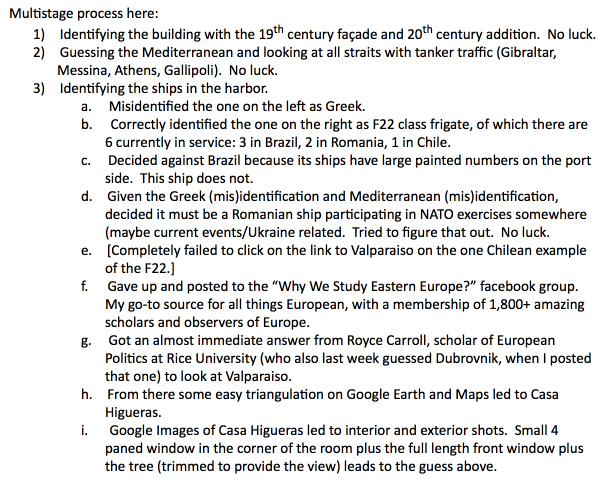
(Photo: Jo Becker appears on “Meet the Press” on April 20, 2014. By William B. Plowman/NBC/NBC NewsWire via Getty Images)

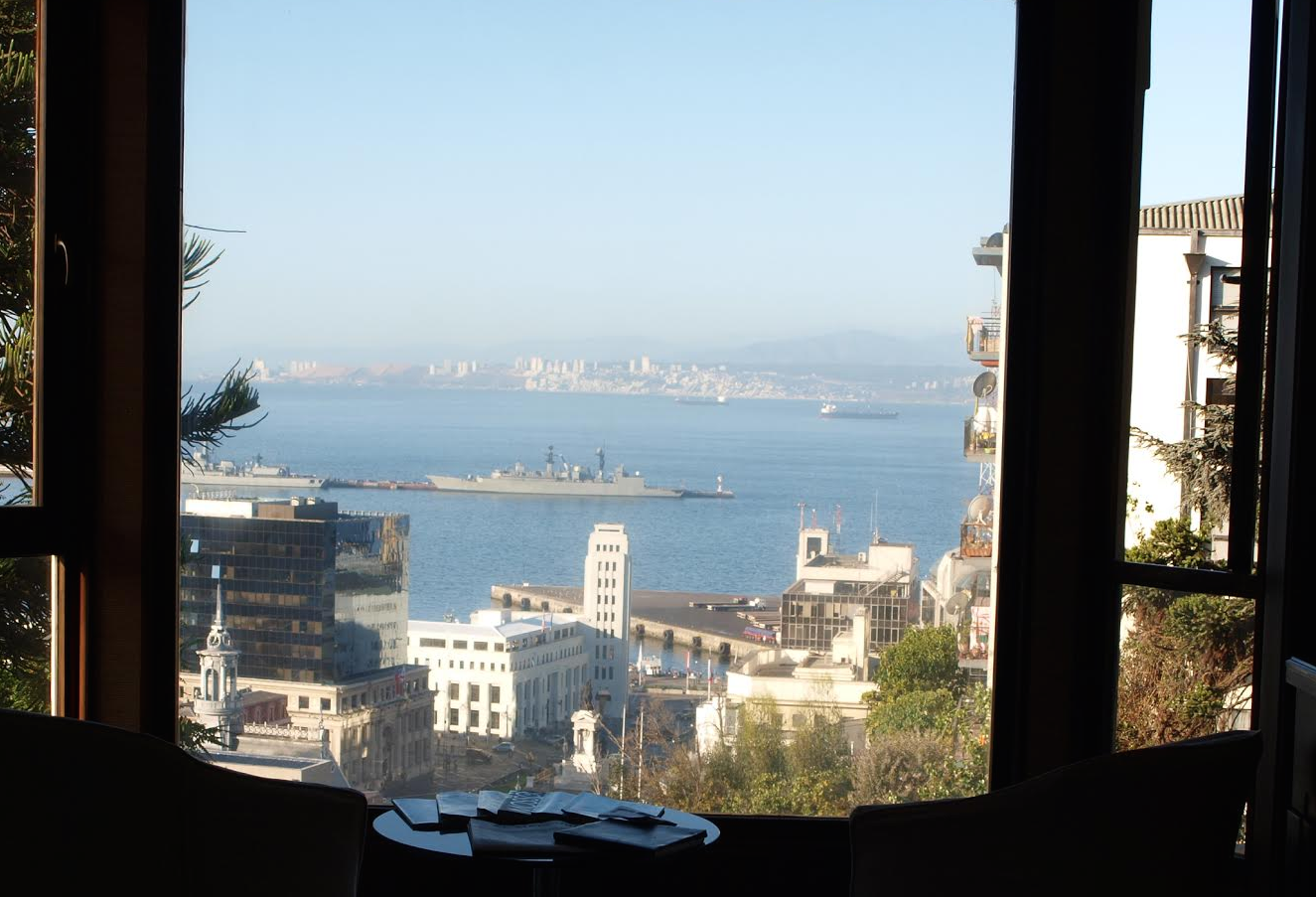
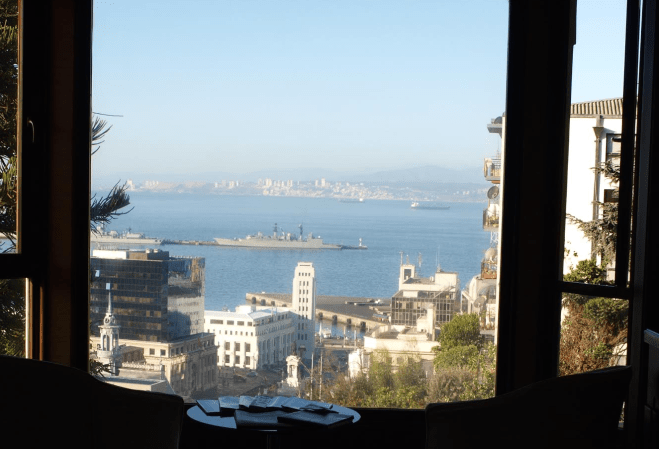
The View From Your Window Contest: Winner #201

vfwy_4-19

A reader exclaims:

Oh beautiful Málaga!

Another:

San Francisco! Or very close to it. That haze the last few days has been gross.

Another:

San Diego! (or “whale vagina”, in the native German)

Another sees Italy:

Taking a shot here, though more out of sentiment than reason. Red clay tiles and pine trees say Mediterreanean. Satellites look to be pointing northwest. Some older buildings, possibly Austro-Hungarian architecture. Statue of … Garibaldi (?) So, since I lived there for a few lovely months some 20 years ago while researching James Joyce, I’m going to say it’s Trieste, or maybe Maggia, which is just to the south. “Yes I said yes and he loved Trieste yes but he’s got it all wrong yes…”

Another thinks it’s Naples. Or maybe Marseille? Another thinks he spots a flag:

Ok, European-style buildings, warships, oil tankers, a narrow strip of water and (what looks like) the flag of the Russian navy. All signs point to the Black Sea port of Novorossiysk, Russia. Except I can’t find those buildings! So I guess I’m wrong … Ah well, hopefully I’m at least closer than the wife, who guesses Gibraltar.

Another sides with the wife:

I have spent hours looking at this, and there’s one thing Im sure of: this picture was not taken from Gibraltar.  Im going with Gibraltar anyway, because I really want that to be the answer.  Gibraltar is awesome.  It has wild apes.  Nowhere else in Europe has wild apes.

I have attached a picture of one of the apes.  Also, I may be going slowly insane staring at this window.

Gibraltar was actually the most popular incorrect guess:

First thought was San Diego – military base, semi-tropical vegetation – but after spending a few minutes looking at maps of San Diego, that doesn’t seem quite right – though it really could be almost any port in southern California.  How about Sevastopol? (It’s certainly in the news – but I’ve never been there and again, the maps don’t seem right).  Gibraltar seems a plausible fit – so I’ll go with that.  The magazine display in the foreground looks like a high-end hotel spread.  So if I had the patience and skill (I actually have some patience, but very little skill), I’d try and find a hotel window looking west over the harbor towards Algeciras.

Another looks east:

My guess is that this picture was taken somewhere along the Bosphorus in Turkey. I took a cruise down the straights a few years ago, and the cargo ships, naval vessels, river hillsides, pine needles, and satellite dishes on those balconies brought me back. Not going to get a more specific guess out of me though – about 5 minutes of searching for “Turkish naval vessles” and “hotels overlooking the Bosphorus” left me discouraged. Who are these people who can search for hours?

Two readers even guessed the Middle East, but this reader gets us on the right continent: “Cartagena, Colombia”. Another, like the majority of our contestants this week, nails the right country and city:

Holy crap – I think I finally got one.

I’m thinking it is in Valparaiso, Chile, and the view is from Pablo Neruda’s home La Sebastiana.

Not Neruda’s home, but close. Another focused on a single detail:
treeThe tree ended up being a very helpful clue for me.  It has the distinctive look of a Cook pine. Wikipedia says that Cook pines are planted abundantly in Australia, Brazil, Chile, New Zealand, Peru, Portugal, South Africa, Spain, so I figured that was as good a starting point as any.

The cars are driving on the right, which knocked out a few countries instantly. I started looking around for cities with a naval presence in the remaining countries, and bam! Valparaiso.  The picture is taken from a building overlooking Plaza Sotomayor. Another fun contest!

Another used the tree to figure out the right building:

The large pine tree resembles, at least to me, a Norfolk Island Pine (Araucia–it could be another species), which I associate with the South Pacific region. As the climate appeared temperate in the photograph, I started my search in New Zealand. When that failed, I went to Chile because of its temperate coastlines and grand colonial buildings and monuments, such as those seen from the contest window. Once in Valparaiso, all the clues fell into place. The large pine tree on the hillside was dominant in many of the photographs taken from Plaza Sotomayor and of the Chilean navel headquarters. A search for hotels in the area listed Hotel Casa Higueras. The large pine tree was conspicuous in many photographs of the hotel and promotional photographs posted on travel websites looked very much like that taken from the contest window.

A long-time contestant:

I wonder if any of your other readers had a strange sense of deja vu upon seeing the view for this week’s contest. That pier with the navy destroyers … those gleaming buildings across the bay …

And then it came to me. One summer day in August 2012, I spent the better part of an afternoon studying every nuance of the photo for contest #115, trying to figure out where in the world was this magnificent port city that I had never seen before. That photo obviously left an imprint in my brain, because this week’s view was unmistakeable: Valparaíso, Chile.

Having nailed that down, a scan of Google Maps identified the statue in the foreground as the Monument to Naval Heroes in Plaza Sotomayor. Over to Google Earth, where some careful triangulation with the 3D buildings helped me line up the view just right. When I looked around that spot, I found a geotagged Panoramio photo with the name of a hotel: Casa Higueras.

And now I’m booking my ticket to Valparaíso.

A happy reader adds:

I’m guessing this week’s contest was intended to give those of us who never get it right a chance to feel good about ourselves. Thanks for showing a little mercy.

Sounds like next week might be time for a more merciless view. More than 60 people answered the correct city this week, and most of them got the hotel as well. To add some geographical context to the range of guesses, below is a map from OpenHeatMap, developed by Dishhead Pete Warden, plotting all of the entries this week (zoom in by double-clicking an area of interest, or drag your cursor up and down the slide):

This embed is invalid

Several readers took advantage of a useful clue:

Given the diversity and globetrotting nature of your readership, I imagine you’ll get a lot of correct entries for this week’s contest. I didn’t find it by identifying any of the several visible landmarks (the Naval Building, the monument to naval heroes), but by discovering the magazine with the word “MOSSO” on it that’s visible on the table.

mossoSome Googling led me to find out that Ernesto Mosso is sort of the Ralph Lauren of Chile, and may be the most interesting man in the world. He publishes a magazine called MOSSO Life, which apparently goes to a lot of hotels in Chile. It didn’t take much searching to locate the port of Valparaíso and recognize I was in the right place.

A first-time contestant:

I’ve always been a bit intimidated by the level of detail of the winning entries. But this is the second time in the last few weeks I’ve looked at the photo and thought, I’ve been there …

The first was Guam. When I saw that picture my gut told me right away it was Guam, but a cursory search of Google maps didn’t reveal any obvious location, so I figured I was wrong. When I saw the picture this time my mind was screaming Valparaiso, so I wasn’t going to be deterred. A little background: I visited Valparaiso as a merchant marine cadet back in 1991. Of all the ports around the world that I visited during my time in the merchant marine, Valparaiso was one of my favorites.

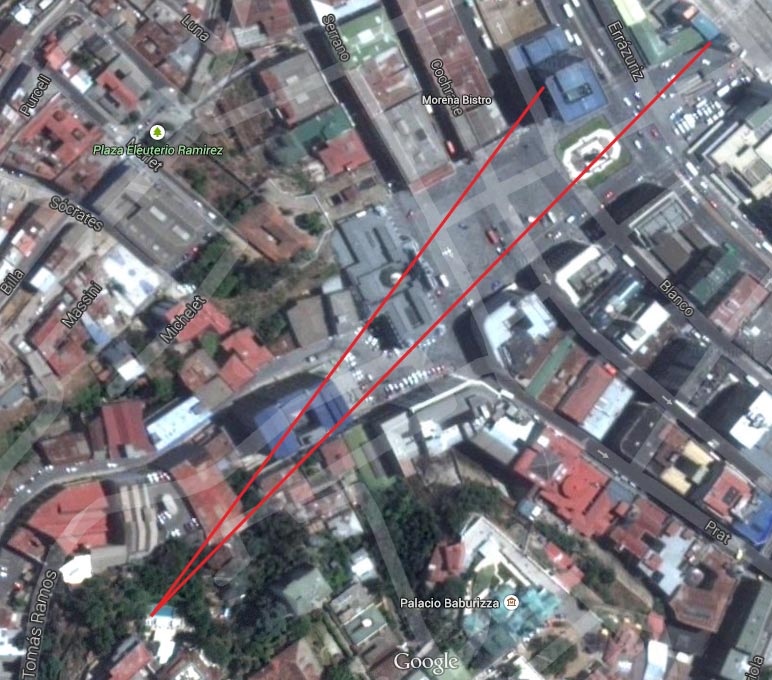
Anyway, the Navy pier in the background is a dead giveaway. Using GoogleValparaiso 1 maps I was able to draw a line from the end of the pier through the tower that is visible in the photo.
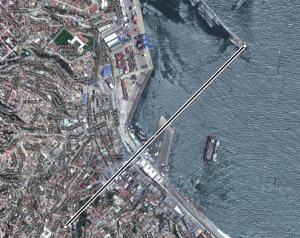
The photo looks like it was taken from a hotel on a hillside, and the line passes directly through a building on a hillside. The view from the window was likely from a hotel, since there was a neat arrangement of brochures on the table. Zooming in on the map, I was hoping Google would give me the name of the hotel. Of course, nothing is so easy, clicking on the building gave me nothing. My next hint was a street name, Higuera. So I tried a google search for “Valparaiso hotels Higuera”. Bingo. Casa Higueras.

A Boston native is struck by coincidence:

Of all days to get this view. A year ago I217415929 was staying at a quaint hostel in the Cerro Alegre neighborhood of Valparaiso from where this photo was taken when I learned of the tragic Boston Marathon bombings. We had spent that day wandering the streets Cerro Concepcion and Cerro Alegre, Plaza Sotomayor, and venturing the hills to see the home of Pablo Neruda. When we found out, we spent several hours on the phone and on Skype with relatives and friends back home to find out what had happened and to make sure that everyone we knew was okay.

So it’s fitting that a year later and on the eve of the first marathon since the bombing, I get a view of Valparaiso while in my apartment in Somerville. I’ve included one of the photos from my trip.

Another gets nostalgic:

YES – for the first time ever in a VFYW contest did I know within a couple of seconds what city I was looking at: I spent several years growing up, on and off, in Santiago, and the occasional trip to the coast would involve a visit to the harbor city of Valparaiso, and when I was little, a boat ride through the harbor. The pier in the middle of the picture, even over 40 years ago, always had a few navy ships and the occasional submarine docked on in. Harbor tours leave right on the waterfront behind the white tower in the picture.

In a country known for its nature and landscapes (Atacama desert, Andes, Patagonia) but relatively short of interesting architecture and cityscapes, Valparaiso is an exception. It was the leading commercial port on South America’s Pacific role in the late 19th and early 20th century on shipping routes between the Atlantic and the Pacific (via the southern tip of South America). Its importance was much diminished with the opening of the Panama Canal in 1914. In 2003 parts of the city were declared a UNESCO World Heritage site. For an interesting overview, click here.

Unfortunately, the city earlier this month suffered from devastating fires in the hillsides that killed 15 and destroyed over 2500 homes.

Another used some triangulation to pinpoint the right window:

In the photo, the statue in the square lines up exactly with the inside corner of the far tower, while the spire at left lines up somewhere in the middle of the bluish office building. The intersection of these lines suggest that the photo was taken from somewhere near the western edge of the white building on the map:
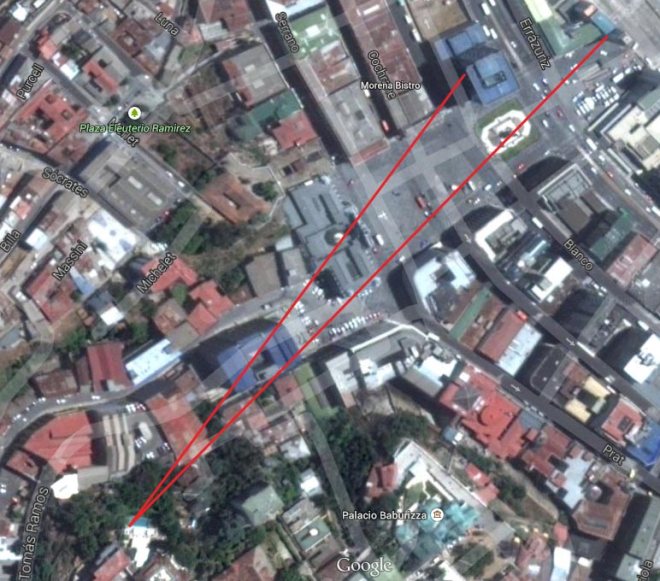
valparaiso_2

It appears that this building would have an address on Calle Higuera. Searching for that street in Valparaiso finds the hotel Casa Higueras. A Trip Advisor photo for Casa Higueras from 2011 titled “la baie vitrée du salon de lecture” shows nearly the exact scene as the contest photo, suggesting that the photo was taking from the hotel’s “reading room”:
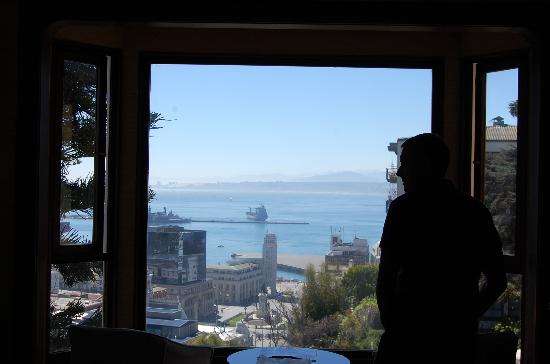
la-baie-vitree-du-salon

The inimitable Chini:

I should have known. Two days after Marquez dies, what chance was there for us not to wind up in the reading room of a South American hotel? (For the Marquez fans, when I heard that he had died I discovered that an old website that I used to go to is still kicking. Definitely worth a visit, especially for the bio.)

This week’s view comes from Valparaiso, Chile. The picture looks northeast along a heading of 40.60 degrees from the Casa Higueras Hotel over the same harbor featured in VFYWC #115.
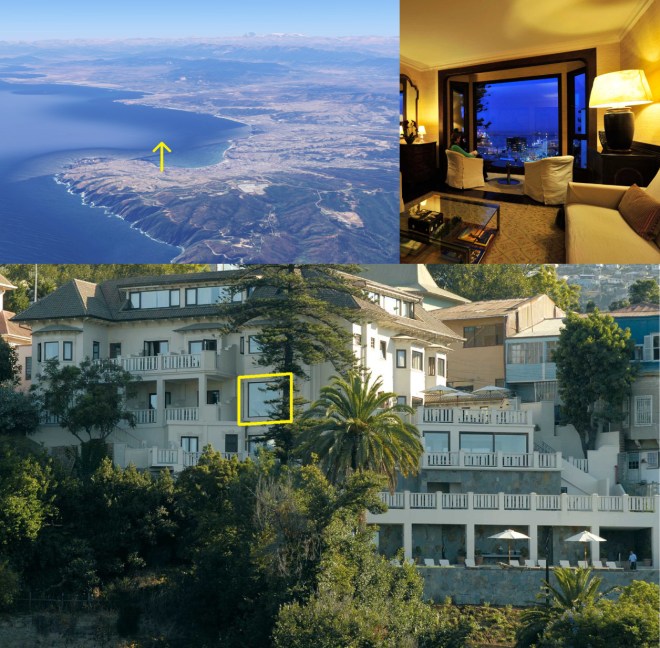
VFYW-Valparaiso-2014-Chini

Although this contest was relatively easy, it also provided my nerdiest moment yet. Upon loading the view, the very first thought that ran through my head was “That looks like a Type 22 Sheffield” – as in, the class of British frigates. And the ship in the center is indeed the Amirante Williams, a former Type 22 that was sold to the Chilean Navy. So that’s my pro tip for the week: get in a time machine, spend your childhood developing a uselessly encyclopedic knowledge of NATO ship profiles, and you too can track down views more quickly.

Another joins Chini in nerdom:
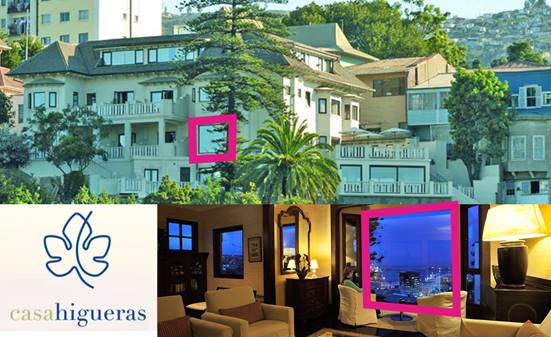
image002

outline

Simple, really.

Another has more details on the ship:

It’s a nice change of pace to be hunting ships instead of buildings. Plus, I learned a whole lot about frigates. The central warship in this week’s view is a Type 22 frigate, originally built for the Royal Navy. The Royal Navy decommissioned its last Type 22 in 2011, but several frigates sold to Brazil, Chile, and Romania remain in service. The architecture and coastline clearly suggested South America, so I took a quick look at the four Type 22s in the Brazilian and Chilean navies. The ship in question is the Almirante Williams, Chile’s only Type 22 frigate. (The Almirante Williams was previously HMS Sheffield (96), named in honor of the Type 42 destroyer of the same name that was sunk during the Falkland Islands War.) After a quick search of Chile’s naval bases, I finally ended up in Valparaiso.

One of the most detailed entries:

Every website I visited for information shows a beautiful and vibrant city. (Though of course Valparaíso is still recovering from the wildfires last weekend that left many dead and thousands homeless.)
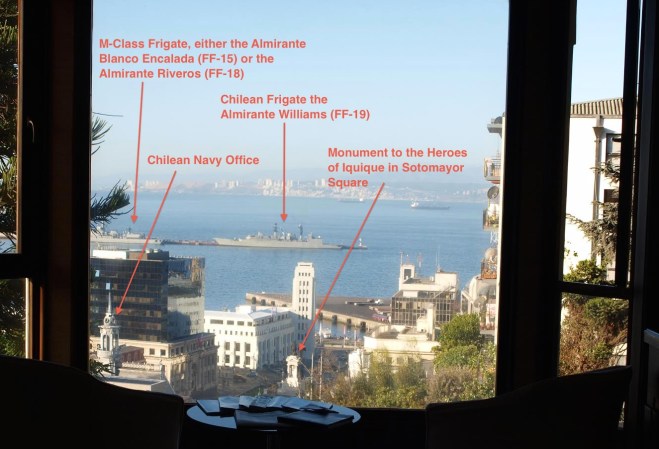
Contest photo with ships and monument labeled

The Monument to Heroes of the Battle of Iquique sits at the center of the picture above the table. Although Chile lost this naval skirmish, it won the War of the Pacific against Peru and Bolivia. As a result of securing territory from Peru and Bolivia, the Chilean border moved much further north and Bolivia became landlocked.  Bolivia has been attempting to regain access to the sea ever since, and just last week filed a lawsuit against Chile at the International Court of Justice in the Hague. I used photos of Chilean naval vessels, Wikipedia, and the navy’s own website to identify the ships.

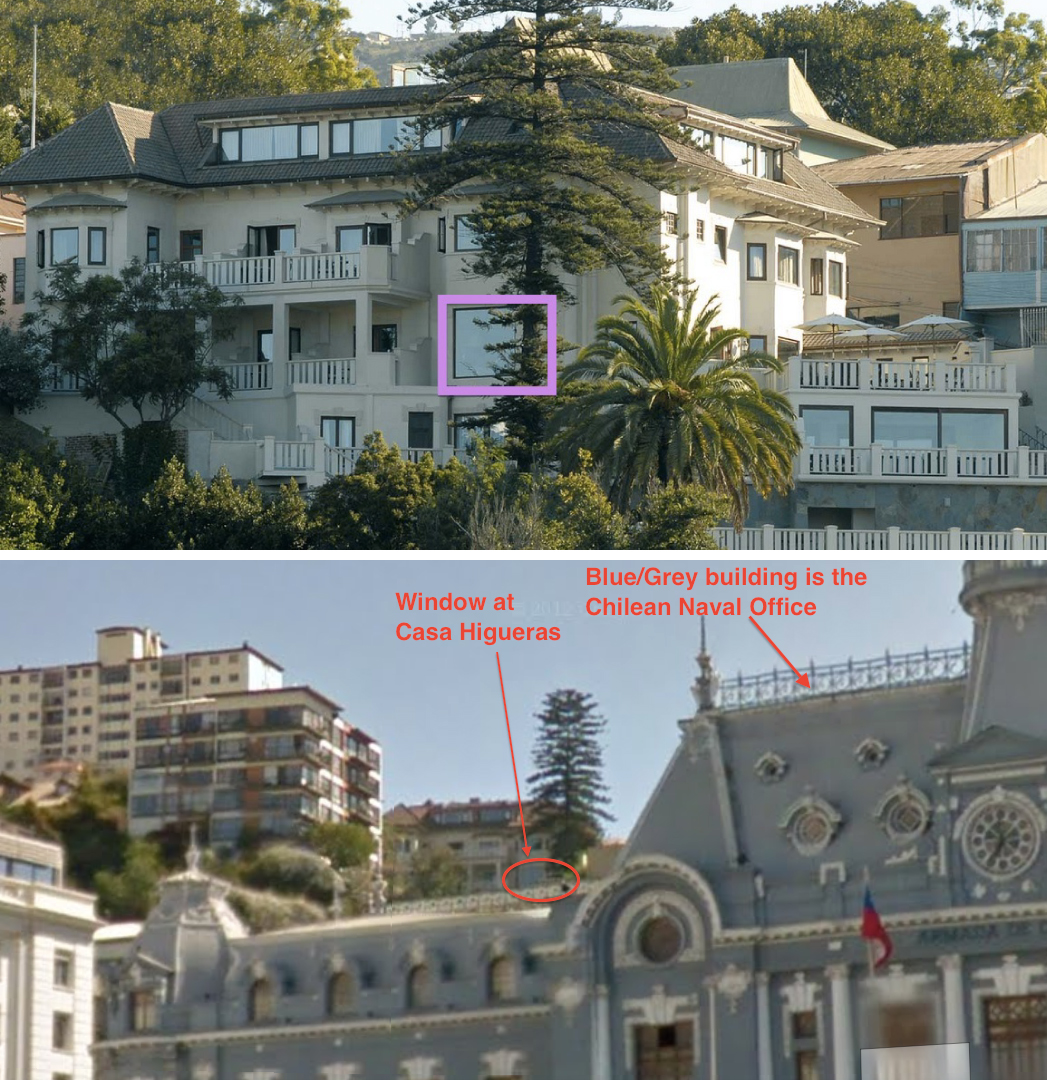
picture-from-the-hotel-website-with-window-squared

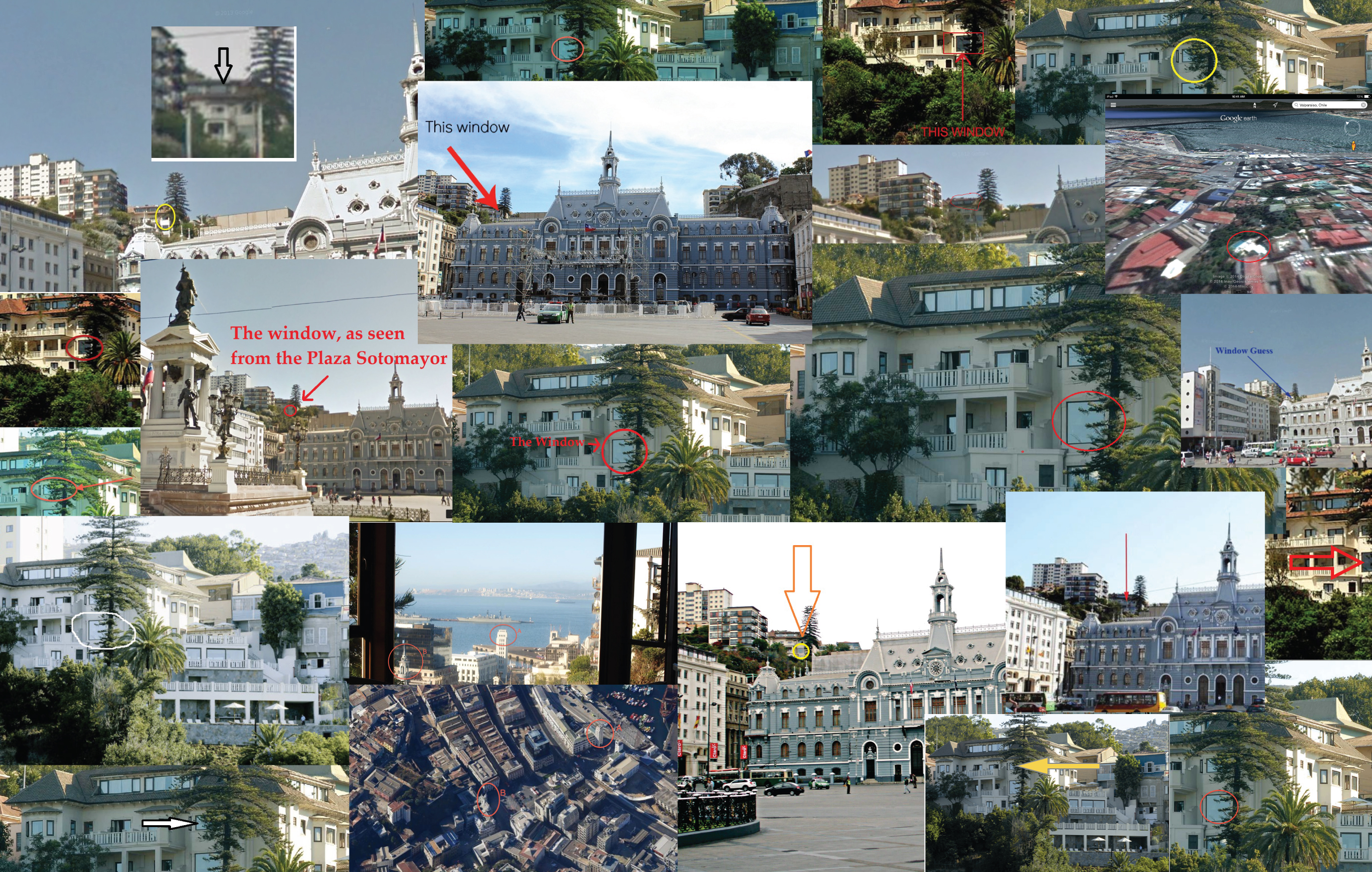
Congrats to the two dozen people who picked the right window this week. If you’re one of them, see if you can spot yours:
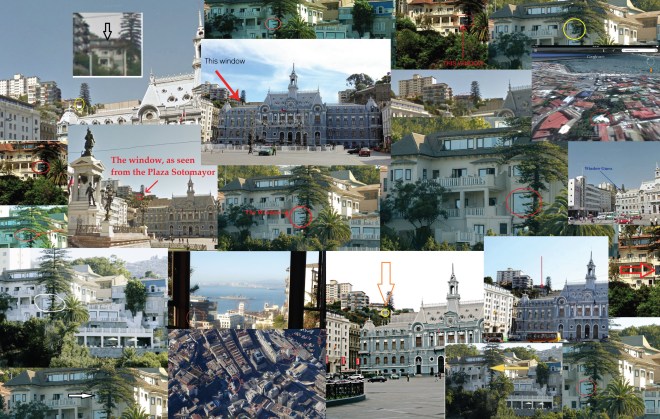
VFYWC-201-Guess-Collage

One of those belongs to this week’s winner, who had the best overall record without yet winning, having participated in 24 contests over the past few years:

I always love it when a gut feeling pays off in this contest.  When I first looked at the picture, I thought it looked like either Lisbon or Valparaiso, and Valparaiso it is. Nailing down the actual location was a little harder because Google street view isn’t especially accurate or helpful here. Long story short, it’s taken from the bay window in the reading room (thank you TripAdvisor) of the Casa Higueras Hotel atgraffiti 133 Calle Higuera in the Cerro Alegre area.

I’m too lazy to paste either of them in, and I’m sure you’ll get several other copies of them anyway, but both the hotel website and TripAdvisor have pictures out the same window, and I have to admit it’s a pretty great view.  I did attach a picture from Street View looking back up at the hotel from the plaza with the statue with the window circled.

I was in Valparaiso a couple of years ago and really loved it.  Somehow I’d totally missed the news about the devastating fire there until I was searching for this view.  It sounds like it was uphill from the historic areas, but I was sorry to hear about it.  Valparaiso is not a wealthy city, so it will be a lot to recover from.  The thing I remember most about the city is the graffiti art that you find all over, but especially up in the hills.  I attached a picture of one of my favorites that’s actually only a few blocks from the Casa Higueras.

Great job! And see everyone Saturday for the next contest.

(Archive: Text | Gallery)

So Much For Iraqi Democracy

Dexter Filkins details Maliki’s growing authoritarianism:

Maliki has grown steadily more imperious, reacting violently to the slightest criticism. He often claims to have files on his rivals, filled with evidence of corruption and killings. “I swear to God, if the parliament wants to summon me, I will go, but I will turn the world upside down,” he said on Iraqi television last year. “I will take a list of names with me and call them out one by one, and tell everyone what they have been doing.” Maliki has even resurrected a Saddam-era law that makes it a criminal offense to criticize the head of the government. He has filed defamation suits against scores of journalists, judges, and members of parliament, demanding that they spend time in prison and pay damages. “For any political difference, any rivalry, he makes a case,” a senior Iraqi politician told me.

A depressing, concluding thought:

Emma Sky, the civilian adviser during the occupation, saw Maliki’s parlous situation as the result of the White House’s own policies: Bush and Obama had invested so heavily in Maliki, and made him so powerful, that his authoritarian behavior became inevitable. “Did we just get it wrong with Maliki and Karzai—were we that unlucky?” Sky asked. “No. Maliki wasn’t like that in the beginning. The whole point of these places—of Iraq especially—is that the leaders need to do political deals. We make them so strong that they no longer need to do political deals. So we undermine any chance at stability. It’s destroying Iraq. We’re strengthening the guy who is creating the problem.”

Recent Dish on Iraq’s upcoming elections here.

A Global Tax On The Super Rich?

French economist Thomas Piketty, author of Capital in the Twenty-First Century, just released the English edition of the book, previously covered on the Dish here and here. In a companion post, Piketty puts forth his panacea to “the world’s spiralling levels of inequality”:

The ideal solution would be a global progressive tax on individual net worth. Those who are just getting started would pay little, while those who have billions would pay a lot. This would keep inequality under control and make it easier to climb the ladder. And it would put global wealth dynamics under public scrutiny. The lack of financial transparency and reliable wealth statistics is one of the main challenges for modern democracies.

Clive Crook surveys reaction to the book:

Martin Wolf of the Financial Times calls it “extraordinarily important.” Paul Krugman, writing in the New York Review of Books, says it’s “truly superb” and “awesome.” Branko Milanovic, a noted authority on global income disparities, calls it “one of the watershed books in economic thinking.” Even John Cassidy, in a relatively balanced appraisal for the New Yorker, says “Piketty has written a book that nobody interested in a defining issue of our era can afford to ignore.”

But Crook isn’t onboard:

This book wants you to worry about low growth in the coming decades not because that would mean a slower rise in living standards, but because it might cause the ratio of capital to output to rise, which would worsen inequality. In the frame of this book, the two world wars struck blows for social justice because they interrupted the aggrandizement of capital. We can’t expect to be so lucky again. The capitalist who squanders his fortune is a better friend to labor than the one who lives modestly and reinvests his surplus. In Piketty’s view of the world, where inequality is all that counts, capital accumulation is almost a sin in its own right.

Douthat is also critical of the book:

[A]s the Manhattan Institute’s Scott Winship has pointed out, Piketty’s data seems to understate the income gains enjoyed by most Americans over the last two generations.

These gains have not been as impressive as during the post-World War II years, but they do exist: For now, even as the rich have gotten much, much richer, the 99 percent have shared in growing prosperity in real, measurable ways. Winship’s point raises the possibility that even if Piketty’s broad projections are correct, the future he envisions might be much more stable and sustainable than many on the left tend to assume. Even if the income and wealth distributions look more Victorian, that is, the 99 percent may still be doing well enough to be wary of any political movement that seems too radical, too utopian, too inclined to rock the boat.

Robert J. Samuelson adds to the objections:

[Piketty’s] economic analysis sometimes seems skewed to fit his political agenda. Take his tax increases [roughly 80 percent on incomes above $500,000 or $1 million]. He doubts that they would hurt economic growth. This seems questionable. Incentives must matter, at least slightly. Or consider his predicted slowdown in the world economy. This seems possible, but if it happens, capital owners would likely suffer lower returns. As for the power of the super-rich, they hardly control most democracies. In the United States, where about 70 percent of federal spending goes to the poor and middle class, the richest 1 percent pay nearly a quarter of federal taxes.

Cowen piles on:

Overall, the main argument [of the book] is based on two (false) claims. First, that capital returns will be high and non-diminishing, relative to other factors, and sufficiently certain to support the r > g story [where wealth (r) is greater than the rate of growth (g)] as a dominant account of economic history looking forward.  Second, that this can happen without significant increases in real wages.

Still, it is a very important book and you should read and study it!  But I’m not convinced by the main arguments, and the positive reviews I have read worsen rather than alleviate my anxieties.

Cowen elaborates on those anxieties in Foreign Affairs. Related Dish on confiscatory taxes here.

The Healthcare Spending Rebound

Philip Klein notes it:

According to government data analyzed by the Altarum Institute, national health spending spiked 6.7 percent in February 2014 compared with the same month a year earlier, representing “the highest rate since March 2007, just prior to the recession, which officially began in December 2007.” There are a number of caveats to apply to this data. To start, it’s still subject to revision, as with all government economic data. It also is still too limited to represent enough of a trend. But if the data is confirmed by subsequent reports and does turn into a trend, it would have major implications for Obamacare.

Cohn talked to various experts about what to expect in the future:

[P]retty much all of these authorities agree on the general shape of things to come. Health care spending will acclerate for a little while, partly because of Obamacare’s coverage expansion but mostly because of the economic recovery. Then it will subside. It will, in other words, be like a wave: Spending will go up, crest, and then return to a lower level.

The good news is that, once the wave is done, year-to-year increases in health care spending should be significantly lower than the historical average. Economists like to talk about “excess growth”—that’s the difference between how quickly health care costs are rising and how fast the economy, measured as Gross Domestic Product, is growing. Over the last 50 years, excess growth has been about 2.6 percent. But the average in the last 20 years has been down to 1.6 percent, thanks to structural changes, some of which date back to the 1990s when insurers first started using managed care. There’s every reason to think that, once the economy fully recovers and Obamacare’s expansion is in place, health care spending will be back to rising at something like the level it was before.

Last week, Kliff explained why these numbers matter so much:

Even if a small portion of the health cost slowdown was structural – and latest decades to come – that could make a huge difference for overall health care spending. The Kaiser Family Foundation, for example, estimates that less than a quarter of the spending slowdown is attributable to permanent changes in the health care system. But even that small fraction that is permanent would cut about a half-trillion in health care spending over the next decade.

Discriminating By Being Neutral

Roger Clegg, Hans A. von Spakovsky and Elizabeth H. Slattery proclaim that “discrimination on the basis of race and ethnicity is unconstitutional, unlawful, and morally repugnant, yet the practice is rife throughout federal law and government programs”:

[M]ost civil-rights laws have no such “disparate impact” provisions; rather, they prohibit actual discrimination (“disparate treatment”). The laws have been expanded, however, through agency interpretation and activist court rulings to include “disparate impact.” As Justice Antonin Scalia has explained, disparate impact “place[s] a racial thumb on the scales, often requiring employers to evaluate the racial outcomes of their policies, and to make decisions based on (because of) those racial outcomes.” Thus, Congress should make clear that laws prohibiting disparate treatment do not extend to mere disparate impact.

Jamelle Bouie calls that argument “ahistorical nonsense”:

“Disparate impact” exists because discrimination was often achieved by neutral means.

During Jim Crow, for instance, explicitly discriminatory voting was illegal. White Southerners could block blacks from using public facilities or mandate segregated businesses, but they couldn’t bar blacks from voting. Hence the poll tax and the literacy test. In theory, they were universal requirements—everyone was vulnerable to failing the test or lacking the funds to pay a tax.

In practice, of course, extreme poverty and deprivation meant that ex-slaves and their descendants were most likely to fail the test or lack the funds. The same went for felon disenfranchisement; in theory, everyone who committed the felony of vagrancy or theft could lose his or her voting rights. In practice, however, these crimes were selectively applied to blacks.

Payback For Skimming A Paycheck

Catherine Rampell wants to criminalize wage theft:

“Wage theft” is an old problem. It can take many forms, including paying less than the minimum hourly wage, working employees off the clock, not paying required overtime rates and shifting hours into the next pay period so that overtime isn’t incurred. Unfortunately, reliable data on the magnitude of the problem are scarce. Workers can be afraid to report the theft for fear of losing their jobs altogether, especially in today’s terrible economy, and many don’t know their rights. Often workers don’t even realize their pay is being skimmed. …

The consequences for wage theft are rare, small and not particularly deterring. Even when government investigators pursue these complaints, for example, criminal charges are rarely filed. Harsher penalties, including prison time, should be on the table more often when willful wrongdoing is proved. Thieves caught stealing thousands of dollars from someone’s home can go to jail; the same should be true for thieves caught stealing thousands of dollars from someone’s paycheck.

Kathleen Geier approves:

Though some people might argue that hard time for the wage thieves is a harsh penalty, I’m not one of them. We call this practice “theft” because that is what it is. Just as anti-choicers who refer to abortion as “murder” should either embrace the logic of their own argument and support prison time for women who undergo abortions, or abandon the use of the “murder” label altogether when applied to abortion, the opponents of wage theft should stand firmly in favor of prison sentences for those convicted of this sleazy, bottom-feeding crime.

The Soaring Suicide In South Korea

Following the suicide of Kang Min-gyu, the vice-principal of the South Korean school whose students died on a ferry last week, Adam Taylor explored the country’s epidemic:

South Korea has one of the highest suicide rates in the world, more than double that of the United States. According to one recent OECD report, Korea had bucked a trend of falling suicide rates among developed nations, with suicide rising to become the fourth most common cause of death. Unlike most other countries, South Koreans actually become more likely to commit suicide as they age.

High-profile suicides have become a regular feature in the media. Former South Korean president Roh Moo-Hyun jumped off a hill to his death in 2009. Park Yong-oh, a well-known businessman who once led the Doosan Group, the country’s oldest conglomerate, also committed suicide that year. In 2010, singer and actor Park Yong-ha committed suicide at the height of his career, just one of a string of suicides in the entertainment industry, and earlier this year, a well-known reality TV show was taken off the air after a contestant killed herself.

A reader fills us in on the ferry incident, which he calls “Korea’s 9/11”:

I’m not sure whether the lack of Dish coverage is reflective of your editorial filtering process or of the level of general media coverage, but this is the ONLY story in Korea right now and one the world needs to know.

Last week a Korean ferry sank while carrying a high school class full of kids en route to Jeju, a popular resort island. Some 250 are missing and by now most likely dead – but what makes the tragedy really horrific is that it was easily preventable. The captain instructed the kids to stay in their cabins instead of preparing to evacuate, which he then promptly did himself. When the ship started to list and sink, they were too crushed in the hallway to get out.

Unsurprisingly, families are howling at the captain’s irresponsibility and cowardice. But the problem runs deeper than the individual level. Officers were woefully undertrained – they hadn’t ever drilled in emergency preparations or even read the manual – so they were clueless about what to do except save their own skins.

This is unfortunately representative of Korean business culture at large, which is notoriously unprofessional and short-sighted. Projects are planned based on overly optimistic assumptions and executed as a series of frantic lurches from one deadline to the next. Deals are cemented informally over “hwae-sik” after-work dinners (usually with drinks) rather than in writing at the office. Employees are measured by face-time, not output. The litany goes on, and anyone – Korean or Westerner – who’s done business both in and out of Korea can expound at length.

This strategy of cutting corners and playing fast-and-loose with the rules pays dividends when everything goes well: back in the ’70s, Hyundai initially became a world-class competitor by undercutting foreign competition to win fat contracts in the Middle East. But when the strategy breaks down, it does so catastrophically: recall the Asiana SFO crash last December was attributable to human error.

In terms of scope of tragedy, this ferry incident is Korea’s 9/11. It has already triggered immense teeth-gnashing and soul-searching, but it remains to be seen whether those emotions translate into meaningful change. Please help bring much-needed awareness to this tragedy, both so that the world may share in these families’ grief and so that they can bring pressure to bear on Korean business practices so that these avoidable tragedies – Asiana, the ferry – do not recur.

The Pleasures And Sorrows Of Solo Reading

12466489955_010c33581c_b

Laura Miller mulls them over:

Reading is a private activity, even as it allows us to commune with the mind and imagination of an author we will probably never meet. Yet because reading a great book can be so overwhelmingly gratifying and transformative, many of us yearn to share the experience with the people we care about. That’s why we join book groups and pester our friends to read our favorites. I once heard of two men, both obsessed with a popular novel series, who check into a hotel whenever a new title in the series is released so that together they can read the whole thing in one fell swoop and talk about it afterward – all without aggravating their wives. …

I suspect that, despite our pervasively socially networked culture, willful idiosyncrasy remains the very essence of reading. A book, and especially a novel, is a world you can enter at a time of your own choosing, and the world itself can be chosen from a seemingly infinite array of alternatives to suit whichever mood has taken you. That’s one of the things we love about reading. A reader’s imaginative freedom is absolute. My mother was not wrong in recognizing my childhood book binges as a retreat into a mental sanctuary whose doors were closed in her face. It turns out that even when we want to let other people in, there may not be enough room.

Perhaps the Dish Book Club can help reconcile those contradictions. Update from a reader:

Oh, so you fell for the old “Jim and I are checking into the Holiday Inn for a couple of days so we can read…” trick, did you?

Heh.

(Photo: “The Reading Club” by Nate Edwards)

Biting The Stardust

dish_hubble

In a loving tribute to her father, Sasha Sagan remembers how she came to learn about death. She describes an exchange in which she asked Carl if he would ever see his deceased parents again. He responded that “there was nothing he would like more in the world than to see his mother and father again, but that he had no reason — and no evidence — to support the idea of an afterlife, so he couldn’t give in to the temptation”:

Then he told me, very tenderly, that it can be dangerous to believe things just because you want them to be true. You can get tricked if you don’t question yourself and others, especially people in a position of authority. He told me that anything that’s truly real can stand up to scrutiny. As far as I can remember, this is the first time I began to understand the permanence of death. As I veered into a kind of mini existential crisis, my parents comforted me without deviating from their scientific worldview.

“You are alive right this second. That is an amazing thing,” they told me. When you consider the nearly infinite number of forks in the road that lead to any single person being born, they said, you must be grateful that you’re you at this very second.

Think of the enormous number of potential alternate universes where, for example, your great-great-grandparents never meet and you never come to be. Moreover, you have the pleasure of living on a planet where you have evolved to breathe the air, drink the water, and love the warmth of the closest star. You’re connected to the generations through DNA — and, even farther back, to the universe, because every cell in your body was cooked in the hearts of stars. We are star stuff, my dad famously said, and he made me feel that way.

Meanwhile, Jason Koebler explains the latest Hubble photo, pictured above:

What you’re seeing is a cross-section of the universe, showcasing objects that are one billion times fainter than those that you can see with your naked eye. Most of the things that look close are actually billions of light years apart, and most of them are billions of light years away from us. Check out the ultra high-res version here.

(Image by the NASA/ESA Hubble Space Telescope)