Marc Champion discusses the possibility that fraud was a factor in last weekend’s Turkish municipal elections:
The suspicions of many Turks were raised on election day, by a series of statistically improbable electricity blackouts that according to local news reports occurred in 40 cities across more than 20 Turkish provinces during Sunday’s vote count, in some cases forcing hand counts by candlelight.
Energy Minister Taner Yildiz has blamed a cat, which got into a substation and shorted out the electricity in Ankara. Other outages were caused by storms and snow, he said. Still, the image of a “lobby” of stray feline kamikazes fanning out across a country that stretches from Bulgaria to Iran to short electricity substations has gripped the imagination of Turkey’s social media users. Conspiracy theories are rampant.
Since then, the main opposition Republican People’s Party, or CHP, has produced bags of discarded opposition ballots that it says were found in one constituency, as well as numerous discrepancies between written ballots and their digital entries elsewhere.
Dan Berman, however, doubts that a clean vote would have produced a significantly different outcome:
[I]f the AKP played dirty, and probably stole some of the key close races, the overall picture is neither as implausible as that in Iran, nor as easily explained by the irregularities that appear to take place. Despite the failure of the official website, results were released to the media in real-time, and despite high opposition expectations, at a national level fell at about the middle point of the expected range of results, with the AKP managing between 43% and 44% at about the median of its performance in the last local polls in 2009, and the National Assembly elections of 2011. As a consequence, while I have doubts that the elections were fair, and even less confidence in the Ankara and Antalya results, I have almost no doubt that a plurality of Turks who went to the polls on Sunday cast their ballots for the AKP, and I strongly suspect the same was true in Istanbul, where the final margin, over 700,0000 votes out of 7 million cast, seems large enough to render redundant the tactics used to achieve it.
But Lisel Hintz views the manipulation as part of a bigger problem:
From foreign spies to terrorists to necrophiliacs, being in the opposition camp in Turkey doesn’t look pretty. This delegitimizing rhetoric appeared again during the elections, with Erdogan deeming opposition forces “worse than Assassins,” referring to medieval groups that would murder their rivals to produce instability. It is this factor – the absolute unwillingness by Erdogan and his government to attribute legitimacy to any form of opposition – that best explains the electoral manipulation Turkey is experiencing. For a prime minister who declared to those objecting to his style of rule during Gezi: “We will see at the ballot box,” there was no room for allowing an opposition he can’t comprehend or respect to take the seats of power in key cities such as Ankara and Istanbul. His victory speech, vowing that those who opposed him will “pay the price,” was positively chilling in this respect.
On a larger scale than the electoral irregularities and their ongoing contestation, it is this larger issue of legitimacy of opposition, and the knee-jerk reaction of demonizing anyone that defies or disagrees with the AKP’s will that poses the greatest obstacle to democratization in Turkey.
Francisco Toro debunks Venezuelan President Nicolas Maduro’s NYT op-ed, focusing on his specious claim that Hugo Chávez and his movement “created flagship universal health care and education programs, free to our citizens nationwide”:
Yes, both the school system and the hospital network were overstretched, underperforming, and in need of reform by the time Chávez came to power in 1998, and yes, chavismo‘s reforms of both systems have been broadly popular. There’s an interesting conversation to be had about the successes and failures of those reforms.
But that conversation can’t happen when the government insists on a wholesale falsification of history, simply erasing the long, rich history of health and education reforms that in 1999 bequeathed Chávez the large and ambitious, albeit flawed, health and education systems that Maduro oversees today.
José Cárdenas calls Maduro’s professed desire for “dialogue” with protesters pointless:
Maduro doesn’t need a staged dialogue to resolve the crisis; the grievances are known to anyone who has read an article about Venezuela in the past year. Even he can figure that one out. First, he should demobilize and disarm the paramilitary groups and cease with the incendiary rhetoric against his fellow citizens. Then he could unilaterally quell the tensions by committing to credible and irreversible reforms that would restore to those who disagree with the government the institutional channels to express dissent. This would mean reforming the subservient Supreme Court, the electoral authority, the legislature, and the media, while at the same time reducing the state’s stranglehold on the private sector so it can start to replenish empty consumer shelves.
The problem is that such reforms are anathema to Maduro’s Cuban minders, who exert inordinate influence over his decisions — a dynamic that remains one of the protestors’ primary grievances. The Cubans know that they, along with the $6 billion a year in Venezuelan giveaways to the mendicant Castro brothers, are hugely unpopular and rightly see an end to such benefits, including two-thirds of the island’s oil needs, as an existential threat. To cede any ground to the opposition directly threatens the survival of the Castro regime. The violence will continue in Venezuela because the Cubans cannot have it any other way.
Meanwhile, the Catholic Church has turned on the government:
On Wednesday, the Venezuelan Episcopal Conference, the council of the nation’s bishops that speaks for the Catholic Church, condemned the Maduro government’s implementation of an “authoritarian” agenda and questioned its “democratic profile.” In a communiqué, the bishops declared that the government “applies brutal repression on political dissidents” and seeks to attain peace by using “threats, physical or verbal violence, and repression.”
Church leaders also rejected the abusive judicial repression and persecution of opposition politicians. And, they criticized the lack of adequate public policies to address impunity, insecurity, and “attacks on domestic production,” which has led to a serious deterioration of economic conditions.
Rachel Giese insists that teen boys need better sex ed:
Sex educators report that young straight men are the most frequently ignored demographic when it comes to sexual health. Since girls and women overwhelmingly bear the consequences of unwanted pregnancies, violence, and discrimination, sexual health initiatives around the world tend to focus on their needs (one exception being AIDS awareness campaigns targeted at men). It comes as no surprise, then, that boys often find these female-slanted programs irrelevant and boring, and may even come to think that they have no responsibility for their own sexual health or their partners’. This lack of education and expectation, coupled with the shoulder-shrugging cop-out that “boys will be boys,” carries serious repercussions. …
Studies indicate that boys are less likely than girls to seek clinical sexual health care, because they feel embarrassed and afraid to look stupid or unmanly. When they do receive medical attention, doctors are less likely to raise the issue of sexual health with them than with girls. Meanwhile, as teenage pregnancy in Canada continues to decline, sexually transmitted infections are climbing. More than two-thirds of chlamydia cases reported in this country occur among those aged fifteen to twenty-four. In the United States, the same age group accounts for nearly half of the 19 million new cases of STDs each year. This suggests that while girls are using contraception to prevent pregnancies, boys, who have more control over the use of condoms, are not wearing them consistently to prevent the spread of infections.
Rick Hasen sees the McCutcheonopinion as an example of the chief justice’s “long game” at work: concealing sweeping rulings in a cloak of judicial minimalism. In keeping with this style, he notes, the ruling enables a much more dramatic erosion of the regulatory regime down the line:
[T]he court seems to open the door for a future challenge to what remains of the McCain-Feingold law: the ban on large, “soft money” contributions collected by political parties. These contributions were banned because it had become clear that political parties were becoming conduits for access between elected officials and big donors. Today Roberts rejects ingratiation and access as a problem, and says that this funnel of significant money to parties could serve the purpose of strengthening political parties and thus be a good thing. He writes: “When donors furnish widely distributed support within all applicable base limits, all members of the party or supporters of the cause may benefit, and the leaders of the party or cause may feel particular gratitude. That gratitude stems from the basic nature of the party system, in which party members join together to further common political beliefs, and citizens can choose to support a party because they share some, most, or all of those beliefs. … To recast such shared interest, standing alone, as an opportunity for quid pro quo corruption would dramatically expand government regulation of the political process.”
Building on Hasen’s argument, Emily Bazelon takes Roberts to task for handing Congress instructions he knows they won’t follow:
Roberts tells Congress it can still achieve the ends of fairer and cleaner elections, it just has to alter the means it chose for getting there. Never mind that this Congress will do no such thing, just as it has failed to take up Roberts’ invitation last June to pass a new version of the Voting Rights Act.
… Every time the rules of campaign finance loosen, money finds new ways to get to the giver’s intended recipient. Surely that will be the case this time, too. As Breyer says, “in the real world, the methods of achieving circumvention are more subtle and more complex.” Roberts waves away these concerns by telling Congress to just tighten up if it sees new problems emerging. Restrict transfers among candidates and political committees. Make it harder to earmark donations. Rely on the benefits of disclosure. It will be Congress’s fault, not the court’s, if politics tilt further toward the rich.
Dahlia Lithwick worries “that the court has located itself so outside the orbit of the 99 percent that it simply doesn’t matter to the five conservatives in the majority that the American public knows perfectly well what bought government looks like”:
Roberts honestly seems to inhabit a world in which what really worries the average Joe about the current electoral regime is not that his voice is drowned out by that of Sheldon Adelson, but that he might be forced to spend his millions “at lower levels than others because he wants to support more candidates” or that he is too busy making billions of dollars at work to volunteer for a campaign, or that he has Jay Z and Beyoncé on standby to perform at a house party in the event that his billions are tied up elsewhere this week.
Really, it’s weird. The man takes the Metro to work, and yet he handily dismisses what every human American knows to be true: That if dollars are speech, and billions are more speech, then billionaires who spend money don’t do so for the mere joy of making themselves heard, but because it offers them a return on their investment.
Looking back at the previous holdings of the Roberts court, Waldman sees the total dismantling of the campaign finance regulations as its inevitable legacy:
Every time this Court has confronted a question of campaign finance, where there is a conflict between the freedom of wealthy donors to do as they wish on one hand and the integrity of the system on the other, it has sided with the wealthy donors. Every time.
Cillizza tallies them up, counting joint fundraising committees as among the big winners:
These organizations allow a donor to write a single check that is then split up between a handful of candidates/committees. So, if you wrote a $50,000 check, for example, the first $32,400 would go to the national party committee (that’s the current federal donation limit for a single year) and the remaining $17,600 would be parceled out in $2,600 increments to candidates. Prior to the McCutcheon ruling, an individual could give only $123,200 in a single election cycle: $48,600 to candidates (which breaks down to 18 “max out” candidate donations) and $74,600 to federal party committees. That limit is now gone. “An individual may now make as many ‘max out’ contributions to candidates in an election cycle, and to parties and PACs in a calendar year, as he or she wishes,” according to a summary of the opinion from the political law wing of Perkins Coie. The joint fundraising committee will almost certainly be the preferred vehicle that candidates and party committees set up to collect — and disburse — big checks from wealthy individuals.
First, the parties will become more powerful. Over the past few elections, most people looking to get around donation limits gave tons of money to Super PACs. Now contributors can ingratiate themselves with a party by giving directly. Along the same lines, major bundlers (e.g. those who have a habit of getting ambassadorships) will gain more pull.
Second, very few donors hit the limits set out by the Federal Election Committee (FEC) in 2012. Per Open Secrets, only 2,972 donors maxed out to committees, and only 591 maxed out to candidates. Maxed-out donors leaned about 3 to 2 toward giving to Republican candidates. Only 646 donors hit the limit on both committees and candidates. These numbers, however, probably slightly underestimate the GOP advantage going forward, because top Super PAC donations leaned 2 to 1 toward Republicans in 2012, according to the Sunlight Foundation.
Noting that the ruling empowers the biggest of the big donors, Lee Drutman mulls what that implies:
Of the top 1,000 donors in 2012, 580 gave at least 90 percent of their party and candidate contributions to Republicans, as compared to 326 who gave at least 90 percent of their party and candidate contributions to Democrats. (This doesn’t count super PAC money, since super PACs are technically non-partisan.) Given that these donors will be able to give more money to candidates and parties directly, Republicans are likely to have an advantage.
Second, they are far more likely to come from the financial sector than any other sector. Just over one third of these donors work in the financial sector. No other sector comes close. This means Wall Street and Greenwich billionaires are likely to become even more important players in funding elections.
Responding to the notion that the ruling might help the GOP in its war on rogue “outside groups,” Weigel notes that these groups don’t seem too concerned:
Funny thing: None of the outside groups seems bothered by the decision. “This is a great day for the first amendment, and a great day for political speech,” said Club for Growth President Chris Chocola in a statement. “With Citizens United and now McCutcheon, the Supreme Court has continued to restrict the role of the federal government in limiting and regulating speech.” …
Americans for Prosperity, which has been pounding Democratic incumbents with TV ads all year, struck the same chords. “We always welcome more participation, more voices, and more activity,” said spokesman Levi Russell. “Our mission and focus is distinct from any political party or typical PAC—so this decision is not likely to impact us.”
Finally, Scott Lemieux considers the ruling a blow for Average Joe:
As Ari Berman of The Nation points out, there is a particularly cruel irony about the Roberts Court’s attack on campaign finance reform in cases like McCutcheon and Citizens United. On the one hand, the Court is making it nearly impossible for Congress or state legislatures to reduce the influence of money in politics, holding restrictions unconstitutional even in cases where they don’t suppress speech at all. On the other hand, the Court has been extremely hostile to the voting rights. On the one hand, they’ve upheld vote suppression at the state level even when these restrictions are directed at concededly non-existent problems. On the other hand, they’ve eviscerated the Voting Rights Act with an opinion that finds no discernible basis in the text of the Constitution or the Court’s precedents. To the Roberts Court, money should talk as loudly as possible while ordinary voters can take a walk.
Frum fears that when Russian officials speak of a “federal” solution for Ukraine, they really mean partition:
In the context of Ukraine and its already-dysfunctional institutions, “federalism” is code for rule by local oligarchs in tandem with their Moscow overlords. Such an approach would dash any hope of Ukraine developing transparent and responsive institutions, honest policing, and an economy that offers something like opportunity to more than a well-connected few. …
As Putin said in his speech justifying the annexation of Crimea, he cannot accept Ukraine as a distinct nationality. In tsarist times, the preferred Russian term for Ukraine was “Little Russia,” with all the condescension that phrase implies. The New Yorker’s David Remnick reports that Putin told President George W. Bush that Ukraine is “not even a country.” Putin, it seems, views Ukrainian independence as fundamentally absurd, as well as wrongheaded and dangerous.
Putin’s machinations notwithstanding, Ilya Somin points out that federalism might actually be a good idea:
Federalism has often been a successful strategy for reducing ethnic conflict in divided societies. Cases like Switzerland, Belgium, and Canada are good examples. Given the deep division in Ukrainian society between ethnic Russians and russified Ukrainians on the one hand and more nationalistic Ukrainians on the other, a federal solution might help reduce conflict there as well by assuring each group that they will retain a measure of autonomy and political influence even if the other one has a majority in the central government. Although Ukraine has a degree of regional autonomy already, it could potentially would work better and promote ethnic reconciliation more effectively if it were more decentralized, as some Ukrainians have long advocated.
Ukraine has never shown itself able to exist as a viable independent nation. Throughout nearly all of its history, it has been a province of Russia, or divided between Russia and other neighbors. The major period of independence from 1991 to the present–a blink of an eye–has been marked by extreme government mismanagement that has resulted in the impoverishment of Ukrainians relative to Poles, Russians, and other neighbors. In the 1990s, many experts doubted that Ukraine would survive. Now that Russia is back on its feet, their doubts seem increasingly realistic.
The in-tray had been flooded with responses to the Coates-Chait debate and we will continue to air them as I gather my thoughts. A common sentiment from readers:
I’m glad to read this thread because I didn’t realize others also saw changes in Ta-Nehisi’s writing. Personally, I’m not troubled by his opinions or his anger. What bothers me is his certitude. His blog was so exciting because he wrestled with seemingly contradictory arguments and truths, and resisted being seduced by certainty. He tolerated doubt and wrestled with ideas. He embraced the sentiment of that old H.L. Mencken quote, “For every problem, there is a solution that is simple, neat, and wrong.” He had a point of view and opinions but approached the ideas and problems as though his point of view was both valuable and limiting. He never stopped searching, questioning and listening. I haven’t read anything from that guy in a while. I miss him.
Another:
I’m an avid TNC reader, but he just went off on a tangent with this back and forth. Obama does talk to African Americans differently – and if he can’t use himself as an example of working hard in spite of the odds (which are always changing, albeit far too slowly), then who could? Obama doesn’t get to pull out a wand and change a history of white privilege or supremacy. There is no executive order for it. But he can say that he’s an example of working hard and finding a place in a new America that isn’t so racist. I can’t say Coates’ rebuttal is an “attack,” but it sure turned into something other than a debate.
Then there’s the “knife in back” line. I don’t grok why someone saying “Hey, things are getting better” (essentially Chait’s point) is so objectionable. The counterpoint of “Yeah, but things are still bad, and the reason they are bad is because things have always been that way” is … well, I don’t know. True, I suppose. But that isn’t really a response to “things are getting better.” It’s a worthwhile history and cultural lesson in search of a pupil.
Rudy Giuliani became a national caricature for his reflexive “noun, verb, 911” spiel. Coates is getting close to doing that on this topic. It isn’t 1850 or 1950, except when it is. In 1950, it was always 1950. In 2014, less so. That seems to be the point Chait got around to.
A different view:
I have read the posts and want to provide some context for what you see as Coates’s “pessimism.” I am an African American in my mid-40s. Several years ago, I was involved in a yearlong series of programs where “big issues” were discussed by leaders in my city. Because race is a thread that touches virtually every issue confronting our city – from education to criminal justice to housing – the very first program focused exclusively on race and racial awareness. About midway into the program, each African American was asked, “Do you think race relations will be better in your lifetime?”
These were people from different corners of the country, with vastly differing life experiences. They were Gen Xers, Gen Yers and Baby Boomers. They all were senior professionals in the for-profit, non-profit and public sectors, all leaders in their respective milieus. Nevertheless, when asked that critical question about race relations improving in their lifetime, not a single person said they thought that they would. I later learned that this question was asked in each year of the series’ existence, and that it was almost always responded to in the negative by the African-American participants.
These weren’t a group of pessimists; in fact, the very reason these people were in the room together was because they thought they could make a difference in their city. And they didn’t mean that nothing would improve. Rather, it was the sincere belief of optimistic people that, in general, the same fights they fought before are the same fights they are fighting now, and on balance, would be the same fights that they’d have for decades into the foreseeable future.
I could point to dozens of reasons big and small why this was the case, some of which touch me personally, and others that do not. It’s Trayvon Martin and all the other black kids who have been killed with no criminal consequences for being somewhere someone else didn’t think they should be and/or holding innocuous items that were mistaken for weapons. It’s the flagrant use of government institutions to try to prevent African Americans from easy access to voting and the representation of their choice (again) and the Supreme Court’s gutting of the Voting Rights act for its so-called obsolescence. It’s seeing Obama being called “the Food Stamp president” and treated as a pretender who lied, cheated and stole his way to the presidency. Twice. It’s the starving of largely black urban cities of moneys to fund the adjacent white suburbs. It’s black kids having to create “I, Too, am Harvard,” because in 2014, even they are still having to shout from the rooftops that they deserve to be where they are.
It’s the personal indignities big (being detained by the police for asking for directions – at a police station) and small (being repeatedly seated in front of the kitchen door in empty restaurants) that my siblings and I suffer, as my mother and father suffered before me, and that I see my teenage nephew – who looks more man than the child he is – already having to deal with. It’s these things and so many others and being able to draw a straight line between “back in the day” and “how is this happening now?” In other words, there is a clear historical context for many of the issues currently being grappled with that African Americans recognize. However, all too often, when we draw the line between this history and the present, that past is treated as nonexistent, too ancient to count or otherwise somehow irrelevant, and we are accused of being angry, pessimistic, hysterical or even radical.
From its founding documents forward – touting inalienable rights for “all men” while legally conferring none on a group of people based upon their skin color – America has been a place of hope, disappointment and ambivalence for black Americans. It is these experiences and the feelings (and resulting behaviors) that they engender that Coates is trying to convey, grapple with and encourage his readers to think about and better understand.
Another is more optimistic about the future:
Over the years, Coates has provided ample evidence to convince me of his main argument – that white supremacy has been inseparable from the American project, and far more pervasive than either liberals or conservatives wish to acknowledge. But that does not preclude genuine progress. I consider my daughters, now 8 and 10 years old.
To my white daughters, the president of the United States – the most powerful person in the country and the world – looks like Barack Obama. He is essentially the only president they have ever known; the very idea of “President” is inseparable from Mr. Obama. The very idea of “first family of the United States” for them is inseparable from Michelle and Sasha and Malia Obama. To my daughters, the smartest man in the world is Neil deGrasse Tyson, who comes on their TV once a week to blow their minds about the nature of the universe. The fact that he is a black man is not strange or revolutionary to them. From their perspective, it is entirely normal that black people are associated with prestige and power and intellect and public adoration. (FWIW, their elementary school principal is also black.) For them, this is the way things have always been, as long as they have been conscious human beings.
Yes, as my daughters grow older, they will confront the reality of how their society treats their black peers who have not reached such heights as the Obamas or deGrasse Tyson. They will be tempted to imagine that there is no such thing as racism anymore, and it is possible they will cling to this illusion at the expense of seeking to understand their history and society. But it’s also possible that, given the “normal” under which they’ve acclimated themselves to the world, they will more readily identify and respond to racism and its pernicious manifestations.
My daughters are just two kids out of millions growing up as Americans under the same model of what is normal. My sincere question to TNC (which I can’t ask, because there is no way to provide feedback to him anymore): Does this not constitute progress in the long battle against white supremacy in America? And if it doesn’t, what does progress look like?
I can find little to fault in his diagnosis of our past and present. The disagreement boils down to a difference of opinion about what the future will hold. He can amass plenty of evidence to support his assertion that the future will see more of the same injustice, the ongoing prosecution of America’s longtime war against black families. I can appreciate why he is pessimistic on this question. But I look at the world through my daughters’ eyes, and I find reason to hope he is wrong.
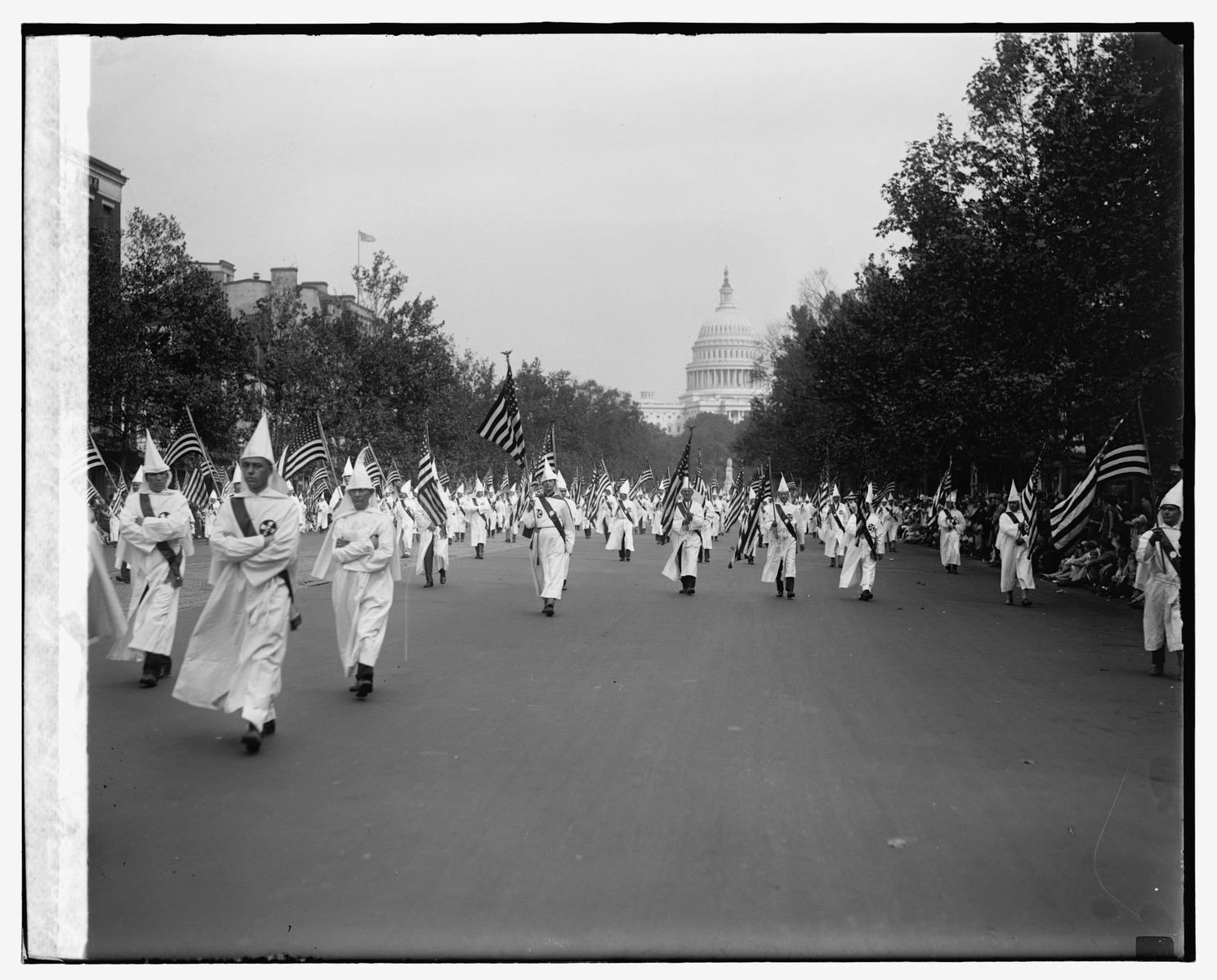
(Top photo of a KKK parade in 1926 via Wikimedia Commons. Bottom photo of the First Family from Getty)
One of the key arguments in Chief Justice Roberts’s opinion in McCutcheon is that aggregate limits on campaign donations do nothing to prevent corruption. Sam Kleiner calls this argument “remarkably uninformed when it comes to the relationship between wealthy donors and elected officials,” and questions Roberts’ understanding of “corruption”:
Roberts says that legislation cannot seek to limit what he calls the “general gratitude a candidate may feel toward those who support him or his allies, or the political access such support may afford.” Roberts said “spending large sums of money” would not “give rise to such quid pro quo corruption.” The reality is, of course, that looking for evidence of direct trades of a Congressional vote for a donation will reveal very few instances of corruption. However, as Lawrence Lessig has established, there is a broader system of “dependence corruption” in which candidates must rely on wealthy donors in order to have access to the political system. The Roberts Court reflects a lack of understanding in how money actually operates in our political system and has adopted such a hollow understanding of corruption that they are able to view our system as free of any corrupting influence.
In his analysis, Lessig also points out that defining corruption down to quid pro quo corruption alone gives the lie to the “originalism” of the Court’s conservative wing:
[B]y “corruption,” the Framers certainly did not mean quid pro quo corruption alone. That exclusive usage is completely modern.
And while there were cases where by “corruption” the Framers plainly meant quid pro quo corruption, these cases were the exception. The much more common usage was “corruption” as in improper dependence. Parliament, for example, was “corrupt,” according to the Framers, because it had developed an improper dependence on the King. That impropriety had nothing to do with any quid pro quo. It had everything to do with the wrong incentives being allowed into the system because of that improper dependence. …
If the originalists on the Court believe the Framers would have permitted laws regulating the freedom of speech if those laws targeted “corruption,” why would an originalist use an understanding of the term from a 1976 per curium opinion (Buckley v. Valeo) rather than an understanding of the Framers—corruption as in “improper dependence”—made manifest by the Framers again and again?
Noah Feldman notes that the connection between campaign finance and corruption is even younger than Buckley v. Valeo:
What is fascinating and important about the debate over the meaning of the word “corruption” is that the word, which has become a talisman, only appears once in Buckley v. Valeo. The reason for campaign finance law, from its inception, was to facilitate greater equality among voting citizens by stopping the richer ones from influencing the political process too disproportionately. This objective doesn’t depend on the semantic question of whether a system heavily influenced by money should be described as “corrupt.” But in the years since Buckley, the rationale of avoiding the appearance of corruption has come to dominate the doctrine and discourse of the court when campaign finance is on the table. This is an example of misdirection, whether conscious or unconscious, from the fundamental question of whether the Constitution allows Congress to try to enhance voter equality by reducing the influence of money.
On the other hand, David Bernstein calls Justice Breyer’s understanding of corruption, elaborated in his dissenting opinion, “dangerous”:
Breyer adds that “corruption,” by which he means individuals engaging in too much freedom of speech via campaign donations, ”derails the essential speech-to-government-action tie. Where enough money calls the tune, the general public will not be heard. Insofar as corruption cuts the link between political thought and political action, a free marketplace of political ideas loses its point.”
The danger of this argument is that analogous reasoning could be used to censor major media corporations such as the New York Times, Hollywood, and so on, to wit: ”When Hollywood spends billions of dollars each year advancing a liberal agenda, the general public will not be heard. Instead of a free marketplace of ideas, we get a marketplace in which major Hollywood moguls have hundreds of thousands of times the ‘speech power’ of the average American.” And given that almost everyone deems it appropriate to regulate the economic marketplace to counter inefficiencies and unfairness, why should the much-less-efficient (because it’s much more costly for an individual to make an error in his economic life than to have a mistaken ideology) marketplace of ideas be exempt from harsh regulation?
Yesterday, the Supreme Court issued its first major campaign finance ruling since Citizens United, striking down aggregate donation limits on First Amendment grounds:
At issue was the $123,200 cap on overall spending—$48,600 to all candidates and $74,600 to all political action committees and parties—imposed by Congress and the Federal Election Commission, which was designed to limit the overall amount of money an individual could give directly to candidates. But the court ruled that these caps limited the number of campaigns a donor could support. Donation limits to campaigns, set at $2,600 for individuals and $5,000 for parties and most PACs, were not the subject of the case.
Seth Masket explains why this might not be as terrible as liberals would tend to believe:
I have no doubt many will disagree on this front, but this is not going to undermine American democracy. In fact, in some ways, this will be an improvement. Here’s why:
Donation caps are notoriously bad at limiting the involvement of wealthy people in elections. Donors want to donate. Candidates want to receive. If you erect a wall in between them, money will typically find a way around it. In the vast majority of cases, this is not a criminal enterprise. It simply means that once a donor reaches her contribution limit, she will find another way to get the money to candidates who need it. That could mean contributing to a Super PAC, a 503(c)(4), an independent expenditure committee, etc. That money can still be put to use helping out candidates, but the flow of the money is much less direct and much less transparent.
The effect of this decision is unclear. Will billionaires start giving enormous sums of soft money to political parties? That would presumably require parties to set up lots of different committees that are putatively for different purposes, which in turn would probably give rise to yet more legal challenges. But if the past is any indication, the bright boys and girls who run these things will figure out a way.
I suppose it might even be a good thing, if you believe that parties have gotten too weak compared to billionaire donors these days. This could give them a way of rebuilding their influence and providing more central control over messaging and candidate selection. But I doubt that. The cringe-inducing spectacle of Republicans trekking to Las Vegas this weekend to kiss Sheldon Adelson’s ring in hopes of becoming his fair-haired child and sole recipient of his millions, shows that the horse is truly out of the barn on the role of the super-rich in political campaigns.
The practical results of this decision will be to make fundraising easier for party committees and candidates. That is almost certainly a good thing and should help ease concerns that “super PACS” are too influential with parties. Don’t expect a landslide in new giving, however, as the old aggregates did not affect most donors, who contribute to only a few candidates.
Ultimately, this decision is a significant victory for the First Amendment. Perhaps more important than the immediate result is the insistence that the government must have an actual, rather than conjectural, theory of corruption to be prevented. The “monsters under the bed” theory of constitutional jurisprudence seems headed for the dustbin.
As Justice Roberts wrote, “If the First Amendment protects flag burning, funeral protests, and Nazi parades — despite the profound offense such spectacles cause — it surely protects political campaign speech despite popular opposition.
The upshot here is that you’re going to hear even more screeching about the Koch brothers buying elections from Harry Reid and the rest of the Democrats, even as lefty billionaires like Soros and Tom Steyer start maxing out donations to every Democratic candidate for Congress in America. The other takeaway, ironically, is that this might produce more accountability in campaign finance compared to what we have now. One of the big knocks on Super PACs is that their donors can legally conceal their names; donors to candidates’ campaigns can’t. In the past, if you were rich and wanted to donate more than the aggregate limit on campaign donations, Super PACs were your main option. Now that wealthy donors no longer have to worry about the aggregate limit and can give directly to as many candidates as they want, their donations will be reported under disclosure rules.
Some of the largest donors in politics have hundreds of millions of dollars to throw around. Are the managers of super PACs truly worried about losing out if those donors can also max out to candidates and parties? The network of super PACs and 501s can still promise the ultrawealthy something that the parties never can. They can keep their donations and their identities secret.
It’s true that the contributions we’re talking about here will be easier to track than 503(c)(4) contributions, which don’t have to be disclosed. But disclosure—not just how it works, but whether it works in stopping corruption—is something we’re going to have to do a lot more thinking about in the coming years. Because as I said, if the Roberts Court takes the final step and declares even the limits on direct contributions to candidates to be unconstitutional, they will almost certainly justify it by saying that disclosure is sufficient to forestall corruption. It’s OK if the Koch brothers write Mitch McConnell a check for $20 million for his next campaign, because we’ll all know about it, and we’ll keep our eagle eyes on McConnell to make sure he isn’t doing the Kochs’ bidding.
Justin Levitt thinksMcCutcheon will put pressure on big donors to go even bigger:
Now, after [yesterday’s] decision, a demonstration of true commitment to the party has no real ceiling at all. “Maxing out” across the board has lost its meaning. Just taking care of the official bearers of the party brand will cost at least $3.9 million, every two years.
Four million bucks is a rather sharp uptick from $123,200. And while most of the attention has focused on the impact of that quantum of money flowing directly to party coffers, it is also worth noting that if maxing out used to be the cost of doing business, the cost of doing business just got a lot more expensive.
Some of the maxed-out donors from the 2012 cycle will have the means and desire to join the new biennial multi-million club. But many will likely balk. The plutocracy just got smaller.
In practice, the new rules could give monied interests a bigger say in politics, and those writing the checks can expect to pay higher prices for access to leading politicians. Now there is nothing to stop Obama from asking donors to give $500,000 or even $1 million to attend a sit-down dinner, so long as the money is distributed among dozens of Democratic Party committees and candidates. The question for historians will be whether this new freedom leads to an increase in the sort of quid pro quo dealmaking between donors and politicians that Roberts says Congress still has a right to discourage.
In light of this ruling, Jonathan Rauch contends that the best solution to dark money in politics is to dramatically increase contribution limits:
If the burgeoning gray market in political money is to be countered, a few things need to happen. First, political money needs to be made easier, not harder, for politicians to raise. Second, the money needs to be encouraged to flow through channels that are ultimately accountable to voters and the national interest. Third, candidate and party donations need to flow in straightforward, observable ways rather than being routed circuitously, so that everyone can see what’s going on and vote or campaign accordingly. Fourth, disclosure needs to be improved for the nonprofits and other black holes.
Greatly raising contribution limits and simultaneously improving disclosure would achieve those goals. High limits would affect only the most stratospheric contributions, the ones that raise the most serious questions about corruption; other donors could bring their money back into the mainstream system in an above-board way. Voters might not like it, but at least they could see it and, if they chose, vote against it. With money inside the political system, candidates and parties would have more control over their own campaigns and destinies.
Yes, big donations buy access and influence. Yes, high limits tempt politicians to squeeze donors mercilessly for money. But if you think the existing system puts a stop to that, I refer you to the Adelson Primary the other day in Las Vegas, where Republican hopefuls lined up to curry favor with the gambling magnate.
Michael Lewis explains what led him to write his new book on the abuses in high frequency trading:
This NYT Magazine excerpt from the book gives you a general sense of its arguments:
Technology had collided with Wall Street in a peculiar way. It had been used to increase efficiency. But it had also been used to introduce a peculiar sort of market inefficiency. Taking advantage of loopholes in some well-meaning regulation introduced in the mid-2000s, some large amount of what Wall Street had been doing with technology was simply so someone inside the financial markets would know something that the outside world did not. The same system that once gave us subprime-mortgage collateralized debt obligations no investor could possibly truly understand now gave us stock-market trades involving fractions of a penny that occurred at unsafe speeds using order types that no investor could possibly truly understand. That is why Brad Katsuyama’s desire to explain things so that others would understand was so seditious. He attacked the newly automated financial system at its core, where the money was made from its incomprehensibility.
There is this perception that Wall Street insiders understand how Wall Street works — and it’s false. It’s especially false right now. Here you have this young man, this kid [Katsuyama] at the Royal Bank of Canada who’s engaged in this kind of science experiment in the market. He figures out at least one angle the predators are taking ,and he goes and talks to not just ordinary investors … the biggest investors, the smartest investors in the world, and their jaws are on the floor. … Even these people have no idea what’s going on in the market and are being educated by this Canadian who has basically just arrived on the scene and has decided to make understanding [this] his business.
It’s a riveting book, but it has its critics. Matthew Philips claims that Lewis gets much wrong about high frequency trading (HFT):
HFT doesn’t prey on small mom-and-pop investors. In his first two TV appearances, Lewis stuck to a simple pitch: Speed traders have rigged the stock market, and the biggest losers are average, middle-class retail investors-exactly the kind of people who watch 60 Minutes and the Today show. It’s “the guy sitting at his ETrade account,” Lewis told Matt Lauer. The way Lewis sees it, speed traders prey on retail investors by “trading against people who don’t know the market.”
The idea that retail investors are losing out to sophisticated speed traders is an old claim in the debate over HFT, and it’s pretty much been discredited. Speed traders aren’t competing against the ETrade guy, they’re competing with each other to fill the ETrade guy’s order.
Felix Salmon agrees that “Lewis goes to great lengths to elide the distinction between small investors and big investors” and argues that it’s “big investors who get hurt by HFT.” Another criticism:
This vagueness about time is one of the weaknesses of the book: it’s hard to keep track of time, and a lot of it seems to be an exposé not of high-frequency trading as it exists today, but rather of high-frequency trading as it existed during its brief heyday circa 2008. Lewis takes pains to tell us what happened to the number of trades per day between 2006 and 2009, for instance, but doesn’t feel the need to mention what has happened since then. (It is falling, quite dramatically.) The scale of the HFT problem — and the amount of money being made by the HFT industry — is in sharp decline: there was big money to be made once upon a time, but nowadays it’s not really there anymore. Because that fact doesn’t fit Lewis’s narrative, however, I doubt I’m going to find it anywhere in his book.
Mark Gorton, who “makes his living running a high-frequency trading firm,” criticizes the book for “conflating what high-frequency trading firms do with what exchanges and brokers do”:
The biggest conflicts of interest and problems in the market have to do with how brokers treat orders. Have you heard of payment for order flow? If you order through eTrade or TD Ameritrade, that order doesn’t get sent to one of the stock markets. There are firms out there that pay eTrade and the other firms to have their orders routed to them, and then they execute the orders. This payment obviously creates incentives for brokers to do things that aren’t in the customer’s interest.
The problem that exists is small. The amount you’re talking about in any of these cases is fractions of a penny. So even if you do have this payment for order flow, it’s a fairly small amount. And again, I think it’s a practice that should be banned. But it’s not a giant amount of money. And it’s a broker practice.
Matt Levine thinks that there “are two ways of characterizing high frequency trading”:
In one, HFTs are front-running big investors, rigging the game against them and making the stock market illusory. In the other, HFTs are reacting instantly to demand, avoiding being picked off by informed investors and making the stock market more efficient.
In my alternative Michael Lewis story, the smart young whippersnappers build high-frequency trading firms that undercut big banks’ gut-instinct-driven market making with tighter spreads and cheaper trading costs. Big HFTs like Knight/Getco and Virtu trade vast volumes of stock while still taking in much less money than the traditional market makers: $688 million and $623 million in 2013 market-making revenue, respectively, for Knight and Virtu, versus $2.6 billion in equities revenue for Goldman Sachs and $4.8 billion for J.P. Morgan. Even RBC made 594 million Canadian dollars trading equities last year. The high-frequency traders make money more consistently than the old-school traders, but they also make less of it.
You don’t have to be absolutist about this either way. Whether or not HFTs’ behavior of quickly adjusting quotes to market conditions is “predatory” in some moral sense — and whether or not it ultimately makes markets more or less efficient on balance — it is clearly annoying to a lot of institutional investors. So those investors like having the option of trading on IEX. And there’s no obvious reason to think that the current market structures and rules are the “right” rules, or that high-frequency traders aren’t sometimes gaming those rules in not-so-socially-optimal ways.
High-frequency trading quickly propagates information across markets, reducing the need for fundamental investors to do research and make capital allocation decisions.
High-frequency trading drives down the rewards to fundamental investors, by making prices react instantly to their activity so that they can never make a profit by buying (selling) undervalued (overvalued) stocks.
If force 1 outweighs force 2 then markets will be more efficient: The David Einhorns of the world will make less money finding undervalued companies, but their work will have more effect on market prices and capital allocation. If force 2 outweighs force 1, then … well, you could imagine a world where high-frequency trading is so speedy and efficient that there’s no way for fundamental investors to make any money: As soon as David Einhorn even thinks about buying a stock, its price snaps up to what he’d consider a fair price, so he can’t profit from buying it.
In this world, where high-frequency trading firms could instantly capture all of David Einhorn’s profits, he’d just quit investing and go play poker. And so would everyone: No one would invest in investment research, because any information advantage you could obtain by research would disappear instantly the minute you tried to buy stock. The market would be left to no one but the hobbyists and the high frequency traders, neither of whom are much good at the fundamental analysis that in theory should go into allocating capital.
Back in 2012, Felix Salmon identified another problem with HFT:
The more obvious problem with exchanges run by computers is that computers don’t have any common sense. We saw this on the 6th of May, 2010 — the day of the so-called “flash crash”, when in a matter of a couple of minutes the US stock market plunged hundreds of points for no particular reason, and some stocks traded at a price of just one cent. It was sheer luck that the crash happened just before 3pm, rather than just before 4pm, and that as a result there was time for the market to recover before the closing bell. If there hadn’t been, then Asian markets would have sold off as well, and then European markets, and hundreds of billions of pounds of value would have been destroyed, just because of a trading glitch which started on something called the e-mini contract in Chicago.
In a more recent post, Salmon wonders about HFT regulation:
Brad Katsuyama, the founder of IEX and the hero of Lewis’s book, is no white-hat absolutist: he doesn’t like the way in which the term “HFT” is used to cover a multiplicity of different behaviors, and in fact he is all in favor of computerized trading. (Which makes sense, seeing as how he runs a dark pool.) And BATS president Bill O’Brien is happy to concede that the market has become too complex. He said only that the complexity needs to be “managed”, rather than simplified, but in reality simplification is by far the most effective way to manage complexity. A market with only three or four order types, for instance, is a lot simpler and easier to manage than a market with hundreds.
Can the market be fixed? Michael Lewis says he would like to see that — but at the same time he says that he welcomes the way in which the FBI and the New York attorney general are launching investigations into HFT, to see whether anything in that world can be considered criminal insider trading or market manipulation. My feeling is that if you want prosecutions, then law-enforcement should launch investigations — but that if you really want to fix things, then creating a highly adversarial relationship between HFT shops and the government is not going to help and is in fact almost certain to hurt.
We should welcome the current debate and the negative spotlight cast on high-frequency trading. But that doesn’t mean that behavior that was previously deemed acceptable should be suddenly criminalized just because the pendulum shifts. The behavior can be unacceptable and be curtailed without the attendant use of state power to prosecute, fine, and potentially incarcerate. Let’s end this system of high-frequency trading that makes it possible for a few firms to profit unfairly and at times distort markets, but let’s do it in a way that avoids the bread-and-circuses spectacle of hunting for villains.
Our regulatory framework in general, whether in finance or any other aspect of life, has become too focused on punishment, often at the expense of meaningful societal reform. Since change and reform are what benefits us all, that is where our energies should go. Trials and scalps may garner media attention and act as proxies for reform, but they are a pallid alternative to the structural changes we actually need.
Finally, Justin Fox looks at the debate from 10,000 feet:
Yes, “the stock market is rigged,” as Lewis said on 60 Minutes. But it’s always been rigged, and that hasn’t prevented it from delivering pretty impressive returns to long-run investors. Yes, we should strive toward a market that’s rigged in the least expensive, most transparent, most efficient, most stable way possible. I don’t think we’ll ever get rid of the people (or computers) in the middle making money off the customers, though. And there may even be something to be said for letting them do it the old way, out in the open, with cartels and fixed fees and Cadillacs to drive home to Long Island.
I find this world-wear capitulation to rigging to be a little like the journalism pundits who say of fake articles: “nothing new here, walk on by.” The fact that some traders operated in a market milliseconds ahead of everyone else, and did so by subterfuge and flying below the radar is a reminder, once again, that Wall Street’s insiders simply cannot be trusted. They have one goal: to make as much money as possible by whatever means possible. They have close to zero interest in the integrity of your investments or mine. That they felt able to do this after all but destroying the lives of countless human beings through their addiction to complexity they didn’t fully understand makes it all the more shocking to me. Almost as shocking as the blase attitude of so many toward these unrepentant, greednik vandals.