Dissent Of The Day

A reader writes:

I have a feeling this might be a bit of a tough sell for you, but I’m going to take a shot anyway. Is this really about craven people making immoral decisions? It seems to me that what’s going on is that market conditions are pushing journalists to sponsored content. I’m sure there’s a spectrum of feelings about the morality of sponsored content – that some folks are more ok with it than others. But I’m certain lots of people at the very institutions you’re criticizing feel more or less as you do.

Companies that do sponsored content aren’t doing it to fatten an already-wide profit margin. It’s not about buying yachts and champagne. Here’s the problem: the market has moved into a place in which lots of publications have to use sponsored content in order to survive. I don’t know, but I have to think that choices are being made between firing people and taking the sponsored content.

This is the thing about markets. No one has any control over them. And sometimes, the numbers just don’t line up. And it’s like we have this panglossian idea that if the market says it, it’s for the best. Sometimes it’s not. Sponsored content is a pure product of the market, and it sucks. I guess I’d urge you to try to be a little bit more compassionate about the pressures your colleagues face, even as you speak out against the trend. And also to please try to continue to hold the line yourself, if you can.

This is an absolutely fair point. In my defense, I’ve tried not to cast absolute moral aspersions on those running fake articles for money. It’s possible for well-intentioned people to be swimming in market forces they have no option but to co-opt. I doubt Jill Abramson is thrilled to be doing what the NYT is doing with sponsored content. But Mark Thompson has over-ruled her, and for understandable reasons. Yes, of course, the media economy is currently brutal. Serious journalism used to be subsidized by many things – classifieds, comics, and sports coverage bundled in with foreign policy; lucrative advertising in scarce paper sources, etc – that have disappeared entirely. Something has to replace them for journalism to survive this technological onslaught. At the Dish, we do not have the resources (yet) to invest in the kind of deep reporting that requires big budgets that require big revenue. I get that. I also get the fact that some people are doing their best to manage this balancing act while not throwing out every ethical guideline we ever had in this business.

But it is still a terrible precedent to attempt to pass off ad copy as editorial with phony words and crafty design. Go check out TPM’s home-page today. A third of it is taken up with a huge chunk of space for a fake article by Phrma above the fold; a Phrma ad below it; and a big section on the side as a vehicle for Phrma’s propaganda, with some token TPM copy and AP stories as filler. At some point, you might be forgiven for wondering where TPM’s coverage ends and where Phrma’s propaganda begins. As I said at Buzzfeed more than a year ago, there is a real danger that you could be destroying the village in order to save it.

And the consequences of letting down the drawbridge so completely have yet to be seen. I suspect that online, in a relatively short time, branded journalism will be more plentiful and more lucrative than actual journalism, that readers online will get used to there being no real difference between corporate messaging and editorial writing, that the blurred lines will become fuzzier. I suspect that, having used the media in this fashion, the propaganda industry will soon move on to create their own media products – videos, listicles, fake articles, etc. – without the help of journalism at all. And when they do that, there will be so little left to distinguish it from what used to be clearly definable places for editorial content that the very idea of the fourth estate – independent and able to challenge all concentrations of power, economic and governmental – will disappear.

I’m not writing these critiques to demonize my fellow journalists – least of all, Josh, who is a dear friend – but to take a stand because so many others are now compromised by the very fake journalism I oppose. I do it because I have a rare platform to air this issue, which is flying way below the radar of most readers. I know it won’t make me friends – I love Ben Smith, for example, and don’t exactly love railing against his enterprise – but I feel it’s a duty to raise these concerns. If I come off as a bit moralizing and pious, I apologize. But I will not apologize for defending the principle of an independent press. It’s what having a blog of your own is for.

Married 10 Years

Tuesday was the 10th wedding anniversary of Michael Hendricks and René Leboeuf, the first gay couple to be legally married in Quebec, about a month before marriage equality came to Massachusetts. In a recent interview, the couple reflected on the fight to the altar:

POP TART: Your court case began on Nov 8, 2001. Over the next few years, what was the most difficult part about this legal battle and journey?

Hendricks: Putting up with the “know-it-all” lawyers we had at first who tried dish_hendricks-leboeuf to dictate to us what we should do and say – very politically ill-informed people, with wacky ideas and enormous egos. But we were really lucky once we got rid of them and built a legal team that respected us and, in the end, carried the day in the Quebec Appeals Court. They attended our wedding as honoured guests. … As for the myth that “the gay community” is rich and paid for everything – they paid around $7,000 out of the $300,000 [in lawyer fees]. There was a lack of support from the LGBT community in general until we started to win. Then they were all over us like a cheap suit. We quickly learned what the term “Success has many parents while failure is an orphan” means. For example, one “community” lawyer pleaded for civil unions in court which led the Chief Justice of the Quebec Appeals Court, Michel Robert, to ask him during the hearing for which side was he arguing.

POP TART: How did you guys feel when you finally won?

Leboeuf: Thank god, it’s over!

Hendricks: We were tired after 6 years of constant hostility, constant fundraising, putting up with whacky lawyers and with sniping by members of the community – many of whom, incidentally, now take credit for having won the marriage battle and have gotten legally married after telling us for years how they rejected it in favour of civil unions. …

POP TART: How important do feel your 10th wedding anniversary is, both personally and publicly?

Hendricks: Personally, after our first 30 years together, 10 years is nothing. Nothing really changed in our everyday lives except our legal affairs which, as a couple, are now straightened out. Publicly? At the time we were talking about moving a mountain. But today, 10 years later, SSM is accepted – trivial in fact – and forgotten. That’s perfect, exactly what we hoped would happen. Today, gay and lesbian adolescents generally think that marriage always existed for them, which is exactly what we wanted to achieve back in 1998.

(Image: Hendricks and Leboeuf at their wedding on April 1, 2004, via Wikimedia Commons)

A Treacherous Climb Up The Social Ladder

While studying the causes and motivations of high school bullying, UC Davis sociologist Robert Faris found that kids who ascend the social hierarchy, especially girls, run a high risk of being victimized:

Faris was interested in understanding bullying at a deeper level, to identify “hotspots” of conflict and aggression in school-based hierarchies. He and his colleague Diane Felmlee, professor of sociology at Pennsylvania State University, investigated whether there were other reasons for students’ aggression toward one another, such as using it as a tool for social climbing.

Their results, published in American Sociological Review, suggest that kids get bullied not only when they don’t fit in, but also when they are simply trying to avoid being victims by moving up the social ladder. “As social status increases, the involvement in aggression–both as perpetrator and now as victims–also tends to go up until they get to the very top, when things start to reverse,” says Faris.

Emily Bazelon explains what this means for how we approach the problem of bullying:

Faris and Felmlee come out with one clear proposal for schools: Bullying-prevention programs should try to de-emphasize hierarchy. The more that students feel there are multiple routes to social success—the choir as well as sports, chess champion as well as class president—the better. That sounds right to me, but also hard for adults to construct. Teenagers have to have their own ways of taking each other’s measure separate from adult wishes and meddling. That’s part of growing up. The trick is for them to lead each other to social rewards that come from building other people up rather than tearing them down. This study is an important reminder that all kinds of kids benefit from making that shift, from all points in the high school universe.

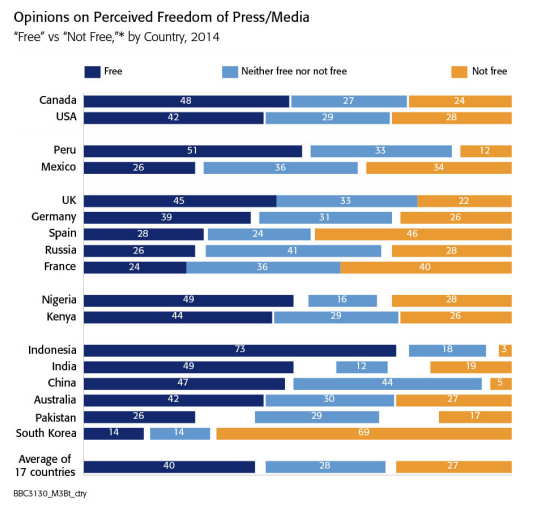
Press Not Censored, Say Readers Of Censored Press

Screen Shot 2014-04-02 at 12.53.57 PM

That’s one finding from a recent survey showing how people in 17 countries perceive their level of freedom:

Some of the results of the poll will not surprise anyone who has heard of Edward Snowden: a majority of Americans and Germans feel they are not free from government surveillance or monitoring, and only a third of Americans and Canadians, 38 percent of Britons and 27 percent of Germans feel the Internet is a safe place to express their opinions. But the eye-catching figure is that 76 percent of respondents in China said they do feel free from government surveillance and monitoring – the highest proportion among the 17 countries polled (Australia came in second with 72 percent). And 45 percent of Chinese respondents said the Internet was a safe place to express their opinions, more than in most countries polled (France rated worst on this score, at 22 percent).

Another surprise was the proportion of respondents in China – 47 percent – who said their press, which is in fact rigidly censored, is free. This was higher than the result for France (24 percent), Spain (28 percent), Germany (39 percent), America (42 percent), Australia (42 percent) and Britain (45 percent).

Over at Quartz, Lily Kuo notes that China is easing off its “more Orwellian approaches” to information control in favor of “allowing a certain degree of open debate on the Internet”:

How does this work in practice? Since 2005, dozens of local governments have been hiring Internet commentators – known as wumao for the supposed ¢50-a-post state-backed bloggers receive for interjecting pro-government sentiment into online discussions and for defusing anti-Communist Party sentiment. This is consistent with government directives, advising officials to focus less on controlling online discussion, Yang says. For instance, in 2010, a local public security department in Fujian province published a document saying Internet management should combine “damming with channeling, with more focus on channeling.”

Another way the government attempts to influence public opinion via the internet is through actual government engagement. In the city of Ji’an, in Jiangxi province, Yang explains that rather than blocking bloggers’ comments or accounts, officials have been contacting bloggers, explaining the harm of their posts and encouraging them to delete or modify them of their own accord.

Just Looking

nasiralmulkmosque1

Mohan Matthen parses the philosophy of visual pleasure:

Aesthetic pleasure is pleasure in contemplating something. This pleasure could be sensory, like the enjoyment one derives from looking at a painting or listening to music. Or it could be intellectual, like the pleasure of reading the latest Robert Harris. In both cases, pleasure in contemplation has to be distinguished from wanting an object for other uses.

Immanuel Kant in the 18th century was among the first to understand this. His example was that of a palace. You might long to live in it, or you might hate it for its extravagance and want to destroy it. But both of these responses are distinct from the pleasure or displeasure derived from merely looking at it. Only the latter pleasure counts as aesthetic.

Discussing sexual selection, Charles Darwin wrote:

‘When we behold a male bird elaborately displaying his graceful plumes or splendid colours before the female … it is impossible to doubt that she admires the beauty of her male partner.’ Assuming that he really means beauty, and not sexual attractiveness, this is a mistake. It confuses sexual desire with aesthetic admiration. According to Darwin’s own theory, when a female looks at a male that way, she is not getting pleasure from looking at him for the sake of looking at him; rather, she is driven to mate with him. Darwin wrongly equates the lustful gaze with simple looking. Kant’s point was that aesthetic appreciation is disinterested. It is pleasure just in looking.

On the above photo by Mohammad Reza Domiri Ganji:

The stunning Nasir al-mulk Mosque hides a gorgeous secret between the walls of its fairly traditional exterior: stepping inside is like walking into a kaleidoscope of colors. Every day, the rays of the early morning sun shine through colorful stained-glass windows, transforming the halls into a dazzling wonderland of rich hues, patterns, and light that play on the floor of the mosque.

In addition to the glorious display of light and color through the stained glass, the mosque features other striking elements of design and architecture, including intricate geometric tile designs, painted arches and niches, and spectacular domes. The usage of beautiful rose-colored tiles in the interior design earned the mosque the nickname Pink Mosque in popular culture.

The mosque, located in Shiraz, Iran, was built from 1876 to 1888 by the order of one of the Qajar Dynasty lords. The beautiful structure was designed by Muhammad Hasan-e-Memar and Muhammad Reza Kashi Paz-e-Shirazi.

More stunning shots of the mosque here.

Why We Love Sad Songs, Ctd

A reader writes:

I have a response to two different but related items at the Dish: the recent post about why we like sad songs, and the moving, thoughtful remarks about suicide prevention from Jennifer Michael Hecht.  I want to offer up one of the most poignantly beautiful songs about suicide that I know of, Lucinda Williams’ “Sweet Old World.”  Written in response to a friend’s suicide, the song basically catalogues the many things the departed friend is now missing out on.  The song manages to express mourning for the loss of the person who chose to leave “this sweet old world” and also becomes a sort of meditation on things for which we should be grateful.  It’s a remarkable song. Here’s Lucinda herself performing the song [unembeddable]. And it happens that Emmylou Harris also did a very nice cover [above]. Here are the lyrics:

See what you lost when you left this world, this sweet old world
The breath from your own lips, the touch of fingertips
A sweet and tender kiss
The sound of a midnight train, wearing someone’s ring
Someone calling your name
Somebody so warm cradled in your arms
Didn’t you think you were worth anything
See what you lost when you left this world, this sweet old world

Millions of us in love, promises made good
Your own flesh and blood
Looking for some truth, dancing with no shoes
The beat, the rhythm, the blues
The pounding of your heart’s drum together with another one
Didn’t you think anyone loved you
See what you lost when you left this world, this sweet old world

Sending thanks from NYC, a city where one can be surrounded by tens of millions of people and yet still feel quite alone …

Driven To Success

A new study (pdf) from the Urban Institute suggests that access to cars makes low-income Americans more likely to escape poverty. Co-author Rolf Pendall explains the findings:

Our evidence comes from two Department of Housing and Urban Development demonstration programs: Moving to Opportunity for Fair Housing and Welfare to Work Vouchers. Both were designed to test whether housing choice vouchers—that is, subsidies that allowed participants to choose where they live—propelled low-income households into greater economic security. …

The results? Housing voucher recipients with cars tended to live and remain in higher-opportunity neighborhoods—places with lower poverty rates, higher social status, stronger housing markets, and lower health risks. Cars are also associated with improved neighborhood satisfaction and better employment outcomes. Among Moving to Opportunity families, those with cars were twice as likely to find a job and four times as likely to remain employed.

Emily Badger considers the implications:

All of these findings are as much a reflection on the value of cars as the relatively poor state of public transit.

The underlying issue also isn’t so much that cars create opportunity. Rather, it’s that we’ve created many places where you can’t access opportunity without a car. Which also means that we’ve created places that punish people who don’t have one (or can’t afford to get one). That’s a much larger critique. …

How, though, would you increase car access among the poor in a way that doesn’t simply saddle families with even more unsustainable expenses? Car ownership, for any kind of family, comes with all kinds of related costs: in insurance, in repairs, in gas. The burden of those costs, though, tends to weigh even more heavily on the low-income. They’re more likely to access financing through a predatory loan. They may have less access in the neighborhood to a reliable mechanic. A family living in a low-income neighborhood with high crime by definition faces higher insurance rates.

Dressing Down A Dress Code

After an Evanston, IL middle school banned leggings on the logic that they are “distracting to boys,” seventh grader Sophie Hasty spearheaded a civil disobedience campaign against the new rule. In an interview with Amanda Hess, the 13-year-old girl explains how the dress code fight came about:

Last year, I never really paid attention to the dress code. But this year, teachers started to get stricter about it and giving stupid reasons for it. The reason was basically: “boys.” It’s a lot like saying that if guys do something to harass us, it’s our fault for that. We’re the ones being punished for what guys do. My friends and I got mad about it, and we would talk about it often earlier in the year, but we didn’t think we could really do anything about it.

Girls caught wearing leggings are forced to put on their gym shorts over them, which draws much more attention than the leggings themselves:

It’s humiliating to walk around the hallways wearing bright blue shorts. Boys yell “dress code!” when they see you. They act more inappropriate when you’re walking around in blue shorts when you’ve gotten dress-coded than when you’re just wearing leggings. I asked a teacher to tell us about an incident where a girl was wearing leggings and a guy was getting distracted. There hasn’t been one.

Eliana Dockterman calls the no-leggings rule akin to slut shaming:

The argument being made by school administrators is not that distant from the arguments made by those who accuse rape victims of asking to be assaulted by dressing a certain way. We tell women to cover themselves from the male gaze, but we neglect to tell the boys to look at something else. That this has a sexist undertone is demonstrated by the fact that the girls who had more curves to show off were the ones more often disciplined. “Students who were getting ‘dress-coded,’ or disciplined for their attire, tended to be girls who were more developed,” Juliet Bond, a parent of a student at Haven, told the Evanston Review.

Lucy Shapiro, a 12-year-old at Haven, added that when both she and a friend wore the same type of athletic shorts, a teacher disciplined her but not her friend because, she was told, “I had a different body type than my friend…With all the social expectations of being a girl, it’s already hard enough to pick an outfit without adding in the dress code factor.”

A Study In Stuff

In a New Scientist series on “stuff,” Alison George outlines the pre-history of property:

By the time modern humans reached Europe around 40,000 years ago there are clear signs of ownership. “You can see notches and marks on various items – the notion of ownership is there,” says Steven Mithen of the University of Reading, UK. But the amount of stuff that people could accumulate was constrained by their nomadic lifestyle, leading some archaeologists to speculate that bags or papooses might have been among our earliest possessions. This changed with the switch to a settled lifestyle. …

In fact, some archaeologists such as Ian Hodder of Stanford University in California argue that societies could not have become complex and hierarchical without an associated “material culture.” This switch to sedentariness drove materialism in another way. Gary Feinman at the University of Illinois in Chicago argues that our urge to accumulate stuff is based on a desire to minimize risk. “When people settled down, they became more susceptible to environmental disaster,” he says. A way to insure against this was to store surplus food – a process that created the need for possessions to gather and hoard, as well as the domestication of animals.

Meanwhile, Michael Bond investigates the psychology of property ownership:

Our ability to imbue things with rich meaning is a universal human trait that develops early in life (see “My blankie!“), and develops as we get older. A 1977 survey of multiple generations of families in Chicago revealed that older people tend to prize objects that spur memories and reflection, whereas younger people value things with multiple uses – like a kitchen table and chairs. That may be the case in the digital era as well. Sociologist Eugene Halton, who conducted the survey, speculates that younger people today might prize their smartphone above all else, but it is unlikely to stay special for long. “Not a lot of people collect their old computers and cellphones as meaningful possessions,” he says.

The inclination to value things we own beyond what others think they are worth is known in psychology as the endowment effect. It explains why we are more likely to buy a coat once we have tried it on, or a car once we have test-driven it – just imagining that something is ours makes it seem more valuable.

The Editor As Reader

In an interview, Allie Sommer explains how her reading habits have shifted since she took a job as an editor at Little, Brown:

I read very differently now than I used to. First, I’m extremely picky. I have to prioritize the books I read since I have so little time to do it, and so I don’t impulse buy anymore. I rely heavily on recommendations from friends, colleagues, and reviewers. Still, I always read the first few pages of a book before I buy it to make sure I’ll be able to get into it. Second, once I’m reading, I often think about how I would have edited the book differently. I get frustrated with stories that feel overlong or don’t deliver on plot the way I’d hoped they would. Third, I never finish a book I’m not enjoying. That’s a huge change for me. I used to think I had to finish every book I started. Now I’ve realized that life is too short to read a bad book — especially when there are so many wonderful books out there waiting to become part of your soul and fundamentally change the way you think about the world.

Sommer also describes what surprised her most about her job:

Everyone thinks that editors get to sit at their desks and read all day. At least, that’s what I thought! Even as an intern, that was mostly my experience. Sadly, that’s not quite how it works. As I mentioned earlier, there are so many other parts of the publishing process we need to manage during the day that reading almost always gets pushed to after hours.

I was also surprised by how much you have to schmooze! There’s lots of networking involved — with authors, agents, editors, and other publicity or industry contacts. There’s always someone you need to meet. I thought in an industry full of bookworms, you could just hole up at your desk and get away with being shy, but that’s just not the way it works. Publishing seems to favor the outgoing (or the shy who are good at faking it!). At a party, you have to train yourself to go up to a group of people you’ve never met and introduce yourself, and shamelessly follow up the next day by email. You also have to cold call or email people you’ve never met and ask them out for lunch. And then when you get to lunch, you have to be able to keep the conversation going. Luckily, people are generally very nice about all this (since they are in the same position), but it can definitely be terrifying at times.