In her new essay collection The Empathy Exams, Leslie Jamison explores the various ways people connect. In an interview, she discusses how empathy functions on the Internet, describing what she learned from her students while teaching a writing course during the Boston Marathon bombing:
A couple of their essays ended up focusing on what is the role of social media in response to a tragedy, and a lot of interesting issues came up. There was clearly something that rubbed them the wrong way about the sort of outpouring of empathy that comes up on the Internet. Like, one guy had all this beef with the phrase, “Our thoughts and prayers go out,” or something that felt like it was really hollow and trite and what did it mean that it was so easy to offer and that there was no work behind it? And this other girl was taking issue with people who would do things like post photos on Instagram for email listings they’d gotten for charitable donations. Stuff like that.
I feel like when we critique hollow displays of empathy on the Internet, what we’re critiquing is usually some aspect of empathy that is much more deeply entrenched but just made visible.
For example, we’re critiquing the way that whenever we feel empathy, we also feel proud of ourselves. So it starts to feel a little bit dirty or polluted. And so be it, I think there’s something valid in that, if you are thinking about how your empathy makes you look, to the exclusion of actually empathizing or acting on your impulse, that’s misguided and ultimately not that useful. … I like to think there’s something about the mass support that could be comforting, but again the danger is if a tweet becomes a substitute if you live in Boston and instead of donating blood you’re just tweeting about your feelings.
In another interview, Jamison turns to the perils of empathy:
I’m interested in everything that might be flawed or messy about empathy — how imagining other lives can constitute a kind of tyranny, or artificially absolve our sense of guilt or responsibility; how feeling empathy can make us feel we’ve done something good when we actually haven’t. Zizek talks about how “feeling good” has become a kind of commodity we purchase for ourselves when we buy socially responsible products; there’s some version of this inoculation logic — or danger — that’s possible with empathy as well: we start to like the feeling of feeling bad for others; it can make us feel good about ourselves. So there’s a lot of danger attached to empathy: it might be self-serving or self-absorbed; it might lead our moral reasoning astray, or supplant moral reasoning entirely. (See this fantastic piece by Paul Bloom in The New Yorker.)
But do I want to defend it, despite acknowledging this mess? More like: I want to defend it by acknowledging this mess. Saying: Yes. Of course. But yet. Anyway.
A recent report from the Consumer Financial Protection Bureau suggests that many Americans are being hounded by collectors for debt they may not actually owe:
The CFPB’s “Fair Debt Collection Practices Act” annual report [PDF] shows that nearly 34% of complaints received by the Bureau involve consumers being hounded by collectors for a debt the consumer does not believe is owed. Of those complaints 65% of consumers report the debt is not theirs, and 27% report the debt was paid. The reports notes that in many cases the attempt to collect the debt is not the issue, but rather the calculation of the amount of underlying debt is inaccurate or unfair.
David Dayen delves into why the debt collection industry does this:
Can the debt collection industry be so careless as to continually harass the wrong individuals? The more you learn about how debt collection works, the more you’re surprised that they ever find the right target in the first place. When a consumer sustains a debt, the creditor can either attempt to personally collect it, or sell the debt to one of America’s 4,500 collection agencies. That auction process is completely broken, producing the ultimate in caveat emptor.
“Creditors provide debt buyers with almost no data, no original contract, no backup information,” said Ira Rheingold, executive director of the National Association of Consumer Attorneys. “The records are so poor that sometimes the amount of the debt is wrong too.” In a world of big data, the debt buyer market operates like it’s still the 1970s, where the commodity is merely a spreadsheet full of hints and leads, instead of reliable information about debts.
In the next video from the journalist behind The Bright Continent, she explains how Africans have a different perception of corruption than most Americans do:
Previous Dish on the difficulty measuring worldwide corruption here. In another video from Dayo, she goes on to reject other over-simplistic ways in which the West typically judge African countries:
[T]he western focus on governance and foreign aid obscures the individual dynamism and informal social adaptation driving the last decade of African development. Dayo Olopade set out across sub-Saharan Africa to find out how ordinary people are dealing with the challenges they face every day. She found an unexpected Africa: resilient, joyful, and innovative, a continent of DIY changemakers and impassioned community leaders. Everywhere Olopade went, she witnessed the specific creativity born from African difficulty—a trait she began calling kanju. It’s embodied by bootstrapping innovators like Kenneth Nnebue, who turned his low-budget, straight-to-VHS movies into a multi-million dollar film industry known as Nollywood. Or Soyapi Mumba, who helped transform cast-off American computers into touchscreen databases that allow hospitals across Malawi to process patients in seconds. Or Ushahidi, the Kenyan technology collective that crowdsources citizen activism and disaster relief.
The Bright Continent calls for a necessary shift in our thinking about Africa. Olopade shows us that the increasingly globalized challenges Africa faces can and must be addressed with the tools Africans are already using to solve these problems themselves. Africa’s ability to do more with less—to transform bad aid and bad government into an opportunity to innovate—is a clear ray of hope amidst the dire headlines and a powerful model for the rest of the world.
Dan Savage reacts to the announcement that the ACA hit its enrollment target of 7 million:
Great news! And Republicans—who will never offer a Republican alternative health-care planand who will never acknowledge that Obamacare used to be the Republican alternative to the kind of single-payer health care plan preferred by liberals, progressives, and sane countries everywhere (countries like Canada, Germany, France, Israel, and Vatican City)—are gnashing their teeth.
Chait details how that GOP intransigence reveals a deeper divide between the parties:
One of my longstanding fixations, going back almost a decade now, is that we make a mistake when we think of liberalism and conservative as symmetric ways of thinking. On economic policy, at least, they are asymmetric. Liberals believe in activist government entirely as a means to various ends. Pollution controls are useful only insofar as they result in cleaner air; national health insurance is valuable only to the extent that it helps people obtain medical care. More spending and more regulation are not ends in and of themselves. Conservatives, on the other hand, believe in small government not only for practical reasons — this program will cost too much or fail to work — but for philosophical reasons as well.
A new political science paper by Matt Grossman and David Hopkins bears out this way of thinking about American politics. The authors find a fundamental asymmetry between the Republican and Democratic coalitions. They examined survey results and other data among voters, activists, and elites, and found that Republicans express their beliefs about government as abstract ideology (big government is bad) while Democrats express their beliefs in the form of benefits for groups. The differences are enormous [as the above chart from the paper demonstrates.]
This, he argues, is why Republicans “have expressed from the beginning a theological certainty that Obamacare will fail.” Steinglass also tries to understand ACA opposition:
For the most part … opposition to Obamacare now is based on two things.
At one level, it’s a question of partisanship. Republicans have turned “Obamacare” into a word that much of the country finds inherently distasteful. No matter how well the system performs, it’s too late to reverse those associations. At another level, many dislike the basic transaction at the heart of universal coverage: richer people have to basically pay for poorer people’s health-insurance. In Kentucky, for example, Republicans are avidly working to reverse the state’s Medicaid expansion, even though the federal government pays for the entire thing initially, with the state expected to kick in 10% in the future.
Ponnuru, yet again, calls for conservatives to stop awaiting the ACA’s failure:
The likelihood of replacement would be higher if there was an alternative that didn’t take away people’s insurance — one that promised to cover roughly as many people as Obamacare does, or even more. Letting people on Medicaid buy into the market by converting much of the program into tax credits, for example, would be more viable than just kicking its new beneficiaries off the rolls. Opponents of Obamacare should always have been thinking along these lines. Now they have less and less choice.
After South Dakota’s governor signed into law a new ban on sex-selective abortion last week, Tara Culp-Ressler denounced it as “an unnecessary abortion restriction that reinforces racial stereotypes about the Asian American community”:
In fact, this type of legislation is a solution in search of a problem. While female infanticide is an issue in some parts of the world, there’s absolutely no evidence that the Asian American or Pacific Islander (AAPI) individuals who live here in the U.S. are having abortions based on gender. There is no epidemic of sex-selective abortion among the AAPI community, and passing legislation to “fix” this nonexistent issue simply ends up damaging women of color. Ultimately, these laws scrutinize Asian American women based solely on their race.
Jonathan Coppage demurs, saying the Guttmacher paper Culp-Ressler cites for “no evidence” doesn’t really support that claim:
The policy review paper acknowledges the evidence, but calls it limited and inconclusive. Yet the two leadingstudies cited by Guttmacher policy review author Sneha Barot, and subsequently most of the authors relying on her paper, are neither especially limited nor inconclusive.
Drawing on U.S. Census data and published in the Proceedings of the National Academy of Science, study authors Douglas Almond and Lena Edlund of Columbia University open their discussion, “We document son-biased sex ratios at higher parities in a contemporary Western society. We interpret the found deviation in favor of sons to be evidence of sex selection, most likely at the prenatal stage.”
Now, as the second study‘s author, Jason Abrevaya, explains in American Economic Journal: Applied Economics, prenatal sex selection could conceivably be a result of using more advanced reproductive technologies, like IVF or sperm sorting. In practice, the high expense and rarity of such procedures means that almost all prenatal sex selection most likely takes place by abortion. He concludes his study, “This study has offered evidence consistent with gender selection at later births within the United States.”
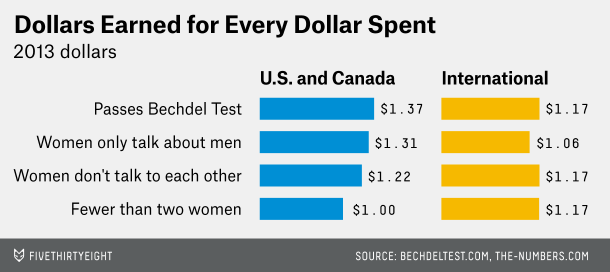
Walt Hickey employs the Bechdel test to argue that Hollywood’s exclusion of women makes no economic sense:
[T]here’s a wide-ranging perception in Hollywood that audiences — in the U.S. and abroad — simply don’t care for women in leading roles and that movies for and about men are more likely to have better cross-market appeal than movies about women. The theory is that “women will go to a ‘guy’s movie’ more easily than guys will go to a ‘woman’s movie,’” said Michael Shamberg, who produced “Pulp Fiction” (1994), “Django Unchained”(2012) and “Garden State” (2004).
This assumption is up for debate; we found that films that pass the Bechdel test tend to do better dollar for dollar than those that don’t — even internationally. …
The total median gross return on investment for a film that passed the Bechdel test was $2.68 for each dollar spent. The total median gross return on investment for films that failed was only $2.45 for each dollar spent. And while this might be a side effect of films with lower budgets tending to have higher returns on investment than films with higher budgets, it’s still a strong indicator that films with women in somewhat prominent roles are performing well.
This is exactly the kind of analysis that I suggested data-driven journalists could profitably contribute to entertainment reporting back when FiveThirtyEight.com launched. And it is exactly the sort of data that backs up the anecdotal evidence that those of us who would like to see more female characters, and more kinds of stories about women, have been brandishing at Hollywood for years. If skeptics of women-centered stories are able to brush off examples like the billion-dollar box office for “Frozen” as some sort of fluke, maybe long-range data like Hickey presents here, and that which [journalism professor Stacy] Smith is assembling, can start to turn this titantically misguided assumption around.
Well, it’s more like a resuscitation of the Book Club, since we had one more than a decade ago now. But the format will be the same. Each month, we’ll pick a book, and Dish readers are invited to read it alongside us. After three weeks, we’ll start debating it, through posts on the Dish and a reader thread fueled by your thoughts on the book. If the author is still alive, we’ll try and get him or her to do a podcast at the end (on Deep Dish) to answer some of the questions readers have raised and keep the conversation going.
If you’re like me, you find your time for book-reading increasingly constrained by our Googled minds and our overwhelmed lives. So think of this club, as I am, as an incentive to read alongside others the kind of book you might have passed on without the prompt of a Dish discussion. In the future, we will have guests championing a favorite book – sometimes new, sometimes old – and hosting the discussion alongside Dish editors curating the reader threads. Maria Popova, of Brain Pickings, has generously agreed to host the second club.
We had been mulling re-starting this feature and then a new book arrived that clinched it. I know some of you may flinch at such a religious subject to kick off the club, but the book is written for believers and skeptics alike, and focuses on the historical exploration of what the earliest Christians meant when they claimed that a first-century rural Jewish preacher was actually God. The reason I find this such a compelling area of research is because I have honestly always wondered what Incarnation is supposed to mean. I know what it means in the abstract – but what it means in reality eludes me. It is a mystery, and yet such a mystery is the linchpin of Christianity. The key questions are: what exactly did Jesus’ followers mean when they insisted upon this after Jesus’ death; and what can it ever mean to claim that someone is the Son of God?
The book is Bart Ehrman‘s How Jesus Became God: The Exaltation of a Jewish Preacher from Galilee. Buy it through this link to join the club and thereby help support the Dish with a little affiliate revenue. Here’s the publisher’s official description of the book:
New York Times bestselling author and Bible expert Bart Ehrman reveals how Jesus’s divinity became dogma in the first few centuries of the early church. The claim at the heart of the Christian faith is that Jesus of Nazareth was, and is, God. But this is not what the original disciples believed during Jesus’s lifetime—and it is not what Jesus claimed about himself. How Jesus Became God tells the story of an idea that shaped Christianity, and of the evolution of a belief that looked very different in the fourth century than it did in the first.
A master explainer of Christian history, texts, and traditions, Ehrman reveals how an apocalyptic prophet from the backwaters of rural Galilee crucified for crimes against the state came to be thought of as equal with the one God Almighty, Creator of all things. But how did he move from being a Jewish prophet to being God?
In a book that took eight years to research and write, Ehrman sketches Jesus’s transformation from a human prophet to the Son of God exalted to divine status at his resurrection. Only when some of Jesus’s followers had visions of him after his death—alive again—did anyone come to think that he, the prophet from Galilee, had become God. And what they meant by that was not at all what people mean today.
Written for secular historians of religion and believers alike, How Jesus Became God will engage anyone interested in the historical developments that led to the affirmation at the heart of Christianity: Jesus was, and is, God.
Join me in exploring this topic and the roots of Christianity. Atheists and non-believers are particularly invited. This will emphatically not be a debate within the confines of any religious community. It may even, I hope, be a way for religious and non-religious Dish readers to communicate with each other in the threads that will eventually emerge. We’ll start the debate the week after Easter, on April 23. So get the book now and start reading.
Update from a reader:
Fantastic idea to bring this back, and terrific selection for the first book. I look forward to reading the thread. Have to say, though, I have a real hard time reading physical books any more. Got mine for the iPad.
In fact, all of our affiliate links go to the electronic version of the book. We don’t get as much affiliate revenue doing so, but since the Dish has long championed the spread of e-books over the dead-tree version, we want to put our money where our mouth is. Also, following the lead of Popova, we will provide a link to public library access. Meanwhile, another reader shares a heartbreaking story about her Christian mother:
I just 1-clicked my way into the Dish Book Club (enjoy the affiliate revenue!). This is a book I would never have given a second, if ever a first, glance to normally, as I am a non-believer.
A non-believer who was raised in the United Methodist church and enjoyed many aspects of the denomination (the musicality, the general welcoming of others). I was also a born-again Christian from the time I was about six years old, but as I got into my teen years, I increasingly felt like a fraud among my Christian peers. The older I got, the less I believed. In my logic-driven brain, it just didn’t add up for me. I don’t know if I lost my faith so much as I let it go. Religion just isn’t a factor in my life very much. I understand how many of my friends and family are of strong faith and I don’t fault them for that or try to take it from them. Some of them know I don’t believe and some don’t. It isn’t much of an issue, except with one person: my mother.
As I’ve become a non-believer, she’s moved towards shades of Christianist. A Baptist church. Much more politically active in the GOP. She’s been unemployed for the past several years living on nothing but social security but still thinks the Affordable Care Act is socialism.
Two years ago at Thanksgiving she cornered me in conversation and asked me point blank if I was still a Christian and I answered honestly (one of my core beliefs) and said, “no.” That basically destroyed her emotionally. This past Thanksgiving she admitted to me that she had planned her suicide because she felt she had failed at everything at life, that the only thing she’d ever done that she’d been proud of was raising me, but when I told her I wasn’t a Christian any longer, then she realized she’d failed at raising me too. As I sat opposite my mother completely stunned at that revelation, she then told me the only reason she hadn’t killed herself was that she realized if she did, she’d never see me again, since she’s going to heaven and I’m going to hell, so she has to stay here until she converts me back to being a Christian. And she said it all so matter-of-factly, I think that might have been the most disturbing part of it all.
My mom wants me to explain to her why I don’t believe in God but she doesn’t have to explain why she does. My response is to just not talk about it at all. It seems like a lose-lose conversation.
Now I’m not looking at any book to solve my problems, but I’ve got to face facts that I have to deal with the religious elephant in my family room sometime and this book seems like a sane, logical place to dip my toe in the water and have some conversations with people on both sides of the belief fence. And I really enjoy history, so bonus there.
April Fools! I took the previous pic in Jan ’13 specifically for this joke! Been setting you guys up this whole time! pic.twitter.com/PvhxWEZvvA — Sean Doolittle (@whatwouldDOOdo) April 1, 2014
Lots of readers are pushing back against the following claim from David Sessions:
Bruno was killed because he flamboyantly denied basic tenets of the Catholic faith, not because religious authorities were out to suppress all “freedom of thought.”
One reader:
If the church is gracious enough to declare that it does not deny all freedom of thought, but still manages to murder you for denying the wrong tenet, pray tell, what freedom do you have if you’re at risk for declaring anything? All you have is the freedom to be afraid and live in fear.
So, was Bruno really killed because he was … flamboyant? If you can lose your life by challenging the Church’s basic tenets, at what point is it sane or just for the church to declare that it’s not suppressing all freedom just because murder is not the response for doing so? The struggle to make the church seem rational or sane is ludicrous. Bruno was killed because he didn’t think correctly. This is about totalitarianism. Faith has absolutely nothing to do with it. Very few heroes of the Enlightenment were atheists because they would have been killed before they could influence anyone. It doesn’t seem improbable that many of the clergy who were responsible for the Enlightenment would have remained in the clergy if their lives were not at risk for leaving it.
Another adds:
Bruno may have been a mean son-of-a-bitch, but those expounding revolutionary thoughts tend to be difficult to get along with. As Cosmos writer Steve Soter noted in a response to Discover’s critique, Bruno was an “extremely difficult person,” but “so was Isaac Newton, who devoted as much time to alchemy and biblical numerology as to physics. But that has no bearing whatever on the value of his good ideas.”
Another goes into greater depth:
First, the Church long suppressed the reasons cited for Bruno’s execution. Second, these reasons reveal that Cardinal Bellarmine executed Bruno explicitly with the charge that Bruno said the Earth orbits the Sun: “The idea of terrestrial movement, which according to Bruno, did not oppose the Holy Scriptures, which were popularized for the faithful and did not apply to scientists.” Bruno was murdered precisely because the Church sought to suppress freedom of thought. Anyone who doubts this should read the historical account of Bruno’s execution, which Cosmos did not describe because it is too violent and horrible to relate to a primetime audience:
As the parade moved on, Bruno became animated and excited. He reacted to the mocking crowds, responding to their yells with quotes from his books and the sayings of the ancients. His comforters, the Brotherhood of St. John, tried to quiet the exchange, to protect Bruno from yet further pain and indignity, but he ignored them. And so after a few minutes the procession was halted by the Servants of Justice. A jailer was brought forward and another two held Bruno’s head rigid. A long metal spike was thrust through Bruno’s left cheek, pinning his tongue and emerging through the right cheek. Then another spike was rammed vertically through his lips. Together, the spikes formed a cross. Great sprays of blood erupted onto his gown and splashed the faces of the brotherhood close by. Bruno spoke no more. …
As the fire began to grip, the Brothers of Pity of St. John the Beheaded tried one last time to save the man’s soul. Risking the flames, one of them leaned into the fire with a crucifix, but Bruno merely turned his head away. Seconds later, the fire caught his robe and seared his body, and above the hissing and crackling of the flames could be heard the man’s muffled agony.
This violent suppression of knowledge cannot be wished away by denying the historical record. Even Cosmos’s cartoon history of Bruno’s execution is accurate, relevant, and important to know.
Another gets snippy:
I suspect that you dislike Cosmos because Tyson attacks superstition head-on in every single episode, unapologetically and using rigorous science as his weapon. Our media is filled with seemingly infinite positive references to religion every single day. Forgive me if I have zero sympathy for you if a single fact-based, supernaturalism-free mini-series makes you so uncomfortable. From where I sit – in a world where billions of people believe in idiotic ideas disproved long ago simply because hoary books promising eternal life tell them they must do so – we need more like Cosmos, and quickly.
That is simply untrue. I find the series’ candid defenses of the scientific method refreshing. It just made me wince at its cheesiness. Another considers the miniseries a work of art:
Cosmos, in its current form or in Sagan’s original, isn’t designed to teach science or history to its audience. That would be an impossible task, given the scale of the material that’s being presented. The most important thing that a program like this needs to do is to create a sense of wonder and amazement at the universe that we live in. It’s not the cartoons or the awkwardly patronizing host that keep me tuning in. Rather, it’s the beautiful renderings of our universe – deep space, vast galaxies, black holes, solar systems, micro-organisms – that I find both thrilling and exciting.
There are a few things that Cosmos needs to do, on a strictly narrative level: it needs to define terms, explain context, and demonstrate ideas. The first part is relatively boring, but essential. You can’t very well talk about the time and space without defining “light speed” or explaining what an Astronomical Unit is. The second part is where most of the Cosmic complaints seem to come from, and that’s fair. But it’s the third area where I think the series really shines. The images and animations do such a fantastic job of simply showing the audience what something is that you can almost turn off the sound and just marvel at it.
Watching Cosmos won’t make you a “master of the universe.” That’s not the goal. What it should do, though, is whet your appetite by showing you how much there is out there, how little we know, and how important it is that we keep trying to learn more. It’s a success, if you ask me.
I think it’s only fair to revisit this after I’ve watched a few more episodes of the series. They’re DVRed. Update from a reader:
I just thought I would weigh in on Cosmos through the eyes of a parent of a nine-year-old. My nine-year-old son has been tuning in to the show with me every Sunday night, and for him it is full of the wonder that one of your readers described. Now he’s a science-oriented kid to begin with (my husband is a biologist), and somewhat precocious at that, but Cosmos has a great deal to offer him. It gets his mind going and imagining all the things that could be, it makes him want to expand on the ideas that Tyson is presenting, he talks non-stop through the commercials. He sees nothing but wonder in all of it.
At one point during the first episode I asked him why he thought some people might not like to learn about the universe, was it because it made them feel small or not important? He replied: “They shouldn’t feel that way! There are so many interesting things out there, and they might be able to discover one of them!”
So Tyson and crew seemed to have pitched this just right for a young mind to cultivate a broader interest in science. At the same time, I am filling in some gaps in my complete ignorance of planetary physics, so I can hold my own in conversations with my son. It might seem simplistic to people more sophisticated in some aspects of these disciplines, including the biographies of the scientists and of Bruno, but it is serving a purpose to engage people with science who might not otherwise have reason to consider the Cosmos at all.
I guess it’s hard to do something that can truly capture the imagination of a nine year old and that satisfies a curmudgeon like myself.
I’m sorry if some were confused a little by my last post on the TNC-Chait debate (a bad case of pronoun vagueness). If I’m being completely honest – and Coates makes such honesty more possible by such intense vulnerability and candor in his own prose – I still haven’t recovered from TNC’s last post. I don’t even know quite what to do with it. But I’m going to sit with it for a while, turning it over in my head, wondering if I need to re-visit a huge amount of my previous convictions and understandings. It makes me uncomfortable. It makes these abstract debates real. It’s what writing can do.
We can and should have much more debate about how to tackle the culture of poverty, period. Ross today points out that there have indeed been discussions of white poverty on the right, and that the current state of play is indeed focusing on white poverty as much as black poverty, in fact, seeing both as a function of a relatively new kind of pan-racial culture of poverty that is entrenching social disadvantage and inequality:
The story that some of us on the right, at least, would tell about that crisis is one that’s actually reasonably consonant with Coates’s grim account of the African-American experience on these shores. Beginning in the 1960s, we would argue, a combination of cultural, economic and ideological changes undercut the institutions — communal, religious, familial — that sustained what you might call the bourgeois virtues among less-educated Americans. Precisely because blacks had been consistently brutalized throughout their history in this country, they were more vulnerable than whites to these forces, and so the social crisis showed up earlier, and manifested itself more sweepingly, in African-American communities than it did among the white working class and among more recent immigrants …
We don’t have a black culture of poverty; we have an American culture of poverty. We don’t have an African-American social crisis; we have an American social crisis. We aren’t dealing with “other people’s pathologies” (the title of Coates’s post) in the sense of “other people” who exist across a color line from “us.” We’re dealing with pathologies that follow (and draw) the lines of class, but implicate every race, every color, every region and community and creed.
And what can we do about that? In many ways, the relentless pragmatism of Obama is the only response. If we know that certain behaviors do indeed lead to worse outcomes, and if we can somehow encourage more productive ways of living, then we surely should, regardless of the burden of history and white supremacy. To surrender to total determinism is too bleak. There is, of course, an ocean of injustice in that “regardless”. But the fate of a minority is not to live in a world in which racial difference (or any distinguishing difference) is erased, but one in which it can be fought against. Interminably. Always. And in the full knowledge that racism and homophobia and sexism and so much else will never end.
It was, to take a proximate example, deeply unfair that gay people had to assert our basic humanity, to explain ourselves as human beings first to heterosexuals, to jump through hoops that were and are deeply humiliating, to be vulnerable in ways no straight person needs to be, to insist simply that we are capable of love and family, and not intrinsically morally subhuman, because our natures somehow compel us to iniquity. There have been times when the double standards have been close to psychologically crippling.
Not so long ago, the lives of gay men were not regarded as equal to straight ones, and the society reacted at first with simple complacency as hundreds of thousands of us died in agony in front of them. When I arrived in America, I had to sign an immigration form declaring that I was not a homosexual. For almost two decades, I had to fight for a chance just to stay in America because this gay disease marked me for deportation, if detected by the authorities. My marriage was trumped by absurd defenses of “public health” and remained vulnerable years after it happened. The spiritual, psychological, emotional desolation of those years made me who I am, for good or ill.
And yet, somehow, a critical mass of gay people were able to master their utterly justified rage to insist on progress and justice and fairness. We have come a long way – but even this week, we read of a new law in Mississippi that would empower individuals to fire or refuse to serve or interact with any homosexual on the grounds of religious belief. We see state-backed pogroms against gays in Russia and untold terror in Uganda and Nigeria. We know, as surely as African-Americans know, that this prejudice, this hatred, will course through humanity for as long as humanity exists on the planet.
I feel sure that TNC sees the necessity of perseverance even if it is deeply unfair, even maddening, and even if, as I believe, the predicament of an African-American in a country built on slavery is deeper than that confronting gays. I guess at some level, that is where my religious faith kicks in. Perhaps it is only psychologically possible to resist evil even knowing that evil will often have the last word on earth if there is some spiritual dimension to relieve the pain and injustice in your soul. Rationally, what King and others did may not have been humanly possible without a faith that prevents you from going mad. It never surprised me that the civil rights movement was a religious movement at its core. How could it have endured without it?
But Coates is not a spiritual leader; he is a writer. And a writer does not need – and should not try – to offer a solution. He is entitled to describe the predicament, to voice the darkness, and has no obligation to put this to practical or pragmatic ends. Which is why Ta-Nehisi’s latest post is, to my mind, as important as anything he has written in this debate:
I am a writer. And that is not a hustle. And this is not my “in” to get on Meet The Press, to become an activist, to get my life-coach game on. I don’t need anymore platforms. I am here to see things as clearly as I can, and then name them. Sometimes what I see is gorgeous. And then sometimes what I see is ugly. And sometimes my sight failsme. But what I write can never be dictated by anyone’s need to feel warm and fuzzy inside.
Amen. And I am simply glad to be a reader. Or perhaps not glad as such. Just deeply uncomfortable in the face of honesty and argument and perspective. And thinking, like TNC, and thanks to TNC. And not done.

 Dish) to answer some of the questions readers have raised and keep the conversation going.


