Walmart: Welfare Queen

Krissy Clark investigates how big box stores profit enormously from SNAP benefits:

While we don’t know exactly how much individual stores make in EBT card sales, we know that EBT revenue really matters to stores’ bottom lines. This is something Walmart share-holders have learned firsthand. When Walmart announced disappointing profits and store sales last quarter, company executives blamed bad weather and the reduction in SNAP benefits that went into effect in November 2013, after an economic stimulus bill expired. …

Walmart is likely the biggest single corporate beneficiary of SNAP, but it’s not just Walmart. A growing number of stores have baked food stamp funding into their business models since the Great Recession. The tally of stores authorized to accept food stamps has more than doubled since the year 2000, from big-box stores like Target and Costco to 7-Elevens and dollar stores. It’s a paradox that the more people are struggling to get by, the more valuable food stamps become for business.

Elizabeth Nolan Brown doesn’t get why this is controversial:

Food stamp users have to shop somewhere, and Walmart is often cheaper than other grocery stores and has more (and healthier) options than the local bodega or 7-Eleven.

I suppose the animosity shouldn’t be surprising—Walmart can do no right in some eyes—but that Walmart is an affordable and accessible option for many on food stamps seems like a benefit to me, not a bug. If there is cause to be upset at here, it’s the fact that so many Americans are unemployed, living in poverty, and forced to rely on food stamps in the first place. It is not the fact that a company provides them with a place to buy affordable food (no matter how much you might personally not like that company).

A GOP Senate Is Getting More Likely, Ctd

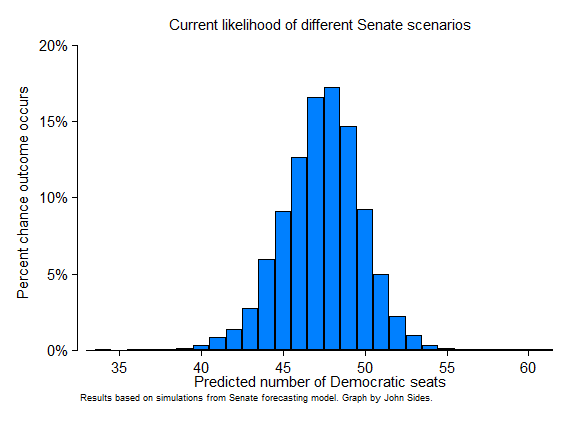
Senate Forecast

John Sides updates his forecasting model:

One key piece of information is whether candidates have held an elective office before and, if so, which one.  Unsurprisingly, political science research has long shown that candidates who have held elective office and higher levels of office tend to do better on Election Day.  They usually run better campaigns and make fewer mistakes, if only because they’ve done it before. As we have begun to incorporate candidate experience into the model, our initial sense is this: Republicans may have a far better chance of winning control of the Senate than we or other analysts previously thought. Here is a preliminary estimate: The GOP could have as much as a 4 in 5 chance of controlling the chamber.

Harry Enten looks at the generic ballot, which also suggests a rough election for Democrats:

In the closing days of the 2012 election, Democrats led the generic congressional ballot by an average of 3.2 percentage points among registered voters, according to the final five polls that released registered voter numbers (CBS/New York TimesCNN/ORCGallup,United Technologies/National Journal and YouGov/Economist). The generic ballot is a standard polling question that typically pits a generic Democrat against a generic Republican in a race for Congress. It’s one of the best indicators of the national political environment. Over the past month, the Democratic advantage among registered voters on the generic ballot is down to 0.5 points. That’s a gain of 2.7 points for Republicans.

Kilgore considers the Democrats’ turnout efforts:

The X-factor is whether the social-media-focused, voter-to-voter motivational techniques deployed by the Obama campaign to such good effect in 2012 are replicable in a midterm. In the old days, for Democrats especially, GOTV centered on “knock-and-drag”—flooding heavily pro-Democratic areas with labor-intensive campaign contacts, especially immediately prior to or on Election Day. That is not so easy with geographically dispersed young voters (other than on college campuses), and with the spread of early voting. And that’s why the new GOTV techniques—less limited in time and place—are so important.

Earlier Dish on Senate forecasting here and here.

The Silencing Of Russian Journalism

Julia Ioffe focuses on Dozhd, the last independent TV channel in the country, and its struggle to stay alive:

Given the youth and often shoestring budget of the staff, its shows can feel raw and unprofessional, but the steady pressure on the channel has instilled fear in their advertisers, not letting Dozhd expand, despite having the most educated and wealthy audience in Russia. And why do high-grossing urban professionals tune in, despite the sometimes high-school paper feel of the channel? There’s nothing else on television in Russia that isn’t controlled by the Kremlin in one way or another. On Dozhd, you can actually get information, rather than propaganda.

Now Dozhd has months to live. Earlier this month, Natalia Sindeeva, the channel’s owner, drastically cut salaries and announced that Dozhd had, at most, three months left. Then the building’s owners told her that Dozhd had to vacate its headquarters by June. Sindeeva said it’s not clear that the lights would or could come back on after such an expensive move. And that’s if anyone decides to let in a liberal entity that’s fallen from the Kremlin’s favor.

Joshua Yaffa also chronicles the crackdown on Russia’s opposition media:

As the space for independent journalism shrinks, the propaganda apparatus is working at feverish speed. Dmitry Kiselyov, a television host and media executive who represents the id of the state propaganda machine at its most grotesque, blamed this same fifth column for the sanctions imposed against more than thirty Russian and Ukrainian officials by the European Union. Kiselyov, who was among those sanctioned, cited Putin’s speech as evidence to blame the fifth column for compiling the blacklist. “Putin legalized that term in the political language of Russia,” he said. “We know their names. We know how they wrote our names and sent them to these Western embassies.”

Irina Kalinina looks at Russian TV’s portrayal of Ukraine:

Perhaps the most vivid propagandist on Russian television, especially these last few weeks, is Vladimir Zhirinovsky, the vice chairman of the Russian Duma, who recently proposed to divide Ukraine between Russia, Poland, Romania, and Hungary. Most Ukrainians and a lot of Russians as well have long considered Zhirinovsky a fool for his tendency to make exceedingly strange proposals. He has advocated, for example, that Russia seize Alaska and use it as a deportation dumping ground for Ukrainians. Not long ago, he claimed that a meteor shower was a test of a new American weapon.

These days, Zhirinovsky is no less surreal in his predictions—but we find ourselves wondering if there just might be a suggestion of Russian policy in his pronouncements. “If you want presidential elections in Ukraine,” he said on Russian television, “you want fascists to win them.” There is a certain twisted logic to this. Russian policy in Ukraine is based upon the strange premise that only Russia can protect the world from Ukrainian fascism. (In fact the opposite is true: The only way radicals in Ukraine would have a chance is if Russia continues its invasion of the country.)

The Bowling Bubble

John McDuling gives a history lesson:

According to HighBeam Business research, the number of bowling alleys in America nearly doubled from 6,600 in 1955 to 11,000 by 1963. Over the same period, the number of people bowling in leagues increased from less than three million to seven million. Around this time, “action bowling,” which the New York Times described as “a high-stakes form of gambling in which bowlers faced off for thousands of dollars” was particularly popular in New York City. ““You’d go at 1 in the morning, and there were 50 lanes and the place was packed,” one exponent of the sport, hall of famer Ernie Schlegel told the Times. “The action was huge back then, like poker is today.” All of this ebullience was reflected in the stock prices of bowling companies such as Brunswick Corporation, which according to the Wall Street Journal [paywall] increased 1,590 percent between 1957 and its 1961 peak. That bowling stock bubble deflated, but it took a while longer for bowling to suffer in the real world.

As Zachary Crockett recently noted, the professional bowlers of yore were pioneers of the celebrity endorsement:

Throughout the 1930s and 40s, “Beer Leagues” dominated professional bowling. The best bowlers were recruited by beer companies – Miller, Stroh’s, Budweiser – and pitted against each other in tournaments. … Harry Smith, the top bowler in 1963, made more money than MLB MVP Sandy Koufax and NFL MVP Y.A. Tittle combined.  Sports Illustrated adds that Smith enjoyed a life of copious luxury:

“Harry does so well that he is able to support a wife and four children in style, tool around the circuit in a maroon Lincoln Continental and indulge a taste for epicurean delicacies. In short, he is the personification of the prosperity that has suddenly overtaken the world of professional bowling.”

In 1964, “bowling legend” Don Carter was the first athlete in any sport to receive a $1 million endorsement deal ($7.6 million today). In return, bowling manufacturing company Ebonite got the rights to release the bowler’s signature model ball. At the time, the offer was 200x what professional golfer Arnold Palmer got for his endorsement with Wilson, and 100x what football star Joe Namath got from his deal with Schick razor. Additionally, Carter was already making $100,000> ($750,000) per year through tournaments, exhibitions, television appearances, and other endorsements, including Miller, Viceroys, and Wonder Bread.

GM Must Have A Great Memory …

Just look at how much they recall:

General Motors announced on Monday that it’s recalling more than 1.3 million vehicles that may experience a sudden loss of electric power steering. GM’s new recall comes after 2.6 million vehicles were recalled earlier this year for ignition-switch problems linked to 13 deaths. GM models involved in the new recall include Chevy Malibus, HHRs and Cobalts, Saturn Auras and IONs, as well as Pontiac G6s from model years 2004 to 2010. GM says it will replace the vehicles’ power-steering motors, steering columns, power-steering motor-control units or a combination of those free of charge, depending on the vehicle.

Sara Morrison notices that the recall “includes ‘Service parts installed into certain vehicles before May 31, 2010 under a previous safety recall'”:

Yes, at this point, GM is recalling its own recalls.

In the first three months of 2014, GM has recalled 6.1 million cars. Last year, Toyota was the automaker with the most recalls, with 5.3 million. GM had just 750,000 recalls in that year, which means in the first three months of 2014 alone, GM has recalled more cars than it and Toyota did in all of 2013 combined. GM also said it expects to spend up to $750 million this quarter on recall-related repairs, more than double its previous estimate of $300 million.

Schuyler Velasco looks into what’s causing all these recalls and finds a silver lining:

The good news is that this seemingly unending stream is actually a side effect of US automakers building safer cars, says Joe Phillippi, an industry analyst and president of AutoTrends Consulting in Andover, N.J. “Safety technology is a lot more democratic than it was even three years ago,” he notes. “Now, even little cheap cars like a Mazda 3 compact have features that you could only get in [Mercedes-] Benzes and BMWs before. Lane departure warning systems, stability control, electronically controlled brake force distribution – nothing is exclusive to high-end cars anymore.”

As cars become more complex, however, problems – and subsequent recalls – become more frequent. And as car parts become more expensive and complicated, there is less diversity in suppliers. For example, Faurecia, a large global auto producer, manufactures seats and other auto parts for Nissan, Volkswagen, Ford, and GM, among others. If, theoretically, something goes wrong with one of its products, it could prompt a recall affecting several automakers.

Nicholas Freudenberg sees the GM recall as part of a bigger problem:

According to the latest report from the International Transport Forum, a body that monitors global road safety, the auto death rate in the United States is more than three times higher than the rate in Sweden, a country that has made auto safety a priority. If the United States had achieved Sweden’s rate, in 2011 more than 20,000 U.S. automobile deaths would have been averted. Since its inception, however, the auto industry has resisted regulation, failed to disclose problems, and refused to correct problems when they were detected.

Meanwhile, Shikha Dalmia points out that the GM bailout has left some victims of faulty products without legal recourse:

If you are own one of the 1.6 million vehicles General Motors has recalled since February with faulty ignitions and you or a loved one had an accident in the car, there’s some more bad news. Your right to collect damages from GM has been signed away. If your accident happened in the years before the old GM’s 2009 bankruptcy reorganization, the managers of the auto industry bailout gave immunity to the new GM that emerged.

The GM bailout, which ultimately cost U.S. taxpayers more than $10 billion, is the gift that keeps on giving to the auto giant. Unless courts overturn that immunity, many victims of GM’s delayed response in recalling cars with faulty ignition switches will recover few damages.
Life After A Stroke, Ctd

A reader writes:

Having had a stroke myself when I was 46 (I’m now 57), I can empathize with Mr. Dyer’s situation. After reading his description, he was quite fortunate.  His impairments were quite limited and he never mentioned any need of rehabilitation services.  But I was concerned about his driving, considering the visual deficits he described.  The problem is that stroke survivors tend to develop a sense of overconfidence once they feel healed, but his visual impairments may be more involved than he notices. The brain needs closure.  Stroke-induced visual deficits can be masked by the brain as it searches to fill in missing visual information with what it perceives should be there, and that perception is often a mismatch with reality.

An example: Patients with ischemias of the right cerebral cortex often develop a condition called visual neglect or visual field cut.  The damaged brain may not see an obstacle in a hallway to the left but the brain has experienced that hallway before, so it plugs in that missing information as an obstacle.  The patient walks into the object, insisting it is not there.  Now imagine driving on a familiar street with an oncoming car on his left.

I forgot to mention I am a retired medical speech pathologist with 25 years of practice.  The cognitive issues are a major pain in the ass. Reading for enjoyment is limited.  In fact, if you have a blog entry over three paragraphs, I go into brain lock.

Another stroke survivor:

I read Geoff Dyer’s story with interest. When I reached the end I realized an obvious point. “Oh my God” I thought.

He’s writing about this year! He’s not even three months in. While his stroke was milder than mild, he’s barely had time to sort out it’s impact. I am also a survivor. I’ll have my fifth re-birthday over Memorial Day weekend. My two strokes happened within hours, and like Geoff’s, they were mild. I continue to play tennis, and I’m in the market for a ping pong table. It won’t fit in my apartment, and I don’t really have the money – I haven’t worked since – but I’m looking (I love the game so).

One of the mantras that survivors hear from their doctors is that six months is the golden window at which point you’ll know the extent of your recovery. What I, and many survivors will tell you, is that recovery continues beyond that point. Almost five years later, I’m still getting better. What’s more, is that as time passes, my awareness of the stroke’s impact has increased as well.

In Letters to a Young Poet, Rilke notes that “the point of life is to live everything.” What he didn’t say, is that while change can happen in an instant, we have to live into what follows. It will be interesting to see what Geoff has to say about his stroke in three more months, in a year, and again in two. In this piece it seems clear to me that he’s not sure what the lasting impact of his stroke is:

There had certainly been some cognitive impairment, but my wife insisted that this had occurred before the stroke. I used to pride myself on my sense of direction but that had long gone south, or maybe north or east. I had trouble concentrating but that too had been going on for ages; I put it down to the internet, not to my brain blowing a fuse or springing a leak. So no, nothing had gone permanently wrong in my head, or at least nothing had gone wrong that had not been in the process of going wrong for a while…” [italics are mine]

One of the experiences I had that is similar to what Dyer described in the quote, is that the people who knew me best were quick to locate impairments to pre-existing issues, or associate it with age-related issues. For me, this speaks to the way we really don’t know how to talk about strokes without relating it to experiences we have had, or our sense of pre-existing conditions. When it comes to ailments we cannot see, our imagination fails us. It takes seeing someone who is “sadly diminished” as Dyers describes Gilbert Adair – using Adair’s own words – before we admit it is real. A year after my strokes, I broke my wrist riding a bike. I received more care afterwards simply because people could see my cast.

Two months after my strokes, I could describe to folks what I was doing when I had the strokes. It’s a story I had to learn because I was having short-term memory issues. At the same time, I wasn’t aware of what I was living into. I pretty much lived in the present moment. I’m smart, and my ability to create coping mechanisms, allowed me to mask impacts I couldn’t see or put words to. As a result, I didn’t begin to become aware of what was happening to me, until fifteen months later.

Almost five years later I feel like myself again. Part of my brain is dead. I understand more of what the lasting impact of my strokes are. I’ve lived into this new life of mine. I know that I have gifts, what they are, and that they should be shared. I am very close to the person I was before (it’s glorious). Will Geoff experience something similar? Something different? Time will tell.

Mr. Faulkner Goes To Hollywood

William Faulkner won the Nobel Prize for brilliant novels like The Sound and the Fury (1929) and As I Lay Dying (1930), but when he needed money, he turned to Hollywood. John Meroney retraces the writer’s steps:

It all started in 1932, when, riding on the success of his novel Sanctuary, Faulkner got word that Leland Hayward, a prominent Hollywood talent agent, had secured for him a $500-a-week contract (the equivalent of $8,500 today) to write scripts at Metro-Goldwyn-Mayer. Faulkner was a modernist, and film was still a new, exciting form of storytelling. But that wasn’t the reason Faulkner accepted. It was the money.

At the same time Faulkner received the offer from Metro, he got news that his publisher, Cape & Smith, was bankrupt. Faulkner had been planning on $4,000 ($68,000 in today’s money) from the company for Sanctuary but was informed he wouldn’t see any of it. Suddenly, he was broke. Word apparently got around Oxford. When he tried writing a check for three dollars at a sporting goods store, the owner told him, I’d rather have cash. All at once, Hollywood became attractive. Faulkner didn’t even have the money to send a wire to answer yes. Eventually MGM advanced him some cash and paid for his train ticket, and days later he arrived in Culver City.

Amidst tales of an affair and lots of bourbon, Meroney includes tantalizing details of scripts Faulkner wrote that never made it onto the screen. How his Hollywood adventures came to a close:

I discovered that Faulkner’s upward trajectory peaked with an offer to work exclusively with [director Howard] Hawks in their own independent filmmaking unit. “He and I had a talk at the fishing camp…. I am to be his writer,” Faulkner wrote to [his wife] Estelle in 1943. “He says he and I together as a team will always be worth two million dollars at least.” It was an outstanding plan, one that would appeal to filmmakers even today. Faulkner wrote, “We can count on getting at least two million from any studio with which to make any picture we cook up, we to make the picture with the two million dollars and divide the profits from it. When I come home, I intend to have Hawks completely satisfied with this job, as well as the studio. If I can do that, I won’t have to worry again about going broke temporarily…. This is my chance.”

The dream of a lifetime. One that would have launched Faulkner and Hawks into the Hollywood stratosphere. But it was never to be. Hawks had a reputation for going over budget on his pictures, which meant that the $4 million required to produce [the proposed WWII epic] Battle Cry ($53.8 million in today’s money) would surely mean more…and more…and more. The studio said no. Faulkner’s romantic dream of filmmaking had come to an end. He would continue to do work for Hawks, including writing screenplays for Hemingway’s To Have and Have Not and Chandler’s The Big Sleep, both of which became films starring Bogart and Bacall. To an outsider, those classics might seem like the pinnacle of a career. For Faulkner, they were little more than paychecks, not the imaginative, unique film projects he and Hawks had once dreamed of making on those summer nights up at June Lake.

Previous Dish on Faulkner here, here, here, and here.

Finding A Voice For The Voiceless

Rupal Patel, a speech scientist behind the Human Voicebank Initiative, wants to diversify and liven up the range of computer-generated voices available to people physically unable to speak. Megan Garber explains the process:

It works like this: Volunteers come to a studio and read through several thousand sample sentences (sourced from books like White Fang and The Wonderful Wizard of Oz). Patel, [collaborator Tim] Bunnell, and their team then take recordings of a recipient’s own voice, if possible, to get a sense of its pitch and tone. (If the recipient has no voice at all, they select for thing like gender, age, and regional origin.) Then, the team strips down the voice recordings into micro-units of speech (with, for example, a single vowel consisting of several of those units). Then, using software they created—VocaliD, it’s called—they blend the two voice samples together to create a new, lab-engineered lexicon: an acoustic collection of words that are at the disposal of a person who needs them to communicate.

Randy Rieland elaborates:

The project’s website, VocaliD.org, has both a sign-up page for donors and another for those hoping to get a personal voice. The latter must submit their names and other relevant information such as their speech ability, which can range from “completely non-vocal” to “can make sounds but not words” to “can use some words for communication.”

While only a handful of voices have actually been created during the project’s infancy, more than 10,000 people already have volunteered to be voice donors, Patel says. “Several hundred” others, she says, have signed up to get new voices. … Her vision is to collect a million different voice samples by 2020. But already her work is making an impact. The site features an audio file, only two sentences long, provided by a young woman described as having a “severe speech impairment.” Her words are as clear as day:

“This voice is only for me. I can’t wait to try it with my friends.”

Is Literary Criticism An Art Or Science? Ctd

Scott Esposito weighs in on the debate:

I don’t see the point of asking whether literary criticism should be an art or a science. It’s obviously not a science and never will be. There’s simply no way as a critic that you can form hypotheses and test them, that being the heart of the scientific method. Yes, sure, you can try to determine the structures beneath texts, movements, etc., but I’ve never seen a literary critic make a single falsifiable prediction, not even in the sense of how it’s done in social sciences like economics and political science. And of course theorists like Paul de Man did nothing of the sort … not even Roland Barthes, who’s probably much closer to a “literary critic/scientist” than de Man, got even close to science.

Meanwhile, from the in-tray:

I took a course on 19th-century European novels from Dr. Moretti while at Stanford some 10 years ago, before he founded the Literary Lab, and his interest in analytical literature shouldn’t be taken as a reflection of his overall approach to books.

His lectures in what was very much a “great books” kind of course (Flaubert, Zola, Hardy, Dickens – the list goes on) were wonderful, penetrating 90-minute monologues on very un-quantitative questions of character and theme and setting and everything any classic lit buff would expect. I skipped a fair number of classes in college, but I never missed a Moretti lecture. So I think his new endeavor’s critics make valid big-picture critiques, but Moretti’s hardly advocating analytics as the sole (or even best!) approach to literature. Instead he’s doing his best to arrest Stanford’s incredibly lame degeneration into a school of pre-meds, pre-laws, and pre-techs – bringing in other disciplines to attract students otherwise warded off by the techie scorn of anything “squishy.”

And his approach actually makes sense! Great books are great, but the overwhelming majority of printed works are not. If these non-great books won’t yield arresting experiences, why not use them to ask and answer some macro-level questions about literature? Computers are bad at some things, but they’re great at boring repetitive stuff … like, say, scanning and parsing thousands of mediocre books no research assistant would want to approach. Moretti’s a brilliant scholar and teacher who’s using Stanford’s prodigious tech resources for some interesting research. There’s no battle of civilizations here, just an earnest effort to expand the relevance of literary analysis at a time when it’s not terribly valued.

Burma Still Isn’t Free

MYANMAR-POLITICS-CENSUS

Min Zin worries that the country will grow increasingly unstable:

Under the current Burmese system, the people do not directly elect the president: parliament does, in a complicated procedure that gives disproportionate power to the military. Even though the current ruling party is unlikely to win both houses of parliament in the 2015 elections, the military members of parliament can still nominate its leader as their candidate for the presidency. So it’s entirely possible that army chief Min Aung Hlaing, who reaches retirement age next year, will enter politics and become the military’s nominee for the presidency.

And that, obviously, is a problem. The military has dominated politics in our country for the past half-century. As long as the military continues to control the presidency rather than handing power over to a civilian leader like Aung San Suu Kyi, the legitimacy and stability of the political transition will be incomplete.

Jay Ulfelder, while a bit more sanguine about Burma’s liberalization, zeroes in on the same problem:

[W]hat’s emerged so far is more like the arrangements that hold in monarchies like Morocco or Jordan. There, loyal opposition parties are allowed to contest seats in the legislature, and a certain amount of free discourse and even protest is tolerated, but formal and informal rules ensure that incumbent insiders retain control over the political agenda and veto power over all major decisions.

For that to change in Burma, the country’s constitution would have to change. When military elites rewrote that document a few years ago, however, they cleverly ensured that constitutional reform couldn’t happen without their approval. So far, we have seen no signs that they plan to relinquish that arrangement any time soon. Until we do, I think it’s premature to speak of a transition to democracy in Burma. Democratization, yes, but not enough yet to say that the country is between political orders. What we have now, I think, is a partially liberalized authoritarian regime that’s still led by a military elite with uncertain intentions.

(Photo: Burma police provide security during census taking in the village of Theechaung on the outskirts of Sittwe in the western Myanmar state of Rakhine on April 1, 2014. Tens of thousands of census-takers fanned out across Myanmar on March 30 to gather data for a rare snapshot of the former junta-ruled nation that is already stoking sectarian tensions. By Soe Than Win/AFP/Getty Images. More Dish on the census here. )