The Cartoonish View Of History In Cosmos


I really wanted to love Cosmos, Neil deGrasse Tyson’s reboot of Carl Sagan’s 1980 television series. I know it has to be very accessible, but it felt a little too desperate not to lose its audience’s attention. Tyson himself turns out to be best appreciated in small doses. His overly-emphatic style – keep your hands still! – and tone that seems to assume we’re all around 12, lacked all the stoner wonder of Sagan, and felt like a new priest trying to make the Gospels more “relevant”, without realizing their relevance is beyond any age. In the end, I tried to block out the ego of the way-too-intrusive host (Like blocking out the sun) and ignore the silliness. And then we got in the very first episode a truly weird history lesson, made into a cartoon.

David Sessions pans it. The segment previewed above is on the 16th century priest and philosopher Giordano Bruno, which includes deGrasse Tyson intoning that the Roman Catholic Church sought to “investigate and torment anyone who voiced views that differed from theirs”. Really?

Bruno’s conflict with the Catholic Church was theological, not scientific, even if it did involve his wild—and occasionally correct—guesses about the universe. As Discover magazine’s Corey Powell pointed out, the philosophers of the 16th century weren’t anything like scientists in the modern sense. Bruno, for instance, was a “pandeist,” which is the belief that God had transformed himself into all matter and ceased to exist as a distinct entity in himself. He believed in all sort of magic and spirits, and extrapolated those views far beyond his ideas about the infinity of the universe. In contrast to contemporaries who drew more modest conclusions from their similar ideas, Bruno agitated for an elaborate counter-theology, and was (unlike the poor, humble outcast portrayed in Cosmos) supported by powerful royal benefactors. The church didn’t even have a position on whether the Earth orbited the sun, and didn’t bring it up at Bruno’s trial. While the early-modern religious persecution certainly can’t be denied, Bruno was killed because he flamboyantly denied basic tenets of the Catholic faith, not because religious authorities were out to suppress all “freedom of thought.”

Cosmos’ treatment of Bruno as a “martyr for science” is just a small example of a kind of cultural myth we tell ourselves about the development of modern society, one that’s almost completely divorced from the messy reality. It’s a story of an upward march from ignorance and darkness, where bold, rebel intellectuals like Bruno faced down the tyrannical dogma of religion and eventually gave us secularism, democracy, and prosperity. Iconoclastic individuals are our heroes, and big, bad institutions—monarchies, patriarchies, churches—are the villains. In the process, our fascinating, convoluted history gets flattened into a kind of secular Bible story to remind us why individual freedom and “separation of church and state” are the most important things for us to believe in.

The real path to our modern selves is much more complicated—so complicated that academic historians still endlessly debate how it happened.

While some scholars treat “the Enlightenment” as if it were a single movement, others argue that it unfolded differently—at different paces, in different styles—in different countries. Some argue that atheism was a central concern, while others think the “age of reason” was driven more by the desire for greater political freedom. Either way, deeply religious Catholic scholars contributed to many of the great discoveries of natural science, and even the foundations of disciplines like geology. Very few of the heroes of the Enlightenment were atheists, and even the scientific luminaries of the period fell for various forms of “occultism,” from alchemy to spirit-conjuring. Many were elitists who, despite their opposition to tyranny, remained contemptuous of the masses. The veneration of reason did not lead neatly or automatically to moderate democratic politics; in some cases, like the Terror of the French Revolution, it resulted in bloody brutality not much different from the sort visited on religious heretics like Bruno a few centuries before.

My memory of the original is shaky, but Artur Rosman digs up this passage from Walker Percy’s mock self-help book, Lost in the Cosmos. Sagan’s may have been as wince-inducing as Tyson’s version – and for the same reasons:

[A]s Whitehead pointed out, it is no coincidence that science sprang, not from Ionian metaphysics, not from the Brahmin-Buddhist-Taoist East, not from the Egyptian-Mayan astrological South, but from the heart of the Christian West, that although Galileo fell out with the Church, he would hardly have taken so much trouble studying Jupiter and dropping objects from towers if the reality and value and order of things had not first been conferred by belief in the Incarnation.

Yet one is not offended by Sagan. There is too little malice and too much ignorance. It is enough to take pleasure in the pleasant style, the knack for popularizing science, and the beautiful pictures of Saturn and the Ring Nebula.

Indeed, more often than not, I found myself on Sagan’s side, especially in his admiration for science and the scientific method, which is what he says it is — a noble, elegant, and self-correcting method of attaining a kind of truth — and when he attacks the current superstitions, astrology, UFO’s, parapsychology, and such, which seem to engage the Western mind now more than ever — more perhaps than either science or Christianity.

What is to be deplored is not Sagan’s sophomoric scientism — which I think better than its counterpart, a sophomoric theism which attributes the wonders of the Cosmos to a God who created it like a child with a cookie cutter — no, what is deplorable is that these serious issues involving God and the nature of man should be co-opted by the present disputants, a popularizer like Sagan and fundamentalists who believe God created the world six-thousand years ago. It’s enough to give both science and Christianity a bad name. Really, it is a case of an ancient and still honorable argument going to pot. Even arguments in a college dormitory are, or were, conducted at a higher level.

Previous Dish on Cosmos here, here, and here.

Et Tu, Josh?

Every now and again, it’s perhaps worth revisiting the entire definition of journalism. In my view, it is writers and editors attempting to tell the truth about what’s happening in the world to readers every day or more frequently. A journalistic institution that lasts builds a trust between its editors and readers so that no one is in any doubt about the sincerity of the enterprise, its freedom from outside interference, or its integrity as a form of communication.

Screen Shot 2014-03-28 at 6.29.44 PMMy concern with “sponsored content” in vast swathes of online media – from the New York Times to Time Inc. and Buzzfeed – is simply that, by deliberately blurring the distinction between advertising and editorial, it must necessarily undermine this integrity and cast a doubt over that trust. It violates the core integrity of any journalistic institution to treat the prose of commercial interests as the equivalent of the prose of editors and writers – or to blur the lines between the two, by presenting commercial speech in extremely similar formats to editorial speech.

Am I being too purist? All I can say is that my position was once held by every journalistic institution you can think of only a few years ago. Back then, advertising was a revenue model that was self-explanatory, clearly differentiated from any article, and if it could in any way be confused with an article would have the word “Advertisement” attached to it. It was also assumed that the editor would know no specifics of the advertiser. The reader of a magazine knew that what appeared in its pages was written entirely by journalists and guided by editors. That is not purism. It is the basic ethical code of journalism as we have known it for decades.

And so we come to the deeply depressing news that Josh Marshall’s TPM has joined the throng. In introducing the series – a completely new step for TPM – Josh didn’t address the obvious glaring issue. Instead he wrote a post that doesn’t sound like him, and in fact reads like a p.r. press release:

Today I’m really excited to announce that we’ve launched a very cool new section to our popular Idea Lab vertical called Idea Lab: Impact, which is being sponsored by the Pharmaceutical Research and Manufacturers of America. I’ve wanted to take Idea Lab in this direction for some time. Idea Lab focuses science, cutting edge technology, the tech industry and the economics, policy and politics that surrounds those issues and sometimes on the gizmos we all use everyday. Idea Lab: Impact will have a different focus. How is science and applied technology affecting real human lives?

I.e. “The Data Sharing Effort To Cure Cancer.” Which was the first article in the new “vertical”. Which was written by a Phrma corporate flak.

On Friday, Josh responded to some brutally effective takedowns by Henry Farrell (it’s worth reading the entire debate, including the comments where Josh participated). His argument is that these are advertisements and are clearly labeled as such, but include text like an article because, well, er:

Our advertisers are policy focused and thus tend to have more complex arguments. They’re not just selling soap or peanut butter. There’s only so much of those arguments you can fit into a picture box or a video. They want room to make fuller arguments, lengthier descriptions of who they are and what they do, as you would if you were writing an editorial – in text, going into detail.

But they could do all that in a traditional advertisement: in their own font, attached to a real article, in their own color, with their own branding. We’d all know what it is. But this is not what Josh has offered them. He has offered them the appearance of being an article in TPM, and that offer is precisely and solely what makes sponsored content ads worth more than the others. If it were clearly an ad, that w0uld defeat the purpose of the enterprise, which is to blur that difference. So there is something inherently corrupting and unethical about this arrangement.

To quote E.B. White, stating the obvious, when discussing mere sponsorship of an article written by a journalist in Esquire in 1975:

Sponsorship is attractive to the sponsor himself, who, for one reason or another, feels an urge to penetrate the editorial columns after being so long pent up in the advertising pages. These temptations are real, and if the barriers were to be let down I believe corruption and abuse would soon follow.

That’s what all this is: an invitation to advertisers to penetrate the editorial columns. TPM and Josh, of course, are laggards in this. The betrayal of basic journalistic ethics by Time Inc. and the New York Times are far greater evils. I am focusing on TPM today because I’ve always thought of it as a sister site to the Dish, started just a short while afterwards, and imbued with the same spirit of independence. It’s not a desperate dinosaur grabbing one last stream of revenue in a panic. It’s a successful new media site that has actively decided to embrace this development with both hands. The news that they have done this has hit me like a sucker-punch to the gut.

TPM, after all, was an ethical model for online advertising and very successful at it. They accepted network ads blindly, wisely refusing to remove any for political reasons, because if they picked one ad over another, they’d be giving away their independence, and implicitly endorsing what were simply ads. But now, Josh absolutely picks advertisers over others, and thereby endorses Phrma, a controversial group whose activities might seem somewhat alien to Josh’s liberalism. In the past he could just say: heck, they’re an advertiser. An agency sends them our way and they pay the rent. Now, he has to own his endorsement of Phrma, and his integration of their propaganda into the core fabric of his magazine. As indeed he does:

This isn’t just something I’m comfortable doing or willing to do. I’m glad to do it. Because it allows me to continue funding what I believe is a great news organization, keeping it growing and expanding.

Compare that with E.B White:

The sponsorship principle seemed to challenge and threaten everything I believe in: that the press must not only be free, it must be fiercely independent — to survive and to serve.

Today, TPM is a little richer and a lot less independent. They chose the money over the principle. But there are some things money should never buy.

Erdogan Wins; Does Democracy Lose?

Despite a corruption scandal and controversy over his crackdown on social media, the Turkish prime minister’s Justice and Development Party (AKP) won big in yesterday’s municipal elections, garnering over 45 percent of the vote over the main opposition party’s 28 percent. Piotr Zalewski previews the PM’s next move:

Erdogan has already made it clear that he intends to capitalize on his big win by settling accounts with his enemies, not least the Gulen movement, a powerful Islamic sect that he and many others in Turkey consider “a parallel state,” and the driving force behind the graft investigation.

“The time has come for the traitors to reckon with this country,” Erdogan said on Sunday, referring to the Gulenists. “Their plan was chaos. We will enter their caves. We will make them pay.”

The list of other potential traitors, fears Atilla Yesilada, a political analyst with Global Source Partners, might quickly grow longer. “The man who shuts down Twitter and YouTube is not going to stop at just that,” he says. A further clampdown on what Erdogan calls the “partisan media” might not be long in coming.

Mohammed Ayoob explains why Erdogan and the AKP remain so popular:

The AKP government, even if corrupt, has delivered on the economic front with a very visible rise in the income level and standard of living of the average Turkish citizen.

Furthermore, the benefits of the past decade’s economic growth have percolated down to the previously disadvantaged segments of society, the “Black” Turks, whose economic and political demands and requirements had been neglected by governments led by the Kemalist elites. They were, and continue to be, seen by many in the Anatolian heartland as representatives of the “White” Turks from the western seaboard who had ruled the republic for much of its first 80 years, and with whom the CHP is identified. There are, therefore, significant class and regional divisions between the AKP supporters and its opponents. The regional division has been clearly reflected in the local elections.

And A.Z. looks at the challenges ahead, noting that Erdogan, who is expected to run for president this summer, “cannot afford to be complacent”:

His increasingly authoritarian methods of stifling dissent (Twitter and YouTube have been blocked) may not cost him votes at home but they have tarnished his international image. Turkey’s Western friends are increasingly nervous about Mr Erdogan’s erratic ways. And though Turkey has managed to emerge largely unscathed from the global financial crisis, its economy is slowing down. AK may not be able to afford the big-ticket projects it is has promised to deliver, including building a third airport and third bridge over the Bosporus in Istanbul. AK’s strong showing is linked to its strong economic performance in the past. Markets reacted positively to the outcome. After months in the doldrums, the Turkish lira rallied against the dollar.

Recent Dish on Turkey here, here, and here.

An Autism Epidemic? Ctd

Jessica Grose chatted with Dr. Catherine Lord about the study released last week:

As for the overall rise, we can’t know whether there are more autistic children now than there were in previous generations, because we’re so much more aware of the disorder today than we’ve ever been. (Lord does not believe that autism is being overdiagnosed.) The criteria for autism didn’t change between 2008 and 2010 (though the criteria did change in 2013), and a 30 percent rise does seem like a lot to simply attribute to raised awareness.

Still, there is no indication that there’s a rise in severity. Just as they did in 2008, the numbers refer to everyone on the spectrum, which includes a huge range, from extremely mild to extremely severe. In 2008, 62 percent of children with ASD did not have an intellectual disability (which means an IQ over 70). In 2010, 69 percent of children did not have an intellectual disability. Lord compares the breadth of this study to one about people with sight problems, which included “both people who have to wear glasses when they’re 60 to read up close, up to people who are functionally blind. It is a very, very broad range.”

Aaron Carroll makes related points:

1) The definition of autism is evolving. It’s now a spectrum, and being identified in higher functioning individuals.

2) Awareness is increasing, leading more children to be labelled.

3) There are many areas where support for autism services are robust, but support for other disabilities are thin. Giving children the diagnosis of autism opens up doors for them that might otherwise be closed with respect to help.

4) Of course, the prevalence could be increasing as well.

Over the weekend, Sam Wang looked (NYT) at the various factors that increase the risk of autism. One of the more surprising ones:

A highly underappreciated prenatal risk is stress. For pregnant women who take the sometimes-wrenching step of emigrating to a new country, for example, the risk ratio is 2.3. In the fifth through ninth months of pregnancy, getting caught in a hurricane strike zone carries a risk ratio of about 3. Maternal post-traumatic stress disorder during pregnancy is associated with a similar effect. These events are likely to trigger the secretion of stress hormones, which can enter the fetus’s bloodstream and affect the developing brain for a lifetime. Stressors may also lead to maternal illness, the immune response to which may interfere with brain development.

Wang promotes the article at his blog:

In my article in the Sunday New York Times on how to think about autism risks, I apply meta-analytical techniques to autism research literature. It’s nearly impossible to get a good overall perspective from news reports. However, I provide a way to look at it all at once. My secret decoder ring takes the form of risk ratios. Check it out.

Back To The Futurism, Ctd

The Guggenheim’s exhibit on Italian Futurism continues to inspire tributes to F.T. Marinetti’s movement. On a recent tour, Morgan Meis singled out a work by Umberto Boccioni:

Amusingly, perhaps maddeningly, you can scratch the surface of any work of Futurism dish_Unique_Forms_of_Continuity_in_Space and the past comes rushing back in. Take Umberto Boccioni’s Futurist sculpture, “Unique Forms of Continuity in Space.” Boccioni’s work is to sculpture what Pannaggi’s “Speeding Train” is to painting. It is the attempt to make a solid, motionless piece of cast bronze into something that is fluid in space and time. Boccioni achieves this by breaking up the surfaces of a human figure. That’s to say, he sculpts a person in several moments of motion all at once.

Look, especially, at the legs of the figure. The legs are thick because Boccioni is showing us multiple positions of a moving leg. It is as if Boccioni took a series of photographs of a person striding forward, spliced those photographs together, and then made a sculpture of the result. The sculpture does not freeze a moment into sculptural eternity, as a more traditional sculpture might do. Instead, it shows us that form is never frozen, but always in transition from one state to another. That’s an essentially Futurist thought—all the emphasis is on dynamism, with little regard for the fixed state.

But the problem with Boccioni’s sculpture is that, though it may suggest movement, as a sculpture, it is still in a fixed state.

It may express dynamism, but it does so in static — one almost wants to say classical — form. Indeed, as has been noticed before, “Unique Forms of Continuity in Space” resembles the classical sculpture, “Winged Victory of Samothrace.” You’ll recall that “Winged Victory of Samothrace” was the very sculpture that Marinetti referred to in his Manifesto. Marinetti claimed that the roaring motorcar was more beautiful than the “Winged Victory of Samothrace.” This was his way of rejecting past notions of beauty in the name of the resolutely modern. But Boccioni’s sculpture is beautiful partly because of what it shares, formally and historically, with the “Winged Victory of Samothrace.” Boccioni’s sculpture does not resemble an automobile; it resembles a stone statue from ancient times. Boccioni and the sculptor of “Winged Victory” share the assumption that there is something essentially compelling about the movement of human bodies. When a human being strides forward, the rest of us pause to take a look. The lyrical quality in “Unique Forms of Continuity in Space” would have been beautiful to a citizen of 2nd century Hellenistic society, just as it is to someone wandering through the Guggenheim in the early 21st century.

Previous Dish on Futurism here.

(Image of “Unique Forms of Continuity in Space” by Umberto Boccioni, 1913, via Wikimedia Commons)

The Slumping Stadium

3379519505_c002592880_o

Springtime means baseball, and George Will has a new book, A Nice Little Place on the North Side: Wrigley Field at One Hundred. One of his arguments? The team has struggled in part because Wrigley was built and marketed as “a destination whose appeal was largely independent of its tenant’s won-loss record”:

The strategy wasn’t always foolproof — attendance dipped as the Cubs slogged through particularly wretched stretches — but by and large, Wrigley Field gave the team’s owners a comfy cushion of fan loyalty through thick and (mostly) thin. But Will’s provocative hypothesis, which over the course of this slender book’s 223 pages comes to seem indisputable, is that the ballpark is “part cause and part symptom of the Cubs’ dysfunctional performance.” If the Cubs ownership hadn’t been able to rely so heavily on the stadium’s enduring popularity with fans, Will argues, it might actually have been forced to field a winning team.

Joseph Epstein recaps that dysfunction:

The Cubs’ last World Series victory was 1908; its last appearance in a World Series was 1945. Since moving to Wrigley Field in 1916, the team’s winning percentage has been a dispiriting .488, its overall record 7,478 wins to 7,833 losses. The question is: Has the antique elegance of Wrigley Field been an enticement for the team’s owners to do nothing to improve the team, since the fans, allured by the field’s fading grandeur, come out in any case?

Larry Thornberry looks at the evidence Will provides:

The latest stats, dreamed up by a couple of quantitative sports guys named Tobias Moskowitz and Jon Wertheim, claim to demonstrate, with charts and graphs, that the attendance at Wrigley Field is less sensitive to the Cubs’ winning than is the case with any other team and any other ballpark.

I’ll spare you the boiler-plate, but the average “attendance sensitivity” in Major League Baseball is 1. The Yankees sensitivity is 0.9, meaning attendance tracks the pin-stripes’ won-lost percentage pretty closely. The Red Sox are also at 0.9. The Cubs are at 0.6, leading Moskowitz and Wertheim to label the Cubs “America’s Teflon team.” In fact, the pair finds the price of beer in the park tracks attendance better than the Cubs’ won-lost percentage.

Update from a reader:

Another problem with Wrigley is that due to the eccentric lake winds, it’s nearly impossible to establish a home-field advantage. Despite its reputation as a homerun-happy bandbox, when the winds blow in – as they regularly do, especially early in the season – Wrigley is really a pitcher’s park. So there’s no clear blueprint for a winning edge like there is at, say, Yankee Stadium (load up on lefty power to take advantage of the short porch in right) or the old Busch Stadium in St. Louis (where the Cardinals memorably stocked their outfield with gazelles to roam the cavernous gaps). Add to that the fact that all those day games really do mess up the players’ circadian rhythms and it’s no wonder the Curse of the Billy Goat has held so long …

Another:

OK, now you’re in my area of expertise; I reviewed Will’s book and four other 100th Anniversary-of-Wrigley for the Chicago Tribune this weekend.

The key fallacy in the idea that the appeal of Wrigley as an antique ballpark has led to the team’s lack of success is the simple fact that for its first 60 or 70 years, Wrigley was not an antique ballpark: it wasn’t even the oldest ballpark in Chicago until Comiskey Park (1910) was demolished in 1992.  The spate of construction of dual-use concrete bowl stadia in the ‘60s and ‘70s (all of them except Oakland’s now demolished because they were bad for both football and baseball) led to the Wrigley/Fenway romanticism.  It’s true that ownership promoted “fun at the friendly confines” rather than a winning team (because he didn’t have very many winning teams) but the Ye Olde Wrigley meme doesn’t begin till the 1980s.  And since ’84, while the Cubs haven’t won a World Series, they have won 5 division titles and made one Wild Card appearance.  They are not as bad as people think, and lately attendance has dropped as the quality of play has gotten worse since ’08.

As for Will, my take on his book:

George Will’s “A Nice Little Place on the North Side: Wrigley Field at 100” belongs in the dining room. Not because his book is especially suited to formal meals, but because at every holiday dinner, there’s one cranky uncle or in-law who disagrees with everyone else about religion or politics. To keep the familial peace, you seek some conversational common ground and end up talking about baseball (unless of course, this cranky uncle is a Sox fan, in which case you talk about football). As a renowned conservative columnist and bow-tie fancier, Will fits this profile. …

In his narrative, Will re-creates the structure of a conversation at the ballpark. The ballpark’s lore provides the main thread, and Will adds to our knowledge of that history. (His take on the Elia rant, for instance, adds intriguing context from interviews with Keith Moreland.) But there’s time for digressions on Chicago history, the importance of beer in civilization, or the invention of Ladies Day, just as during a game, one will follow the action but chat about nearly anything else between pitches, at-bats and innings. Will’s conversational tone hits the sweet spot of just such a day’s talk.

But like the guy talking at the ballpark, Will sometimes gets things wrong. To cite one error, Will claims that one indignity contemporary Cubs fans will have to suffer is Greg Maddux in an Atlanta Braves cap on his Hall of Fame plaque in Cooperstown. Maddux chose to go into the Hall with no logo on his cap — he was more generous to Cubs fans than Will was when he assumed that three Cy Youngs and a World Series ring outweigh playing at Wrigley after coming up in the Cubs system. But as the old cliché goes, when you “assume” … no, never mind. Be generous to cranky Uncle George; put his book in the dining room.

(Photo by Flickr user atalou)

The Animal Mind, Ctd

Virginia Morell describes why she wrote Animal Wise: The Thoughts and Emotions of Our Fellow Creatures:

I wanted to reveal something about the scientists who are investigating animal cognition and emotion, to show their personalities, backgrounds, and what led them to devote their lives to studying the mind of a particular species of animal. … When you consider their results overall, it’s not difficult to reach the conclusion that other animals think and feel. This includes the pets we have, and domesticated and wild animals. They have active minds and experience feelings.

The idea that we are special and at the top of a hierarchy of animals just doesn’t fit with what scientists now know. There isn’t a tree of life; it’s more like a bush.

Humans are at the end of one of the branches on the bush. It’s often said — even by some scientists — that there is a cognitive chasm between us and other animals. The researchers in my book are helping to close this chasm, to show us there is not as great a gap between us and the other animals. I think Darwin put it best: the differences between humans and other animals are “one of degree, not of kind.” There really isn’t any evidence for assuming that other animals are not cognitive, feeling creatures. The discoveries reported in my book show that indeed they are, and that we humans are part of a continuum of life. The scientific experiments and observations in Animal Wise are also supported by neurobiological research showing how similar our brains are to those of other animals. Ours are more complex, but at a fundamental level there are important similarities that give animals the ability to experience the world, make decisions, and do things intentionally.

In a February interview, Morell described the responses she’s been getting from readers:

I get messages from people that my book changed their lives and opened up a whole new way of looking at the world. Some say, “I can’t kill the ants on my kitchen counter anymore.” It seems to have opened people’s minds and hearts to recognizing that the other animals aren’t just robots—they truly are living, sentient beings. What an amazing world we live in, to be surrounded by all these other minds.

Previous Dish on animal cognition here, here, and here.

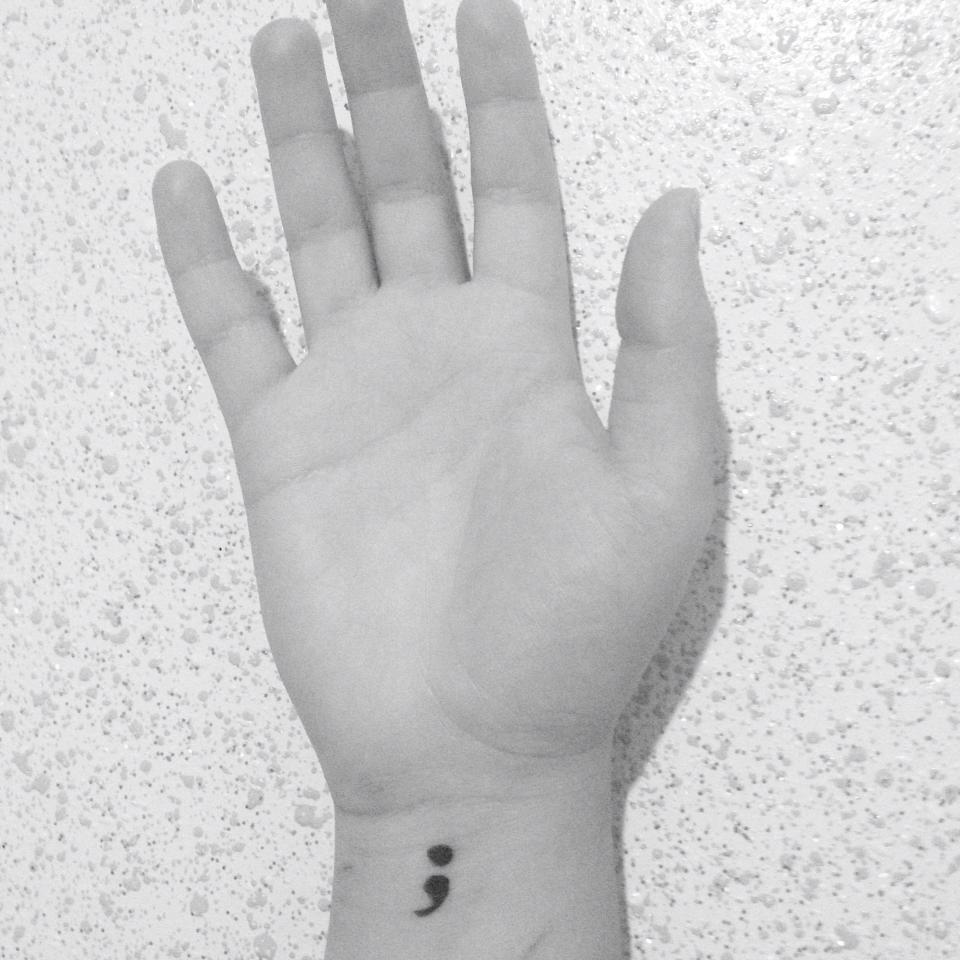
Punctuating Life Sentences

dish_semicolon

“[W]hy are people all of a sudden inking or tattooing semicolons on their wrists?” asks Allan Metcalf of a new Internet phenomenon. “To prevent suicide, of course”:

Here’s an explanation from the website of the Semicolon Movement on Tumblr:

“The semicolon is used when a sentence could have ended, but didn’t.

“The movement is for anyone who has ever self-harmed, has a personality disorder, or has tried to commit suicide. The semicolon is a sign of hope. Your sentence is not over yet. …

“If you have ever harmed yourself, attempted suicide, or just want to support the cause, put a semicolon on your wrist or wherever you feel would mean the most. Every time you see it, think of something that makes life worth living.”

You can find explanations like these, and numerous illustrations of semicolons decorating arms and wrists, on Facebook and Pinterest, as well as Tumbler. And there’s a website for The Semicolon Project, “a nonprofit organization dedicated to presenting hope, help, and support to the people and communities suffering from mental-health issues. We are here to address depression, anxiety, self-harm, addiction, and suicide.”

The website announces a special day: “On April 16, 2014, everyone who self-harms, is suicidal, depressed, has anxiety, is unhappy, going through a broken heart, just lost a loved one, etc., draw a semicolon on your wrist. A semicolon represents a sentence the author could’ve ended, but chose not to. The author is you and the sentence is your life.”

(Image via The Semicolon Movement)

Franklin And The Security State

“The government’s surveillance program,” writes Christopher Cox in Harper’s (subscription required), “is so far removed from what the Fourth Amendment defines as a permissible search … that it’s hard to believe they thought they could get away with it—and still think they can.” He looks to history to illustrate his point:

Two hundred sixty years ago … Shawnees were attacking Englishmen on the American frontier.

The frontier, at the time, was in Pennsylvania. In Philadelphia, the colonial assembly voted to raise a militia to fight back, but Governor Robert Hunter Morris rejected the bill because the assembly proposed a tax on all landowners to pay for it. Morris insisted that the legislation exempt the Penn family, who were the largest landowners in the colony (and had appointed him to his position). The assembly, led by Benjamin Franklin, refused to revise the bill.

It may have been the first time an American dispute started with a proposed tax on the rich. It certainly wasn’t the last time the country was threatened by what Franklin, in his Historical Review of Pennsylvania (1759), called the “insidious attacks of small parties of skulking murderers.” In Franklin’s account, Morris wanted to be made “provincial dictator” and was exaggerating the threat from the Shawnee and their French allies in order to get his way. (“The populace are never so ripe for mischief as in times of most danger.”) The assembly, in any case, wasn’t persuaded: better to let the frontier burn than accept Morris’s proposal. Their reply to the governor: “Those who would give up essential liberty, to purchase a little temporary safety, deserve neither liberty nor safety.”

Time has edited the phrase to remove the adjectives; Franklin would probably admit that there’s really no such thing as permanent safety or inessential liberty. And its application has shifted over the years. In the eighteenth century, fighting for liberty meant preserving the power of the legislature; today, it means preserving the power of individual citizens to resist the state’s intrusions. But Franklin’s sentiment, made universal, should be the one to guide us in this debate.

Where The Wild Things Are

dish_exoticpets

dish_exoticpetsmapkey

Lauren Slater investigates exotic pet ownership across the country:

Privately owning exotic animals is currently permitted in a handful of states with essentially no restrictions: You must have a license to own a dog, but you are free to purchase a lion or baboon and keep it as a pet. Even in the states where exotic-pet ownership is banned, “people break the law,” says Adam Roberts of Born Free USA, who keeps a running database of deaths and injuries attributed to exotic-pet ownership:

In Texas a four-year-old mauled by a mountain lion his aunt kept as a pet, in Connecticut a 55-year-old woman’s face permanently disfigured by her friend’s lifelong pet chimpanzee, in Ohio an 80-year-old man attacked by a 200-pound kangaroo, in Nebraska a 34-year-old man strangled to death by his pet snake. And that list does not capture the number of people who become sick from coming into contact with zoonotic diseases.

The term exotic pet has no firm definition; it can refer to any wildlife kept in human households—or simply to a pet that’s more unusual than the standard dog or cat. Lack of oversight and regulation makes it difficult to pin down just how many exotics are out there. “The short answer is, too many,” says Patty Finch of the Global Federation of Animal Sanctuaries. It’s estimated that the number of captive tigers alone is at least 5,000—most kept not by accredited zoos but by private owners. And while many owners tend to their exotic pets with great care and at no small expense, some keep their pets in cramped cages and poor conditions.