Mark Vernon finds that “a definitional approach to friendship has its limits”:
Try listing some of the friends you have – your partner, oldest friend, mates or girlfriends, one or two family members, work colleagues, neighbours, friends from online chat rooms, family friends, a boss perhaps, therapist, teacher, personal trainer – whoever you might at some time think of as a friend. A look at such a list puts your friends in front of you, as it were, and highlights the vast differences. For example, the friendship with your partner will in certain key respects be unlike that of your oldest friend, though you may be very close to both. Conversely, although friendship is for the most part a far less strong tie than say the connection to family, you may feel less close to members of your family in terms of friendship than others with whom you have no genetic or legal bond. Then again, lovers might make you blush and families can make you scream, but friendship – even soul friendship – is usually cool in comparison.
As you continue further down the list to the friends who are in many ways little more than acquaintances, associates or individuals for whom you have merely a sense of friendliness, it is obvious that friendship stretches from a love you could scarcely do without to an affection that you’d barely miss if it ended.
Some people would say there is some minimal quality which means that it makes sense to call all of them friends, perhaps Aristotle’s goodwill. Others would disagree: they are the sort who say they have a handful of friends and that others are people they only know. In other words, the ambiguity of friendship extends to the very possibility of prolific and profound friendship-making.
Personally, I think that Aristotle is on to something in his belief that the closest kind of friendship is only possible with a handful of individuals, such is the investment of time and self that it takes. ‘Host not many but host not none’, was his formula. He would argue that less is more and it is easy to substitute mere networking for the friendships it is supposed to yield. He actually went so far as to express a fear of having too many friends, ‘polyphilia’ as it might be called. There is an expression attributed to Aristotle that captures the concern: ‘Oh my friends, there is no friend.’
Greek and German researchers have compiled the results of looking at sunsets in 310 works from the Tate and National Gallery in London. The art dates from 1500 to 2000 and covers some 50 volcanic explosions and the stunning skies in their aftermath. The focus is on sunsets because, as atmospheric refractions beaming light through the Earth’s atmosphere in a way we usually can’t see, they can potentially show what the climate was like in the past and help improve climate change models for the future. Called ”Further evidence of important environmental information content in red-to-green ratios as depicted in paintings by great masters,” the study follows and confirms findings from the team’s 2007 exploration of paintings by such artists as Rembrandt, Hogarth, and Rubens. The current study is heavy on J. M. W. Turner, who was drawn to the sunsets just after the [1815 Mount] Tambora eruption.
By measuring the amount of red and green in the paintings, the researchers were able to figure out past aerosol pollution levels. More aerosols meant redder sunsets, because the tiny particles are small compared to the wavelength of visible light, More long wavelength red light makes it through the aerosols, and shorter wavelength blues and violets get scattered by the aerosol particles. “Regardless of the school and style, all painters provided quite accurate aerosol information when red/green ratios were examined,” lead study author Christos Zerefos, a professor of atmospheric physics at the Academy of Athens in Greece, said in an email interview.
Update from a reader:
In a similar vein, “Vanishing Ice: Alpine and Polar Landscapes in Art, 1775-2012” just ended it’s first exhibition at the local art museum in Bellingham, WA. Admittedly, it scrimped as small museums must by using occasionally using reproductions in place of originals, but the themes and messages were all quite original and powerful. Explore the meaning of ice in our world, in its many forms, and witness the changing ice patterns in “before and after” type comparisons of paintings, prints, sketches and photographs. Lots of other great media reviews on the exhibition website.
At the start of the exhibit in November 2013, the museum commissioned an installation in the museum courtyard. Called “Melting Ice” by Jyoti Duwadi in collaboration with Bellingham Cold Storage. From this YouTube video: “The sculpture was assembled with blocks of ice from the company’s old ice house and left to melt. A variety of fossils, some dating to the Ice Age, was embedded in the cube and revealed during the melting process. Fossils are time capsules into the earth’s natural history. Students from Bellingham schools participated in various educational activities related to the artwork. The process of creating this installation and the ice melting was captured on tape.”
The exhibition website is here. A complete video tour of the exhibit is here (damn the internet is cool).
(Image of Chichester Canal by J. M. W. Turner, 1828, via Wikimedia Commons)
Dan Piepenbring marvels at the 1980 short seen above, Fisheye, by the Croatian animator Joško Marušić:
Fisheye is an inspired blend of the macabre and the mundane. Its premise is simple: instead of people going fishing, fish go peopling. At night, these jowly blue creatures of the deep take to the land, a murderous glint in their eyes—they feast on the residents of a sleepy coastal hamlet. While they’re well-bred enough to use forks, they seem to have forgotten that forks are intended for use with food that has already been killed. And they spareth not the rod: children are maimed, old ladies clubbed. If this doesn’t sound like your cuppa, give it sixty seconds; you may find yourself, as I did, transfixed. Is the film best paired with a psychotropic substance? That’s not my place to say. (Yes.)
A few years ago, Ian Lumsden described the experience of watching the film as “a chilling one”:
Josko’s whole design from sound by Tomica Simovic, colour scheme, images and violence is disquieting. Take the colour. Each variation on green or blue has a tinge that is unpleasant. No blue fish of this intimidating shade would be selected from the fishmonger’s slab. The beasts may waddle on land in ludicrous fashion but there is no laughter as they club old women to death or spear them with their forks. No mercy is shown by fish or fishermen; and note the absence of warmth amongst the humans, except perhaps for the small children who, let me emphasise, are not spared the net and thrown back for a later date. There are some remarkable scenes but perhaps nothing matches the net of humans being dragged to the sea by malevolent predators whose menace matches the nonchalance of the fishermen killing by torchlight unaware that their families are suffering a similar fate on land.
This week, Lorne Manly reported (NYT) on the case of Antwain Steward, a Virginia man being tried for a double homicide. The twist? He raps under the name Twan Gotti, and the above video of his song, “Ride Out,” was used as evidence against him:
“But nobody saw when I [expletive] smoked him,” Mr. Steward sang on the video. “Roped him, sharpened up the shank, then I poked him, 357 Smith & Wesson beam scoped him.”
Mr. Steward denies any role in the killings, but the authorities took the lyrics to be a boast that he was responsible and, based largely on the song,charged him last July with the crimes.
Manly notes that “the lyrics don’t neatly correspond to the crime: No knife was involved, the song mentions only one murder, and shell casings found at the scene were of different calibers from the gun cited in the song.” Simon Waxman responds:
I imagine prosecutors have more to go on than rap lyrics alone, but it’s easy to see how, in these cases, rap is the new hoodie—a symbol of black male aggression.
Rap is frequently viewed as threatening; listening to it is taken as a form of misbehavior to be corrected. Witness the case of Michael Dunn, the Florida man who murdered seventeen-year-old Jordan Davis and shot at Davis’s friends after they refused to turn down the “rap crap” they were blasting in their car. Dunn believed the teens were a danger to him. Would he have felt the same way had they been listening to the Beach Boys?
Pointing to a double-standard, he goes on to pose a question – “what are we to make of murder ballads, those mainstays of folk and country music,” such as “Down in the Willow Garden,” performed by the very non-threatening Everly Brothers, among others? Nathan S. at Refined Hypeaddressed Steward’s case last year:
I feel the need to pause here and make it clear that it’s unclear just how much police considered [Steward’s] lyrics when considered him a suspect for Horton and Dean’s murders. The media essentially makes it sound like the cops conducted their investigation on Rap Genius, stopped when they found lyrics that seemed to describe the murders, and then arrested the corresponding rapper.
In reality, I’m willing to bet the truth is far more complicated and that “Ride Out” was only one piece of evidence among many, and almost definitely the most important piece.
Nevertheless, he thinks that “using rap lyrics as evidence in court feels shaky at best, and a violation of the 1st Amendment at worst.”
It doesn’t work unless you take his religious beliefs seriously. That’s one of the lessons gleaned from Malcolm Gladwell’s absorbing retrospective on the 1993 raid and subsequent siege of the Branch Davidian complex in Waco, TX, that resulted in the death of the sect’s leader, David Koresh, along with 82 other men, women, and children, and four ATF agents:
[A]s the conflict-studies scholar Jayne Docherty argues, the F.B.I.’s approach was doomed from the outset. In “Learning Lessons from Waco”—one of the very best of the Mount Carmel retrospectives—Docherty points out that the techniques that work on bank robbers don’t work on committed believers. There was no pragmatism hidden below a layer of posturing, lies, and grandiosity. Docherty uses Max Weber’s typology to describe the Davidians. They were “value-rational”—that is to say, their rationality was organized around values, not goals. A value-rational person would accept his fourteen-year-old daughter’s polygamous marriage, if he was convinced that it was in fulfillment of Biblical prophecy. Because the F.B.I. could not take the faith of the Branch Davidians seriously, it had no meaningful way to communicate with them.
Gladwell goes on to describe an approach – informed by Koresh’s understanding of Biblical prophecies – that could have ended the standoff peacefully:
Not long after the Waco siege began, James Tabor, the Biblical scholar, heard David Koresh on CNN talking about the Seven Seals. Tabor is an expert on Biblical apocalypticism and recognized the Branch Davidians for what they were—a community immersed in the world of the Old Testament prophets.
He contacted a fellow religious scholar, Phillip Arnold, and together they went to the F.B.I. “It became clear to me that neither the officials in charge nor the media who were sensationally reporting the sexual escapades of David Koresh had a clue about the biblical world which this group inhabited,” Tabor writes, in an essay about his role in the Mount Carmel conflict. “I realized that in order to deal with David Koresh, and to have any chance for a peaceful resolution of the Waco situation, one would have to understand and make use of these biblical texts.” …
Koresh needed another way to make sense of the prophecies in the Book of Revelation, so that a violent end was not preordained. Tabor and Arnold made a tape—a long, technical discussion of an alternative reading of Revelation—aired it on the radio, and sent it to Koresh. Koresh listened and was persuaded. He had been called a liar, a child molester, a con man, and a phony messiah. He had been invited to treat his children like bargaining chips and his followers like hostages. But now someone was taking his beliefs seriously. “I am presently being permitted to document in structured form the decoded messages of the seven seals,” he wrote back. “Upon the completion of this task, I will be freed of my waiting period. . . . As soon as I can see that people like Jim Tabor and Phil Arnold have a copy, I will come out and then you can do your thing with this beast.”
Inside Mount Carmel, [former Branch Davidian Clive] Doyle writes, there was rejoicing. Soon they would all come out together, and the ordeal would be over. The F.B.I., however, remained skeptical. “Then what’s next?” one of the agents in charge allegedly said. “He’s going to write his memoirs?”
Daniel Silliman understands the episode as revealing an aspect of secularization:
One of the current explanations about secularization, held by Steve Bruce, among others, is that secularization does not mean that religious belief disappears. What happens with secularization, rather, is that the social power of religious belief declines. What happens with secularization is that increasing numbers of people don’t take religious beliefs seriously. They don’t understand religious motivations, and assume them to be false. They fail to understand and fail to make themselves understood.
Dominic Preziosi, however, found Gladwell’s essay lacking, especially his assertion that the lesson of Waco “is that Americans aren’t very good at respecting the freedom of others to be so obnoxiously different”:
Granted, dishing up delightfully unexpected if semi-plausible interpretations of phenomena he deems insufficiently understood is Gladwell’s stock in trade, and he’s likely not responsible for how the story is titled and packaged. And fortunately, the piece doesn’t focus on lurid, cult-y details or rehash events in a way that invites readers simply to blame Janet Reno or demonize David Koresh. What’s frustrating is that it uses an extreme case to sidle up to a big question—what is a proper response to unshakeable and “different” belief?—while implicitly posing other questions about the limits and extensibility of religious expression, without actually engaging the issue explicitly.
Gladwell treats the Davidians and their beliefs with careful respect, even if it means citing sociologist Max Weber’s typology of such a group as “value-rational” (not organized around short-term goals, say, like bank robbers), and he keeps the fact of so many pointless deaths in the foreground. But it’s ultimately an unsatisfying exploration: The catchy hook and provocative marshalling of quotes and conceits have that familiar intuitive appeal but amount to little more than another Malcolm Gladwell special; molehills are made precociously out of slightly larger molehills. That the mistakes of the FBI twenty-one years ago offer a promising starting point for a discussion on responses to “obnoxiously different” expressions of belief is fine. What would have been better is if such a discussion actually followed in a meaningful way.
For more, check out this podcast Gladwell did about the essay.
(Image: A 1993 FBI photo of the Branch Davidian complex, known as Mount Carmel, in flames, via Wikimedia Commons)
David P. Goldman praises Jody Bottum’s new book, An Anxious Age, for revealing it, noting that “the inner life of secular Americans remains dense with spiritual experience”:
America’s consensus culture, Bottum argues, is the unmistakable descendant of the old Protestant Mainline, in particular the “Social Gospel” promulgated by Walter Rauschenbusch before the First World War and adopted by the liberal majority in the Mainline denominations during the 1920s. Although this assertion seems unremarkable at first glance, the method that Bottum brings to bear is entirely original. A deeply religious thinker, he understands spiritual life from the inside. He is less concerned with the outward forms and specific dogmas of religion than with its inner experience, and this approach leads him down paths often inaccessible to secular inquiry.
Michael Brendan Dougherty explains the connection:
Over a century ago Rauschenbusch wrote, “If a man has drawn any religious feeling from Christ, his participation in the systematized oppression of civilization will, at least at times, seem an intolerable burden and guilt.” Bottum deftly notes that in theological terms this signals “a nearly complete transfer of Christian fear and Christian assurance into a sensibility of the need for reform, a mysticism of the social order — the anxiety about salvation resolved by ecstatic transport into the feeling of social solidarity.”
Can we not hear in the progressive’s soul-searching examination of his own “privilege,” as well as his unconscious participation in structural injustice, an echo of Rauschenbusch’s words?
Whereas Catholics make an examination of conscience before confession, and confess their personal sins before promising to amend their life, today’s progressives examine their place in the social structure of oppression, and then vow to reform society. That is what it means to have a “social gospel without the gospel” — to be motivated by religious impulses, but believe it is entirely secular.
In an interview on the book’s Amazon page, Bottum describes the work’s origins:
In some ways, An Anxious Age really began when I was sent out to report on the protestors at Occupy Wall Street—and couldn’t finish the assignment. I could feel a spiritual anxiety about modern civilization radiating from nearly all of them, but I could find no easy way to explain it.
Now, two years later, this book is my answer: Not just those protestors, but nearly everyone today is driven by supernatural concerns, however much or little they realize it. Radicals and traditionalists, liberals and conservatives—together with politicians, artists, environmentalists, followers of food fads, and the chattering classes of television commentators: America is filled with people frantically seeking confirmation of their own essential goodness. We are a nation of individuals desperate to stand on the side of morality—anxious to know that we are righteous and dwell in the light. The trouble, of course, is that we’ve lost any shared cultural notion of what exactly that goodness might entail.
In an interview, Darren Aronofsky, director of the just-released Noah, argues that the biblical story of Noah actually is more powerful when “you get away from the arguments about history and accuracy and literalism” and grasp its underlying message:
[W]hen you think about Icarus, you don’t talk about the feathers and the wax and how the wax attached to his body and how is that physically possible that he could fly with feathers on his arms. No. You’re talking about how he flew too high and was filled with hubris and it destroyed him. That’s the message and that’s the power. That’s power to have that idea.
But when you’re talking about a pre-diluvian world—a pre-flood world—where people are living for millennia and centuries, where there were no rainbows, where giants and angels walked on the planet, where the world was created in seven days, where people were naked and had no shame, you’re talking about a universe that is very, very different from what we understand. And to portray that as realistic is impossible. You have to enter the fantastical. The Leviathan in the sea. It’s a different understanding of the world, and that’s OK. That’s not dangerous.
What happens is that you get nonbelievers, then, saying “That’s impossible, because all the species of the world would never all fit on the ark.” But that’s the exact wrong argument, you know? And then you have other people saying, “Yeah, it’s possible by the grace and majesty of God.” If you look at it as poetry and myth and legend, then you can actually use it to understand your world and who you are.
Even so, after his own conversation with Aronofsky, Jonathan Merritt notes “the amount of biblical and historical research his team conducted for this movie nearly knocked me off my chair,” and hopes evangelical Christians will give it a chance:
“Noah” was never intended to be a heavy-handed evangelistic tool, but rather good art. And I’m sorry to say that few evangelicals today have an eye, ear, or stomach for such things. Not much has changed since the late Francis Schaeffer wrote in Art and the Bible, “I am afraid that as evangelicals, we think that a work of art only has value if we reduce it to a tract.”
In order to engage with “Noah,” Christians must recognize that artistic liberties are inevitable whenever a story is transferred from one medium to another. What Aronofsky has done is similar to Rembrandt inserting himself into “The Raising of the Cross.” The Bible obviously doesn’t mention Rembrandt lifting the cross with the executioners more than a millennium earlier, but the artist was making a deeper point. Christians traveling to Munich could boycott the Alte Pinakothek museum where the painting is on display, but they would miss an opportunity for theological reflection.
Like other artistic endeavors drawing on biblical themes, “Noah” requires that audiences actually think about symbols and forms. Aronofsky adds elements to Noah’s story, for example, that reflect the grief God must have felt over having to destroy creation. The movie doesn’t get every detail right, but it captures the spirit of the scriptural narrative and the character of God displayed therein.
Noah could be a terrible adaptation of any number of elements: the person and story of God, the person and story of Noah, and the side characters and story-world of the Flood. I can likely live with filmmakers messing up those last two. Others would disagree. But I would suggest that all Christians enjoy the potential right to see or even appreciate a bad biblical fantasy film.
We can do this without adapting the few that some marketers and biblical-fidelity critics imply: that if a film is not “useful” for evangelism, then it’s not useful at all.
Brook Wilensky-Lanford defendsNoah as more biblical than some will admit, claiming that “none of the film’s inventions are explicitly disallowed by Genesis or other biblical texts”:
If you’re going to make a movie of a Bible story, you’re going to need to fill in some major gaps. Genesis mentions Noah’s kids, but not his wife. How did that happen? We know that God had to flood the earth to punish humanity’s wickedness,but the mass graves are invisible. After Noah saves the world, the next thing he does is get drunk and naked, and curse his sons. What’s that about? The more interesting question is not “Did he add stuff?” but “What did he add, and why?” Impressively, Aronofsky’s interpretation manages to stay “true” both to the messiness of the Old Testament and to his own directorial sensibilities. …
In the story of Noah, Aronofsky has found the quintessential thought experiment: If God asked you to save the world, but lose your soul, would you do it? What kind of person is able to save the animal kingdom and his own family, but leave the rest of humanity to drown? The deal this time is with God, but that doesn’t mean Noah suffers less pain. When he sees that even his own sons are impure, which means that all humans contain both good and evil, which means that his agreement to leave thousands of people behind amounts to mass murder; the realization hits him like a stone to the gut.
But he knows he has to proceed with the Ark; this is the Old Testament after all, where God, is less concerned with redemption than with loyalty and obedience. So Noah makes a decision that turns him into the villain for a good bit of the film. There’s a moment with a knife and a baby that I won’t say any more about. Still, what makes Aronofsky’s moviemaking compelling is his unwillingness to judge the tortured souls that populate his films.
Most of the early press about Noah has focused on its fidelity to the Bible (or lack thereof). Having seen the finished product, I doubt that anyone but the most fanatical fundamentalists will object. Sure, the characters call their deity “The Creator” rather than “God.” And yes, not all of those characters appeared in Genesis. But go back and reread the Noah story sometime. It’s basically an outline—Noah is righteous; God tells Noah to build a boat; it rains; and so on. There’s no conflict, no villain, no characters, and very little dialogue.
A totally faithful movie wouldn’t have been a movie at all. It would have been an elementary-school film strip. To adapt Noah for the big screen—Aronofsky’s dream for more than a decade, apparently—the director had two choices: either invent or extrapolate. He chose the latter. And so almost everything in Noah, as nutty as it might seem, has its roots in the actual text of the Bible.
Tuesday was the Catholic writer Flannery O’Connor’s birthday. TNR celebrated by pulling Ellen Douglas’s essay “Provincialism in Literature” from their archives, which praises O’Connor for building “her life in a specific place and on a specific faith”:
In O’Connor we see the masterful presentation of the universal through the particular, the provincial. Consider, for example, “A Good Man Is Hard to Find,” where the evil in human hearts, and the possibility of grace, the gift of love, are made terrifyingly and magnificently real in the lives of ignorant and limited people on a Southern backwoods roadside. In this sense, then, we must rejoice when our writers are provincial and parochial.
As for the provinces we live in, the real places that we perhaps think of as our homes, we may believe to begin with that we apprehend them through our own experience; but the more we read and compare, the clearer it is that we see them through the eyes of our writers. We would be crippled and limited without the insights that fiction brings to our provincial reality.
Reviewing her recently published prayer journals, Jamie Quatro finds their “driving tension” – whether O’Connor could consecrate her life to God and achieve literary greatness:
“I want so to love God all the way,” she writes on November 6, 1946. “At the same time I want all the things that seem opposed to it—I want to be a fine writer. Any success will tend to swell my head—unconsciously even.” The deep dive into the self that writing requires and the natural temptation of pride literary success would surely bring; contrasted with the dying to the self love for God requires, the sacrifice and suffering—how to reconcile the two? Aren’t they inherently inimical to one another?
What is a Christian writer to do but accept—indeed, possess—the struggle?
It’s striking how often O’Connor expresses her fears of “mediocrity” in both arenas, religious and creative. On the one hand, she prays against a lukewarm faith: “I don’t want to be doomed to mediocrity in my feeling for Christ. I want to feel. I want to love.”
… But if she fears a mediocre faith, she abhors the thought of a mediocre craft, calling it a “scourge,” saying she’d rather be an “imbecile” or “nothing” than become anything less than a fine writer. To accept mediocrity, she writes, would be to resign herself to a life of despair: “Maybe I’m mediocre. I’d rather be less. I’d rather be nothing. An imbecile. Yet this is wrong. Mediocrity, if that is my scourge, is something I’ll have to submit to.” And: “Mediocrity is a hard word to apply to oneself; yet I see myself so equal with it that it is impossible not to throw it at myself . . . I think to accept it would be to accept Despair. There must be some way for the naturally mediocre to escape it. The way must be Grace.”
Marking O’Connor’s birthday, Popova highlighted her classic essay, “Some Aspects of the Grotesque in Southern Fiction,” found in Mystery and Manners: Occasional Prose. One passage worth noting:
There is something in us, as storytellers and as listeners to stories, that demands the redemptive act, that demands that what falls at least be offered the chance to be restored. The reader of today looks for this motion, and rightly so, but what he has forgotten is the cost of it. His sense of evil is diluted or lacking altogether, and so he has forgotten the price of restoration. When he reads a novel, he wants either his senses tormented or his spirits raised. He wants to be transported, instantly, either to mock damnation or a mock innocence.
Listen to O’Connor read from the essay here. Previous Dish on O’Connor’s prayer journals here, here, and here. Recent Dish on Southern fiction here.
NYU psychiatrists have been experimenting with using psilocybin to treat cancer patients. For Nick Fernandez, a study participant who was diagnosed with leukemia in high school, the experience was transformative:
[A]s the drug began to take effect, the blackness inside his head turned into an onrushing cascade of white dots that swiftly morphed into a kaleidoscope of geometric patterns – gears, stars, triangles, trapezoids – in all the colours of the rainbow. He started to hear an insistent voice in his head, telling him over and over: ‘I’m going to show you what I can do.’ Fernandez slowly suspended his skepticism and reluctantly surrendered to the experience. What he perceived to be his spirit guide took him on a Marley’s ghost-style journey, with stops at his own funeral, a hellish place littered with skulls that smelled of death where he was in excruciating pain. Once his agony reached an almost unbearable crescendo, his spirit guide catapulted him through hundreds of light years of space, allowing him to escape the pain. ‘I went into this mystical state, and this intense visual palate took over my mind,’ Fernandez said.
He suddenly found himself in Grand Central Terminal, which was filled with hundreds of people he knew dressed in tuxedos and ball gowns, dancing happily to symphonic music. He spied his girlfriend, Claire, across the dance floor.
They walked towards each other and embraced, which filled him with intense feelings of bliss and joy. Soon he was again catapulted, down into the sewers of the city, and then to the top of the Empire State Building where he serenely surveyed the city just as dawn broke its rosy glow over the skyscrapers. The spirit guide took him from there to a cave in the forest where he went shopping for another body, but the only body to be had was his own.
This realisation gave Fernandez a new appreciation of his body, and all it had been through: the workouts, the swims, the bike rides, the sickness when the cancer cells had taken over, and the chemotherapy drugs that had destroyed them. ‘For the first time in my life, I felt like there was a creator of the universe, a force greater than myself, and that I should be kind and loving,’ he said. ‘Something inside me snapped and I experienced a profound psychic shift that made me realise all my anxieties, defences and insecurities weren’t something to worry about.’
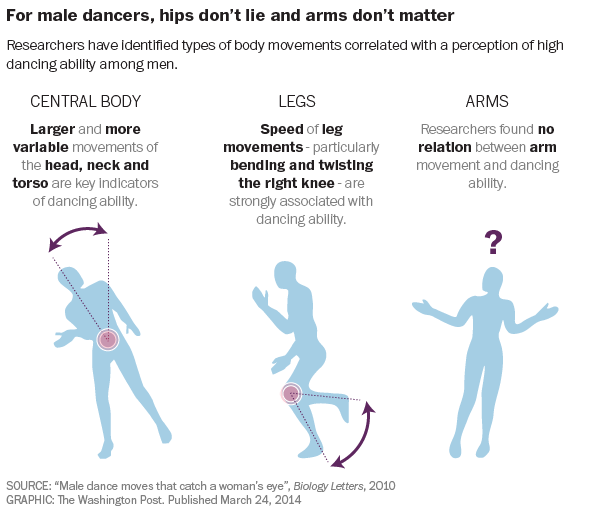
Researchers investigated what attracts straight women to guys on the dance floor:
[W]omen rated dancers higher when they showed larger and more variable movements of the head, neck and torso. Speed of leg movements mattered too, particularly bending and twisting of the right knee. In what might be bad news for the 20% of the population who is left-footed, left knee movement didn’t seem to matter. In fact, certain left-legged movements had a small negative correlation with dancing ability, meaning that dancers who favored left leg motion were rated more poorly. While not statistically significant, these findings suggest that there might be something to that old adage about “two left feet” after all. One final surprise – arm movement didn’t correlate with perceived dancing ability in any significant way.
Going beyond the dance floor, these findings could demonstrate that mens’ dance moves could carry “honest signals of traits such as health, fitness, genetic quality and developmental history,” although the authors stress that more research is needed to be sure. It would be particularly instructive to see whether similar findings hold true for mens’ assessments of womens’ dancing ability.
Update from a reader:
The Washington Post summary of the “putting your right knee forward’ article gets a couple of things pretty badly wrong.
Yes, the variability and speed in neck and trunk movement predict dance ratings but the implication that arm movement does not predict dance ratings is simply wrong. Arm movement amplitude, variability, and speed are correlated r= .45, r=.44 and r=.34 respectively with ratings of dancing quality. These would typically be interpreted as moderately strong effects and are only “non-significant” because the original study was based on so few individuals and because the authors chose to interpret these effects using a statistical significance standard that is largely arbitrary and highly limited for such a small sample. Men wishing to impress women on the dance floor should not, however, conclude that arm movement does not matter because it matters almost exactly as much the movement speed of your legs (r= .47). Even some of the left leg movement indicators are pretty decent predictors of ratings of dance quality. Left hip twisting and left knee bending, for example, both correlate r = .31 with ratings of dance quality while left knee twisting correlates r= .34 with dance quality ratings – all moderately large effects.
The authors of the original paper also share some blame for using a statistical method (stepwise regression) that is pretty awful for analyzing this kind of data. The take-home message should be that straight men wishing to impress women on the dance floor should definitely vigorously move their trunk, neck, arms, and both legs – not just their trunk, neck and right leg.




.jpg)
