Ukraine’s Tea Party?

Motyl insists the new government in Kiev isn’t fascist:

Both Svoboda and Right Sector are on the right. They are decidedly not liberals—and some of them may be fascists—but they are far more like the Tea Party or right-wing Republicans than like fascists or neo-Nazis. I for one wouldn’t want them to be setting the tone for Ukrainian policy. But neither would I want the Tea Party to be in charge of Washington. No less important, their role in the Kyiv government is at best tertiary (they would probably win no more than 5 percent of the vote in a national election), and policy is set not by them but by the broad coalition of unquestioned liberal democrats.

He recommends focusing on “the activity of Putin and his fascist state.” Cathy Young also worries about Russian fascists:

[I]n Russia, nationalists in the upper echelons of power include such prominent figures as former NATO envoy and current Deputy Prime Minister Dmitry Rogozin, who first entered the political scene as a leader of the nationalist bloc Rodina (Motherland). In 2005, Rodina was banned from Moscow City Council elections for running a blatantly racist campaign ad: the clip showed three Azerbaijani migrants littering and insulting a Russian woman and Rogozin stepping in to tell them off, and ended with a slogan promising to “clean up the trash.” While Rogozin is no fan of America, he has some peculiar American fans: in 2011, a glowing tribute that concluded with, “Let’s hope that Rogozin rises to power in Russia—and for the rise of a ‘Rogozin’ in America and elsewhere throughout the West,” appeared on the “white identity” website, Occidental Observer.

Rodina co-founder and Rogozin’s erstwhile rival for its leadership, Sergei Glazyev, most recently served as Putin’s man in charge of developing the Customs Union—the alliance with Kazakhstan and Belarus that was also to include Ukraine. Like Rogozin, Glazyev has attracted the sympathetic attention of far-right kooks in the Unites States—in this case, Lyndon LaRouche: in 1999, LaRouche Books published an English translation of Glazyev’s book, Genocide: Russia and the New World Order, with a foreword by LaRouche himself.

Previous Dish on fascist fears in Ukraine here.
The GOP Burns Its Tax Reform Camp

Last week the House GOP, under pressure from Wall Street, rejected the financial tax component of Congressman Dave Camp’s tax reform plan. Chait is unsurprised:

Camp’s [plan] – not just the financial tax, but the whole thing — represented a shocking moment in Republican policymaking. Here was not just a vague gesture in the direction of moderation that characterizes most Republican “reform” proposals, but a genuinely serious effort to grapple with trade-offs and impose the real, necessary pain on Republican constituencies that any such effort requires.

He adds that plan’s demise may prove telling:

The whole point of the push-back from Wall Street, which has reinforced a wildly unenthusiastic reception within the GOP, is not only to prevent Republicans from striking a deal with Democrats and actually passing a tax reform, which could happen if Republicans wanted it. … It’s to murder his plan in a public way so as to prevent it from becoming the baseline for any future Republican agenda. That effort seems to be meeting with predictable, depressing success.

Ben White And Maggie Haberman sound a similarly ominous note:

Republican elites on Wall Street and elsewhere in corporate America are now actually cheering inaction in Congress as preferable to ideas such as Camp’s. “The Camp draft catalyzed most of the business community around the notion that it was so bad, and it’s not just private equity and financial services — there were so many other punitive measures in there — that people just decided, the whole system’s broken here, nothing’s going to get done,” another senior Republican business leader said. “And that’s what we need to work toward. We need to work toward gridlock.”

In another post, Chait notes that the Tea Party seems to have jumped into bed with its one-time enemy:

[B]ecause [Wall Steet] is pushing for partisan combat rather than bipartisan cooperation, it has provoked zero backlash from conservative activists – even though it is killing a reformist, preference-eliminating, tax-rate-lowering reform that is the most promising legislative incarnation of a populist reform to have emerged in years.

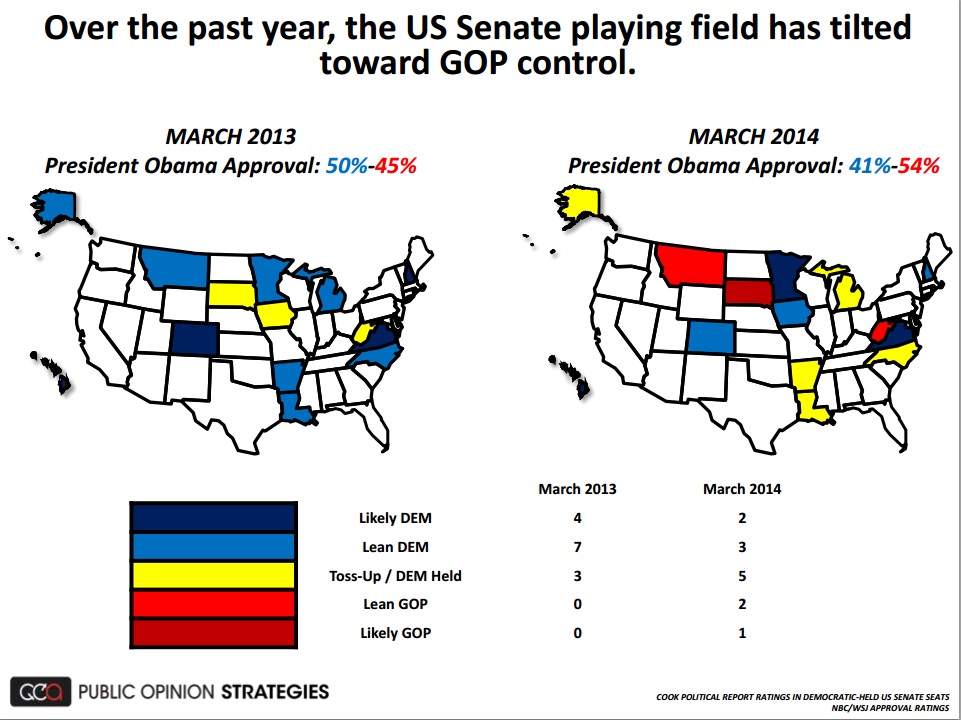
A GOP Senate Is Getting More Likely

Sean Sullivan looks at how the Senate landscape has changed:

Senate Landscape

Nate Silver calculates that “Republicans are now slight favorites to win at least six seats and capture the chamber.” His rather large qualifier:

There are 10 races that each party has at least a 25 percent chance of winning, according to our ratings. If Republicans were to win all of them, they would gain a net of 11 seats from Democrats, which would give them a 56-44 majority in the new Senate. If Democrats were to sweep, they would lose a net of just one seat and hold a 54-46 majority. So our forecast might be thought of as a Republican gain of six seats — plus or minus five. The balance has shifted slightly toward the GOP. But it wouldn’t take much for it to revert to the Democrats, nor for this year to develop into a Republican rout along the lines of 2010.

The Democratic Senatorial Campaign Committee is challenging Silver’s math. Carpenter takes the DSCC to task:

There’s nothing like happy-face propaganda in the sorryass face of facts. Should Silver’s facts re-shift in favor of Democrats, he will again be hailed by the DSCC as America’s one statistician who has never erred.

Meanwhile, Cillizza remakes a point Trende made awhile back:

So, let’s say Republicans retake the Senate this fall.  Can they keep it in 2016? Much of that depends on just how many seats they win in November.  Yes, they technically need six seats for the majority. But, they probably need to pick up in the neighborhood of eight or even nine seats in order to ensure themselves a fair shot at holding the Senate for more than two years.

Here’s why: There are 23 Republican seats up compared to just 10 for Democrats in 2016. (This is the class that got elected in 2010, a great year to be a Republican.)

Sponsored Content On TV

A reader elaborates on a recent “Sponsored Content Watch” (a depressingly ongoing feature on the Dish):

What your reader is describing is called a video news release, or VNR. It’s a publicity tactic – basically an advertisement made to look like a news report. In a way, they serve a purpose, as news agencies (especially smaller local stations with limited budgets) can use pieces of them to supplement ongoing reports, the same way newspapers will use information from a press release. The problem with them comes when they’re just aired whole without attribution, as if they’re regular news. Your reader’s note that the segments discussed ended with a “sponsored by” notice is actually an improvement; until about a decade ago, many VNRs aired without any notice at all, such as being produced by a pharmaceutical company or government agency. In 2005, the FCC started cracking down on the practice and said stations could be fined for airing VNRs without attribution, so news programs are a little more cautious about it nowadays (not to say the practice has gone away entirely).

Another points to a more disappointing offender:

Regarding the growth of sponsored content on TV, last month PandoDaily broke the huge story that PBS received $3.5 million from anti-pensions billionaire John Arnold to fund a scare series called “Pension Peril”.

The point of the series – that public pensions are underfunded and therefore benefits should be slashed – is a baldly partisan argument that happens to coincide perfectly with one of the Laura and John Arnold Foundation’s main lobbying goals. Arnold also personally helped finance a California initiative to roll back public employee pensions. The irony is Arnold made his fortunes as an energy trader at Enron, the company notorious for manipulating the energy markets of – you guessed it – California.

PBS stonewalled the journalists, refusing to show a copy of their agreement with the Arnold Foundation, but once the shit hit the media fan, they backed down and returned Arnold’s funding, and now the series is “on hiatus,” according to the NYT. The whole thing brazenly violated PBS’s own rules that forbid accepting funding from a source whose interests align with a project, and not just for partisan issues: even for something as benign as advocating cancer research, which they give as an example in their own rules: “Similarly, a nonprofit organization whose mission is to eradicate heart disease or to raise money for leukemia research could not fund a program designed to educate the public about these respective illnesses.”

The icing on the cake was that PBS never disclosed the funding source on TV, and the evidence for the connection was virtually non-existent online. Perhaps they hoped to keep it quiet, because according to PandoDaily, a source at a meeting with PBS execs said, “I asked who was funding that project, and the executive said that at this point they are not disclosing who their funders are, and everybody sitting around the room kind of paused.” If PandoDaily hadn’t dug up the dirt and published it, no one might have ever known. Whoever set this thing up at PBS needs to be shown the door, and soon.

Close The Door On Open Offices?

A growing body of research suggests it’s time to end the era of open-office plans:

A 2002 longitudinal study of Canadian oil-and-gas-company employees who moved from a traditional office to an open one found that on every aspect measured, from feelings about the work environment to co-worker relationships to self-reported performance, employees were significantly less satisfied in the open office. One explanation for why this might be is that open offices prioritize communication and collaboration but sacrifice privacy.

In 1980, a group of psychology researchers published a study suggesting that this sacrifice might have unintended consequences. They found that “architectural privacy” (the ability to close one’s door, say) went hand in hand with a sense of “psychological privacy” (feeling “control over access to oneself or one’s group”). And a healthy dose of psychological privacy correlated with greater job satisfaction and performance. With a lack of privacy comes noise—the talking, typing, and even chewing of one’s co-workers. A 1998 study found that background noise, whether or not it included speech, impaired both memory and the ability to do mental arithmetic, while another study found that even music hindered performance.

There’s also the question of lighting. Open offices tend to cluster cubicles away from windows, and a forthcoming study shows that on workdays, employees without windows get an average of 47 fewer minutes of sleep than those with windows, and have worse sleep quality overall. Artificial light has its own downsides. One pair of researchers found that bright overhead light intensifies emotions, enhancing perceptions of aggression and sexiness—which could lead to a lack of focus during meetings if arguments get heated, or co-workers get overheated.

The Amazing Memory Of Toddlers

New research indicates that three-year-olds can recognize a person they’ve met only once before, at age one:

[Researcher Osman] Kingo and his team first renewed contact with parents and their children who’d taken part in an earlier study when the children were age one. That earlier research involved the infant children interacting with one of two researchers for 45 minutes – either a Scandinavian-Caucasian man or a Scandinavian-African man.

Now two years on, 50 of these parents and children – the latter now aged three – were invited back to the exact same lab (hopefully cueing their earlier memories). Here the children were shown two simultaneous 45-second videos side by side. One video was a recording of the researcher – either the Scandinavian-Caucasian or Scandinavian-African man – interacting with them two years earlier; the other video showed the other researcher (the one they hadn’t met) interacting with a different child in the exact same way. The children themselves were not visible in these videos.

The key test was whether the three-year-olds would show a preference for looking at one video rather than the other. Amazingly, the children spent significantly more time looking at the video that featured the researcher they’d never met. This is not due to the children having a bias for either the white or black man, because for some of these children the previously unseen researcher was Scandinavian-African and for others he was Scandinavian-Caucasian. All background features and behaviours in the videos were identical, so this result provides strong evidence that the children had some recognition of the researcher they’d met, and were drawn more strongly to look at the unfamiliar researcher.

Importantly, this same looking pattern was not observed among a control group of 36 three-year-olds who hadn’t taken part in the original research two years’ earlier. In fact, these children showed a bias toward looking at the black researcher. This is unsurprising because young children often show a bias towards looking at other-race faces. The fact that the three-year-olds in the experimental group didn’t display this pattern shows that the influence of their memory overrode the usual other-race bias.

Conspicuous Coffee Consumption

dish_coffeemap

Nathan Yau mapped “the nearest coffee shop, among popular chains, within a 10-mile radius”:

My expectation was that Starbucks and Dunkin’ Donuts would dominate, with 10,000-plus and 7,000-plus locations nationwide, respectively. This wasn’t far-fetched when you look at the map above. … Starbucks is all over, whereas Dunkin’ Donuts clearly dominates on the east coast. … The spatial concentration in cities didn’t surprise me so much, but the cumulative coverage of the coffee places did. … [T]here are lots of areas in the country where it is more than ten miles to the nearest chain.

Khoi Vinh, who considers coffee a “scourge,” wouldn’t mind being miles away from a chain:

In the West, and particularly in urban centers of the United States, we’ve turned coffee into not just a daily habit, but a totem of conspicuous consumption. They are “rituals of self-congratulation” (a choice phrase from Frank Bruni) wherein we continually obsess over certain coffee purveyors or certain methods of brewing coffee — each new one more complex, more Rube Goldbergian and more comically self-involved than the previous brewing fad.

Responding to Vinh’s aversion, Kottke draws an analogy:

Coffee, like almost everything else these days, is a sport. Everyone has a favorite team (or coffee making method or political affiliation or design style or TV drama or rapper or comic book), discusses techniques and relives great moments with other likeminded fans, and argues with fans of other teams. The proliferation and diversification of media over the past 35 years created thousands of new sports and billions of new teams. These people turned hard-to-find nail polish into a sport. These people support Apple in their battle against Microsoft and Samsung. This guy scouts fashion phenoms on city streets. Finding the best bowl of ramen in NYC is a sport. Design is a sport. Even hating sports is a sport; people compete for the funniest “what time is the sportsball match today? har har people who like sports are dumb jocks” joke on Twitter.

Let people have their sports, I say. Liking coffee can’t be any worse than liking the Yankees, can it?

Einstein’s God

In a 1978 profile, Carl Sagan discussed the great physicist’s spiritual beliefs:

In matters of religion, Einstein thought more deeply than many others and was repeatedly misunderstood. On the occasion of Einstein’s first visit to America, Cardinal O’Connell of Boston warned that the relativity theory “cloaked the ghastly apparition of atheism.” This alarmed a New York rabbi who cabled Einstein: “Do you believe in God?” Einstein cabled back: “I believe in Spinoza’s God, who reveals himself in the harmony of all being, not in the God who concerns himself with the fate and actions of men”—a more subtle religious view embraced by many theologians today.

Einstein’s religious beliefs were very genuine. In the 1920s and 1930s he expressed grave doubts about a basic precept of quantum mechanics: that at the most fundamental level of matter particles behaved in an unpredictable way, as expressed by the Heisenberg uncertainty principle. Einstein said, “God does not play dice with the cosmos.” And on another occasion he asserted, “God is subtle but he is not malicious.” In fact Einstein was so fond of such aphorisms that the Danish physicist Niels Bohr turned to him on one occasion and with some exasperation said, “Stop telling God what to do.”

Update from a reader:

You quote Einstein selectively. He also expressed contempt for the “childish” belief in a Biblical god. He also called misrepresentations of his religious convictions “a lie which is being systematically repeated.” Einstein’s views in context are here:

The word god is for me nothing more than the expression and product of human weaknesses, the Bible a collection of honourable, but still primitive legends which are nevertheless pretty childish. No interpretation no matter how subtle can (for me) change this.

It was, of course, a lie what you read about my religious convictions, a lie which is being systematically repeated. I do not believe in a personal God and I have never denied this but have expressed it clearly. If something is in me which can be called religious then it is the unbounded admiration for the structure of the world so far as our science can reveal it.

It seems to me that the idea of a personal God is an anthropological concept which I cannot take seriously. I also cannot imagine some will or goal outside the human sphere. … Ethical behavior should be based effectually on sympathy, education, and social ties and needs; no religious basis is necessary. Man would indeed be in a poor way if he had to be restrained by fear of punishment and hope of reward after death.

Another:

I would very much like to point out that the quotes your reader inserted are, in an interesting way, incorrect:

The word god is for me nothing more than the expression and product of human weaknesses, the Bible a collection of honourable, but still primitive legends which are nevertheless pretty childish. No interpretation no matter how subtle can (for me) change this. … For me the Jewish religion like all others is an incarnation of the most childish superstitions.

The parts in bold simply do not exist in the original letter: they have been made up by the translator and yet this is the translation you will see quoted over one million times on the Internet. (No need to take my word for it: feel free to show a scan of the original German letter, recently sold for just over 3 million dollars, to anyone who speaks German.)

What happened? I can’t claim to know the motives of the translator, but it is clear that virtually no one has bothered to verify the correctness of the translation. You’ll even find the fabrication on (the English version of) wikiquote (but not the German one). I am happy you too fell into this trap because I know that you, unlike many of your colleagues, will gladly update the article and correct the mistake. I am also sure the truth will now reach many people.

P.S.: In case you were wondering: I am an atheist and I try to avoid the Dish on Sundays as much as possible. The other days I follow the Dish almost religiously.

Great Music For Awful Days

by Matthew Sitman

Nick Rynerson praises one of my favorite bands, the Drive-By Truckers, for the way they “write songs about real people having bad days — or bad lives.” He thinks Christians could learn from their honesty:

Life is hard — for everybody. Well, maybe not everybody, but more people than you think. Pastors, accountants, students, baristas, and cashiers are all trying to keep their head above water, just like you. And Christianity is not a quick fix emotional high that takes away all of our sin, problems and struggles. And in the fight of faith, sometimes we just need to be reminded that what we are going through is normal.

Christians aren’t immune from hard marriages, toxic jobs, and alcohol problems. Instead of judging our brothers and sisters or at least pretending that we aren’t as bad off as everybody else, we can empathize. The Truckers write and live in the world we know so well, but are afraid to tell anybody about.

Jesus isn’t typically in the business of saving people who have it all together; in fact, it’s usually the misfits, failures and screw-ups who best understand grace. Following Drive-By Truckers, we can learn from people who are hurting. And we can admit that we rank among their numbers. In sharing the garbage of our lives, we can do more good than if we pretend to have all the answers.

Reviewing the Truckers’ just-released album English Oceans, David McClister highlights “Primer Coat,” a song about “a factory foreman, a Southerner, sitting by his pool and thinking about his twentysomething daughter leaving home,” that exemplifies the kind of writing described above:

This is an unusual subject for a rock ‘n’ roll band, which is more likely to focus on freewheeling characters in the no-man’s land between school and marriage/career. But the Truckers have always specialized in characters with jobs, spouses, little glamour and lots of debt.

This song is sung by the foreman’s son, who knows more than he’d like about painting houses. His mother may be as plain as a primer coat, he realizes, but there’s a clarity and necessity in that undercoat of paint that shouldn’t be underestimated. In four minutes, [guitarist Mike] Cooley lets us know all four members of that family, while his Keith Richards-like, just-ahead-of-the-beat guitar riff and Morgan’s Charlie Watts-like, just-behind-the-beat drumming supply all the tension the story needs.

“I had this image of this guy, middle-aged and working class, sitting by his swimming pool,” Cooley explains. “I didn’t know what he was thinking about, but I liked that image. I thought he might be thinking about politics and how working class families can’t afford pools like they used to. But that wasn’t it; he was thinking about his daughter. The mother of the family’s almost always stronger, especially when it comes to things that kick you in the gut. She’ll do what she has to do; she won’t be moping by the pool.”

Make It Rain … Animals?

by Jessie Roberts

Apocalypse isn’t the only explanation for creatures falling from the sky:

Reasons for animals hurtling from the sky range from signs of the apocalypse (dating back to the Bible) to an everyday — or at least every-few-yearsish — act of meteorology. One of the most confusing parts of this persistent phenomenon is the notion of “falling.” For instance, when dark-brown snakes filled streets in Tennessee in January 1877, it wasn’t that they came from the sky.

Rather, torrential rains that morning may have dislodged the serpents from underground and flushed them to the surface. Similar deluge events may also explain some of the worm rains, some of the fish rains and the snails. New Year’s Eve fireworks exploding near blackbird roosting sites may have caused the 2011 Arkansas bird fall. And as wonderfully frightening as a rain of Brazilian spiders sounds (as was reported in the town of Santo Antônio da Platina last year) the phenomenon has been attributed to the species Anelosimus eximius, which spins massive group webs that can span trees and telephone poles and be scattered into a rain in strong winds. And the suspected deer or sheep meat that fell over Kentucky in 1876? Vomiting buzzards, or, as jokingly reported in the New York Times, a “meat meteorite.”

But what about the fish and frogs?

“It is certainly within the realm of possibility that fish and frogs could rain from the sky,” says Greg Carbin, a severe weather expert with the National Weather Service. “Especially when you look at the power of some thunderstorms and tornados, there’s a tremendous vertical component to the wind that can suck things up and deposit them far from where they were picked up.”

(Video: A scene from Magnolia)