Rose Eveleth explores why people sometimes hallucinate during meditation:
Buddhist literature refers to lights and visions in myriad ways. The Theravada tradition refers to nimitta, an vision of a series of lights seen during meditation that can be taken to represent everything from the meditator’s pure mind to a visual symbol of a real object. In one Buddhist text, called The Path of Purification, the nimitta is described this way:
It appears to some as a star or cluster of gems or a cluster of pearls, […] to others like a long braid string or a wreath of flowers or a puff of smoke, to others like a stretched-out cobweb or a film of cloud or a lotus flower or a chariot wheel or the moon’s disk or the sun’s disk. …
What is it about meditation that opens the brain up to these kinds of hallucinations?
To answer that question, [researcher Jared] Lindahl and his team looked for occasions where the descriptions he gathered from meditators intersected with descriptions of neurophysiological disorders. They found that both the first-person accounts and the Buddhist literary descriptions of these lights intersected pretty well with the experiences of people undergoing the intentional practice of sensory deprivation.
Hallucinations are relatively well-documented in the world of sensory deprivation, and they dovetail with the lights seen by meditators. Where meditators describe jewel lights, white spots and little stars, those under sensory deprivation sometimes describe dots and points of light. Where meditators see shimmering ropes, electrical sparks, and rays of light that go through everything, the sensory deprived might see visual snow, bright sunsets, and shimmering, luminous fog. Neuroscientists think that when the eyes and ears are deprived of input, the brain becomes hypersensitive and neurons may fire with little provocation, creating these kinds of light shows. Lindahl suspects that the lights that meditators see are the result of the same phenomenon—that meditating is itself a mild form of sensory deprivation.
Read more about the research of Lindahl and his colleagues here.
J.P. O’Malley reviews Simon Schama’s book, The Story of the Jews, a tie-in to a BBC and PBS series of the same name:
Reading Schama’s heart-wrenching tales of suffering bought home an important point: the horrors of Nazism didn’t spring up in isolation. It also made me think of Marx’s observation that “history repeats itself, first time as tragedy, second time as farce.”
This epic historical narrative is one that has already been widely covered in recent decades by writers such as Stan Mack and Paul Johnson. But Schama’s prose has a melancholic music that you rarely find in historical writing. It’s this ability to empathize with his narrative, rather than just coldly regurgitating the facts, that makes Schama one of the finest historians of his generation.
Michael Hiltzik finds the book at times struggles to separate myth from history:
Schama attempts to finesse the uncertainties of the historic record by reporting on the present-day archaeological investigations that strive to fill in its blank spots or perhaps reinterpret the discoveries of earlier generations of archaeologists. This is a fascinating story, yet it feels misplaced in this volume, especially because the conclusion one draws from Schama’s extended description of the excavations at Khirbet Qeyafah, an ancient fortress a few miles west of Jerusalem, is that the history of the Jews of its time (about 1000 BCE or earlier) is still being prised from beneath the dust deposited by the succeeding millenniums.
Schama is on firmer ground as he moves forward to the Christian era. Here a dark story grows darker, shadowed by a conflict that began, Schama writes, as a “family quarrel. That, of course, did not prevent it from going lethal, early; perhaps it guaranteed it.”
Schama talked to Ray Suarez about why he chose to write the book now:
When the BBC said, “We would actually like to do ‘The Story of the Jews,’“ I thought, “How many years have you got left? You can’t not do this.” Partly because Jewish history for people who are not Jewish tends to be so overwhelmingly dominated by the Holocaust and the Israeli-Palestinian conflict. And those are not incidental historical events — they still rightly exercise the world. But they, in some ways, kind of close off the accessibility of Jewish history, which is such a rich and complicated and not always horribly tearful story, as one might imagine. So, I thought, “Well, here’s the possibility in Europe, and I think even a possibility in the United States, to provide a point of access — for non-Jews as well as Jews — to actually enter this story, which has had such a profound impact on the world.”
The Story of the Jews does not scant those dark passages of Jewish history. Much of the second episode is devoted to the harrowing experiences of the Jews in medieval Christian Europe—including, pointedly, in Britain, where Schama visits the shrine of “Little Hugh of Lincoln,” a child supposedly murdered by local Jews in the 13th century. (Today, Schama notes, the shrine includes a sign regretting long history of anti-Jewish violence spurred by blood libels like Hugh’s.) That episode culminates in the expulsion of the Jews from Spain in 1492, which Schama dramatizes by reading a contemporary register of Ferdinand and Isabella’s decree.
Yet that is not the end of the episode. Instead, Schama moves from Spain to Venice, where a community of Jews found asylum after the expulsion. They were confined to the quarter called the ghetto—thus giving the world a new word in the vocabulary of exclusion—but even there, they managed to build a synagogue of extraordinary elegance and spaciousness. Standing in that synagogue five centuries later, Schama feels the pull of “irrational memory”—“I feel I’ve been here before,” he says. It is especially important to him as a proof that, when they could, the Jews gave expression to a longing for beauty and splendor equal to that of any other civilization.
(Video: Trailer for The Story of the Jews, which premieres in the US on PBS on March 25th)
In a remarkable review of Darling, Rodriguez’s recent “spiritual autobiography,” Paul J. Griffiths ponders the question:
He is, by the account of this book (a more detailed account of his raising and formation can be had from Hunger of Memory and Days of Obligation) a regular Mass-goer; a lover of the Church; one who intends to stay in and with the Church until death; one who rarely goes to confession (he notes a thirty-two-year span when he did not go at all); one who loves the Sisters of Mercy, the Sisters of Perpetual Indulgence (a gay-transvestite group that performs corporal works of mercy while also publicly mocking the Church), and Mother Teresa; and one who has deep and principled disagreements with some of the Church’s doctrinal positions on the nature and place of women, and on the acceptability of homosexual acts and the loves that accompany them. More important than all this, informing and subtending all this, is that he is the kind of Catholic who understands, represents, and tries to respond to the love of the Lord in a devastated world of pain.
Griffiths goes on to grapple with how Rodriguez approaches the fraught issue of homosexuality and the Church:
I don’t agree with every position taken in Darling, or with every argument offered. On Islam, I suspect that what’s needed at the moment isn’t emphasis on the similarities among the three so-called Abrahamic religions as desert faiths, real though these are, but rather on difference and complementarity. The recent work of Rémi Brague on this, especially On the God of the Christians (and on one or two others), is especially instructive. On homosexuality and homosexual acts, by contrast, I think Rodriguez much closer to being right than not. Insofar as such acts are motivated by and evoke love, they are good and to be loved; insofar as they do not, not. In this, they are no different from heterosexual acts.
There are other interesting differences between the two kinds of act. But if you think, as Rodriguez seems to, and I do, and all Catholics should, that we live in a devastated world in which no sexual acts are undamaged, free from the taint of sin and death and the concomitant need for lament, then the fact that homosexual acts have their own characteristic disorder is no ground for blindness to the goods they enshrine. Gay men should, of course, darling one another; those of us whose darlings are of the opposite sex should be glad that they do, and glad of instruction in love by the ways in which they do. Love is hard enough to come by in a devastated world without encouraging blindness to its presence.
That last sentence is an almost perfect way of putting it, made all the more heartening because the review is from First Things.
Previous Dish on Darling here. Listen to Andrew’s Deep Dish conversation with Rodriguez here.
David Mihalyfy offers a theologically-inflected take on the film Gravity, noting that in addition to the “survival narrative” of astronauts Ryan Stone and Matt Kowalski (played by Sandra Bullock and George Clooney, respectively) struggling to make it back to earth, there’s another story going on:
[I]n the parallel and primary narrative of “rebirth as a possible outcome of adversity” (to use [director Alfonso] Cuaron’s words), the emotionally remote Stone works through the death of her young daughter. In what film critic Stephanie Zacharek calls “as apt and unsentimental a metaphor for prayer as I can think of,” Kowalski has to persuade Stone to keep talking during a communications blackout with Houston mission control since “if someone is listening they might just save your life.” After the two astronauts are separated, Stone in a desperate moment confesses her inability to pray since “no one ever taught me how,” but a hallucination of the dead Kowalski ends her reticence and she pours out messages for her daughter. When, finally, she is back on earth, she says a single “Thank you” as the very last words of the film.
This parallel narrative rebuts popular arguments that the existence of evil prove that there is no God. As Dawkins has written in his book, The God Delusion, attempts to “justify suffering in a world run by God” are “beyond satire.”
For Cuaron, however, the greatest unexpected gift trumps the worst unexpected evil. “Your kid died, doesn’t get any rougher than that,” the dead Kowalski tells Stone in her hallucination. But Stone’s improbable return to earth finds her renewed spiritually and thankful for her life.
Mihalyfy doesn’t quite make this explicit, but what he’s doing in this essay nicely connects to how I would argue religious people, especially Christians, should grapple with the problem of evil and suffering.
On the one hand, there’s the perennial temptation to try to explain the ways of God to men, to produce a philosophical or theological argument that somehow squares the existence of an all-powerful, all-loving God with the tragedies and hardships, both great and small, we see and experience. Some of these arguments are more persuasive than others, but they tend to leave me cold. They often seem to rely, at least implicitly, on an understanding of the divine that makes God a bigger, more powerful version of ourselves – when we ask why God “allows” evil in the world, we impose a model of choice and decision onto God that’s extracted from our own experiences. God figures in these debates like a character in one of those ethics problems you encounter in an introductory philosophy course, which is exactly the kind of anthropomorphism classical theism strives to avoid. Note how Dawkins, in the quote above, writes that God “runs” the universe, as if God were a CEO or president. As Mihalyfy asks in his essay, “Of all people, who better than an astronaut to understand that there is not a physical God sitting up somewhere in the sky?”
The better question, then, is not why does God permit suffering, but how do we respond to it? What resources do we – whether religious or not – have to deal with suffering when it inevitably comes? The Christian answers by pointing to Jesus, the suffering servant. The Christian God is a God who suffered with us and for us in the person of Jesus, who knows in full what it means to experience pain, loneliness, anguish, and death. And, even more, in the mysterious accounts of Jesus’ resurrection, we are told that suffering does not have the final word. This does not really “make sense” of suffering, but it does make Christianity a faith that has solidarity with, and deep compassion for, those who suffer at its core. It means that Christians can say to sufferers that they are understood and loved in the midst of their suffering, not just by those around them, but by God – and that this understanding and love is not the mere whim or benevolence certain people might choose to exhibit, but acts of mercy that point to what is ultimately deepest and truest about our existence.
Here’s one more passage from Mihalyfy, a gloss on Stone’s gratitude at the end of the film:
As the script specifies, Stone “drags herself from the water, like the first amphibious life form crawling out of the primordial soup onto land.” After she stands, she looks around, and then, as the music swells in a major key, she tilts her head upward. The camera-shot from below emphasizes Stone staring into the heavens. Yes, evolution exists, Cuaron communicates, but when the odd phenomenon of life is comprehended by the life-form that has become sentient, the fact that there is life at all confirms the activity of a benevolent God.
The Christian vision is one in which suffering is real and terrible but not, ultimately, the deepest element of our lives. Our hope is that there’s a goodness and love more enduring than our trials and tribulations that, paradoxically, suffering actually can reveal. This is not to claim Gravity is a “Christian” film – indeed, Milhalfy notices that both Christian and Buddhist imagery figures in the movie. Instead, it seems that spiritual resources – something like prayer, especially – allow Ryan Stone to endure suffering, and to cultivate gratitude for her life despite such suffering. I’m far more interested in how that actually happens, how faith and spirituality can connect with the suffering person to allow them to move forward and live, than I am in debating the theodicy problem with atheists whose view of God is as crude as the fundamentalists they so frequently deride.
There was nothing, and then, in an instant, there was something. It’s almost like somebody created the cosmos out of nothing.
UPDATE: Um, guys, I know this doesn’t prove God’s existence, or that God created the universe, etc. Let me state here without fear of contradiction that I do not believe science can ever prove such a thing, though astrophysics and cosmology can make (and is making, I think) belief in an intelligent designer more credible.
The prevalent theory of cosmic origins prior to the Big Bang theory was the “Steady State,” which argued that the universe has always existed, without a beginning that necessitated a cause. However, this new evidence strongly suggests that there was a beginning to our universe. If the universe did indeed have a beginning, by the simple logic of cause and effect, there had to be an agent – separate and apart from the effect – that caused it. That sounds a lot like Genesis 1:1 to me: “In the beginning God created the heavens and the Earth.”
So this latest discovery is good news for us believers, as it adds scientific support to the idea that the universe was caused – or created – by something or someone outside it and not dependent on it.
First, this announcement may be improperly understood and reported. For instance, in 2003 proof for cosmic inflation was incorrectly reported and a similar erroneous claim was made last year. Second, the predictions that are being supposedly confirmed are very model-dependent: if the model changes, then the predictions change. Inflation is just one of many free parameters that cosmologists have at their disposal within the big bang model, so they can alter these parameters at will to get the intended result. Third, other mechanisms could mimic the signal being claimed today. So, even if the data are confirmed, there may be some other physical mechanism at play rather than cosmic inflation.
In summary, 1) the scientists might be wrong, 2) Science changes so we can’t trust it, 3) God may have caused the thing the scientists are talking about.
Which, let’s face it, are [creationists’] explanations for damn near everything. It’s an evasion of how scientific theories work, which parts of the experiment Faulkner thinks the scientists got wrong, and the usual admission that something else (hint: God) could’ve provided the same results a few thousand years ago. Creationism: Proof that you can always deny that which you don’t understand.
Previous Dish coverage of the findings here, here, and here.
Amid the ongoing conversation about whether non-believers can ever truly understand religious art, Kenan Malik calls for a humanist appreciation of the sacred:
Transcendence does not necessarily have to be understood in a religious fashion, solely in relation to some concept of the divine. It is rather a recognition that our humanness is invested not simply in our existence as individuals or as physical beings but also in our collective existence as social beings and in our ability, as social beings, to rise above our individual physical selves and to see ourselves as part of a larger project, to project onto the world, and onto human life, a meaning or purpose that exists only because we as human beings create it.
The capacity to grasp the transcendent in this fashion has transformed through history. In the premodern world it was difficult to conceive of meaning or purpose except in relation to God, or gods, or as aspects of the universe itself (though there were major strands in ancient Greek, Indian and Chinese philosophy that attempted to understand this in a purely human way). Hence, transcendence was inevitably seen in a religious light. But with modernity it became increasingly plausible to imagine purpose and meaning as humanly created. Indeed, as the French philosopher Denis Diderot claimed: “If we banish man, the thinking and contemplating being, from the face of the earth, this moving and sublime spectacle of nature will be nothing more than a sad and mute scene.” It was “the presence of man which makes the existence of beings meaningful.” …
If today we are uncomfortable with the idea of the transcendent, if many reject the idea entirely, while others can discover it only in a religious context, it is largely because we have a degraded sense of the human. That is why to read Marilynne Robinson, to gaze upon a Rothko, to listen to Olivier Messiaen can feel so essential. For some it may be to surrender to a religious experience. It is also, paradoxically, to remind ourselves what is truly human about the human condition.
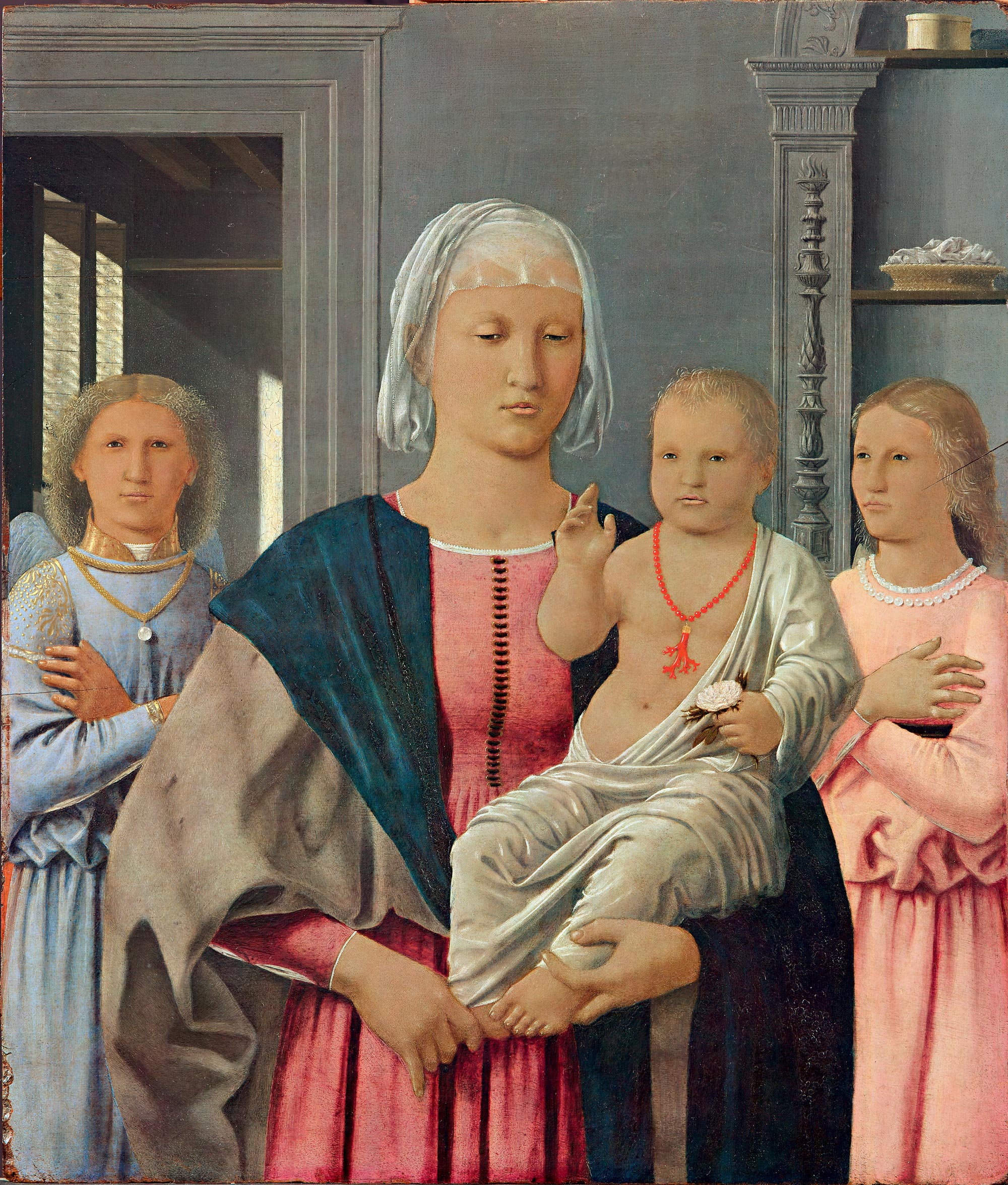
Sanford Schwartz reviews the Metropolitan Museum’s exhibit on the devotional works of Piero della Francesca, writing that his “figures can be strangely contemporary in their sexiness, and there is nothing dated about the way they encounter and judge one another, or appraise us”:
The most impressive work in the show is Madonna and Child with Two Angels…. With her downcast eyes, gentle demeanor, and small features set in a large, wide-nosed face, the Madonna is a choice example of a kind of woman, at once regal and rustic, that Piero created. Her quiet strength is reiterated in the work’s painted surface, which has an enamel-like density.
The angel in pink is an attentive young person, but the angel in blue (who is possibly the same model seen in a different way) is, along with the suggestion of a room behind him, transfixing.
Piero’s angels, whether attending a Nativity, a baptism, or a Madonna, can be guarded or genuinely sweet. They almost always have a distinct presence. The angel, or seraph, in blue here, whose arms are crossed before his chest and who might be blocking entry to the background space, would seem to be Piero’s last word on the subject. His baby-blue outfit is exquisitely touched with bits of white and gold, and his white-blond hair is set in little electrified ringlets. Kenneth Clark, in his book on the artist, called him “daunting,” and [curator Keith] Christiansen says he is “implacable.”
But surely his protectiveness has something sensual and brazen about it, and the glimpse we have of the bare space behind him, where all we see are shadows of window blinds and a patch of strong sunlight on the wall, is uncannily of our day and age. Am I alone in thinking that this part of the picture might be set in Palm Springs? The angel and the mysterious area he is linked with form almost a painting within the painting. It is kind of a gift within the larger gift that is Piero’s art.
(Image of Madonna and Child with Two Angels (ca. 1464–74?), also known as the “Senigallia Madonna,” via Wikimedia Commons)
“Honestly, I think if I were in your situation, with what I take to be your beliefs and aspirations and attractions, the odds are that I’d end up seeking exactly what you’re seeking — a stable, long-term same-sex relationship. And I don’t think there’s anything in my political worldview that would deny that aspiration a place in society, or deny you the opportunity to pursue happiness. …
I don’t see a way for my church — and yours by baptism — to bless same-sex unions absent a true doctrinal revolution, which if it happened would essentially involve Catholicism becoming a very different kind of church and faith than the one that I understand it to be. (The issue isn’t just a matter of reinterpreting a few biblical passages; the conjugal, procreative view of marriage is woven into Christian doctrine in ways that would require truly radical revisionism to undo.) So the position of gay people who are raised Catholic or Christian, or feel drawn — or in your case, perhaps someday drawn back — to Christianity is, I expect, going to continue to be fraught and complicated and uniquely challenging, at least barring some sort of shift that I can’t conceive of at the moment.
This fraughtness will take (and already takes) various forms in a post-closet world:
There will be churches that bless same-sex unions, but they will have an at-best-uneasy relationship to their own scriptures and traditions; there will be gay Christians who attend more orthodox churches while maintaining relationships that conflict with their faith’s official teachings, and who live (like all of us, but more so than many) with unresolved tensions in their spiritual life; and there will be gay Christians who embrace some sort of celibate vocation, and try to carve out or revive (as various gay Christian writers are trying to do) forms of religious community that are specific to their situation.
If I were attracted to men and otherwise held exactly the same theological views, my beliefs would impel me toward the third option. But as I suggested at the beginning of this response, it’s entirely possible that under those circumstances my beliefs would bend or break, and I’d end up in a different situation, a different church, or simply end up lapsed, skeptical, secular.
What I’d want for society, though, is for all of those different possibilities to be available, and for them not to be necessarily set against each other: For the love and fidelity of gay couples to be respected, and for gay people to be free to pursue happiness the way most straights pursue it, but for the door to still be open to other ideas and possibilities as well,” – Ross Douthat, answering a question from a gay, lapsed-Catholic reader.
Last week the Dish featured an interview with Peter Watson, author of The Age of Atheists, an intellectual history of European and American thought since Nietzsche’s 1882 proclamation that “God is dead.” Emma Green accuses Watson of “intellectual snobbery” for believing that because “intellectual history trends toward non-belief, human history must, too.” Why she objects:
For one thing, it suggests that believers are inherently less thoughtful than non-believers. Watson tells stories of famous thinkers and artists who have struggled to reconcile themselves to a godless world. And these are helpful, in that they offer insight into how dynamic, creative people have tried to live. But that doesn’t mean the average believer’s search for meaning and understanding is any less rigorous or valuable—it just ends with a different conclusion: that God exists. Watson implies that full engagement with the project of being human in the modern world leads to atheism, and that’s just not true.
We know it’s not true because the vast majority of the world believes in God or some sort higher power. Worldwide, religious belief and observance vary widely by region. It’s tough to get a fully accurate global picture of faith in God or a “higher power,” but the metric of religiosity serves as a helpful proxy. Only 16 percent of the world’s population was not affiliated with a particular faith as of 2010, although many of these people believe in God or a spiritual deity, according to the Pew Research Center.
Green goes on to cite a litany of statistics, broken down by region and country, showing just how many people still believe in God, even in Europe. I find this a puzzling and unpersuasive retort.
To begin with, the distinction between “intellectual history” and “human history” is a strange one – isn’t the former part of the latter, and might it not portend the shape of things to come? Even more, large numbers of people across the globe still having a “religious affiliation” doesn’t mean such social facts will be durable, or indicate how strong such affiliations are, or predict how the ongoing churn of the modern world will impact areas outside the United States and Europe. That 30 percent of the religiously unaffiliated in France believe in God, a number Green trots out, seems irrelevant to me; one can imagine a survey respondent shrugging and saying, “Sure, I believe in God,” with that belief being of no practical import to that person. The Pew study she cites specifically notes that such numbers only deal with the self-identification of those surveyed, and “does not attempt to measure the degree to which members of these groups actively practice their faiths or how religious they are.”
Most of all, in her own summary of his book, Green describes Watson as implying that “full engagement with the project of being human in the modern world leads to atheism.” That means he’s making an argument that an array of forces in contemporary life – from modern science to capitalism to the overturning of traditional ideas about sex and morality – mitigate against religious belief, or at least make it more tenuous and difficult. In other words, there are reasons, intellectual and cultural, that make Watson predict an atheistic future. I’m not convinced Watson is right, but responding with rather weak survey data does nothing to address these deeper issues. That’s why John Gray’s review of The Age of Atheists (along with Terry Eagleton’s Culture and the Death of God) is so on point, getting at the true intellectual and moral alternatives at stake. Here’s why he praises Watson and Eagleton as the rare exceptions who take Nietzsche as the “central reference point” in their books:
There can be little doubt that Nietzsche is the most important figure in modern atheism, but you would never know it from reading the current crop of unbelievers, who rarely cite his arguments or even mention him. Today’s atheists cultivate a broad ignorance of the history of the ideas they fervently preach, and there are many reasons why they might prefer that the 19th-century German thinker be consigned to the memory hole. With few exceptions, contemporary atheists are earnest and militant liberals. Awkwardly, Nietzsche pointed out that liberal values derive from Jewish and Christian monotheism, and rejected these values for that very reason. There is no basis – whether in logic or history – for the prevailing notion that atheism and liberalism go together. Illustrating this fact, Nietzsche can only be an embarrassment for atheists today. Worse, they can’t help dimly suspecting they embody precisely the kind of pious freethinker that Nietzsche despised and mocked: loud in their mawkish reverence for humanity, and stridently censorious of any criticism of liberal hopes.
I want more discussions prompted by this line of thought, more atheists who have absorbed the full import of what rejecting Christianity really might entail, especially the faith’s deep, if not uncomplicated, impact on the West’s moral and political heritage. To the extent Watson’s book, along with Eagleton’s, contribute to this happening, I rather enthusiastically welcome them.
A couple months back, a Reddit user spotted the above pamphlet from a Christian organization, replete with garbled texts that make it seem like Jesus didn’t have time for the person he was messaging. The episode prompts Billy Kangas to lament evangelicals’ “groan worthy” attempts at making Christianity cool and relevant, arguing that when “the Church employs superficial symbols to communicate the Gospel, the Gospel can only take hold of people on a superficial level”:
A slogan-branded faith can’t communicate the depth of the mystery of Jesus’ life, death and resurrection. Perhaps this is part of the reasons there has been such a mass exodus of evangelical children after they graduate from youth group.
Historical Christian symbols, on the other hand, are primordial and polyvalent:
Flesh, blood, light, water, birth, death, eating, drinking, hunger and thirst. These symbols are not seeking to emulate the ephemeral but they encompass our entire existence. The symbols not only contain a wealth of meaning, they contain us. They dig deep into who we are as people in our deepest depths, in our hopes and fears. They are the building blocks of poetry, romance and drama. They have layers of meaning and depths that require a lifetime to divulge. They captivate rather than entertain. In many places these images have been lost, and I believe they need to be reclaimed.
One alternative he suggests Christians cultivate – “create space for silence”:
It’s no secret that we live in a noisy world. Part of the reason the creating of a pop-culture Jesus is so tempting is because many in the Church realize that they are competing for the attention of people who are constantly bombarded with images and sounds designed to overwhelm the senses. The fact that there is rarely a moment of stillness in our lives means that we rarely give images and symbols the space they need to settle deeply within us.
that can be taken to represent everything from the meditator’s pure mind to a visual symbol of a real object. In one Buddhist text, called The Path of Purification, the nimitta is described this way: