How Bad Might It Get In Ukraine?

by Jonah Shepp

Very bad, says Paul Hockenos, who compares the situation today to the former Yugoslavia in the 1990s:

[A]nyone who followed the unfolding of the wars in Croatia, Bosnia and Herzegovina, Macedonia, and Kosovo is surely horrified today by the dynamics between Russia’s Vladimir Putin, the Ukrainian leadership, the people of Crimea, and citizens in the rest of Ukraine. The similarities to the Balkans of the 1990s are, in many ways, striking: Just as Serbia and Croatia cynically exploited the presence of their compatriots outside the borders of their republics, so too is Putin manipulating the welfare of the Russophone Crimeans as justification for cross-border military operations, the seizure of territory, and a phoney referendum. As in the Balkans, the media has been turned into the mouthpiece of extreme nationalists. Once again, there’s inadequate security architecture to defuse tensions; and then there’s the radicalization of nationalism which, when fanned so fiercely, becomes a self-fulfilling prophecy and, in the Balkans, led to Europe’s worst bloodshed since World War II.

Alexander Motyl fears ethnic strife in Crimea:

Unsurprisingly, Ukrainians are terrified by Putin’s warmongering. A friend in Lviv, which is as far as one can be from Ukraine’s eastern border (or is it front?) with Russia, tells me that “people are petrified and believe war is inevitable.” So are Crimean Tatars, whose ancestral land has already been occupied by Putin’s troops and who remember Stalin’s genocidal policies in 1944, when the entire Tatar population was deported to Central Asia and half died.

What if Crimean Tatars, who have already begun forming self-defense units (and some of whom have begun talking of an anti-Russian jihad), take to the streets after Putin wrests Crimea from Ukraine? How will Putin respond? His warmongering statements suggest that mass internments of Crimean Tatars in concentration camps, ethnic cleansing, and even genocide are no longer inconceivable.

Oleg Shynkarenko expects a mass exodus from the region:

In the run-up to the vote, Russian media has been churning out non-stop propaganda about how thousands of Ukrainians are fleeing into Russia proper to escape neo-Nazis and fascists. But the reality is that many Crimeans are fleeing north to other regions of Ukraine, to escape the local militias manned by Russian separatists. This weekend, as reports surfaced of Russian armed forces landing in Kherson, the escape to safety seemed even more pressing for the region’s pro-Kiev activists and ethnic minority Tatars. …

Taras Beresovets is a political analyst of Crimea origin. He is sure that Ukraine is now witnessing the beginning of a long process of annexation and flight. He predicts that after the March 16 referendum, the suppression of dissidents and even ethnic cleansing could become more common. “At least 100,000 people will leave Crimea then”, Beresovets said.

St. Patrick’s Day Drinking

by Tracy R. Walsh

Denver St. Patrick's Day Parade

Scott Bixby tsk-tsks from his perch at McSorley’s, the venerable New York tavern:

On St. Patrick’s Day, everyone is Irish – except for the gays – but mostly, everyone is just drunk. In one hour, the East Village street that lays claim to McSorley’s saw three people vomiting, four young men belligerently insisting that every stranger within arm’s distance give them a high five, two public urinations, one apparent breakup, and two more young men losing their Lucky Charms behind parked cars. … Underneath the Irish pride and the excitement about the coming spring, St. Patrick’s Day is a childish spectacle of obnoxious behavior celebrated by inebriated manchildren who could use a few whacks with a shillelagh.

But not everyone is so sour on the revelry. Over at Next City, Jake Blumgart makes “the urbanist case for rowdy-ass bars”:

Let’s call it the Jane Jacobs Theory of Drinking:

It’s good to have eyes on the street, even if they are seeing double, and especially because many non-drinking businesses are closed after 9pm or 10pm on weeknights. Jacobs famously lived at 555 Hudson Street in Greenwich Village and wrote of the “sidewalk ballet” that made her block a joy to live on. One of the businesses she names as a neighbor in good standing is the White Horse Tavern, where according to literary legend Dylan Thomas drank himself to death (“I have had 18 straight whiskies, I think that’s the record”). In The Death and Life of Great American Cities, Jacobs speaks highly of the influence of bars on her block:

Strangers become an enormous asset on the street on which l live … particularly at night when safety assets are most needed. We are fortunate enough, on the street, to be gifted not only with a locally supported bar and another around the corner, but also with a famous bar that draws continuous troops of strangers from adjoining neighborhoods and even from out of town … this continues until the early hours of the morning … The comings and goings from this bar do much to keep our street reasonably populated until three in the morning, and it is a street always safe to come home to.

She may have felt differently if the shop below her apartment sold shots and not lollipops, but from a utilitarian perspective the point is good.

Update from a reader:

Check out what happened in 24 hours this past weekend on Chicago’s north side, from Wrigley Field to Lincoln Park, the “safe” part of town.

The title of that play-by-play post: “St. Pat’s Festivities Rack Up 21 Arrests, 17 Ambulance Runs In Wrigleyville”.

(Photo: Revelers lead the Pedal Hopper ‘party bike’ down Denver’s Blake Street during the city’s St. Patrick’s Day Parade. By Craig F. Walker/Denver Post)

Putin Is Just Getting Started

by Jonah Shepp

Looking north from Crimea, Jon Lee Anderson points out that the stage is already set for Russia to occupy the rest of eastern Ukraine:

Beyond Crimea, in the eastern Ukrainian cities of Donestk and Kharkiv, where there is also a large ethnic Russian population, public calls are being made for Crimea-style “referendums” to accede to Russia. Today, as if on cue, [Crimean prime minister Sergey] Aksionov’s deputy openly suggested that eastern Ukraine would follow Crimea’s example.

If snap referendums are called, will the Russian troops that are now massed on eastern Ukraine’s borders move into those areas in the name of protecting ethnic Russians from Kiev’s “provocateurs,” as in Crimea? Putin has reserved the right to intervene on their behalf. If Ukraine’s borders change yet again, what happens next?

Noting that there is no road linking Russia directly with the Crimean peninsula, Julia Ioffe thinks an invasion is geographically inevitable:

[W]hat happens if, as is quite likely, Kiev cuts newly-Russian Crimea off from gas, electricity, and water, which Crimea has none of on its own? How will Moscow, the new owner, supply its latest acquisition with the necessities? …

If you’re Russia, do you really want to ferry the necessities across the bay, or build an expensive bridge, or lay down expensive new pipelines? Wouldn’t you rather use pre-existing land routes (and pipelines)? Wouldn’t it just be easier to take the land just north and east of Perekop and the Swiss cheese area, now that you’ve already put in the effort to massively destabilize it? And while you’re there, wouldn’t you want to just take the entire Ukrainian east, the parts with the coal and the pipe-making plants and the industry? You know, since you already have permission?

Marc Champion considers how Europe would respond to further escalations:

Should Putin choose to escalate by moving troops into Ukraine beyond Crimea, even Germany has pledged to hit Russia with painful sanctions. This would damage the economy seriously: Former Russian Finance Minister Alexei Kudrin has forecast $50 billion in capital flight per quarter this year, “in a mild scenario.”

And yet, sanctions too can add to the logic of escalation. Serious economic sanctions would, as the most fervent Soviet die-hards and Russian nationalists have been hoping ever since the 1990s, create a full break with the West and return Russia’s economy to a less extreme version of its Soviet-era isolation — or, in their view, self-sufficiency. Sanctions would also force corrupt businessmen either to repatriate their ill-gotten gains or flee the country. The “liberals” who have, according to conservatives, held the country ransom for private gain since the collapse of the Soviet Union and prevented Russia’s return to greatness would be routed.

Andrew Bowen notes that, if Putin wants to risk an all-out invasion, he has the military power to do it:

Since few predicted the Russian occupation of Crimea, it would be premature to rule out the possibility of a full-scale invasion. While it would seem unlikely that Russian troops would march on Kiev, some sort of limited incursion into the Russian leaning east of the country is a very real possibility. The airborne forces and Spetsnaz units that would spearhead such an assault are available and close to the border. But those units would need to be backed up by larger regular Russian military formations after the initial incursion.

Whatever the future holds for the rest of Ukraine, it’s clear that Russia is staying put in Crimea.

Anna Nemtsova takes a closer look at what the Spetsnaz, Russia’s special forces, are already up to in Ukraine:

This week the Security Service of Ukraine (SBU) arrested a group of people led by a Ukrainian citizen who were said to be scoping out three of its most crucial military divisions in the southern Ukrainian city of Kherson.

In Donetsk in eastern Ukraine, press reports from the ground say that Russian provocateurs have attacked Ukrainians who organized anti-Russian street protests.

The forces behind these operations, according to U.S. officials briefed on the updates in Ukraine, are likely the Spetsnaz, the Russian military’s highly trained saboteurs, spies and special operations forces who may change the face—and the borders—of Ukraine without once showing the Russian flag on their uniforms. Or, for that matter, without wearing any particular uniforms at all.

The Return Of A Deadly Disease

by Patrick Appel

Russell Saunders blames anti-vaxxers for the measles outbreak in NYC:

This is not some inconvenience to be laughed off. Measles is a highly-contagious illness caused by a virus. It usually presents with a combination of rash, fevers, cough and runny nose, as well as characteristic spots in the mouth. Most patients recover after an unpleasant but relatively uneventful period of sickness.  Unfortunately, about one patient in every 1,000 develops inflammation of the brain, and one to three cases per 1000 in the United States result in death. …

Just over a dozen years ago this illness was considered eliminated in our country, and this year people are being hospitalized for it. All due to the hysteria about a safe, effective vaccine. All based on nothing.

Brian Palmer fears such outbreaks could get more serious:

Falling vaccination rates are now an urgent concern in public health. Measles incidence dropped 99 percent after the vaccine was introduced in 1963. Between 2000 and 2007, the United States saw an average of just 63 measles cases per year, and almost all of those victims brought the disease into the United States from abroad. In 2013, however, the incidence of measles tripled. Unlike in previous years, the majority of the victims contracted the disease here in the United States, meaning that measles outbreaks are now a serious national problem. It could get worse. Vaccination rates in the United States remain at about 90 percent, but in the United Kingdom, where vaccination has fallen below 80 percent, the disease is once again endemic.

Tara C. Smith spells out why she vaccinates:

I’ve spent almost 20 years of my life studying infectious diseases up-close and personal, not from random websites on Google. I’ve worked with viruses and bacteria in the lab. I respect what germs are capable of. I worry about vaccine-preventable diseases coming back because oflow levels of herd immunity. I cry over stories of babies lost to pertussis and other vaccine-preventable diseases. As I’ve noted before, chicken pox has played a role in the deaths of two family members, so I don’t view that as just a “harmless childhood disease.” Vaccines have eradicated or severely reduced many of the deadliest diseases from the past: smallpox, polio, measles, diptheria.

But that’s not the only reason I vaccinate. I vaccinate because I’m all too aware of the nasty diseases out there that still don’t have an effective vaccine. My current work focuses on a germ called methicillin-resistant Staphylococcus aureus (“MRSA”), a “superbug” which kills about 11,000 people every year in the United States. We have no vaccine. I previously worked on two different types of Streptococcus: group A and group B. Group B is mainly a problem for babies, and kills about 2,000 of them every year. It leaves many others with permanent brain damage after infection. We have no vaccine. Group A kills about 1,500 people each year in the U.S. and can cause nasty (and deadly) infections like necrotizing fasciitis (the “flesh-eating disease”). We  have no vaccine. These are all despite the fact that we still have antibiotics to treat most of these infections (though untreatable infections are increasing). Infectious diseases still injure and kill, despite our nutritional status, despite appropriate vitamin D levels, despite sanitation improvements, despite breastfeeding, despite handwashing, despite everything we do to keep our kids healthy. This is why protection via vaccination is so important for the diseases where it’s available. If vaccines were available for the diseases I listed above, I’d have my kids get them in a heartbeat.


About Last Night …

by Jonah Shepp

https://twitter.com/shaunwalker7/status/445308236867325953

Leonid Bershidsky summarizes how yesterday’s referendum in Crimea went down:

According to preliminary results, 96.6 percent of Crimea’s population voted in a hastily arranged referendum on Sunday for their territory’s secession from Ukraine and inclusion in Russia. The plebiscite was, predictably, a farce, with the votes counted behind closed doors in the absence of observers or the press, and with almost the entire indigenous population of Crimean tatars failing to turn out.

There were, however, fireworks on Sunday night, and locals celebrated in the streets. Most of them do want Crimea to be part of Russia, and it’s anybody’s guess why Russia and the pro-Russian authorities on the peninsula decided against arranging a real, honest, transparent vote. For some reason, Russia appears to be full of resolve to become an international pariah or expose the cynicism of Western politicians if they do not confer that status on Moscow. The Russian parliament is promising to act quickly to make Crimea part of Russia. The die is cast, and the Kremlin is now waiting to see what the costs will be, pretending as best it can that it does not care one way or another.

Oliver Bullough examines how this “unconstitutional sham” was orchestrated:

Some polling stations—such as the one in the village of Arpat—have helpfully laid out campaign literature. One leaflet had a BuzzFeed-style list of “10 reasons to be together with Russia.” These ranged from the spiritual (“In our many centuries of history, tens of thousands of sons of Russia have sacrificed their heads to give [Crimea] freedom”) to the practical (“Pensions in Russia are almost twice as high as in Ukraine”) to the rhetorical (“Today the people of Crimea have the chance to restore historical justice”).

There were no leaflets supportive of the constitution of 1992, incidentally.

The presence of international observers was also, of course, a joke:

[T]hey’re a very select group of about 30 international observers authorized by the Crimean government, who were paraded to the press at a news conference yesterday. “Speaking near-flawless Russian and repeating Russian talking points on the Ukrainian crisis word for word, a motley team of foreign election observers lined up to praise the referendum at a press conference Saturday evening,” Buzzfeed’s Max Seddon reported from the scene. The OSCE tried to get a team of 40 observers into Crimea, but warning shots were fired when the group tried to pass through a checkpoint last week. Crimea has since “invited” OSCE observers to attend the referendum.

Eric Posner passes along an e-mail from a Ukrainian reader highlighting even more brazen abuses:

If you follow the Russian and Ukrainian language press as well as Crimean groups on social-networking sites (such as SOS_Krym), you already realize that large scale attempts at voter fraud are under way. Several of my friends in Crimea (this has been verified by reports throughout the peninsula) have been visited by unidentified individuals who either make off with their passports or damage them. This just so happens to coincide with an announcement by Sevastopol city authorities that any form of photo ID will be accepted during the referendum, given what has been happening to passports. This is a clear invitation to “Russian tourists”, many of whom have already created problems in Donetsk and Kharkov.

Morrissey doubts any western countries will recognize the outcome:

The [Crimean] parliament has formally requested recognition for its new status at the UN and with Western nations, but they’re not going to get it — and that will extend the diplomatic issues with Russia. If Putin and Russia’s Duma annex Crimea, it will technically be a seizure rather than a legitimate annexation in the paradigm of self-determination. No Western nation is going to recognize the legitimacy of a plebescite held under occupation by foreign troops, no matter how many ethnic Russians live on the Crimean peninsula.

But Posner writes off the peninsula as lost:

It doesn’t matter that the referendum did not allow voters to express a preference for the status quo, that many of the 90+ percent who favor annexation by Russia (according to (possibly questionable) exit polls) may have been trucked in, that international election monitors were not used, that ballot boxes may have been stuffed, that Tatar groups refused to participate, that the public debate was drowned out by pro-Russian propaganda, and that Russian soldiers and/or pro-Russia militias roamed the streets. It is sufficient that there wasn’t violence, that western journalists were free to move about and interviewed plenty of ordinary people who strongly favored annexation, that there were enthusiastic public demonstrations in favor of annexation and celebrations after the result was announced, and that the outcome is consistent with demographic realities and what seems plausibly (to us ill-informed westerners) the preference of most Crimeans. Unless large groups of Tatars and ethnic Ukrainians take to the streets to protest the referendum and are clubbed by riot police, any western effort at this point to try to rescue Crimea from the invaders it embraces will be not only pointless but ludicrous.

What’s The Best Way To Combat Military Rape? Ctd

by Chris Bodenner

A reader goes in-depth on the issue:

First off, I want to say that military sexual assault (MSA) is a scourge within our military and we must weigh every available option in seeking to eliminate it. That being said, I believe that Sen. Gillibrand’s legislation (and broader campaign) fails in three critical ways: substantively, technically, and stylistically.

1) Substantively – There is really nothing beyond anecdotal evidence backing up Sen. Gillibrand’s claim that the chain of command serves as the main deterrent to reporting. The 2012 SAPRO Report (DoD’s office responsible for collecting data on sexual assault within the military and for developing strategies to curb and combat MSA), 73% of women and 85% of men believe that their leadership does well to create an environment where they would feel comfortable reporting. Those numbers need to be closer to 100% and the gulf between male and female servicemembers is alarming, but that data does not suggest that lack of confidence in command is the central driver of underreporting.

SAPRO reported that the top three reasons why women failed to report sexual assault were:

-They did not want anyone to know (70%)

-They felt uncomfortable making a report (66%)

-Did not think the report would be kept confidential (51%)

Likewise, the top three reasons why men failed to report were:

-They believed they or others would be punished for other infractions or violations, such as -underage drinking (22%)

-They would not be believed (17%)

-Their performance evaluations or chances for promotion would suffer (16%)

The data seems to suggest that the chief barrier to reporting is not the chain of command, but the comfort of the individual victim. An appropriate response would demand much more emphasis on supporting the victims of MSA as opposed to tweaking the justice system. Sen. Gillibrand’s legislation does not provide any additional supports for victims at the individual level. Ultimately, it’s a big, unwieldy bureaucratic revamp.

Lastly, the military has wielded the chain of command to affect cultural transformation. Racial desegregation, repeal of Don’t Ask, Don’t Tell, and today’s integration of women into combat forces have all been implemented through – not in spite – of the chain of command. The chain is a means of holding commanders accountable for the actions of their subordinates; now, more than ever before, that includes sexual harassment and all forms of unwanted sexual contact.

2) Technically – Gillibrand’s legislation would create a special office of prosecutors within each Service Secretary’s office to dispose of reported alleged offenses. Prosecutors eligible for assignment to this office would have to be grade O-6 (Colonel-equivalent) or higher. In the Army, for example, there are somewhere around 140 O-6 Judge Advocates. These officers commonly serve as staff Judge Advocates for commanders of larger units (think Brigades, Divisions, sometimes Corps). According to the the SAPRO report, the Army fielded 1122 unrestricted reports of sexual assault/harassment last year. How many Judge Advocates would be tasked with referring these cases? While many public defenders may juggle somewhere around 400 cases a year, that’d be high inadvisable to base a staffing model around; these incidents vary wildly in severity (offensive comments to brutal rapes), geographical location, and cross-jurisdictional concerns. Additionally, the UCMJ requires trials to commence within 120 days of charges being filed. Taking this all together, let’s assume that these O-6s are given 100 cases a year, bringing the number of attorneys in this office to 11.

Sen. Gillibrand’s central claim is that MSA reporting is so low because victims are mistrustful of the chain of command. Consequently, we could expect reporting to increase if we removed disposition of these cases from the chain. Following that logic, a greater reporting level would demand a greater number of these limited O-6 prosecutors. Pulling these prosecutors from the units that they are assigned to into this newly created office would materially degrade the military’s ability to competently and expediently dispense with justice with regards to UCMJ offenses not covered by Sen. Gillibrand’s bill. This would create a situation where the services are forced to rapidly promote junior officers to fill positions typically held by more experienced individuals. Moreover, there are significant concerns about the quality of prosecution that victims would receive under this system. Most O-6s within the services’ respective Judge Advocate corps spend more time behind a desk than before a courtroom and many of these individuals have not argued a case for years.

3) Stylistically – The debate over Sen. Gillibrand’s legislation became all too acrimonious, and I largely blame her for that. While her passion undoubtedly brought much-needed attention to the matter, it also created an unfortunate narrative of “Gillibrand or Nothing” with regards to Congressional action. That could not be further from the truth. The FY14 NDAA contained dozens of provisions addressing MSA and represents the single largest step towards combating the issue. There is still far more work to be done, but it is disingenuous to say that Congress failed to act on the matter. Yeah, this is a historically shitty Congress, deserving of much of the contempt directed at it, but when it comes to MSA, the body shapes up rather well.

Tragically, a lot of these victims were used as pawns by either side of the debate. That’s unconscionable. But on the balance, the attention directed at this issue, one that had reared its gut-wrenching head over and over and over again across the past several decades, was positive and proof that our legislature and nation benefits from a greater number of women filling its halls. If there’s an enduring vision to be had from this whole episode, it’s of the women of the Senate Armed Services Committee grilling the shit out of the Joint Chiefs. That’s why this time is different – the advocates are not only more numerous, but much, much, much more powerful.

Finally, thank you providing a unique and compelling forum for discussing so many diverse, important, and sometimes not-so-important issues. The Dish is definitely one of the better corners of the Internet.

Previous Dish on efforts to combat military rape here.

Political Biology

by Jonah Shepp

Chris Mooney reviews John R. Hibbing, Kevin B. Smith, and John R. Alford’s Predisposed: Liberals, Conservatives, and the Biology of Political Differences:

As Hibbing et al. explain, the evidence suggests that around 40 percent of the variation in political beliefs is ultimately rooted in DNA. The studies that form the basis for this conclusion use a simple but powerful paradigm: they examine the differences between pairs of monozygotic (“identical”) twins and pairs of dizygotic (“fraternal”) twins when it comes to political views. Again and again, the identical twins, who share 100 percent of their DNA, also share much more of their politics.

In other words, politics runs in families and is passed on to offspring. Hibbing and his coauthors suspect that what is ultimately being inherited is a set of core dispositions about how societies should resolve recurring problems: how to distribute resources (should we be individualistic or collectivist?); how to deal with outsiders and out-groups (are they threatening or enticing?); how to structure power relationships (should we be hierarchical or egalitarian?); and so on. These are, of course, problems that all human societies have had to grapple with; they are ancient. And inheriting a core disposition on how to resolve them would naturally predispose one to a variety of specific issue stances in a given political context.

He also looks at Avi Tuschman’s Our Political Nature, which takes the same argument further:

Tuschman doesn’t hold back. Conservatives, he suggests in one of three interrelated evolutionary accounts of the origins of politics, are a modern reflection of an evolutionary impulse that leads some of us to seek to control sexual reproduction and keep it within a relatively homogenous group. This naturally makes today’s conservatives more tribal and in-group oriented; if tribalism does anything, it makes it clear who you are and aren’t supposed to mate with.

Tuschman’s liberals, in contrast, are a modern reflection of an evolutionary impulse to take risks, and thereby pull in more genetic diversity through outbreeding. This naturally makes today’s liberals more exploratory and cosmopolitan, just as the personality tests always suggest. Ultimately, Tuschman bluntly writes, it all comes down to “different attitudes toward the transmission of DNA.” And if you want to set these two groups at absolute war with one another, all you need is something like the 1960s.

Arnold Kling thinks this type of scholarship is overhyped:

Mooney leaves readers with the impression that psychologists explain a larger share of political differences than they themselves claim to explain. In contrast, my guess is that they explain less. These are the sorts of studies that tend to suffer from publication bias (20 studies are tried, one out of 20 passes the “significance test” of having a 5 percent probability of being true by chance, and that study gets published). In these sorts of studies, attempts at replication sometimes fail completely, and even when successful the effects are smaller than in the original published study.

In fact, my guess is that we are approaching peak political psychology. I would bet that ten years from now the links between political beliefs and psychological traits will be regarded as a very minor field of inquiry.

In his own review, Kling panned Our Political Nature:

Overall, the pattern is that for Tuschman, every evil of conservatives is essential, by which I mean that it follows directly from the conservative point of view. On the other hand, every evil of the left is accidental, meaning that it occurs in spite of what leftists believe.

And yet, Tuschman declares early on that he will not take an ideological position, but instead he will speak objectively. To me, this lowers his credibility. It would have been more persuasive had he simply said at the outset, “I think that conservatives are racist, authoritarian, and warmongering, and here is some psychological research that supports my point of view.”

The PRC According To Autocomplete

by Jonah Shepp

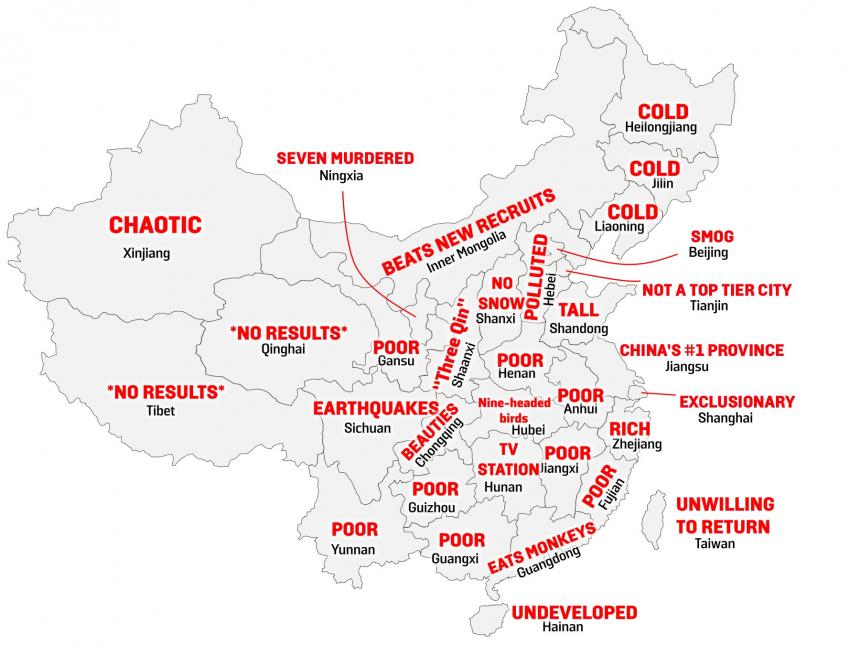
finalbaidumap

Warner Brown mapped China’s regional stereotypes according to Baidu autocomplete:

Why is the northwestern Chinese region of Xinjiang “so chaotic?” Why are many from the southern metropolis of Shanghai “unfit to lead”? And do people from central Henan Province really steal manhole covers? These are just some of the questions — ranging from the provocative, to the offensive, to the downright ridiculous — that Chinese people ask about themselves and each other on Baidu, the country’s top search engine, which says it processes about 5 billion queries each day.

In the West, amateur sociologists use Google’s voluminous search history to finish half-written questions about different regions. They then plot the stereotypes onto maps such as this one of the United States, which The Atlantic called “The U.S. According to Autocomplete.” China, with its long history of regional stereotyping, is ripe for similar treatment.

Christopher Beam explores what else the search engine reveals about Chinese web users:

Sex questions are popular—understandably so, given the relative dearth of sex education in China. (Plus, asking the Internet is less awkward than asking your teacher or mom.) The top “why” question among Googlers may be “why is the sky blue,” but Baidu users have a different primary concern: “Why is my semen yellow?” Runners up include “Why do I ejaculate so quickly?” and “Why don’t I have any semen?” They also pose questions they might be too shy to ask their partners, such as, “Why do girls go to the bathroom after sex?” You may have noticed these are all dude questions. It’s hard to say whether that’s because Chinese men have a disproportionately large number of sexual hang-ups, or because Baidu users are disproportionately male, or because China itself is disproportionately male. Evidence points to the latter two explanations: If you type in “I’m looking for,” “a wife” makes the list of top suggestions, but “a husband” does not.

How To Look Trustworthy

by Tracy R. Walsh

Smiling_Girl,_a_Courtesan,_Holding_an_Obscene_Image 2

It’s all in the cheeks:

The Dutch psychologist Corine Dijk gave volunteers a series of photos of people, some blushing and some not, accompanied by tales of their recent mishaps, ranging from appearing overdressed at a party to farting in a lift. The blushers were judged more favorably, despite their indiscretion.

Other research has found that if you blush people are more likely to forgive you, and it can even avert a conflict. When you’re trying to work out who to trust, it makes sense to choose the people who would feel guilty if they did anything wrong. The ideal person is someone who would blush and give themselves away.

Update from a reader:

That blushing article is really troubling (as is the research producing it). Everyone blushes, but not everyone’s blush is visible to everyone. Indeed, this sounds a lot like Thomas Jefferson’s infamous “Query XIV” in Notes on the State of Virginia, in which he aesthetically assesses human beings of European and African descent:

Whether the black of the negro resides in the reticular membrane between the skin and scarf-skin, or in the scarf-skin itself; whether it proceeds from the colour of the blood, the colour of the bile, or from that of some other secretion, the difference is fixed in nature, and is as real as if its seat and cause were better known to us.  And is this difference of no importance?  Is it not the foundation of a greater or less share of beauty in the two races?  Are not the fine mixtures of red and white, the expressions of every passion by greater or less suffusions of colour in the one, preferable to that eternal monotony, which reigns in the countenances, that immoveable veil of black which covers all the emotions of the other race?  Add to these, flowing hair, a more elegant symmetry of form, their own judgment in favour of the whites, declared by their preference of them, as uniformly as is the preference of the Oranootan for the black women over those of his own species.  The circumstance of superior beauty, is thought worthy attention in the propagation of our horses, dogs, and other domestic animals; why not in that of man?

In other words, Jefferson’s eye can’t see the blush. He “sees” like a black-and-white photocopier that would later reproduce complex, verisimilitudinous images of lighter-complexioned people and reduce images and thus the humanity of darker-complexioned people to an undifferentiated dark blop. It doesn’t take too much reason and imagination to see how pernicious and dangerous this all is amid current conversations about how cops see black children as “less innocent and less young than white children.” Jefferson’s beliefs are hardly a relic of the past.

(Gerard van Honthorst’s Smiling Girl, a Courtesan, Holding an Obscene Image, 1625, via Wikimedia Commons)

Asylum, Sponsored By Coca-Cola

by Jonah Shepp

Masha Gessen suggests a way for pro-gay companies to support LGBT individuals in Russia and other oppressive countries without damaging their business interests:

Immigration Equality, a legal organization that represents LGBT asylum-seekers in the United States, has recently hired a full-time Russian-speaking paralegal to help with the intake of new clients.

Russian speakers now represent the bulk of the group’s incoming clients, overtaking people from Jamaica, who had traditionally held first place. (To grasp the significance of that information, think how much more difficult it is to get to the United States from Russia than from Jamaica.) The hundreds of Russian LGBT refugees who have come over in the last few months are but the forerunners of a larger looming exodus—these are the people with enough money or self-confidence to leave now. As things get more desperate, as they inevitably will, many more will follow. These people are lucky enough to get legal help from Immigration Equality, but at this point there is no organization that can reliably help them with housing, money, job training, and job placement.

This is where the multinational companies come in. First, they should offer their Russian LGBT employees and their families the opportunity to transfer to the United States. Second, they should create programs to actively recruit, hire, and, if necessary, retrain LGBT refugees who are already in the United States. Such programs should not be limited to Russians: As the civilizational divide along LGBT-rights lines grows ever wider, increasing numbers will face more and more danger in countries all over the world, and they will need a safe haven.

Listen to Masha in a long conversation with Andrew about Russian gays, Putin’s policies, and what we should do about them here. A sample: