Russia Can Mess With Us, Too

Norm Ornstein explains why getting tough with Putin is tricky for Obama:

Putin saved the president from a huge embarrassment with the intervention to resolve Syria’s chemical-weapons stockpile, just before the Senate would have voted down his request for authorization to use force to punish Assad for using the weapons repeatedly against Syrians. Russia is a key player in the delicate negotiations with Iran over its nuclear program. Moscow can make the U.S. transition out of Afghanistan more painful and disruptive, and can be a positive or negative player in negotiations between the Israelis and Palestinians.

For those who immediately began calling for the harshest sanctions we can apply against Russia after its outrageous behavior in Crimea, those considerations were nowhere evident. Of course, one can make the case—and it is a powerful one—that Putin’s Russia will act in its cold, hard self-interest no matter what we do to try to appease it or cushion any reaction. But it is also likely that the harder we push, the more Russia will respond in a hard and negative way in every other area of our interest, at least in the short run. And when it comes to Russia and Syria, the short run is absolutely crucial.

In addition, Jamila Trindle warns the US not to underestimate how badly Russia can mess up our efforts to crack down on international criminal finance:

[Russia] could stop helping the U.S.-led effort to ferret out financial transactions of drug kingpins, weapons traffickers, and terrorist organizations like al Qaeda.

Russia has signed on with international efforts to combat money laundering, bribery, and nuclear weapons proliferators by stepping up oversight of the financial system, isolating bad actors, and freezing their assets. If Russia becomes a target of those same efforts, it will likely be less enthusiastic about enforcing them against others. …

If the United States tries to isolate Russia financially, Juan Zarate, formerly a senior Treasury Department official charged with overseeing the Bush administration’s sanctions program, said the effort could backfire. If Russian banks are cut off from the financial system by sanctions, they could react by slacking off on enforcement of those rules or creating financial havens for sanctions-breakers and criminals.

Rogin highlights another way Russia might retaliate:

One administration official told The Daily Beast that the White House’s National Security Council is leading an interagency process to examine all of the possible retaliatory steps Moscow might take if U.S. and European sanctions move forward. The potential counterstrikes include what this official called “asymmetric” actions by Moscow — Russian actions against the U.S. that have nothing to do with Ukraine. The NSC is preparing for potential Russian actions on all issues in its multi-faceted relationship with the United Stated: American military access to Afghanistan through Russia; Moscow’s cooperation on the destruction of Syria’s chemical weapons stockpiles; Russian pressure on Iran to strike a deal over its nuclear program; and much, much more.

Juan Cole points out that the Ukraine crisis is pushing Moscow and Tehran closer together:

Since Iran is under financial blockade by the United States, increases in bilateral trade with Russia would be very welcome. … [One] area of cooperation between the two is that Russia built three nuclear reactors for Iran at Bushehr, and is rumored to be considering constructing two more. Putin also referred to Iran’s observer status in the Shanghai Cooperation Council (which links Russia, China, Turkmenistan, Uzbekistan, Tajikistan, Kyrgyzstan and Kazakhstan) and spoke of the need to implement the decisions taken recently at Bishkek by the SCC. Iran wants to become a full member of this trading and political bloc, in a bid to escape the isolation imposed on it by the United States.
Can Writing Be Taught? (Can Teaching?)

Novelist and playwright Hanif Kureishi recently savaged creative writing MFA programs as “a waste of time,” having done one himself:

It’s probably 99.9 percent who are not talented and the little bit that is left is talent … A lot of my students just can’t tell a story. They can write sentences but they don’t know how to make a story go from there all the way through to the end without people dying of boredom in between. It’s a difficult thing to do and it’s a great skill to have. Can you teach that? I don’t think you can.

Scott Esposito offers constructive criticism:

I agree with this in spirit. But I would very quickly add that learning how to write is not the point of the MFA. They’re more about having time off to write and making connections than actually being taught how to write.

I think in the best case you have a group of talented, motivated people who want to learn things from truly great writers, and the program ends up being partly getting a master’s “spin” on writing/editing, partly two years of uninterrupted time to do your thing. (Or fuck around on Facebook, if that’s what you prefer.) Yes, programs admit people who have no clue, and those people probably won’t get much out of their MFA and will end up in some completely different line of work in a year or two, but I don’t know that there’s any kind of professional degree where this isn’t the case.

Matt Haig objects to Kureishi’s hypothesis on innate talent:

Creative writing lessons can be very useful, just like music lessons can be useful. To say, as Hanif Kureishi did, that 99.9 percent of students are talentless is cruel and wrong. I believe that certain writers like to believe they arrived into the world with special, unteachable powers because it is good for the ego. …. Of course, it is always important to know your limitations. For instance, I could have 7,000 guitar lessons but I wouldn’t be Hendrix, though I would be a lot better than I am now. Like most art forms, writing is part instinct and part craft. The craft part is the part that can be taught, and that can make a crucial difference to lots of writers.

Jane Messer suggests Kureishi could learn a thing or two about teaching:

Kureishi, it would appear, is from the school of teachers whose focus is not on the learner, but on themself. This approach focuses on the transmission of knowledge from the expert to the receptive learner. Ideally, the student is an elite talent: preternaturally bright, both an autodidact and a willing disciple. Students for whom sentences and narrative are not easy, whose best work comes with much rethinking and rewriting, who are sometimes inarticulate on the page; these students are hard work in Kureishi’s world. In the learner-teacher model in which the learner is a reflection of the teacher, such students offer the teacher a spotty mirror image.

Previous Dish on MFAs in the visual arts here.

Another Shot At Unemployment

Alex Rogers summarizes a bipartisan Senate proposal to restore the emergency unemployment benefits that expired in December:

The proposal from senators representing some of the most economically distraught states would be paid for through changes to single-employer pension plans and extending fees on U.S. customs users through 2024. The extension would not be restored for the tiny fraction of millionaires who receive unemployment insurance. Sen. Jack Reed (D-R.I), who led the negotiations with Sen. Dean Heller (R-Nev.), called it a “bipartisan breakthrough.”

But the reaction from influential House conservatives who had yet to hear of the plan ranged from skeptical to outright opposition, suggesting the bill will struggle to get beyond the Senate.

Danny Vinik explains what the proposal would do:

It means people who have been out of work more than 26 weeks and less than 73 would receive a big check from the government for unemployment benefits they would’ve been collecting over the past 10 weeks.

If you were out of work 70 weeks as of December 28, you’d receive three weeks of unemployment insurance. If you were unemployed 50 weeks as of then, you’d receive 10 weeks of benefits now and continue receiving them until the five month extension expires. Oh, that’s assuming you didn’t make more than a million dollars last year. If you did, then you wouldn’t get anything.

As for the amount, unemployment benefits generally make up half a person’s previous wages by average, although the exact amount varies by state. In 2012, average benefits ranged from $133 in Puerto Rico to $653 in Massachusetts.

Sargent thinks bringing up the subject again benefits the Democrats:

This is really good news, and let’s hope it passes. It probably won’t; it will probably die in the House.

But in raw political terms, that means UI as a key issue is back. Now the Senate will vote on it, and Senate Republicans will be challenged to vote against it. Senate candidates on both sides will be asked by the press to take a position on it. Presuming it passes the Senate, which it should (any Dem defections are unlikely), the House GOP will have to decide whether to kill it — by not allowing a vote on it or by voting it down. House Republicans will now have to confront the issue.

Chad Stone supports extending UI, considering the still-weak job market:

It’s still hard to find a job, especially for the “long-term unemployed” — those who’ve been looking for a job for 27 weeks or more. In the early stages of the recovery, when unemployment insurance spending was at its highest, there were about six or seven unemployed workers for every job opening. That ratio has declined substantially, but it is still closer to the highest level it reached in the 2001 recession and its aftermath than to the more normal levels just before the Great Recession.

Most tellingly, long-term unemployment remains much higher than at any previous time when policymakers allowed emergency unemployment insurance to expire

Noting that there’s no ironclad argument against extending UI, Jennifer Rubin suggests the GOP support it and try to get something in return:

Let me suggest that Republicans have leverage here and should apply it precisely to the issue at hand: jobs. The House has already passed the SKILLS Act, which reforms job-training programs. That trade would signal that Republicans are willing to work with Democrats but insist on meaningful measures that help job readiness. It’s hard for Senate Democrats to say no to job-training reform, especially with UI, a big issue with their depressed base, in play. Alternatively, the House could attach a pro-growth, pro-jobs energy bill.

How We Feel About Ukraine, Ctd

ukraine5

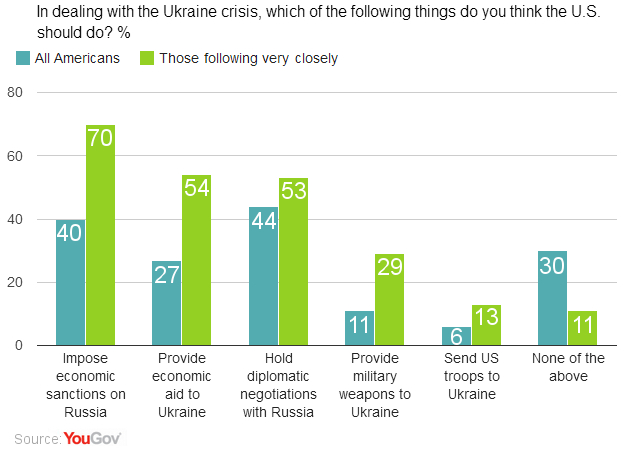
Kathy Frankovic summarizes the latest YouGov poll on how Americans think we should respond to the crisis:

Even those paying very close attention doubt that either a military or an economic response from the U.S., like sending troops to Ukraine, would result in Russian troop withdrawal.  Just one in four overall think military action by the United States would result in the Russians leaving the country.  One in four think economic sanctions on Russia would have that result. Still, most Americans would approve of some action by the United States, with the largest numbers supporting negotiations and economic sanctions against Russia.  A majority of those paying very close attention would also support economic aid.  There is far less support for military assistance and only 6% overall would favor sending U.S. troops to Ukraine.

Sheldon Richman proposes an option not asked about in the poll:

I’m talking about opening America’s borders—scrapping immigration controls.

Ukrainians who want to get out of their dicey neighborhood, whether permanently or temporarily, should be free to move to the United States. Look at it this way: How dare we Americans confine Ukrainians to a condition they might desperately wish to escape? How can we imagine ourselves to be a humane people while engaged in a policy with such odious consequences and implications for liberty?

Opening the borders, of course, is not offered here as a comprehensive answer to the conflict between Russia and the Ukrainians who want to be free of Russian influence, but it may be an answer for some Ukrainians. How many, no one can know. But it makes little difference. Let them in! There are about a million Ukrainians in the United States (2006 census figures), second only to Canada outside of Ukraine itself, with the largest centers in New York City, Philadelphia, Chicago, Los Angeles, Detroit, Cleveland, and Indianapolis. The newcomers need not be strangers in a strange land, though they should be welcome throughout the country.

More recent US polls on Ukraine here.

The Boring, Relentless Advance Of Obama’s Agenda, Ctd

A reader writes:

You forgot one boring, but vital, detail about Obama’s relentless advance: The courts.  Yes, the president has seated two Supreme Court Justices (on par with Bush’s three and Clinton’s two), and he may get one or two more shots at it, but the real action is in the appellate courts.  For 50 years, Democrats reigned supreme at the appellate level.  This was a center of power that wasn’t dismantled until Ronald Reagan, who managed to flip the majority of the courts by around 1986.  Because George H. W. Bush amounted to a third Republican term, the GOP was able to consolidate that majority so decisively that Clinton was barely able to make a dent in it before George W. Bush could continue the process.  Now, however, 9 out of 13 appellate courts have majority Democratic appointees.

(No, that doesn’t include the semi-retired “senior bench,” but they take a much a lighter course load, and don’t really factor into a long, or even medium-term political calculus.) “But if you see [Hillary Clinton] as being to Barack Obama what George H.W. Bush was to Reagan,” as you said, four years could also be enough to push the courts to the left for the indefinite future.  FDR’s power play gave him 50 years of court dominance.  Reagan, the only president to successfully flip the court since WWII, maintained his influence well beyond his death – 30 years.  A president Clinton will have all those same advantages, plus a very gray Supreme Court (FOUR octogenarians in her first term).  Think about what that means for all those Voting Rights Act cases winding their way up, for gerrymandering (hence, the makeup of the House), for a whole host of immigration issues (as they relate to the electorate).  Those are all issues with profound political consequences (the merits of each issue aside).

The courts are a full third of our political system, and Obama has been marching them in his direction very quietly, and more successfully than any president in a generation.

Illiberalizing Russia

Ioffe can’t keep up with the snowballing absurdity of Russia’s nationalist fervor:

Within the span of a couple months, the Kremlin, by hook and by crook, has cleared all the media underbrush. There’s suddenly not much left of the independent media, even of what little of it there was left after Putin’s first two terms at the wheel.

She fears that the game is up for Moscow liberals:

What [they] are discovering is how quickly the ground has shifted beneath their feet since Putin came back to power in 2012, how futile and pathetic their resistance, and how easily wartime mobilization can steamroll them into nonexistence, in a way it couldn’t when Russia went to war with Georgia in 2008. This time, even their tiny Internet ghetto isn’t safe anymore. And it’s not clear that, once all this over and Crimea is safely part of Russia, that the regime will roll back these measures. In fact, it’s highly likely that it won’t.

Leonid Ragozin notices something all too familiar in Putin’s media manipulations:

One can clearly sense what’s next by following government propaganda, whose main target these days is the “fifth column”: journalists, opposition activists, and anyone else who dares to doubt the wisdom of President Vladimir Putin’s decision to send troops into Ukraine. Here’s how it works: First an “investigative” documentary appears on government TV, then the authorities launch criminal cases against those that the documentary targeted (as was the case with left-wing leader Sergey Udaltsov, now on trial on charges of organizing riots). It was the same in Stalin’s times, when show trials were preceded by Pravda editorials pointing at “enemies of the people.”

And yet, Adam Taylor points out, the president’s star just keeps rising:

In a poll conducted by the Russian Public Opinion Research Center (VTsIOM) last week, Putin’s popularity level in Russia has reached 71.6 percent. That’s a 9.7 percent increase since mid-February, which seems quite obviously linked to the Russian president’s handling of Ukraine and the Sochi Olympics. As Ria Novosti notes, it means that Putin’s popularity levels are now at a three-year high.

You might want to put that down to the fact that the VTsIOM is state-run, but that argument doesn’t really hold. The Levada Center, a well-respected independent polling center, has also found that Putin had a 72 percent approval rating, up 7 points from January and a recent record.

The Other B-Word, Ctd

Ann Friedman nails it:

The main reason I can’t stomach a bossy ban … is that it represents a feminist strategy that’s failed in the past, and it plays into a negative characterization of feminism more generally. The movement for gender equality is at its best when it emphasizes expanding choices for everyone. … [M]any restrictions are worth fighting for, especially when they protect physical safety and personal autonomy — think of child-pornography laws or perimeters around abortion clinics. When it comes to cultural change, though, applying such hard-nosed tactics doesn’t make much sense.

Culture is a constantly changing thing that we create and shape collectively, not a set of rules that are formally written and rewritten by some governing body.

Sure, radio stations can be persuaded to drop a host who used racial slurs or Wal-Mart can be pushed to stop selling girls’ underwear with the phrase “Who needs credit cards …” on the front. Bans and boycotts can be used to great effect when they’re concrete and narrowly focused. But the feminist movement, at its best, does not simply decry negative media depictions or declare certain words off-limits; it creates better alternatives and rewrites narratives to be more inclusive. Kathleen Hanna didn’t start a “Ban Slut” campaign in the ’90s — she wrote the word on her belly with a Sharpie, owned it, and continued making awesome music.

Which is why it’s so frustrating to watch Lean In try to expand girls’ options by restricting the way we talk about them. It’s counterintuitive, and it makes feminists look like thought police rather than the expansive forward-thinkers we really are.

Along those lines, Zara Kessler adds:

Perhaps instead we should champion bossy, both the word and the behavior, pushing it toward a positive definition instead of attempting to stamp it out of existence. Slate’s Waldman says bossy “seems like a great candidate for rehabilitation” and notes that Tina Fey “started off the recovery process by naming her book Bossypants.” At CNN.com, Peggy Drexler pointed to Sandberg’s bossiness as a likely contributor to her success: “So, how about an initiative to reclaim bossiness as a point of pride?”

Poniewozik looks at the “bossy” double standard in a different way:

As Lean In’s Sheryl Sandberg says, correctly, the problem with the term “bossy” is that we apply it more often to girls, while boys with the same traits are considered “assertive” and “aggressive.” Her solution: stop calling your daughters bossy. Here’s another idea: Start calling your sons bossy. The double standard Sandberg identifies is absolutely real. But why is the solution to encourage aggressive, domineering behavior in women, rather than discouraging it in men? I know plenty of obnoxious, bossy men. And maybe society does applaud them. But I don’t want to be around them, I don’t want to work with them, and I certainly don’t want to work for them.

A reader is on the same page:

As a male who isn’t obsessed with worshiping the reigning masculine paradigm, I absolutely love working under women in most cases. Female bosses are outstanding. Most of them collaborate, share, nurture. My experience is that the ones that suck are the ones who suck for the same reason the men I’ve worked under who suck also suck: they aren’t collaborative, they don’t share, they don’t nurture.

We should be retiring the word bossy because acting like a boss is a pretty shitty way to act. I’d much rather a boss that says, “Let’s,” or a boss that says “What could you do to…” as a way of starting a sentence. Male or female.  Let’s work towards a world where both men and women act like human beings and not bosses. We might get more work done. We might be happier.

Previous Dish on the debate here.

Did The Obama Administration Torture? Ctd

An apology is in order. After reading more reader emails on this subject, and after properly reading and thinking about Conor’s original post, I withdraw my aside that this wasn’t technically torture because it was not done to procure information and could be defended as a medical procedure to keep someone alive. If the facts of the case are as the lawsuit alleges, Conor is dead right and I am dead wrong. Conor is wrong, however, to say I am blinded by fealty to Obama, as my posts this week on the Senate Intelligence Report should prove. I was, rather, guilty of blogging while traveling.

I hope readers understand I wasn’t defending the ghastly practice, just concerned about the legal technicalities. The manner of this force-feeding, if the lawsuit is correct, puts it in an entirely different category from medical procedures. I should have taken more time. This email was especially persuasive:

I am a surgeon well versed in the use of nasogastric tubes.

You wrote, “Many hospital patients are fed with NG tubes, even children. No one would describe that as torture, if medically necessary”. Andrew, I see many patients who have indisputable medical indications for NG tubes who, when informed of my treatment recommendations, refuse insertion of the tube. If I were to then restrain a coherent patient fully in charge of her mental faculties and forcibly jam the NG tube down that patient’s nose, I would be, incontrovertibly, assaulting that patient.

There are plenty of medical interventions that are justifiably “indicated”. A diabetic with gangrene of the foot may truly need an amputation, but if you restrain him against his will and go lopping off his limb, then you should have to face criminal charges.

This is about consent. Torture isn’t just to elicit information. You have said yourself that torture has nothing to do with intelligence gathering or ticking time-bomb scenarios. It’s all about power and domination.

An unfiltered comments section on Facebook is here.

The Smearing Of Ryan As A Racist

One of the worst traits of some left-liberals is their easy resort to calling those who disagree with them bigots or racists or worse. There are some sites on the web that seem almost entirely devoted to patrolling the discourse for any sign of sin. This one’s a homophobe; this one’s a racist; so-and-so said this and that could be – shock! – prejudiced. It can sometimes be a way to avoid engaging arguments rather than tackling them. And so, on cue, Paul Ryan is taking heat for these remarks:

We have got this tailspin of culture, in our inner cities in particular, of men not working and just generations of men not even thinking about working or learning the value and the culture of work, and so there is a real culture problem here that has to be dealt with.

He noted that “Charles Murray or Bob Putnam over at Harvard – those guys have written books on this.” Cue liberal freakout. Josh Marshall focuses on the citation of Murray:

When you start off by basing your arguments around the work of Charles Murray you just lose your credibility from the start as someone actually interested in addressing poverty or joblessness or really doing anything other than coming up with reasons to cut off what little assistance society provides for its most marginalized members or, alternatively, pumping up people with racial resentments against black people and giving them ersatz ‘scholarship’ to justify their racial antipathies.

That’s because Murray’s public career has been based on pushing the idea that black urban poverty is primarily the fault of black people and their diseased ‘culture.’ Relatedly, and more controversially, he has argued that black people are genetically inferior to white people and other notional races with regards to intelligence. Yes, that last part should be crystal clear: Murray is best known for attempting to marshal social science evidence to argue that black people are genetically not as smart as white people.

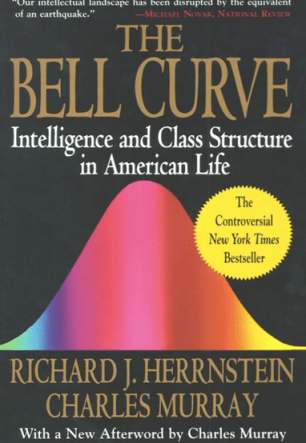
Sigh. Josh seems to be arguing that Murray blames all resilient urban black poverty on culture …. and then blames it all on genes! Pick one canard, would be my advice. And the truth is: in The Bell Curve, Murray was concerned about the role of genes and environment in the resilient IQ differentials among different ethnic groups, as anyone who actually read his book (I did, most liberals wouldn’t) would know. As Screen Shot 2014-03-14 at 11.32.05 AMfor the notion that Murray is useless in actually attempting to help urban poverty, has Josh ever heard of the book Losing Ground? It was the key text for the Clinton welfare reforms of the 1990s – which even Obama now concedes he dismissed too easily.

And it is simply untrue that Murray has argued that “black people are genetically inferior to white people and other notional races with regards to intelligence.” Murray’s work specifically insists that there are countless African-Americans with higher IQs than countless whites and Asians and Hispanics. (He has recently focused his efforts on white poverty as well – which would seem to disprove some of Josh’s claims.) It’s just that the bell curve (which was the title of the whole fricking book) starts at a slightly different place for different racial groupings – something that drives blank slate liberals nuts with cognitive dissonance. Years later, the differentials still exist. Why do you think there are de facto quotas to prevent brainy Asians from dominating the Ivy League? But of course, nothing drives ideologues nuts like reality.

One more thing: I’m sure Murray has gotten used to this distortion of his work. But it still strikes me as outrageous that a scholar like Murray is subjected to being called a racist of the worst sort and a dishonest scholar – simply because the resilient data support his core point, and because he dares to cite genetics. (It’s an old and great line that liberals believe nothing is genetic but homosexuality, while conservatives believe everything is genetic except homosexuality. For my part, it seems pretty damn obvious that almost all human behavior is a function of both – and the interaction between them.)

Josh goes another round:

Weigel notes that it’s not necessarily clear that Ryan was referencing The Bell Curve. He might just as well have been talking about Losing Ground, the critique of liberal social policies, particularly welfare, which put Murray on the map in the 1980s or his more recent work on the ‘white underclass’. To which I would say, maybe? Who knows? And really, who cares? At the risk of sounding wrenchingly corny, The Bell Curve is a bell you simply cannot un-ring.

As Joan Walsh notes here, in the years since publishing The Bell Curve, Murray has slightly softened his argument. He now refers to IQ and what he believes is the mental inferiority of African-Americans not as ‘genetic’ but rather as ‘intractable.’ By this Murray seems to mean that there are too many factors playing into intelligence to definitively say genetics are behind what he claims are the mental/intellectual shortcomings of black people. The deficit is simply ‘intractable’ – by which he means that whatever mix of genetics, culture and circumstance create it, nothing can be done to change it in any meaningful way.

But if Josh had read the original book, he would have seen that that was Murray’s argument all along! “Intractable” means a function of both culture and genes. Now I should make clear that I’m not entirely persuaded by Charles’ thesis. I think it’s too fatalist and gloomy. The plasticity of IQ is obvious, and culture may matter far more in the long run. If Murray’s thesis requires no government action to help the poor, I’m as opposed to it as David Frum. But Murray is an intellectual adventurer. He speaks things we only talk about in our own heads. And his original prediction – that modern, SAT-based, liberal economies will, over time, lead to greater and greater inequality has not exactly been proven unfounded, has it? And referencing Murray – along with Bob Putnam, one should add – is perfectly appropriate when talking about arguments about poverty and how to tackle it.

Michael Sean Winters gives Ryan the benefit of the doubt:

First, we on the left have been complaining that Republicans like don’t give a hoot about the poor, and not without cause. I remember Cong. Ryan speaking at Georgetown in 2012 and talking about subsidiarity and federalism and how the federal government should not be the lead actor in anti-poverty efforts. I thought at the time: That would be credible if he could point to any single Republican governor or mayor who was actually attempting some innovative anti-poverty efforts, but he can’t, so the invocation of subsidiarity in this regard is a smokescreen. It is obvious that Ryan has been trying to wrestle with the issue of poverty since then, and I think we have an obligation not to throw his words back in his teeth the second they are uttered. That is not the way to create a bipartisan consensus on the need for our nation to confront lingering poverty in our midst.

By the way, check out Murray’s responses in our Ask Anything series to get his recent take on the Bell Curve criticism. A long thread on race and IQ is here.

The Hounding Of A Young Gay Writer, Ctd

A reader writes:

I’m with you on this one.  I’m a late-blooming gay from a fundamentalist background (who came out when I was 34, now 38). After a brief foray into fiery, intolerant atheism, I’ve had to take a few steps back after realizing that not believing in a church’s worldview doesn’t make me better than anyone, especially when I try to enforce that belief with equally rigid legalistic intolerance of dissenting opinions.  And I’ve been growing increasingly irritated by the leftist purity crusade I see in some quarters, where there’s no forgiveness for and listening to people who do not come to the table pre-converted to liberal opinions.

If the left wants to hold itself up as “better than”, then they have to actually BE better.  This will require them to do the things they are mad at fundamentalists for not doing: listening to the stories of people who disagree with them and recognizing their common humanity and basic dignity.

Another dissents:

Why are you making lazy rebuttals in defense of someone making terrible arguments that you mocked only hours earlier? Using language like “the new gay intolerance”? And only a day or two after getting into a cat fight with Rod Dreher about it?

There are specific criticisms being levied at Ambrosino’s take on gay issues, exemplified by the fact that he thinks Jerry Falwell was not a homophobe. The criticisms are: he is overly considerate of the feelings of people who are obviously bigoted while utterly dismissive of the concerns of people who have been and are being discriminated against. Pointing out Ambrosino’s age is well-taken – many develop bad writing habits while young and just need a good editor to break them of their lazy contrarianism. On the other hand, some can never quite purge themselves of their lazy contrarian streak, Andrew.

Zing! More readers defend the young writer:

Isn’t the point of hiring Ambrosino to take a raw talent and help him become a better writer?  Or is that what the folks who are railing against him are afraid of?  That he might actually become a better writer and express himself in ways that are more convincing than they are now?

Another:

I’m the fiction editor of a literary magazine based in Philadelphia, and there are few things more rewarding to me then reading a distinctive voice and a different point of view. I like being taken to unexpected places. A really, really good personal essay can do that like few things can.

And that Atlantic piece Ambrosino wrote about being gay at Liberty U qualifies as to all that. I had never heard of him before yesterday, and with all the pile up on his head, I read that essay expecting to find, from all the invective, some self loathing, conversion therapy endorsing resident of Crazyville.  What I read was a writer neither taking nor giving any easy paths out.  He showed complexity.   He allowed me to see as non caricatures both an institution and the people in it.

I will never like Jerry Falwell. As far as I’m concerned, Christopher Hitchens’ line about giving Falwell an enema and burying him in a shoebox is pretty accurate. But I didn’t know him. Brandon did. And he has the right to allow the reader to see Falwell in a way that is different than Hitch’s was because he knew him in a different way.  It takes both writing skill and courage to do that. And I think the guy has both.

I hope Vox doesn’t back down. And I look forward to reading more of Ambrosino’s work.