Obama Orders More Overtime

ot_fig1

The White House announced on Wednesday that Obama would raise the weekly wage cap on overtime pay:

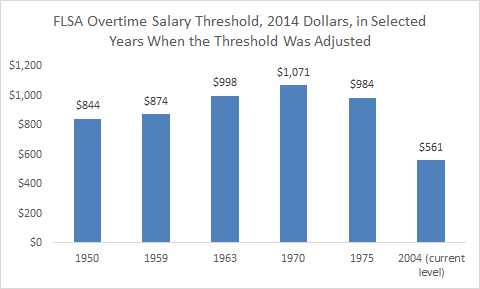
Under current regulations, salaried employees making less than $455 a week must be paid overtime, a threshold set in 2005 by the Bush administration. In 1975 it was $250 per week, the equivalent of $970 in today’s dollars. The White House is not yet revealing its proposed new cap—which will be subject to public comment and will likely face strong opposition from the business community—or when it will kick in. But a White House official said the proposal will help “millions,” and offered up California and New York as models for the proposal. Those states have set thresholds of $640 per week and $600 per week (which will increase to $800 per week and $675 per week in 2016), respectively.

McArdle connects the overtime push to “The Politics of Crap Retail Jobs”:

These days, it seems that a lot more people are finding that these jobs in fast food or retail are “the best we can do”; it’s no longer housewives and teenagers looking for some extra income. Meanwhile, in many ways the work has gotten worse. Employers, themselves facing brutal competition, are using software packages to help them schedule workers in ways that maximize their profitability while maximizing inconvenience to employees. Hours are kept low to ensure that workers don’t qualify for overtime, much less benefits — and because the software requires employees to make available many more hours than they actually get, they often can’t even string together two part-time jobs to make a full-time income.

Meanwhile, the folks scheduling them are often people who would like to get a better job with more opportunity but can’t find one. They too feel trapped in jobs that don’t pay much but require too many hours for them to pick up a second shift somewhere else.

These workers may not be numerous enough to succeed in unionizing Wal-Mart. But they are numerous enough to make up a powerful political force.

Walter Olson points out that the executive order will have unintended consequences:

As with the expansion by decree of minimum wage law, it will be interpreted in some quarters as an undiluted boon to the employees it covers – their employers will either raise their pay or limit the hours they are expected to work, or both, and how could they be anything but happy about that? But as the piece quotes Cato’s Dan Mitchell as warning, “There’s no such thing as a free lunch… If they push through something to make a certain class of workers more expensive, something will happen to adjust.”

At Forbes, Daniel Fisher explains some of the mechanisms by which that will happen. It will probably become harder to retain exempt status, for example, for “management-plus” jobs, such as one where a shift manager is expected to fill in occasionally at the register during a cashier’s break. That will hit smaller establishments especially hard, while yanking away transitional positions by which ambitious hourly hires can cross over to management.

Morrissey agrees:

Right now, the exemption allows businesses to claim overtime exemption for people earning $455 a week or more (annual salary of $23,660)* just by asserting that any part of their duties is “executive” in nature. That’s a ridiculously low level, but businesses have structured their work forces on the basis of this regulation. No matter what level the White House chooses, it’s going to impact staffing decisions; the question is how bad it will get, and how many jobs end up going from full- to part-time in defense of potential unforecasted costs in smaller businesses especially.

Jared Bernstein addresses criticisms of the order:

[Y]ou hear the knee-jerk “job killer” response from the business lobby.  But in this case, the logic doesn’t follow.  If a currently ineligible salaried worker becomes eligible for overtime pay by dint of this change, her employer can easily avoid paying her the overtime premium by hiring a new worker at the “straight time” wage.  And this happens to scratch another labor market itch we have right now: weak job creation.  That’s why Dan Hamermesh, a highly respected labor economist who’s studied this issue for decades, said about the president’s proposal in an article in The Washington Post: “I would argue it’s a job-creation program.”

But this argument doesn’t impress Pethokoukis:

So Obama’s directive might mean less pay for some, but possibly create jobs for others in what is essentially a federal mandated work-share program. Just what is the net effect of the Obama wage floor? … [R]etail shops and other small businesses look to be most affected because they need salaried managers and shift supervisors to monitor “low-skilled workers in need of oversight.” These managers also fill in when these low-skill workers unexpectedly don’t show up for work. Does enhanced OT, then, make it more likely that business is a bit more likely to replace low-skill workers with machines? Tell me, CBO!

(Chart from Jared Bernstein)
Ask Rob Thomas Anything: Giving Fans What They Paid For

In today’s video, Rob explores the Veronica Mars business model and says he had no problem trying to tailor the film to its Kickstarter backers:

In Willa Paskin’s opinion, Rob hits his mark with the Mars movie (which comes out today):

I don’t know how much money Veronica Mars will make, or how much money it has to make to be deemed a success, but as means of fan-satisfaction it is a needle to a major vein. Unlike the new, structurally complex Arrested DevelopmentVeronica Mars’ only ambition seems to be to deliver a product of the same quality as the incisive, quippy show—not at all a low bar. By unapologetically being an extended TV-episode in movie form, Veronica Mars keeps on keeping on with its major theme: taking things that are assumed to be adorable and unserious and safe and complicating the hell out of them.

In the next video from Rob, he explains that while he expected the Kickstarter campaign to be successful with fans, he didn’t anticipate how much the project would raise the profile of a show cancelled seven years ago:

Alan Sepinwall bets that non-fans will enjoy the movie, but he still wonders if the enthusiasm will translate to a good take at the box office:

I would say it’s a film where the story will be easy to follow for a newbie, and where they may appreciate both the performances ([Kristen] Bell’s depth and versatility, in particular, will be eye-opening to anyone who only knows her from the many dumb romantic comedies she’s made in the years since) and the snappy dialogue for its own sake, but where the impact — both the dramatic beats and the smaller character moments — won’t be nearly as satisfying without 64 episodes worth of history with Veronica and friends. …

Like the “Firefly” sequel movie “Serenity,” this one’s going to have to rely almost entirely on pre-existing fans if Thomas wants to be able to make more movies. (There is going to be a series of novels about Veronica, spinning out of the events of the movie, and the story leaves several plot threads dangling for a sequel.) On the plus side, the movie cost Warner Bros. peanuts, even after they chipped in a bit. On the minus side, over 70 percent of the Kickstarter backers get a downloadable copy of the movie, on the day of release, as one of their rewards, that they may not feel the need to spend even more money to see it in a theater.

For more discussion of Rob’s innovative, Dish-like project, go here. His previous Ask Anything answers are here.

(Archive)

The Hounding Of A Young Gay Writer, Ctd

Ezra addresses the controversy over Vox hiring Ambrosino:

Brandon isn’t our LGBT correspondent. He’s not even the only LGBT employee of Vox.com. He is a young writer who we think has talent who’s going to receive a lot of editing and a lot of guidance.

Brandon applied for the news-writing fellowship, a one-year position focused on helping inexperienced writers develop aggregation and reportorial skills. Contrary to some garbled reports, before hiring Brandon I read a lot of his previous work. Brandon’s past writing was often quite pointed and personal, and not a fit for Vox — and I told him so. The writing fellowship requires a very different approach.

But something that often happens to young freelance writers on the Internet is that they end up writing reams of their most controversial opinions before they ever get a chance to do basic reporting or benefit from a routine relationship with an editor. So as part of Brandon’s writing test, I asked him to do eight news articles and two explainers — more than 5,000 words of original content, in all. He needed more editing, training and direction. But he showed himself a strong, fast writer who really wanted to learn. And that training is what the fellowship is there for.

So back off, pitch-forkers! In his comments to Gabriel Arana, Ezra defended the hire partially on the grounds “ideological diversity.” Kilgore hates that rationale:

It kind of makes me crazy when someone appears to assume that only Christian conservatives are authentic religious voices, and that finding a gay conservative evangelical Christian strikes some sort of “balance.” It’s the same mindset that seems to have led the President of the United States to conduct his “religious outreach” mostly among conservative evangelicals who are minority folk or who have some other reasons for playing nice with Democrats. Obama really ought to know better, and so should Ezra: there are these people called mainline or liberal Christians around, too, and if you are trying to give Christians a voice in progressive venues, you might want to start with them instead of always looking for an unconventional conservative.

I have not seen anywhere in Ambrosino’s slim portfolio of clips anything like an unreconstructed fundie. Dreher loves Ambrosino’s Time piece:

This is what sent Mark Joseph Stern to his fainting couch? I had not seen this Time piece, but its sheer humanity made me want to stand up and cheer. Brandon Ambrosino will do more to change minds and turn hearts than a thousand cartoonishly militant Mark Joseph Sterns.

Good for Vox for hiring someone who actually thinks and reflects to cover gay issues, and who tries to see the other side, even if he ultimately disagrees with it, versus Slate, which satisfies itself with employing someone who mistakes outrage for integrity. If Brandon Ambrosino is the Martin Luther King of the gay rights movement, then Mark Joseph Stern is Stokely Queermichael. 

Matt Baume thinks he’s just a bad writer:

Brandon’s not especially insightful. He doesn’t have any particular talent for constructing an argument. There’s nothing all that compelling about what he has to say. There’s no reason to suffer through his work. His only distinction is that he’s a gay guy who writes with disdain for other gay guys. And as anyone who’s ever read the comments on Queerty can tell you, there’s nothing all that unusual about that.

I’m really staggered by this pile-on. It’s not about the quality of his work. It’s about policing the discourse to permit only one gay perspective rather than many. It’s a stultifying, ugly, petty piece of ideological police-work. It repels me as much now that we have made so much gains as it did when exactly this kind of leftist viciousness hounded me in my twenties as well.

The Mandate Fight Is Back

Jon Cohn covers the new attempt to kill Obamacare’s mandate:

The Republicans’ latest gambit is to propose a five-year delay, which would save the government money, and then use those funds to offset the cost of a “doc fix”—a measure to spare physicians looming cuts in Medicare reimbursements.

It’s a new and clever way to package an effort to undermine the mandate—and, through it, the law. But, of course, it has consequences. According to the Congressional Budget Office, which released an analysis of the proposal on Wednesday, pushing back the mandate by five years would mean about 13 million fewer people would have health insurance, while premiums for those buying coverage would be 10 to 20 percent higher than they would be if the mandate remained in place. The estimates were for 2018 but, CBO said, the results would be similar for each of the previous years.

Jason Millman relays what both sides are saying:

People can avoid any penalties if they “experienced another hardship in obtaining health insurance.” This language is pretty broad. And those who claim hardship don’t have to provide documentation. So doesn’t this mean anyone can just claim hardship and avoid the penalty for not having insurance? The GOP is arguing as much.

But the administration says these exemptions are limited, and just applying for one doesn’t guarantee you’re going to get it. Each request is processed manually, and people could be asked to provide more information or be denied outright.

Suderman argues that the mandate is fairly toothless:

In some sense, it’s like used car pricing, or cable company discounts. Officially, the price is what’s on the sticker. But if you make even a token effort to bargain, or half-heartedly threaten to cancel service, you can get the price lowered. Mostly, it’s a mechanism that allows the administration to have it both ways: Of course the mandate is absolutely essential to the law, and of course practically anyone who wants out of it can get an exemption on a hardship basis. But that approach also reveals the tough spot administration officials are in with regards to the mandate: They don’t want to remove the requirement, but they don’t really want to enforce it either.

The Left’s Favorite Bogeymen

Cillizza considers why Harry Reid has been vilifying the Koch brothers from the Senate floor:

The more he talks about the Kochs, the more — he hopes — rank and file Democrats get fired up to turn out to stick it to the Kochs. And the more — he hopes — major Democratic donors open up their checkbooks to counter the Kochs spending.

Sargent’s take:

As I noted the other day, this is all about creating a framework within which voters can be made to understand the actual policy agenda Republicans are campaigning on. … [The Koch attacks] aren’t really about the Kochs. They are a proxy for the one percent, a means through which to tap into a general sense that the economy remains rigged in favor of the very wealthy.

Waldman doubts this strategy will pay dividends:

The problem is that most Americans have no idea who Charles and David Koch are. Yet they’re already being featured in ads like this one in which we see their picture without any explanation. I’d be interested to see a poll on their name ID, but until somebody does one, I’d guess that maybe 10 percent of voters are familiar with them. Now maybe between now and November, Democrats can successfully educate enough of the voters on the Kochs to have a real impact. But it won’t be easy.

Like Cillizza, Alex Roarty thinks the target audience is donors more than voters:

Although most citizens may not know who the Kochs are, liberal activists certainly do—including the wealthy ones, from whom the Democrats are desperately trying to coax the kind of large donations that will let them push back more forcefully in TV ads. And the Kochs do complicate the GOP’s own political efforts, too, as when their company closed down a small plant in Alaska. It wasn’t a game-changer for the Alaska race, but it did allow Democrats to blast the GOP field’s ties to the brothers.

But those efforts are about mitigating the damage done by the [Americans For Prosperity’s] ads, and not necessarily a way to start scoring points of their own.

How Morrissey sees the attacks:

When asked to rank their top priority, unemployment and jobs topped yesterday’s Gallup poll list, while environmental issues and global warming didn’t even make the list. Income inequality, by the way, polled 2% at the bottom. They’re flailing, and the reek of desperation is only getting more obvious.

Update from a reader:

Ed Morrissey conveniently missed the forest for the trees. Individuals like the Koch brothers, Sheldon Adelson, Shaun McCutcheon, Jeffrey Katzenberg, and Tom Steyer are all corrupting the political process by dropping huge piles of money on political advocacy and pushing the president and Congress to listen to their opinions and sign into law policies that they support rather than listening to and signing into law policies that the voters who elected them support. This Gallup poll showed that Americans in July 2012 believed reducing corruption in the federal government was the second-most important task for the future President Obama or Romney to tackle. Conveniently, it’s also the second-most important task in the poll that Morrissey cited as well!

High Consumer Spending

rand_drugs1

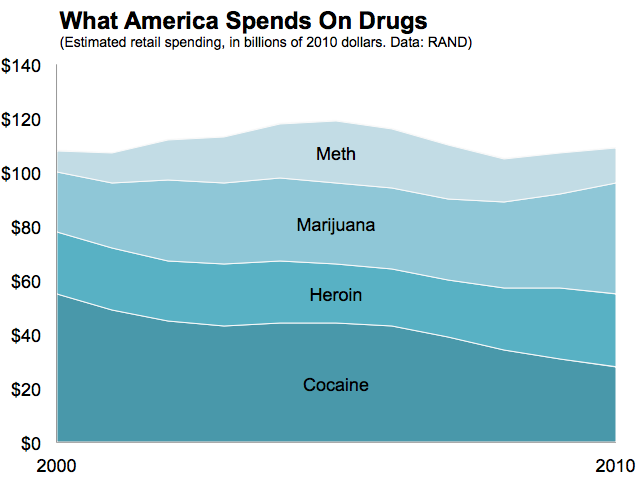
John Tozzi outlines the findings of a RAND Corporation study estimating that Americans spent $109 billion on illegal drugs in 2010:

To put that number in perspective: It’s more than we spend at furniture stores ($90 billion) or electronics and appliance retailers ($101 billion) annually, according to U.S. Census data. It’s more than one-fifth of what we spend eating out each year, and it dwarfs the $21 billion we drop at bars.

Most of that $109 billion is spent by what the RAND report calls “the minority of heavy users,” who get high during at least 21 days of a month. And while the total dollars spent (adjusted for inflation) remained roughly stable from 2000 to 2010, the mix has changed. Cocaine use has gone down; marijuana use has gone up. Meth peaked in the middle of the Aughts, though the report’s authors caution that the meth numbers are less reliable than other estimates.

Zoë Schlanger discusses the study’s limitations:

[G]athering data on undocumented dollar amounts spent on illegal drugs is extremely difficult. RAND’s numbers acknowledge a significant amount of uncertainty. For example, RAND’s best estimate of marijuana spending in 2010 is $41 billion, but it pegs the possible range of spending at $30 billion to $60 billion. For cocaine (crack and powder) RAND’s best estimate is $28 billion, with a range of $18 billion to $44 billion.

“Since there are many other sources of uncertainty, readers should not consider these as lower or upper bounds or as 95-percent confidence intervals,” the report reads. “The range should be considered plausible, but not extreme.”

Noting that the study counted far more regular heroin users than the National Survey on Drug Use and Health, Mike Riggs compares the data sources:

[R]esearchers suggest that one reason for this disparity may be that the NSDUH survey underestimates heroin use by an eye-boggling amount. “Estimates from the 2010 NSDUH suggest there were only about 60,000 daily and near daily heroin users in the United States,” drug policy researchers Beau Kilmer and Jonathan Caulkins, both of the RAND Corporation, wrote in a recent editorial. “The real number is closer to 1 million.” …

Kilmer and Caulkins came up with their much higher figures for heroin and hard-drug use by combining county-level treatment and mortality data with NSDUH data and a lesser known government survey called the Arrestee Drug Abuse Monitoring Program. Instead of calling people at home and asking them about their drug use, the ADAM survey questions arrestees when they’re being booked and tests their urine. “ADAM goes where serious substance abuse is concentrated — among those entangled with the criminal justice system, specifically arrestees in booking facilities,” Kilmer and Caulkins write.

It’s Hardly Hard Out There For A Pimp

pimps

A report (pdf) from the Urban Institute looks at the sex work economy in eight major US cities. Emily Badger recaps the findings:

Urban’s researchers estimate that, in 2007, the entire illegal sex economy in Atlanta – including brothels, escort services and dubious massage parlors –was valued at $290 million. In Miami, it was $205 million (that’s more than twice the size of the market there for illegal drugs). In Washington, it was $103 million. On the low end, in Denver it was about $40 million.

Between 2003 and 2007, Washington’s market shrunk. Seattle’s boomed. Meanwhile, the mean weekly income for a pimp in Denver, post-2005, was $31,200.

The report is the first of its kind to affix hard numbers like this to the shadowy market for sex work. The findings are based in part on 260 interviews with convicted pimps and sex workers, prosecutors, law enforcement officials and other experts in San Diego, Seattle, Dallas, Denver, Washington, Kansas City, Atlanta, and Miami (cities selected, among other things, for being part of “known ‘pimp circuits’ in the United States”).

Derek Thompson, who passes along the above chart, pulls some highlights from the report, which also covered illegal drug and gun markets:

1. Atlanta has the biggest sex economy among the studied cities, by far. Dallas has the largest market for drugs or guns. …

2. As a share of each city’s cash economy (i.e.: doesn’t include the vast majority of commercial activity with credit) Atlanta has both the biggest sex and guns trade. San Diego has the biggest underground drug economy. If you add all the underground economies together, you’ll see the largest combined black markets (by city) are: Atlanta, Miami, San Diego, and Dallas. Across the studied cities, the largest underground market is sex, followed by drugs, then guns.

Kyle Chayka focuses on how pimps and sex workers employ social media marketing, including on the mostly defunct MySpace:

[P]imps set up profiles for their workers with codewords like “girlfriend experience” and wait for the customers to inquire. “Friend them, once you make a connection, you let them know what the deal is. It’s [sex] for sale,” one former sex worker interviewed in the study explained. “Myspace, all that, it’s just a disguise.”

The report shows even Twitter being used to advertise job openings. “Believe it or not, people still use [social networks], and the ones that are using them are usually younger, and pimps are on there like crazy,” a Dallas police official said.

And Amanda Hess takes note of how the pimps interviewed for the report represented themselves:

Many of the convicted pimps didn’t identify as pimps because they claimed not to engage in some of the behavior typically associated with the profession, like confiscating money, beating sex workers, or trafficking women. The madam insisted that she took smaller cuts of her workers’ fees than many assumed. And a male manager said: “The old school cats would talk about how the girls would hide money, not give it all up, and in the old days they would beat the girls if they didn’t get it all. Now, I know the girls come to me and will stash some around the corner before they come in, but I’m just as happy if they give me any of it, as long as they bring me something, because they’re the ones doing all the work.”

Update from a skeptical reader:

The Urban Institute numbers seem a tad bit farfetched; the entire Denver area illicit sex market is valued at $40 million USD, even though the average pimp is making somewhere in the neighborhood of $31,000 * 52 = ~$1.6 million USD a year? Are there only twenty pimps in charge of “brothels, escort services and dubious massage parlors” in Denver?

Another is even more skeptical:

I would take that Urban Institute study of prostitution with several massive helpings of salt. It represents everything that is wrong with how sex work is studied in this country. The researchers interviewed a grand total of 36 actual sex workers.  In three cities, they interviewed none.  And all the interviews were of sex workers in prison, which is a known massive bias in studies of sex work (80-90% of sex workers are not street walkers, but most jailed sex workers are). They interviewed twice as many pimps and almost five times as many law enforcement personnel. In effect, this “study” amounts to taking the boasts of convicted pimps and the speculations of law enforcement and putting a very thin scientific veneer on it. Massive parts of the study consist of lurid anecdotes from law enforcement personnel speculating on what sex work is really like.

I’ll also point you to Maggie McNeill’s discussion of pimps, where she argues that they are actually rare in sex work. So this study is looking at a tiny sliver of the sex industry. It’s not representative at all.

The War Over The Core

Seth Masket considers the latest debate roiling the education world:

By now, you’ve probably heard of the Common Core State Standards. They are a set of skills expectations for students that have been adopted by 45 states plus the District of Columbia. They require that students be broadly competent in mathematics and literacy and know how to do things like critically read a text, argue and defend a point of view, interpret data, etc. – all things that we’d consider pretty useful for students entering college or the work world. The Common Core itself contains no specific prescriptions for content or curriculum, just the requirement that students learn these vital skills.

But that’s not at all what you’ll hear about it in the conservative media. For them, not only is the Common Core a massive federal intrusion into state and local education policy (a debatable point, but one roughly grounded in reality), but it’s a primary tool of President Obama and the Left (and possibly the United Nations) to fundamentally transform education, to undermine the authority of religion and parents, to track the location and behavior of children who’ve committed thought crimes (perhaps using iris scans), and to essentially impose collectivism upon America. As Glenn Beck sums up, “This is like some really spooky, sci-fi, Gattaca kind of thing.”

Peter Wood’s criticisms are more reality-based. He argues that Common Core “set a ceiling on the academic preparation of most students”:

None of this might matter if the Common Core were just a baseline and students and schools could easily move above it if they wished to.  The trouble is that the Common Core has been designed to be a sticky baseline.  It is hard for schools to rise above it.

There are two reasons for that. First, it uses up most of the time in a K-12 curriculum, leaving little room for anything else. Second, the states that were leveraged into it via Obama’s “Race to the Top” agreed that students who graduate from high school with a Common Core education and are admitted to public colleges and universities will automatically be entered into “credit-bearing courses.” This is tricky. Essentially what it means is that public colleges will have to adjust their curricula down to the level of knowledge and skill that the Common Core mandates. And that in turn means that most schools will have little reason to offer anything beyond the Common Core, even if they can. In this way, the Common Core floor becomes very much a ceiling, too.

Neal McCluskey isn’t thrilled about Common Core’s relationship with the SAT:

What’s the connection between the Core and the SAT? A big one: David Coleman, who is both a chief architect of the Core and president of the SAT-owning College Board. Coleman announced when he took over the Board that he would align the SAT with the Core, and it was clear in the Board’s SAT press release that that is what’s happening. Employing Common Core code, the Board announced that the new SAT will focus on “college and career readiness.” Why is this potentially bad news for Core supporters? Because the SAT changes are widely being criticized as dumbing-down the test – good-bye words like “prevaricator,” hello toughies like “synthesis” – and that may drive attention to people who are questioning the quality of the Core.

And longtime standards proponent Diane Ravitch recently leveled her own criticisms:

The Common Core standards have been adopted in 46 states and the District of Columbia without any field test. They are being imposed on the children of this nation despite the fact that no one has any idea how they will affect students, teachers, or schools. We are a nation of guinea pigs, almost all trying an unknown new program at the same time.

Maybe the standards will be great. Maybe they will be a disaster. Maybe they will improve achievement. Maybe they will widen the achievement gaps between haves and have-nots. Maybe they will cause the children who now struggle to give up altogether. Would the Federal Drug Administration approve the use of a drug with no trials, no concern for possible harm or unintended consequences

She made similar points in new interview:

[Common Core standards] haven’t been tried anywhere, they’ve been tested — and we know that where they’re tested, they cause massive failure. So I would say we need to have more time before we can reach any judgment that they have some miracle cure embedded in them.

I know, and a lot of teachers know, they’re totally inappropriate for children in kindergarten, first grade, second grade and third grade, because when they were written there was no one on various writing committees who was an expert in early childhood education… They’re also totally inappropriate for children who have disabilities — they can’t keep up. There’s an assumption in the Common Core that if you teach everybody the same thing, everybody will progress at the same speed. And that’s not human nature. It doesn’t work that way.

The Hounding Of A Young Gay Writer

So I’m perusing the web on the airplane to Los Angeles and saw a blast of incandescent gay fury all over the place. It turns out that Ezra Klein had the gall to offer a writing fellowship at Vox to one Brandon Ambrosino, a 23 year-old professional dancer who is a graduate of Liberty College, Jerry Falwell’s joint. Judging from the reaction, you might have thought Ezra had hired Rick Santorum. Oh! the screeds and harrumphs, the sighs and the gasps! Here’s the gay politburo official at Slate, Mark Joseph Stern, in a dreary tract against what he calls Klein’s “unbelievably bad hire”:

Ambrosino’s ideas are not brash, unconventional, exciting, or avant-garde. They are reckless, retrograde, and vapid—and hiring Ambrosino reflects startlingly bad, potentially catastrophic judgment by Vox.

“Potentially catastrophic!” A 23-year old who doesn’t parrot what the left likes could bring the entire Ezra Klein venture down! Not to be outdone, we get this from my friend John Aravosis:

While I think Brandon Ambrosino is sloppy, unimaginative, a bad writer, and a not-very-complicated thinker, my biggest concern is that he comes across, to me, as having an agenda that borders on animus … Brandon Ambrosino is the Allen West of homosexuality. He’s your go-to guy, if your goal has nothing to do with finding a legitimate minority voice on the issues of the day.

Notice the disturbing notion of a “legitimate minority voice.” And who decides what’s legitimate? Why John of course! As for the imputation of anti-gay animus: it’s as lame as neocons calling critics of Israel anti-Semites or self-hating Jews. Equality Matters calls him baldly an anti-gay apologist and then proceeds to tell us solemnly that

The announcement was met with widespread condemnation from LGBT activists and writers who called his hiring an “embarrassment” and a “major mistake.”

So, as you would, I went and read some of Ambrosino’s work. We posted about one recently but I hadn’t read much else. The most impressive by far is a funny, sometimes moving, self-deprecating and brutally honest memoir of his time as a gay kid at Falwell’s school. Maybe The Atlantic‘s editors made it better (as they do) – but as a piece of writing, it’s livelier and funnier than anything I’ve read from, say, Mark Joseph Stern. As for his other pieces, they do suffer from some occasional cluelessness and attention-seeking pyrotechnics. But is a young writer not allowed some attention-seeking pieces any more? And his critique of gay-left intolerance gains a little poignancy as the rhetorical lynch mob now prowls the interwebs in order to get him fired.

Here’s what I also found: He wants the gay rights movement to adopt more of the forgiveness and compassion that marked the spirit (if not always the letter) of Martin Luther King Jr. He gets a little grossed out by hyper-sexual antics at gay rights parades – which is a bit of a bore, at this point, but within his rights (and certainly something some gay people say sotto voce). He conflates too many issues when discussing gay identity – but, in his emphasis on choosing sexual identity, he echoes the new left rather than the gay right. Sure he trades on being the gay writer willing to criticize the gay world, but he seems perfectly sincere to me, if a little jejune. And why is he not allowed to criticize what he sees? Is he supposed to take some gay test before he’s allowed a voice?

He is unusual, in as much as his journey into gay life from religious fundamentalism inevitably makes his take on being gay a very particular – and fascinating – one. But guess what? Millions of gay people are born and brought up in fundamentalist Christian environments and families. Understanding their lives and finding a place for them in the world is something we should be striving to achieve rather than attempting to snuff out. And gays from fundamentalist backgrounds can help us engage in dialogue with some of our most dedicated opponents. What I found truly disgusting about some of the commentary is that they tried to portray the man as somehow a Jerry Falwell clone. That’s a deliberate lie and a smear. And it springs from anti-Christian animus.

Gabriel Arana flatters me thus:

Sullivan’s and Rauch’s positions are thoughtfully staked out and stem from nuanced views about the role of government, Ambrosino’s iconoclasm amounts to heedless self-promotion.

Yes, but no one’s making him the editor of The New Republic, are they? He’s just got a gig as a writing fellow at Vox, for Pete’s sake. Give him time and some mentoring and editing (which is presumably what such a fellowship is for), and his 23-year-old talent might indeed go on to become more thoughtful and nuanced. And why would these harrumphing lefties want to stop that?

Could it be because they don’t actually want to continue the dialogue with people of faith, but rather seek to leverage the growing majority in favor of gay equality to rhetorically bludgeon the “bigots” into submission, to create a world in which they call the shots the way homophobes used to? Could it be that they enjoy policing the discourse now that they seem in the majority? This latest surge of gay intolerance needs to be beaten back as forcefully as the anti-gay right’s cornered animus. It’s particularly brutal when that intolerance is directed at a young gay writer whose work and life are being trashed as somehow illegitimate. If anything is anti-gay in this kerfuffle, that is.

A Foreign Policy Full Of Gas

Rory Johnston explains why the US can’t use liquified natural gas exports to undercut Russia in Europe:

Most of the natural gas that could potentially head for Europe is already committed in long-term supply contracts. … Furthermore, most of those contracts are in Asia, where natural gas prices are higher than in Europe. The United States does not sell natural gas, nor does Europe buy it; commercial entities do, and these companies are not going to voluntarily lose money in order to advance American interests. As Michael Levi explains, the U.S. government “can create a framework in which commercial entities can sell gas, but after that, it’s up to those businesses to decide where the gas goes.”

Meghan O’Sullivan suggests US oil production could hit Russia harder and faster:

Russia’s real vulnerability lies in the price of oil, not in the realm of gas.

Revenue from gas sales abroad make up 8 percent to 9 percent of the Russian budget, while oil revenue accounts for a much heftier 37 percent to 38 percent. It was not that long ago that a prolonged collapse in the price of oil undermined the foundations of the Soviet Union, according to former Deputy Prime Minister Yegor Gaidar. The U.S., by adding 2.5 million barrels of oil to global markets in the last three years, has prevented the price of oil from edging higher in the face of disruptions in Libya, Iran and elsewhere. Should the U.S. continue to increase its oil production, as is widely assumed, it could create pressure to further lower the price.

It would not take a huge price collapse to harm Putin’s regime; already, the Russian economy is struggling, and the government has made across-the-board cuts. Plus, Putin’s power comes in large measure from extensive patronage networks made possible by high oil prices. To balance its budget, Russia needs oil prices of about $110 (the current price is about $108). A further dip in oil prices is the largest challenge on the horizon to Putin.

Matt Steinglass calls a time-out:

The idea that America can defeat Russian irredentism in Eastern Europe by deregulating its own energy industries is frankly ridiculous. Deregulation can make airline tickets cheaper. It cannot stop the Russian army. Energy-industry deregulation has become part of the standard Republican line on Crimea largely because of the relentless self-congratulatory process by which political actors cement their followers’ ideological convictions. Leaders apply such flattery like a soothing unguent, assuring their backers that the things they already believe in would have solved every imaginable problem in advance, if only the foolish opposition had gone along. This helps fuse ideological blocs into coherent, hard-to-dent juggernauts.