The Geriatric Saudi Royal Family

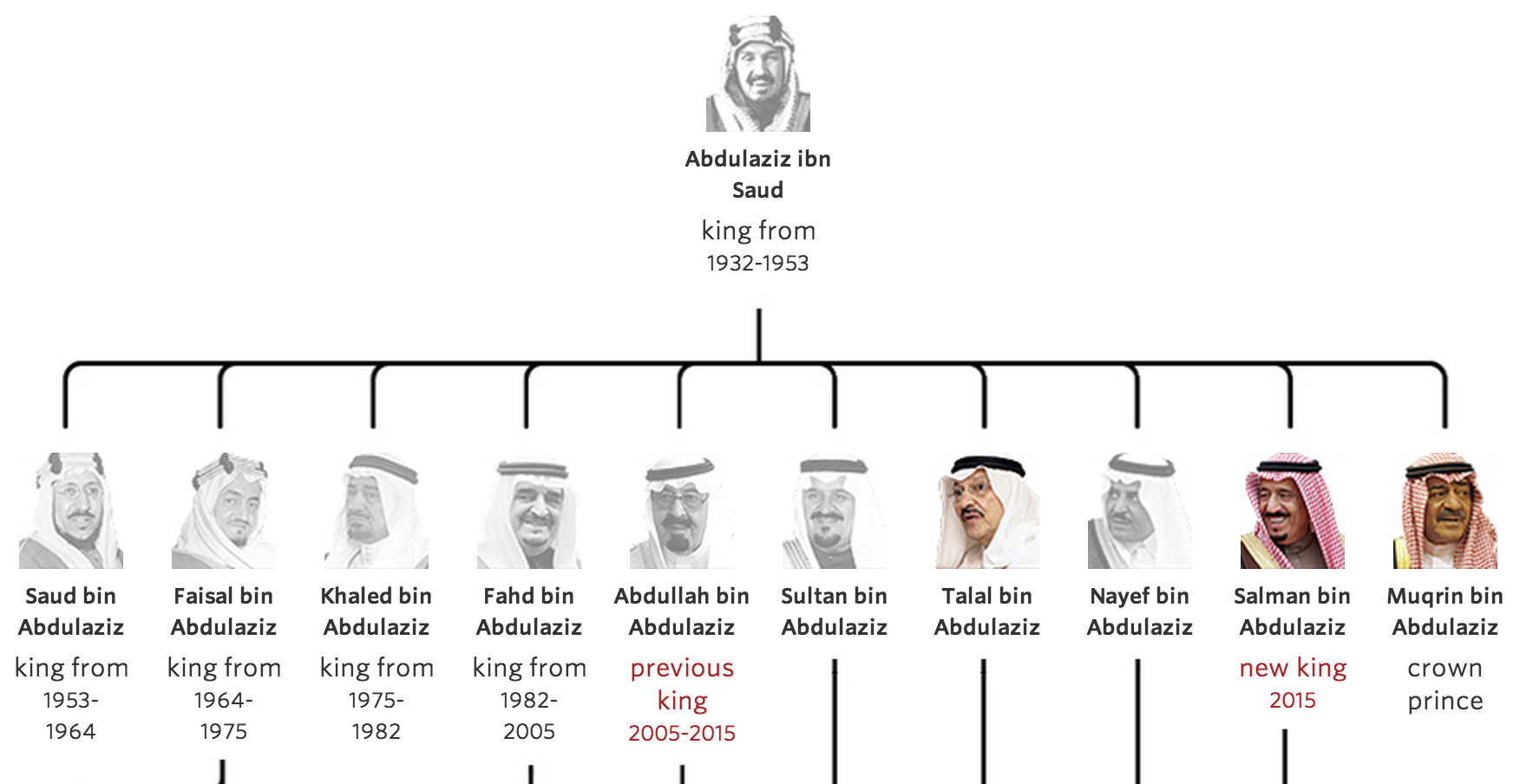
King Abdullah, Saudi Arabia’s ruler, died yesterday. The WSJ has a useful Saudi dynasty family tree (full interactive version here):
Saudi Arabia

Dan Stewart introduces us to the new king:

A longtime governor of the capital, Riyadh, Salman has a reputation as a progressive and practical prince similar in bearing to his late brother. The transition is expected to be a smooth one, with little instability and no long-term policy changes. But the 79-year-old has reportedly been in poor health in recent years, and is perhaps unlikely to rule for as long as his elder sibling.

Josh Marshall marvels at how “every Saudi head of state who has governed this pivotal, brittle and profoundly influential petro-state during the years of its ascendency since 1953 has been the son of a man born only a decade after the US Civil War.” But, he notes, “they are coming to the end of the line”:

[Salman’s] successor will be Crown Prince Muqrin. But he’s it – the last surviving son of ibn Saud at a youngish 69. After Muqrin dies, assuming he outlives Salman, the family will move on to the grandsons of ibn Saud, with a council of princes of some sort who will choose who succeeds who. We will see then just how much the legitimacy of ibn Saud and the longevity of his sons was the key to holding the tightly wound edifice together.

Michael Kelley focuses on the royal now second-in-line:

“Given that there are scores of princes in [the third generation], the potential for discord is high,” Liz Sly of The Washington Post explained last year. “Whoever inherits the throne is likely to anoint his own brothers as future heirs, thereby cutting out multiple cousins from access to the throne and the patronage it provides.”

However, Saudi Arabia’s new king is moving swiftly to make sure that a looming succession crisis — driven by chaotic jostling for power — does not happen. King Salman has named his nephew Prince Mohammed bin Nayef as deputy crown prince, making him the second-in-line to the throne behind Muqrin. Mohammed, believed to be in his 30s, is currently the country’s interior minister.

David Ignatius looks ahead:

The next generation of Saudi leaders, symbolized for American officials by Prince Mohammed bin Nayef, the minister of the interior, is talented and modern. But the paradox of Saudi Arabia is that the Western-facing kingdom has depended for its legitimacy on a pact with conservative Muslim religious leaders. Frightened now by the power of the Islamic State’s extremism, Saudi leaders may be tempted to repeat that bargain — and govern through the repressive power of the Muslim conservatives.

Many Western analysts believe that doubling down now on Muslim conservatism would be a mistake. But decades have shown that the West’s ability to influence the royal family in moments like this is limited, to put it mildly.

Big Brother For Books?

Late last year, an article appeared in The Guardian about the info that e-book seller Kobo collected about the habits of their readers:

After collecting data between January and November 2014 from more than 21m users, in 13624974countries including Canada, the US, the UK, France, Italy and the Netherlands, Kobo found that its most completed book of 2014 in the UK was not a Man Booker or Baileys prize winner. Instead, readers were most keen to finish Casey Kelleher’s self-published thriller Rotten to the Core, which doesn’t even feature on the overall bestseller list – although Kelleher has gone on to win a book deal with Amazon’s UK publishing imprint Thomas & Mercer after selling nearly 150,000 copies of her three self-published novels. “Rotten to The Core by Casey Kelleher was the most completed book in the UK, with 83% of people reading it cover to cover,” said Kobo, “whereas the number one bestselling ebook in the UK, One Cold Night by Katia Lief [also a thriller] was only completed by 69% of those who read it.”

Francine Prose frets about the implications of collecting such data:

For the time being, the data being gathered concerns general patterns of behavior rather than what happens between each of us and our personal E-readers. But we have come to live with the fact that anything can be found out. Today “the information” is anonymous; tomorrow it may well be just about us. Will readers who feel guilty when they fail to finish a book now feel doubly ashamed because abandoning a novel is no longer a private but a public act? Will it ever happen that someone can be convicted of a crime because of a passage that he is found to have read, many times, on his e-book? Could this become a more streamlined and sophisticated equivalent of that provision of the Patriot Act that allowed government officials to demand and seize the reading records of public library patrons?

As disturbing may be the implications for writers themselves. Since Kobo is apparently sharing its data with publishers, writers (and their editors) could soon be facing meetings in which the marketing department informs them that 82 percent of readers lost interest in their memoir on page 272. And if they want to be published in the future, whatever happens on that page should never be repeated.

Will authors be urged to write the sorts of books that the highest percentage of readers read to the end? Or shorter books? Are readers less likely to finish longer books? We’ll definitely know that.

What’s In A Black Name? Ctd

Readers ramp up the thread:

About the discussion on discriminating against black names, there is also this research, where the researchers sent out emails to professors from many disciplines seeking help/information about their PhD programs. The emails were signed by generic White, Black, Hispanic, Indian, and Chinese male/female names. Then they measured the response rate: how fast the professors responded and how willing they were to help the student. Regardless of the professors’ discipline, sex, race, White males had it the best, and the Asians the worst. This only changed with Chinese professors responding to Chinese students. So, there you go.

A few readers also point to a study entitled “Are Emily and Greg More Employable Than Lakisha and Jamal?” The abstract conclusion states, “White names receive 50 percent more callbacks for interviews.” Another redirects to the real world:

I read your post and thought perhaps employers need to institute anonymous application processes. A quick search online revealed that some organizations (and governments) have done just that with positive results.

Here is a link to a recent article summarizing the efforts of the City of Celle, which is in Germany. I find it encouraging that the data suggests that hiring process becomes fairer when applications are judged only on their work histories, levels of education, skills, and accomplishments. Seems like a strategy we could all embrace, does it not?

Another makes a broader point:

I think there’s something off about the post about how employers are making “not an entirely unreasonable assumption” when discounting the educational achievements of black applicants. The evidence presented is that of SAT scores, that black students scored less on average than the mean scores accepted to universities. The implication being, universities are accepting less-than-optimal students for the sake of affirmative action. And, ok, there may be some argument or debate there.

However, the purpose of SAT scores are as a predictive measure of how students will do in college. Beyond the college application, they have absolutely no relevance. Why not? Affirmative action as a policy may help students with lower SAT scores get into college, but it doesn’t go to class for them, or write their papers, or take their final exams. Graduating college is an achievement that is mostly up to the student. So, a college degree on a resume stands on its own. My point is, affirmative action is actually not a plausible explanation for discrimination, at least not where education is concerned. If it was, then employers would ask for SAT scores on resumes. Guess what? They don’t.

Another shares an anecdote:

Many years ago I was a state civil rights investigator.  I remember one college-educated long-time head teller at a bank who was finally upset enough about the young white guys with no college and no experience heading straight into management tracks that she filed a complaint.  I talked to the branch manager about it.  He told me that the young guy he’d just hired reminded him of himself when he was just starting out and he wanted to give the new guy the same chance someone had given him.  He would have sworn on a stack of Bibles that he didn’t have a racist bone in his body.  He thought the world of his head teller.  He relied on her to train all the new staff.  But in his unconscious world view, black women were tellers, white men were management.

Another attests to the often fickle nature of hiring:

I’m a hiring manager at a software company. I receive dozens or hundreds of applications for every open position. Generally I skip cover letters altogether and spend somewhere between 20 and 30 seconds scanning resumes to come to an initial decision of whether to reject or follow-up. Even if there weren’t all sorts of academic studies telling us so, it’s pretty freaking clear to any even marginally self-aware person that this process is fraught with implicit biases. Have I heard of your college? Did I go to your college? Do I wonder whether you’ll “fit in” with our other employees? Do I want to drink beer with you? Is your job experience as impressive as it seems, or did you benefit from being a “diversity hire?”

This stuff sucks, but it’s the reality of the hiring process in good old meritocratic Silicon Valley. Other industries are probably even worse.

Update from a reader, who quotes a previous one:

So, a college degree on a resume stands on its own. My point is, affirmative action is actually not a plausible explanation for discrimination, at least not where education is concerned. If it was, then employers would ask for SAT scores on resumes. Guess what? They don’t.

ummm … actually … yes they do!

Big-name consulting firms such as McKinsey and Bain, as well as banks like Goldman Sachs, are among the companies that ask newly minted college grads for their scores in job applications, …Some other companies request scores even from candidates in their 40s and 50s. Jeff Bezos, the billionaire founder and CEO of Amazon, is one of the most famous proponents of using SAT scores in hiring decisions. Bezos scored highly on a standardized IQ test when he was only 8 years old, and in his early days as a manager, he liked to ask candidates for their SAT results in interviews he conducted. He has said that “hiring only the best and brightest was key to Amazon’s success.”

To Screen But Not To See

Iraq veteran Brian Turner, author of the memoir My Life as a Foreign Country, has an insightful take on American Sniper and how the film reflects our flawed understanding of the conflict:

This isn’t the defining film of the Iraq War. After nearly a quarter century of war and occupation in Iraq, we still haven’t seen that film. I’m beginning to think we’re incapable as a nation of producing a film of that magnitude, one that would explore the civilian experience of war, one that might begin to approach so vast and profound a repository of knowledge. I’m more and more certain that, if such a film film ever arrives, it’ll be made by Iraqi filmmakers a decade or more from now, and it’ll be little known or viewed, if at all, on our shores. The children of Iraq have far more to teach me about the war I fought in than any film I’ve yet seen — and I hope some of those children have the courage and opportunity to share their lessons onscreen. If this film I can only vaguely imagine is ever made, it certainly won’t gross $100 million on its opening weekend.

The biggest problem I have with American Sniper is also a problem I have with myself.

It’s a problem I sometimes find in my own work, and it’s an American problem: We don’t see, or even try to see, actual Iraqi people. We lack the empathy necessary to see them as fully human. In American Sniper, Iraqi men, women, and children are known and defined only in relation to combat and the potential threat they pose. Their bodies are the site and source of violence. In both the film and our collective imagination, their humanity is reduced in ways that, ultimately, define our own narrow humanity. In American Sniper, Iraqis are called “savages,” and the “streets are crawling” with them. Eastwood and his screenwriter Jason Hall give Iraqis no memorable lines. Their interior lives are a blank canvas, with no access points to let us in. I get why that is: If Iraqis are seen in any other light, if their humanity is recognized, then the construct of our imagination, the ride-off-into-the-sunset-on-a-white-horse story we tell ourselves to push forward, falls apart.

If we saw Iraqis as humans, we’d have to learn how to live in a world far, far more complicated and painful than the difficult, painful one we currently live in.

What’s Killing The Bees? Ctd

The crisis could be spreading:

Wild bees are at risk of catching diseases from their struggling domesticated brethren, according to a recent study published in The Journal of Applied Ecology.

The study, led by evolutionary geneticist Lena Wilfert of the University of Exeter, adds a new layer to the crisis known as colony collapse disorder (CCD), which has precipitated an alarming drop in honeybee populations worldwide. … [T]he use of pesticides isn’t the only anthropogenic driver behind the transmission of pathogens into the wild. Wilfert’s team also found that many commercial beekeepers are creating ideal conditions for virulent diseases to emerge. “High densities within breeding facilities and in commercial pollination operations increase the contact rate between infected and uninfected conspecifics, thereby lowering the threshold for disease emergence,” the authors explain.

Helen Briggs reports from across the Pond:

Vanessa Amaral-Rogers of the charity, Buglife, said the results of the study showed an urgent need for changes in how the government regulates the importation of bees. “Wild honey bees can no longer be found in England or Wales, thought to have been wiped out by disease,” she told BBC News. “Now these studies show how diseases can be transmitted between managed honey bees and commercial bumble bees, and could have potentially drastic impacts on the rest of our wild pollinators.”

A study last year on a sample of commercial bumble bee hives imported into the UK found 77% were contaminated with up to five different parasites, with a further three being found in the pollen that was brought in with them, she added.

More Dish on the bee problem here and here.

How Can We Beef Up Cyber Security?

Adam Segal sees new cyber laws as a real possibility:

Could this finally be the year when the Congress passes cyber legislation? I think yes. Public awareness of the threat is at an all-time high. The Sony attack has created pressure for Congress to act (though it is not clear that any of the legislation would have prevented the North Korean hackers from breaching the company). Moreover, there is bipartisan support for cybersecurity legislation. … [W]hile disparaging most of the President’s agenda, prominent Republicans like Senator Lamar Alexander of Tennessee have pointed to cybersecurity as an area where “we can get some agreement.” As in the past, privacy concerns will make or break the legislation, but we should expect to see real signs of progress.

Katie Benner examines the cyber proposals in Obama’s SOTU:

The Obama ideas with the most potential to bolster corporate security are his threat-sharing measure and the corporate disclosure rule.

As I’ve written before, collaboration is considered to be one of the best defenses against cybercrime, but a recent PricewaterhouseCoopers survey found that only 25 percent of businesses currently share information about attacks. Obama wants to encourage companies to share threat data with the government in order to get liability protection. … The disclosure rule isn’t useful because it increases security per se, but because it gives companies an incentive to pre-emptively beef up their defenses.

However, Timothy Edgar declares that no “proposal in Obama’s State of the Union address would truly hold companies accountable for cyber insecurity”:

If you are looking for effective ideas on this score, you would do better to listen to students here at Brown University where I’ve lately been teaching.

One student’s idea was to build on existing “bug bounty” programs in which software companies pay researchers money for uncovering security flaws by turning the federal hacking law on its head. Today, all intrusions—even “white hat” penetrations for security research—are illegal unless the system owner consents. A company with lousy security may threaten a security researcher with a lawsuit or jail time for pointing out a gaping hole in its defenses. What if Congress reversed this perverse law, requiring companies to pay ethical hackers for demonstrating vulnerabilities?

A New Way Forward On Abortion?

Charles C. Camosy’s forthcoming Beyond the Abortion Wars tries to chart it. Calling the book “fascinating and compelling,” Jim A.C. Everett applauds it for cutting through the spin:

In this book, Camosy masterfully traverses the ‘battleground’ between the ‘pro-life’ and ‘pro-choice’ camps in order to show that this battleground is in fact no such thing. In fact, as Camosy notes, the majority of the American public actually agree on a middle-ground position on abortion. Despite what one might think from reading certain media outlets and Twitter wars, there is actually a large consensus in the public regarding abortion. This insight is deceptively powerful. By demonstrating the areas of agreement, Camosy is able to help guide us beyond the abortion wars to allow a way forward for a new generation.

Commenting on the House GOP’s Pain-Capable Unborn Child Protection Act, which would have prohibited abortions after 20 weeks (except in cases of rape or to save the mother’s life), Camosy points to one key factor in crafting legislation that appeals to this middle-ground – “that Roe has, in effect, already been overturned”: 

In a 2010 article she wrote in the William and Mary Journal of Women and the LawCaitlin W. Bormann says quite directly that the 1992 case Planned Parenthood v. Casey “established a new, less protective, constitutional standard for abortion restrictions.” Instead of defending privacy, Casey focused on making sure that abortion restrictions didn’t impose what it calls an “undue burden” on women. This standard, she says, “immediately enabled states to invade women’s privacy in new ways.”

Bormann says the Roberts court “has interpreted Casey expansively”, resulting in “erosions of the privacy boundaries” that were once protected by Roe. Indeed, she says that certain privacy rights to abortion were “eviscerated” by Casey, especially as interpreted by the all-important swing voter on the Court, Justice Anthony Kennedy.

Writing in the New Yorker, Jeffery Toobin agrees. Would Kennedy uphold a state law with a 20-week (or earlier) ban? Toobin points out that in Gonzales v. Carhart (2007) this swing justice upheld federal law against late-term abortions with a very different sensibility from his opinion in Casey. Kennedy wrote, “The State may use its regulatory power to bar certain procedures and substitute others, all in furtherance of its legitimate interests in regulating the medical profession in order to promote respect for life, including life of the unborn.” What counted as an undue burden for him when he helped decide Casey in 1992, Toobin noted ominously, looked very different to Kennedy fifteen years later.

As The World Warms

In a bizarre bit of political theater yesterday, Senate Democrats tried to force their GOP counterparts to go on the record about whether or not climate change is a hoax:

The Senate overwhelmingly voted, 98-1, in favor of an amendment stating that “climate change is real and not a hoax.” In an amusing twist, the chamber’s most notorious climate denier, Senator Jim Inhofe of Oklahoma, signed on to the amendment at the last minute, mostly because it didn’t attribute a cause to global warming. “The climate is changing. The climate has always changed,” Inhofe said. He then criticized supporters of man-caused climate change by saying that the real “hoax” was “that there are some people that are so arrogant to think” that they can change the climate. (The only senator to oppose that statement was Roger Wicker, a conservative from Mississippi.)

Phillip Bump sighs:

It was a nifty, if insincere, bit of politics. There’s no question that a vote against a flat statement that climate change is real could have been problematic for candidates down the road – especially for those various Republican senators quietly preparing for the big election in 2016. With Inhofe’s re-framing the question, the Democrats, trying to engineer a gotcha moment, ended up empty-handed on the vote, with neither the satisfaction of nailing down opposition to scientific consensus and without a point of leverage for future discussions of addressing the warming planet.

Nonetheless, Rebecca Leber applauds the Dems’ strategic trolling:

The Washington Examiner’Zack Colman reported Monday that Republicans are regrouping to consider a new strategy on climate. “They’re going to try to drag their feet as long as possible, but there are certain things out there that could bring the predominant GOP position to light,” Ford O’Connell, a GOP strategist and former adviser to John McCain, told Colman. “They want to at least have a unified position and they want to be able to have their ducks in a row. And if they have a solution, they want to have one that has the least impact on the economy.”

That the GOP is strategizing about climate change is itself an admission that they don’t have a climate plan. And until they actually come up with one, they’ll be easy marks for the environmentally minded Democrats who are laughing at their expense.

Can Congress Strike A Deal On Trade?

Obama hasn’t met his goal of doubling exports:

Trade

But this Congress could make progress:

There wasn’t a lot of overlap between the proposals in President Obama’s State of the Union address and those in Iowa Senator Joni Ernst’s Republican response. But here’s one thing they both advocated: trade deals. The Trans-Pacific Partnership, one of the big deals the administration is negotiating, has suddenly become one of the hottest topics in Washington, as it appears to be one of the few topics on which President Barack Obama and Republicans might be able to reach any sort of agreement in this session of Congress.

Edward Alden considers the benefits and drawbacks of more trade:

Trade does have a chance of passing, and should. The stakes are high. The United States needs to be deeply engaged in Asia in particular to help build an economic future for the region that is not dominated solely by China, and to make sure the United States has the most open access possible to the fastest-growing consumer markets in the world. President Obama, after many years of hedging on trade, has now clearly made that commitment. The White House has set up a whip operation to build support on the Hill, and the president has signaled that he is willing to work closely with Republicans to muster the votes he needs.

But there will be minimal support from Democrats. Most of the Democratic opponents are not protectionists wanting to run way from competition. Instead, they see a game being played in which too many Americans have little chance of winning. While highly educated Americans have been enormously successful in the more open global economy, building some of the world’s most innovative and dynamic companies, far too many are simply unprepared for that competition.

He argues that, if “even some of the proposals that President Obama urged last night were enacted by Congress, it would be far easier to expand support for trade liberalization”:

An American workforce that was better prepared for the rigors of competition would be far more enthusiastic about taking on new competitors. But until the United States addresses more of its competitive challenges head on – and that means in part new initiatives from the government in Washington — support for trade will continue to be far weaker than it should be.

Mr. Netanyahu Goes To Washington, Again

Kilgore isn’t impressed with the upcoming Bibi-Congress love-fest:

To be clear, the Speaker of the House can invite anybody he wants to address Congress, and the president cannot do much about it. So while the invitation is not a breach of protocol for Boehner, it’s a really bad idea for Bibi. Not only will it further alienate the people who actually conduct America’s foreign policies; it will also expose Netanyahu’s habit of indiscretion in seeking to manipulate partisan divisions in this country in pursuit of his own interests. I’m sure his defenders will make the plea that Iran’s nuclear program represents an “existential threat” to Israel, making all normal diplomatic rules disposable. But since everybody agrees that Iran’s a major global problem and disagree on how to deal with it, Netanyahu would be better advised to make his case in private. But bullying and excessively Machiavellian maneuvering do seem to be a basic part of his personality, I’m afraid.

Aaron David Miller thinks Bibi is mostly just focused on keeping his job:

Any time an incumbent has an opportunity to use the powers and prestige of office to burnish his prime ministerial image, particularly that close to an election, so much the better. It won’t be determinative. Israelis didn’t ride in on a bale of hay yesterday; they’re all too familiar with their politicians’ politicking.  But in a close election, being feted and supported by your country’s key ally with a focus on critical security issues in an age of jihadi terror, well…..that’s not a  bad photo op. And if Bibi wins? We probably can expect to see more of him as both Democratic and Republican candidates for president of the United States fight for the title of Israel’s best friend.

Along those lines, Larison grimaces:

The frequency with which Israeli leaders have been addressing Congress in the last decade is remarkable in itself. This will also be the third time overall that Netanyahu has addressed Congress as Israeli prime minister, and the second time in four years that he will have done so. It will be the third address to Congress by an Israeli prime minister within a decade, and fifth since 1995. No other country’s head of government has spoken so often to our Congress in the last twenty years. (It is not an accident that the last five appearances have taken place while the GOP controlled the House.) That might make sense if Israel were actually a treaty ally of the United States, but it isn’t. It also might make sense if the relationship with Israel were extraordinarily valuable to the U.S., but the U.S. gets almost nothing from this relationship except political and diplomatic headaches. It is one more example of how one-sided and strange the U.S.-Israel relationship has become.

Meanwhile, Juan Cole fumes over Bibi and the hawks’ ongoing and blatant attempts to block the Iran deal:

The US Joint Chiefs of Staff looked at this issue and have decided that only an Iraq-style invasion, occupation and regime change could hope to abolish the nuclear enrichment program. If that is what it takes, the US and Israeli hawks are perfectly all right with it. It would be good times for the military-industrial complex, and Israel’s last major conventional enemy (though a toothless one) would be destroyed. An irritant to US policy and a threat to Wahhabi Saudi Arabia, our big volatile Gasoline Station in the Sky, would also be removed.

Iran is three times as populous and three times as large as Iraq. So I figure this [war] enterprise would cost at least 15,000 troops dead, 90,000 seriously wounded, and altogether $15- 24 trillion dollars over time (including health care for the 90,000 wounded vets). Given the size of the country and the nationalism of the population, it could be much more like the US war in Vietnam than Iraq was, i.e. it could end in absolute defeat.

And again, Mossad isn’t game either.