Hollywood Lets The Terrorists Win

by Dish Staff

Columbia Pictures' Premiere Of "The Interview" - Arrivals

Cyber war expert Peter Singer calls Sony canceling the theatrical release of The Interview “a case study in how not to respond to terrorism threats”:

We have just communicated to any would-be attacker that we will do whatever they want.

It is mind-boggling to me, particularly when you compare it to real things that have actually happened. Someone killed 12 people and shot another 70 people at the opening night of Batman: The Dark Knight [Rises]. They kept that movie in the theaters. You issue an anonymous cyber threat that you do not have the capability to carry out? We pulled a movie from 18,000 theaters.

Eugene Volokh is also dismayed:

I sympathize with the theaters’ situation — they’re in the business of showing patrons a good time, and they’re rightly not interested in becoming free speech martyrs, even if there’s only a small chance that they’ll be attacked. Moreover, the very threats may well keep moviegoers away from theater complexes that are showing the movie, thus reducing revenue from all the screens at the complex.

But behavior that is rewarded is repeated.

Thugs who oppose movies that are hostile to North Korea, China, Russia, Iran, the Islamic State, extremist Islam generally or any other country or religion will learn the lesson. The same will go as to thugs who are willing to use threats of violence to squelch expression they oppose for reasons related to abortion, environmentalism, animal rights and so on.

Fred Kaplan wonders how far this will go:

Will hackers now threaten to raid and expose the computer files of other studios, publishers, art museums, and record companies if their executives don’t cancel some other movie, book, exhibition, or album?

Dreher notes that studios are already self-censoring:

[P]roduction on a new thriller starring Steve Carell and based in North Korea has now been cancelled. So film studios are afraid that what happened to Sony will happen to them. It is easy to imagine that studios and publishers will be intimidated into canceling or never taking on all kinds of projects on a wide variety of topics, simply out of legitimate fear of cybercrime or worse. Troubling.

Todd VanDerWerff expects Hollywood to become even more risk averse:

This decision was driven as much by placating theatre owners as much as anybody else, but it also has the effect of essentially writing off a whole area of the map.

What happens when someone wants to make a dumb action movie set in North Korea? Or a romantic comedy on both sides of the Korean border (as improbable as that would be)? Or a serious, weighty political drama about the struggles of the North Korean people, aimed at winning some Oscars? What do the bean-counters say then?

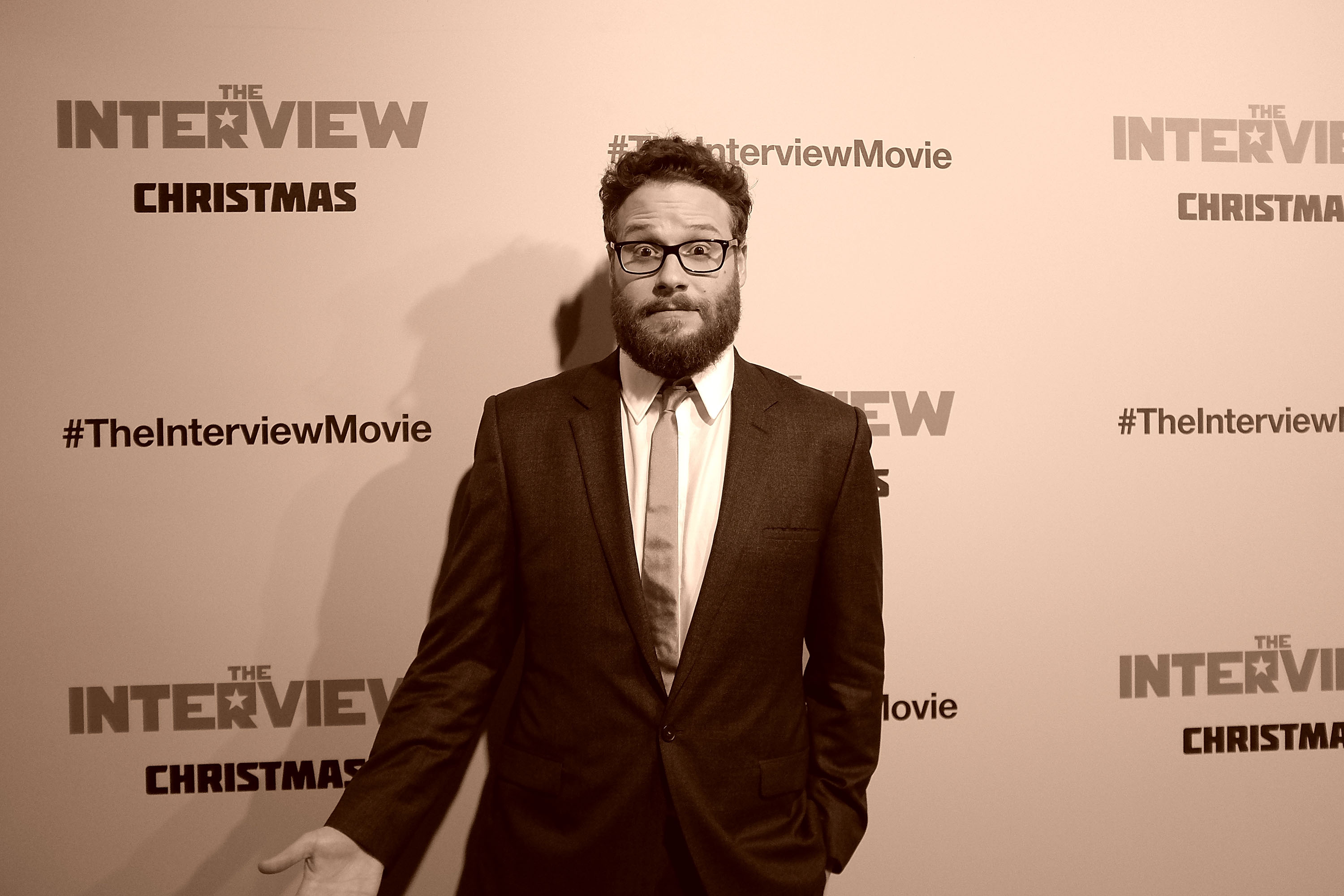
(Photo: Seth Rogen arrives at the Los Angeles premiere of ‘The Interview’ held in Downtown LA on December 11, 2014 in Los Angeles, California. By Araya Diaz/WireImage)

A Bottomless Heaping Of “Have”

by Phoebe Maltz Bovy

Reihan Salam dissects the concept of white privilege, making reference to a piece I wrote on the concept of privilege generally. He agrees with me that privilege-checking as sensitivity-signaling is silly, and I agree with him that unearned advantage is very much real. Here’s Reihan:

Even white Americans of modest means are more likely to have inherited something, in the form of housing wealth or useful professional connections, than the descendants of slaves. In his influential 2005 book When Affirmative Action Was White, Ira Katznelson recounts in fascinating detail the various ways in which the New Deal and Fair Deal social programs of the 1930s and 1940s expanded economic opportunities for whites while doing so unevenly at best for blacks, particularly in the segregated South. Many rural whites who had known nothing but the direst poverty saw their lives transformed as everything from rural electrification to generous educational benefits for veterans allowed them to build human capital, earn higher incomes, and accumulate savings. This legacy, in ways large and small, continues to enrich the children and grandchildren of the whites of that era. This is the stuff of white privilege. …

In Blurring the Color Line, CUNY Graduate Center sociologist Richard Alba argues that rapid aging of white America creates an opportunity for younger Latinos, blacks, and Asians. Even if whites want to hoard all of the most privileged jobs for themselves, they’ll have no choice but to open up competition to those with the necessary skills, regardless of race. But this process of opening things up, as WASPs did for southern and eastern European immigrants and their children in an earlier era, will go far more smoothly if we have a growing economy, which will give everyone an opportunity to climb the social ladder. If we instead have economic stagnation, we will see a fierce zero-sum contest for economic and political power, in which tribal identities—including white identity—will become more central.

I’d argue that this is exactly what we’re living through right now: If everyone’s wages were growing, and if everyone felt secure enough in their jobs to quit every now and again in search of better opportunities elsewhere, I doubt that we’d be talking quite so much about white privilege. We’d definitely talk about broken schools and mass incarceration and law enforcement policies that disproportionately damage the lives of nonwhites. Yet we might talk about these problems in a more forward-looking way, as formidable obstacles that need to be overcome by all Americans, not just guilty whites.

As I read him, what Reihan is saying is that the white-privilege conversation has emerged, paradoxically, because most white Americans – along with most non-white Americans – aren’t doing so great economically. A sense emerges that success (or just access to a living wage) is a zero-sum game. It emerges, that is, in all parts of society, except among the most entrenched of society’s haves.

There are, even in crap economic times, a handful of Americans whose central concern is that they have too much unearned comfort. Unfortunately but unsurprisingly, these are the very same people who are directing the cultural conversation about social injustice. I could get into why – journalism’s barriers to entry explain a lot – but the point, for our purposes, is that that’s how it goes. And for those already accustomed to apologizing for their very existence, further privilege-acknowledgment comes naturally. For this set, racism of resentment isn’t just worthy of condemnation (which, of course, it is; resentment explains but doesn’t excuse), but altogether baffling.

Reihan’s commenter nomoreno puts it well:

My experience is that white people who prattle on about white privilege, actually do have privilege, usually middle class, parents paid for college, hetero, etc… The problem is they think all other white people are in the same situation and are shocked that not everyone is.

As does commenter MysticWav:

I’m fine with the concept, I just hate the term. “Privilege” implies something extra to me in connotation. The proverbial silver spoon. That’s not the problem we face. Whites don’t have anything that we don’t all deserve. What we have a problem with is people that are “Disadvantaged”. Ones that don’t have the things we all deserve.

The language matters because it influences how we react to the problem and how we think about the necessary solutions. One inspires reflexive resentment from white people, the other inspires reflexive sympathy.

Indeed. The problem with the term “privilege” – both the luxe the word evokes and the manner in which it’s all too often used – is that it frames questions of justice in terms of haves graciously offering up some of their bottomless reserves of have to have-nots. It may help some posh racists change their ways, but it’s of absolutely no use in convincing anyone whose racism is one of resentment.

Bitcoin: The Next Internet?

by Dish Staff

Tim Lee believes the crypto-currency can thrive as a global payment system, even if it fails as a currency. He compares it to another innovation that proved far more influential than anyone thought it would be:

dish_bitcoinHistory suggests that open platforms like Bitcoin often become fertile soil for innovation. Think about the internet. It didn’t seem like a very practical technology in the 1980s. But it was an open platform that anyone could build on, and in the long run it proved to be really useful. The internet succeeded because Silicon Valley have created applications that harness the internet’s power while shielding users from its complexity. You don’t have to be an expert on the internet’s TCP/IP protocols to check Facebook on your iPhone.

Bitcoin applications can work the same way. There are already some Bitcoin applications that allow customers to make transactions over the Bitcoin network without being exposed to fluctuations in the value of Bitcoin’s currency. That basic model should work for a wide variety of Bitcoin-based services, allowing the Bitcoin payment network to reach a mainstream audience.

Henry Farrell is skeptical, predicting that governments would act quickly to shut down such a system if it seemed to be taking off:

Because so many international transactions are (a) settled in dollars and (b) settled across payment systems run by banks and other financial intermediaries that are vulnerable to U.S. pressure, the U.S. can use these systems to exert political control. Now, imagine the likely response of the U.S. (and the E.U., and, for that matter, China) to a payment network which is designed from the ground up to be decentralized, so that it is impossible for any specific intermediaries to really control payment flows from one actor to another. Such a network would be impossible for states to control. The U.S. wouldn’t be able to use it, for example, to squeeze Iran out of the world financial system. If such a network ever showed signs of really becoming established (rather than being a relatively small-scale thought experiment, and money suck for libertarians with more ideology than good sense), the U.S. would ruthlessly act to isolate it from the international financial system.

And that is the story of Bitcoin.

In response, Lee contends that it might be too late for that:

Bitcoin already has more powerful allies than it did two years ago. In 2014 alone, dozens of Bitcoin startups have raised money. Their backers aren’t going to stand idly by while the government destroys their investments. … The Bitcoin network probably can’t be shut down; it can only be driven underground. Doing so won’t prevent serious criminals from using it, but it will make it harder for law enforcement to track down people using the network. And Bitcoin has good applications as well as bad ones. After going before Congress and endorsing these arguments last year, it would be awkward for regulators to do an about-face and declare war on the technology.

In short, if the regulators were going to try to shut down Bitcoin, they would have done it two years ago when it was still a fringe technology with no real support among elites. Now it’s too late.

In an update to his original post, Farrell answers that Lee “seems to me to underestimate the willingness of the US and other major states to pursue their strategic interests, even if it annoys business, and the vulnerability of any payments systems to regulatory action”. Drum agrees with Farrell, stressing that China, for example, won’t give two Bitcoins about making its backers angry:

The evolution of the internet itself provides conflicting guidance as an analogy. Generally speaking, national governments have had considerable difficulty regulating internet content. It’s just too distributed and fast moving. So perhaps digital payment networks similar to Bitcoin will eventually thrive because they pose similar problems to would-be regulators. Like kudzu, they’ll simply be impossible to contain.

On the other hand, countries like China have shown that internet content can be regulated. It merely requires sufficient motivation. And even less authoritarian governments have managed to throw a lot of sand in the gears when they rouse themselves to action. Given that regulating commerce and money is easier than regulating content, this bodes ill for the future of Bitcoin. There’s not much question that it can harried into uselessness if national governments decide to do it.

(Photo by Flickr user BTC Keychain)

Obama Scraps Our Failed Cuba Policy, Ctd

by Dish Staff

Readers react to the big news:

Normalization of relations is a great and long overdue policy.  I have a question about it that I haven’t seen addressed: will it create an opportunity to close Guantanamo?

Another:

Hopefully everyone’s noticed that the Republicans opposed to normalizing relations with Cuba:

A) Have no problem with us having diplomatic relations with China, another Communist country with an even worse human rights record.

B) Are currently defending the US’ own recent human rights abuses, i.e. torture.

We all know the real reason: political posturing.  Castro stripped Cuban aristocrats of their wealth.  They fled to Florida and have been propping up anti-Castro policy ever since.  There are no principles here.

Another asks:

Lost in all the coverage is the one issue I think is the most important – will this change the absurd “Wet-foot/Dry-foot policy?

After we normalize relations with Cuba, what happens to refugees who make it to U.S. shores? Or those who overstay their (presumably soon to be issued) visas? Will they be allowed to stay and fast-tracked to attaining resident status? Or will Cuban refugees be deported like Haitians, Mexicans and others who come here illegally? I’m not saying they should. But it’s wrong to treat economic refugees from Cuba who aren’t facing imprisonment as dissidents differently than those from other nations. Anyone have an answer to this?

Another outlines “the points to make”:

1) The 50-plus years of sanctions and embargoes were failing to drive the Castros and their ilk from power.  Diplomacy such as this – with an effort to defuse tensions to where the authoritarian regime will end political harassment – is due its chance to work.

2) The outrage against a friendly posture towards Cuba by the far right, and by the anti-Castro hardliners, are going to fall on deaf ears.  Polling has shown a sizable majority of Americans, sizable majority of CUBANS (especially younger generations distanced from the passions of the Cold War era) back an end to sanctions and normalizing relations.

3) Obama’s move is honestly a very small, very minor moment in our nation’s international efforts … except somehow this move is one of the cornerstones of Obama’s administration.  Because it is one of the moves his office has done to improve our nation’s international reputation that has been damaged by the heavy-handed neocon exploitations of the Bush/Cheney years.  This move is going to go over well with our Caribbean and Central/South American allies, for starters.  And it’s been a move we SHOULD HAVE done since the fall of the Soviet Union …

While Obama’s and the nation’s reputation remains stained by the failures to bring Cheney and his ilk to trial for their torture regime, he’s at least made good faith efforts in other areas – isolating Putin over his assault on Ukraine, getting Syria to clean out MWDs, treating with Iran as part of efforts to block ISIL and the Taliban, etc. – to show the United States takes its role as a superpower serious.  This move is part of that trend.

4) Obama shouldn’t have received that Nobel Peace Prize so early in his presidency; they should have waited until moves like this to demonstrate how he’s using diplomacy the best way possible: ending hostilities, improving relations with ally and foe alike, and

This isn’t over yet, obviously.  A lot has to get resolved over the issues of reparations (property ownership seized from the 1960s for example) and human rights (end to political arrests, open local elections).  But this is a huge step.  It breaks the stalemate of embargoes that weren’t working, and it forces the political ideologues to face new realities.

Meep-meep.

Another addresses Will’s post:

I’m one of the Twitterers who posted a comment about getting to Cuba before Starbucks (in an @reply to a friend). But my comment was not intended the way you suggest, and the way that a dozen other think pieces are also suggesting. I had not forgotten that Cuba was unbelievably poor, and that their mid-century architectural/technological condition was actually the sad result of arrested economic development. I have no interest in poverty tourism.

What I meant – and what I think most people meant – was that we hoped Cuba could grow fully into a nation with their own culture, as free from American normalization as possible. It would be a shame if American developers stormed in and turned the country into just another Floridianesque suburb. That seems all too possible.

Of course, if that kind of American assistance is what’s best for Cuba, then that’s fine. I want what’s best for them. But how do you say all this in a tweet. Really.

The backlash on these comments is exactly that Illiberal Left position that you’ve been writing about on the Dish, hacking away at harmless comments for not being explicitly clear that such and such person is not being maligned. It’s pouncing on people for personal gain and satisfaction.

I’m excited and hopeful for Cuba.

What’s On Jeb’s Agenda?

by Dish Staff

Ambinder sees an opening:

Bush’s biggest opportunity corresponds to the biggest hole in the GOP platform: its radio silence on practical economic solutions for the middle class, which, it turns out, corresponds to the biggest bread-and-butter concern that Americans repeatedly chastise Washington for not addressing.

If he can move beyond supply-side economics and invent or adopt policies that directly benefit middle class voters who aren’t big savers, if he can speak to their concerns, if he can draw for us a picture for how a governing conservative president might function, then everything I’ve ever said about him — namely, that he’s a Bush and he can’t win the presidency, much less the nomination — goes out the window. If he can square THIS hexagon, and if he can get people to forget that he’s a Bush, he might be able to win both.

Republicans certainly don’t need a replay of Romney 2012, where the candidate focused too much on big macro issues like tax and entitlement reform — issues that failed to connect with voters struggling with everyday, middle-class problems. But that’s what a Bush candidacy could well look like. In an October fundraising letter for an education group he founded, Bush put forward a broad-strokes economic agenda that once again argued America needs to “radically simplify our tax and regulation structures to be fairer and more practical” and “reform our entitlement programs, which are now ballooning government beyond taxpayers’ means to pay for it.” That’s just GOP boilerplate that many voters will tune out.

But don’t fret quite yet, conservative reformers. There are still signs that Jebonomics has the potential to be smart and important. For instance, Bush also spent a lot of time in that letter discussing K-12 and higher education challenges and reform, both of which are crucial to improving middle-class fortunes. Anyone remember the Romney education plan, or him even talking much about student debt? The candidate actually had a plan, but it was a mystery to voters. Bush sounds like he could focus on these middle-class issues far more than Romney did.

America’s Pro-Torture Cult

by Dish Staff

Ambinder bets that “Cheney would still have us torturing innocents, even today”:

I can only think of Cheney now as the personification of the Cult of Terror, that September 11th, 2001 political construct that gave Americans license to act outside the stream of history instead of at its headwaters, and to suppress dissent in the name of state security. What makes this scarier, even, and why I feel justified in calling it a cult, is that it also suppresses, denigrates, and stigmatizes the moral and political foundations that it seeks to protect. It’s an American cult, because it plays to our own biases about what makes us special. It is not unique or exceptional.

Chait also examines the pro-torture mindset. He contends that “admiration for the methods used by totalitarian states is … embedded in the torture program created by the Bush administration”:

Three decades ago, right-wing French intellectual Jean-François Revel published a call to arms entitled How Democracies Perish, which quickly became a key text of the neoconservative movement and an ideological blueprint for the Reagan administration. Revel argued that the Soviet Union’s brutality and immunity from internal criticism gave it an inherent advantage over the democratic West — the United States and Europe were too liberal, too open, too humane, too soft to defeat the resolute men of the Iron Curtain.

“Unlike the Western leadership, which is tormented by remorse and a sense of guilt,” wrote Revel, “Soviet leaders’ consciences are perfectly clear, which allows them to use brute force with utter serenity both to preserve their power at home and to extend it abroad.” Even though Revel’s prediction that the Soviet Union would outlast the West was falsified within a few years, conservatives continue to tout its wisdom. And even as Revel’s name has faded further into the backdrop, recent events have revealed the continuing influence of his ideas.

The End of Serial, Part One

by Michelle Dean

Tomorrow morning will see the airing of the very last episode of Serial. At this point everyone’s spilled so much ink on the podcast you might be feeling some fatigue, but I’ll throw my own writing on the subject your way anyway. I’ve been following closely and also doing some reporting on the subreddit that became a sort of second character on the show as things moved along. It has been a strange, sad, and oddly moving to experience and observe this phenomenon. I’m still trying to figure out what to make of it all.

I’ll write more in the morning once I’ve heard the episode, but it seemed worth recording my last-Serial-eve feelings of trepidation with you. I am not expecting fireworks tomorrow. I am expecting a whimper.

I may be wrong to do so. It’s of course possible Koenig will announce that she has found evidence either that Adnan Syed is either innocent or guilty of the murder he is now in prison for. But more likely, I think, is that we’ll get a kind of meditation on how weird this whole experience has been for Koenig herself. And then she’ll sign off. And we’ll all be left looking at each other, wondering exactly what it is we’ve done by opening this whole case up to rabid public attention if there was no endgame in sight.

It may sound like I’m condemning Koenig there. I’m not. I’m oddly sympathetic to her. I don’t think she could have predicted the rabid attention this podcast got, and I especially don’t think she could have predicted that the last episode of this show would come freighted with so many feelings. Tonight has got to be a strange night of her life.

And you know, I’ve done enough of my own reporting to know that this is the way things are, if you do non-fiction. Sometimes stories don’t pan out. Life doesn’t offer happy endings. Telling stories about other people involves, all too frequently, hurting them. It most certainly involves leaving them to their own devices after you’re done reporting, to live on their lives as people who were once written about. I think most of my weird feelings amount to that, actually: what will happen to Adnan Syed now, one the white hot spotlight of national obsession leaves him?

Designing A Less Deadly Police Force

by Dish Staff

Outrage In Missouri Town After Police Shooting Of 18-Yr-Old Man

Seth Stoughton wants police training to “emphasize de-escalation and flexible tactics in a way that minimizes the need to rely on force, particularly lethal force”:

Police agencies that have emphasized de-escalation over assertive policing, such as Richmond, California, have seen a substantial decrease in officer uses of force, including lethal force, without seeing an increase in officer fatalities (there is no data on assaults). It is no surprise that the federal Department of Justice reviews de-escalation training (or the lack thereof) when it investigates police agencies for civil rights violations. More comprehensive tactical training would also help prevent unnecessary uses of force. Instead of rushing in to confront someone, officers need to be taught that it is often preferable to take an oblique approach that protects them as they gather information or make contact from a safe distance. Relatedly, as I’ve written elsewhere, a temporary retreat—what officers call a “tactical withdrawal”—can, in the right circumstances, maintain safety while offering alternatives to deadly force.

Officers must also be trained to think beyond the gun-belt.

The pepper spray, baton, Taser, and gun that are so easily accessible to officers are meant to be tools of last resort, to be used when non-violent tactics fail or aren’t an option. By changing officer training, agencies could start to shift the culture of policing away from the “frontal assault” mindset and toward an approach that emphasizes preserving the lives that officers are charged with protecting. Earlier this year, officers took just that approach in Kalamazoo, Michigan, relying on tactics and communication rather than weaponry to deal with a belligerent man carrying a rifle. As a result, a 40-minute standoff ended with a handshake, not an ambulance. The Seattle Police Department offered an even more dramatic example in 1997, when they eventually ended an 11-hour standoff with a mentally ill man wielding a samurai sword by making creative use of a fire-hose and a ladder. The suspect was apprehended with only minor bruises, and no officers were injured.

Finally, police executives need to move beyond the reflexive refusal to engage in meaningful review of police uses of force. Police may act in the heat of the moment, although not nearly as often as is commonly believed, but that should not insulate their choices from review.

(Photo: A police officer watches over demonstrators in Ferguson, Missouri protesting the shooting death of teenager Michael Brown on August 13, 2014. By Scott Olson/Getty Images)

An Alternative To “No”?

by Dish Staff

In a recent meditation on the language of consent, which featured in one of the Dish’s roundups on the UVA rape debacle last week, Susan Dominus searched for a “linguistic rip cord” to help young women reject unwanted sex “without the mundane familiarity of ‘no’ or the intensity demanded in ‘Get off or I’ll scream'”:

One phrase that might work is “red zone” — as in, “Hey, we’re in a red zone,” or “This is starting to feel too red zone.” Descriptive and matter-of-fact, it would not implicitly assign aggressor and victim, but would flatly convey that danger — emotional, possibly legal — lay ahead. Such a phrase could serve as a linguistic proxy for confronting or demanding, both options that can seem impossible in the moment. “We’re in a red zone” — the person who utters that is not a supplicant (“Please stop”); or an accuser (“I told you to stop!”). Many young women are uncomfortable in either of those roles; I know I was.

In an ideal world, clear consent will always precede sex, and young women (and men) who do find themselves in a tricky situation will express their discomfort firmly. But in the imperfect world in which we live, new language — if not red zone, then some other phrase that could take off with the universality of slang — might fill a silence.

But McArdle pours cold water on the idea:

I understand what Dominus is trying to do, but I don’t think it will work.

Twenty-five years after I registered for college, we’re still searching for an alternative to the stark simplicity of “No.”  And unfortunately, there’s just no substitute. If you want to “teach men not to rape” — a formulation that floated around the Internet a lot in the days after the Rolling Stone story was published — then you need to give them a rule that can be clearly articulated, and followed even if you’ve had a few.

That’s why “no means no” worked so well, even if it wasn’t perfect. It’s a heuristic that even a guy who’s been sucking at the end of a three-story beer funnel can remember and put into practice. The rule obviously needed some refinement, by adding other equally clear rules — like “if she’s stumbling drunk or vomiting, just pretend she said no, because she’s not legally capable of consent.” But the basic idea, of listening to what the woman is saying, not some super-secret countersignals you might think she is sending, is exactly the sort of rule that we need in the often-confusing, choose-your-own-adventure world of modern sexual mores.

Men (No Longer) At Work

by Dish Staff

Screen Shot 2014-12-16 at 5.33.21 PM

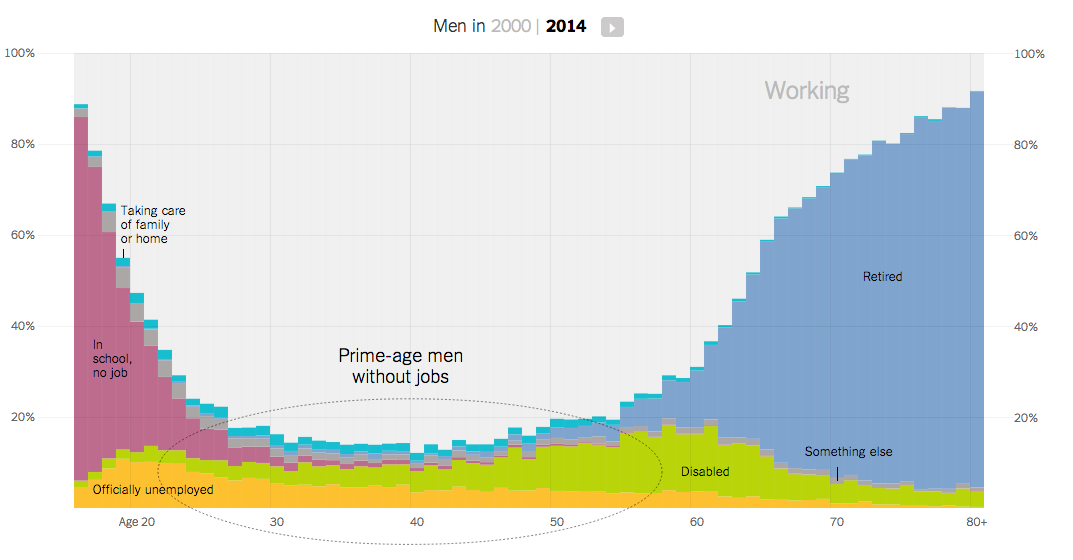
Binyamin Appelbaum looks into the causes of the decline in America’s male work force:

Working, in America, is in decline. The share of prime-age men — those 25 to 54 years old — who are not working has more than tripled since the late 1960s, to 16 percent. … Many men, in particular, have decided that low-wage work will not improve their lives, in part because deep changes in American society have made it easier for them to live without working. These changes include the availability of federal disability benefits; the decline of marriage, which means fewer men provide for children; and the rise of the Internet, which has reduced the isolation of unemployment. …

The resulting absence of millions of potential workers has serious consequences not just for the men and their families but for the nation as a whole. A smaller work force is likely to lead to a slower-growing economy, and will leave a smaller share of the population to cover the cost of government, even as a larger share seeks help. “They’re not working, because it’s not paying them enough to work,” said Alan B. Krueger, a leading labor economist and a professor at Princeton. “And that means the economy is going to be smaller than it otherwise would be.”

At the same time, Amanda Cox points out, many older men are postponing retirement:

The decline of traditional pension plans and rising education levels, which are associated with less physically demanding jobs, may both help explain why the elderly are working longer. The full retirement age for Social Security benefits also began gradually increasing in 2000.

Some countries have developed policies that encourage older people to leave the labor force, so they do not “crowd out” younger workers. But studies across countries and time suggest that crowding-out may not actually be a problem. Economies do not appear to have a fixed number of jobs. When more older people are working, they are earning money that they will then spend in ways that may create more jobs for young people, for example. Even if this is the case, though, the rise of elderly employment in recent years has not provided enough of a lift to put more young people back to work.

Derek Thompson suspects that more is at play here than employment, suggesting that the American male is having a full-on identity crisis:

Looking to the future, one aspect of the decline of work that might not receive enough attention is identity. If the future of work isn’t quite biased against men, it certainly seemed biased against the traditional idea of manliness. Construction and manufacturing, two male-dominated industries, are down 3 million jobs since 2008. Most of those jobs are dead, forever. Meanwhile, the only occupations expected to add more than 100,000 jobs in the next decade are personal care aides, home health aides, medical secretaries, and marketing specialists, all of which are currently majority female. …

The economy is not simply leaving men behind. It is leaving manliness behind. Machines are replacing the brawn that powered the 20th century economy, clearing way for work that requires a softer human touch.