The Life Cycles Of Language

Joe Mac Donnacha offers a sober assessment of Irish as a “living” language:

In sociolinguistic terms, a language can be defined as living if it meets two criteria. First, it should be the dominant (but not necessarily the only) language in most or all of the social networks that make up a community. Second, the community of individuals who speak it as their dominant language must be capable of regenerating themselves as a “language community” – in other words, they must be a sustainable community in terms of both their demographic regeneration and the intergenerational transmission of their language.

On both of these criteria the Irish language is no longer a living language. It has not gained new dominance in the combined social networks of any community outside the Gaeltacht since the formation of the state, and since the late 1960s it has been losing its dominance in what were the Irish-language communities of the Gaeltacht. It is clear from the current research that though most of these communities have been able to regenerate themselves demographically since the early 1970s … they have been finding it increasingly difficult to regenerate themselves linguistically. What we are now seeing in the Gaeltacht, therefore, are the final throes of Irish as a living language.

But not all language is lost; Cal Flyn has good news for Gaelic speakers in Scotland:

The 1991 census showed a drop of more than 20 per cent [of Gaelic speakers] in a single decade. By 2001 the number had fallen another 11 per cent, to just 59,000. Gaelic speakers were ageing, then dying, and their language was dying with them. When the latest figures were released in September, naysayers were preparing to sound the knell. But the new total (58,000) had barely dipped and closer inspection revealed new growth: in every age group under the age of 20, there had been a rise.

There is a Gaelic revival under way. Increasing numbers of parents – even those who don’t speak the language – are opting to send their children to Gaelic-medium schools, where all subjects are taught in the language. In 1985 there were only 24 primary school children being taught in Gaelic; last year the figure was 2,953. Sixty-one schools across Scotland now offer Gaelic-medium education. The expectation is that, as time passes, these young Gaels will revitalise a language that is intricately tied up with their country’s identity.

Is Obama Naive?

President Obama Meets With Israeli Prime Minister Netanyahu At The White House

Leon Wieseltier – surprise! – blames Obama’s rationality and his belief that others share it for blinding him to the ambitions of Putin’s Russia:

The lack of preparedness at the White House was not merely a weakness of policy but also a weakness of worldview. The president is too often caught off guard by enmity, and by the nastiness of things. There really is no excuse for being surprised by evil. There is also no excuse for projecting one’s good intentions, one’s commitment to reason, one’s optimism about history, upon other individuals and other societies and other countries: narcissism is the enemy of empiricism, and we must perceive differences and threats empirically, lucidly, not with disbelief but with resolve. “Our opinions do not coincide,” Putin said after meeting with Obama last year. The sentence reverberates. That lack of coincidence is now a fact of enormous geopolitical significance.

But opinions don’t coincide with almost all geo-political adversaries and even allies. That doesn’t mean that some common ground on the question of shared interests cannot also be reached, even as one retains no illusions about the underlying conflict. Rich Lowry shakes his head at the administration, which he says should have learned from the Bush era that Putin was not to be trusted:

Of all President George W. Bush’s failings, not giving the Russians a chance wasn’t one of them. He notoriously looked into the eyes of Russian resident Vladimir Putin at the beginning of his presidency and saw sweetness and light. His illusions were shattered by the end, with the Russian invasion of Georgia in 2008.

Larison counters Lowry’s whitewashing of Bush’s Russia policy:

It is not possible to understand Russian behavior over the last ten years without acknowledging the extent to which U.S.-Russian relations were wrecked by several Western policies, chief among them being Bush’s push for missile defense in eastern Europe and NATO expansion into the former USSR. If the Bush administration suffered from any illusions, it was that the U.S. could consistently goad and provoke Russia in its own region without consequences. By the end of Bush’s second term, that illusion was dispelled, and it was in order to repair the substantial damage that had been done in the previous five or six years that the U.S. successfully sought to find common interests with Russia.

Chait takes a broader look at Obama’s foreign policy. He argues, contra Fred Kaplan, that Obama isn’t a realist:

The Libya example alone cracks apart the case – no Realist would ever have committed American military power to save civilians in the service of a social revolution obviously unsettling to American interests.

The reason Obama has had liberal humanitarians like Power and Susan Rice on his foreign policy staff since his campaign, and throughout his presidency, is that he shares their ideological goals within the limits of what is practically attainable. Obviously, Obama is no George W. Bush. On the other hand, nobody else is George W. Bush, either. Most American presidents fall somewhere on the continuum between Bushian crusading moralism and Nixonian ruthlessness. Obama does, too.

Chait is right, it seems to me, on the broad level. And yet Libya remains more of an exception than a rule. And Obama seems to have learned from its unintended consequences just how dangerous liberal internationalist impulses can be.

(Photo: Israel Prime Minister Benjamin Netanyahu sits with U.S. President Barack Obama during a meeting in the Oval Office of the White House March 3, 2014 in Washington, D.C. Obama urged Netanyahu to ‘seize the moment’ to make peace, saying time is running out of time to negotiate an Israeli-Palestinian agreement. By Andrew Harrer-Pool/Getty Images.)

A Grave Concern

Charles Simic recalls a business scheme for a new kind of gravestone dreamed up by the poet Mark Strand when he was down and out:

It would include, in addition to the usual name, date, and epitaph, a slot where a coin could be inserted, that would activate a tape machine built into it, and play the deceased’s favorite songs, jokes, passages from scriptures, quotes by great men and speeches addressed to their fellow citizens, and whatever else they find worthy of preserving for posterity. … One of the benefits of this invention, as [Strand] saw it, is that it would transform these notoriously gloomy and desolate places by attracting big crowds—not just of the relatives and acquaintances of the deceased, but also complete strangers seeking entertainment and the pearls of wisdom and musical selections of hundreds and hundreds of unknown men and women.

Simic continues:

While this invention may strike one as frivolous and irreverent, in my view it deals with a serious problem.

What happens to everything we kept in our heads and hoped others would find amusing after we pass away? No trace of them will be left, unless, of course, we write them down. Even that is not a guarantee. Libraries, both private and public, are full of books no one reads any more. Anyone who frequents town dumps has seen yellowed manuscripts and letters thrown out with the trash—papers that sadly, but unmistakably, not even the family of their author wants. Just imagine that Strand’s dream had come true and your dead grandmother is a big hit in some large urban cemetery, passing on her soup and pie recipes to an admiring crowd of young housewives; while your grandpa is telling dirty jokes to boys playing hooky from school. Given their immense local fame, you, too, are regarded with interest by your friends and neighbors, who can’t help but wonder how your everlasting selection is coming along and what inspiring words and vile blasphemies they’ll be hearing from your gravestone.

Down With The Upskirt

On Wednesday, the Massachusetts court ruled that the state had no laws barring someone from taking a photo up a woman’s skirt. Meghan DeMaria notes the court’s judgment that those women were not “completely or partially undressed”:

If you’re wearing Spanx, a thong, or other undergarments that could constitute being “partially nude” beneath your skirt, you’re entitled to legal protection, but women who favor granny panties are out of luck. Good to know.

Doug Mataconis defends the court’s reasoning:

I agree generally with the principle that something like this should be against the law, but it seems to me that the Court was correct on the law here. As a general principle, people can only be convicted of a crime when they’ve actually committed an illegal act that is specifically defined in the law and, in this case, what Robinson was accused and convicted of did not comport with the statute under which he was charged. If the legislators in Massachusetts want to prevent this from happening again, they simply need to rewrite the law to cover the activities that Robinson was accused of committing.

In response to the case, the legislature quickly passed a bill to ban such behavior. The governor signed it this morning. Nichi Hodgson wonders if it will have any effect:

[S]omething tells me we won’t be seeing a wave of prosecutions any time soon – at least not if the backlog of domestic violence, rape and restraining order cases are anything to go by. California, the only US state to institute a revenge porn law, did make two major prosecutions since it passed a law in October, but only time will tell as to whether that was merely a PR flurry.

Hanna Rosin follows through on the revenge porn comparison:

Upskirting is like an anonymous version of “revenge porn,” the practice of posting your girlfriend’s naked pictures online if you’re pissed at her. Upskirting, by contrast, is more passive and generally not directed at any one woman in particular. Air marshals do it. Commuters do it. Players do it, like this one who posted on an upskirting site:

I’ve been upskirting chicks, mostly at clubs, for almost two years. The club I go to is a great spot, real crowded, strobe lights going, loud music, so no one notices me sitting near the edge of the dance floor and if a woman in a skirt ends up by me I stick the cam under and snap.

Now even if this douche moved to a state where upskirting was illegal, it would still be perfectly legal in most states for him to post online all the pictures he already has on his cellphone, according to Danielle Citron, a law professor who supports the effort to make revenge porn illegal. In her forthcoming book, Hate Crimes in Cyberspace, Citron documents the way women’s lives can be ruined when someone posts a nude picture of them online that co-workers or employers or anyone else can easily look up. (One of the women she profiles had to change her name.)

How To Spot A Winner

It’s all in the body language. Christian Jarrett surveys a study that explored whether people pick up on losing athletes’ submissive body language without knowing the score (the above clip is a sample from the study):

The researchers showed adult and child participants dozens of silent, three-second clips of winning and losing athletes in table tennis, basketball and handball, and tested whether the observers could tell, based purely on “thin slices” of non-verbal body language, whether each athlete was winning or losing, and by how much (from “far behind” to “high lead”). The clips were taken from the breaks between play. Scores were concealed. And any clips containing explicit emotion, such as shame or pride, were omitted. … The researchers found high levels of accuracy, among young children (aged 4 to 8), older children (age 9 to 12), and adults. That is, the participants’ estimates of whether an athlete was losing or winning, and by how much, tended to correlate with the actual situation, as measured by the (hidden) score at that stage in the contest.

Jarrett considers the implications:

Assuming the main finding is accurate – that athlete’s express clear submissive signals when they’re losing – this will surely be of interest to sports psychologists and athletes looking for a competitive edge. Exhibiting submissive non-verbal behaviours could be “highly dysfunctional”, the researchers said, encouraging an opponent to increase pressure. “What makes sense for a primate losing a fight may lead to exacerbating the downward spiral for athletes on the losing side.” This suggests learning to mask submissive body language could be highly advantageous, something Roger Federer and other cool champions appear to have mastered already.

Getty Gets The Internet

Megan Garber explains the photo agency’s decision to make 35 million of its photos freely embeddable for non-commercial use:

It’s important to note that, while many millions of Getty images are now available for embed, not all Getty images are. And there seems to be a fairly significant split, from what I can tell, between stock images and photojournalism images when it comes to embeddability. So do a search for “Ukraine,” and you”ll get lots of photos … but that one of John Kerry shaking hands with Sergei Lavrov in Rome yesterday? Nope, not embeddable. …

That distinction is important; it emphasizes, among other things, the bet that Getty is making by opening this new revenue stream. News outlets, after all, will always need news photos. Keeping the newsy stuff out of the “free photo” pool allows Getty to preserve its value for its already-paying digital subscribers, while the embed system could be a way to capture some value from The Rogues. This is Getty attempting to have its cake, and eat it, too.

The Dish has paid for Getty images for many years now, both within larger media companies and into its independence, and we couldn’t be more satisfied with their service and quality. A special thanks to Stephen Hanley for shepherding our account through the stressful period of setting up our own site and company last year. Meanwhile, Pat David points to some downsides of Getty’s new feature:

First of all, the embed tool generates an <iframe> element to show the image.  For anyone not in the know, it is basically creating a frame in the web page that will load whatever Getty wants inside of it, not just the image requested (more on that in a moment). While not necessarily a problem in and of itself, it does present a problem for possibilities of link-rot across the Internet.  If for any reason Getty decides it no longer wants to serve its images in this way (and it’s absolutely within their right to do so), then every site that used these images will now have a dead space where the image used to be… or worse.

Some photographers are not happy about the change:

“It’s going to put people out of work, without the shadow of a doubt,” Jeff Moore, chairman of the British Press Photographers’ Association, told trade magazine BJP. “The first ones to fall will be small and independent freelancers and smaller agencies that are relying on small Internet sales.” [Picfair founder Benji] Lanyado agrees, and has written an open letter to photographers in the wake of the deal, warning them to be wary of middlemen like Getty.

“Getty was one of the big agencies that was helping the creative industry in trying to make the internet work, making it pay, and they decided to go into the opposite direction,” Moore continued. “This is a massively cynical move from Getty.”

And it’s not the only move the agency is making, either:

While Getty is opening up to small users, it is also escalating enforcement against commercial infringers. After years of not filing lawsuits against infringers in spite of blustery demand letters, Getty suddenly filed five suits this January. Where there is a carrot, there is often a stick. … I suspect these two policy changes are not concurrent by accident. Getty has the same frustratingly persistent infringement problems that plague all online content creators. By granting the little fish a pass, they free up resources to more effectively counter the rule-breaking sharks. I would not want to be one of Getty Image’s corporate infringers in 2014.

No, We Can’t Wreck Russia’s Economy, Ctd

Walter Russell Mead rejects the premise that the US or even the EU can pressure Putin economically:

Putin does not worry nearly as much about the Russian stock market as western leaders worry about financial markets in their own countries. Putin broke the oligarchs as a political force years ago; in Russia, corporations exist to serve the state and not the other way round. He is not worried that business leaders will lose confidence in him; in Putin’s Russia, it is business leaders who worry about losing the trust of the country’s political master.

As for banking crackdowns and visa limits, it will help Putin, not hurt him, if powerful Russians are unable to leave the country or move their money around in the West. One of his worries is that various oligarchs and power brokers can put enough money in the west to be able to get out from under his thumb. He would like all of his backers to be dependent on him for continued enjoyment of wealth and property. If the West wants to fence his backers in, so be it. (If the west goes after Putin’s own golden horde of ill-gotten simoleons, estimated by many to be north of $50 billion, the calculation might change.)

Daniel Berman notes that, for the governments of the UK and Germany, an economic war with Russia would be political suicide:

Both the UK Conservative Party of David Cameron and the German Christian Democrats under Angela Merkel have staked their political legitimacy on a particular vision of austerity and the belief that this austerity can bring economic growth, the former to Britain, the latter to the Eurozone as a whole. In particular Merkel has enforced her vision of belt-tightening not just on Germany, but on much of the EU including Greece and Italy. In return the results achieved by both governments have been mixed. The UK is growing again, but only at a rate of about 2.4%, with Germany a bit lower.

That number is critical. Sanctions would almost certainly hurt, likely to the tune of a. 8% haircut in GDP growth over the next year, especially without extensive stimulus spending. Critically however either option would destroy the legitimacy of the governments implementing them. A Keynesian approach would make a mockery of the policies followed hitherto and lead to resentment against Germany, while allowing that sort of haircut would eliminate the limited growth both economies have achieved. In the UK it would discredit Chancellor George Osborne, and almost certainly lead the Tories, already substantial underdogs for 2015, to their doom.

Jordan Weissmann investigates the idea of fighting Russia with natural gas exports:

“You hear these calls for us to ship gas to Europe,” [energy security expert Michael Levi] said. “We do not ship gas to anyone. Private companies ship gas. And Europe doesn’t buy gas. Private companies in Europe buy gas. The reality is that North American natural gas is not going to be attractively priced for most European companies. You can approve all the terminals you want. You still aren’t going to get any American companies to lose money pursuing geopolitical objectives.”

Danny Vinik calls out Republicans for blocking IMF reforms that would allow Ukraine to borrow the money it needs:

The reforms would allow Ukraine to borrow approximately 60 percent more (from $1 billion to $1.6 billion) from the IMF’s emergency fund. That’s money that Ukraine can use to pay off its debts and avoid a default. In certain scenarios, the IMF makes exceptions and allows countries to access additional funds, as it did with Greece and Ireland after the financial crisis. But there’s no guarantee it would do so with Ukraine. By blocking the passage of the IMF reforms, Republicans are actively making it harder for Ukraine to pay back its loans.

The U.S.’s refusal to pass the reforms—which 130 countries have already approved—only hurts our credibility. Given the broad constituency of nations that want to help Ukraine, this won’t stop the IMF from offering a loan. But it’s a bit rich for the U.S. to call for IMF help when it refuses to pass basic reforms that would have no material effect on the United States and that most of the world has already approved.

Previous Dish on sanctions here and here.

Does Vaping Lead To Smoking?

Meghan Neal flags a new study finding “that vaping makes adolescents more likely to start or continue smoking tobacco, and less likely to manage to quit”:

That’s after surveying 40,000 middle and high school students, first in 2011 and then again in 2012 to follow up. Researchers at the University of California San Francisco parsed the data and published their grim results in the journal JAMA Pediatrics [yesterday].

Highly publicized research claiming that e-smoking gets teenagers addicted to cigarettes deals a tough blow to e-cig advocates, who strongly believe that puffing on vaporized liquid is a healthier choice than inhaling burning tobacco, and that making the switch from analog to digital cigs can help wean smokers off the habit.

Sullum takes issue with the study:

Even if we knew that some people start with vaping and move on to smoking, that would not necessarily mean that e-cigarettes made them more likely to smoke. We still would not know what would have happened in the absence of e-cigarettes. Would those same people have started smoking anyway, or did the experience of vaping somehow prime them to like a habit that otherwise would not have attracted them? The same sort of question comes up in discussions of marijuana’s purported role as a “gateway” to other drugs. In both cases, symbolism and emotion seem to carry more weight than evidence and logic.

Has The World Never Changed?

I understand that’s a ridiculously broad question, but it arises from a ridiculously broad analysis:

Obama says Putin is on the wrong side of history and Secretary of State John Kerry says Putin’s is “really 19th-century behavior in the 21st century.” This must mean that seeking national power, territory, dominion — the driving impulse of nations since Thucydides — is obsolete. As if a calendar change caused a revolution in human nature that transformed the international arena from a Hobbesian struggle for power into a gentleman’s club where violations of territorial integrity just don’t happen.

Is it possible things are just a little bit more complicated than that? It could be that the impulse for national power, territory, dominion is now not obsolete, but simply much more attenuated now than it once was (and that argument is easily compatible with Kerry’s phrase). And the case for that is pretty strong. I mean: if nations have one driving impulse – “seeking national power, territory, dominion” – and if the record shows no change or evolution in this eternal truth, how do we explain huge tranches of recent history?
war2012Why on earth, for example, would European countries pool sovereignty in the EU? How could they be deluded into thinking that giving up “national power” could be a good thing? And why, for that matter, would this arrangement remain attractive to other countries as well, not least of which Ukraine? Why on earth did the US invade and conquer Iraq only to leave it a decade later? Why did we not seize the oil-fields with our military might to fuel our economy? What was Krauthammer’s hero, George W Bush, doing – singing hymns to human freedom rather than American hegemony?

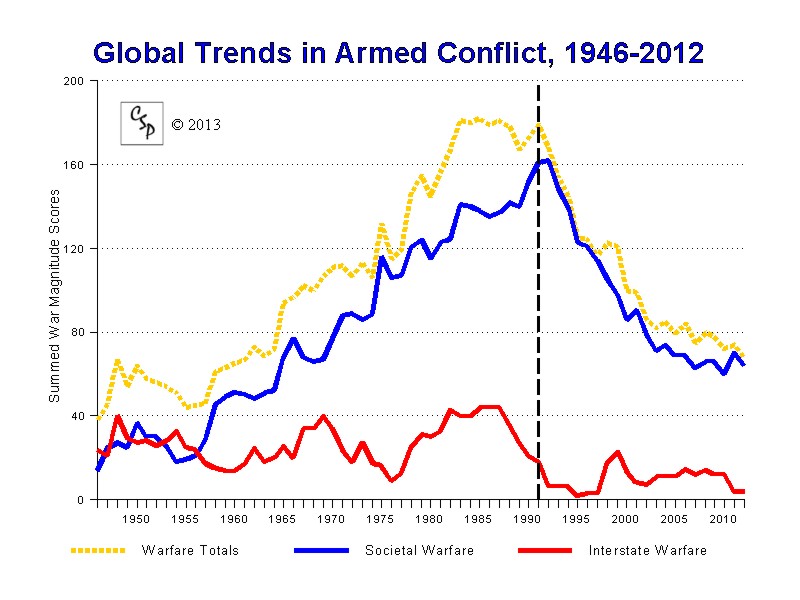
Why, for that matter, have military incursions into other countries become rarer over time? Why has the level of inter-state violence in human affairs declined to historically low levels?

The answers to that question are, of course, legion, and I’m not trying to settle the debate here. I’m just noting that if the classic aims of territory acquisition and dominion never change, Krauthammer has a lot of explaining to do.

Even with Putin, I think it’s worth noting that his current Tsarist mojo is not exactly triumphalist. Krauthammer concedes as much:

Crimea belonged to Moscow for 200 years. Russia conquered it 20 years before the U.S. acquired Louisiana. Lost it in the humiliation of the 1990s. Putin got it back in about three days without firing a shot.

So this is less like Hitlerian aggression and more like a sad attempt to re-seize one tiny portion that was part of Russia proper far longer than it was “lost”. More to the point, Putin “got it back” only in the wake of Ukraine deposing its democratically-elected, Russophile leader in a violent, popular putsch. Yes, if your contention is that the desire for territory/dominion/power is “obsolete,” you’re a fool. But if your contention is that this impulse plays a much less critical role in international affairs than in almost all previous periods in human history, you’d be merely making an empirical observation.

The truth is that global interdependence – the immensely complex and proliferating global economy that vastly expanded as communism collapsed under the weight of its own lies – clearly mitigates the classic impulse that Krauthammer approves of. It doesn’t abolish it – but it shapes it.

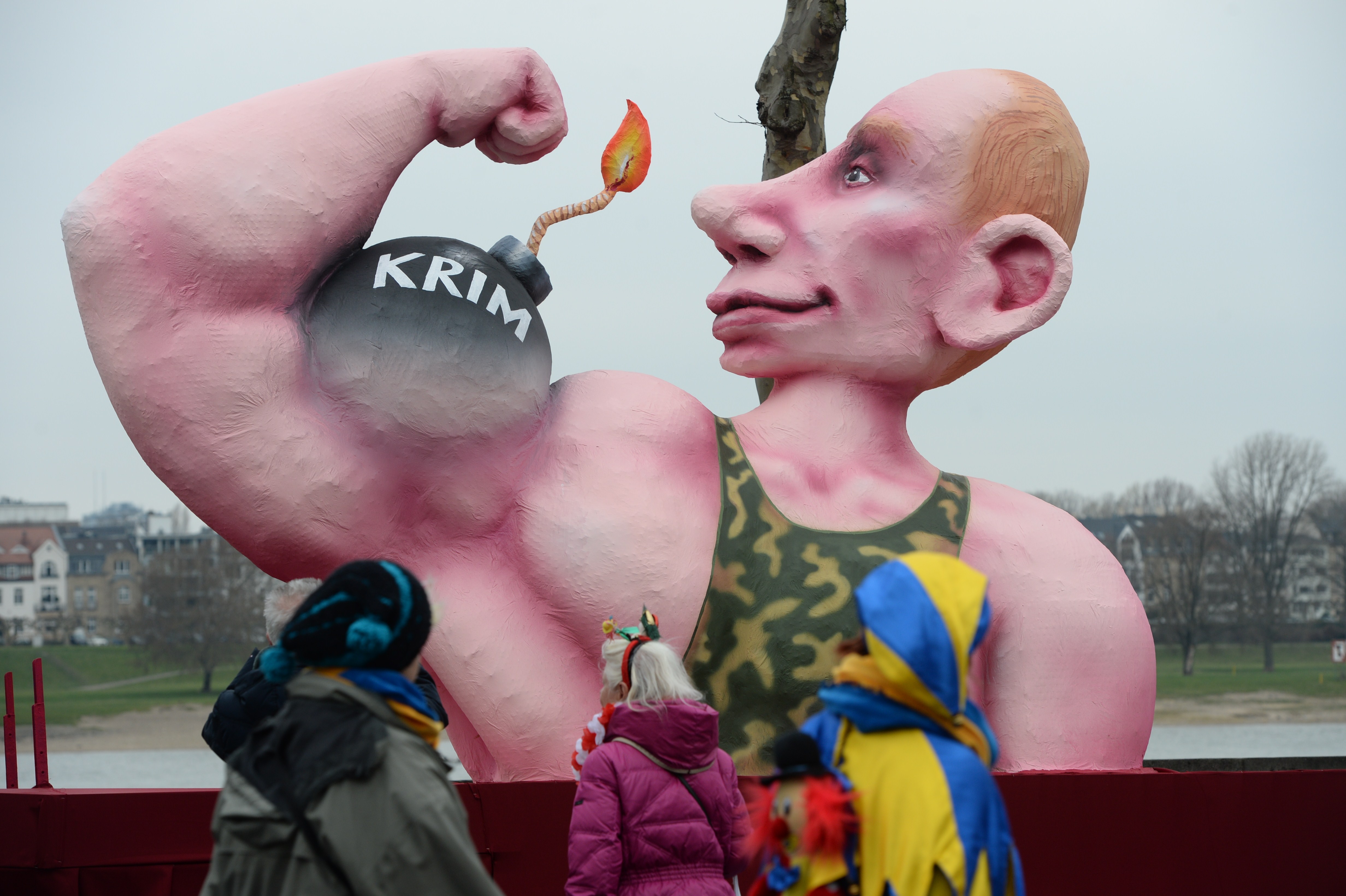
One reason we won’t see major armed conflict over Ukraine, for example, is because the Germans and Brits have too much to lose in terms of their economies – and Russia does too. In the end, economic power is the basis for military power. Economic power, in the global capitalist economy, is also related to soft power, to where human capital wants to go, and where money wants to flow. Becoming a global pariah is not GERMANY-CARNIVAL-ROSE-MONDAY-STREET-PARADEgood for that kind of thing – and it has a direct relationship to power as a whole. And one reason why Putin’s attempt to coerce Ukraine is not as win-win as Krauthammer suggests is that controlling and occupying countries by brute force is much more difficult than it used to be. The most advanced military machine in history occupied Iraq for a decade and lost. Ditto Afghanistan – for both the Soviets and the Americans. Ditto, for that matter, the Israelis on the West Bank. In each case, the occupying power’s cost-benefit analysis looks weaker than ever. And if Putin attempts to invade or annex Crimea, his headaches are sure to become even worse, as he manages Russia’s steep decline by beginning an armed conflict within what used to be the Soviet Union’s undisputed territory.

Then there is the simple matter of collective memory. For many Americans and for Krauthammer, the key referent is the Second World War which America won with almost none of the devastating trauma experienced by Germany, Britain or the Soviet Union. But in Germany and Britain right now, the collective memory is much more indelibly that of the Great War, where small matters of territory – like Crimea – metastasized through miscalculation into a generational catastrophe. Hence the resilience of the EU, even as it seems to cripple the economies of its weaker members through punishing austerity. Hence also, of course, the survival of the UN and the countless instruments of collective security we’ve built in its wake.
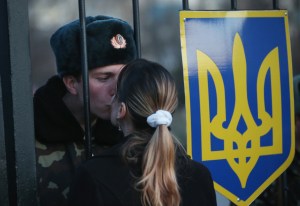
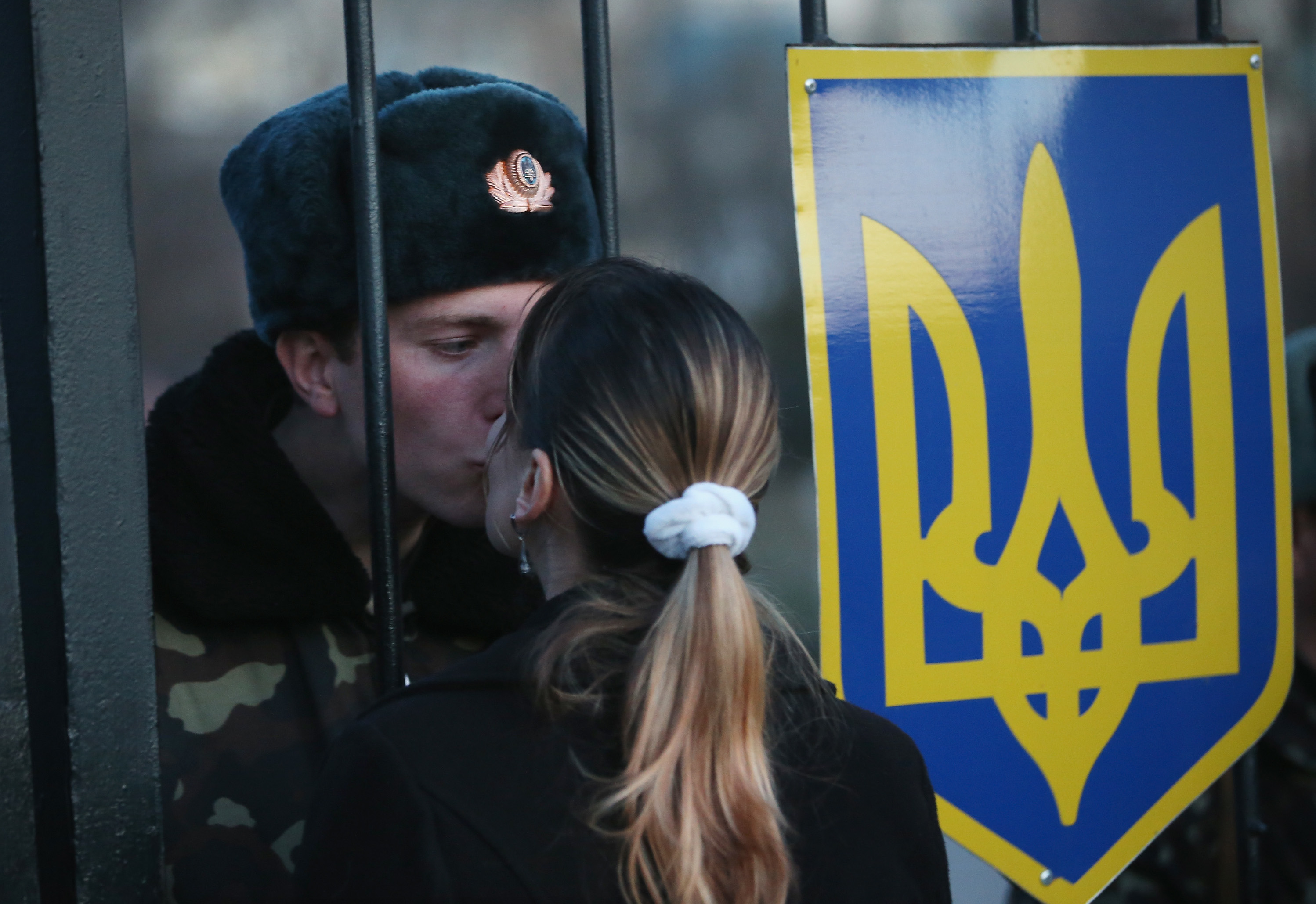
Concerns Grow In Ukraine Over Pro Russian Demonstrations In The Crimea RegionIn other words, power rests on money; and money rests on the global economy. Russia is able right now to get away with its somewhat lame attempt to annex Crimea because its core economy is so primitive and petro-based. But even then, its potential vulnerability to economic retaliation – through global trade and travel and finance – makes this a mug’s game at some point.

Putin, of course, may not see it this way. And understanding that is critical to dealing with him. But that means, in Merkel’s alleged phrase, that he is in “another world.” That may be disastrous, of course, when you’re running an autocracy with nukes. But in the real world, he is misreading his country’s and his own actual interests. In the real world, the invasion and occupation of Iraq was a huge defeat for the US. In the real world, permanently occupying the West Bank is national suicide. And in that sense, Putin is not a symbol of the world order reverting to its eternal nineteenth century dynamic. He is a symbol, in fact, of how that dynamic has ended, and how attempts to restart it are unlikely to result in the glorious military victories some still seem so eager to celebrate.

(Chart from systemicpeace.org. Photos from Getty)

Meanwhile, In Kiev …

John O’Sullivan is impressed at how the new Ukrainian government has pulled itself together amid Putin’s provocations:

[I]t has maintained a lively democratic unity; passed a series of reforms leading to a more liberal constitution, fresh elections and a new government; discussed these proposals with great transparency (its parliamentary proceedings are televised); won over the main oligarchs, who prefer even a Kiev regime hostile to corruption to a Putin-esque world in which the government is a rival oligarch; and responded firmly but not rashly to Russia’s invasion of Crimea and other provocations.

It has, accordingly, been accepted as legitimate throughout most of Ukraine even before the elections. Attacks on its supporters, attempts to seize official buildings, demonstrations by crowds calling for Russian intervention there have been seen in some eastern cities, but on a smaller scale than most experts predicted. Most Russophone Ukrainians seem to support Kiev — which suggests that a distinctly Ukrainian nationalism has spread eastwards in the past 20 years. And when they switched sides, the oligarchs ensured that much political and public opinion switched sides, too.

All of which means that there is simply not enough disorder and anarchy in Ukraine to provide [Putin] a pretext for any further incursion.

“Calm,” Massie adds, “even of a relative and tense kind, is Russia’s enemy”:

Perhaps Moscow will gain the Crimea but only, at least for now, at the expense of its own long-term ambitions in its near abroad. Indeed Moscow’s aggression may prove counter-productive, effectively ensuring Russia cannot achieve its own goals. Heckuva job, Vladimir.

If the east were to rise, best it rose quickly. But it has not risen and time is not on Russia’s side. Each day that passes without a fresh confrontation is time Moscow loses – time, too, that it can scarcely afford to lose. Time is Moscow’s enemy and Kiev’s friend. Even in the spring. If Russia was to bring Ukraine back into the fold it needed to do so quickly by winning a swift victory in decisive, indisputable, fashion.

Anna Nemtsova reports that the invasion is swelling the ranks of Ukraine’s nationalist militias:

[T]his week marked another transformation for the Maidan: Never before have they been as anti-Putin as they are now. From Monday night to Tuesday morning, after Russia’s threat, hundreds of volunteer recruits arrived on the Maidan and at other militia headquarters throughout Kiev, determined to join the impending fight against Russian forces. These well-organized and well-trained armies are independent from the new leadership. The nationalist armies, including Right Sector and White Hammer, are seen as the heroes of the Maidan — but they are critical of the new leadership. They told me they hate Yulia Tymoshenko and her allies who are now running the new government. But Putin’s threat of invasion brought these groups closer together again. On the Maidan, demonstrators chanted “Putin het! Putin het!” (or “Putin Out!” in Ukrainian) in the capital’s streets and squares. Signs reading “Putin, calm down!” and caricatures casting the Russian president as Adolf Hitler appeared all over the square: tacked onto piles of tires, on soot-covered barricades, on the nylon tents that have housed protesters for months.