“The Likeliest Republican Nominee”

Cillizza thinks it’s Rand Paul because “the establishment conservative field is packed with potential candidates while the movement conservative field is relatively sparse”:

Simply put, Paul is more likely to emerge victorious from the movement conservative primary than any of the potential candidates seeking the establishment conservative banner. At the start of the year, we would have said Christie would have had a leg up in that establishment primary — and hence an edge to be the nominee since the party’s pick traditionally comes from the establishment wing. But Christie’s struggles to get out from under the lane closures scandal that reaches high into his administration has reduced him to just another member of the pack. Walker and Kasich both have the potential to break out but first need to get by real reelection races this fall. Jeb Bush would quite clearly be the establishment frontrunner if he ran but no one has any idea if he wants to or will. Ditto Paul Ryan. And, while Jindal seems to be gaining a bit of steam, he remains second tier in this group.

But Weigel thinks the senator is overrated as a candidate:

As long as Paul’s in the Senate, as long as he’s a fascinating, quotable, and potentially successful libertarian iconoclast, stories about his associations and his movement will be relegated to the think-piece pile. If he’s a credible presidential candidate? The jackals run loose, and they know where to hunt. Years of experience and evidence tell us that Paul can be rattled by that. His potential opponents know this.

Henry Olsen points out that movement conservative candidates usually don’t appeal to the crucial “somewhat conservative” subset of Republicans:

This group is the most numerous nationally and in most states, comprising 35–40 percent of the national GOP electorate. While the numbers of moderates, very conservative and evangelical voters vary significantly by state, somewhat conservative voters are found in similar proportions in every state. They are not very vocal, but they form the bedrock base of the Republican Party.

They also have a significant distinction: they always back the winner. The candidate who garners their favor has won each of the last four open races. This tendency runs down to the state level as well. Look at the exit polls from virtually any state caucus or primary since 1996 and you will find that the winner received a plurality of or ran roughly even among the somewhat conservative voters.
Apathetic Atheism vs New Atheism, Ctd

A reader sighs:

Wow. These last few letters get to the heart I think of what drives so many of us non-believers crazy. Here we have Christians telling an atheist that he should make a mockery of the priest’s exhortation by essentially lying in a house of worship. Then we have another insinuating that non-believers aren’t welcome at church. I would remind those readers that it wasn’t the atheist who couldn’t handle the call for affirmation; it was the family who couldn’t handle his respectful honesty. The right answer here isn’t for the priest to change his tradition nor for the atheist to stay home or pretend he’s something he’s not. The right answer is for Christians like this reader’s in-laws to grow up and realize that atheists are everywhere, they’re not boogeymen, and being in the presence of one isn’t a reason to be upset. Ever.

Another assents:

What exactly did the brother-in-law do wrong? This isn’t a simple mid-week mass where it can be reasonably assumes that all attendees are Catholic. This was a funeral. Is it reasonable for the priest to think that all her friends and family share the same religion? Is it unreasonable to think that some non-coreligionists would want to pay their respects to the deceased or support her surviving family? It’s not okay for an atheist to skip the funeral of a loved one just because it’s held in a house of worship, and by the same token it’s not okay for the minister to ignore the fact that, at such times, not everyone will be members of their faith.

The story resonates for another reader:

Your readers’ less-than-sympathetic responses to the atheist who chose not to stand up to “affirm his belief” at his wife’s sister’s funeral reminds me of my mother’s experience with her church.

She is not very religious, but a believer of sorts, and someone who really enjoyed attending church at Christmas and Easter. (She liked the music and the singing and the space and time to get in touch with god.) But about five years ago at a Christmas service, during the hymn where the congregation sings “We will raise him up, we will raise him up, we will raise him up in the highest,” the priest gestured in such a way as to indicate that everyone should raise up their hands while singing. Most everyone did this, but my mother was uncomfortable with this kind of outward expression and chose not to participate. She mentioned her discomfort to the priest as she was walking out of the service, and, as she tells it, he icily smiled at her and said, “There are plenty of other churches in the neighborhood at which you would not have this problem.” Or something to that effect. “I’ve just been excommunicated from my local church,” she thought. And she hasn’t attended that – or any other – church since.

These kinds of public expressions feel very coercive, if not downright creepy. Not just to atheists like me, or wavering believers like my mother, but, I would think, to everyone. If you don’t participate, or participate fully, you might be looked down upon, ostracized. In the case of my mother, its practical effect was to weed out the less devoted members of the congregation. I can’t help but think this is part of the ritual’s appeal. The true believers would rather not have the less-than-true-believers and non-believers around – not even at a Christmas service, or at funerals of their close relations.

Update from the earlier reader who spurred backlash from the in-tray:

I’m the “dickhead” atheist who wrote about my experience at the Catholic funeral for my wife’s sister. You printed some critical responses, which I read with interest. However, a few remarks smacked of the kind of religious arrogance that turn non-believers like me into “dickhead” atheists. One wrote:

Perhaps one could argue that a funeral (or a marriage), bringing together many disparate friends and relatives of the deceased should be a more neutral occasion than a regular church service, but just how sensitive to the feelings of the irreligious do we need to be in our own houses of worship? Atheists who cannot deal with calls for affirmation of belief in a church probably need to think very hard about going into them in the first place.

Perhaps a funeral or marriage should be a more neutral occasion than a regular church service? Why “perhaps”? Is it vitally important in a house of worship that all who enter must believe and act accordingly? In a church I bow my head during prayers, I open the hymnal to the page of the song, I kneel when everyone else kneels. I do this out of respect, and every atheist I know does the same. Is respect in a house of worship a one-way street? All I asked was that when there are two ways to ask those in attendance to affirm their belief in Jesus’s love, pick the one that doesn’t offend or embarrass.

Many atheists are still in the closet for practical reasons. I find it offensive that religious folks suggest that maybe atheists should just stay away from weddings or funerals in houses of worship if we’re worried that the priest or minister might force us to out ourselves, or lie instead.

My wife needed me at that service. Even if I had known what was going to happen, I would have gone. By remaining seated I outed myself to people who didn’t need to know I’m an atheist any more than they need to know I’m uncircumcised. If I had stood I would have lied. There were other options that wouldn’t have put non-Christians on the spot, but then, as some assert, why should religious people give a damn about the irreligious in their house of worship?

To the writer who asked, “How would a better understanding and acceptance of atheism among the general populace have changed that moment?”, the “dickhead atheist” responds:

I don’t believe the priest in question meant to embarrass non-believers; he just lives in a religious bubble most of the time. A better understanding that there are a lot of atheists in the world, some of whom will likely attend funerals and weddings in his church might have spurred him to change how he asked people to show their love for his God.

Read the entire discussion thread here.

The Creationist Won

Creation Museum founder Ken Ham claims he has raised the money he needs to build his “Ark Encounter” theme park, thanks in no small part to the publicity generated from his debate with Bill Nye last month:

Ham’s Ark project was in danger of collapsing without investor support of $29 million in municipal (or, as Slate described them, “junk”) bonds by February 6. The debate took place on February 4, which is great timing (Ham does not mention the possibility of raising funds for his Ark project in his column on why he decided to debate Nye). Now the project, which was announced in 2010 and will receive “generous tax incentives” from the state of Kentucky, is going forward. Ham told the AP that his widely-publicized debate “helped encourage more of our ministry friends to get involved in the past few weeks.” It will cost $73 million and take several years to build.

Jerry Coyne, who predicted this exact scenario, rips into the Science Guy:

Nye said he was “heartbroken and sickened for the Commonwealth of Kentucky” after learning that the project would move forward. He said the ark would eventually draw more attention to the beliefs of Ham’s ministry, which preaches that the Bible’s creation story is a true account, and as a result, “voters and taxpayers in Kentucky will eventually see that this is not in their best interest.”

Well, he’s heartbroken and sickened because of his own actions. By agreeing to show up and debate Ham—something I suspect Nye did (at least in part) to keep himself in the media spotlight—he’s allowed Ham to further his project. The result, even if you think Nye gained a transitory victory in the debate, is that Ham will build yet another popular tourist attraction, one designed to promulgate lies to kids. Nye, of course, devoted his career as The Science Guy to precisely the opposite: teaching and exciting kids about science. In other words, Nye scuppered himself.

The Dish covered the Nye/Ham debate here.

Unfriending Facebook, Ctd

Readers add to a recent thread:

I’ve been enjoying the discussion over Facebook, but I haven’t yet seen anyone point out the value of interaction with near-strangers or people with whom we greatly disagree. Some of the people in my “friends” list hold distinctly opposite political views. As a left-of-center liberal, I’ve got a nutty libertarian friend who knows vastly more than I do about fiscal policy and who is virulently pro-gun and anti-government. I’ve got a much-leftier SEC friend in NJ who alerted me to Cory Booker’s sketchiness well before the media did. These are all people with whom I, an introvert, would have trouble discussing politics in real life, but online, I can read their opinions and think about them and question my own.

In personal life as well, we benefit from our proximity to unlike people. Neither elders nor children are well-represented in my daily life, but through Facebook I get the benefit of their world views and experiences. I’m white, and I don’t have black friends, but I have black “friends,” and their daily experience is invaluable in helping me understand our places in society. I have religious friends and secular friends, straight and gay, married and single and widowed and divorced, local, national, international. I do not agree with them all. I do not look for agreement.

A few more readers:

I really like hearing positive news from my friends, near and far, about their kids’ achievements, their vacations, Screen Shot 2014-03-05 at 2.50.15 AMjob promotions, and so on. What I find difficult about Facebook is quite the opposite – the sudden, terrible, shocking news that comes out of the blue, jumping out of your news feed from the usual chatter.

I cannot count the number of times I’ve learned of a death on Facebook of someone I cared about. Then there is news of serious illness, difficult diagnoses, all kinds of overwhelming personal struggles, and even once (really) that a distant acquaintance who suffers from mental illness was in a Tijuana prison. Facebook puts us in slight touch with a lot of people who are not currently active participants in our lives, so we hear about and can respond to their personal tragedies immediately – news that might take years to filter down to us otherwise, or that we might not ever know.

You can make the case that all these reminders of how fragile it all is are a good thing, reminding us to live our lives fully and completely while we can. Most of the time I buy that – but sometimes it makes me want to stay in bed with the covers over my head, or at the very least never log into Facebook again.

Another:

I know I’m a bit late to this one, but I’m hoping you have room for one more. Back in 1999 I met this wonderfully smart and talented woman, the one all others would subsequently be compared to. But then she moved to Nashville, and I moved to New York. And then she moved to San Diego, and I married someone else (and divorced them too!). She became engaged and 11 years went by. I started my Facebook page in 2010 (I was 32) and immediately found her profile.

Two months later I was visiting her in San Diego. Three months after that she was pregnant and four months after that we were married. It’s four years later and we have two kids, a house, and a life that’s more than I deserve.

Other readers may want to de-friend, but Mark Zuckerberg is my friend for life.

Meanwhile, Back In Venezuela

VENEZUELA-POLITICS-OPPOSITION-PROTEST

Rafael Osío Cabrices, who lives near the epicenter of the protests in Caracas, describes his family’s day-to-day struggle:

Throughout these dark days, my wife and I had been trying to keep our baby girl safe. Every day there have been protests in Plaza Altamira. A few nights have been very violent, and two even nightmarish. Those evenings, we had to take refuge in my home office, which has no windows that look into the street. There, between jazz records, old magazines, and a messy desk, my wife and our daughter slept in the guest bed while the National Guard hunted down the students they had just expelled from the square with tear gas and plastic shotgun pellets.

The National Guard wanted to take the students back to their headquarters, where, according to many student accounts, some would be tortured and handed back to their parents for a ransom that could climb to as much as $10,000 per prisoner. In U.S. dollars, of course—not even the regime’s thugs have faith in their own currency.

So we shut all the windows and waited there, gunfire and sirens blaring around us like a flock of Furies.

Mark Weisbrot defends the regime and blames the US for encouraging the anti-democratic opposition:

Washington has been more committed to “regime change” in Venezuela than anywhere else in South America – not surprisingly, given that it is sitting on the largest oil reserves in the world. And that has always given opposition politicians a strong incentive to not work within the democratic system.

Jackson Diehl examines how Latin American countries are reacting to the crisis:

Countries such as Colombia, Mexico and Peru, which opposed “Chavismo,” keep their distance, leery of picking a fight with a regime known for its combativeness. More sympathetic governments, led by Brazil, cite high principle in refusing to intervene: “Brazil does not speak about the internal situation of any country,” President Dilma Rousseff declared recently. Of course, that is not true. When the left-wing president of Honduras was ousted by its supreme court in 2009, Brazil led the charge to have Honduras expelled from the OAS. When Paraguay’s parliament impeached its populist president in 2012, Rousseff went on a diplomatic rampage, forcing Paraguay out of the Mercosur trade bloc. The real reason Brazil won’t act in Venezuela is ideological. “For Brazil it’s very important that Venezuela always be looked at from the point of view of advances . . . in education and health for the people,” Rousseff said. In other words, intervention is called for only when it benefits the left.

Previous Dish on the unrest in Venezuela here.

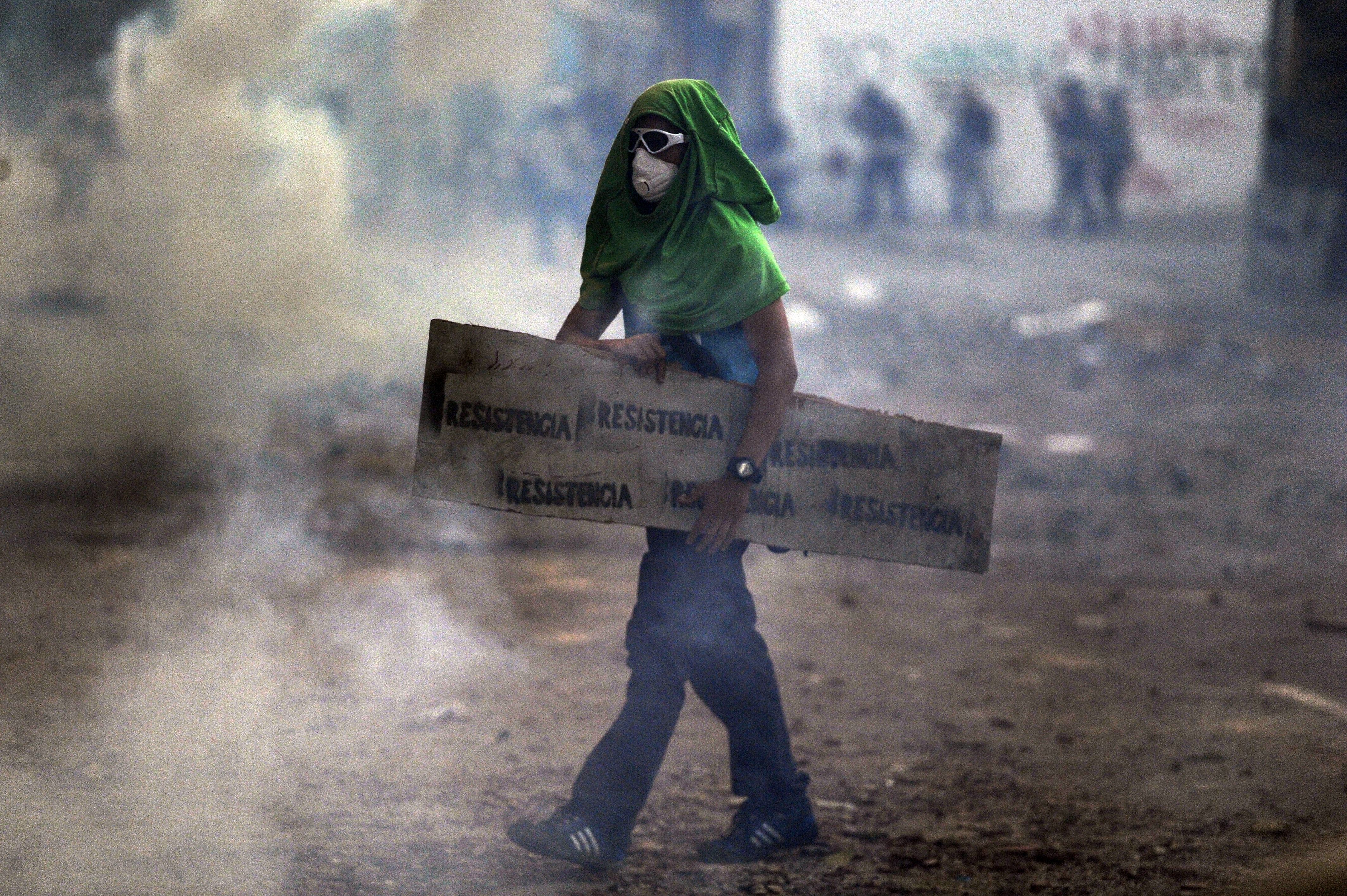
(Photo: An opposition activist helps set up barricades during a protest against the government of Venezuelan President Nicolas Maduro, in Caracas on March 3, 2014. At least 18 people have been killed and 250 injured since a wave of protests began on February 4. By Leo Ramirez/AFP/Getty Images)

Talking Sense Into Anti-Vaxxers

Chris Mooney reports on a new study that suggests it may be impossible:

The paper tested the effectiveness of four separate pro-vaccine messages, three of which were based very closely on how the Centers for Disease Control and Prevention (CDC) itself talks about vaccines. The results can only be called grim: Not a single one of the messages was successful when it came to increasing parents’ professed intent to vaccinate their children. And in several cases the messages actually backfired, either increasing the ill-founded belief that vaccines cause autism or even, in one case, apparently reducing parents’ intent to vaccinate.

The findings deeply depress Aaron Carroll, who debunked anti-vaccine beliefs in the video seen above:

When they gave evidence that vaccines aren’t linked to autism, that actually made parents who were already skittish about vaccines less likely to get their child one in the future. When they showed images of sick children to parents it increased their belief that vaccines caused autism. When they told a dramatic story about an infant in danger because he wasn’t immunized, it increased parents’ beliefs that vaccines had serious side effects.

Basically, it was all depressing. Nothing was effective.

Marcotte asks how to combat the anti-vaccine trend if appeals to reason don’t work:

Mooney suggests that state governments should respond by making it harder to opt out of vaccinations. That would be helpful, but there’s also some preliminary research from the James Randi Educational Foundation and Women Thinking Inc. that shows that reframing the argument in positive terms can help. When parents were prompted to think of vaccination as one of the steps you take to protect a child, like buckling a seat belt, they were more invested in doing it than if they were reminded that vaccine denialists are spouting misinformation. Hopefully, future research into pro-vaccination messaging, as opposed to just anti-anti-vaccination messaging, will provide further insight.

Why Doesn’t Aid Win Any Friends?

Noting that the US is decidedly unpopular in most of the countries that receive the largest tranches of aid money, Keating explains why that is and why it might be a problem:

On one level, this makes perfect sense. The U.S. doesn’t give aid to those countries as a reward for good behavior. To put it bluntly, it’s because we’re worried there are people in those countries who will try to kill us, (or kill our friends, or get their hands on nuclear weapons) and we want their governments to do something about it.

The problem is when this aid starts to look like a perverse incentive. An analysis by Navin Bapat of the University of North Carolina found that between 1997 and 2006, U.S. military assistance correlates with a 67 percent increase in the duration of terrorist campaigns in the country receiving the aid. This could suggest that governments like Yemen, Afghanistan, Iraq, and Pakistan actually need a certain baseline of militant activity to continue in order to keep the U.S. aid money flowing.

Meanwhile, Paul Brinkley thinks it was a mistake to put USAID under the State Department’s purview:

The verdict is now in on this transition. USAID is not effective in carrying out its principal mission: delivering cost-effective outcomes that advance U.S. foreign policy goals. In addition, the agency’s humanitarian mission has been broadened to encompass areas that are incompatible with its culture — including economic development.

The priority of the State Department — from staffing, to allocation of resources, to a forbidding security posture that inhibits local engagement of war-torn populations — is to fulfill a diplomatic mission. Not to run foreign assistance programs. Realigning organizations, like this move of USAID into State’s sphere, is a poor means of carrying out presidential policy.

The Economic Battlelines

Matthew Klein looks at Russia’s growing economic troubles:

Real gross domestic product growth has already slowed from 5.1 percent in 2011 to just over 1 percent in 2013. Car sales fell by 5.5 percent in 2013, despite the Russian government’s introduction of subsidized auto loans. If that weren’t bad enough, European demand for natural gas — about 30 percent of which comes from Russia — has been steadily falling since 2010. Additional supply could come on line in the coming years from the U.S. and Israel at the same time as Russia expands its own production capacity. The net effect could be a glut that would lower prices and further reduce Russia’s access to hard currency.

Its neighbor is much weaker:

To put the Ukraine’s economy into some perspective, let’s go to the CIA World Factbook.

The annual gross domestic product of the country is $175.5 billion. That is about 4 days of GDP in America. Indeed, the entire stock-market capitalization of the Ukraine is about the size of Walt Disney Company. Ukraine’s per capita income is a touch higher than Egypt’s. In other words, it is not very economically significant.

And for now, Ukraine relies heavily on Russia for fuel:

Ukraine depends on Gazprom for the vast majority—70 percent in 2011—of the gas needed to heat homes and keep its industry functioning. This is a matter of no small import given its usually harsh winters. “Ukraine just hasn’t paid attention to the gas problem at all,” [Fiona] Hill [of Brookings] said. “It’s had too many people getting rich acting as middlemen for Russian gas.”

It might take Ukraine three to five years to bring its gas sector up to speed, she added. But Clifford Gaddy, a Brookings Institution economist who specializes in Russia, pointed out that “Ukraine . . . has not found alternatives to Russian gas, and it will not be able to. They are too expensive. Gas is and will always be a Russian lever.”

Update from a reader:

I think it was very useful to present some quantification of the differences in the economies and militaries of Russia and Ukraine, but those numbers are quite misleading as markers for how a shooting war between Russia and Ukraine might proceed.

First, while the Economy of Russia is vastly larger, the Russian economy is freakishly reliant on the Ukraine. The modern economy of Russia is built primarily on the export of natural gas (e.g., oil and gas exports provides 50% of all government revenue) and 2/3 of their exported gas transships the Ukraine. The Russian economy that would be fighting a shooting war with Ukraine would be much weaker than the one assessed in 2013 because those gas lines would certainly be shut down, possibly for a protracted period. A true war with Ukraine … even one with a relatively quick “victory” for Russia, will result in a severe economic contraction Russia if the Ukrainian nationalists destroy pipeline infrastructure. Put another way, the value to Russia of the gas that transships Ukraine is worth more money than the entire economy of the Ukraine.

Second, while all of Ukraine’s (limited) military resources would be devoted to defending its territory, Russia has simmering territorial or political conflicts with nearly all of its neighbors, as well as a perceived threat from the United States. Russia may have 40,000 armored fighting vehicles, but it cannot use them all in the Ukraine without wars opening up on other fronts. Similarly, a large part of Russian military spending is for weapons systems that are designed for conflict with the US and could not be used against Ukraine (e.g., nuclear subs, ICBMs).

If Ukrainians chose to fight an invading Russian Army, they could extract a stunningly high cost both militarily and economically from Russia. My view is that Putin’s movement of unmarked troops and agitators into Crimea/Ukraine makes tactical sense only as a test to determine if Ukrainians would actually chose to fight an invasion by Russia. Putin is putting a toe in the water to determine the temperature. If he can get Ukrainian military commanders in to surrender without firing a shot, then an invasion is likely. If not, he has still not risked that much.

Fighting Putin With Platitudes

James Mann tires of the administration’s rhetoric on Russia:

The administration loves to brand actions it doesn’t like as relics of the past. “It’s really nineteenth century behavior in the twenty-first century,” Kerry said of Putin’s Crimean gambit. A senior administration official who sounded like either National Security Advisor Susan Rice or Ben Rhodes told reporters on background, “What we see here are distinctly nineteenth- and twenty-first century decisions made by President Putin to address problems.”

Well, to start with, by definition Putin’s decisions are taking place in the twenty-first century. The administration here seems to be using the centuries like a teacher handing out a grade: twenty-first century is an A, twentieth century is a C, nineteenth century is an F. More importantly, talking this way raises an uncomfortable question: Does the reality of the twenty-first century conform to what Obama administration officials think it is?

Dmitri K. Simes makes related points:

We are speaking very loudly. We are carrying a small stick. We are not really disciplining the Russians. We are not clearly defining what is important to us. We are acting like King Lear. We are issuing pathetic declarations which nobody is taking seriously.

When I saw Secretary Kerry on television yesterday, I think it was a very sad performance. He was visibly angry. He was visibly defensive. He was accusing Russians using very harsh language of violations of international law. His description of the political process in Ukraine which led to this situation was incomplete and disingenuous at best. And then, after he said all of these things, he did not say, “Well, because of the Russians violating international law, threatening international security, that because of that the President of the United States is moving our naval assets in the Black Sea!” With the language he was using, that’s what you would expect him to do. But he was carrying a small stick.

Rhetoric is not policy and sounding tough doesn’t roll back Russia’s advances. The administration will have to do something that does not come naturally to it: think strategically. This means taking steps, preferably quietly, to demonstrate our commitment to the security of the Baltic States. It means considering strengthening the Ukrainian military if the conflict escalates. But it also means avoiding empty public threats, respecting Russia’s dignity and avoiding creating an impression that it’s our way or the highway.

The full Simes interview is worth a read.

Cleavers Of Mass Destruction, Ctd

Heather Timmons puts in context Saturday’s knife attack, which the Chinese are attributing to “Xinjiang separatists”:

Tensions in resource-rich western China have been escalating for years, as Han Chinese emigrate to the [Xinjiang] region, in many cases taking the best jobs while locals, especially those who don’t speak Mandarin, face widespread poverty and growing unemployment. The Chinese government has clashed with Xinjiang citizens many times in recent months, resulting in dozens of deaths, and six weeks ago authorities detained the group’s best-known moderate voice, economics professor Ilham Tohti. He was recently charged with “inciting separatism,” a charge his lawyer and wife deny.

But international terrorism experts and influential Chinese commentators believe China’s policies in the Western region are just one factor contributing to rising terrorist activity like this weekend’s attack. China’s economic rise, and particularly its growing reach in the Middle East and North Africa, areas contested by extremist Islamic jihadi organizations, could also be fueling terrorism inside the country itself.

Evan Osnos has more on why “militant Uighurs are motivated largely by resentment of their relationship to Han Chinese”:

Xinjiang’s Uighur population has dropped from ninety-five per cent, in the early twentieth century, to forty per cent, in 2008, thanks to an explicit migration policy intended to bind the country more tightly. On the ground, the development policy has created vast new infrastructure and economic activity, but, crucially, it has also accentuated the socioeconomic gaps between Hans and Uighurs. In Xinjiang today, Hans hold more than thirty five per cent of the region’s the high-income jobs, while Uighurs hold thirteen per cent. The ratio is widening by the year, fuelled by, and creating, even more resentment and suspicion. The events of 3/1 will make that worse.

Nisid Hajari argues that the “Chinese might want to think twice before they start adopting the U.S.’s politically charged, post-Sept. 11 enthusiasm for labeling terrorists and terror attacks”:

The Chinese regime has tagged Uighur separatists as “terrorists” at least since Sept. 11, 2001, when Beijing sought to link long-running tensions in Xinjiang to the newly sexy “war on terror.” The discovery of several Uighur men in Afghanistan after the U.S. invasion bolstered China’s claims. Some of the fighters were indeed looking for insurgent training; others may have been traveling through the country on their way to the Middle East.

But of the 22 Uighurs who landed up in Guantanamo Bay, U.S. officials eventually determined none had any real links to al-Qaeda or the Taliban leadership. Indeed, more than a decade after the 9/11 attacks, concrete ties between Uighur extremists and the global jihadist movement are hard to corroborate.

Many Chinese are furious, however, that the US government and Western media outlets have declined to use the t-word:

A post by the official account of the U.S. Embassy in Beijing fueled the outrage. It did not, as many Chinese had hoped, characterize the attack as terrorism, but instead called it a “senseless act of violence.” Almost all of the more than 50,000 comments left on the post accused the U.S. Embassy of a double standard when it comes to violence in China. “If the Kunming attack were a ‘horrific, senseless act of violence,'” the most up-voted comment reads, “then the 9/11 attack in New York City would be a ‘regrettable traffic accident.'” (The United Nations Security Council released a statement late Sunday condemning “in the strongest terms the terrorist attack.”)

Some of the fallout from the embassy’s statement stems from an unfortunate translation. “Senseless violence,” a common diplomatic phrase the Obama administration has also used to describe the 2012 attack on the U.S. Consulate in Benghazi, which killed the U.S. ambassador to Libya, read as “meaningless violence” in Chinese.

Julie Makinen points out that the attack took place far from the Uighur heartland of Xinjiang province:

Analysts said the location and nature of Saturday’s attack — a “soft target” in the balmy, tourist-friendly capital of Yunnan province in southwestern China — indicates further bloodshed well beyond Xinjiang’s borders is likely. “It shows that Uighurs are, like Chechens in Russia, expressing their discontent throughout the country, not just where they are based,” said Dru Gladney, a professor at Pomona College and author of “Muslim Chinese: Ethnic Nationalism in the People’s Republic.”

“It’s a sad day for China and a sad day for Uighurs,” he added. “Many Han think all Uighurs are violent, and this could lead to a real backlash.”