Decriminalized In DC

The City Council voted yesterday to decriminalize petty marijuana possession:

The measure removes criminal penalties for possession of up to one ounce of marijuana for individuals 18 years of age and older and replaces them with a civil fine of $25, similar to a parking ticket. It also removes penalties for possession of paraphernalia in conjunction with small amounts of marijuana, and it specifies that individuals cannot be searched or detained based solely on an officer’s suspicion of marijuana possession. Public use of marijuana would remain a criminal offense punishable by up to 60 days in jail and a fine of up to $500. Currently, possession of any amount of marijuana is a criminal offense punishable by up to six months in jail and a fine of up to $1,000.

Serwer explains why this is a big social justice victory for the majority-black city:

Nationally, according to a 2012 report by the American Civil Liberties Union, black people are almost four times as likely as white people to be arrested for marijuana possession, despite the fact that whites and blacks use marijuana at similar rates.

That may sound shocking, but in D.C. the disparity is even greater.

In the District according to the ACLU, blacks are eight times more likely than whites to be arrested for marijuana possession. Black people, who made up slightly more than half of the population of the city when the study was produced, also made up more than nine out of 10 arrests–91%–for marijuana possession. According to the ACLU in 2010, the more than 5,000 arrests for marijuana possession made up nearly half (47%) of the District’s arrests for drug offenses.

Allie Jones warns that Congress can scuttle the bill if they want, though it isn’t likely:

The bill now has to sit before congressional panel for 60 days, during which time the House and Senate could agree to reject it. That probably won’t happen — Congress has only rejected a bill before a panel like this three times since 1972. But if federal lawmakers are going to speak up about decriminalization, now would be the time to do it.

Rep. Darrell Issa, whose House committee controls many D.C. affairs, declined to comment to The Washington Post about the bill. But Del. Eleanor Holmes Norton, D.C.’s nonvoting member of Congress, told the Post the doesn’t expect Congress to “interfere.”

Yes, The CIA Spied On Congress

Why? The torture report, of course:

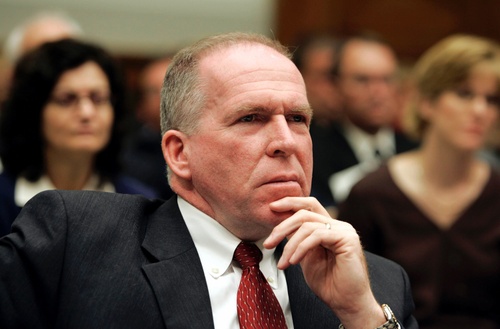
Late last night, McClatchy reported that the CIA inspector general has asked the Justice Department to investigate allegations that johnbrennanbrendansmialowskigetty.jpgthe CIA illegally monitored Congressional staff investigating the Agency’s secret detention and interrogation programs. The Senate Intelligence Committee spent four years and $40 million investigating the use of waterboarding and enhanced interrogation techniques in secret overseas prisons, producing a reportedly “searing” 6,300 page finding excoriating the Agency’s actions.

As part of this investigation, intelligence committee staff were required by the CIA to use Agency computers in a secure room in Langley to access millions of sensitive documents. Congressional investigators reportedly agreed to use those computers under the condition that their work not be monitored by the CIA, in accordance with due respect for the separation of powers and the integrity and independence of the investigation. Apparently, the spy mentality proved too strong to resist, as earlier this year the committee determined that their work had in fact been monitored in possible violation of their agreement.

What we have here is a rogue agency, believing it is above the law, above Congress and indeed immune to even presidential oversight. John Brennan, a man who never piped up as the CIA was orchestrating war crimes in a manner unprecedented in US history, is now revealed as running an agency that broke the law and attacked the very basis of a constitutional democracy by targeting the Congress for domestic spying! The CIA is legally barred from any domestic spying, let alone on its constitutional over-seers.

It’s enough to make you think that the CIA committed crimes so damning and lied so aggressively during the torture regime that it is now doing what all criminals do when confronted with the evidence: stonewall, attack the prosecution, try to remove or suppress evidence, police its employees’ testimony, and generally throw up as much dust as possible. That they continue to do this is a real challenge to this president. How much longer is he going to let these goons prevent the truth from being known? Why is he allowing Brennan to continue to run an agency when, under his watch, it has laid itself open to a criminal investigation of its own alleged obstruction of justice?

Ed Morrissey rightly fumes:

This is among the worst possible accusations that could be levied against an intelligence service in a constitutional republic. For the CIA, it would be doubly worse, since the CIA’s charter forbids it to conduct any kind of domestic intelligence; that jurisdiction belongs to the FBI, and it’s significantly limited. The legislature oversees CIA, not the other way around, and if the CIA is snooping on their oversight work, that would undermine their authority.

An agency that can commit war crimes and get away with it seems to believe it can also undermine the very basis of a constitutional democracy and get away with it. This agency needs to be cut down to size and pronto. Its record in recent years has been execrable – the latest evidence being their failure to detect Russia’s intentions in Crimea. They are far too busy protecting their collective asses to do their job. Brennan needs to go forthwith. And the report needs to be published, in its original form, with all the vital details included. These war criminals cannot be appeased any longer. They need to be brought back under constitutional control.

(Photo: John Brennan via Getty Images)

The Focus Of Our Foreign Policy

Beinart expects America’s rivalry with Russia to replace the War on Terror:

When there’s serious tension between America and other major powers, that tension becomes the dominant reality in U.S. foreign policy. And it’s likely that tension will endure. Vladimir Putin has now twice invaded his neighbors in an effort to halt, if not reverse, the West’s encroachment into the former U.S.S.R. Yet the more bullying he becomes, the more desperately many in Ukraine, Georgia, Moldova, and perhaps other ex-Soviet republics will seek economic and military bonds with Europe and the U.S. Large chunks of the former Soviet Union now constitute a gray zone where competition between Russia and the West can breed diplomatic feuds, economic sanctions, and even proxy war.

Michael Brendan Dougherty has a very different view:

[T]he political class in America should remember that Moscow is mostly a symbolic foil in world affairs, not a great geostrategic foe.

America’s political class should stop ducking under its desks and wailing for some kind of symbolic action or rebuke to soothe the nerves. It’s unnecessary. The Kremlin used to compete with the free world for entire continents — now it is reduced to an embarrassing grab at Crimea. An aggressive U.S. response over a sliver of Ukraine would not be meeting Putin’s strength with our strength, but matching his desperate anxiety with our own.

Fred Kaplan suggests we are making too much of Putin:

Just as Putin is not as much in command as many Western hawks suppose, Russia is not as great a power as Putin himself likes to project. It’s at best a regional power, with no global reach. Even his incursion into Crimea is hardly an imperial gesture. Leonid Brezhnev sent five tank divisions into Czechoslovakia. (Now that was aggression!) U.S. military advisers estimate that the Russian army could invade eastern Ukraine if Putin so ordered, but they say it’s much less clear how long they could sustain an occupation, especially with even sporadic insurgent resistance.

Putin Is Losing?

That’s what Massie thinks:

Putin’s hopes for his Eurasian Economic Union are ruined now. He has Belarus and Kazakhstan in his pocket and little Armenia may have little choice but to join. But that’s it. Ukraine is the prize and the only one really worth having. Without Ukraine Putin’s pet project is, if not meaningless, severely devalued. The other former Soviet republics are like so many toes; Ukraine is an entire leg.

And Putin has lost that leg. Or at any rate, at least half of it. Moscow’s best hope scenario now is only half as promising as that posited just a year ago. It bears remembering that since Putin’s demands proved too much for Yanukovych they will be unacceptable to any other plausible government that may take power in Kiev. Putin’s hand is weaker than it seems.

Daniel Berman isn’t so sure. He imagines a scenario where Putin emerges “from this crisis having neutralized any prospect of Ukrainian NATO membership, secured Russia’s position in the Crimea, and strengthened Russian-German ties”:

Eastern Ukraine is of far greater use to Putin as a hostage for Kiev’s good behavior than as a Russian province.

The region is poor, with high unemployment, a devastated environment, and little prospect of improvement without extensive investment. Its seizure, would, as many have observed and Putin clearly comprehends, lead the rump of Ukraine into undying hostility and NATO membership, moving that alliance’s borders 400 kilometers to the East.

By contrast, leaving it in Kiev’s hands gives Putin the opportunity to pressure the Ukrainian government by threatening to engage in subversion and military action in the region, especially as its emotional and political value to both Ukraine and the West will increase the longer it remains under Kiev’s control. Putin can wield both economic pressure through Gazprom, and utilize political unrest in the East to destabilize the government in Kiev while offering the prospect of recognition if Ukraine’s leaders make their pilgrimage to Moscow to receive his forgiveness.

Obama’s Election-Year Budget

agencies-m

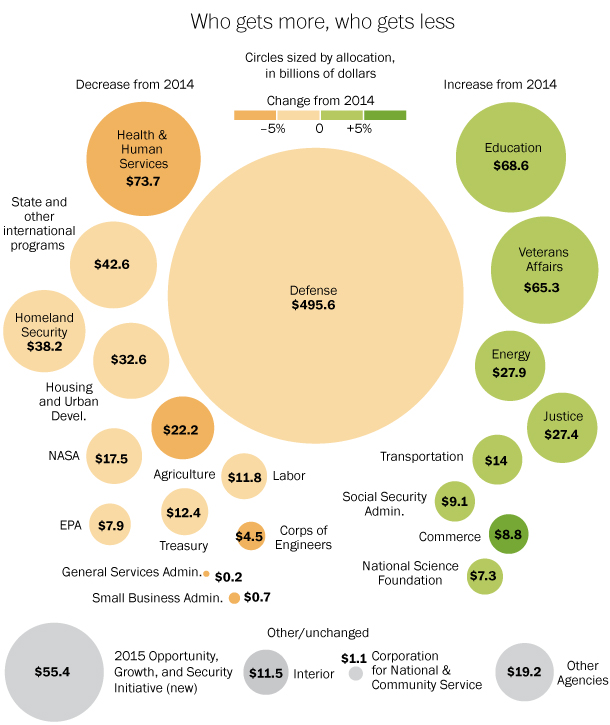
Philip Bump highlights some of the proposals in the 2015 budget the White House released yesterday:

Remove tax loopholes for the wealthy. Obama calls for taxing certain hedge fund and private equity earnings as income instead of capital gains, which are taxed at a lower rate, as Time reports. It would also eliminate a loophole that lets some individual income be claimed as corporate profit to avoid payroll taxes.

Enact the “Buffett Rule.” The by-now-infamous Buffett Rule would ensure that those making more than a million dollars in income annually pay the same amount in taxes as those in the middle class. The various tax changes proposed would result in about $1 trillion in new funding, according to The Washington Post.

An expansion to the earned-income tax credit for low-income taxpayers. As USA Today notes, the Obama proposal would expand the EITC to cover people aged 21 to 24, 65, and 66. In total, 5.8 million more Americans would be eligible for the credit. In addition 7.7 million would see an expanded EITC, which reduces the amount of taxes owed.

David Graham sees the budget as a political document:

If 2013 was the year of Eternal-Optimist Obama, who felt residual buzz from his reelection and held out hope Republicans might go for a compromise, Election-Year Obama’s attitude is blunter and bleaker: Fine, if you don’t won’t meet me halfway, I’m not going to put my neck out. I’ll just ask for what I want. After all, this budget is dead on arrival. Republicans showed no interest in compromising last year, and they’re even less inclined to partner with the president in an election year.

The EITC expansion, Danny Vinik points out, could be bait for Republicans. But Chait doubts the GOP will bite:

So now that Obama is agreeing to do what conservatives have been begging, Congress will quickly whisk this plan to the president’s desk, right? Ha, ha – of course not. …

In theory, the two sides might agree to combine the mutually agreeable EITC expansion with Obama’s compromise proposal to scale back cost of living increases for Social Security recipients. But this sort of bargain presupposes a functional Congress with an incentive to engage in cooperative lawmaking. All the incentives push in the opposite direction. And so, in the end, Obama’s embrace of Republican proposals to expand the EITC will likely wind up serving the sole function of calling their bluff.

Drum agrees:

Yep. This is one of the reasons I support an increase in the minimum wage: Republicans may oppose it, but they oppose the EITC even more. That’s because corporations absorb the cost of the minimum wage while the EITC is funded by taxes—and Republicans will never, ever, ever agree to raise taxes in order to fund an EITC increase. Combine this with the fact that the public is strongly in favor of raising the minimum wage but probably thinks the EITC is a communicable disease or something, and this means that even though the odds of getting Republicans to vote for a minimum wage increase are slim, they’re still better than the odds of getting them to vote for an EITC increase. The fact that the EITC is theoretically more conservative really doesn’t matter.

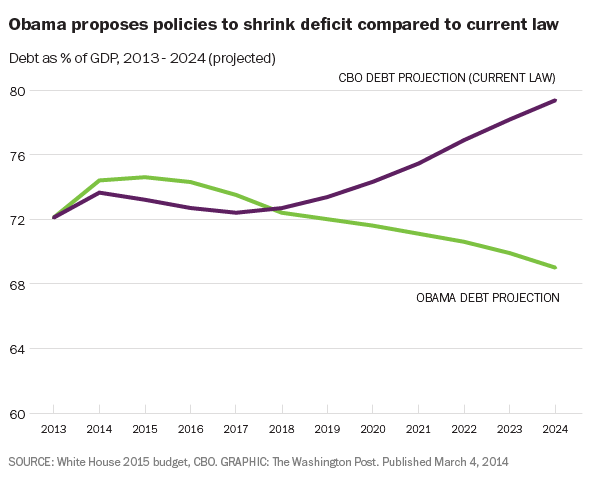
Christopher Ingraham explains how the budget spends so much and still claims to reduce the deficit:
rosy_budget_part_1In his budget request, Obama projects public debt as a percentage of gross domestic project falling to 69 percent by 2024, while the CBO has it rising to 79 percent — a difference of 10 percentage points, or roughly $2.7 trillion.

This is largely because Obama assumes the passage of legislation that the CBO doesn’t, and he assumes those laws will generate far more revenue over the next decade. In 2024, the spending/revenue gap (i.e., the annual deficit) in Obama’s budget amounts to 1.6 percent of GDP. CBO’s projected deficit is more than twice that, at 4 percent of GDP.

The difference lies largely on the revenue side – Obama assumes hearty revenue increases coming from the elimination of tax breaks benefiting the wealthy.

Philip Klein tallies the tax increases envisioned in the budget:

These all add up to over $1.2 trillion. But pinning down an exact number for tax increases is difficult because, as Ryan Ellis of Americans for Tax Reform has detailed, there are a lot of moving parts in the budget and the administration’s presentation of its tax proposals is messy and opaque.

The proposal also includes various changes to mandatory spending programs that have implications for revenue; assumes more revenue by strengthening tax compliance; and it estimates another $456 billion of revenue from enacting immigration reform on the assumption that newly legalized immigrants would be paying more taxes.

Nicole Kaeding pans the budget for raising both spending and taxes:

Over the ten-year budgetary window, the President spends $171 billion more than Congressional Budget Office (CBO) projections. The budget also does not reach balance and runs deficits every single year. According to Obama’s budget, the federal government will collect $3.3 trillion in tax revenue this year, more than any other year in history. The budget includes $650 billion in new revenue though various distortionary tax hikes.

Vinik criticizes the budget from the other side, for doing too little to help the long-term unemployed:

The budget does include $4 billion for a public-private partnership, designed to provide the long-term unemployed with job training so that they can rebuild skills that may have deteriorated while they’ve been out of work. It also includes a new “Opportunity, Growth and Security” initiative to invest in critical areas like research, education and public safety. More than 80 percent of the $56 billion that the White House proposes for this initiative would be spent in the first two years and some of it will certainly create new jobs. But given the current rate of long-term unemployment, that’s simply not enough. There are other smart ideas targeted at finding the long-term unemployed jobs—ideas that even have a chance at becoming law. The White House could have put them forward.

(Chart via Zachary Goldfarb)
Francis On Civil Unions

mary-knots-SD-thumb

The knots begin to be untied:

On the question of marriage and civil unions, the Pope reaffirmed that “marriage is between a man and a woman”. States seek to justify civil unions “to regularize different situations of living together”, pushed by the need to regularize the economic aspects between people, such as, for example, to ensure health care, he said. “We have to look at the different cases and evaluate them in their variety”.

On this, as on contraception, the Pope is not calling for a change in doctrine about the sacrament of marriage. What he is clearly saying, I think, is that you don’t have to change doctrine to respect the civil society’s and secular state’s decision to accommodate gay couples and families within its existing arrangements for heterosexual households. This was his position in the internal church struggle in Argentina, reflecting his understandable concern that a Benedict-style counter-revolution against gay couples would not only be counter to the spirit of the Gospels, but deeply divisive for the church as a whole and damaging to its broader goal of evangelization. A 21st Century bishop of Rome might well accede to civil unions for gay couples and “not judge” the sincere consciences of gay couples seeking civil protections and rights under the law. That would end a misguided cultural war against an entire younger generation in the West, while not abandoning core doctrinal teachings on the family.

It’s a pragmatic and humane position – whereas Benedict’s was both a loser among most Western Catholics and clearly inhumane, and even callous, at times. I expect to see it nudged forward at the Synods this year and next.

I expect mercy to be primary in grappling with the questions of divorced Catholics, contraception and gay lives. Less judgment, more mercy. You know: like Jesus. And look at the stark difference between Francis’ approach to doctrinal and theological debate and Benedict’s relentless imposition of total orthodoxy:

Pope Francis praised Cardinal Walter Kasper’s keynote talk on the family to the assembly of cardinals (the Consistory) on 20-21 February which the interviewer said had sparked divisions among them. “It was a most beautiful and profound presentation, which will soon be published in German.  It dealt with five points, the fifth of which was the question of second marriages”, Francis commented. He said he would have been “worried” if there had not been “intense discussion” and, moreover, the cardinals knew they could speak freely. Indeed, “the fraternal and open confrontations make the theological and pastoral theology develop.  I do not fear this; on the contrary I seek it.”

In my view, it is this new and overdue opening of the Catholic mind for which Francis may one day be remembered most of all.

No, We Can’t Wreck Russia’s Economy

Russia Exports

Danny Vinik uses charts on Russian exports and imports to explain why American sanctions against Russia pack little punch:

The little blue areas in each graph is the United States. The purple is Europe. Without the E.U.’s cooperation in implementing sanctions, American sanctions won’t hurt Russia very much. Of course, because the the E.U. economy is so interconnected with Russia’s, it means any economic sanctions will also hurt the E.U. That’s the reason that countries like Germany and the Nertherlands are withholding support for sanctions and instead pushing for a diplomatic solution. That may make sense for those countries, but it makes the U.S. threat of sanctions very weak.

Vinik also looks at what Russia sanctions would mean for US companies:

The U.S. Chamber of Commerce estimated that U.S. exports of goods and services to Russia in 2011 was more than $10 billion. That’s not much compared to the $2.1 trillion in total exports that American companies did that year. Nevertheless, Russia is an emerging market with growing incomes, and U.S. companies have been actively looking to increase their investment there in recent years. Companies like Pepsi, Coke, and Ford will be reluctant to support any economic sanctions that dig into their bottom line, especially if the European Union refuses to implement their own sanctions. Since the U.S. and Russia do very little business together (only $30 billion in 2013), any unilateral sanctions from the U.S. will only have a marginal economic effect, although they may offer symbolic value as well.

Peter Feaver wonders what Putin’s counter-counter-move will be:

The commentary has rightly focused on the immediate A-B-C moves: (a) what Russia has done in Crimea, (b) what the West should do in response to that, (c) what Russia would do in Crimea and Ukraine after the West has acted. Less attention has been paid to the things we will all be talking about once those preliminary moves have taken place: how Putin will seek to impose costs on the West for the sanctions and other diplomatic steps we take in move “b.” Germany appears to be quite concerned about this, though much of that concern may just be about lost business opportunities. Of greater importance will be the cost-imposing strategies available to Putin elsewhere on the geopolitical chess board, especially Syria, Iran, and perhaps even Afghanistan.

The Tidal Wave For Marriage Equality

US-JUSTICE-GAY-MARRIAGE

Yes, I have to keep pinching myself. For the longest time, in my marriage equality stump speech from the 1990s, I would end by citing Hannah Arendt’s classic case for ending the anti-miscegenation laws:

Even political rights, like the right to vote, and nearly all other rights enumerated in the Constitution, are secondary to the inalienable human rights to ‘life, liberty and the pursuit of happiness’ proclaimed in the Declaration of Independence; and to this category the right to home and marriage unquestionably belongs.

What I was trying to do was to get (at that point) mainly gay people to see how the denial of the right to marry was effectively a nullification of the Declaration of Independence for gay Americans. The right of gay people to marry was more profound in truth and in law than the right of gay people to vote. “So why aren’t you fighting for it?” I’d declare. Until they did. Getting straight people to see this was actually easier over the years (tell a straight person he doesn’t have the right to marry the woman he loves and you’ll get some powerful pushback). But now look:

Americans think the equal protection clause of the U.S. Constitution gives gays the legal right to marry. In a closer but still significant division, 50 percent say it does, while 41 percent say not, with the rest undecided.

So a Supreme Court ruling that did not find civil marriage as a core constitutional right for gay couples would now be against public opinion. Ross and Rod are surely more right than they might imagine. This is becoming not a victory for gay equality but a rout. The new Post/ABC poll, for example, finds for the first time that there is a plurality in favor of marriage equality in every age group. Even the over-65s are now in favor, by 47 – 43 percent. The next generation (under 40s) sees the issue as a no-brainer with a massive 72 – 22 percent in favor.  40 percent of Republicans are now supportive, with 23 percent strongly supportive. And, in fact, the intensity factor – long on the side of fundamentalists – now operates in favor of gays and their friends and families.

By the end of the Obama presidency, gay Americans may well achieve a near-total victory in their quest for equality.

And the backlash, as we saw with the Arizona debacle, is likely to be ferocious but also, at this point, self-defeating. I’m honestly staggered by the swiftness and totality of this victory in public opinion. But also, of course, incredibly heartened. Our gamble was correct: if we speak our truth, others will listen; if we explain our pain, others will salve it; if we are guided by our consciences, and make our arguments sincerely, Americans will come around. I wish more Christians would see this for what it really is: a huge moral achievement, an expansion of human consciousness and compassion, an extension of mercy and of dignity to many long shunned and excluded for irrational and often hateful reasons, and, above all, the alleviation of  profound and ancient and unnecessary human pain and suffering.

I wish more Christians could see that this movement has been and remains God’s work on earth. But that wish, every day, becomes more and more of a reality. The long, dark Lent of gay history is slowly inching toward Easter.

(Photo: Michael Knaapen and his husband John Becker react outside the Supreme Court on June 26, 2013, after DOMA was struck down. By Mladen Antonov/AFP/Getty Images.)

Chart Of The Day

Pizza Cost

Quoctrung Bui explains why you should always order the largest pizza:

The math of why bigger pizzas are such a good deal is simple: A pizza is a circle, and the area of a circle increases with the square of the radius. So, for example, a 16-inch pizza is actually four times as big as an 8-inch pizza. And when you look at thousands of pizza prices from around the U.S., you see that you almost always get a much, much better deal when you buy a bigger pizza.

Update from a reader:

As a real New Yorker, I feel it is important to share the information on the other reason to buy the largest pizza you can.

In “real” pizza places (not chains), they pre-make the dough ahead of time and save it out into dough-balls.  When you order your pizza, the pizza maker stretches the dough into the appropriate size for the pan, puts the sauce, cheese and toppings on, and shoves it in the oven.  What he does not do, is say, “hmmm, they have ordered a medium pizza as opposed to the standard large pizza, let me take a portion of this dough off of my dough ball.” What you actually get is a pizza with a tougher, thicker, less-good crust because the dough is the right amount for the standard size pizza.  And the standard sized pizza is a large.

On an unrelated note, I just renewed today.  I upped my renewal from the standard rate ($19.99) to one dollar for every year I have been alive ($42).  I think this will be my go-to going forward.  I was going to just renew, but I found out yesterday I am getting a promotion, so my good fortune is your good fortune.

Damn, now I am hungry for pizza for lunch.

Will Pot Shops Be Kind To Patients?

Sullum is concerned over how the legalization of recreational pot in Washington state actually limits options for those who use it medically:

The cannabis strains that best meet patients’ needs may not appeal to recreational consumers. They may be low in psychoactive THC, for example, but high in cannabidiol (CBD), which shows promise as a treatment for a wide range of disorders, including epilepsy and multiple sclerosis. … H.B. 2149 and S.B. 5887 both would offer “medical marijuana endorsements” to pot stores that choose to serve patients, either exclusively or in addition to recreational users. The endorsements would allow registered patients to benefit from a higher purchase limit (three ounces rather than one) and an exemption from the standard sales tax. But patients worry that they will still be treated as an afterthought and may have trouble obtaining the specific varieties that are tailored to their symptoms.

Meanwhile, Nora Caplan-Bricker notes that the feds are still prosecuting pot-shop workers in states where medical marijuana is legal:

Obama’s administration brought 153 medical marijuana cases in its first four years, according to a June 2013 study from the National Organization for the Reform of Marijuana Laws (NORML). Bush brought 163 in eight years. At the time of the study, Obama had not granted a single pardon or clemency petition to a medical marijuana defendant. Over 335 defendants had been charged with federal medical marijuana crimes in states where its sale was legal, and 158 had gone to jail.

But support for cannabis continues to grow – now in New York, set to become the 21st state to permit pot for patients:

State Senator Tom O’Mara, a conservative Republican from Western New York, is the fourth Republican lawmaker to come out publicly in support of a plan to legalize medical marijuana. “I have carefully considered the facts, and after meeting with patients and their families I have come to the conclusion it’s time for New York to offer a highly restrictive, tightly regulated network to provide patients access to treatment that will improve their quality of life,” O’Mara said in a statement released today.