Arizona On A National Scale?

Gabriel Arana warns that a Supreme Court ruling in favor of the defendant in Sebelius v. Hobby Lobby could have the same effect as the Arizona bill Jan Brewer vetoed last week, but nationwide:

It’s easy to see how a win for social conservatives in Hobby Lobby could sanction the same sort of discrimination as the Arizona law. If a for-profit employer is allowed to opt out of the contraception mandate, it stands to reason that refusing to extend health benefits to gay couples would also be protected. “It’s a slippery slope,” [director of the Faith and Progressive Policy Initiative at the Center for American Progress Sally] Steenland says. … Sebelius vs. Hobby Lobby is poised to become the Citizens United of the culture wars. In fact, the question at the heart of the case bears a striking resemblance to the one the justices considered in Citizens: Do corporations have freedom-of-religion rights? If the Supreme Court finds that they do, then religious owners and employees of for-profit corporations have pretty good grounds for refusing to cover treatment for HIV or any health care related to the pregnancy of an unwed mother.

Ian Millhiser shares that concern:

Denying birth control to your workers because of your own religious objections to it superimposes your own personal beliefs about conscience and faith onto your employees. So does refusing to serve a gay person due to a religious objection to their sexual orientation. If the Supreme Court winds up holding that one person’s faith can impose itself on another, which is exactly what the plaintiffs in Hobby Lobby and Conestoga Wood want them to do, then all the nightmare scenarios imagined in the debate over the Arizona bill could become very real — at least at the federal level. Indeed, it is even possible that business owners who object to serving African Americans on religious grounds could challenge a 1983 Supreme Court decision holding that religious beliefs cannot justify racist discrimination.

But John McCormack suggests that neither the Arizona bill nor the Hobby Lobby case would grant for-profit businesses new rights:

“The irony about the Arizona law is that I actually think the law was quite unnecessary. But it certainly wasn’t dangerous,” Stanford law professor Michael W. McConnell told THE WEEKLY STANDARD. “I don’t know anything about politics in Arizona or why the legislature voted for it, but there was no pressing legal need for it.”

The Madison Avenue Color Line

Continuing his series on how liberalism failed black Americans, Tanner Colby explores the development of our segregated ad industry and the role affirmative-action policies played in encouraging it:

Culturally, legally, and economically, the industry settled into a pattern which ensured that “white” advertising happened over here and “black” advertising happened over there. White agencies did little more than token hiring and recruiting. Meanwhile, the few black hires who did make it in the door at white agencies now had a very strong incentive to turn around and walk back out to a black agency, because that’s where the short-term benefits were.

Life at a black agency offered decent money, a likelier shot at promotion, and a chance to join in the Black Pride movement that was taking hold in the 1970s. By the mid-1980s, black employment at general market agencies fell from 3.5 percent back to 1.7 percent, with high-profile black defectors frequently leavingwhitefirms to hang out their own shingles on the other side of the color line. Which might have been an acceptable outcome had the black agencies flourished and become a thriving industry of their own.

They didn’t. In 2000, the top 20 black-owned ad agencies combined accounted for 0.5 percent of total industry revenues. Integration on Madison Avenue failed. Black solidarity and empowerment failed as well. In trying to split the difference between the two, we wound up with neither.

Update from a reader:

I publish a neighborhood blog about Roosevelt Island, New York. I read your post and thought you would be interested to know that a Roosevelt Island resident is considered to be the Jackie Robinson of the advertising industry. His name is Roy Eaton and he wrote the Beefaroni commercial jingle. He is also a classical pianist. Here’s a recent post about Mr. Eaton and direct link to a Fox News story on him.

Fix Inequality, Boost Growth?

John Cassidy highlights a study challenging the notion that addressing inequality slows growth:

[T]hanks to three researchers at the International Monetary Fund, we’ve got some striking new findings that answer the second question, whether tackling inequality reduces growth, with a firm no. Countries that take redistributive measures in order to attenuate inequitable market outcomes do not, on average, tend to grow less rapidly than other countries. Indeed, the contrary is true. They tend to grow a bit more rapidly.

The research paper, “Redistribution, Inequality, and Growth,” has been posted on the I.M.F.’s Web site and authorized for distribution by Olivier Blanchard, the I.M.F.’s chief economist. … Its authors—Jonathan D. Ostry, Andrew Berg, and Charalambos G. Tsanarides—begin by pointing to previous empirical findings that sustained economic growth seems, on average, to be associated with more equal income distribution. But this might not, in itself, make the case for using distribution to attain that equality, they explain: “In particular, inequality may impede growth, at least in part, because it calls forth efforts to redistribute that themselves undercut growth. In such a situation…taxes and transfers may be precisely the wrong remedy.”

Drum plays up another finding – that higher inequality correlates with shorter boom periods:

In particular, the authors find that a 1-point increase in a country’s GINI score (a measure of inequality) is associated with a decrease of about 7 percent in the length of its growth spells. In other words, countries with high inequality simply can’t maintain economic booms as long as countries with lower inequality. This is consistent with the idea that growth in these countries is driven partly by the rich loaning money to the middle class, which is obviously less sustainable than growth driven by an increase in middle-class wages. In high-inequality countries, growth is too dependent on financialization and leverage. When the merry-go-round stops, as it inevitably must, the boom times are over.

Let’s drop these ideas into a current real-world example: Stephanie Rudat explains how Venezuela’s foreign exchange regulator fed corruption and added to the country’s economic woes:

Under the pretext of creating a more equal society for the underprivileged, not only has the government nationalized key industries, but has also instituted Comisión de Administración de Divisas (CADIVI), a government institution whose purpose is to regulate foreign currency exchange. Despite the fact Venezuelans could once exchange Bolívares for US Dollars at a local bank through a simple transaction, CADIVI has imposed strict regulations in the currency exchange market. As a consequence of this, a large parallel US Dollar black market has formed in which US Dollars sell for over ten times the official exchange rate, a ratio that increases on a daily basis. The combination of nationalization of the private sector and currency exchange market regulation has driven Venezuela into an economic downward spiral that has led to uncontrollable and ever-increasing inflation rates, and dangerous levels of food and goods shortages at local supermarkets.

But Juan Cristobal Nagel, quoting a friend, suggests that Maduro’s recent attempt to reform CADIVI might have been what set off the protests:

“I think,” she said, “this all has to do with the end of Cadivi. Up until December, things were really bad, but you could still count on your cupo, your folder, and your raspaíto to make a quick buck. Take a subsidized trip abroad, buy a bunch of stuff to bring back home, or charge the credit card for cash, bring the cash home, and you earned a fortune. Now, Cadivi is a lost dream. It’s dead. The drama with the airlines means ticket prices have skyrocketed. There is an increased sense that the days of free Cadivi cash are gone forever. The end of this bubble … is really difficult for many middle-class Venezuelans to accept.”

This makes a lot of sense to me. Cadivi played such a huge role in the life of middle-class Venezuelans, its death should not be underestimated. For years, it was many people’s main source of income. Now, that’s gone, and we’re coming crashing down to Earth. It’s effect on people’s pocketbooks is enough to trigger a protest movement.

Googletown, USA

Screen Shot 2014-03-04 at 2.38.22 AM

Sean Hollister investigates the company’s takeover of Mountain View, California and surrounding areas:

Google’s lease of the 1,000-acre Moffett Federal Airfield is mystifying at first. According to Deborah Feng, associate director of NASA’s Ames Research Center, Google can’t do whatever it wants with the land. The company will not only need to renovate the historic hangars but also run the actual airport whenever the California Air National Guard or other government entities need to use it. “What they do in the hangars is their own business as long as it’s not illegal,” says Feng, adding that Google can use Moffett’s sizable airspace too. However, an FAA representative tells us that the company still won’t be able to do anything special with that airspace — like testing drones — without explicit approval. Feng says that to her knowledge Google will use the hangars as R&D facilities of some sort, but that the company is limited to a relatively small 90,000 square feet of developable space outside the hangar walls.

Moffett Field begins to make more sense, though, when you consider that it could be part of Google’s master plan.

In 2008 Google leased 42 acres from NASA at the northwestern corner of Moffett Field as well as nine acres at the east end of Charleston Road, and it soon proposed building futuristic new campuses to rival the Googleplex at both locations. Then it proposed a bridge over the creek separating its huge North Bayshore holdings from the Moffett Field area. If you add the Palo Alto tract that Google bought this year and another proposed bridge between that Palo Alto property and Mountain View, Google could soon have a practically unbroken line of property bridging Palo Alto, Mountain View, and Sunnyvale. With a clear corridor connecting those three areas like one that Google has proposed, the company could reduce its dependence on Highway 101. And if it could house employees on federal property, those people could work, eat at Google cafes, and go home again without ever leaving Google’s island.

Update from a reader:

A few things: One, we should be so lucky as to have Google buy Mountain View. Unfortunately, it’s not going to happen; the MTV City Council cares more about inflating the property values of existing landowners than allowing new housing construction. Second, anything that reduces Google’s dependence on the 101 is a good thing. Right now, Google’s campus essentially has two ways in or out. The Shoreline Blvd. exit on the 101 looks like a scene from Dante during rush hour. This is not remotely sustainable. So if linking up their campuses north of the 101 helps reduce that congestion, that’d be bloody wonderful.

And no, I am not a Googler.

(Aerial view of Google’s headquarters, Moffett Field, and other parts of Mountain View courtesy of, well, Google Maps)

GROWing Pains

Jay Newton-Small examines Project GROW, the GOP’s effort to get more Republican women in Congress. So far it looks like an uphill battle:

Thirty years ago, Republicans and Democrats had equal numbers of female politicians, but since then Democratic female representation has taken off dramatically. Part of the problem is that Republican female state legislators tend to be more moderate than their male counterparts and therefore have a tougher time getting through increasingly partisan primaries, according to Debbie Walsh, director of the Center for American Women in Politics at Rutgers University.

But the good news is that female candidates, especially Republicans, may suffer less gender bias than the conventional wisdom holds:

In examining the candidate evaluations and vote choice decisions people make in races where women run against men for the U.S. House, I find very little evidence that abstract gender stereotypes hurt or help these women. There is no evidence that voter beliefs about the abilities and traits of women in the abstract lead voters to evaluate individual women candidates differently than their male opponents. In examining how people evaluate candidates, I find that none of the female and male policy or trait stereotypes people hold about women and men are related to their evaluations of Republican women candidates.

Things are a bit different for Democratic women candidates, however, with voters who hold negative stereotypes about the ability of women to handle traditionally “male” issues being more likely to favor their male opponents on male policy issues.

Giving The SAT A Low Score, Ctd

A reader writes:

I’m currently training to tutor kids on the SAT and ACT, so I have some special insight on Elizabeth Kolbert’s piece. She is right: SAT tests are pretty superficial. But they’re not trying to test you on the questions, since all of the math and verbal concepts are relatively easy to understand and memorize. They’re testing you on your cognitive skills: how well and how quickly do you process information? Do stressful and tiring situations trip you up? Yet the SAT isn’t even good at testing those skills. The questions are all too straightforward.

But we have a similar test that doesn’t fall into that trap: the GMAT. Questions are not always straightforward. Red herrings are everywhere. The notorious data sufficiency questions stretch test-takers’ brains in unique ways. You are being tested on your problem-solving abilities, your time management, and your ability to actually make a damn decision. Even the writing section is more relevant than the SAT’s version. You have to engage and dissect an argument and show how it is flawed. The GMAT is the best, most fun test I have ever taken.

But another reader is very skeptical of standardized testing:

The colleges to which I applied when I was in high school didn’t require the SAT; the ACT has in many locales replaced the SAT. But the same premise is there – you pay for tutoring classes, review classes, prep courses, and all in the hopes of getting into a better school. I nearly burned myself out my junior year stressing over a test that really had no way of indicating whether or not I was going to have success in college.

A couple of years after I graduated college, I started looking into grad schools, knowing I wanted to study English literature. The schools to which I wanted to apply mostly required not only the GRE, but also a subject-specific GRE in literature. I plugged away with studying again, trying to prepare myself for what by all accounts is an intensely rigorous exam.

I needn’t have worried. The exam was thoroughly awful. The majority of the exam tested not an ability to understand and analyze literature but the ability to recall specific details from a smattering of books, as well as which authors had written which titles. In other words, the test did not so much feel qualitative as quantitative – which might work for some sciences but is antithetical to work in the arts.

As you can guess, I did pretty poorly on the GRE literature exam. I began exploring my alternatives for grad school, as I simply did not want to put myself through that horrible examination again. I ended up finding, applying to, and ultimately attending, a small school in Wales. This school did not need examination results; rather, they wanted me to submit a proposal for my area of study, as well as proof that I could do the rigorous research graduate work requires.

My point is: I got an excellent education from an institution that didn’t expect me to take some silly standardized exam. If that could happen for me and my classmates, it could happen for everyone. Why, then, do American institutions put so much emphasis on standardized exams and scores? Well, it seems pretty obvious to me. As Kolbert explains, higher standardized test scores lead to better rankings. She doesn’t come right out and say it, but the truth is that these higher rankings inexorably lead to more money, through donations, increased applications (which usually include fees ranging from $50 to $200 per application), government grants, and so forth. To me, that’s deplorable. But then, the “nonprofit” education system in America really is a misnomer, isn’t it?

Another offers a heads-up that changes are in store for the SAT:

In a couple of days, College Board president David Coleman is going to announce changes to the SAT that will enrich the content of the test. This is part of the new president’s overall goal of rededicating the College Board to its mission of delivering opportunity. Information is below for any Dishheads who would like to follow!

A Russian Ultimatum? Ctd

A tense series of tweets from reporters at Time (Shuster) and Haaretz (Pfeffer), embedded in chronological order:

Pfeffer says in his latest update that “Russian commander said would respond to Ukrainian demand by Noon” – which is two hours from now. So the Dish is headed to bed. But you can follow Pfeffer here and Shuster here. Earlier coverage of the ultimatum here. Updates from the morning:

Your Moment Of Cat

And a break from the ongoing Ukraine coverage. The Dish is biased as a dog blog, but we want to be balanced as well. So here’s Whitney Erin Boesel, who waxes philosophical about her best feline friend:

I overdocument my cat because it’s (sort of) easy; because I love her; because she’s pretty and the antigone-routerInternet rewards me with Attention Points™ for doing so. But I also overdocument my cat because I simultaneously accept and dread her mortality. I take too many pictures now because I can, and because I know that, eventually, I won’t be able to take any. I overdocument my cat, and then with each new health scare I really overdocument my cat—as if by preserving so many images of her, I can somehow preserve the creature herself. …

Yes, I will be glad for these pictures years down the line, even though I will not need them to remember what my cat looked like; yes, oftentimes pictures of my cat get used in my communications, or as communications in their own right. In the back of my mind though, in the place where magical thinking lives, I’m not just trying to share a moment or to freeze a moment in time; I’m actively trying to prevent time’s progression, trying to anchor and pin down the present so that it cannot slide into the future.

Shortly after we spotted Boesel’s essay, a reader happened to write:

cosmoI should have renewed my founding membership earlier last week, but finally got it done today.  The plus side is that by opting for the monthly option, I could increase my support on a cash-flow friendly basis for a self-employed person with a retired (if not legally recognized where we live) husband.  I originally subscribed last year for $31, representing the number of years that he and I had then been together.  This year I did $54 for the year divided monthly into $4.50. This represents the 33 years that we will have been together later this year, plus 21 to honor the age of our beloved Cosmo, who we had to let go to sleepforever on January 27.

It seemed an appropriate way to honor him, since you and your reader’s sharing of their stories of 100thhaving to let their pets go was very helpful in knowing that the time had come that day.  By then, he hadreached 101 in cat years, celebrating his 100th birthday last September. We, of course, had a nice celebration for his 100th and I have included a picture of him eating tuna on his big day (he usually had to eat special food from the vet) and another picture that greets me whenever I open my cell phone.

Below are many more stories from cat owners collected from the in-tray:

Your “Broadcasting Bereavement” and “Last Lesson we Learn from Our Pets” posts have been an absolute godsend to me in the last 24 hours. I unexpectedly had to put my 12-year-old Torbie cat to rest after finding out Friday morning she had Pancreatitis and a large mass on her liver. She had stopped eating for 2 days and had been vomiting foam for 24 hours.

I held her in my arms as the vet administered the final push of liquid through the tube attached to her little, striped leg. I felt her grow heavy in my arms and am so glad I was there with her, holding her close for her final breaths. I felt so guilty having had given her a death sentence (it’s hard for me to even swat a fly), but after remembering what you were going through with Dusty, I visited the “Last Lesson” thread and read it over and over. I’m not saying it made the pain and grief go away, but it sure as hell made me feel a whole lot better. I know now what I gave Shanks (my cat) was a gift – a gift of dying peacefully and with dignity. I loved her so much, but I have faith that she is now somewhere comfortable and at rest.

Another:

cat-paintingI carefully followed that thread throughout the summer, and I happened to be in a Texas golf resort bar (not at all my usual type of place) when I read your post about the loss of Dusty. Within three weeks my wife and I were at the vet’s office saying goodbye to our 12-year-old cat, shocked after having to make the decision much quicker than we’d expected. When the time came to let her go, I remembered your posts, and the procedure happened much as you and several of your readers had described. Since I knew what to expect I was able to be more present during our pet’s last moments. Thanks to you and your readers for that.

Another:

I got my first cat in 1992 when I had just started my first year of law school.  She had already belonged to another law student through her three years, but that woman was going to New Zealand after graduation and didn’t want to quarantine her cat.  I took her in and she became my one steady companion through the most tumultuous years of my life.  She saw me through law school.  She saw me through a very difficult relationship and break-up during law school. She saw me through the two years following law school when I had to move back in with my parents because I couldn’t find a job.  She moved with me down to Charlotte where I started my legal career in 1997.  She was with me when I met my future wife in 1999.

She saved my life many times.  But she didn’t make it to my marriage.  She had lung cancer and her lungs would fill with fluids, making it very hard for her to breathe. We could drain them, but the frequency was increasing.  On the night before our engagement party, I decided she had had enough, so I took her to the vet to let her go.  It was the hardest thing I have ever done.  I’ve had other cats since, but I miss her every day.

Another:

Just two weeks ago, my now 19-year-old son told me in the car while running errands that he can now finally talk about his cat George. George was euthanized four years ago. We spared no expense in trying to prolong his life. After sending George to countless feline specialists and getting a diagnosis that his lungs were filling with fluid, idiopathic in nature, we knew it was time to let George go.

This came a four months after our beloved Weimaraner Fritz was diagnosed with bone cancer. We IMG_0150-1opted for amputation as a palliative measure for Fritz because he was so fit and healthy. Six weeks after we euthanized sweet George, Fritz became paralyzed. It was clear the cancer had spread. It was early on a Monday morning, when he awoke whining and desperate. We took Fritz to our vet immediately – and as a family we let him go as we did for sweet George. So, we lost our two beloved pets within six weeks of one another.

My son told me in that car ride two weeks ago that it has taken him this long to be able to even speak about George and that he doesn’t yet know if he will ever fill that void that George’s death left in him. I’ve attached a photo of George nursing our kitten, Mira. Yes, our male cat nursed our kitten for two years! He was a very special cat indeed.

Another:

Your Dusty died about the time one of our cats was diagnosed with terminal cancer. We had to euthanize him (Thomas Merton) last week. I’m not surprised that you aren’t read to dispose of Dusty’s ashes. We have two small urns on a bookcase upstairs and Merton’s will soon join them.

I’m an Episcopal priest, and I see something of the same thing with family members dealing with the deaths of their loved ones. Sometimes those who die are closely tied to the places where they lived. Perhaps their roots go back generations. I have buried bodies and interred ashes of people who had left their hometowns decades ago but wanted to return for their final resting place. Other people, other families have no such ties, no such roots. For them, the idea that a body or ashes are tied to a particular spot is itself a barrier to coming to terms with death. Having no particular home in life for them to think of a permanent resting place is, I suspect, a frightful burden.

One more:

RoscoeI had a great cat, and when he became so sick from kidney failure at the age of 14, I had to have him put to sleep (this is term I grew up with; we never said “put down.”). Holding Roscoe as the drugs extinguished his life, something occurred to me.  I was struck by how EASY it is to take a life. All this shit about the power of our will to live and the strength of the human spirit is nonsense. Stick an IV into a vein and death comes in moments. No trauma, not writhing; just the flip of a switch. The experience reminded me just how tenuous our hold on life is. There’s no difference whatsoever between how my cat went and how someone I love might go.

In fact, watching my cat succumb to the drugs, I thought of my parents’ deaths. My mom dropped dead in the backyard when I was 8, from a brain hemorrhage. Boy, did she love life, and how valiantly she would have fought to remain on hand to care for her kids. And yet when that blood vessel burst, she was GONE. My dad dropped dead from a massive heart attack some years later (but still way too soon; in his fifties). He was a force of nature, that man – but it didn’t do him any good when his heart suddenly stopped. I’d forgotten much of what I felt when my parents died – the feeling of utter helplessness against the shovel fate swings to the back of our head – until I had to put Roscoe to sleep. Ever since then, I really do try to remember how quickly our lives – our world, the whole universe – can end.

Fortunately, I also take comfort from the fact that when my moment arrives, it’ll likely happen fast, and I probably won’t even see it coming. You know the phrase, “Don’t blink or you’ll miss it.”? You can apply that to our entire existence.

Update from a reader:

Goddammit Andrew! Your blog is the only place on the Internet where a post with the word “cat” in the headline that can leave me in tears considering my ephemeral existence …

On that note:

I couldn’t sleep tonight, so I stopped by the Dish and found the thread about cats. I couldn’t help it. I had to tell you my cat story.

In 2001, our 10-year-old son, Max, was diagnosed with neuroblastoma, a very aggressive childhood cancer. In late 2002 we got two new kittens, Kishka and Gingey, after losing Max’s beloved cat, Tinkerbelle, to a sudden bout of liver disease. We took the new kitties to the vet for their shots. As we were leaving the exam room, Max decided to check out the cats waiting their turn with the vet. He walked over to one carrier and peered inside. My kittens were getting skitterish and so I said, “Max, we gotta go.”

The owner of the cat, said, “Your name is Max? So is his!” pointing to the grey tabby in his carrier. Max asked the owner if the cat was okay. The owner responded that his cat had cancer. Max sat for a minute, took off his baseball cap to reveal his bald head, and leaned down to the carrier and said, “Hi maxMax! I’m Max too! And I have cancer too! You have to fight it … just like I am fighting it. I’m gonna beat it and so will you.” He stuck a finger through door, gave the kitty a quick scratch on the head, and followed me out the door. I don’t think there was a dry eye in the waiting room.
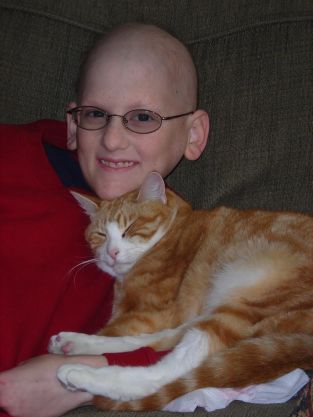
Six years later, as my son lay in his own bed, dying from his cancer, his cat Gingey climbed up on the bed and wouldn’t let anyone touch Max. He was there for just a minute. But we all understood that this was his time to be with his best buddy. He soon jumped down and left the room. After Max passed, as we waited for the funeral home worker to arrive, Gingey and our other two felines came into the room and sat at the foot of the bed. They didn’t move. They just sat there. A few minutes later they walked out. It was almost as if they knew Max was gone and they just wanted to pay their respects.

Here is a picture of Max and his best friend, Gingey, taken about four months before Max died. Gingey is still with us and we love him very much.


A Russian Ultimatum?

Russia is allegedly pressuring Ukrainian soldiers in Crimea to surrender:

Ukrainian defence sources have accused Russia’s military of demanding the surrender of their forces in Crimea. Russia’s Black Sea Fleet chief Aleksander Vitko threatened a full assault if they did not surrender by dawn on Tuesday, the sources said. However, Interfax news agency later quoted a Russian spokesman denying that any ultimatum had been issued.

Daniel Berman analyzes the reports:

I make use of the term “supposed” before the ultimatum, as the Russian Foreign Ministry has claimed no such ultimatum has been issued, though they appear to be quibbling more over the use of the word “ultimatum” than its content. As for why Russia issued the ultimatum, the answer is simple. Russia is operating on a schedule.

Regardless of warnings of World War III or a new Cold War, the current conflict will end in a “negotiated” settlement which will in reality ratify the actual situation on the ground. It will ostensibly be an agreement between the Ukrainian government and Moscow, but will in reality be reached between the United States and Russia and imposed on the Ukrainians.

Russia’s interests are in ensuring that when the time comes to sit down and work out the terms of such an agreement, they are in a position to achieve all of their political objectives. As one of their key objectives is to retain control of the Crimea, either de facto or de jure, it is vitally important that no military forces loyal to Kiev remain in the Peninsula when the game of military musical chairs stop.

But the Ukrainian troops don’t seem to be backing down. In one dramatic example, the Guardian shares an exchange between a Ukrainian marine and a Russian general. The Ukrainian:

“From my childhood I have lived right next to Russia, we have always looked at Russia like an older brother or a helper, and we always were thrilled by your courage in different wars and operations, and saw you as a defender and expected help in any situation. Nobody could have imagined that such an awful time would have come to our country, but in our weakest moment, you have decided to do this. Do you not think your current behaviour will ruin not only our country but yours?”

The general responds with a long answer about Russia’s greatness, which culminates in an ode to the Winter Olympics, held last month in Sochi. “The international community trusted Russia to hold the Olympic Games, and not every country in the world is trusted with something like that,” he says

Christopher Miller, editor of the English-language newspaper Kyiv Post, backed up the above tweet with another:

The Awlaki Problem, Again

Nick Baumann wonders whether the US will decide to use a drone to assassinate Abdullah al-Shami, an American-born militant who is believed to be involved in the production of IEDs for al-Qaeda and is currently living in northwest Pakistan:

The government claims that, of the four Americans killed by drone strikes under Obama, only [Anwar al-Awlaki] was deliberately and specifically targeted for death—the first and only American to receive such treatment thus far. Shami would be the second. This time, though, there’s even less public information about the man the government is targeting for death. The New York Times‘ Mark Mazzetti and Eric Schmitt reported Friday that Shami is a nom de guerre, and the Obama administration won’t even release the alleged terrorist’s real name.

Leah Libresco looks at how the administration could be maneuvering itself:

According to the Times, the debate over al-Shami’s death has been driven as much by logistical concerns as by ethical or legal scruples.

Obama has been working to hand over responsibility for drone assassinations to the Pentagon. This would put drone program under a few more legal restrictions, but free the United States to claim responsibility for strikes and make other disclosures that the CIA can’t.

However, the Pentagon has no authority to kill anyone in Pakistan, where al-Shami is rumored to be hiding. If the President makes an exception to allow the CIA to conduct this strike, it will be yet another jury-rigged change to our legal system, meant to secure the short-term objective of killing the enemy, while possibly endangering the security and trustworthiness of the government we are defending from men like al-Shami.

Wells Bennett picks up on a quote in the NYT piece that may illuminate the administration’s thinking:

“We have clear and convincing evidence that [al-Shami’s] involved in the production and distribution of I.E.D.’s,” said one senior administration official, referring to improvised explosive devices, long the leading killer of American troops in Afghanistan.

It happens that “clear and convincing evidence” is an established legal standard, one lying somewhere between the “preponderance of the evidence” that applies in many civil disputes, and the “beyond a reasonable doubt” standard that prosecutors must satisfy in criminal trials. … Does the official’s quote hint that the “clear and convincing” standard broadly governs the executive branch’s decision to use lethal force in cases such as al-Shami’s—that is, to target him to begin with?