Putin’s Posture

Maria Snegovaya unpacks his view of foreign policy:

The recent literature on Putin is [correctly] drawing attention to his pro-Soviet imperialistic views: remember, to Putin the collapse of the USSR the biggest geopolitical catastrophe of 20th century. But what exactly this pro-Soviet worldview means is fairly poorly understood. To get a grasp on one needs to check what Putin’s preferred readings are. Putin’s favorites include a bunch of Russian nationalist philosophers of early 20th century – Berdyaev, Solovyev, Ilyin — whom he often quotes in his public speeches. Moreover, recently the Kremlin has specifically assigned Russia’s regional governors to read the works by these philosophers during 2014 winter holidays. The main message of these authors is Russia’s messianic role in world history, preservation and restoration of Russia’s historical borders and Orthodoxy.

She illustrates her point by quoting from a 1950 essay by Ilyin:

We know that Western nations don’t understand and don’t tolerate Russian identity… They are going to divide the united Russian ‘broom’ into twigs to break these twigs one by one and rekindle with them the fading light of their civilization. They need to partition Russia to equate it with the West, and thus destroy it: a plan of hatred and lust for power

KermlinRussia, the highly influential satirical duo, explains Putin’s calculus:

The West has already begun to threaten Russia with political and economic isolation, but this stems from a misunderstanding of the nature of Putin’s power.

For example, Western analysts say that “Russia will not invade Crimea because Russia’s economy is in bad shape and this would only weaken it further.” They are mistaken. Putin no longer needs economic growth. He has grasped the contradiction between economic growth and the consolidation of his own power, and he has made his choice. He understands very well that in 2011-2012 it was the most economically active and wealthy segments of the population that protested against him. He understands that millions of entrepreneurs and workers of the knowledge economy had already emigrated to the U.S. and European Union during his reign. And he understands that a solution which simultaneously halts economic growth and strengthens the patriotism of the poorest segments of the population is an opportunity to kill two birds with one stone.

On that note, Andrew Ryvkin looks at how the Crimea invasion is playing in Russia:

A growing number of right-leaning Russians, known for their resentment of Putin due to his lax stance on Central Asian immigrants and his support of the Muslim republics of Northern Caucasus, are praising the invasion. To many of them, this regime’s shortcomings can now be overlooked, overshadowed as they are by the image of a “Great Russia” finally reunited with its prodigal sibling, Ukraine. No one really cares what happens in Russia, as long as this country still has the balls to send a military force outside of its borders to protect ethnic Russians. The fact that Russia often can’t provide security for its citizens—mostly ethnic Russians—within its own borders, often losing in its never-ending war on homegrown terror, fades away at the prospect of a territorial gain and a victorious war.

With Ukraine, the Kremlin is creating its own axis of evil: America, the “fascists” who seized power in Kiev, and their liberal Russian supporters.

Motyl’s view:

If one considers Russia’s interests, none of this — the armed intervention in Crimea, the claimed right to intervene anywhere in Ukraine — makes sense. Putin’s arguments simply do not hold water. As objective observers will confirm, there is absolutely no threat to Russian citizens anywhere in Ukraine. There may have been a diminution of overall law and order following the collapse of Viktor Yanukovich’s regime, but that affects all Ukrainian residents equally. Nor is the Kremlin’s claim that putative “fascists” from Western Ukraine are about to descend on Crimea and the southeast even remotely true. By the same token, intervention, war, international isolation, and the like will not enhance Russians’ living standards or their sense of well-being. There may be a temporary spurt of excitement at seeing the Russian tricolor hoisted in Donetsk, but that enthusiasm will quickly fade when Russians realize that these regions will impose an enormous economic liability. And, finally, there is no way that a truncated Ukraine’s transformation into a hostile anti-Russian state and a permanent occupation by Russian troops of potentially rebellious provinces — after all, there are also large numbers of pro-Western Ukrainians in the southeast — could possibly serve Russia’s interests.

There is only one reason Putin has embarked on what Russian democratic opposition leader Boris Nemtsov calls “folly”: flexing his military muscle enhances Putin’s authority as a strongman who will reestablish Russia’s grandeur and brook no people-power in former Soviet states.
Is Social Media Anti-Social?

danah boyd (who for some reason prefers her name lowercased) is the author of It’s Complicated: The Social Lives of Networked Teen. Denise Tanton appreciates that the book “helps adults get past the very confusing and often frightening stories we see often see about bullying, online sexual predators and teen addiction to the internet to understand what’s really happening with kids online”:

Our kids are over-scheduled. We don’t believe it’s safe for them to ride their bikes around their neighborhoods. Malls and diners often have restrictions in place that prevent teens from gathering in public spaces. Sometimes the only place our kids can hang out with their friends IS on social media. And, when they are with their friends, they aren’t using social media to escape — they’re using their using the smart phones to connect with other friends, take photos and otherwise document their in-real-life experience, (which is not necessarily the way adults use their smart phones when they’re out and about), an example danah mentions in the introduction her her book, from a high school football game:

They whipped out their phones to take photos of the Homecoming Court, and many were texting frantically while trying to find one another in the crowd. Once they connected, the texting often stopped…. And even though many teens are frequent texters, the teens were not directing most of their attention to their devices. When they did look at their phones, they were often sharing the screen with the person sitting next to them, reading or viewing something together.

The parents in the stands were paying much more attention to their devices. They were even more universally equipped with smartphones than their children and those devices dominated their focus.

Emily Bazelon asked the author about how adults should interact with kids on social media. Her response:

I tell parents to build a network for your child—the older cousin, the cool aunt, the awesome coach. That way, when they need advice, you’re not the only person they have to turn to. You should really encourage those other relationships, and they’ll form on technology, on social media or via texting. As a parent, there are times your kid won’t want to talk to you. So the more you’ve thought through how they have a support network that’s not just you, the better off they’ll be when they hit any bump. And increasingly, the way that happens is online. As a parent, you can also reach out to other kids in your friend networks, so you’re an adult those kids can turn to.

How Much Is Privacy Worth?

Julia Angwin, author of Dragnet Nationspeculates about the future of privacy-protection tools:

I think that it’s hard to know whether there will be a robust market. What’s happening now that’s really weird is that the more companies that collect data about us, the more they all have the same data and the uniqueness of their data actually falls. So in some ways, the companies that are collecting data are bringing down the price of our data because there’s no scarcity. There are hundreds, literally hundreds of companies have information about me. And many of them have the exact same information about me. So they can’t sell it for very much.

There are people who argue that privacy would help us make our data more scarce. And then actually those companies would benefit, they would actually be able to sell it for more because they would be the only one that had it.

There’s also the fact that they’re going to be people who will pay for privacy, and it might just become a luxury good. Where some people will buy their way out of it. And that might be an unfair situation societally, in the sense that some people will have this protection that some people won’t. And I’m not sure where the market will go, but I suspect that we will see a rise in maybe both these markets.

In an excerpt from her book, Angwin details how a pro-privacy search engine helped her say goodbye to Google:

I found a tiny search engine called DuckDuckGo that has a zero-data-retention policy.

It doesn’t store any of the information that is automatically transmitted by my computer — the IP address and other digital footprints. As a result, DuckDuckGo has no way to link my search queries to me. “When you access DuckDuckGo (or any website), your web browser automatically sends information about your computer,” the company’s privacy policy states. “Because this information could be used to link you to your searches, we do not log (store) it at all. This is a very unusual practice, but we feel it is an important step to protect your privacy.”

As soon as I switched, I realized how dependent on Google I had become. Without Google’s suggested searches and perfect memory of what I usually search for, each search required more work from me. … In fact, I had gotten so accustomed to letting Google do my work that I found it a bit jarring to have to finish typing an entire word without Google’s finishing it for me. Without Google’s suggestions, however, I found that I was less distracted to search for things I didn’t need. No more typing in the letter a and having Google suggest “amazon,” and then suddenly remembering that I needed to order something from Amazon.com. With DuckDuckGo, I usually found what I wanted, although sometimes it was strange to be confronted with just three results. I was so conditioned to seeing millions of results for everything on Google.

Update from a reader:

Excited to see DuckDuckGo mentioned. I’m nearing my first year after switching from Google/Bing to DuckDuckGo and I’m not looking back. A few months into using DDG, I found out about DuckDuckGo Goodies, and they’re absolutely awesome. Maybe you already mentioned how DDG popularity exploded after NSA/PRISM leaks. There’s also a recent profile of them on FastCompany.

Artistry In Bloom

Screen shot 2014-02-19 at 11.48.18 AM

Artist Rebecca Louise Law takes her skills as a florist to the next level:

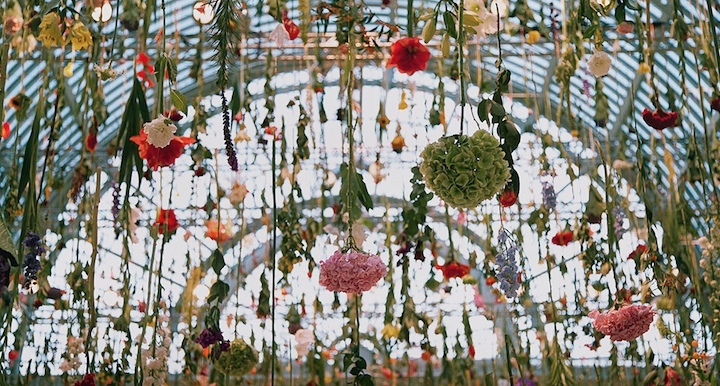
Rebecca Louise Law is known for her breathtaking installations that consist of thousands of hanging flowers suspended overhead. Last February, she was commissioned by London’s Garden Museum to create a temporary, site-specific work for their Floriculture: Flowers, Love and Money exhibition. 3,500 multicolored roses were hung on copper wire and suspended in the central part of the historic building. Visitors were invited to walk beneath the ethereal canopy.

In an interview last summer, she offered insight into the field:

You work a lot with dried flowers…

There are certain flowers that look really beautiful and ethereal dried rather than zingy, fresh and bang in your face, which I do like, but I really enjoy the process of preserving and prolonging the experience of that flower. Most of my work’s a physical thing, you’re surrounded by it, you can touch it rather than view it in a vase, out of reach. I suppose I want people to notice flowers, because you can walk into a room and not really register them; if you’ve seen the same traditional arrangements the whole of your life you don’t truly consider what you’re seeing. …

Florists repeatedly top job satisfaction polls – why do you think this is?

For me, the satisfaction comes from that fact that there’s a start and finish to each job, and because the season’s change, your creations are always changing. When I was a florist, I could get satisfaction ten times in one day by doing a beautiful bouquet and pleasing people – a guy comes in who’s got no idea what he wants to buy for his girlfriend and you have to do some detective work – are they a classic, elegant or arty? You say all these different words and they go: ‘oh yeah that one!’

See more of Law’s work here.

The Loneliness Loop

Does shopping make you sad? Nicholas Hune-Brown reviews a recent study that explored the connection between materialism and loneliness:

In the study [PDF], [researcher Rik] Pieters followed more than 2,500 Dutch people over six years. For more specificity, the researcher broke materialism down into three categories that have subtle but significant differences. What Pieters calls “acquisition centrality” is pure, unfettered materialism. It’s the consumerism of the shopaholic—an unadulterated love of acquiring and owning possessions. “Possession-defined success” is the desire to keep up with your neighbours, a status-driven urge to make sure you’re not falling behind. And “acquisition in the pursuit of happiness” is exactly what it sounds like: buying with the belief that happiness is just one more Apple product away. It is materialism that “reflects a deficit.” …

He found that, over time, loneliness increased materialism and materialism increased loneliness (though the effects here were much smaller). Consumers can find themselves in a vicious circle, shopping because they’re sad, getting sadder as they shop, shopping some more—a loneliness loop that threatens to end with authorities discovering you alone in your apartment, long since dead, surrounded by a heaps of unopened Amazon boxes.

Surprisingly, however, as Pieters dug down into the different types of materialism, he found that not all materialism makes you miserable. While those who shopped in pursuit of happiness or to attain a particular status predictably increased loneliness over time, the people shopping out of “acquisitive centrality” actually seemed to decrease their loneliness.

A Nation Of Home-Wreckers

dish_ise

Japan:

It turns out that half of all homes in Japan are demolished within 38 years — compared to 100 years in the U.S.  There is virtually no market for pre-owned homes in Japan, and 60 percent of all homes were built after 1980. In [professor Jiro] Yoshida’s estimation, while land continues to hold value, physical homes become worthless within 30 years. Other studies have shown this to happen in as little as 15 years.

Does this make  sense? Not according to Alastair Townsend, a British-American architect living in Japan, who is perplexed — and awestruck — by the housing scenario there:

TOWNSEND: The houses that are built today exceed the quality of just about any other country in the world, at least for timber buildings. So there’s really no reason that they should drop in value and be demolished.

In a November blog post, Townshend shed light on the cultural logic:

Firstly, Japan fetishizes newness.

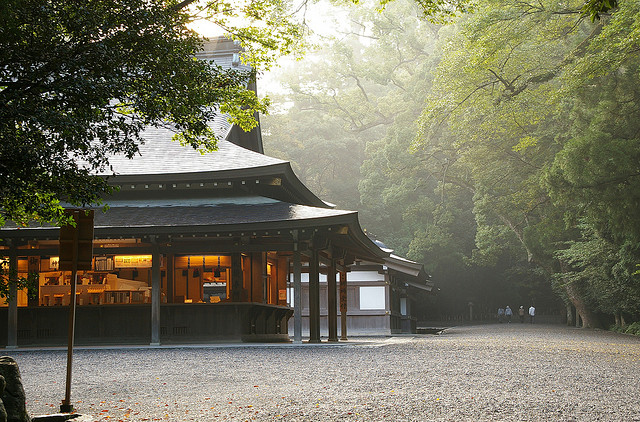
The frequent severity of earthquakes has taught its people not to take buildings for granted. And impermanence is an enshrined cultural and religious value (nowhere more so than at Ise’s Grand Shinto Shrine, which is rebuilt every 20 years). These oft-repeated truisms nonetheless fail to offer a sufficient economic rationale for Japan’s ingrained real estate depreciation. Its disposable attitude to housing seems to fly in the face of Western financial sense.

In the country’s rush to industrialize and rebuild cities decimated after WWII, housebuilders rapidly spawned many cheap, low quality wooden frame houses – shoddily built without insulation or proper seismic reinforcement. Older homes from this period are assumed to be substandard, or even toxic, and investing in their maintenance or improvement is considered futile. So, rather than maintain or upgrade them, most are simply torn down.

Listen to a podcast on the topic here.

(Photo of building at the Ise Shrine in Naikū by Flickr user pelican)

Liking “Like”

Sociolinguist Alexandra D’Arcy explains how using “like” as a form of quotation opens up new avenues for storytelling:

There used to be a time when my story might have been: ‘I saw her enter the room and I was terrified that she would recognize me and so I crouched down.’ Which is actually sort of boring. But now you can tell that as: ‘I saw her, and I was like, oh my god! I was like, what if she sees me? I was like, oh my god, I’ve gotta hide. I was like, what am I supposed to say to her?’ And it can go on. I’ve seen it where you have eight quotes in a row of strictly first-person internal monologue where that monologue becomes action. That’s new.

Michael Bourne elaborates on the history of the linguistic usage (followed by a few reader updates):

D’Arcy traces the expanded use of “like” to speakers born in the 1960s, but says the language feature came into its own with speakers born in the 1970s, “so that by the time you get to speakers born in the 1980s, you get these entire sequences of quotations that recreate an internal thought process.” This accords with the pop cultural history of the usage, which first became famous when Moon Unit Zappa (born 1967) accompanied her father Frank Zappa’s 1982 hit song “Valley Girl,” with an improvised monologue taken from slang she’d overheard at parties and at the Sherman Oaks Galleria in Los Angeles’s San Fernando Valley. The same year, Sean Penn starred in Fast Times at Ridgemont High, partly filmed at the Sherman Oaks Galleria, and the rest is, like, history.

A reader chimes in:

Ummm, seems to me that the addition of so many likes to story telling is also “sort of boring”. Why not:

She walked into the room and I thought, ‘Oh, my god! What if she sees me? What am I supposed to say to her? Oh, my God!  I’ve got to hide!’  So, I dumped into a crouch.

I, like, sorta like that better.

Another:

Twenty or so years ago I was standing in a hallway at the university where I taught when two female students walked by.  One was earnestly recounting a story to her friend. The part of her story that I overheard, in full:

“I was like ‘Yeah’, and he was like ‘No.’ And I was like ‘Yeah’, and he was like ‘No’. And I was like ‘Ye-ah’, and he was like …”

When A Census Could Kill

Burma is set to hold one next month, but observers are worried it will inflame ethnic tensions:

The census, supported by several UN agencies, is deemed important because it has been more than 30 years since a nationwide census was conducted. Through the census, Myanmar’s demographic profile can be objectively determined, which would prove useful for policymakers and potential investors in planning for Myanmar’s development needs.

But the census question on ethnic or tribal identification threatens to ignite more conflicts in the country. The census form requires citizens to choose from the 135 ethnic groups identified by the government. This listing, according to some scholars, is a colonial legacy that should have been revamped a long time ago. Several ethnic groups have complained about being lumped with other minorities while others claimed they were dropped from the listing.

Thin Lei Win has more:

[T]he last census in 1983 reported the national population to be 89.4 percent Buddhist, 4.9 percent Christian, and 4.4 percent Muslim. Although it is widely believed Muslims were undercounted for political reasons, any divergence from the 1983 figures could inflame communal tensions, especially against the Rohingya. Since June 2012, religious conflict across Myanmar has killed at least 240 people and displaced more than 140,000 – most of them Rohingya whom Myanmar does not recognize as citizens.

“Many Rohingya fear the census will become a tool to further deny their access to citizenship rights and to further alienate them from the country’s diverse population. We share those concerns,” said [Matthew] Smith of Fortify Rights, which on Tuesday released a 79-page report on government abuses against the Rohingya using leaked government documents. “There’s a risk the census will contribute to statelessness rather than help end it, which is patently unacceptable.”

Previous Dish on strife in Burma here, here, and here. (Dish on “Burma” vs “Myanmar” here.)

How Should The West Respond?

Russian Anti-War Protesters Detained In Moscow

I’m still absorbing all the information I can, and hope to post something at length tomorrow. But this much seems clear to me: Putin has panicked. To initiate a full-scale war with Ukraine, after effectively losing it because of the over-reach and corruption of Yanukovych, opens up scenario after scenario that  no prudent Russian statesman would want to even consider, let alone embrace. That doesn’t mean he won’t continue to over-reach or that we should be irresolute in confronting this aggression; just that we should be clear that the consequences of further escalation will be deeply damaging for his regime – and certainly far graver for him than for the West.

Obama and Putin spoke on the phone last night. Here’s what Leon Aron wishes Obama had said:

Ideally, the conversation would have been one in which the American president was speaking not only for the U.S., but also for NATO and the EU. The president is likely to have pointed out that the risks would involve Russia’s membership in the G-8, the safety of financial and other assets of the Russian elite which are located outside of Russia, as well as the ability of the members of this elite and their families to visit, live or study in the U.S. and the EU. In addition, Moscow’s behavior could trigger new export controls, which given its dependence on Western technology, particularly in the oil and gas sector as well as in the food industry, could have a very negative impact on the Russian economy.​

Alongside these measures, the U.S. and its allies might also provide – publicly and in private – a few face-saving devices for Russia, such as guarantees that the Russian-speaking Ukrainians will be free from harassment or discrimination of any kind; an introduction of U.N.  peacemaking forces in Crimea to protect the political rights of all Crimeans, and the reaffirmation of the pre-existing “special status” of Crimea within Ukraine, as well as the continuation of the pre-existing Russian sovereignty of the leased naval base in Sevastopol.

It seems to me that the Western-based financial assets of the Russian oligarchy should be the first targets for potential retaliation. Timothy Snyder explains why:

Russian propaganda about depraved Europe conceals an intimate relationship. Tourism in the European Union is a safety valve for a large Russian middle class that takes its cues in fashion and pretty much everything else from European culture. Much of the Russian elite has sent its children to private schools in the European Union or Switzerland. Beyond that, since no Russian of any serious means trusts the Russian financial system, wealthy Russians park their wealth in European banks. In other words, the Russian social order depends upon the Europe that Russian propaganda mocks. And beneath hypocrisy, as usual, lies vulnerability.

Soft power can hurt. General restrictions on tourist visas, a few thousand travel bans, and a few dozen frozen accounts might make a real difference. If millions of urban Russians understood that invading Ukraine meant no summer vacation, they might have second thoughts.

Ben Judah disagrees, noting that Europeans have become more and more dependent on Russia’s money:

Moscow is not nervous. Russia’s elites have exposed themselves in a gigantic manner – everything they hold dear is now locked up in European properties and bank accounts. Theoretically, this makes them vulnerable. … But, time and time again, [Russia’s elites] have watched European governments balk at passing anything remotely similar to the U.S. Magnitsky Act, which bars a handful of criminal-officials from entering the United States.

All this has made Putin [very] confident that European elites are more concerned about making money than standing up to him. The evidence is there. After Russia’s strike force reached the outskirts of Tbilisi, the Georgian capital, in 2008, there were statements and bluster, but not a squeak about Russia’s billions. After Russia’s opposition were thrown into show trials, there were concerned letters from the European Union, but again silence about Russia’s billions.

But messing with Ukraine is different. Europe will feel – does feel – far more threatened by an attack on Ukraine than on Georgia. And Putin has frittered away any benefit of the doubt he once might have had. We have many cards to play. Putin has one: military force. But if he uses it, he will be in a full-scale war within his own region of influence. Whatever else that is, it is not a demonstration of strength. It’s a sign of profound weakness.

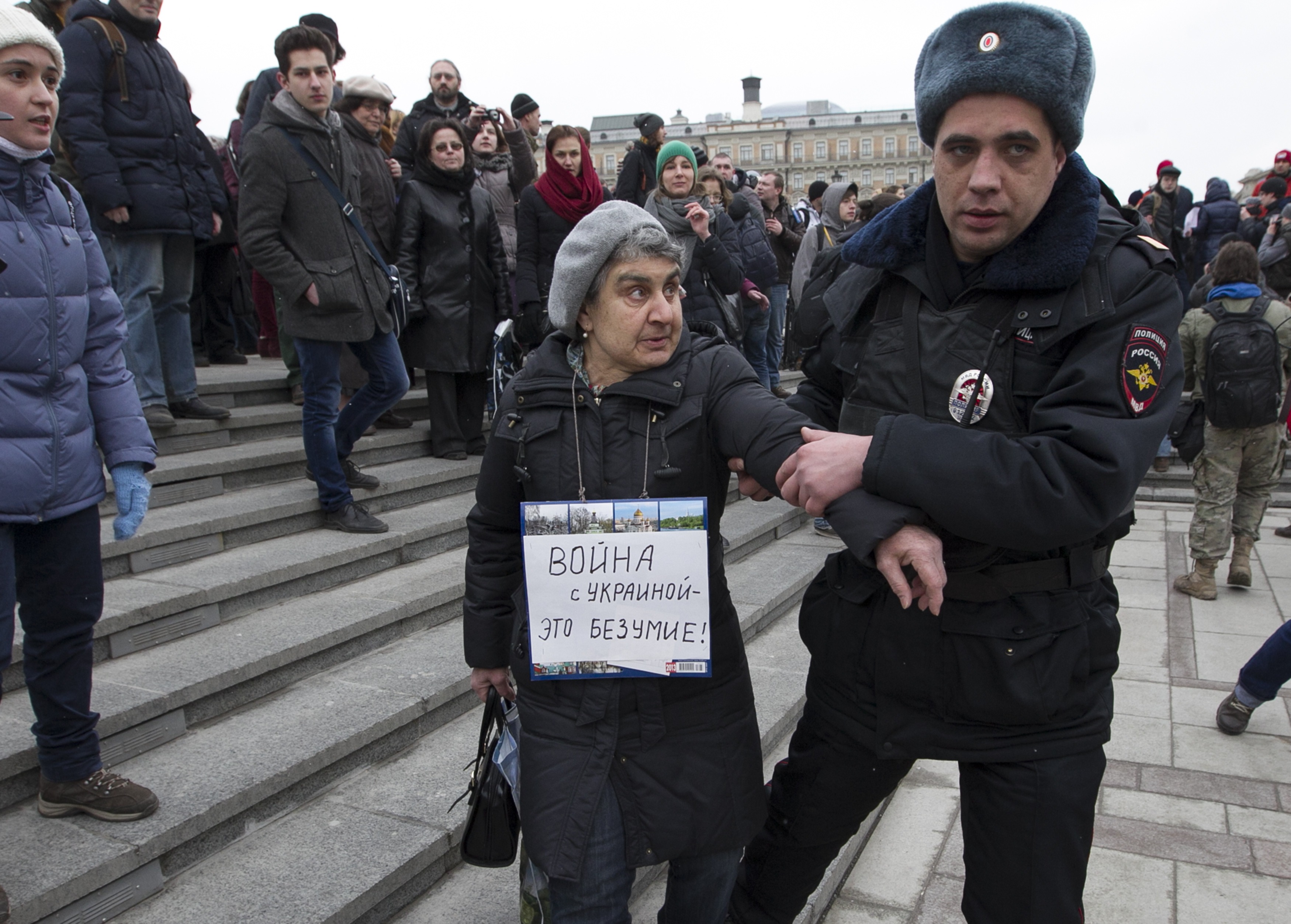
(Photo: An elderly woman wearing a sign that reads “War against Ukraine is madness” is detained by riot police during an unsanctioned anti-war rally close to the Kremlin at Manezhnaya Square on March 2, 2014. Dozens of protesters were detained by police on Sunday during a rally against the military intervention in the Ukraine, after the parliament in Moscow gave President Vladimir Putin approval to use Russian military forces in Ukraine. By Sasha Mordovets/Getty Images.)

Is Breast Still Best?

Jessica Grose flags a new study questioning the long-term benefits of breastfeeding:

[Ohio State University professor Cynthia Colen] looked at more than 8,000 children total, about 25 percent of whom were in “discordant sibling pairs,” which means one was bottle-fed and the other was breast-fed. The study then measured those siblings for 11 outcomes, including BMI, obesity, asthma, different measures of intelligence, hyperactivity, and parental attachment.

When children from different families were compared, the kids who were breast-fed did better on those 11 measures than kids who were not breast-fed. But, as Colen points out, mothers who breast-feed their kids are disproportionately advantaged—they tend to be wealthier and better educated. When children fed differently within the same family were compared—those discordant sibling pairs—there was no statistically significant difference in any of the measures, except for asthma. Children who were breast-fed were at a higher risk for asthma than children who drank formula.

But the study does not dispute the other benefits of breastfeeding:

Colen and [co-author David] Ramey did not examine the short-term protection against chest and gut infections, because these have been most clearly demonstrated by previous research. Breast is still best, says Colen, but the findings suggest that health systems should put less effort into promoting breastfeeding and more into other ways to help poorer households, she says.

Another recent study attributes the higher IQs commonly associated with breastfeeding to other factors:

[A] new study by sociologists at Brigham Young University pinpoints two parenting skills as the real source of this cognitive boost: Responding to children’s emotional cues and reading to children starting at 9 months of age. Breastfeeding mothers tend to do both of those things, said lead study author Ben Gibbs. “It’s really the parenting that makes the difference,” said Gibbs. “Breastfeeding matters in others ways, but this actually gives us a better mechanism and can shape our confidence about interventions that promote school readiness.”