Trade Deals Are Tricky

Banyan has a primer on the Trans-Pacific Partnership negotiations:

Some analysts fear that the compulsion to get the deal done may result in a lowest-common-denominator agreement, whereby each country’s sacred cows are respected and the potential benefits (estimated at nearly $300 billion a year to global income) squandered in advance.

That risk may have increased following the biggest of the many setbacks TPP has suffered recently: it now seems highly unlikely that Barack Obama will persuade Congress to grant him “fast-track” authority (also called Trade Promotion Authority, or TPA), to negotiate trade agreements before the mid-term elections in November (if ever). Without fast-track, agreements can be unpicked line-by-line by Congress, and other TPP countries will be reluctant to sign up.

James Traub looks at the big picture:

The TPP is the Obama administration’s bid to shape an Asia more in America’s image than China’s — which is precisely why it’s the pivot of the Asia pivot.

The traditional objection to trade pacts — and the default position of all too many Democrats — is that they do more harm than good to American workers. But the public-interest critique of the TPP focuses much more on harms that the United States will allegedly be perpetrating upon citizens elsewhere (even though the political representatives of those citizens will have signed the deal). The fear it reflects is a fear of the globalization of U.S. principles. For groups like Public Citizen, one of the most vocal opponents of the pact, the TPP’s hidden agenda is advancing “corporate policy goals, rights and privileges.” The domestic debate over the TPP is thus very largely a debate over the merits of the American economic model.

Noam Scheiber criticizes the priorities of the administration:

What we do know, based on leaked text of negotiations, is that U.S. officials are hard at work on priorities other than U.S. jobs. Many of them look like the priorities of the financial sector, as well as big energy, chemical, and pharmaceutical companies. For example, [Trade Representative Michael] Froman’s team, like the U.S. trade reps that came before him, is pressing to make it harder for countries to restrict the flow of capital across their borders, regulations that helped insulate the likes of Malaysia and Chile from recent financial crises, but which are unpopular on Wall Street. The U.S. negotiators also favor provisions that would make it easier for companies to challenge a variety of financial, consumer, and environmental regulations in foreign countries, and which could help, say, European banks to chip away at Wall Street reform in this country.

The Biological Basis Of Metaphors

Tom Bartlett reports on a relatively new area of inquiry:

Research on embodied cognition – the idea, basically, that the body strongly influences the mind in multiple ways we’re not aware of (though not everyone agrees with that definition) – is a fairly new field, and in the last few years it has produced a number of head-scratching results. For instance, there’s the 2009 study that seems to show that people holding heavy clipboards are more likely to disagree with weak arguments than people holding light clipboards. Or the study, also published in 2009, that found that people gripping a warm cup of coffee judged others as having a “warm” personality.

Another study indicated that that people who like sweet foods are more likely to volunteer – or as Bartlett puts it, “They were metaphorically sweet people who loved actual sweets”:

That finding hits on one of the underlying ideas of embodied cognition – that is, that the metaphors we toss around are grounded in more concrete, physiological truths. Warm things make you physically and psychologically warmer. Cold things make you feel more alienated. Sweet things make you sweeter, and liking sweet things means you behave more sweetly.

Now there are plenty of people, including some psychologists, who are skeptical about some of those results. I wrote about the critics of John Bargh’s research – he did the coffee-mug experiment – in an article last year. And a study that purported to show that people were more generous after riding an “up” escalator was shot down by Uri Simonsohn, an associate professor of psychology at the University of Pennsylvania and a dry-witted crusader against suspicious statistics. (The Dutch researcher who did the escalator study, Lawrence Sanna, later resigned.) But that doesn’t mean embodied cognition as a whole is wrong, of course.

The Vanilla Icing Of Rap, Ctd

A reader writes:

I’m not saying the white boy you posted doesn’t have skills, but the alphabet rapping concept, including progressive acceleration, was done a long time ago by Blackalcious [see above]. I’m more okay with white boys having their place in hip hop if they bring their own perspective and style to the table, like The Streets for example.

Another points to a true original:

A white (as in, albino white), legally blind, Muslim rapper from the Midwest: Brother Ali. He’s been, at times, inspiring to those who are perceived as different (a song called Forrest Whittaker); at times controversial (Uncle Sam, Goddamn); and, always, pretty intelligent and insightful (Dorian, about confronting his physically abusive neighbor, and Travelers, about slavery, African plight, and cultural repercussions for acting so immorally then). He’s not for everyone, but he is very talented.

This freestyle by Brother Ali is pretty amazing:

Comical Racism

Noah Berlatsky explores the controversy over the selection of Michael B. Jordan to play Johnny Storm in the new Fantastic Four movie, asking why this deviation from comic book canon – a black actor playing an originally white character – is such a problem when others are overlooked:

American racism holds that only certain racial differences matter. Jews, Italians, Eastern Europeans, Irish—all those people are white and can play one another with nary an eyebrow raised. Nobody is worried about whether Sue Storm has exactly the mix of Irish, German, and French-Canadian ancestry as Kate Mara, who has been cast to play her. For that matter, no one would say a thing if the actors cast to play Sue and Johnny, sister and brother, came from different ethnic backgrounds and didn’t look much alike. It’s only when one is black and one is white that you need to start worrying about family logistics. (And yes, you can find folks doing that on Twitter as well—because getting turned into living fire by cosmic rays is an everyday thing, but adoption is weird.)

“Fans often seem to believe that if a character is changed from white to black, they will no longer be able to identify with that superhero” Aaron Kashtan, a postdoctoral fellow at Georgia Tech who teaches a course on transmedia storytelling, wrote in an email to me. Kashtan adds that this is an example of “unconscious or overt racism”—a point underlined by the fact that the barriers to identification are so clearly arbitrary. Certain different people—Jews, or Irish, or folks with a hide made of orange rock—can be points of identification. Others, especially African-Americans or anyone with dark skin, can’t.  The issue here isn’t staying true to the original.  The issue is racism.

Daniel D’Addario adds:

The sort of franchise fans whose tweets get quoted in industry stories after big casting decisions see themselves as incapable, apparently, of empathizing with anyone not of their race; in order for a character to be understandable on-screen, that character must be white. But fans will, of course, end up going to see the movie — if you like the “Fantastic Four” characters, you’re simply not going to skip it because you disagree with a casting choice — and will discover what nonwhite movie fans have known for years: There’s no impediment to understanding a character’s motivations and actions simply because he’s of a different race than yours.

Update from a reader:

An even more egregious example happened just a few years ago. When the live-action version of Marvel’s Thor was put into production, there was an enormous uproar in the comics community among people who simply could not accept that Idris Elba, a black man, had been chosen to play Heimdall.

It’s important to note that Heimdall is a god, and his job is to stand guard on the Rainbow Bridge and watch for attacks on Asgard. I guess you could sort of make a case (clearly a racist case) for the notion that changing Johnny Storm from white to black in the new Fantastic Four movie would limit some people’s ability to “identify” with him. But Elba was to play a god. A fictional god. Who does nothing but stand on a mythical bridge, listening intently for invasions by other gods. Who could “identify” with that?

But I’m not totally sure it’s some kind of deeply-held traditional racism at work. Interestingly I think with the Elba casting with Thor, an enormous amount of the fanboys who complained actually were just sharing their initial gut feelings; and I would say the vast majority became completely comfortable with the casting of Elba soon thereafter. I don’t think they were particularly racist; it was just that Elba appeared so visibly “different” than what they had grown up on. It reminded me of many people who, 5-10 year ago opposed gay marriage; not out of any particular anti-gay animus – more from a “Wait, what? That’s for men and women” kind of thinking. But that opposition was a millimeter thick.

I’m embarrassed to admit I wasn’t a lot different 10 years ago; the idea of gay marriage just seemed totally from Mars; and I was a VERY progressive person. Now that it’s “traditional” marriage is thankfully going the way of the Dodo I am constantly asking myself, why didn’t I spend two seconds really thinking this through earlier? I suspect any opposition to Michael B. Jordan’s casting will have a similar arc.

Do Children Have A Right To Die? Ctd

A reader feels that Belgium is moving in the right direction to legalize euthanasia for terminally-ill kids:

I don’t see why we should force a child to suffer when death is imminent in the short term, the child wants to die, the parents consent, and the doctors are in agreement. I think people in the US need to be much more rational and realistic about these things. The reality is that with the advances in modern medicine, we are also condemning people to longer suffering before we allow them to die. Now that we have the power to postpone death almost indefinitely, we should wield that power wisely and humanely.

But another is skeptical:

The problem with the “guidelines” is that they slowly but inevitably widen. In the Netherlands, you can now obtain assisted suicide when you suffer from normal geriatric conditions like hearing/sight loss/fatigue, or mental health issues such as depression. And these guidelines also have to work in conjunction with a patient’s right to refuse a particular treatment. So you have a situation where a depressed person can be a suicidal (a symptom of their condition) and refuse therapy or medication because it is their right to do so, and then can opt for assisted suicide because their suffering is unbearable to them (to mention nothing of the informed consent issues around such patients). And the Netherlands have already used their euthanasia laws to euthanize babies born with severe spina bifida, despite the fact that such children could live long and fruitful lives with modern pain-reduction treatments.

It’s much harder to close the gate once it’s open. I’d prefer any country use its resources to improve pain management rather than bring in these laws.

A Dutch reader unloads:

How dare this reader judge the fate of these babies.

Let me first protest with the phrasing of the reader. The Netherlands – as a country – did not use their laws. The Netherlands – as a country – democratically passed complex laws with the intent of limiting the suffering of patients. The parents of those babies made a heart-wrenching choice. And who better to have the freedom of deciding the fate of their babies than the parents? These decision are not taken lightly. This is not an easy process.

Again, how dare that reader evaluate the life of those babies, while he knows nothing else than an ethics paper describing the legal path the parents chose. As a Dutch citizen, I get pretty pissed when foreigners denigrate our thoughtful laws to bylines. The legal framework of all these laws is incredibly thoughtful and thorough. These are good processes. They offer choices and freedom. Nobody is being forced to do anything at all. The only way you can object is if you just object by principle to whatever is allowed. But you should realize then that you are letting your freedom of religion limit the freedoms of others.

(And now a little rant – maybe not appropriate, but it gots to get out)

It pisses me off even more when supposedly freedom-loving Americans criticize our laws. A couple of reminders:

– We were the first country to recognize the US as an independent nation.
– We were the first to realize that everybody deserves the freedom to marry whom they choose. We have a lower divorce rate than the US.
– We were the first not to go bonkers on pot. We have considerably lower drug use rates than the US.
– We were pretty early on with a very balanced abortion law that works and does not allow partial birth abortion.
– We have a lower abortion rate as well as a lower teen-pregnancy rate.
– We were one of the first with a decent euthanasia law. The US has a hysterical debate about death panels.

(end rant)

By the way, the minister who enacted many of our laws, Els Borst, was found dead laying next to her car recently. Police is investigating and hold all options open.

More reader feedback on our unfiltered Facebook page.

Using The Budget For Target Practice

In the recent White House budget, Obama dropped “chained CPI” – reductions to social security benefits that were supposed to be part of a grand bargain on deficit reduction. Stan Collender puts the move in context:

The reports said that the Social Security plan was dropped because the administration realized it made no sense to propose something that (1) was not going to be well received by Democrats, (2) would not generate bipartisan cooperation from Republicans, (3) would likely cost Democrats votes (and maybe seats) in November and (4) had no chance whatsoever of being enacted. There was no grand budget bargain in the offing so why bother.

But the decision to drop the Social Security plan actually has additional implications that were not covered. It demonstrates that the president’s budget — I’m talking about any president and not just the current one — has become a liability and no longer has much positive value as far as the fiscal policy debate is concerned.

He thinks that president’s budget has become useless since the “president’s proposals have stopped being the place where discussions begin and instead just give Congress something to criticize and reject out-of-hand.” Chait thinks Republicans are losing the budgetary long game:

What I genuinely don’t grasp is the calculation from the long-term perspective of the conservative movement.

While I don’t come close to sharing their bug-eyed fear about the scope of the long-term deficit, I do agree that at some point, a fiscal correction will probably be needed. Now here is an important political-economic reality undergirding this long game. It’s politically feasible to cut future retirement benefits, but it’s not feasible to cut current retirement benefits (as even Republican hard-liners agree.) The longer any such correction is postponed, the longer current benefits are locked in. Every year a deal is delayed, the harder it gets to cut spending, and thus the easier it gets to raise taxes. Bolstering this reality is a simple political dynamic: cutting retirement benefits is wildly unpopular. If forced to choose, people would overwhelmingly prefer to raise taxes.

Paul Van de Water is glad the chained CPI is gone for now:

Since Social Security benefits are modest, and since most beneficiaries have little other income, no one should propose a cut in benefits casually.  We’ve said time and again that the chained CPI is worth considering only if two crucial conditions are met:

•  First, measures to protect the very old and low-income people must be an essential part of the chained CPI; the Administration included these features in last year’s proposal.

•  Second, even with such protections, the chained CPI must be part of a larger budget package that shrinks long-term deficits significantly and does so in a fair and balanced manner by including measures that raise significant revenue in a progressive manner.

This second condition remains well out of reach.

James Pethokoukis is also glad, for different reasons:

Now the demise of this idea is no great loss. Two big problems (beyond Obama’s progressive base hating it): first, this new inflation measure would do a poor job of accurately reflecting prices changes for seniors. Second, switching to chained CPI would be a big long-term, middle-class tax hike. By also lowering annual inflation adjustments to the tax code, chained CPI would, as AEI’s Andrew Biggs has noted, “reduce the value of credits and deductions and push a greater share of workers’ incomes into the higher tax brackets. Result: higher taxes, and particularly so on low and middle class households.”

Erick Erickson Has A Point

The right-wing pundit, who supported the Kansas discrimination bill, feels that his side’s position is being distorted:

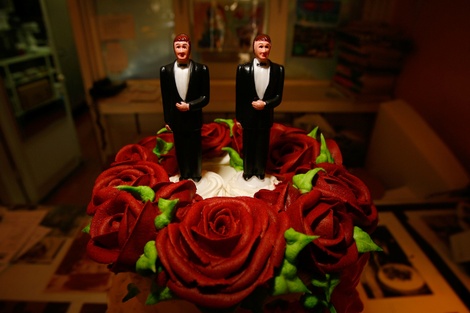
If a Christian owns a bakery or a florist shop or a photography shop or a diner, a Christian should no more be allowed to deny weddingcakedavidmcnewgetty.jpgservice to a gay person than to a black person. It is against the tenets of 2000 years of orthodox Christian faith, no matter how poorly some Christians have practiced their faith over two millennia.

And honestly, I don’t know that I know anyone who disagrees with any of this. The disagreement comes on one issue only — should a Christian provide goods and services to a gay wedding. That’s it. We’re not talking about serving a meal at a restaurant. We’re not talking about baking a cake for a birthday party. We’re talking about a wedding, which millions of Christians view as a sacrament of the faith and other, mostly Protestant Christians, view as a relationship ordained by God to reflect a holy relationship.

This slope is only slippery if you grease it with hypotheticals not in play.

But the wording of the bills in question – from Kansas to Arizona – is a veritable, icy piste for widespread religious discrimination. And that’s for an obvious reason. If legislatures were to craft bills specifically allowing discrimination only in the case of services for weddings for gay couples, as Erickson says he wants, it would seem not only bizarre but obviously unconstitutional – clearly targeting a named minority for legal discrimination. So they had to broaden it, and in broadening it, came careening into their own double standards. Allow a religious exemption for interacting with gays, and you beg the question: why not other types of sinners? If the principle is not violating sincere religious belief, then discriminating against the divorced or those who use contraception would naturally follow. I’ve yet to read an argument about these laws that shows they cannot have that broad effect.

But here’s where Erick has a point:

It boggles my mind to think any Christian should want the government to force their [pro-gay] view of Christianity on another believer.

That’s my feeling too. I would never want to coerce any fundamentalist to provide services for my wedding – or anything else for that matter – if it made them in any way uncomfortable. The idea of suing these businesses to force them to provide services they are clearly uncomfortable providing is anathema to me. I think it should be repellent to the gay rights movement as well.

The truth is: we’re winning this argument. We’ve made the compelling moral case that gay citizens should be treated no differently by their government than straight citizens. And the world has shifted dramatically in our direction. Inevitably, many fundamentalist Christians and Orthodox Jews and many Muslims feel threatened and bewildered by such change and feel that it inchoately affects their religious convictions. I think they’re mistaken – but we’re not talking logic here. We’re talking religious conviction. My view is that in a free and live-and-let-live society, we should give them space. As long as our government is not discriminating against us, we should be tolerant of prejudice as long as it does not truly hurt us. And finding another florist may be a bother, and even upsetting, as one reader expressed so well. But we can surely handle it. And should.

Leave the fundamentalists and bigots alone. In any marketplace in a diverse society, they will suffer economically by refusing and alienating some customers, their families and their friends. By all means stop patronizing them in both senses of the word. Let them embrace discrimination and lose revenue. Let us let them be in the name of their freedom – and ours’.

What If Ukraine Splits? Ctd

Alexander Motyl calls the country’s east-west divide a false binary that doesn’t explain the conflict as neatly as some Western commentators would like:

The real divide in Ukraine is not between East and West, but between the democratic forces on the one hand and the Party of Regions on the other. The latter is strongest in the southeast, mostly because its cadres (who are mostly former communists) have controlled the region’s information networks and economic resources since Soviet times and continue to do so to this day. Their domination since Ukraine’s independence rests on their having constructed alliances with organized crime and the country’s oligarchs, in particular with Ukraine’s richest tycoon, Rinat Akhmetov. They have enormous financial resources at their disposal, control the local media, and quash — or have quashed — all challengers to their hegemony. Their rule has been compared, not inaccurately, to that of the mafia. Ukrainians in the southeast tend to vote for them, less because they’re enamored of Yanukovych (they are not), and more because they have no alternatives and, due to the Region Party’s control of the media, see no alternatives.

But Christian Caryl says neglecting the divide is “wishful thinking”:

To emphasize these complexities is not — as some would claim – to deny Ukraine’s viability as a state. Nor does it imply that Ukraine ought to be carved up into constituent units.

Ukraine is perfectly capable of continuing its existence as a state if it can find an institutional framework that will take its political diversity into account — instead of lurching from one crisis to the next as it has over the past 15 years.

Ukraine’s regional differences do, however, mean that we should take the possibility of civil conflict seriously. Reporters in Kiev have already described the rise of quasi-military “self-defense units” among the protesters. What has gone largely unremarked is the rise of similar paramilitary groups in the East. As this map by political observer Sergii Gorbachev shows, Yanukovych’s political machine has been busily standing up “militia units” throughout the East, sometimes with overt ties to local gangland structures. Here, for example, is a Russian-language interview with one ex-convict who’s setting up his own pro-Yanukovych militia in the Eastern city of Kharkov. He won’t say how many members the new group has, but he’s quite open about its aims: “I’m preparing my population and my people for war.”

Adam Taylor points to Crimea, where loyalties are distinctly Russian, as a potential breakaway region:

From the 18th century on, the region was part of Russia, but that changed in 1954, when the Supreme Soviet of the Soviet Union passed it from the Russian Soviet Federative Socialist Republic to the Ukrainian Soviet Socialist Republic, a decision that is still controversial in some circles. Today the peninsula might still be a part of Ukraine, but in many ways it is separate from the rest of the country: It has its own legislature and constitution, for example, and it’s still very Russian: Some  60 percent of the population is ethnically Russian, with the rest being Ukrainian or Crimean Tatars.

It appears that some members of this Russian community have regarded the events in Kiev with a mixture horror and opportunism: The chaos in Ukraine could finally be the region’s chance to turn back to Moscow.

Max Fisher, who has pushed a structural explanation of the conflict, argues that both competing narratives have some merit:

The structural storyline, of an identity crisis fueled by history and demographics, appeals for its neatness and its comprehensive breadth. But it tends to rankle people, and not without reason, who see it as explaining away the bravery and idealism of the protesters, or forgiving the very real abuses of Yanukovych.

The more human narrative, of regular Ukrainians pushed to the breaking point by an abusive government they can no longer tolerate, is much more emotionally satisfying. Anyone can relate to it. It appeals especially to Americans, who feel an immediate affection for any pro-democracy movement, particularly one that expresses a desire to reject Russia and embrace the West. Still, this story ignores the 30 percent of Ukrainians who wanted to reject the E.U. deal for a Russia-led trade union, and it ignores the pro-Russia attitudes in the eastern half of the country. It almost seems to tell pro-Russia Ukrainians that they don’t count, which can feel a bit Russophobic.

Yglesias Award Nominee

“There are several possible explanations for why Republicans would not denounce Nugent and his statement in unqualified terms. One is that they aren’t all that offended by what Nugent said. A second is Nugent is on their “team” and therefore needs to be treated with kid gloves. A third explanation is that they fear that in denouncing Nugent they will upset elements of the GOP base. Any of these explanations is an indictment,” – Pete Wehner, Commentary.

Are Colleges Failing Their Mentally Ill Students? Ctd

A reader writes:

I find this thread very interesting, though not surprising. I was suicidal in college for a time, and I did get counseling for depression. And it helped, a lot. But I never, ever admitted to anyone on campus that I was suicidal. I can’t remember why, exactly, but I knew the reaction from admin would make things worse. I believe the Resident Advisers told us during orientation that they were required to report anyone who acknowledged suicidal tendencies, so that might have been the tip off that something was up.

What’s especially strange to me is that from my perspective, it seems like everyone goes through a time where they feel somewhat suicidal.

I’m sure the intensity varies, but I suspect everyone considers it at some point. I think it’s pretty normal, and natural, and most people reject it. Which is good. But the fact that you can’t acknowledge those kinds of feelings without triggering a massive over-the-top freakout from people who are supposed to be there to help you is very counter productive. Even acknowledging having had suicidal thoughts in the past sends therapists spinning – the only time the student counselor I saw in graduate school really pressed me on anything was when I admitted to having been suicidal in college, and she clarified several times that I wasn’t suicidal anymore.

In a way, this whole debate seems similar to the counseling for child molesters discussion. Mandatory reporting in both cases drives the sufferer underground where they can’t get the help they need and are more likely to act on their thoughts. And that’s not good for anyone.

Another shares an old story:

I was a law student working in the library one night about 20 years ago now, when a woman came to the desk where my co-worker and I were softly chatting and said “Excuse me, I’m sorry, what did you say?” At first we responded normally, but after she repeated this phrase like a stuck record about the sixth time and threw in a “what did you say about being submissive?” we ignored her and she wandered off.  After we started getting reports about her saying odd things to other students, I called the campus police – not sure what else to do.  I really just wanted to make sure she was safe, because she didn’t seem very functional.  They ended up taking her out of the library in handcuffs.

I have no idea what happened after that, though I later heard she was a staff member who had been discharged as a result of mental illness and had been trying to look up information about the Americans with Disabilities Act, to the extent that here poor, afflicted brain would let her.  It’s not just suicide we don’t know how to handle, it’s any malfunctioning brain.  And sadly, I doubt the response today would be any different than it was 20 years ago.

Another with present-day experience:

As a human resources management professor, I feel sensitive to the needs of students with mental health issues. I include a statement relating to Americans with Disabilities Act in all of my syllabi to let any student know that my university and I are committed to providing reasonable accommodation to any student in need. However, helping any student with a mental health problem is difficult.  Might I note that:

1) Does any entity or organization in the U.S. really do a good job handling mental health issues?

2) We have ADA, the Privacy Rule of HIPAA, and FERPA all interacting to cause a lot of apprehension and confusion among professors.  While I’m not a lawyer, I understand all of these laws; yet I’m not a lawyer and many times have to make numerous phone calls to even understand what I can, can’t, should, or shouldn’t do.

3) My employer has several resources available to help educate professors and to help students in need of mental health treatment. However, I cannot force a student to seek help.  I can only recommend.  I can notify the proper people on campus if I suspect a student needs help, and those people can contact that student.  That student doesn’t have to accept the help.  Unless the student poses an immediate threat to him or herself, a professor, or classmates, I can’t do much except make it known that resources are available.

In the wake of the Virginia Teach shootings, I know many of my colleagues have increased their efforts the help those with mental health issues.  That is, if we can determine symptoms correctly.  I mentioned I have an ADA statement in my syllabus, which asks students to contact me as soon as possible so we can agree on reasonable accommodation. What if a student doesn’t tell me? I have a graduate student this semester that demonstrates clear impulse control and manic behaviors.  I and other faculty members have discussed his behaviors with him. We cannot make clinical diagnoses but can recommend counseling services.  Even doing that carries a risk. What if we’re wrong?  In this case, the student came to us after several meetings over months and several demonstrations of inappropriate behaviors to finally tell us he has a problem. Now, almost halfway into the semester, we can try to get him help, if he accepts it.

How many of your readers have ever had a student tell them that he went through double-agent espionage training? That the Russians and Americans are both after him?  That his former girlfriend injected him with a tracking device?  That his own mother is a Russian agent? And … oh … he received military training and carries a licensed weapon. How safe would they feel? All you can do is notify the proper people on campus, hope he doesn’t get upset with you, and takes the help offered. It’s easy to say higher ed has failed, but how many of your readers have grappled with these issues? It’s not as simple as going up to a student and saying, “Hey, I think you have a mental health problem…let’s walk to the counselor.” We’re not trained lawyers or clinical psychologists, but most of us are trying very hard to do what’s in the best interests of affected students AND their classmates.