Chutzpah Watch

Bill Kristol’s latest column is close to self-parody:

Kiev is ablaze. Syria is a killing field. The Iranian mullahs aren’t giving up their nuclear weapons capability, and other regimes in the Middle East are preparing to acquire their own. Al Qaeda is making gains and is probably stronger than ever. China and Russia throw their weight around, while our allies shudder and squabble.

Why is this happening? Because the United States is in retreat. What is the Obama administration’s response to these events? Further retreat.

PM Carpenter calls the editorial “a magnificent send-up to flamboyant despair and rhetorical folderol”:

Regional history needn’t be consulted, complexities needn’t be pondered, alternatives needn’t be explored. All trouble spots can be explained by America’s “retreat” in confronting what Kristol obliquely calls the world’s “barbarians”–a perilous legacy, he warns us as well, which is at our gates: “Rome fell not to the majestic Hannibal but to groups of unimpressive barbarians.” You might think Rome fell because of a bloated military complex that had extended its imperial borders beyond both affordability and defensibility–by which point those “unimpressive barbarians” were indeed remarkably impressive–but you would only be committing the error of consulting history.

Michael Brendan Dougherty adds:

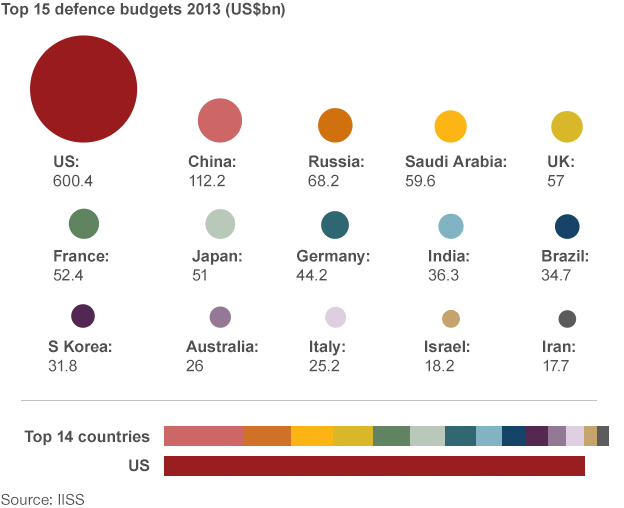
[T]he idea that America is in retreat is hysterical gibberish. It can only be made plausible if one takes the immediate years after 2001 as the normal state of American foreign policy, or if you consider the emergence of any regional power (whether it be Iran or Russia) a dire threat. The U.S. still maintains 20 large foreign military bases around the globe, including some 70,000 troops stationed throughout Europe. Any diminishment of our war footing initiated by the Obama administration over his last years in office will leave America far and away the largest military force on the globe, better equipped and more easily deployed than any of its rivals.

Larison piles on:

It is absurd to pin these events on American “retreat,” since for the most part this isn’t even happening. So-called U.S. “retreat” didn’t cause any of these things, and all of them would probably still be happening whether the U.S. was “retreating” or “advancing.” The U.S. is responsible for the effects of its own actions and policies, and to a lesser extent the actions of its allies and clients that it supports, but it isn’t responsible for what authoritarian and illiberal regimes do inside their own countries, and for the most part it can’t be held responsible for how other major powers behave.

Back To The Futurism

States_of_Mind-_The_Farewells_by_Umberto_Boccioni,_1911

Vivien Greene, curator of the Guggenheim’s new exhibit on the Italian Futurists, explains how F.T. Marinetti and his compatriots violate our ideas about the avant-garde:

This is sort of a scholarly debate, but I think for many people the definition of avant-garde means it follows the idea of the scholar named Bürger, and to be avant-garde means you have to be of the left. So if you break out of that mold—it’s hard to think of an avant-garde that was on the right. And I think with Futurism you have that, because in every other way, they’re satisfying our ideas of what is avant-garde: they’re new, they’re disruptive, and as they continue to develop into the ’20s and ’30s, they are reinventing themselves. It’s not as though they’re painting the same thing over and over again. They evolve while still keeping in mind the basic tenets of what is Futurist: dynamism, simultaneity, speed, technology, the machines. They embrace new things; they’re not at all static. Innovation is very important to the ideas of the avant-garde.

The Economist suggests that the movement’s fascist associates were one reason the Futurists have never had a major retrospective in the US:

Marinetti, a showman who liked to call himself “the caffeine of Europe” for the energy he put into promoting the futurist movement, was an early fan of Benito Mussolini and took part in the founding of the fascist movement in 1919. Marinetti wanted futurism to be Italian fascism’s official art movement. But the dictator refused, preferring to bestow his favours on different art movements at different times. The two men blew hot and cold about one another. Yet when Mussolini fell from power in 1943 and Hitler named him the head of the puppet Italian republic of Salò, the founder of futurism was one of the first to offer his support. Marinetti died just five months before Mussolini was executed, their lives seemingly forever linked.

In a largely complimentary review, Peter Schjeldahl calls Italian Futurism “the most neglected canonical movement in modern art – because it is also the most embarrassing”:

An avant-garde so clownish, in its grandiose posturing, and so sinister, in its political embrace of Italian Fascism, has been easy to shrug off, but the [Guggenheim] show makes a powerful case for second thoughts. It arrays some superb paintings and sculptures, the best of them by Umberto Boccioni, whose death in the First World War, at the age of 33, deprived the movement of its one great artist. And marvels of graphic and architectural invention reward a stroll up the Guggenheim’s ramp.

(Boccioni’s States of Mind II: The Farewells, 1911, via Wikimedia Commons)

A Hollow Victory In Mexico’s Drug War?

On Saturday, Joaquín “El Chapo” Guzmán, head of Mexico’s Sinaloa cartel, was captured after a 13-year manhunt. Daniel Hernández profiles the infamous kingpin:

[In 1993, Guzmán] was sentenced to 20 years in a maximum-security prison, but in 2001 he managed to escape, cartoonishly, in a laundry cart. Guzmán expanded his reach by trafficking marijuana, heroin, and cocaine into the United States, Europe, and Australia. He is said to exert control over most of western Mexico, parts of Guatemala, and trafficking ports in West Africa. While his nickname means “Shorty,” there’s nothing diminutive about El Chapo’s stature in the illicit drug world. Forbes has regularly named him in its lists of richest and “most powerful” people.

Juan Carlos Hidalgo asks the obvious question:

Without a doubt, Guzmán’s capture is a huge success for [Mexican president] Enrique Peña Nieto. In the last seven months, the leaders of Mexico’s top three drug cartels (Zetas, Gulf and Sinaloa) were arrested without a single shot being fired. So, are we on the verge of wining the war on drugs? That all depends on what the ultimate goal is.

Is it taking down drug kingpins or stopping the flow of drugs into the United States? If it’s the latter, the war is far from over. A report from the Office of Intelligence and Operations Coordination of the U.S. Custom and Border Protection agency looked at drug seizure data from January 2009 to January 2010 and matched it with the arrests or deaths of drug operatives (11 druglords in total). It found that “there is no perceptible pattern that correlates either a decrease or increase in drug seizures due to the removal of key DTO [drug trafficking organization] personnel.”

Keegan Hamilton warns that Guzmán’s arrest might actually make matters worse:

Each time a kingpin falls, bloody internecine conflict inevitably follows. When the Gulf Cartel boss Osiel Cárdenas Guillén ended up in Colorado’s infamous “supermax” federal penitentiary after his arrest in 2003 (a fate that may await El Chapo—federal prosecutors have already announced that they will seek his extradition), it paved the way for the Los Zetas cartel to commence its reign of terror across Mexico. The current situation in the Mexican state of Michoacán—where peasants have formed heavily armed militias to fight back against corrupt police and extortionist gangs—stems from the fragmentation of the La Familia cartel after the rumored death of its leader, Nazario “El Chayo” Moreno.

Even with El Chapo behind bars, the Sinaloa Cartel remains the most powerful drug-trafficking organization in Mexico, if not the world. Its operatives have been arrested in Africa, Asia, Europe, South America, the Caribbean, and, of course, the United States. The cartel may have lost its CEO, but its board of directors remains intact.

Mark Guarino highlights Sinaloa’s US distribution operation, based out of Chicago:

The city, centrally located, has become a hub for distributing drugs to other cities across the country, and its sizable Mexican population (both legal and illegal) provides the cartel with ready access to foot soldiers. For those reasons, the US Attorney’s Office in Chicago indicted Guzman in absentia in August 2009 for conspiring to transport drugs across international borders, and the US has prosecuted key figures in the cartel’s US operations here. The Chicago Crime Commission named Guzman public enemy No. 1, a designation previously given to a crime boss from another era, Al Capone.

Keating adds that Mexico’s much-touted drop in violence under Peña Nieto’s leadership is misleading:

According to the government’s statistics, the 18 percent drop in murders in 2013 was accompanied by a 35 percent increase in kidnapping. And Molly Molloy, a research librarian and a specialist on Latin America and the U.S.-Mexico border at the New Mexico State University Library, argues that the declining murder rate is the result of the country’s statistical agencies classifying fewer killings as “intentional homicides,” coupled with the fact that “the epicenters of extreme violence have dispersed around the country, making it more difficult to know how many people are dying.” She argues that there’s no evidence to suggest the total number of murders has declined at all, though different regions have seen changes in the level of violence.

The View From Your Window Contest: Winner #193

vfyw_2-22

A reader writes:

Hmmmmm. The fan palms (perhaps Sabals), not much of any other type of palm present except for miniatures, the hint of industry with smokestacks and powerlines in the background, make me think of the area northeast of downtown Jacksonville, FL, perhaps in proximity to Heckscher Blvd, near where I-295 & state 105 intersect, on a heading towards A1A (my favorite state highway in the US today!). If so, I’m glad the photographer caught it during a time of relatively few industrial explosions – looks more appealing then.

Another is apathetic:

This has got to be one of the most uninteresting and mundane views you’ve featured in a contest. The palm trees, flat terrain and mountains in the background appear to be Southern California, and I’ll be a little more specific to guess the L.A. Basin somewhere. But beyond that, I don’t really care.

The views are only as good as the submissions. Another reader:

Palm trees, red curbs, and it sure looks better than today in Minnesota! Hawaii?

Another:

I really don’t know. The vibe is definitely Southeast US – the buildings, the parking lot, the vegetation, to me it looks like any number of small cities in Florida. But the distant cranes and smoke stacks suggest a major port. Could it instead be Georgia? South Carolina? Can’t make out the license plates. Without the skills of many of your contestants, I’m afraid I’m going to have to just guess – how about Charleston, SC?

Nope, the other coast:

This has got to be southern California! Wide parking spaces, GM work van, yellow Prius taxis, combined with palm trees, smog, and mountains faintly visible in the background. What looks like a refinery or chemical processing plant in the background makes me say an area like Long Beach or El Segundo, but I don’t have the time to be a superguesser!

California it is. Another reader:

If I google one more California oil refinery I’m going to end up in GITMO, so I’m giving up. Guessing Huntingdon Beach because their parking lots have those double-line bay dividers and the diamond-shaped islands of shrub, but the distant industrial thing doesn’t seem to match.

Another gets on the right track:

The van and large pickup in the parking lot makes it the U.S.A. The combination of palm trees and eucalyptus trees makes it Southern California. The dark line across the horizon might be mountains, but I don’t think so – I think it’s a marine layer fog bank, and the camera wasn’t pointed toward the mountains. In the background you can make out both refinery towers and port cranes. That puts it somewhere near the ports of Los Angeles–Long Beach, probably the “South Bay” area: Torrance, Wilmington, San Pedro, somewhere like that. I didn’t try to explore it down to the street level.

Another gets the right city:

A completely nondescript yet very typical place in Southern California. The industrial background + a lack of visible landmarks rules out a large number of places in the LA basin but does not help me zero on a particular location. Judging by the shadows, the photographer is facing NNE, yet the mountains are far. So I’ll just guess Torrance.

Another nails the right building:
Google Map

When I looked at this week’s contest photo, my first reaction was: “Wow, this is easy.” Eucalyptus trees and palm trees and an oil refinery all in the same picture? Smoggy mountains in the distance? This pretty much has to be somewhere in Southern California.

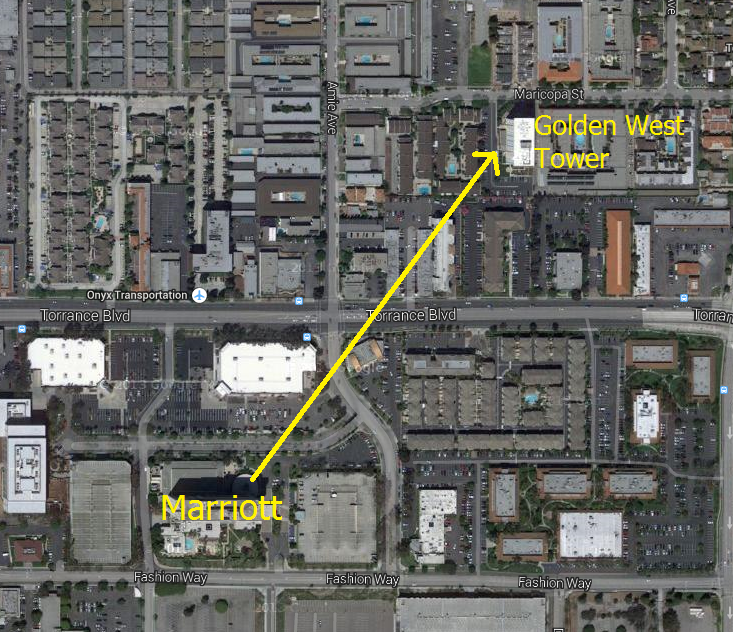
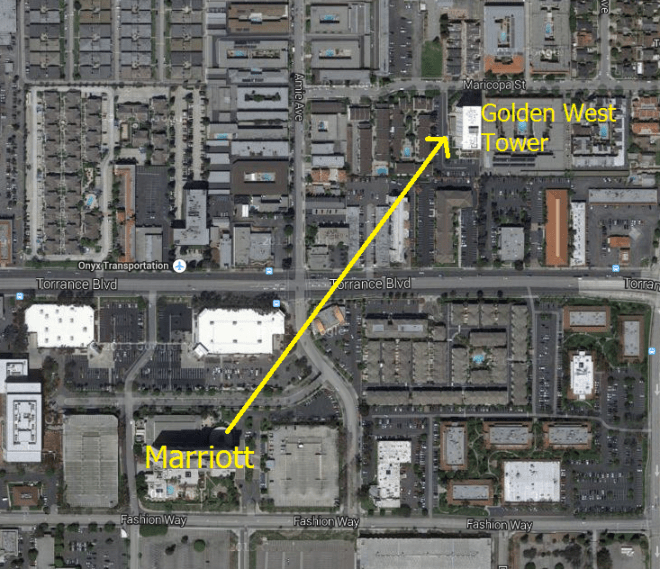
But it was only when I looked more closely at the photo that I realized just how easy it was (at least for me). You see, this is my hometown, Torrance, in the South Bay area of greater Los Angeles. The tallish building in the center of the photo is the Golden West Tower, an apartment complex for seniors built back in the 1970s. (As a child I watched the construction of that building from my second-floor bedroom window.) The refinery in the background is an Exxon Mobil facility (which exploded at least twice during my childhood.) The photograph was apparently taken from the Torrance Marriott South Bay Hotel, located just to the north of the Del Amo Fashion Center on Fashion Way. The person who took the picture is on the north side of the hotel looking to the northeast (you can just make out the San Gabriel Mountains in the haze on the horizon).

A wider view:

unnamed

Another reader:

Ordinarily I try to send in some interesting tidbit about the places in the picture. But this week’s searches turned up a different type of results. The picture features a large ExxonMobile refinery that was evacuated last year and the Golden West Tower apartment building for seniors where an 80 year old resident committed a double murder-suicide in 2012. Oil and gun violence. A very American landscape.

Another adds, “I thought about calling up the hotel and asking about their room numbering scheme, but that just seemed creepy.” Another ventures a guess at the room number:

I finally got one. I have been reading your blog for years now and am going to join right away. Usually the contests are in some far off place, but this one is in my backyard. The photo in this week’s contest is taken from the Torrance Marriott Hotel. The only lower floors that have balconies are the 3rd and the 4th. So my best guess is Room #337.

Another:

Hi! Founding and renewing member here.  So, I fire up the page, see the picture, turn to the wife and say “I know that building!” My grandparents lived in that large building in the ’70s. When I was a kid, we’d drive up from San Diego about every couple of months for a visit and have lox and bagels for breakfast and later go to the coffee shop around the corner for dinner. Every time. They were also the first and only people I knew that were actually afraid of the microwave oven. I could tell you more about them and my visits but I believe that’s a different contest. Now for the guessing: 6th floor, room 622.

So close. The winner was the only reader to correctly guess the room:

marriott

Well this just screams Los Angeles. But where? The real clue in finding the exact location was the refinery in the distance. The obvious first choice was the Exxon-Mobil refinery in Torrance. A quick search of hotels in the area turned up the Marriott at 3635 Fashion Way, Torrance, CA.

Now to guess the room number (argh). It looks like the floor is just above tree level, so it’s probably the sixth or seventh floor. I’ll go with the sixth floor. I can pinpoint the room visually, but I couldn’t turn up a floor plan to be sure of the room number. Taking a guess as to the numbering scheme, I’ll go with 629 (608, 607 and 630 would be my alternatives).

Thanks for an easy one this week. St Paul drove me nuts last week.

From the submitter:

I’m not sure if this one will be too easy, given that you certainly have many followers in Southern California, but I showed it to my husband, who grew up here in Los Angeles in the South Bay, and he didn’t recognize it, so here goes. That building in the distance is of no particular significance, by the way (it’s a retirement community), except that there was a murder-suicide there a couple of years ago, something that sadly is not unheard of in retirement homes. In the farther distance you can see the Exxon Mobil Refinery, and beyond that, mountains.

I had to spend a good part of the weekend chaperoning students from my school who were attending the Junior Statesmen of America Winter Congress that was being held at the Torrance Marriott. This photo was taken at about 11 am on Sunday, February 16 from room 629.

(Archive)

Right-Sizing The Military

Defense Budget

Chuck Hagel’s 2015 budget would reduce the number of Army soldiers to the lowest level since before the World War II mobilization:

The budget also targets personnel costs, with cuts to soldiers’ housing allowances and commissary subsidies, as well as potential increases in health-care fees for the family of active service members. Hagel also proposed a one-percent pay raise in 2015, though pay for flag officers and generals would be frozen at current levels.

Those cuts take a small swipe at what’s known as “brass creep”—the swelling ranks of generals and admirals who earn high salaries and retire with cushy pensions. Congress approved multiple raises during the Iraq and Afghanistan wars, but a look at base pay rates (what soldiers earn before add-ons like housing allowances and combat pay) shows that the wartime wages didn’t trickle down the chain of command.

Derek Mead explains why the Pentagon is cutting personnel:

The main reasoning behind the personnel cuts, according to the Defense Department, is that the US does not need to maintain a force capable of large-scale land occupation when the war in Afghanistan is drawing to a close. Instead, the military is increasing its focus on special operations and cyberwar—and increasing its use of robots.

The growth of war bots has been noted for years now, thanks to revelations about the drone war and key reports like Peter Singer’s 2010 “War Machines” story for Scientific American. Since then, we’ve seen the military head further into its cyberpunk phase, with autonomous killer robots now going through testing, which the UN has cautioned against. But in the near term, the reality for the military means higher tech soldiers in fewer numbers; whether they are firing smart rifles or flying drones, a high-tech, automated army can be less costly if utilized effectively.

But Christopher Preble argues that the cuts don’t go far enough:

The Pentagon apparently still intends to retain 11 aircraft carriers, possibly cutting into modernization of the Navy’s surface combatant ships. As had been reported earlier, the venerable A-10 attack aircraft is going away, but the Pentagon remains committed to the troubled F-35. The early details don’t address the possible modernization of the nuclear triad, which is sure to compete with other Air Force and Navy priorities. If the Pentagon isn’t serious about confronting those tradeoffs, the resulting infighting could get ugly.

David Edelstein suggests that Hagel may be “tying hands” – preventing the US from engaging in more foreign entanglements. But Millman doubts a smaller army will rein in the interventionists:

The proposed changes in forces structure do not imply a shift non-interventionism. They will make it even more difficult to contemplate long-term, large-scale occupations, but such would have been difficult to contemplate even at a 500,000-person Army. That still leaves very much open the use of force in more “discrete” ways – drones, Special Forces, etc. – that have been the hallmark of the Obama Administration since the beginning of the drawdown in Afghanistan. We should also remember that fighter jock Donald Rumsfeld also advocated a lean and mean Army, and planned the Iraq War precisely as a demonstration of how much we could achieve without deploying an occupation-scale force. We all know how that turned out, but while some learned the lesson, “don’t do that again,” others learned the lesson, “we need to learn how to do that better before we do that again.”

Allahpundit imagines what kind of hay the Republican presidential candidates will make of this:

Rubio, a hawk in the McCain mold, will rip Obama for retreating — but candidates like Walker and Christie will try to walk a line between hawks and doves. So will Paul, actually: His big liability potentially is being seen as Ron Jr. on foreign policy so he may feel obliged to balance his praise for the “smaller, leaner military” approach with criticism of Obama for not beefing up certain areas. And what about Cruz? In a sense he has the opposite problem of Paul, wanting to attack Obama for weakening America but needing to find some merit in cuts to the budget.

Kori Schake is pleased that the Pentagon is learning to live within its means:

Defense Secretary Chuck Hagel deserves considerable credit for owning up to the fiscal reality that defense spending will no longer have galloping rates of increase. Specifically, he deserves credit for bringing the department’s budget into compliance with the law. An obvious point, one would think, is that the budget request ought to be in line with the Defense Department spending cap legislated in the 2011 Budget Control Act. Not something we loyal opposition should applaud, since it ought to be standard practice. Yet this is the first budget that acknowledges Congress has given federal spending guidelines that must be followed. The budgets submitted by Barack Obama’s administration were in excess of the top line.

Larison pushes back on the headline, seized on by the right, that the budget reduces the Army to pre-WWII levels:

Critics of any reduction in the size of the military or the military budget are always going to seize on such misleading comparisons to make reductions appear to be much more significant, so it’s important not to blow them out of proportion or make them out to be something more than they are. Before and during the 2012 campaign, Republican hawks repeatedly claimed that the Navy was being shrunk to WWI-era levels, which was true provided that you paid no attention to the quality of the ships, the vast technological differences between the two periods, and the relative strength of other naval forces. Likewise,references to having the “smallest Army since 1940″ conveniently ignore that the U.S. will still have more men under arms than any country in the world except for the two most populous countries, and will still be far and away the leading military power in the world.

Peter Weber does the math:

Here’s another way of looking at Hagel’s budget: In 1940, U.S. defense spending was $1.7 billion, or 1.3 percent of GDP; in 2011, it was $705.6 billion, or 4.7 percent of GDP. Hagel’s budget proposes lowering defense spending to $496 billion — the cap in last December’s bipartisan budget deal, or about 2.7 percent of GDP. America would still be spending more than twice as much on defense as it did in 1940, as a percentage of GDP.

Conor weighs in:

Circa 1940, the U.S. had a grand total of zero nuclear weapons. Today the U.S. has 5,113 nuclear warheads. An already dated Wired article noted in 2011 that the U.S. had  7,494 drones, including 161 Predators, which are used for targeted killing. The U.S. also has ten aircraft carriers. How many carriers does our closest military rival have?

One.

(Chart from the BBC.)

Who Controls Ukraine Now?

UKRAINE-UNREST-POLITICS

Masha Lipman warns that the new balance of power is unstable:

The authority of the decision-makers in the Ukrainian parliament is not entirely secure. At least some of their decisions may be questioned by regions in the east of the country that barely took part in the bloody struggle in Kiev. In the mostly pro-Russian Crimea, fifty thousand people showed up for a rally on Sunday where the governing force in Kiev was denounced as “Fascist riffraff.” They chanted, “Long live the great Russian city of Sevastopol!” Separatist sentiments are widespread in the Crimean peninsula; Sevastopol, its largest city, is the home of the Russian Black Sea fleet, which makes the Crimea even more of a problem for the new government in Kiev.

Alex Berezow argues that the opposition “must act quickly and carefully to fix Ukraine’s enormous problems, otherwise the country could split in two”:

The new government must reunify the country. Mr. Yanukovych’s supporters — including the Kremlin — feel as though his removal from power was unlawful. That is going to cause long-lasting ill feelings. The new government must make it clear that Mr. Yanukovych’s expulsion was due to corruption and corruption only. However, the parliament has already voted to drop Russian as one of the country’s official languages. This is a big mistake. It gives the impression that ethnic Ukrainians in the western part of the country despise the ethnic Russians in the eastern half. Does Ukraine really want to have an ethnic conflict added to the current political crisis?

Jamile Trindle and Keith Johnson wonder how Russia will respond:

The new leaders were part of the opposition that revolted against President Viktor Yanukovych’s decision to accept Russia’s cash and reject closer trade ties with Europe. Now, they are free to put the country back on a European trajectory, and reconsider signing the trade and political agreement that Yanukovych rejected, but they may face the same fallout from Russia that he did. Ukraine relies on Russia, not just for trade, but also for natural gas imports.

If Ukraine’s short-term financial lifeline comes with the signing of the association agreement with the European Union, which will allow for a free trade zone and lift visa restrictions, it will carry one big additional risk: the threat that an angry Russia could use its energy leverage to try to cow Kiev back into its orbit.

(Photo: An anti-government protestor waits in front of a parliamentary building in Kiev on February 25, 2014. Today Ukraine’s interim leader delayed the appointment of a new unity government until February 27 as the country tries to find a way out of its most serious crisis since independence. By Bulent Kilic/AFP/Getty Images)

The Dingell Dynasty

Michigan Representative John Dingell is retiring at the end of this term after six decades in Congress. Allahpundit notes that Dingell inherited his seat from his father and might pass it on to his wife:

The guy who held Dingell’s seat before he was first elected to the House in 1955 was … John Dingell Sr. And Dingell Sr wasn’t a newcomer: He took his seat on March 3, 1933, the day before FDR was sworn in as president for his first term. The Dingells have been represented in Congress since before the New Deal. And at age 60, Debbie’s got a fair shot at a long run herself. If she can serve 19 years, it’ll be a full century of Dingellmania in the House for Michigan. And if she can’t serve 19 years, no worries. Christopher Dingell, John’s son, was elected to the state senate at the tender age of 30 and now serves as a judge. He’s a few years younger than Debbie and is right in line behind her. Who knows? Maybe we’ll get lucky and have a Dingell-versus-Dingell primary for the old man’s seat. That would be a fittingly grotesque end to having one family dominate its district for more than 80 years.

Philip Klein sees both Dingell’s dynastic succession and his long Congressional career as anti-democratic:

He was re-elected over and over again due to the way congressional districts are drawn up and because incumbents have such a huge money and influence advantage that it creates a barrier to entry for any potential challengers.

The United States was created by a revolution against a monarchy, and yet Americans have had an unhealthy obsession with political dynasties. As if the working assumption that Hillary Clinton will be the next Democratic presidential nominee isn’t enough, Jeb Bush is increasingly being talked about as one of the leading Republican candidates. And seriously, does anybody believe that Caroline Kennedy is the most qualified person in the country to serve as the ambassador to Japan?

Jonathan Bernstein responds:

The good news about dynastic politics is that the practice appears to be decreasing over time, despite the current Republican string of nominating dynastic candidates for president (depending on whether one wants to count John McCain, the only non-dynastic nominee the party has had since 1984 was Bob Dole in 1996, and Dole’s wife wound up serving in the cabinet and the Senate). But yes, I think a polity set up so that families perpetuate themselves in political office is less of a democracy than one in which dynastic politics is rare.

Uganda’s Gay Cleansing Begins

Uganda Paper

Burroway passes along this chilling image:

Just one day after Ugandan president Yoweri Museveni signed the Anti-Homosexuality Act, the tabloid Red Pepper has launched a massive vigilante campaign on the front page of its latest edition. Four photos appear on the front page, with additional photos on the inside pages along with names, addresses and other identifying information on 200 people that the paper says is gay.

J. Bryan Lowder has more on the signing of the law:

According to local reports, President Museveni couched his decision to sign the bill in terms of science, noting that he believes his country’s scientists can “rehabilitate” gays because “nurture is the main cause of homosexuality.” If nothing else, such comments demonstrate how privileged we are in being able to debate the finer points of “choice” and sexuality.

Melina Platas Izama places it in the wider context of African morality politics:

Recent “moral” legislation extends beyond homosexuality, however, and focusing on the salience of LGBT issues may obscure other arenas in which moral dictates are being employed for political purposes. The signing of the anti-homosexuality bill in Uganda comes just weeks after the signing of the Anti-Pornography Bill, widely reported by local and international media as the “mini-skirt ban,” despite no mention of skirts in the bill itself. Legislating morality may seem odd in a country where more than three quarters of survey respondents believe “some of” or “most of” parliamentarians are corrupt, according to Afrobarometer data, but perhaps it is precisely because of their credibility deficit that politicians are employing moral dictates as a nearly costless alternative to delivering the goods and services that are so badly needed.

In addition to serving as quick and cheap political wins, these laws can also be easily converted into tools for political witch hunts.

Christine Hauser points out that Scott Lively, the American evangelical activist believed to have influenced many foreign anti-gay laws, stopped short of condemning the bill:

Mr. Lively often writes about homosexuals on his website, where on Feb. 17 he described the Uganda bill as “overly harsh on its face, but this is typical of African criminal law across the continent.”

On Monday, after the bill was signed into law, The Associated Press quoted Mr. Lively as saying: “I would rather the Ugandans had followed the Russian anti-propaganda model which reflects my philosophy of preventing the mainstreaming of homosexuality with the minimum limitation on personal liberties for those who choose to live discretely outside the mainstream.”

Oh, and those Western gays President Yoweri Museveni accuses of exporting homosexuality to his country? Many Ugandans owe them their lives:

Not only does Uganda have no legitimate grievance against Western homosexuals, it has reason to be hugely grateful to them. If it weren’t for Western homosexuals, hundreds of thousands of Ugandans alive today almost certainly would be dead. The anti-HIV drugs that keep them healthy were a direct result of gay activism, which also helped make the medicines accessible to Ugandans and others in developing countries.

Previous Dish on Uganda’s anti-gay law here and here.

The Tiger Gets Hungrier

INDIA-ANIMAL-TIGER

For a long time now, the Republican party has essentially decided to ride the tiger of right-wing extremism to electoral victories and total Washington gridlock. The real action on the right side of the aisle has been on the far right, with each new anti-Obama movement and eruption out-doing the last in terms of upping the ante. Shock-jocks have defined the message, aided and abetted by key leadership figures. And so, in the latest manifestation, we have the former vice-president, Dick Cheney, telling Sean Hannity the following last night:

They peddle this line that now we’re going to pivot to Asia, but they’ve never justified it. And I think the whole thing is not driven by any change in world circumstances, it is driven by budget considerations. He would much rather spend the money on food stamps than he would on a strong military or support for our troops.

So a former vice-president is out there, saying the president prefers to spend money on food stamps than on “support for our troops.” He could have made an argument why he thinks we should maintain the stratospheric levels of defense spending that have been in place since 9/11; he could have argued that the US needs to maintain the ability to fight two major land wars simultaneously in perpetuity. He could have said a lot of things. But he decided to accuse the commander-in-chief of not supporting the troops and actually wanting to keep people in poverty. There is this belief out there that Republican extremism comes from the base and not the elites. But Cheney proves otherwise.

Now we get the extreme religious liberty bills across the country that are clearly a function of gay panic among fundamentalists and a decision to capitalize on it for electoral gain; we have a Republican lobbyist pulling a publicity stunt by drafting a law to ban gay players from the NFL; we have a state senator, using sarcasm in such a way as to describe mothers as “hosts” of unborn children; we have gubernatorial candidates proudly campaigning with a man who called the president a “subhuman mongrel”; and the list goes on and on:

attempting to make contraception illegal (North Carolina), requiring sonograms and their images of fetuses to be presented to women seeking abortions (several states), advocacy of secession (Colorado and Texas), making enforcement of federal laws regarding guns a crime (Missouri), adopting a tax code that puts a greater burden on the poor and middle class while advantaging the rich (North Carolina and Kansas), mandating photo identification for voting while making the availability of those IDs only in Department of Motor Vehicle offices where the non-driving majority of those without IDs never go (a number of states), refusing federal funds for expanding access to Medicaid for millions who need such access and protection (21 states, all with Republican governors) and, attempting to mandate the teaching of “creationism” in schools (several states).

Now, it’s true that some kind of pushback seems to have begun.

Nugent felt obliged to apologize; McCain is now against the Arizona law that puts religious liberty on steroids; the Chamber of Commerce has tried to push back on the more extreme Tea Party candidates. But the truth, it seems to me, is that the kind of cost-free extremism fostered by Fox News and Jim DeMint and Sarah Palin has a logic and momentum all its own. And at some point, a party that seems increasingly defined as angry, contemptuous of the president, constantly rabble-rousing (Jindal yesterday) and hostile to immigrants, gays, Latinos, African Americans and women will become so tainted in an increasingly diverse, pluralistic and multi-racial society it may take a generation to recover. Right now, there seems little cost to continuing to ride the tiger of senior rightwing rage – as the GOP looks confidently toward the mid-terms. The checks on it, however welcome, seem tactical and defensive rather than structural and positive. The lack of any unifying, multi-cultural message is gaping. Until these problems are more deeply addressed, until someone is capable of tackling them with clarity and reformist urgency, an entire generation may be lost to the left.

For Obama to win them over is one thing; for the GOP to tell the younger generation to get lost is quite another.

(Photo: Noah Seelam/AFP/Getty)

Medical-Grade Merde

According to an op-ed in the latest issue of Nature, the FDA should rethink its classification of feces as a drug. Christine Gorman elaborates:

Stool-2Fecal transplants have become increasingly important over the past few years as a way of  basically taking the healthy gut bacteria out of one person and putting them in another person whose own gut bacteria are deficient in some way. … Currently, the FDA has given fecal transplants a kind of waiver from some of the stricter rules that govern the development and testing of medications. But that’s only as long as the treatment is used strictly for C. difficile infections, which cause debilitating gastrointestinal problems and are not otherwise easily curable. Many physicians and patients would like to know if the therapy could be made to work for other bowel problems – such as Crohn’s disease.

But the stricter FDA rules would make it harder to test fecal transplants for no good reason.

Regulating fecal transplants like other tissue products would still keep patients safe, the [Nature] authors argue. And it would undoubtedly keep the cost of treatment lower than would otherwise be possible if some large company with deep pockets had to undertake the sorts of tests that would need to be done to approve fecal transplants as if they were drugs. After all, if there’s something we have a lot of in this world, it’s poop.

Among other things, the researchers worry that people will make themselves sick with DIY transplants:

Websites explaining how to do fecal transplants at home are becoming common, they point out, but patients who pursue this outside of medicine cannot be protected from diseases transferred with the gut contents, or from injuries if the transplant is done badly.

Previous Dish on fecal transplants here and here.

(Graph from Nature)