You Tweet At Your Mother With That Mouth?

twitter-curses

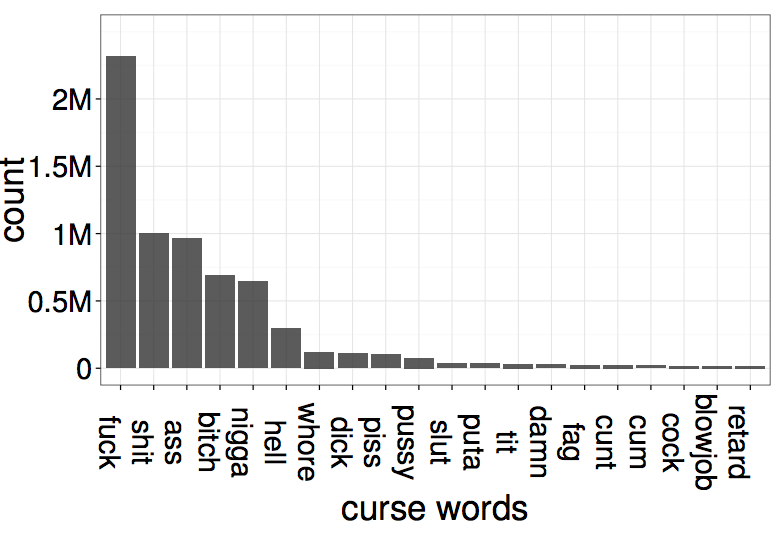
Derek Mead parses a new study that details the cursing habits of Twitter users:

While it should come as no surprise that “fuck” is the star of the show, I didn’t expect that it would represent more than a third of all swear words said. And the swearing is really concentrated. According to the paper, “the top seven curse words – fuck, shit, ass, bitch, nigga, hell and whore cover 90.55% of all the curse word occurrences.” What, no love for damn or crap?

Mario Aguilar highlights another interesting finding:

We all know that we swear when we’re angry or frustrated, but the study interestingly points out that in the real-world, people also tend to swear in more relaxed environments because they’re less likely to be called out by people around them. This remains true online, but the disparity between relaxed environments and places where people tend to be more buttoned up barely registers. According to the study’s conclusion:

We find that users do curse more in relaxed environments, but the differences across different environments are very small, partly due to the fact that Twitter messages are posted in virtual digital world.

In other words, you could say that Twitter turns everywhere into your living room. Is that why I can’t stop cursing online? That’s for you to fucking decide.

The Vanilla Icing Of Rap

This white boy is nuts:

Dave Bry examines how white people are making up an ever greater proportion of hip-hop’s stars and audiences:

In 2013, for the first time in the 55-year-history of the Billboard Hot 100, not one black artist lodged a number-one single. (Of the eleven songs that held the spot for some portion of the year, four were hip-hop, and four featured black singers or rappers in guest roles.) There’s been round, sustained clamor over Macklemore’s Grammy haul, which was all the more glaring because it came at the expense of fellow nominee Kendrick Lamar, a (frankly) far more talented artist, who is black. … Macklemore admits that white privilege is a factor in his success. “I benefit from that privilege,” he has said. “And I think that mainstream Pop culture has accepted me on a level that they might be reluctant to, in terms of a person of color.” But that doesn’t change the facts on the ground:

A new white hip-hop superstar has been anointed, one who does not live up to most rap critics’ definition of excellence. (Eminem is widely considered to be an extremely skilled rapper.) Some have even gone so far as to anoint Macklemore some sort of savior of hip-hop, a Great White Hope who will help the genre evolve into a more enlightened form. A recent Dallas Morning News headline sums up this perspective: “Macklemore shows hip-hop doesn’t need to be homophobic, violent in Dallas concert.”

Like Serch said, with so many more white people listening to rap than black, more and more white people will make it (and, it’s hard to deny that its easier to sell a white rap star to millions and millions of white consumers than it is a black one). So let’s imagine that, in 25 years, most of the people making it are white, and that, like rock, it’s thought of as a white form. Shouldn’t we expect black artists will be on to creating whatever next new form might challenge the status quo the way rap did, and the way rock n’ roll did before that? As rock became whiter over time, black artists forged new paths in R&B, in soul, in funk, in disco. (And many—Chuck Berry, Jimi Hendrix, Phil Lynott of Thin Lizzy, Prince, Bad Brains, Living Colour, Fishbone—stayed on and made an indelible impact in rock.)

Bry goes on to recognize a “new wave of [black] artists from Chicago and Atlanta have been pushing rap into aesthetic spaces it has never been before,” who often use Autotune “to warp their voices in ways traditional rappers never could, they bleed one word into the next, blurring the line between rapping and singing.” Exhibit A is ZMoney:

Slap-Happy In Topeka

A Kansas lawmaker is concerned that parents and teachers aren’t hitting children hard enough:

Democratic Rep. Gail Finney has introduced a bill that would allow parents, teachers and caregivers to spank children hard enough to leave redness or bruising. Under current state law, spanking that does not leave marks is already permitted. … Finney’s bill would allow “up to 10 forceful applications in succession of a bare, open-hand palm against the clothed buttocks of a child and any such reasonable physical force on the child as may be necessary to hold, restrain or control the child in the course of maintaining authority over the child, acknowledging that redness or bruising may occur on the tender skin of a child as a result.”

The chairman of the House Corrections and Juvenile Justice committee says they won’t even consider the bill. Other states, however, have laws on the books that are even more spanking-friendly:

Yes, it’s all the usual suspects. As of 2013: kids are still getting paddled (yes, paddled) in Georgia, though that’s declining in MississippiFlorida banned paddling elementary school students and then un-banned it. A city in Tennessee almost banned corporal punishment, then decided to do more research. In 2012, there was an uproar in Texas when two male assistant principles paddled two girls so hard they had bruises. Parents thought it was inappropriate for men to paddle girls without a same sex administrator in the room. As long as the paddler can prove they’re beating the paddlee for “discipline,” it’s all legal.

Seeing The World As A Prodigy

A short documentary profiles Victoria and Zoe Yin, sisters who are both art prodigies:

Scott Barry Kaufman describes research that “investigated the cognitive profiles of 18 prodigies,” a sample set consisting of eight music prodigies, five math prodigies, and five art prodigies:

In terms of total IQ score, math and music prodigies had a significantly higher total IQ score than the art prodigies:

Math Prodigies: Average IQ= 140; Range= 134-147
Music Prodigies: Average IQ=129; Range=108-142
Art Prodigies: Average IQ= 108; Range=100-116

The math and music prodigies scored higher than the art prodigies on tests of general cultural knowledge, vocabulary, quantitative reasoning, and visual spatial ability. Surprisingly, the art prodigies displayed below average visual spatial skills (average visual spatial IQ = 88; Range=82-94). This finding suggests that the kind of mental visualization skills tested on IQ tests does not adequately capture artistic talent.

As a possible explanation, [psychologist Joanne] Ruthsatz and colleagues discuss research suggesting the key role of attention in the development of artistic talent. Artistically talented children tend to actively focus on the forms, shapes, and detailed surface features of their environments. As a result, the visual information around them is better and more selectively encoded, and they are able to remember those details while drawing. This skill may be at odds with the visual spatial skills tested on IQ tests, which highlight categories, concepts, and holistic perception at the expense of detailed-oriented perception. Consistent with this account, one of the art prodigies explained to the researchers that she uses her extraordinary memory to conjure images in her mind while painting. She remembers such details as how shadows fall on an object and is able to paint the entire scene from memory building up from those details.

Raped Where Rape Doesn’t Exist

In a lengthy, detailed investigation, Kiera Feldman interviews victims of sexual assault at Patrick Henry College, the bastion of evangelical elites, and describes how the college’s fundamentalism makes it hard for them to get justice:

Last September, the school chose Dr. Stephen Baskerville, a professor of government, to deliver a speech that the entire student body was required to attend. He argued that feminism and liberalism have transformed the government into “a matriarchal leviathan.” The result, he said, according to a copy of the speech, was a society plagued by politically motivated “witch hunts” against men—while “the seductress who lures men into a ‘honeytrap’ ” was really to blame. “Recreational sex in the evening turns into accusations of ‘rape’ in the morning, even when it was entirely consensual,” Baskerville explained. “This is especially rampant on college campuses.” (In a statement, PHC said Baskerville’s speech was “an exercise in academic freedom” and not “endorsed by the administration.”)

“When you have a culture of license where you can’t tell the difference between what’s full rape or fake rape and what’s real rape,” PHC journalism professor Les Sillars added during the post-speech Q&A, “it makes dealing with real rape really, really hard.”

Researchers estimate that one in five American women is sexually assaulted in college, and Patrick Henry College’s unique campus culture has not insulated the school from sexual violence. In fact, it puts female students, like Claire Spear, in a particular bind: How do you report sexual assault at a place where authorities seem skeptical that such a thing even exists?

Hanna Rosin, who wrote the book on PHC, comments:

Patrick Henry statement says the expected things: that they don’t “elevate one gender above the other” and that they don’t view women who experience sexual abuse as “deserving of their fate.” But the problem is baked into their philosophy. An “innocent” woman in their context is one who never ever breaks the rules, which would mean never getting in a car or sitting on a bed with a boy. That’s where Patrick Henry shares borders with Andrea Dworkin: all sex is at some level a violation of women. But that line, whether it comes from an evangelical or a feminist, is unlikely to foster a situation where college kids or their administration can make reasonable decisions about what constitutes sexual assault.

Dreher passes along an e-mail from a recent PHC alumna, disputing Feldman’s characterization of the school’s culture:

The TNR piece said women interested in government or leadership are viewed as “unmarriageable.” Nothing could be further from the truth—my smartest, most politically savvy, strong-willed female friends are either dating, engaged, or married (with a couple exceptions, and those women have turned down multiple requests). The meek, frightened, abused woman in the TNR  piece just doesn’t exist: at least not at the fault of the school. There may be larger, familial issues there, but it’s not an issue of institutional patriarchalism.

And Leah Libresco puts Feldman’s report in the context of sexual assault on college campuses in general:

Patrick Henry’s Christian ethos informs the tone in which these students were brushed off (you’d be unlikely to hear concerns about purity at a public or secular private school), but the alleged underlying betrayal is more attributable to being a university than a Christian one in particular.

Treating Patrick Henry’s crisis as unique because of its singular status as a private, Christian school (one of only four private colleges in the country that decline federal funds and, thus, aren’t regulated under Title IX) masks a broader problem with administrations’ treatment of students in crisis, one that isn’t limited to sexual assault.

Net Neutrality 2.0

Federal Communications Commission chair Tom Wheeler announced yesterday that the commission would propose a new regulatory framework to preserve the open Internet after a January court ruling invalidated its net neutrality rules. Fran Berkman outlines Wheeler’s ideas:

Aside for the non-discrimination rules, Wheeler said he will also push for a couple of other new rules to buttress net neutrality. One is a transparency rule that would compel companies to disclose, in detail, how their networks operate. This would ensure that ISPs aren’t violating these standards. The other is a rule to reestablish the Open Internet Order’s “no-blocking goal.” This means ISPs can’t simply block whatever websites they want, for instance, those run by competing companies. The no-blocking goal, which the D.C. appeals court also ruled against, protects any and all websites that operate within the law.

Suderman reminds readers that the FCC’s authority is pretty broad:

Even though the most [recent court] ruling struck down the FCC’s specific net neutrality requirements, it also gave the agency a lot more power over the Internet, saying that under Section 706 of the Telecommunications Act, the agency does have the power to promote and regulate broadband competition and deployment. We’ll have to wait and see how the agency ends up using its new powers, but they are potentially far-reaching. In a dissenting opinion, Judge Laurence Silberman wrote that the majority ruling “grant[s] the FCC virtually unlimited power to regulate the Internet” by giving it the authority to put in place “any regulation that, in the FCC’s judgment might arguably make the Internet ‘better.’”

Brian Fung digs deeper:

As it considers rewriting the net neutrality rules to more explicitly rely on Section 706, the FCC will simultaneously keep open the possibility of “reclassifying” broadband providers. Such a step would allow the FCC to regulate ISPs just like it does phone companies, and policy watchers say reclassification would grant the FCC unambiguous authority to regulate broadband providers with a blanket ban on traffic discrimination. Keeping reclassification on the table effectively gives the FCC a nuclear option to use as a deterrent against companies that want to prioritize Internet traffic.

Benen notes that the change is not so much in the content of the rules but rather the source of the FCC’s authority to enforce them:

How will this be any different from the FCC’s neutrality policy, 1.0? For the most part, it’s not different at all. The FCC appears to have come to the conclusion that the federal appeals court struck down the previous rules because the agency didn’t have the proper legal authority to regulate the major telecoms. So in the new policy, as the New York Times reported, the FCC “will cite another section of the law for its authority.”

Peter Weber warns Republicans that they’re not making any friends by standing against net neutrality:

Their main complaint is that this is government interference in the free market. And in a narrow sense it is, as is all government regulation. But when the government steps in to make sure that private companies can’t bilk consumers by exploiting their dominant slice of a market or through legalese, that tends to be pretty popular. Is anyone really upset that George W. Bush’s FCC mandated that cellphone customers can bring their phone numbers with them when they switch carriers?

More Dish on the net neutrality ruling here and here.

The Face Of Venezuela’s Opposition

The candidates for the primary elections

Michael Moynihan thinks the arrest of Venezuelan opposition leader Leopoldo Lopez exposes the country’s government as a faux democracy:

If you doubted that Maduro was presiding over a rotting Potemkin democracy—kangaroo courts packed with loyalists, a neutered media, violent street gangs beholden to the government—witness his Mussolini-on-the-piazza performance yesterday, when he announced Lopez’s arrest in front of a crowd of regime loyalists. Maduro told the assembled that President of the National Assembly (and the one of the country’s most powerful and recognizable chavistas) Diosdado Cabello had personally driven Lopez to jail, in a bizarre, professional wrestling-type victory lap for the regime: “At this moment, Diosdado Cabello is driving his car and taking Leopoldo López to a jail outside Caracas,” Maduro announced, assuring his supporters of “the surrender of the political chief of the Venezuelan fascist right wing, already in the hands of justice.”

The Daily Beast translated the speech Lopez gave just before being arrested. It begins:

Today, I show my face before an unjust justice system, before a corrupt judiciary and before a justice system that does not pass judgments in accordance with the constitution and the laws.

But today, I also offer you, Venezuelans, our deepest commitment that, if my imprisonment helps awaken our people, if it is good enough to finally make Venezuela wake up so that the majority of those of us who want change are able to effect that change peacefully and democratically, then this infamous imprisonment that Nicolás Maduro wants, so openly and so cowardly, then for me it will have been worth it. This is the biggest example of how there is no separation of powers in Venezuela. How many times did Maduro say he wanted me in jail? How many times did he say he was giving instructions for our arrests? What is a president doing giving instructions to a district attorney, or to a court? Those actions are the best examples of how there is no justice in Venezuela.

Uri Friedman translates the tweet above from Lopez, which was written on the day he was arrested:

I’m disconnecting. Thank you Venezuela. The change is in each one of us. We will not give up. I will not do it!

(Photo by Juan Barreto/AFP/Getty Images)

The Death-Throes Of The Anti-Gay Movement

748px-Niels_Larsen_Stevns-_Zakæus

I know the danger to gay people remains great, and I don’t want to minimize the impact of living in a state where businesses of all kinds are empowered by law to put “No Gays Allowed” or “No Gays Served” in their best practices. But in America in the 21st Century, the movement that seeks to legislate outright discrimination against a tiny minority is doomed to bitter failure. It’s doomed because the principle of non-discrimination is now endemic in American culture – and among the younger generation the first article of their civil religion. Such a principle became embedded in the national identity in the Civil Rights era, where the evil of Jim Crow laws was exposed with fatal finality.

Now, the Christianist right is putting its full weight behind legal discrimination against any groups or individuals who might offend someone’s sincerely held religious conscience. Arizona’s Senate just passed a new bill expanding the concept of religious freedom from being the province of “religious assemblies and institutions” to a much broader category that includes “any individual, association, partnership, corporation, church, religious assembly or institution, estate, trust, foundation or other legal entity.” So rights once accorded to purely religious institutions are now for anyone – any business, any teacher, any pharmacist, any florist, any hotel-owner and on and on.

I’ve had my say on this, but it’s worth reiterating that this bill has absolutely nothing to do with Christianity. It is, rather, is an attack on Christian principles and a betrayal of the Gospels.

If there was one aspect of organized religion that Jesus opposed, it was its attempt to draw lines around the unclean, the marginalized and the sinners. Among his radical acts was immersing himself with sinners of all sorts – prostitutes, lepers, and collaborators with an occupying power. Segregation – the placing of a group of unholy people outside of mainstream interaction – was anathema to Jesus and should be to all Christians. To construct a legal regime in which those people are fair game for outright ostracism and segregation is a disgusting inversion of both democratic and Christian values.

I was struck recently by the massive show of support that Michael Sam received from his Missouri peers when the Westboro Baptist Church decided to picket the university with signs decrying “fag footballers and their enablers.” They formed a line 2,000 strong to block the protest from view. Many of the students backing Sam were devoutly Christian. Here’s how they explained their position:

Yes, practicing homosexuality is a sin. But so is lying, so is cheating, so is coveting. I sin every day. God hates the sin, not the sinner. If God hated all the sinners, he’d hate me!

When will the generation of bigots and Christianists cede to a new generation of citizens and Christians? How long do we have to wait? And how long do we have to tolerate a political party that, far from taking this on, merely aids and abets its poison?

(Painting: Zacchaeus by Niels Larsen Stevns. Jesus calls Zacchaeus, a tax collector for the Romans, down from his height in the tree and asks to stay with him in his house.)
WhatsApp? $19 Billion, That’s WhatsApp

https://twitter.com/MattZeitlin/statuses/436272165592125441

Facebook announced last night that it is buying WhatsApp, whose mobile product allows users to send unlimited text messages using data rather than SMS, for $16 billion in cash and stock plus another $3 billion in restricted stock. Why does Zuckerberg want the company so badly? Its user base, for one thing:

In December, WhatsApp announced it had reached 400 million active monthly users, with 100 million of them having joined since just September. It’s now up to 450 million monthly active users. According to Facebook’s Wednesday filing with the U.S. Securities and Exchange Commission, 70 percent of those people are active on a single day, and 1 million people download WhatsApp every day.

That’s 315 million people using WhatsApp every day. In the same filing, Facebook claims that the amount of data that passes through WhatsApp rivals “the entire global telecom SMS volume.”

The acquisition will also help the social media giant penetrate international markets where WhatsApp eats its lunch:

Facebook Messenger is big in the USA but not in other countries.  In key markets like India and South America WhatsApp is MUCH more popular than Facebook Messenger. And this is where, we think, the majority of the immediate real value is: the global turn to mobile is quite evident and Facebook wants to be a part of it as soon as it can.

John Cassidy looks at how Facebook was able to spend the equivalent of Honduras’ GDP (or 271 Boston Globes) on the deal:

If the owners of WhatsApp had demanded an all-cash payment, it’s highly doubtful that Facebook would have agreed to pay up to nineteen billion dollars. But Facebook has an extremely highly valued currency—its own stock—that it can use in acquisitions. As I pointed out in a post about Internet stocks a couple of weeks ago, Facebook isn’t the most overpriced one around, but it’s still some wonderful wampum; in the past eight months, it has tripled in value, and by the close of business on Wednesday, it was trading at a hundred and eleven times earnings and forty-one times its cash flow. (For comparison purposes, Apple trades at thirteen times its earnings and eight times its cash flow.)

For a company that is valued at roughly a hundred and seventy billion dollars, as Facebook was on Wednesday, issuing fifteen billion dollars in stock doesn’t seem like such a big step to take. In fact, the logic may go the other way: Why wouldn’t you do such a deal?

Larry Dignan explains why the acquisition was attractive to WhatsApp, “(beyond $16 billion in cash and stock of course)”:

Facebook doesn’t go crazy with integration. WhatsApp co-founder and CEO Jan Koum will join Facebook’s board. WhatsApp will run as it does today. And Facebook has no plans to integrate WhatsApp and its Messenger service. In other words, Facebook won’t force things. That approach is appealing to startups looking to be acquired.

Jay Yarow wonders if Facebook will maintain WhatsApp’s principled aversion to ads:

WhatsApp promises that it will never have advertising, even after being bought by Facebook. Facebook is almost entirely ad supported. WhatsApp charges users $1 annually. At least, in theory it does. It has 450 million users, but Forbes says it only did $20 million in revenue last year, so it must not be charging everyone. For Facebook, this will be an experiment to see if it can support a non-advertising based business. For WhatsApp, it’s odd that it wanted to join an ad-based company considering how much it hates ads. We suppose $19 billion makes it less odd, but still.

Yglesias questions the scalability of WhatsApp’s model:

Mobile phone operators aren’t really selling consumers some voice service, some data service, and some SMS service. They are selling access to the network. The different pricing schemes they come up with are just different ways of trying to maximize the value they extract from consumers. In a world without WhatsApp, selling SMS separately from data is the best way to do that. Then along comes WhatsApp to exploit a hole in the pricing system. But if WhatsApp gets big enough, then carrier strategy is going to change. You stop selling separate SMS plans and just have a take-or-it-leave-it overall package. And then suddenly WhatsApp isn’t doing anything.

The Martyr-State Myth

Greg Scoblete slams Eric Cantor’s claim that “given the opportunity, Iran’s leaders would make good on their call to wipe Israel off the map”:

What Cantor is clearly implying is that once Iran obtains a nuclear weapon (if they do decide to build one) they will use it to wage a suicidal attack against Israel. This is an extraordinary claim, given that no nuclear state has launched an unprovoked nuclear strike against another country no matter how bitter the rivalry. Of course, it’s possible that Iran’s leaders may decide to do something that’s clearly insane, but the weight of historical evidence against this claim is enormous and self-evident. Pakistan has not nuked India (or vice-versa). The U.S. and Soviet Union avoided nuclear war, despite some harrowingly close calls. States that obtain nuclear weapons, with the single exception of the United States during World War II, do not use them.

Larison piles on:

More than a few Iran hawks find the idea that Iran’s government would intentionally commit suicide more plausible than the idea that Iran’s leadership is capable of rational decision-making. Add in a major misinterpretation of the regime’s ideology, and you get the “martyr-state” myth that Cantor and many other hawks take for granted. This is how Iran hawks can imagine that a regime that is concerned above all with its own self-preservation would commit an unprecedented act of self-destruction: they ignore the overwhelming amount of evidence that undermines the myth, and then simply assert falsehoods as fact because there is no real political penalty to be paid for making things up about an unfriendly government. Thus the “martyr-state” myth survives and keeps being recycled among Iran hawks despite the fact that it makes absolutely no sense.