What Can We Do About Ukraine?

Jamila Trindle considers sanctions:

Future sanctions against Ukraine would almost certainly be far more limited than what has been in place against Iran, out of concern that the sanctions could hurt ordinary Ukrainians and push public opinion toward embracing an alliance with Russia.  Sanctions would likely focus solely on Ukrainian officials and their supporters.  They would also be less effective because Russia would likely not join in on measures targeting one of its closest allies. The current crisis began late last year when Ukrainians took to the streets after Yanukovych rejected an EU trade deal in favor of a bailout from Russia.

Sam Cutler, a policy advisor for sanctions law firm Ferrari & Associates, says sanctions alone are unlikely to force the government to ease its crackdown or negotiate with protesters. “It’s a way for politicians in the EU and the U.S. to say, ‘Look how much we’re doing,’ and to take a moral stand, but it has to be a complement to a broader policy,” Cutler said.

Hayes Brown looks at the actions that have been taken already:

The European Union on Thursday approved targeted sanctions on Ukrainian government officials, as well as an arms embargo on the country. The U.S. also announced on Wednesday evening that it was imposing a visa ban on 20 Ukrainian officials as part of their initial response to recent escalations. Experts, however, say that the announced embargos are unlikely to do much to change Yanukovych’s calculations. This is particularly true of the arms ban, since as Ukraine was a primary hub for manufacturing weapons during the Soviet Era they are awash in weapons.

Larison’s view:

I don’t see what constructive difference imposing targeted sanctions would have, but since imposing sanctions is almost always done just to express disapproval rather than achieve anything I suppose that is what the U.S. and EU will end up doing. All in all, there doesn’t seem to be very much that the U.S. can do that would be constructive, and it shouldn’t seek to have a larger role in trying to resolve the crisis.

A Ukrainian Civil War?

Simon Shuster thinks things are moving in that direction:

As the sun rose, it became all too apparent that lethal weapons – not merely stun grenades, rocks and Molotov cocktails, but rifles and pistols – had entered the fray on both sides. The conflict appeared to be spiraling toward a civil war, as deadly clashes between armed protestors and police were also reported in at least three other cities. Both sides blamed each other for the escalation.

But Keating sees civil war as unlikely:

Ukrainians may be split almost down the middle on whether they support the protests, but few support the use of force against them. Also, despite the country’s clear split between the Catholic, Ukrainian-speaking west and Orthodox, Russian-speaking east, support for the country’s independence has actually increased over the years, even in the east. (Crimea, which is majority-ethnic-Russian, may be something of an outlier.) And while the general ideological sentiments of the two camps are clear, it also seems like actual enthusiasm for Yanukovych is fairly thin, even among government supporters, and the opposition’s leadership is divided between three men—Vitali Klitschko, Oleh Tyahnybok, and Arseniy Yatsenyuk—all of whom carry some fairly serious flaws as potential leaders of a long-term nationalist uprising.

Fisher weighs in on the prospect of civil war:

The government’s talk about “anti-terrorist” operations doesn’t bode well. And Yanukovych fired his army chief on Wednesday – an extremely bad sign. We don’t know why he did it, but speculation has immediately turned to the possibility that the army chief had refused orders to bring the military out into Kiev’s streets. If that’s the case, then this is worrying both because it implies that Yanukovych may have been pushing for military involvement and because it hints at possible splits within the military leadership. All very bad signs.

Masha Lipman warns that “Ukraine is balancing on the brink of a large-scale armed conflict”:

Yanukovych, from his perspective, has to stay in power at any cost. He had his most serious political rival, Yulia Tymoshenko, jailed. If he loses power, he can expect that the same will happen to him, especially after he has brought his country to a bloody political crisis in which several dozen have already been killed and hundreds wounded. His circle of cronies, his son among them, many of whom have enriched themselves through corruption during his tenure, may face the same fate.

You’ll Never Be Ready For Marriage

Matt Walsh explains why:

We commonly view living together as a logical step before marriage, but it isn’t. It’s something some people do, but it isn’t a step to marriage. Your marriage is defined by the commitment you make to the other person — not by the bathroom or mortgage you share. Living with someone is not a “warm up” for marriage or a “try out” period, precisely because it lacks the essential, definitive characteristic of that permanent commitment. You can’t comfortably transition into an eternal vow. You make it, and then it’s made. Period.

Dreher nods along:

This sounds familiar, because it’s a lot like the path Julie and I followed.

We met one weekend in the autumn of 1996, when I was visiting Austin. We fell instantly, and hard. I was living in Fort Lauderdale, she was finishing college in Austin. Our courtship, such as it was, became mostly a matter of letters and phone calls. Owing to the expense of plane tickets, we saw each other maybe once a month, but usually less frequently. After four months, we became engaged, but waited most of that year for Julie to finish college before we married. Our honeymoon was the longest continuous period of time we had spent in each other’s company since we met.

But it worked, and worked brilliantly, because the answers we held in our hearts were the same as Matt Walsh and his wife held in their hearts. You cannot know in advance what will await you in the wild unknown country of marriage. All you can know — and it’s a matter of intuition as much as anything else — is that you want to have that adventure with the one you love.

Cool Ad Watch

A surprisingly clever spot from Coca-Cola:

Tim Nudd adds:

The video is pretty goofy for Coke, which usually prefers more feel-good stunts that don’t liken its target market to animals that can’t stop licking their stitches. But there’s some honestly there, at least. Just don’t share this with your friends. Coke wouldn’t want that.

Update from a reader, who shows how unoriginal the ad is after all:

Do you think Coke has to pay royalties on that commercial to The New Yorker? This cartoon ran a while back:

url

The Two Thailands

THAILAND-POLITICS-PROTEST

Duncan McCargo explores some of the deeper currents motivating Thailand’s ongoing political crisis. Among them is “the growing political chasm that separates greater Bangkok and the country’s south from its less affluent but more populous regions in the north and northeast”:

Because of Thailand’s hidden “caste system” — which is linked to popular Buddhist notions that the poor deserve their lower status because of accumulated demerits from previous lives — Bangkokians typically have a profoundly paternalistic view of the masses. [Former PM] Thaksin [Shinawatra]’s populist, can-do message, the stuff of self-help books, resonated deeply with many voters in the north and northeast. The leaders of the current anti-government protests — many of whom come from Bangkok — constantly deride these voters as ignorant and susceptible to electoral manipulation and vote-buying. Worse still, these anti-government protesters accuse pro-Thaksin voters of disloyalty to the Thai nation and the monarchy. On Jan. 26, I heard one rally speaker declare that those who had taken part in advance voting did not really love Thailand, and were probably in fact Cambodians casting fake ballots.

Meanwhile, current PM Yingluck Shinawatra, Thaksin’s sister, is facing corruption charges and more violent protests, raising the odds that the crisis will come-8 to a head:

There’s still a possibility of a Yingluck ouster that doesn’t involve once again tearing up the Thai constitution. In a major step toward impeachment, the kingdom’s National Anti-Corruption Commission said on Tuesday it has enough evidence to charge Yingluck with graft associated with her ill-fated program to buy rice from farmers at above-market prices. Thailand has spent 689 billion baht ($21.2 billion) on the program, resulting in rice that the government cannot sell. The stockpile now weighs 14.7 million tons, compared with just 6.1 million tons in 2010.

The opposition has long denounced the rice program as an ill-disguised scheme to reward Yingluck voters in rural areas, and the anti-corruption commission now alleges that graft took place at all stages of the program. Yingluck did nothing to stop it, the commission claims, “which shows that she was negligent in her duty or corrupt and abused her power under the constitution, which may be a cause for impeachment.”

Previous Dish on Thailand here.

(Photo: A policeman observes a demonstration by anti-government protestors in Bangkok on February 14, 2014. Thousands of riot police were deployed in the Thai capital on February 14 to clear areas occupied for weeks by opposition protesters seeking to force Prime Minister Yingluck Shinawatra from office. By Manjunath Kiran/AFP/Getty Images)

The Black Republican Advantage

Jamelle Bouie argues that African-American pols running for statewide office are “much better off in the GOP,” at least strategically: 

I wrote about this at length a few years ago, but in short, if you are a black lawmaker in the House, or the black mayor of a city – the kinds of people who tend to run for statewide office, in other words –odds are overwhelming that you serve a “majority-minority” constituency in a heavily Democratic area. This leads to a few things: First – even if you live in a largely liberal state – you’re considerably to the left of the median voter in your state. Think John Lewis in Georgia, or Bobby Scott in Virginia for examples of this.

Second, you’re likely to lead or represent a low-income area, which makes it harder to raise money for a statewide bid, on account of a smaller fundraising base. And finally, most majority-minority districts, or cities, are located in larger states, where – by definition – there’s more competition for statewide office. Either one of these alone is surmountable for a skilled and ambitious politician. But together, they present a huge barrier to advancement for African American lawmakers who are looking to statewide office …

Insofar that they exist, black Republican lawmakers don’t have these problems. Most likely, they’re representing middle-class to affluent white constituencies, placing them closer to the median voter, statewide, and giving them a healthy base for fundraising. And, judging from Scott in South Carolina, Shannon in Oklahoma, and Mia Love in Utah – who is likely to win her bid for a House seat this year—they seem to emerge in small, highly partisan states where the pool of candidates isn’t as deep, and inter-party competition is less fierce.

The Psychology Of Trolling

Trolls

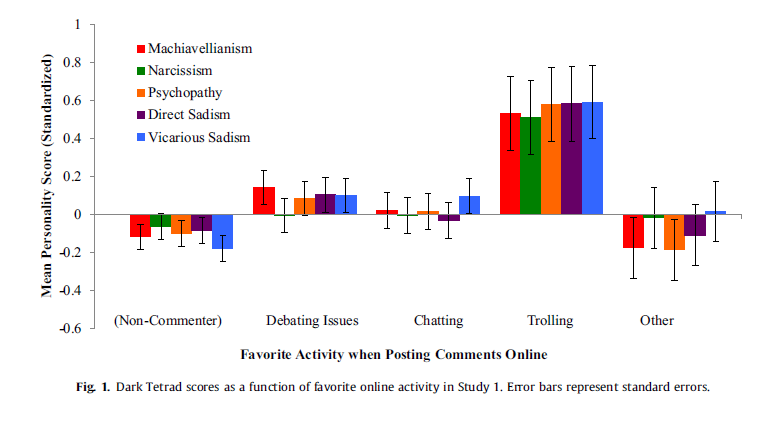
A study of Internet trolls finds that they are often Machiavellian sadists:

The research, conducted by Erin Buckels of the University of Manitoba and two colleagues, sought to directly investigate whether people who engage in trolling are characterized by personality traits that fall in the so-called “Dark Tetrad”: Machiavellianism (willingness to manipulate and deceive others), narcissism (egotism and self-obsession), psychopathy (the lack of remorse and empathy), and sadism (pleasure in the suffering of others).

It is hard to underplay the results: The study found correlations, sometimes quite significant, between these traits and trolling behavior. What’s more, it also found a relationship between all Dark Tetrad traits (except for narcissism) and the overall time that an individual spent, per day, commenting on the internet.

Digby chimes in:

If you are a person who has spent any time online over the past few years, this is self-evident. There is little doubt that internet trolls, whether in comment sections or on twitter or forums, are psychopaths of some form or another. What’s always interested me more than that obvious observation is how otherwise normal people sometimes turn into such trolls when they feel marginalized or misunderstood. For some it’s clearly a very short trip from being a regular person just mixing it up for entertainment and becoming an internet terrorist. For others the journey is more circuitous. But I suspect that many of us could get in touch with an inner Dark Tetrad given enough time crawling around the fetid fever swamps of internet argument. I’ve seen it happen.

Techno-Pessimism

Robert Gordon’s new paper casts doubt on our impending technological utopia:

This time Gordon  takes aim at the so-called techno-optimists, such as the authors of the new book “The Second Machine Age,” [Erik Brynjolffson and Andrew McAfee,] who claim that technological growth is accelerating.

Gordon disagrees, saying that we shouldn’t expect technology to dramatically improve economic performance over the coming half-century. In fact, he argues that the productivity slowdown began long ago, in essence because the wide availability of computers or cell phones still is not nearly as transformative for society as electricity or cars have been.

While real U.S. gross domestic product grew at an average of 2 percent pear year, Gordon estimates the pace will be much slower over the next 50 years. That’s because the economy faces four key headwinds: the retirement of the baby boomer generation; stagnating educational attainment; inequality; and rising national debt. Together, he argues, these trends will deplete — and have already begun to deplete — the pool of educated workers with higher incomes to spend, dampening growth.

Cowen agrees with much of what Gordon says but criticizes the paper’s short-sightedness:

There is a key passage on p.26: “My forecast of 1.3 percent annual total-economy productivity growth in the future does not require any foresight beyond suggesting that the past 40 years are a more relevant benchmark of feasible productivity growth than the 80 years of before 1972.”  Fair enough, but how about looking at the last 120 years or last 120,000 years for that matter?  The overall pattern is lots of pauses, followed by eventual new bursts of progress.  That’s no proof of a future subsequent burst of progress, but so far history is not on the side of the long-term tech pessimists.  It may be on the side of the short-term tech pessimists, at least for a while.

Drum is less charitable:

This is an embarrassingly bad argument. I can somehow imagine a circa-1870 version of Gordon arguing that all this folderol about electricity is ridiculous. Why, we’ve been studying electricity for over a century, and what do we have to show for it? Some clunky batteries, the telegraph, a few arc lamps with limited use, and a steady supply of techno-optimist inventors who keep telling us that any day now they’ll invent a practical generator that will replace steam engines and change the world. Don’t believe it, folks.

Yglesias points out that predicting the technological future is a fool’s errand:

[M]ore computing power will be added during the next two-to-three-year doubling cycle than has been added in the entire history of computing. And then that’s going to happen again. Unless you think about it in the correct exponential terms, you’re going to massively underrate the likely gains in the future. As it happens, I agree with Gordon that self-checkout technology is not incredibly promising but that’s because it addresses an uninteresting problem. What if you could automate grocery delivery? Or what if “the Internet of things” let you just put a bunch of stuff in your bag, walk out of the store, and then automatically have the cost tallied up and charged to your credit card? That’d be cool.

Matthew Klein compares Gordon’s vision of the future with that of the “techno-optimists”. His bottom line:

It’s hard to make the case that the ability to share the results of personality quizzes on social networks is a significant boon to humanity, but only a fool would deny the potential of driverless cars to improve the lives of commuters, to say nothing of the tens of thousands of lives that might be saved from traffic accidents.

The truth is that no matter who is right, growth of a few percent in gross domestic product each year can produce amazing progress after enough years. Instead of worrying about these long-run issues, which may never materialize, maybe we should ask our economists to focus on the problems that need fixing today.

Meanwhile, Freddie deBoer takes on Brynjolfsson and McAfee’s optimism about the rise of the machines:

Millions of people now have a printing press, reference library, school, and computer all at their fingertips. The number of them who do the things that the authors of this piece want people to do fits comfortably in a rounding error. When books ceased to be hand-copied by monks in monasteries, books stopped being the purview of the aristocratic and clerical elite, and yet most of the world’s population remained illiterate for hundreds of years. When televisions became ubiquitous, people wrote breathless pieces arguing that they would give all students the same skills as those taught in the most expensive schools, and yet the vast inequalities in our education system only deepened. And since I was in high school, we’ve been cramming internet-enabled computers into our places of learning, and arguing against evidence that the inevitable result would be the rapid democratization of knowledge and creation. We have seen nothing of the kind, and we have no satisfactory reason to believe that this will change in the coming days ahead. It’s great that you can go on Wikipedia and use it write your own blog. Most people are not doing even that, and that is a far cry from the absurd revolutionary utopianism of this piece and hundreds more like it.

Previous Dish on Brynjolfsson and McAfee’s book here and here.

Uploading The Past Into The Present

“The Internet has muddled the line between past and present,” argues Paul Ford:

Pick any historical subject and the Internet will bring it to life before your eyes. If you’re interested in vaudeville, you’ll find videos galore, while college football scholars can browse Penn State’s 1924 yearbook, complete with all the players’ names and positions. And every day, more history keeps washing up. Not long ago the news went out that a Philadelphia woman named Marion Stokes had recorded 140,000 VHS tapes of local and national news from 1977 to her death in 2012. Her collection has been acquired by the Internet Archive, and soon it will trickle onto the web. [A similar compilation of old network news bloopers is seen above.]

This omnipresence of the past has weird effects on contemporary culture.

Take any genre of music, from death metal to R&B to chillwave, and the cloud directs you not just to similar artists in the present but to deep wells of influence from the past. Yes, people still like new things. But the past gets as much preference as the present—Mozart, for example, has more than 100,000 followers on Spotify. In a history glut, the idea of fashionability in music erodes, because new songs sit on the same shelf as songs recorded five, 25, and 55 years ago, all of them waiting to be discovered. In this eternal present, everything can be made contemporary.

Relatedly, Ted Scheinman appreciates the vastness of online info:

Today we have at least three different ways to follow [Lord] Byron on Twitter and can access facsimiles of certain crucial manuscripts via the Morgan Library. Indeed, each day more and more manuscripts appear on library and university websites, a massive boon for both scholars without one of those blank-check fellowships and civilians curious to see a poet’s hand, and to compare it with unattributed parchment passed down in a commonplace book.

Beyond Byron, whole realms of databases and scholarly communities are making dissertations better, even as they make grad school less lonely. Peter Beal’s Catalogue of English Literary Manuscripts 1450-1700 is appearing in fits and starts, while the Orlando Project at the University of Alberta brings to light hitherto un(der)-read work by women writers whose importance the pre-digital humanities have overlooked. The British Library seems to unveil a new flight of high-resolution images each day, while stateside enterprises, including the William Blake Archive and the Beinecke’s Boswell project, add significant collections annually.

Evidence That Gun Control Works?

A new study on the effects of Missouri’s 2007 decision to repeal its background check requirement for gun purchases has found that it led to an increase in gun homicides:

“Coincident exactly with the policy change, there was an immediate upward trajectory to the homicide rates in Missouri,” the study’s lead author Daniel Webster, director of the Johns Hopkins Center for Gun Policy and Research, told the BBC. “That upward trajectory did not happen with homicides that did not involve guns; it did not occur to any neighboring state; the national trend was doing the opposite – it was trending downward; and it was not specific to one or two localities – it was, for the most part, state-wide.”

The analysis of data compiled from the FBI’s Uniform Crime Reporting system controlled for changes in policing, incarceration, burglaries, unemployment, poverty, and other state laws adopted during the study period that could affect violent crime. “This study provides compelling confirmation that weaknesses in firearm laws lead to deaths from gun violence,” said Webster in a release.

The research is not conclusive, but scholars expect it to bolster pro-gun control arguments:

Since this is only a single study, “it’s just suggestive,” warned David Hemenway of Harvard’s School of Public Health. It is “another piece of evidence that is consistent with the bulk of the literature, which shows where there are fewer guns, there are fewer problems… But you want eight more studies that say background checks really matter.”

And the study isn’t perfect:

Missouri also enacted a “stand your ground” law in 2007, creating some challenges in disentangling the effects. But [Duke University gun expert Philip] Cook said he is confident that background checks played a major role because the authors tracked an increase in guns that went directly from dealers to criminals—exactly the scenario background checks are designed to prevent. The study also notes an uptick in guns “purchased in Missouri that were subsequently recovered by police in border states that retained their [permit-to-purchase] laws.”

Gun rights advocate John Lott pushes back:

You can’t do a study like this on one state over time. There are 17 states with “universal background checks” … You can’t just pick one state. Let me give you an example. You flip a coin 20 times — ten heads and ten tails. If you specifically picked just five heads from the sample, could you conclude that the coin was biased? Presumably not. There is research on these universal background checks across all the states. Indeed, the third edition of More Guns, Less Crime provided one study on this, and, the Webster study, it show no benefit in terms of murder rates from these laws. The question the media should ask is: why pick one state when there are so many states with this law? …

The other question is why the paper only examines murder rates and not any other type of violent crime. Again, the answer is clear: none of the other violent crime rates, including robbery, showed the change that Webster desired.