Are Colleges Failing Their Mentally Ill Students? Ctd

Readers begin to share their stories:

I appreciate your most recent coverage of the ongoing issue of mentally ill students on college campuses. As a current first-year undergraduate at a Northeastern liberal arts college, I have seen countless cases in which students who needed help were met with harsh discipline. A few of these cases have hit close to home. A good friend revealed to our tight-knit group that he has suicidal thoughts. After he seemed hesitant to get help, our group made the decision to alert the Health Services Department on his behalf.

The campus response was, in my opinion, disturbing.

Two campus police officers – not trained medical professionals at the Health Services Department – came to my friend’s door at 3 AM, pulled him out of bed, gave him a full body search, hand-cuffed him and then brought him to the campus police detention facility. In other words, his mental and emotional issues were treated as criminal issues. After he was quickly examined by health services officials, the administration gave him a forced leave of absence for a semester. He was removed from a close, caring group of friends and many other support structures on campus. Keep in mind, this is an 18-year-old kid who’s living away from home for the first time in his life – your typical college freshman.

I think this anecdote reflects just how paranoid universities are about an on-campus death (especially a suicide). Their efforts to avoid the repercussions of a suicide completely miss the point. Their primary goal is not to stop their students from committing suicide; their goal is to make sure that students don’t commit suicide on their campus. It’s not about a commitment to making students healthy; it’s a strategic plan to remove any students who show the slightest signs of mental health needs. Of course, there are so many negative consequences to this approach – the most detrimental being that in criminalizing and punishing students with mental health problems, the university discourages students from seeking help for very serious issues (potentially suicide). This is a grim outlook, but from what I have seen so far this is a recurring pattern.

Again, I really do appreciate your coverage on this topic. I think it deserves much more attention and I think it is a conversation that college officials around the country are failing to have.

One college official would beg to differ:

In the case of my particular campus (a small local campus of a very large research university), I have to say that we most definitely are not failing our students.  We only have about 800 students on our campus, but we made the commitment to hire a full-time personal counselor (MS-level education in counseling with certifications in adolescent and personal counseling and years of experience at another university and in social work) even though that was a huge expense to our smallish budget.  We did it because we could see that more and more students needed the help and because more and more students are arriving on our doorstep diagnosed with some sort of mental illness and/or cognitive/learning disabilities.

Every front-line department, including faculty, has a representative (or several) on our Student Success Committee, including the personal counselor.  We meet several times a semester and we often discuss the students we know who are having problems or who have been reported to us as possibly not adjusting well in addition to trying to deal with all the other factors that go into student success.  We take a team approach to these situations, with everyone involved trying to get the students in question to get help for whatever issue they have.  We never abandon a student until the student abandons us by withdrawing or flunking out.

Perhaps it’s because our campus is so small that we are able to dedicate so many personnel to this issue.  It helps that almost every student on campus knows at least one of us well, if not all of us.  Perhaps it’s that our faculty and staff also know each other well and keep each other up to date on what is happening in their classes/offices.  Maybe it’s our campus’ leadership, who have funded the personal counselor position, created the Student Success Committee and made it a priority for every department and faculty member to keep student success first in our minds and to emphasize that success does not apply only to the most academically successful.

All I know is that we have plenty of students with major emotional problems, but very few of them have withdrawn or acted out.  I can only think of one instance that, despite everything we did to try to help, led a student to cause a major incident on our campus.  And even that was relatively minor in retrospect.  The student in question had flunked out after not taking advantage of the help he had been offered after threatening an ex-girlfriend who, like him, lived in the dorms.  When, the next semester, he started sending threatening messages to her again and this time saying he was coming to campus with a gun, she and other students contacted our campus police and the campus was closed until the young man was arrested that night.  He finally got diagnosed and hospitalized and is going to another school to which he can commute and continuing his therapy as an outpatient.

It’s only been that one in the fifteen years I’ve been here and in the eight years since we committed to the full-time counselor and Student Success Committee.  Some might think we do too much to intervene with our students, but I think that’s a pretty good track record.

The Christianist Florist

Rose_Amber_Flush_20070601

A reader writes:

A little story from my own life. Many years ago, I met a young man at a showing of the Rocky Horror Picture Show. I managed, despite my fear of rejection, to ask him out on a date and, miracle of miracles, he said yes. Just before our date, I stopped in a little neighborhood florist shop and bought him a single yellow rose. He loved it. From then on, we bought each other roses from this shop for every occasion, however little – we’re having hot dogs together! – or important – will you move in with me?

Finally the day came when I asked him to marry me and I went to buy him a single red rose from “our” florist.

In those days, we couldn’t legally marry, but my church, the Religious Society of Friends, would marry us anyway. When I told the florist how special and important this rose was, that I was asking my great love, a man, to marry me, she pulled back the rose and told me she was a good Christian and wouldn’t sell me the rose or roses ever again, not for something sick like that. We had been buying from this florist for five years and never happened to mention what they were for.

The place was always busy, we were in a hurry, so it never came up, but I was so bursting with pride and joy that I was asking the man I loved more than life itself to marry me, to be with me until death, I said something that day. I left empty-handed and broken-hearted. The joy in what I was about to do had a cold pail of hate thrown on it. I asked him to marry me without a rose from “our” shop. He said yes anyway and he was with me until he died from a fire in 1981.

I still bring a rose to his grave every year, but not from our florist.

Libricide In India

Last week, Penguin agreed to remove all copies of Wendy Doniger’s The Hindus: An Alternative History from bookshelves in India and pulp them following a lawsuit by a Hindu nationalist organization that deemed the book offensive. Keating notes that Doniger is not the first author to have this problem:

Salman Rushdie, whose book The Satanic Verses is banned in India, pulled out of a literary festival in Jaipur after receiving death threats. Joseph Lelyveld’s biography of Mohandas K. Gandhi was banned in 2011 because it suggested he may have been bisexual.

If, as expected, the Hindu nationalist BJP comes into power after this year’s elections, there’s good reason to expect things might get worse.

Jonathan Shainin considers the shaky state of free speech in India:

Free speech has innumerable enemies in India, and comparably few principled defenders—against whom vast legal, political, and social obstacles are arrayed.

A writer, publisher, or newspaper editor can fight a case in court, provided he has the patience to endure the interminable delays of the legal system. In the end, he may even win, though the relevant laws have been interpreted, over the decades, to carve out larger and larger exceptions to the right of free expression enshrined in India’s Constitution. No political leader will dare speak in defense of a text under attack unless the book in question targets his enemies; supporting the freedom of unpopular speech only costs votes and never wins them. And the state does not offer much protection from physical harm. When death threats are phoned to your home, or a mob comes to vandalize your office, you’re on your own.

Nilanjana Roy wants the country’s liberal intellectuals to defend their rights:

For all of the support expressed over Doniger, the resentment at “the bullies,” the Indian liberal response has frequently been to ask why the creative class must go out looking for trouble. …  The creative classes in India, especially the middle-class and the elite among them, have bought a precarious immunity through gestures of appeasement. They have not bought freedom; and it remains to be seen whether that sense of safety will last.

The decision to cave is backfiring on the publisher:

The backlash over Penguin’s move last week has been huge, with major literary figures lining up to condemn the withdrawal of The Hindus from India. Penguin took the decision following a four-year legal battle with a Hindu nationalist group which claimed Doniger’s well-reviewed tome violated the Indian penal code – which prevents religious insult – as it “hurt the religious feelings of millions of Hindus”.

Now the Penguin authors Jyotirmaya Sharma and Siddharth Varadarajan have written to the publisher asking for their books to be withdrawn and pulped. “[We] have asked Penguin to pulp our books and revert copyright so we can deal with any would-be bullies on our own terms,” said Varadarajan on Twitter.

The Adderall Paradox

ADHD medications help children concentrate, but they don’t seem to offer any long-term benefits – academic or otherwise. Katherine Sharpe delves into the research:

How can medication that makes children sit still and pay attention not lead to better grades? One possibility is that children develop tolerance to the drug. Dosage could also play a part: as children grow and put on weight, medication has to be adjusted to keep up, which does not always happen. And many children simply stop taking the drugs, especially in adolescence, when they may begin to feel that it affects their personalities. Children may also stop treatment because of side effects, which can include difficulty sleeping, loss of appetite and mood swings, as well as elevated heart rate.

Or it could be that stimulant medications mainly improve behavior, not intellectual functioning. In the 1970s, two researchers, Russell Barkley and Charles Cunningham, noted that when children with ADHD took stimulants, parents and teachers rated their academic performance as vastly improved. But objective measurements showed that the quality of their work hadn’t changed. What looked like achievement was actually manageability in the classroom. If medication made struggling children appear to be doing fine, they might be passed over for needed help, the authors suggested. Janet Currie, an economist at Princeton University in New Jersey, says that she might have been observing just such a phenomenon in the Quebec study that found lower achievement among medicated students.

Previous Dish on ADHD here, here, here, and here.

Map Of The Day

Press Freedom

Last week, Reporters Without Borders released its annual report on global press freedom. Chris Kirk unpacks the findings:

The map, based on Reporters Without Borders’ press freedom rankings for 180 countries, shows home of the current Winter Olympics Russia in bright red, indicating a “difficult situation” for journalists and bloggers there. Russia, ranked 148th, shuts down seditious websites, bans so-called homosexual propaganda, prohibits religiously offensive expression, and heavily controls national TV stations, Russians’ main source of news.

The U.S. shows a “satisfactory situation,” but it has dropped 14 ranks since last year’s report and now sits at the 46th spot.

Eric Levenson explains the drop:

The rankings report blame the U.S.’s drop on its wide-ranging crackdown on whistleblowers, particularly Edward Snowden, Chelsea Manning (who got a 35-year sentence for leaking documents), and the attempted 105-year sentence for Barrett Brown. To the American government, “The whistleblower is the enemy,” the report writes. Similarly, the subpoena of Associated Press phone records contributed to that drastic drop.

Friedersdorf’s response to the report:

Countries that scored better include Romania,  South Africa, Ghana, Cyprus, and Botswana. And 40 others. Put simply, it’s an embarrassing result for the country that conceived the First Amendment almost 240 years ago. These rankings are always a bit arbitrary, but we’re not anywhere close to the top tier these days. Why?

National Review Is To The Right Of The Kansas GOP

In what is a truly depressing development, NRO’s Ryan Anderson insists the Kansas law permitting government officials and any individual person to discriminate against gay couples in civil marriages (which are banned in Kansas) is just a defense against oppression (which doesn’t yet exist). So NRO is now to the right of even the Kansas GOP on this. Anderson’s previous piece on the question actually describes the inclusion of gays and lesbians in routine anti-discrimination laws as “special privileges”, when every other minority group is protected by them, including religious believers. Anderson also claims the following:

Contrary to what some opponents of the bill have suggested, the Kansas policy would only protect religious individuals and organizations from being forced to provide services related to marriage, the celebration of marriage, or similar relationship. It would not allow businesses, individuals, or government employees from refusing to serve someone (or a couple) simply because of his or her sexual orientation.

But if a gay person were already in a relationship of even the vaguest sort, any vendor could decide to discriminate against them. Here’s the language of the Kansas bill, allowing anyone to refuse to provide

any services, accommodations, advantages, facilities, goods, or privileges; provide counseling, adoption, foster care and other social services; or provide employment or employment benefits, related to, or related to the celebration of, any marriage, domestic partnership, civil union or similar arrangement;

It seems pretty clear to me: any individual could refuse to provide employment to someone related to any living arrangement they disapprove of. That’s a massive category that could easily mean de facto publicly legislated discrimination against the tiny gay minority. That Anderson does not even consider the concerns of those of us worried by this vague, open-ended law or is in any way interested in the dignity or equality of gay citizens in Kansas (citizens who are currently denied any protection from discrimination in employment, and denied the right to any stable, lawful relationship as well) reveals the blind spot that so many on the far right have.

And he doesn’t explain why such a law should not also include marriages or relationships that are not gay and which nonetheless violate some aspect of religious conscience – like marriages that involved previously divorced people or those that violate some religious strictures against inter-faith marriage. If you’re really defending religious liberty and not just attacking gays, you’d think the law would be a lot broader in its targets.

National Review has four pieces up right now on marriage equality. All take it as a premise that civil marriage for gay people is a civilizational catastrophe and argue for a ramped up culture war against it. Those who once thought there could be some accommodation between gays and the GOP can only be further dismayed. Our liberties and dignity are meaningless to them – and there are close to no gay writers or thinkers on the right or center right that are allowed to participate in this debate. At some point, you begin to wonder whether this isn’t more than posturing. When they believe gays should be denied any legally supported relationship, when they oppose all anti-discrimination laws for gays (but are fine with them for every other minority), when they oppose hate crime laws for gays (but support them in every other category), you begin to realize that they are still living in the 1970s. If they cannot prevent us from being visible, they can at least put up walls to keep us from interacting with them in any way. And they wonder why the Jim Crow analogy seems so apposite to so many.

A Foreign Policy Election?

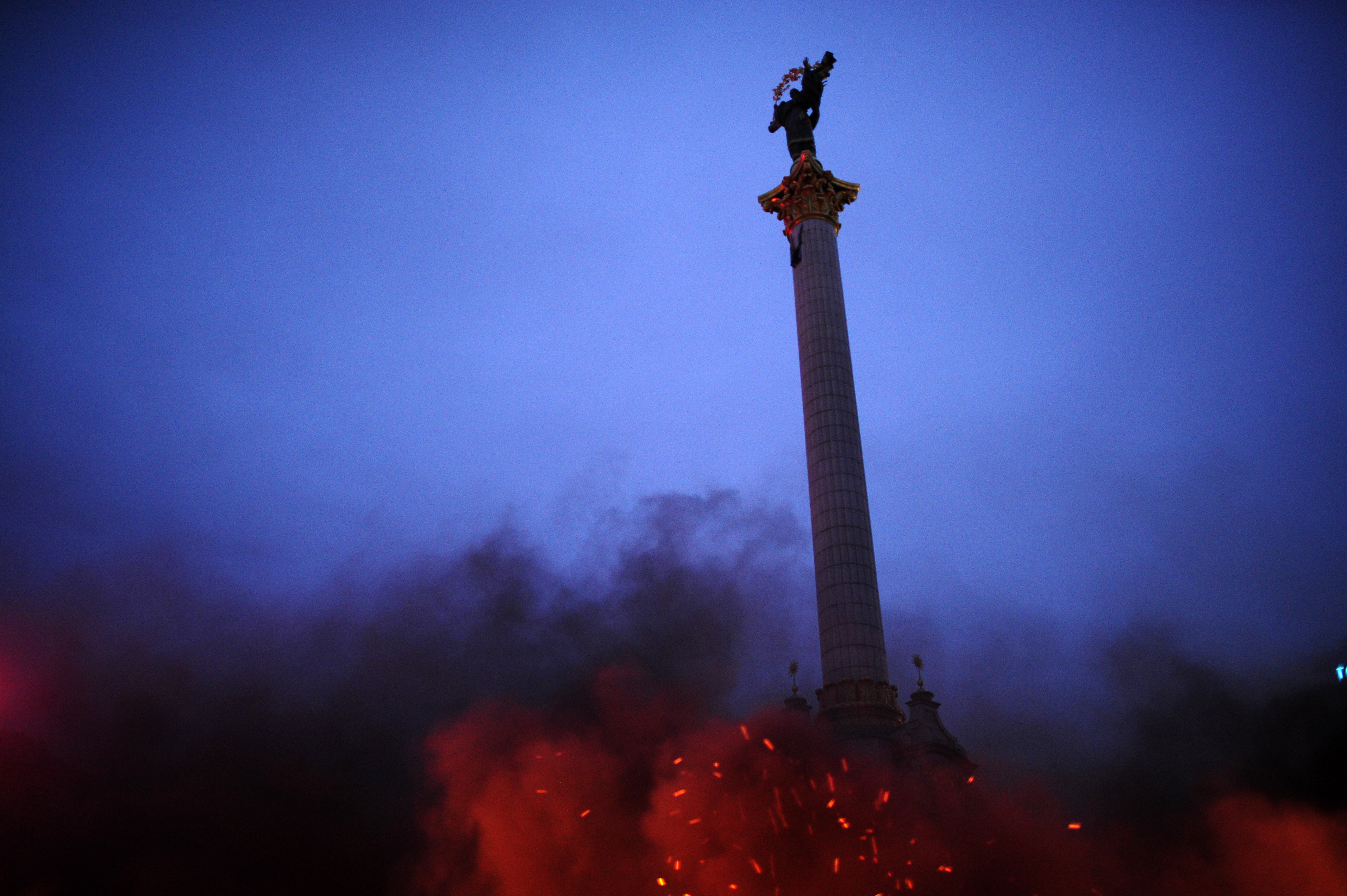
Violence Escalates As Kiev Protests Continue

Wouldn’t that be an excellent idea? The choices an American president has to make today – from Mexico to Russia to Syria and Iran – are fiendishly tough, in the wake of Bush’s revelation of the severe limits on American military power. We could do with an airing of what exactly our options are in restraining Iran’s Revolutionary Guards or Putin’s neo-fascist regime in Russia. But we appear stuck in a miasma of public forgetfulness – a state of affairs which only a few, like Rand Paul, seem to want to challenge. Matthew Feeney wonders how Paul will fare:

A lot could change before the 2016 presidential campaigns begin in earnest. However, assuming there is no major shift in American opinion before Paul’s widely expected White House bid begins, it unfortunately looks like Paul’s positions on foreign policy, which ought to be taken seriously given the current state of American foreign affairs, will be mostly overlooked by an American public that continues to be largely indifferent about foreign affairs.

Larison isn’t so sure:

Normally, no politician can run and win on a platform defined mainly by foreign policy views, but when a politician holds views that line up with public opinion they will still get the attention of quite a few voters. Because hawks in both parties are hostile to what Paul represents, there will also probably be disproportionate attention paid to Paul’s foreign policy views by critics, which will make more voters aware of them and could have the unintended effect of driving some voters in Paul’s direction.

Millman expects that, should Paul get the nomination, that “the general election will turn on economic issues.” He imagines a Clinton-Paul race:

Hillary Clinton has almost no incentive to bring up foreign policy, except to contrast her considerable experience with Paul’s greenness.

She won’t run on the need to confront evil in Syria, or Ukraine, or wherever; she’ll run on competence, not ideology. Her overwhelming incentive is going to be to focus on Paul’s economic and budgetary views, and his leadership role in some of the most ignominious moments of the Congressional GOP’s budgetary hostage-taking. (That, and play identity politics.) That is the contrast she is going to draw, and Paul is going to have to own it.

Larison pushes back:

As an advocate for arming the Syrian opposition, pushing for regime change in Libya, and backing escalation in Afghanistan, Clinton routinely took the more hawkish side in every internal administration debate, and that put her on what proved to be the wrong side of some of the most important decisions of the first term. For that matter, the main reason that Clinton is ever credited with foreign policy competence is that she reliably takes the conventional and “consensus” position on every major issue. In other words, her claim to competence is that she sticks to a predictably hawkish line.

Millman goes another round:

My point was not that Clinton actually has a record of competence in foreign policy; I don’t think she does. I agree, in fact, with pretty much all of Larison’s criticisms of her foreign policy record. I just don’t think Clinton is going to run on a platform of “She’ll keep us at war.” Rather, she will claim that she has the experience to know how to negotiate effectively and get results without war, and the clout to build a broad coalition of international support when the use of force is necessary. Whereas, she’ll portray Paul as a naive ideologue who doesn’t understand how the world works. Her actual foreign policy preferences are quite close to Senator McCain’s, but she won’t make jokes about bombing Iran, and won’t present herself as the heir to “bear any burden, pay any price.”

For my part, I wonder if we are currently under-estimating the public’s interest. We’re in a period before mid-terms when foreign policy is usually dormant. It may perk up as the presidential contest looms on the horizon. And I have to say a contrast between Paul’s principled non-interventionism and Clinton’s restrained McCainism would be quite a tonic. And I suspect Paul would score a few points.

(Photo: General view of Independence Square during clashes between anti-government protesters and riot police forces in Kiev on February 19, 2014 in Kiev, Ukraine. By Alexander Koerner/Getty Images.)

What The Hell Is Happening In Venezuela?

One week into a battle between opposition and pro-government demonstrators, things appear to be escalating:

Venezuelan opposition leader Leopoldo López came out of hiding on Tuesday, as promised, and surrendered to the authorities to face charges of terrorism. Mr. López, a Harvard-educated former mayor of a wealthy section of Caracas, is the political face of ongoing demonstrations against President Nicolás Maduro’s government.

The protests began last Wednesday and turned violent almost immediately. Three people were killed on the first day, and on Thursday the government issued an arrest warrant for Mr. López. One more protester died and several were gravely injured since.

What the protests are about:

Venezuela is faced by economic, social, and political challenges: Inflation is at 56 percent, the currency is rapidly devaluing, shortages of staples like toilet paper and sugar are plaguing the nation, and the murder rate is one of the worst in the world.

What started out as roughly two weeks of small, student-led protests against the Maduro administration has turned into opposition-organized marches that involve stone-throwing and taunting met by tear gas and water cannons.

“These are legitimate issues that do need a popular voice and channel for expression,” says Christopher Sabatini, senior director of policy at the Americas Society in New York. “What makes the protests particularly volatile is that other avenues to express these demands have been closed down,” Mr. Sabatini says, referring to the closure of opposition media over the past several years and the shuttering of multiple newspapers nationwide more recently due to paper shortages.

Juan Carlos Hidalgo warns of a bloodbath:

People who fear the breakout of a civil war in Venezuela don’t understand that only one side is armed: the government and its supporters. The Maduro regime, whose security apparatus is closely controlled by Cuba’s secret services, has already engaged in brutish repression of protestors. The army and the National Guard are firmly aligned with the government and there is little or no chance that they might balk at exercising unrestrained violence against unarmed civilians. Moreover, armed gangs of government supporters, called “tupamaros,” act freely with the complicity of the security services and were supposedly behind the killings of a couple of protesters last week. It’s hard to have a civil war when only one side is armed.

Greg Weeks notes that “neither side seems interested in dialogue”:

The military has already declared itself on the government’s side, which makes this a very different situation from Honduras in 2009 or even Venezuela in 2002. Chávez worked for years to transform the military, and in the absence of any obvious splits (of course, plenty is going on that we don’t know about) a coup is unlikely. If there is no dialogue, then it seems the country waits for the protests to peter out. Even if there is financing top keep it going and organized, people get tired of having their lives disrupted. Will they tire out?

James Bloodworth thinks it’s time for the left to abandon its love affair with Chávez:

Between 2007 and 2011 there was a reduction in extreme poverty in Venezuela by some 38 per cent. Impressive no doubt. But the percentage of people who escaped extreme poverty in Brazil during the same period was 44 per cent, in Peru 41 per cent and in Uruguay 63 per cent. None of these countries possess anything like Venezuela’s vast oil wealth, yet all managed to lift their poorest citizens out of penury without the human rights abuses which have characterised the governments of Chavez and Maduro. Boring social democracy may be less romantic, but it has been far more successful at tackling poverty than the Chavez/Maduro model.

What’s The GOP Running On?

Not much:

Ahead of the 2006 midterms, Congressional Democrats outlined a fairly broad and thorough agenda and vowed to advance them through the House within the first 100 working hours of their majority in the event that they won. When they did win, then-Speaker TO GO WITH AFP STORY By Otto Bakano -- TNancy Pelosi definitely let Bush be The Story for the next two years. But she also moved a bunch of items that lacked GOP support through the House to establish a Democratic agenda (including familiar items like the Employment Non-Discrimination Act, the Employee Free Choice Act, and two different State Children’s Health Insurance Plan expansions, both of which President Bush decided to veto). And moreover she managed to pass some actual laws, including two stimulus bills (can you imagine if Obama requested a stimulus bill now?) and marshaled overwhelming Democratic support (twice) for the bill that ultimately authorized TARP when then-minority leader John Boehner couldn’t muster half his conference to support the bailout President Bush demanded.

This year’s Republicans aren’t capable of anything like this. Winning in 2014 might not require them to be. But it might also leave them without much to tell the public if it watches Democrats actually doing things and begins to wonder what the GOP has to offer other than a single-minded hatred of Obamacare.

It’s hard not to feel extremely dispirited by the prospect of the next eight months. The country’s business is hostage to political gamesmanship and jockeying. Doing nothing about almost anything right now – for brazenly partisan purposes – is the GOP’s game-plan. It’s pure oppositionism – and we’ll likely see the entire pre-election period as one in which the Republicans do one thing only: sabotage and undermine and slander and oppose the ACA. So a law that has greatly expanded the number of insured Americans will be relentlessly described as a law that threatens the insurance of millions. This is not going to be a campaign for an alternative to the ACA – because the actual alternative looks a lot like what we’ve got, and a comparison of alternatives – an exploration of costs and benefits of various approaches – is not something the GOP wants.

The same with immigration reform. The kabuki theater of the past month has been a contest in cynicism, crafted entirely around the desire to bury this issue until after the mid-terms. The purported reason for not acting is a preposterous and self-evident falsehood – that Obama cannot be trusted to enforce the border. As Fareed recently noted,

the Obama administration has enforced immigration laws ferociously. It deported more than 400,000 people in 2012, 2½ times the number in 2002. In 2002, for every two people removed from the country, 13 became legal residents. In 2012, for every two removed, just five became residents. For these reasons, as well as the recession, the number of illegal immigrants has not increased in several years. (On the more general point, Dan Amira of New York magazine has compiled data that show that Obama has issued fewer executive orders than any president in 100 years.)

So these are transparent dodges of pressing national issues almost entirely for internal party politics and the mid-terms.

No, I’m not shocked. But I’m also not so cynical as to ignore the nihilism at the heart of today’s GOP. They are the reason we have gridlock; they are the reason we cannot reach some obvious fiscal compromise that could raise some taxes and trim some entitlements; they are the reason we cannot even have a debate about how to tackle climate change; they are the reason we cannot enact even minor gun control measures backed by huge majorities; they are the reason we cannot offer some relief to countless undocumented immigrants while reforming immigration to allow for more skilled workers. I won’t even begin on foreign policy, where, again, they are all opposition and no coherent policy (or divided by Rand Paul non-interventionism and Cheney-style neoconservatism).

Obama is getting the blame for all this; which, of course, is the strategy. But he doesn’t deserve it; which, of course, is the truth.

The CBO’s Two Cents On The Minimum Wage

The Congressional Budget Office forecasts that raising the minimum wage to $10.10 an hour, as Obama and the Democrats in Congress hope to do, would give 16.5 million American workers a raise and lift 900,000 out of poverty – but it would also lead to 500,000 job losses. Barro thinks this is a pretty good deal:

As economist Richard Thaler puts it, “All methods of helping the poor cause distortions”; a minimum wage increase can cause a modest rise in unemployment and still be a good policy idea, so long as it has more than offsetting positive effects.

And the minimum wage trade-off presented by CBO looks awfully favorable. For every person put out of work by the minimum wage increase, more than 30 will see rises in income, often on the order of several dollars an hour. Low- and moderate-income families will get an extra $17 billion a year in income, even after accounting for people who get put out of work; for reference, that’s roughly equivalent to a 25% increase in the Earned Income Tax Credit.

Mike Konczal accuses the CBO of “putting a thumb on the scale” to inflate the number of job losses:

[T]he CBO’s methodology is weighed to overstate the impact of a $10.10 minimum wage on jobs, while also understating the benefits. Even then there’s a clear tradeoff – a minor fall in jobs for serious real gains again inequality and wage security.

Never mind the scary headlines, or the report that unfortunately plays to them: When you consider that the academy is far more ambiguous about the costs of giving the country a raise, and more bullish on the benefits, this is still an excellent deal for working Americans.

To Jared Bernstein, the report confirms the wisdom of raising the minimum wage:

As I’ve stressed many times on this blog, policy makers need to be concerned about the quantity of jobs, and pursue policies that will increase that number.  But they also have to worry about job quality, especially in the low-wage sector, where the decline in the real value of the minimum wage, the increase in earnings inequality (meaning less growth finds its way to the low end of the wage scale), and the low bargaining power of the work force have placed strong, negative pressure on wage trends for decades.

With such job-quality concerns in mind, I’d say the long history of research shows that increasing the minimum wage is a simple, effective policy that achieves its goal of raising the value of low-wage work with minimal distortions at no cost to the federal budget.  The Congressional Budget Office report further confirms that conclusion.

The administration is disputing the job loss numbers, but Yglesias argues that they really shouldn’t be:

If the White House genuinely believes that a hike to $10.10 would have zero negative impact on job creation, then the White House is probably proposing too low a number. The outcome that the CBO is forecasting—an outcome where you get a small amount of disemployment that’s vastly outweighed by the increase in income among low-wage families writ large—is the outcome that you want. If $10.10 an hour would raise incomes and cost zero jobs, then why not go up to $11 and raise incomes even more at the cost of a little bit of disemployment?

Cowen sees it differently:

Spin it as you wish, we should not have a major party promoting, as a centerpiece initiative and for perceived electoral gain, a law that might put half a million vulnerable people out of work, and that during a slow labor market.

Philip Klein seizes on the contradiction between the CBO report and the president’s promises:

The bottom line is that Obama has presented hiking the minimum wage as a no-brainer that would boost the economy, increase wages and immediately reduce poverty without adverse effects. CBO has estimated that in reality, the action would raise unemployment among lower-income workers, deliver most of its benefits to families living above the poverty level, and have offsetting adverse effects on businesses and consumers. To the extent that it will reduce poverty, according to the CBO, the effect will be less significant and less immediate than what Obama has claimed.

Jordan Weissmann puts the numbers in perspective:

[T]he report … demonstrates the limits of the minimum wage as a policy tool for curing poverty or bolstering the middle class. There are currently about 45 million people living in poverty—the CBO’s estimate suggests the wage hike being debated in Washington would only reduce that number by 2 percent. Among families under the poverty line, average incomes wouldn’t increase any more than 3 percent.

For liberals looking for ways to combat inequality and poverty, raising the minimum wage would be a good start, but no more.

Bouie chimes in:

I should also say that this gets to why—as far as raising incomes is concerned—the minimum wage isn’t the greatest option. An expansion of the Earned Income Tax Credit—to raise payments and include single, childless workers—could increase incomes without the hit to the labor market. Indeed, a combination of the two policies—a larger EITC and higher minimum wage—could substantially boost incomes and provide enough stimulus to the economy to completely outweigh the adverse effects.

But, with the notable exception of Florida Senator Marco Rubio, it’s hard to find Republicans who would support a stronger EITC, or any measure that would move funds from the wealthy to the poor. Which leaves the minimum wage at a disadvantage as well. The difference, of course, is that the EITC is a federal policy, while individual states can set a minimum wage. And it’s for this reason that Democrats have committed to the latter; even if they lose in Congress, they can still take their fight to America’s statehouses.

Suderman cautions against reading too much into the CBO’s findings:

It’s complex and highly politicized, and the CBO tries hard to avoid politicization to the extent that it’s possible. So this report is probably best taken as a wonky but readable guide to the economic research on the topic. And it’s probably not worth investing too much in the specific point projections about jobs lost and incomes raised. Instead, it’s best to think of the report as highlighting the variety of economic costs and trade-offs that would come with a hike in the minimum wage, including job loss, and a reminder that the administration has an incentive to downplay potential negatives and paint its policy proposals in the most positive possible light.

And Drum wonders why the office bothered to take up this issue in the first place:

[T]his is a report that I suspect CBO shouldn’t have bothered doing. Their value-add lies in assessing the effects of legislation that no one else is studying. But the minimum wage has been studied to death. CBO really has nothing to add here except its own judgment about how to average out the dozens of estimates in published academic papers. In other words, they aren’t adding anything important to the conversation at all. This report is going to get a lot of attention, but it really doesn’t teach us anything new.