56 New Flavors

… of gender identity:

In a surprise announcement Tuesday, Facebook revealed that it is now offering custom categories in the gender selection option beyond the traditional “male” and “female” demarcations.

Unlike Google+, however, which uses “other” as a totalizing option for anybody who wants to express their gender identity outside of the male/female binary (which may help explain why only one percent of its users choose to use it), Facebook is doing its users one better: offering 50 unique terms to choose from. So now instead of just selecting either “male” or “female,” you can choose “custom,” which lets you select your preferred gender identification.

Facebook isn’t allowing users to just write whatever they want, mind you. (I just tried to enter the term “walrus” and had no luck.) But it’s giving more than 50 new options, including everything from “genderqueer” to the defiantly simple “neither.” … As for pronouns, the service is adding the vaguely neutral term “them” to the existing “him” or “her” options.

Joyner is a bit confused:

I must admit, I haven’t the slightest clue what some of these terms mean, much less the distinction between, say, Trans Female, Trans*Female, Trans*Woman, Transexual Female, and Transgender Female. For that matter, if I’m understanding the terms correctly, I’m not only male I’m also CisCis MaleCis ManCisgender, and Cisgender Male; I have no idea what advantage is created by having so many choices to describe the exact same thing.

My point isn’t to make light of this. On balance, I think this is the right move. The fact that simply choosing male was a no-brainer for me under the old category system—indeed, it never occurred to me to wonder why additional choices weren’t provided—is an indicator of privilege. Facebook may have overcompensated here. But at least they’ve inspired a useful conversation.

Paris Lees asks, “Why stop there?”:

I doubt Facebook did this as an act of pure progressiveness to cater for its transgender users and I can’t help wondering what the commercial imperative is. What money is there to be made by sorting people into ever more specific boxes? Advertisers will be wetting themselves – particularly anyone selling wigs, chest binders, or any of the other specialised products aimed at those of us who seek to change our gender. It’s the monetisation of minorities.

But – as many of my Facebook friends have pointed out, wouldn’t it be better to leave a blank box for people to dream up their own gender identities? Why choose from 56?

Update from a reader, who answers Lees’ question:

From someone in the tech field, it’s because data normalization on a free-form field is next to impossible. Where you earlier quoted someone as calling it the “monetization of minorities” (which is entirely correct), there’s no way to target them if FB doesn’t know exactly who it’s targeting. That’s why you have to choose a specific gender – so FB knows exactly what it’s targeting.

A Union Vote With The Company’s Blessing

Workers at the Volkswagen plant in Chattanooga vote today on whether to join the United Automobile Workers. Lydia DePillis outlines what’s at stake:

If a majority of Volkswagen’s 1,570 hourly workers vote yes, it would mark the first time in nearly three decades of trying that the UAW has successfully organized a plant for a foreign brand in the United States. This time, the union has a powerful ally: Volkswagen itself, which is hoping the union will collaborate in a German-style “works council” and help manage plant operations.

Tennessee’s GOP leaders — along with well-funded conservative activists such as Grover Norquist — aren’t letting the UAW in without a fight.

Seth Michaels looks at the Republican campaign to stop the plant from unionizing:

Sen. Bob Corker held a press conference Tuesday specifically to ask VW employees to reject a union, claiming potential negative impact on the state’s economy. More insidiously, state legislators suggested that they might punish VW if employees vote for the union – withholding tax incentives for future expansions, for example. In addition to likely being illegal, these threats have a special kind of irony: “we’re so worried that you’ll have a negative jobs impact that we’re willing to block future jobs to prevent it.”

Waldman thinks this reveals something ugly about the Republican anti-union agenda:

Here you have a highly profitable company that wants to have a more cooperative relationship with its workers, and obviously sees a union as a path to that relationship, because they know that they can work that way with unions, since they do it already all over the world. But the Republican politicians don’t care about what the corporation wants. They are so venomously opposed to collective bargaining that they’ll toss aside all their supposed ideals about economic liberty in a heartbeat.

Rana Foroohar chimes in:

[T]he truth is that there’s little evidence that the anti-union manufacturing model (exemplified by companies like Nissan) works better than the unionized one, particularly when it incorporates Germanic work councils. VW actually credits the system with making it the largest and richest auto firm in the world. What’s more, the workers I’ve spoken with in Chattanooga say they are less interested in pay hikes than in having some say over which cars get made in the factory, what sorts of training programs they’ll have access to, etc.

Corruption On Ice

Figure Skating - Winter Olympics Day 6

Last night, Russian figure-skater Evgeni Plushenko withdrew from competition due to injury. Leonid Bershidsky provides background:

Plushenko, 31, has recently suffered one setback after another. After winning silver in Vancouver – and complaining loudly about the judging – he missed most top-level tournaments because of injuries. Last year, he crashed to the ice at the world championships and had to pull out. It took complex spine surgery to get him back on his feet, and in January, 2014, he lost to 18-year-old Maxim Kovtun at the Russian national championship. According to the Russian Figure Skating Federation’s own rules, Kovtun was supposed to travel to Sochi, but, after much debate, officials decided to send Plushenko, anyway. The 18-year-old was deemed too inexperienced and erratic, because of a woeful failure at the 2014 European championships.

The larger symbolism of Plushenko flaming out:

[T]he choice of an injured star over a talented youth and disregard for rules are typical of the way top-level sports are managed in today’s Russia. The Soviet system of selecting and training young athletes, which served as a model for the frighteningly effective Chinese sports machine of today, is gone. The few remaining stars brought up by that system, including Plushenko, are squeezed relentlessly for their few remaining drops of gold.

Julia Ioffe zooms out:

Some Russians are wondering if this isn’t just a symptom of Putin’s Russia, where connections and closeness to the power elite guarantee you positions and privileges that you might not otherwise land.

As I wrote in my cover story last week, this is why many younger, ambitious Russians feel that they’re suffocating: the old men at the top just won’t let go of their thrones and let the young’uns take a stab at things. “This is what we call, is there a path for young people, or like the vetrical of power,” one Russian tweeted tonight, referring to the Putinist power structure, referred to as the “vertical.” “People don’t rotate out until they utter the words, ‘I’m tired, I’m leaving.'” (This is what then-old man Boris Yeltsin said before handing power over to Vladimir Putin.)

She follows up:

Plushenko, despite his precarious health, talked his way onto the Russian Olympic skating team in closed-door meetings. Talked, not skated. (Plushenko is a talented skater, but he’s one hell of a diva and, during the 2010 Olymipcs in Vancouver, his public ranting and whining and complaining were virtually all I wrote about.) But Plushenko is also one of a coterie of athletes and artists that are loyal Kremlin hacks, understanding that, these days, there is pretty much only one side of the bread that’s buttered in Russia. These athletes and artists perform at official functions, they support the Kremlin line when needed, and, as a result, are wealthy, privileged people, existing in a plane far above the rest of their countrymen—and, often, the law.

Update from a reader:

Someone please explain the difference between Plushenko getting a spot on the Olympic team by pushing aside another Russian skater who qualified ahead of him and Ashley Wagner of the US who did EXACTLY the same thing. She fell in the finals but was given a spot by US authorities because she’s older and more experienced. What am I missing?

(Photo: Evgeny Plyushchenko of Russia leaves the stadium after his injury at a warm up during the Men’s Figure Skating Short Program on February 13, 2014 in Sochi, Russia. By Vladimir Rys Photography/Getty Images)

Comwarnercablecast

https://twitter.com/wilw/statuses/433800948930977792


Daniel Gross explains the news of Comcast trying to buy Time Warner Cable for $45.2 billion as “a defensive move—on the part of both companies”:

[T]he big cable companies have been losing customers and market share for years. According to the National Cable Television Association, there were 56.4 million cable subscribers in 2012, down from 66.9 million in 2001. Time Warner, which is concentrated in savvy, wealthy markets like Los Angeles and New York, has been hit particularly hard.  As I noted It’s cable business is eroding like a New Jersey beach. In each of the last seven quarters, Time Warner Cable has lost a significant number of residential video subscribers—a total of 1.27 million subscribers, or nearly 10 percent. That’s pretty stunning.

Now, rapid growth in the other components of the triple play—high-speed internet and voice service—has helped mask the decline of Time Warner Cable’s core business. But those services cost less than cable. And in the most recent quarter, it looks as if those numbers barely budged.

Susan Crawford doesn’t like the deal:

The reason this deal is scary is that for the vast majority of businesses in 19 of the 20 largest metropolitan areas in the country, their only choice for a high-capacity wired connection will be Comcast. Comcast, in turn, has its own built-in conflicts of interest:

It will be serving the interests of its shareholders by keeping investments in its network as low as possible — in particular, making no move to provide the world-class fiber-optic connections that are now standard and cheap in other countries — and extracting as much rent as it can, in all kinds of ways. Comcast, for purposes of today’s public , is calling itself a “cable company.” It no longer is. Comcast sells infrastructure subject to neither competition nor a cop on the beat.

Judis is on the same page:

Monopolies make it more difficult for new entrants to compete. As a result, they allow the larger companies to raise prices without fearing a loss of market share. Since deregulation in 1996, cable prices have risen at about three times the rate of inflation. According to a study from the Free Press, prices for expanded cable service (what most consumers purchase) went up five percent from 2008 top 2013 –almost four times the rate of inflation. Monopolies also allow companies to neglect service to consumers. The American Customer Satisfaction Index rated Comcast and Time-Warner the two worst cable and broadband companies.

Monopolies can also have a corrosive effect on related industries. The big cable companies have been able to squeeze cable content providers—even to cut off access to customers, as Time-Warner did with CBS last fall.  If they also own content providers, as Comcast does, they can harm rival content providers—as Comcast seems to be doing to Netflix.

John Cassidy dismisses the “old and tired argument” that Netflix and Apple are threatening the cable business:

I’ve been writing about the cable industry since the late nineteen-eighties, and something has always been about to destroy it. For a time, the threat was satellite television; then it was the Web; now it’s Netflix or YouTube. But it never materializes. With their quasi-monopoly franchises, and the ability to charge their customers for everything from voice mail to remote controls—look closely at your cable bill—the cable companies get bigger and more profitable every year. No wonder Comcast’s stock price has quintupled since 2009. (Time Warner Cable’s stock has gone up even more.)

What we need is a new competition policy that puts the interests of consumers first, seeks to replicate what other countries have done, and treats with extreme skepticism the arguments of monopoly incumbents such as Comcast and Time Warner Cable. But will we get it?

Morrissey wonders if the government will allow the deal to go through:

Then there is the question of Comcast’s connections to content producers. Comcast owns NBC, for instance, a deal that raised a few eyebrows but still managed to gain regulatory approval. Its size would make them much more competitive on pricing over Charter and Cox, and that plus their hold on NBC’s assets might be just a little too much for the White House to ignore, even for the politically-connected Comcast. This has anti-trust written all over it, especially for Democrats who have played the populist-progressive card more and more.

But Matthew Klein claims the merger will be good for consumers:

The networks consistently raise prices about 10 percent a year on average, irrespective of the state of the economy. By contrast, the typical cable bill only goes up by about 5 percent a year. Cable companies have eaten the difference by lowering their margins and cutting costs elsewhere, but there are limits to both processes. … Merging the two biggest cable operators might give them more bargaining power with the networks, especially if it encourages DIRECTV and Dish Network Corp. to consolidate the satellite business. Saving money on content would allow the enlarged Comcast to improve Internet access and speed — areas in which the U.S. lags behind other rich nations.

Drum quibbles with Klein’s argument:

I’d normally take Klein’s side of this except for one thing: would a bigger Comcast really have more negotiating clout than they do now? I guess that’s possible, but they have a helluva lot of clout already. No network can afford to be shut out of Comcast’s market for long. So it’s not clear to me that a bigger Comcast would really do much for the rest of us.

Brian Fung puts the merger in context:

All of this is taking place against the backdrop of the recent net neutrality court decision that made it legal for Internet providers to block or throttle Web traffic. While there’s no concrete evidence yet that this is occurring, the ruling inherently gives ISPs such as Comcast greater control over how consumers experience the Internet. As a result of the merger, Comcast will be taking on 8 million TWC subscribers, all of whom will be newly subject to Comcast’s bandwidth policies.

That the cable industry is consolidating isn’t really a surprise. But a merger of this magnitude is going to have major downstream effects.

It could also lead to new, cumbersome regulations:

There’s a danger that Comcast will be able to use its growing power over broadband to undermine competitive threats such as Netflix. We don’t know exactly how large Comcast needs to be before it will be able to do this. But the larger it gets, the greater the cause for concern. And it’s much easier to block a merger before it happens than to seek the breakup of a company after it has merged.

Lastly, Sargent weighs the options for better telecom regulation:

There are two basic solutions to this problem: either run telecoms as a regulated monopoly, like how land lines used to work, or break up the telecom trusts within individual markets to force them to compete with each other. Both have upsides and downsides, but the point is that government action will be required either way. This is another reason to keep prevent pointless mergers — to level the power imbalance between regulators and colossal corporate conglomerates.

This will be a tough lift, but I think it’s still possible to do. Telecom capacity is relatively cheap, by infrastructure standards — and for Pete’s sake, Romania somehow manages to have the third-fastest internet in the world. It’s easily within reach, if we can get our act together. It should be a key goal of progressive lawmakers.

Unfriending Facebook, Ctd

A reader defends the site against earlier criticism:

Today is my 73rd birthday, and I’ve been having a tremendous Facebook birthday party. Admittedly, there are some “friends” who sent me e-mails, and there have been a few phone calls and a few mailed cards. But by and large, the acknowledgment on Facebook has been one of today’s thrills for me. This is a reason that I find Facebook so important in my life. There is no way I could manage the quality of my relationships without it.

On that note, a reader from our Facebook page:

I have quit just about everything else social media but unfortunately, FB has become the default for keeping in touch with my elderly relatives – because it is relatively easy for them to use – and other extended family.

The first reader adds:

Some of my Facebook friends have died, and yet they still have Facebook pages. I notice that, for example, I can go to their page on their birthday and say something appropriately memorable about the person. And others do the same. Rather like comments after an obituary.

More defenders sound off:

Your reader wrote, “Another big reason for wanting to leave Facebook comes down to many of my Facebook friends who don’t exercise good editorial control: either don’t know when to keep their ‘Facebook mouths’ shut, or don’t open their Facebook mouths at all.”

You know who else is showing poor editorial control? This guy! Facebook gives you, the reader, incredible editorial control. First off, don’t accept friend requests from every pompous high school buddy or depressed ex-girlfriend. Second, if you’ve got that one friend who only posts amazing vacation photos or trolling Obama comments, hide him/her on your feed. In this regard, Facebook is a lot like real-life relationships: you gotta weed folks out sometimes.

Another sighs:

Oh, for God’s sake. I bet folks said similar things about telephones. (“You can’t really communicate with someone you can’t look in the eye!”) As with anything, it’s a question of moderation. There will always be people who overshare and people whose desperation is exacerbated by something like Facebook. Step away from it occasionally, call people on the phone once in a while.

I think Facebook is fun. It’s a great way to share cool things with friends. As a musician, it gives me a semi-easy way to promote stuff. Sometimes I get strung out on it, but mostly I don’t. If you believe that people’s lives are as fab as their Facebook pics, then you also believed that people’s Christmas letters gave an accurate picture of their year. Relax, people!

Ask Reza Aslan Anything: How Jesus Stood Apart

In the second video from writer and scholar Reza Aslan, he explains the revolutionary nature of Jesus’ message:

[vimeo 86713863 w=580]

In a followup, Aslan notes how unlikely it was that this message endured after Jesus’ death:

[vimeo 86716095 w=580]

In yesterday’s video, Reza imagined how the Jesus would have reacted to a modern Catholic Mass. He is the author of No god but God: The Origins, Evolution, and Future of Islam and, most recently, Zealot: The Life and Times of Jesus of Nazareth, which offers an interpretation of the life and mission of the historical Jesus. Previous Dish on Zealot herehere and here, as well as Fox News’ treatment of Reza here and here.

Our full Ask Anything archive is here.

Marriage Equality Update: Valentine’s Day Edition

A federal judge has ruled against Virginia’s marriage ban on equal protection grounds:

U.S. District Judge Arenda L. Wright Allen – a President Obama appointee – found that Virginia’s constitutional amendment banning same-sex marriage, enacted by voters in 2006, violated the equal protection clause of the Fourteenth Amendment. She issued a stay on her ruling pending an appeal, meaning gay couples cannot get married in the state until a higher court makes its decision.

Shackford examines Allen’s argument:

In the ruling, Wright Allen rejects the argument that gay couples are trying to establish a new right. Marriage, she notes, is treated as a fundamental right … She goes on to invoke the Loving decision to reject the state’s marriage recognition ban on the grounds of upholding “tradition.” She rejects federalist arguments because the civil liberties arguments involved permit federal constitutional review. And she rejects the “for the children” argument (which she actually titles “The ‘for-the-children’ rationale”), stating that, while the state has a compelling interest in protecting the welfare of children, “needlessly stigmatizing and humiliating children who are being raised by the couples targeted by Virginia’s marriage laws betrays that interest.”

Benen remarks on what a milestone this ruling could be:

If yesterday’s ruling stands, Virginia will be the first southern state – the only state of the old Confederacy – to extend equal marriage rights to all of its residents.

Tyler Lopez, who moved out of Virginia, notes how the state has evolved on the issue:

These days, things are looking up in Virginia. The majority of Virginians now support marriage equality; they’ve elected politicians who reflect their values; and now their judiciary has stood firm as a defender of equal rights. The commonwealth, in short, has signaled that it’s ready to welcome back its gay and lesbian sons and daughters—if we’re ready to return. For those of us who never thought this moment would come, the impact is overwhelming. When I finally crossed the Potomac and moved to D.C., I promised myself I’d never return. But reading the brave and beautiful words of Judge Wright Allen’s opinion on Thursday night, Virginia suddenly felt—for the first time in a long time—like home.

Looking at the landslide of recent court decisions, David S. Cohen and Dahlia Lithwick declare, “It’s over”:

Insofar as there was confusion about what Windsor meant at the time it was decided, the lower courts across the country have now effectively settled it. A survey of publicly available opinions shows that in the eight months since Windsor, 18 court decisions have addressed an issue of equality based on sexual orientation. And in those 18 cases, equality has won every single time. In other words, not a single court has agreed with Chief Justice Roberts that Windsor is merely about state versus federal power. Instead, each has used Windsor exactly as Justice Scalia “warned”—as a powerful precedent for equality.

Dreher plays the victim:

Traditional Christians are all segregationists now. The federal judiciary is making that clear. The rout that many of us have seen coming is upon us.

Well, Rod, if you act like segregationists, what do you expect?

The Downsizing Of Ratzinger’s Former Office

It’s one of those things only acute Vatican-watchers notice, but Francis’ demotion of the Congregation for the Doctrine of the Faith, the office for ensuring doctrinal orthodoxy that Joseph Ratzinger ran with an iron fist under John Paul II, is a big departure from the recent past:

There is no question that the Congregation for the Doctrine of the Faith was supreme under Popes John Paul II and Benedict XVI. No one would have questioned its supremacy when Cardinal Joseph Ratzinger was prefect. But the supreme congregation doesn’t look so supreme anymore. It has been publicly criticized by a curial cardinal from Brazil, by the president of the German bishops’ conference, and by two cardinals who are members of the Council of Cardinals, appointed by the pope to advise him on reforming the Vatican. Even Pope Francis told Latin American religious not to worry about the congregation.

Actually, what Francis said was the following:

“The [CDF] will make mistakes, they will make a blunder, this will pass! Perhaps even a letter of the Congregation for the Doctrine [of the Faith] will arrive for you, telling you that you said such or such thing. … But do not worry. Explain whatever you have to explain, but move forward.”

Translation: live the faith, don’t ideologize it.

What The Hell Just Happened In Kansas?

68 peoples drug 18'wide

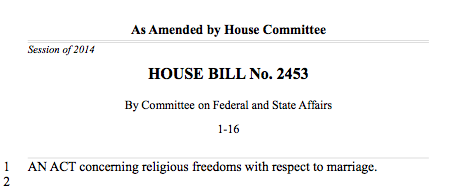
The bill that just overwhelmingly passed the Kansas House of Representatives is quite something. You can read it in its entirety here. It is premised on the notion that the most pressing injustice in Kansas right now is the persecution some religious people are allegedly experiencing at the hands of homosexuals. As Rush Limbaugh recently noted, “They’re under assault. You say, ‘Heterosexuality may be 95, 98 percent of the population.’ They’re under assault by the 2 to 5 percent that are homosexual.” As its sponsor, Charles Macheers, explained:

Discrimination is horrible. It’s hurtful … It has no place in civilized society, and that’s precisely why we’re moving this bill. There have been times throughout history where people have been persecuted for their religious beliefs because they were unpopular. This bill provides a shield of protection for that.

The remedy for such a terrible threat is, however, state support for more discrimination. The law empowers any individual or business to refuse to interact with, do business with, or in any way come into contact with anyone who may have some connection to a gay civil union, or civil marriage or … well any “similar arrangement” (room-mates?). It gives the full backing of the law to any restaurant or bar-owner who puts up a sign that says “No Gays Served”. It empowers employees of the state government to refuse to interact with gay citizens as a group. Its scope is vast: it allows anyone to refuse to provide “services, accommodations, advantages, facilities, goods, or privileges; counseling, adoption, foster care and other social services; or provide employment or employment benefits” to anyone suspected of being complicit in celebrating or enabling the commitment of any kind of a gay couple.
Screen Shot 2014-02-14 at 12.05.56 PMIf the Republican Party wanted to demonstrate that it wants no votes from anyone under 40, it couldn’t have found a better way to do it. Some critics have reacted to this law with the view that it is an outrageous new version of Jim Crow and a terrifying portent of the future for gays in some red states. It is both of those. It’s the kind of law that Vladimir Putin would enthusiastically support. But it is also, to my mind, a fatal mis-step for the movement to keep gay citizens in a marginalized, stigmatized place.

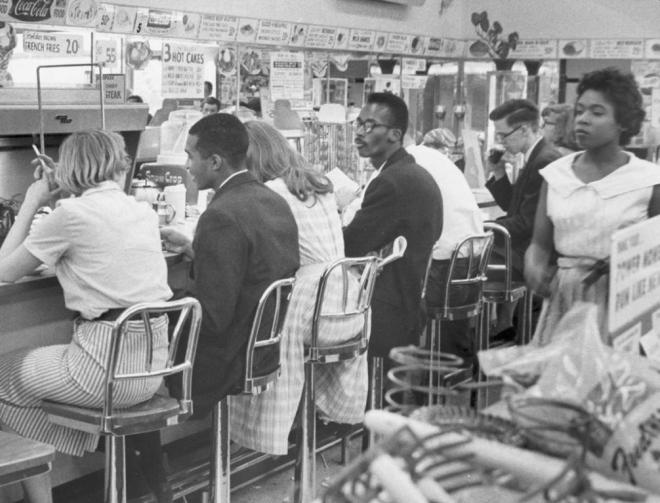
It’s a misstep because it so clearly casts the anti-gay movement as the heirs to Jim Crow. If you want to taint the Republican right as nasty bigots who would do to gays today what Southerners did to segregated African-Americans in the past, you’ve now got a text-book case. The incidents of discrimination will surely follow, and, under the law, be seen to have impunity. Someone will be denied a seat at a lunch counter. The next day, dozens of customers will replace him. The state will have to enforce the owner’s right to refuse service. You can imagine the scenes. Or someone will be fired for marrying the person they love. The next day, his neighbors and friends will rally around.

If you were devising a strategy to make the Republicans look like the Bull Connors of our time, you just stumbled across a winner. If you wanted a strategy to define gay couples as victims and fundamentalist Christians as oppressors, you’ve hit the jackpot. In a period when public opinion has shifted decisively in favor of gay equality and dignity, Kansas and the GOP have decided to go in precisely the opposite direction. The week that the first openly gay potential NFL player came out, the GOP approved a bill that would prevent him from eating in restaurants in the state, if he ever mentioned his intention to marry or just shack up with his boyfriend. Really, Republicans? That’s the party you want?

As for the allegedly Christian nature of this legislation, let’s not mince words. This is the inversion of Christianity.

Even if you believe that gay people are going to Hell, that they have chosen evil, or are somehow trying to subvert society by seeking to commit to one another for life, it does not follow that you should ostracize them. The entire message of the Gospels is about embracing those minorities despised by popular opinion. Jesus made a point to associate with the worst sinners – collaborating tax-collectors, prostitutes or lepers whose disease was often perceived as a sign of moral failing. The idea that Christianity approves of segregating any group is anathema to what Jesus actually preached and the way he actually lived. The current Pope has explicitly opposed such ostracism. Christians, far from seeking distance from “sinners”, should be engaging them, listening to them, ministering to them – not telling them to leave the store or denying them a hotel room or firing them from their job. But then, as I’ve tried to argue for some time now, Christianism is not Christianity. In some practical ways, it is Christianity’s most tenacious foe.

Jan_Wijnants_-_Parable_of_the_Good_SamaritanIf I am confident that this law is, in fact, a huge miscalculation by the far right, I do not mean to discount the very real intimidation and fear that many gay Kansans and their friends and families are experiencing right now. It’s appalling that any government should seek to place itself institutionally hostile to an entire segment of society. But in civil rights movements, acts of intemperate backlash are also opportunities. If this bill becomes law, and gay couples are fired or turned away from hotels or shown the door at restaurants and denied any recourse to the courts, the setback to the anti-gay movement could be severe, even fatal. Yes, of course this bill should never have seen the light of day. But now it has, that light will only further discredit the discriminators. Even they know this, hence the unhinged rationale for the entire bill: “Discrimination is horrible. It’s hurtful … It has no place in civilized society.”

It sure doesn’t. And that’s why the predictable silence on conservative blogs and news sites is so telling. This is about Kansas, but it is also about the Republican party. Are there any Republicans willing to oppose this new strategy? Do the GOP’s national leaders support it? As for Democrats and the left more generally, they are lucky in their enemies. But the gay rights movement, it seems to me, should tread a careful path. We should be wary of being seen to trample on religious freedom and be defined as discriminators of another sort. Allowing space for those in society whose religious convictions make homosexuality anathema, even Satanic, is what true liberals do. And to my mind, a better approach for gay couples and their families is not to try and coerce fundamentalist individuals and businesses into catering to them, but in publicizing the cases of discrimination and shaming them – and then actively seeking out and rewarding individuals and businesses who are not so constrained.

You counter rank discrimination with economic and cultural freedom. Because the side that tries to use the power of the state to enforce a single answer is the side that will seem to have over-stepped its bounds.

(Photo: lunch counter sit-in, Richmond, Virginia, 1960. Painting: Parable of the Good Samaritan, by Jan Winants.)

Abortion Is A Poor Choice

Abortion researcher Tracy Weitz discusses the ongoing Turnaway Study, which examines the long-term outcomes for women who seek out abortions but can’t get them:

The take-home from that study is that most women are having an abortion because they say they can’t afford to have a child. And it turns out that they’re right: Two years later, women who had a baby they weren’t expecting to have, compared to the women who had the abortion they wanted, are three times more likely to be living in poverty. They knew they couldn’t afford a kid and it turns out they were correct. … The study has really exposed how hard it is to be a parent in this country. It is a huge economic investment. And if you don’t have the economic resources to be a parent, there’s nothing to help you.

Eyal Press looks at access to contraception to explain why poor women are more likely than others to have abortions:

Low-income women tend to have less access to the most reliable forms of birth control—in particular, long-acting intrauterine devices (I.U.D.s), which are extremely effective, and which the new Guttmacher study touted as a potential factor behind the recent decline in the over-all abortion rate. …

Thanks to publicly funded family-planning services provided to poor women under Title X—a federal program that House Republicans have repeatedly tried to eliminate—there is evidence that more low-income women have been using I.U.D.s in the past decade. But the total number of users is still small, and the cost, which can exceed a thousand dollars before insertion, remains prohibitive for many low-income women who don’t qualify for Medicaid and cannot afford private insurance. “We know that cost is a major factor in a woman’s ability to choose and access a method of contraception that works best for her, and behind the cost is access to health-insurance coverage,” Kinsey Hasstedt, a public-policy associate at the Guttmacher Institute, told me.

Recent Dish on abortion and contraception here and here.